Michael Kroth's Blog
August 14, 2025
Haiku Narratives with Amy, Davin, and Michael - August 2025
August, 2025 Haiku Narratives
Curator's Note
We started nearly
six
years ago, and since then Davin Carr-Chellman, Amy Hoppock, and I have been writing and sharing haiku's monthly with each other. It has been an enriching and enjoyable way to develop our individual haiku writing practices.
It goes like this
Each person shares a haiku they have written with each other. Usually, as you'll see below, we put them on cards or bookmarks which we can keep ourselves, and often make more to share with others. We either mail these to each other (how nice to get a haiku, hand-addressed, in the mail!) or send them electronically. We each then write a narrative response to each other's haiku, including our own, and then we get together to share our responses. The poet reads their own haiku, the others read their responses to it, and then the author reads their own narrative about it. In that way, we independently think about each haiku and then learn from each other.
Nearly Six Years and Counting
Our first meeting to share haikus in this way was in
September, 2019
.
How about that!
It is a lot of fun!
We enjoy doing this so much we thought you might enjoy being a part of the conversation as well, so we started recording them in May, 2020, and had been exchanging and discussing our haikus almost every month for nearly a year before that. If you watch the clip here, you will see our discussions are very informal and that we laugh a lot.
This is our Forty-Fifth recording
(You can watch them all
here
. I'll stop counting once we hit 50 or something like that)
, and we hope to continue. Please let us know what you think, and share this with anyone you think might benefit.
This Month's Haiku Narrative Video Recording
Check It Out:
This is a recording (our forty-fifth) of our monthly haiku reading and narratives.
You can see them all here:
Haiku Narratives with Amy, Davin, and Michael
August, 2025 Haikus
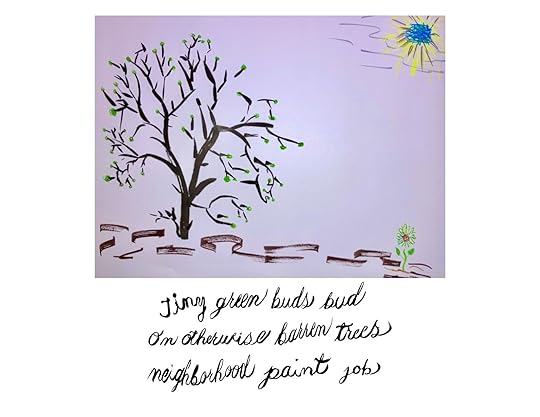
Davin's Haiku
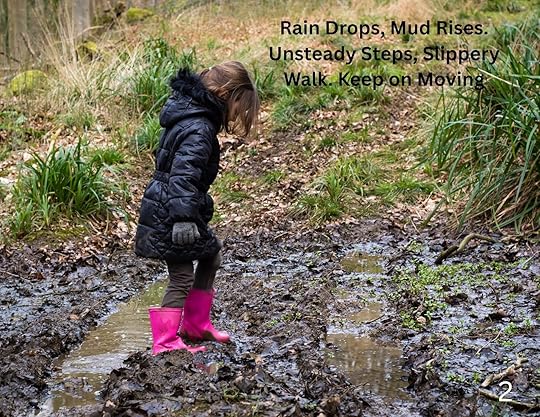

Amy's Haiku
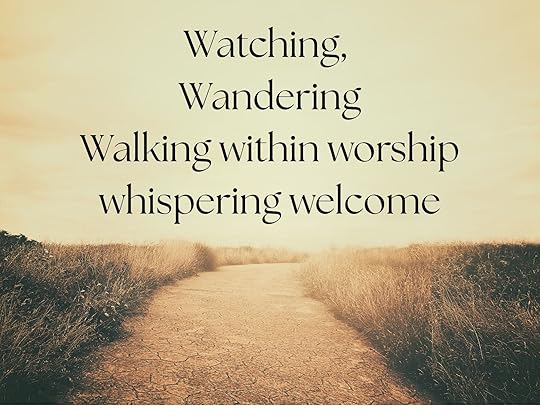
Michael's Haiku
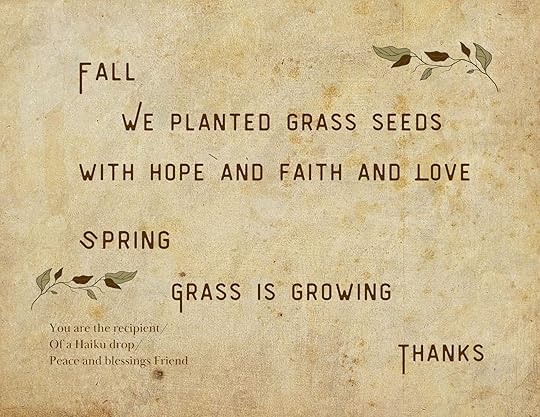
Check These Opportunities Out Too!
Our Book!
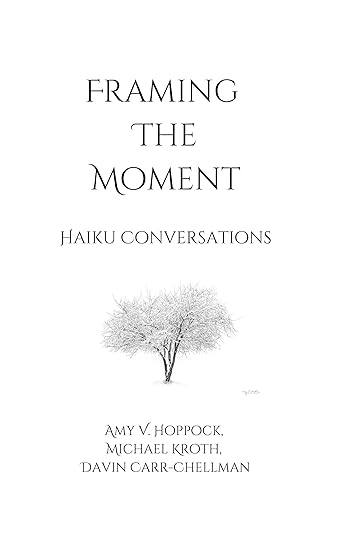
We are very excited about our book,
Framing the Moment: Haiku Conversations
. Here is a short description and video describing how and why we created the book, and how to order one or more.
About Us


May 11, 2025
Mom Extraordinaire
is crazy about her brood. She smiles more
when she’s with them. Laughs more. Enjoys more. Relaxes more. Has more fun. She just loves her
family.
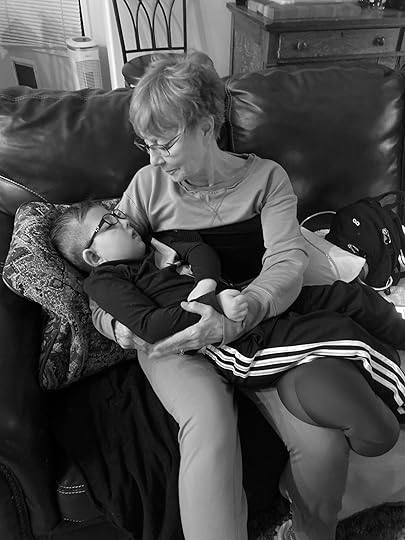
Lana and our grandson, Grayson
I take this moment to tell you about the best mom (and grammy) I know. This woman has a heart of gold, a love for her family beyond…well just beyond. She has sacrificed for her family in ways too numerous to list, in significant matters of the weightiest sort - the kind of dedication that would draw tears from even a James Bond villain.
Her love for her children (as a mom) and grandchildren (as a grand-mom) is an elemental part of who she is. She will defend them and take up for them against the highest odds. Beware those who would harm her progeny – beware! She will lay down her own life dreams for her family - can you imagine anything less getting in her way?
Most of all, she is crazy about her brood, her progeny, her fam. She smiles more when she’s with them. Laughs more. Enjoys more. Relaxes more. Has more fun. She loves her family more...than...anything.
I’m not talking about
my own mom
,who was a saint, or my grandmother or even my daughter Piper, each of whom I put on the highest of motherly pedestals and with whom I share DNA. OK, they are the best moms I know too.
I am talking about my wife Lana.
Yes, she's not
my
mom, and yes it is
Mother's
Day, but bear with me.
I’ve seen for over 40 years of marriage what kind of a mother she is. I know more about her, have lived with her, watched her, more than any other mom in my life, and let me tell you just a little bit about about her.
First, she'll do anything for our kids. I mean it. She’ll give up anything she needs so her children can have what they need. She’ll drop anything she’s doing to help her daughter or son with their own children, or with
their
own challenges or opportunities. She’ll burst with pride - burst, I say - just to hear their smallest of accomplishments. And she'll scour up every resource she can manage, drum up every bit of her imagination, and charge up every bit of her energy to support their dreams and hopes. She is selfless in that way. Selfless, I say. Selfless.
Selfless.
Mothers have relationships with each other that the rest of us don’t share. My mom gave my sister Amy a book called
Moments of Awareness,
by Helen Lowrie Marshall, way back in 1976. I don’t know why I have this book now instead of my sis, but I have a poem in it marked, called
Keep A Dream In The Making.
Here it is:
Keep some little dream in the making
If youth you would like to hold.
Old Father Time is defeated by dreams—
A dreamer never grows old.
For dreams have a way of quickening
The heart, and the years pass you by.
You can always tell the man with a dream
By the ageless gleam in his eye.
So keep as mall dream in the making.
It needn’t be big or bold—
Just some little dream to beckon you on
And you’ll never, no never, grow old.
Lana has an “ageless gleam” in her eye for the "dreams in the making" within her pups, those foals, her young’uns. That gleam does not flicker my friends. It shines as steady as she goes.
When Lana and I married, our preacher and his wife, the wonderful Leonard and Martha Gillingham, gave us a book by Mrs. Charles E. Cowman, titled
streams in the desert
. We’ve kept this book for over 40 years now, and as I was thinking about Lana I picked it up and happened to turn to something I had highlighted years ago:
“Because there are millions of roses we do not thank God for them, and yet the glory of creation is but as one rose flung down from the summer affluence of God”.
There are millions of moms and it is easy to forget that each has given life, each has loved a child, and each is a unique yet timeless “rose flung down” into the lives of her babes and all her heirs. This Lana-red-rose has been our gift of the spirit, and has passed down her elegant splendor to the flowers which follow her.
Lana has literally taught thousands to dance, and shown each of us how to sing our song. If our children, and then our children’s children, and yet their children yet again had but one spirit to catch hold of, one teacher to learn from, and yes one model to aspire to, they could no better than the one who gave our children birth. Lana is the best mom I know.
All children should have the best mom they could ever know. I am quite sure my son and my daughter did, do, and will.
Moms.
Lana.
Best-In-Show.
She's also very, very humble. I had a hard time finding pictures of just her (unlike all those pictures I could find of myself...sigh...). Others always come first with Lana Kroth.
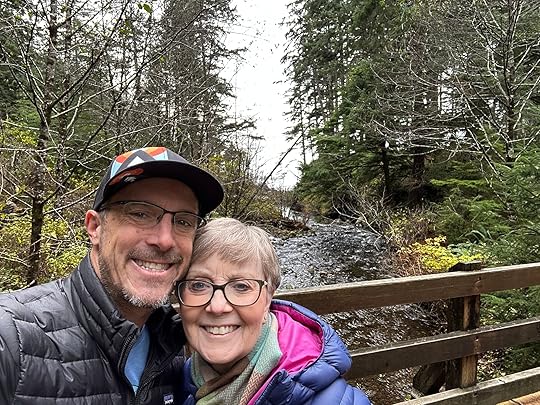

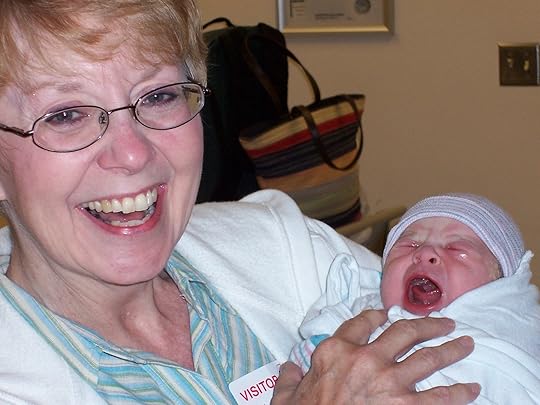
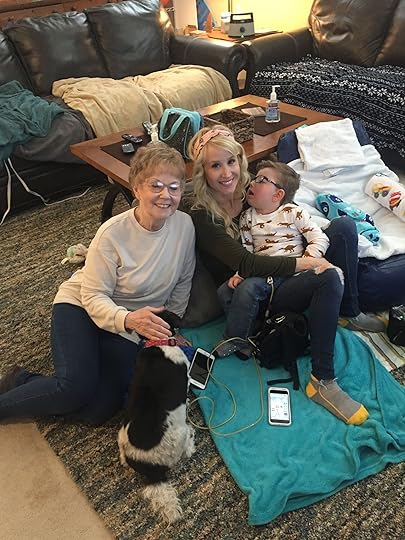
Originally posted on Mother's Day, 2019.
May 10, 2025
Anecdotage
~E.B. White
1
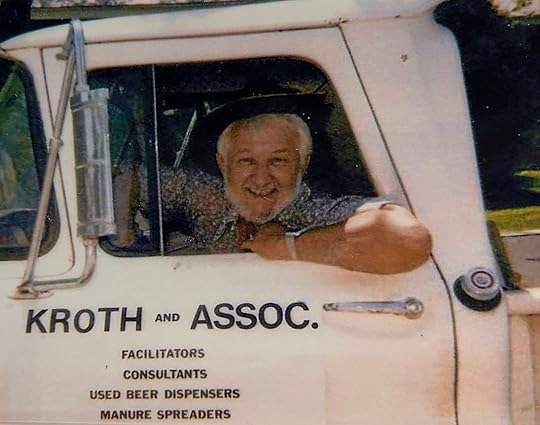
This is a picture of my dad riding around in his old pickup truck and a Kroth and Assoc. magnetic sign attached. This was the early days of car phones, and he would carry a classic handset (
see here if you too young too remember these
) with a cord hanging down that wasn’t connected to anything. That was vintage humor from Dad.
“…there must be millions of aging males, now slipping into their anecdotage…”
~E.B. White
1
There are a number of reasons I am fortunate to have a brother. Here are just two: 1) He remembers things that I have forgotten or never knew about our family, friends, growing up, and growing older; 2) He has an extremely creative, I’d say unique and generative, perspective that my own worldview doesn’t naturally explore. So my conversations with David range from sports to religion to the arts to western paperback novels to divas to movie dance routines to curious questions about how we were raised to…well, you get the idea. And that was just our last conversation.
I laugh out loud a lot when we talk, which is too-rare – both our talks and just laughing out loud - and I find myself considering provocative ideas I hadn’t even thought about before.
Just the other day we started talking about our dad. The conversation turned to a term I’d just read in an E.B. White essay, “Anecdotage.” Words can enthrall me, and this was one of them. White wrote, “…there must be millions of aging males, now slipping into their anecdotage…”
1
E.B. White, author of both the no-nonsense
The Elements of Style
and the beloved
Charlotte’s Web
2
, was also one of our most renowned essayists. To be such requires the skills of both a wise observer of the human condition and a writer with the ability to express those observations deeply, succinctly, and often cleverly. There is nothing I enjoy reading more than an essay about a pig
3
, say, in the hands of a master essayist.
My dad was a genial fellow. He would corner just about anyone and have a long conversation. Likewise, he was easily sidetracked by others. I can’t count how many times my mom or any of us would find ourselves waiting in the car while he was waylaid, or more likely self-marooned, talking with someone. He might have known the person for a while. He was a long-time professor, so many, many students had spent time in his classes, or it could be the elementary school janitor or secretary. He always said that school janitors and secretaries were the most important people to know in any school, because they could open any door (real or metaphorically) in the place and always knew everything that was going on.
Or the person he buttonholed might be a bank teller or the owner of his favorite Mexican restaurant or a crossing guard or a bookstore employee or…well, you get the idea. And the only way that really worked was not because my dad was such a marvelous storyteller, but because he was such an excellent listener. I think he was beloved by so many because he did both – tell meaningful, funny, memorable stories AND listen to others deeply. Many people can do one or the other, but seldom can do both.
His chats with others were often long-winded while we, waiting in the car, were resignedly and knowingly long-suffering.
But I can’t claim that Dad settled into anecdotage as he aged. Storytelling – often humorous examples of points he was making – was an essential part of the presentations he made all around the country throughout his career. Anecdotage, for him, was more like a later-life continuation of what I am guessing – I don’t have irrefutable evidence of it –was anecdolescence, anecdomidlifecrisiscence, anecdomesticence, anecdoyarnspinnerscence (see Navy and Merchant Marine tales from sailing around the world), and anecdospousecence. Many of the stories he shared in speeches were about his family – that was us – and were always told to emphasize a point he was making.
My brother and I haven’t fallen too far from that tree, we opined.
My old man could spin a story and weave it into a speech from the whole cloth of experience.
And that’s not anecdotal, my friends, that’s the truth.
Sources/Resources
1
White, E. B. (1954). Afternoon of an American Boy. In
The second tree from the corner
(1st ed., pp. 17-23). Harper. p. 23
2
White, E. B. (1952).
Charlotte's Web
(G. Williams, Illus.). Harper & Brothers. Strunk, W., Jr., & White, E. B. (1999). The elements of style (4th ed.). Longman.
3
White, E. B. (1948, January). Death of a pig.
The Atlantic Monthly,
181(1), 28–33.
https://www.theatlantic.com/magazine/archive/1948/01/death-pig/309203/
or White, E. B. (1954). Death of a pig. In
The second tree from the corner.
Harper & Brothers. pp. 243-253.
May 6, 2025
Circling and Centering
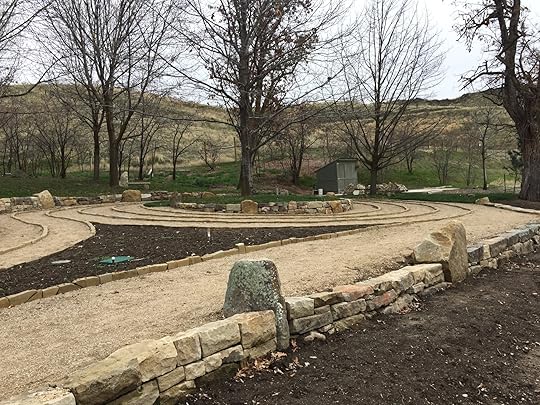
I live my life in widening circles
That reach out across the world
I may not complete this last one
But I give myself to it.
~Rainer Maria Rilke,
Rilke’s Book of Hours
, p. 45
Life from the Center is a life of unhurried peace and power.
It is simple. It is serene. It is amazing. It is triumphant. It is radiant.
It takes no time, but it occupies all our time.
~Thomas R. Kelly,
A Testament of Devotion
, p. 100
“If someone asks me, ‘Are you a conservative or a liberal?’, my answer is ‘Yes!’.”
I have heard this sentiment more than once. In a sermon at my church. In a book I read somewhere, probably something by Fr. Richard Rohr. We are more than a stereotypical label that boxes us in while boxing others out.
But I stray from my main point, which is to advocate for going deeper. While circling wider.
We are complex people, even the simplest of us. We are simple people, even the most complex of us. We all want the same, simple things – love, pleasure, family, friendship, security, growth, to make a positive difference, health. Yet we all are different. Each has a unique story and experiences, personal longings and dreams and fears, a unique way of looking at the world.
My answer to the question about whether I am a conservative or a liberal is that I am neither one nor the other. I am both, and I am much, much more than either of those. I have a touch or two of libertarian in me, sometimes a scootch of socialist might pop up. The skeptic in me wags its finger now and again, the romantic points that finger at the moon, the scientist in me interlocks all my fingers, and the spiritual in me puts ten fingers together and bows.
I am both liberal and conservative, and much, much more.
And so are you.
“Neither one nor the other” does not mean nothing, it may mean everything. It may mean the most important things. It may mean going both deeper and wider than liberal or conservative, beyond political or ideological label.
We need labels. They are short-hand which can represent something much richer. Truth-in-labeling helps us make good choices. Labels are convenient, are useful.
Until they are not.
We all live in perceptual boxes. Some of those boxes are more porous, more transparent, more open than others. Some are more easily repackaged and recycled and re-purposed. Some we just keep in the garage or the attic of our minds, cumbersome cubes weighing us down, the contents worth nothing to us now, or out of date or just empty.
No matter where we have been, no matter what boxes we’ve needed to move us to where we are today, we can always “center down” as Kelly says, going deeper and deeper, delving into the mystery that sits beyond us. We can always circle wider, as Rilke says, to places of wonder and awe and inspiration. Those are choices we make, everyday.
References
Kelly, T. R. (1996).
A testament of devotion.
San Francisco: HarperSanFrancisco.
Rilke, R. M. (2005).
Rilke’s book of hours: love poems to God
(A. Barrows & J. Macy, Trans. 1st Riverhead rev. trade pbk. ed.). New York: Riverhead Books.
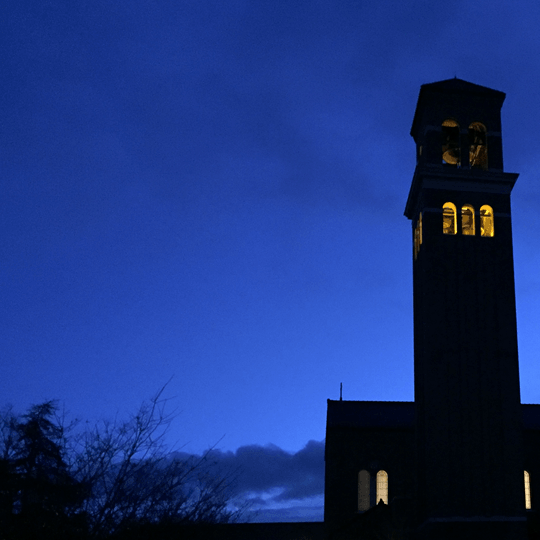
Mt. Angel Abbey, Oregon – A Place for Centering
To receive all our
Profound Living
posts,
please subscribe (it won’t cost you anything but time to read):
https://www.profoundliving.live/
Also,
please share this essay
with others who might find it beneficial.
May 3, 2025
Circling and Centering
I live my life in widening circles
That reach out across the world
I may not complete this last one
But I give myself to it.
~Rainer Maria Rilke,
Rilke’s Book of Hours
, p. 45
Life from the Center is a life of unhurried peace and power.
It is simple. It is serene. It is amazing. It is triumphant. It is radiant.
It takes no time, but it occupies all our time.
~Thomas R. Kelly,
A Testament of Devotion
, p. 100
“If someone asks me, ‘Are you a conservative or a liberal?’, my answer is ‘Yes!’.”
I have heard this sentiment more than once. In a sermon at my church. In a book I read somewhere, probably something by Fr. Richard Rohr. We are more than a stereotypical label that boxes us in while boxing others out.
But I stray from my main point, which is to advocate for going deeper. While circling wider.
We are complex people, even the simplest of us. We are simple people, even the most complex of us. We all want the same, simple things – love, pleasure, family, friendship, security, growth, to make a positive difference, health. Yet we all are different. Each has a unique story and experiences, personal longings and dreams and fears, a unique way of looking at the world.
My answer to the question about whether I am a conservative or a liberal is that I am neither one nor the other. I am both, and I am much, much more than either of those. I have a touch or two of libertarian in me, sometimes a scootch of socialist might pop up. The skeptic in me wags its finger now and again, the romantic points that finger at the moon, the scientist in me interlocks all my fingers, and the spiritual in me puts ten fingers together and bows.
I am both liberal and conservative, and much, much more.
And so are you.
“Neither one nor the other” does not mean nothing, it may mean everything. It may mean the most important things. It may mean going both deeper and wider than liberal or conservative, beyond political or ideological label.
We need labels. They are short-hand which can represent something much richer. Truth-in-labeling helps us make good choices. Labels are convenient, are useful.
Until they are not.
We all live in perceptual boxes. Some of those boxes are more porous, more transparent, more open than others. Some are more easily repackaged and recycled and re-purposed. Some we just keep in the garage or the attic of our minds, cumbersome cubes weighing us down, the contents worth nothing to us now, or out of date or just empty.
No matter where we have been, no matter what boxes we’ve needed to move us to where we are today, we can always “center down” as Kelly says, going deeper and deeper, delving into the mystery that sits beyond us. We can always circle wider, as Rilke says, to places of wonder and awe and inspiration. Those are choices we make, everyday.
References
Kelly, T. R. (1996).
A testament of devotion.
San Francisco: HarperSanFrancisco.
Rilke, R. M. (2005).
Rilke’s book of hours: love poems to God
(A. Barrows & J. Macy, Trans. 1st Riverhead rev. trade pbk. ed.). New York: Riverhead Books.
Mt. Angel Abbey, Oregon – A Place for Centering
To receive all our
Profound Living
posts,
please subscribe (it won’t cost you anything but time to read):
https://www.profoundliving.live/
Also, please consider
following the
Profound Living
Facebook page
at:
http://bit.ly/2Lv44W6
Also,
please share this essay
with others who might find it beneficial.
Changing the Questions, Changing the Answers - What's the BEST way to approach the Federal Government?
Advantage Through Its Government?
Author's Note: This is a repost of an essay I published in 2018. I thought it was a timely topic to revisit.

“When you think about
it, a national government competes with every other national government on
earth to be the most cost effective, the most talented, the best equipped to
act, the quickest to respond to external threats, and the most strategic
thinking about future opportunities.”
Clemons and Kroth,
Managing the Mobile Workforce
, p. 98
Being a profound learner means constantly looking deeper, deeper
than political positions, partisanship, ideology, tradition, religion, what
would benefit us personally the most and, really, any current belief system.
As I've written
before
, we are much more than the labels we give ourselves, like liberal or
conservative or nationalist or globalist or socialist, which reduce us to less
than we are or can be. And our beliefs about such matters, which can be helpful until they’re not, are just
resting
places
for thoughtful people who want to understand more and to deal more wisely
with the challenges and opportunities of their lives and the world.
One way to provoke deeper discussion – internal or amongst
others – is to rethink the questions we have been asking. Trying out new questions or iterations of
questions can provoke different ways of thinking about issues which have
devolved into “positions” or “talking points” or “litmus tests” or any purity
evaluation. “Are you with us or against
us” can easily become a false dichotomy, with folks finding themselves defending
limited “yes or no” options instead of exploring alternatives or looking for something new or creative.
So, occasionally I or others will pose a question here designed to
change how a particular challenge is discussed.
Hopefully these queries will be provocative – and I believe provoking, evoking, invoking….stoking
good discussion is a worthy objective - with something to be learned, even if no
conclusion is, well, concluded.
So, to get us started….
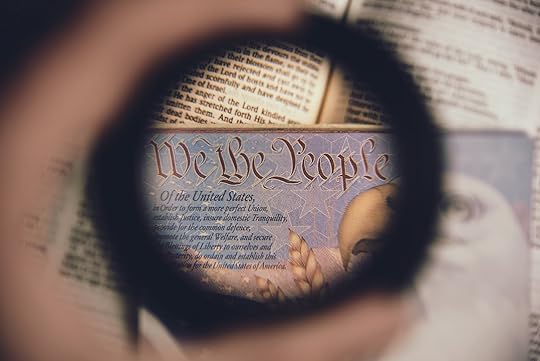
“How does [our country] create sustainable competitive advantage
through the development and maintenance of the best government on earth?”
When I watch the political and ideological battles between
parties and personalities over the size of government and the role of
government, both legitimate areas of discussion,
I wonder if they are really addressing what might be a more useful, more important
question
, “How does our country create sustainable competitive advantage
through the development and maintenance of the best government on earth?” That question would force people to ask what
the most competitive government might look like. Let me try a few ideas to get us started.
The most competitive government in
the world would attract, develop, support, and motivate people who are the best
government workers, perhaps the best workers, in the world.
The most competitive government in
the world would be best at getting the most bang-for-the-invested-buck, would
have rock solid credit, a balanced budget, and long term fiscal viability.
The most competitive government in
the world would be the best at protecting its citizens now but also being
prepared for future threats – militarily, environmentally, scientifically, economically.
The most competitive government in
the world would be the best at assuring its citizens had the best educational
system, best defense system, best support for its citizens, and so on. The best.
The most competitive government in
the world would be interested in “sustainable” competitive advantage” which
means it would have to think and to prepare for the long term – long term
health, environment, resources, quality of life, protection – of its citizens.
And there would doubtless be many other ideas....
That question might induce people to ask about the
importance of investing in scientific advancement, research, and education, and
how sustainability can only occur over the long run when long-term
collaborative efforts across nations are strengthened by building mutual trust
and cooperation.
If the question were changed from “How large or small?” to
“How competitive or how excellent?” what different approaches might arise?

Now, to wrap this up, let’s
remember that this is just one question and it’s related to competition. There are of course other questions we could
ask, that would produce different discussions and likely different answers.
What if the next question was not about being the “best and most
competitive government on earth”, but about “what’s the best system of
government to produce long term health, quality of life, and survivability on our planet”? (Think biggggg......)
Changing the question can
change the dynamics of the discussion, the way the players position themselves,
the creativity of the potential solutions.
We will ask questions here from
time to time. It would be grand to hear your answers. And other questions that provoke thought.
References:
Clemons, D., & Kroth, M. S. (2011).
Managing
the mobile workforce: leading, building, and sustaining virtual teams
. New
York: McGraw-Hill.
https://amzn.to/2LtHE7F
To receive all our
Profound
Living
posts, please subscribe (it won’t cost you anything but time to read):
https://www.profoundliving.live/
Also, please consider following the
Profound Living
Facebook page at:
http://bit.ly/2Lv44W6
Also,
please share this essay
with others who might find it beneficial.
March 30, 2025
Selling Your Soul, Or, Can One Just Take Out a Mortgage?
”
~John Philip Newell
1
What is Soul?
Short answer, I don’t know.
I don’t have any religious schooling or certificates in spiritual formation or any of that. I’m just reflecting here because I need to develop a deeper understanding of and relationship to my own soul. That’s all to say, take what you read here with a grain of your own salt. It’s just one person’s perspective as of today.
Saying “I don’t know,” therefore, isn’t all that surprising, but isn’t this something we all ought to be thinking about? Shouldn’t we all be doing our best to be true to the depths of who we are, to what is most meaningful to us, especially in the midst of the shallows and the shadows and those led by the nose all around us?
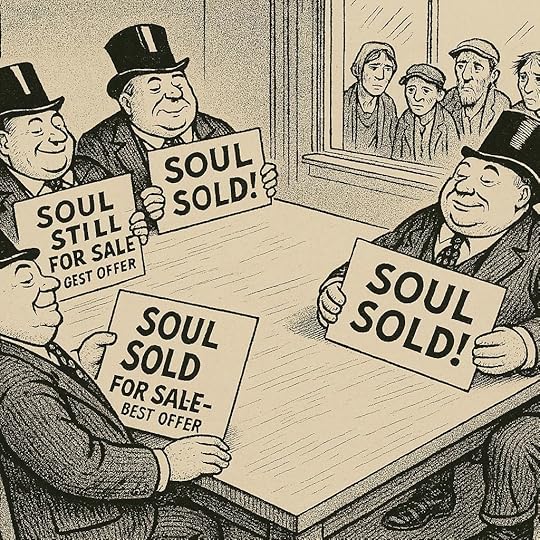
Is one’s soul enough of an entity, do you suppose, that one might “sell it” in exchange for something perceived as worthwhile like, say, eternal life or great power, wealth, or pleasure? Or, closer to home, to receive by hook or crook the promotion someone else deserved? Or to win the game nefariously? Or to deviously win a bet on the game? Or to browbeat someone into saying they agree with you when you know they don’t?
¿Quién sabe?
Je ne sais pas.
I dinna ken.
I don’t know.
And nobody else does either. Not even the saints, not even the mystics, and not even your minister or favorite doctrine can express it accurately and completely. Not for sure. Not for good. Folks can try to explain the territory, and they can track down the horse, and they can name that horse, but can they even capture the magnificence of that horse? Can they tame that horse? Can they break that horse? Some have tried mightily and even poetically and dutifully and helpfully to encapsulate what that horse represents. Some have even tried to hobble it, but…
….it’s a bit of a mystery, you see.
Long answer, a lot of very wise people have tried to lasso a definition for soul and to pull it in. But it’s like roping a pooka. The rope of reason can never pull it in. One can think and think and think and, more importantly and usefully, to experience and experience and experience, and still not be able to say exactly what it is. One can’t corral it, to continue the metaphor, or herd it. One can only hop on as best one can, if we can, and take a ride wherever it takes you. One can “become one with the horse of our soul.”
Enough horsing around. Let’s get down to it.
The word ‘soul’ has always been an ambiguous word for me, and it’s no surprise given all the ways people have tried to explain it. Emily Dickinson wrote, “I cannot see my soul but know “tis there.”
2
Phil Cousineau, who wrote my go-to book about pilgrimage,
3
also edited a book dedicated to exploring soul.
4
The readings in this book are written by a wide range of thought leaders ranging “from Socrates to Ray Charles.” No surprise, the spiritual, unexplainable yet universally experienced “soul” has also been addressed by the great religious traditions as well as deep ponderers over the centuries. Cousineau includes essays, poetry, and lyrics from Plato, Rumi, Black Elk, May Sarton, Jack Kerouac, Alice Walker, and many more. So many of these differing approaches, the many ways of explaining soul, are playing similar chords. Cousineau’s Prologue, I think, is a worthy read for anyone wanting to move toward a deeper understanding of soul.
In the Prologue, Cousineau says, “To fathom the unfathomable soul we immediately plunge into mystery. To probe the images of the soul as the vital force, the source of consciousness, the persistence of things, the core of individuality, the depth dimension, the raw, blue rhythm of life, is to suddenly, with Lear, ‘take upon us the mystery of things, as if we were God’s spies.”
5
He continues,
If we’re not bewildered by the mysteries of the soul, we’re not thinking clearly, to paraphrase the scrawling on subway walls. For the soul’s mysteries compress the most profound mythic questions that have always intrigued human beings. Where do we come from? Why are we here? Where do we go when we die?
6
“Every known culture,” he says, “has taken upon itself the naming of this force, usually after words for wind, shadow, movement, smoke, strength.”
7
The meaning and experience of soul defies a taut, concrete, complete interpretation. Words – which are reductionist symbols to start with - attempt to define soul, but the soul cannot be fully expressed using them. Yet we sense soul, we count on it to be the essence of who we are. “For many,” Cousineau says, “soul is the constellating image for the paradox of unchanging depths in an ever-changing universe.”
8
To summarize, soul can never be completely defined. It represents the deepest essence of who we are, each of us, though we be in the midst of doom scrolling, trolling, extolling, logrolling, button-holing, or universal attention-spoiling. Though we be the least soulful-seeming people one might find watching a reality show or checking out celebrity “how to stay young” tips. Even when we be surface-skimmers, each of us has the capacity to resonate with who we are underneath all that makeup, barroom bluster, or manly Big Truck-covered-with-tough-sounding-stickers-and-big-flags. Even when we be whiners about how our fancy dinner or “Best Burger in the World” wasn’t quite as tasty as usual. Even when we be starry-eyed woke, or we’re not and just don’t get it, sitting asleep at the wheel. The soul, for any of us and all of us, resides.
The beatitude, one might say, abides.
Even at our most superficial, each of us is endowed with something much deeper than we often experience. Cousineau provides the rejoinder to the superficiality which can engulf us:
Down deep in your soul where infinity is echoing. Deep down where the backbeat of eternity resounds, the deep bass line underneath the melody of all things. Soul, nothing but infinity closing in, constantly.
I am haunted by soul.
9
Haunted. Deep. Infinity. Eternity resounds. “The deep bass line underneath the melody of all things.” Whoosh. He pretty much proves me wrong, doesn’t he, in being able to describe qualities of soul. What soul is. Unhobble that magnificent horse. Take a ride on that deep bass line that reverberates deeper than woke, deeper than populism, deeper than any “isms” or national borders. It’s an existential beat.
Best answer, we sense what soul is when we experience connection – perhaps sense some kind of resonance - with our deepest self. We can sense it in others who live their lives in generative, purposeful, wise, joyful ways. We sense it when our deepest deep is aligned, harmonizes, with the divine. With God.
Importantly, we can intentionally become more aware of, develop, and act in ways that are congruent with our deepest sense of soul. Never completely integrated – we are human and fallible after all, but increasingly. It’s a lifetime journey.
We tap into our souls through music – some music is even called soul music, but we can experience soul through opera, folk music, lullabies, hymns, chants, and the other musical genres. Just as the experience of mountain top awe or turbulent ocean waves can crack our social facades wide open, reaching inside us to pull forth the most authenticness of us – exposing the hidden soul, and blooming it to ourselves and maybe even the world – so can music. As can wrenching loss. As can astonishing art. As can a sprouting flower. As can tragic loss or a miraculous cure. As can barely moving a toe just as the gurney pulls up after being thrown to the ground by a 350-pound defensive tackle. As can seeing your daughter being born or your son marching into the hall to
Anchors Aweigh
at the end of bootcamp. It’s more than pride, more than happiness, more than sadness, it’s all that but at their most essential. It’s the absolute core of who we are. It’s the most profoundly meaningful to us and of us.
Our soul is with us always, though we gloss over it, though we know it not.
Though we seem to abandon it.
The Soul Can Become Lost but Never Sold (Well…perhaps…)
I thought and spoke much of the soul. I knew many learned words for her. I had judged her and turned her into a scientific object. I did not consider that my soul cannot be the subject of my judgment and knowledge; much more are my judgment and knowledge the objects of my soul. Therefore the spirit of the depths forced me to speak to my soul, to call upon her as living and self-existing being. I had to become aware that I had lost my soul.
~Carl Jung,
The Red Book
10
One of my favorite movies, based on the play, is
A Man for All Seasons,
11
Here we find Sir Thomas More, who gave up the power and the prestige and the safety bestowed by King Henry XIII because he would not sign the Oath of Supremacy, which would acknowledge the King as the Supreme Head of the Church of England. More, deeply Catholic, refused to sign the document and thus was accused of treason, resigned his position as the Lord Chancellor of England, was sent to the Tower of London, was eventually convicted, and then beheaded.
This is a story about how one man plumbed the depths of his soul and found it too precious, too fundamental to the pith of who he was, and lost his life for it; and of another man, who betrayed him for a bauble.
The play contrasted More with Richard Rich, a man More once mentored. More’s strategy to avoid being found guilty of treason was to remain silent about the Oath, to not take a position on it. This meant that, according to law, he could not be convicted. The strategy seemed like it might work until Rich falsely testified that More had confided in him that the King was not the rightful head of the church. Thus, More’s fate was sealed.
In the play, More notices that Rich has been rewarded with the title of Attorney General for Wales, presumably for his false testimony. And then gives one of the most withering remonstrations in all of literature.
'Why, Richard, it profits a man nothing to give his soul for the whole world... but for Wales?'
12
This indictment, spoken softly and directly, follows the words of Jesus, in Mark 8:36:
For what shall it profit a man, if he shall gain the whole world, and lose his own soul? (KJV).
The next line in the Bible is verse 37:
Or what shall a man give in exchange for his soul
What, indeed, shall a person give his or her soul for? For the huge wealth and recognition that comes from being a top TV show opinion star? For not being primaried in your otherwise safe district? For knowingly eroding free speech and the pillars of democracy for, relatively speaking, a pittance? For selling your influence and power as a Senator in exchange for bribes and gold?
There are, of course, mistakes made by us all, some of which are just poor decisions, others are self-preservation decisions, some are just downright mistakes so wrong that they couldn’t be considered mistakes as much as intentional acts of malice.
But even if Jesus used the terms, “losing one’s soul” and “exchange one’s soul,” can one actually give up their soul, and if they were able to, what would remain? Does forfeiting one’s principles and values, whether in exchange for something directly giving or through inaction when virtuous action is called for – sins of commission or omission - constitutes the absence of soul?
Losing and exchanging – not selling
Johann Wolfgang von Goethe – Faust (1808)
13
“That I to the moment might say: ‘Stay, thou art so fair!’ Then bind me in thy bonds, O time and fate, and let my soul be sold.”
This in Faust, his soul in exchange for knowledge and pleasure.
From Howard Roark, speaking in Ayn Rand’s, The Fountainhead
14
,
"To sell your soul is the easiest thing in the world. That's what everybody does every hour of his life. If I asked you to keep your soul—would you understand why that's much harder?"
These two very different, deep thinkers from different eras, Goethe and Rand, are talking about the trade offs – between easy and hard, and present happiness in exchange for – one can assume – eternal hell. And once one’s soul has been “sold” that that’s it. Game over. Very, very hard to keep it in the first place.
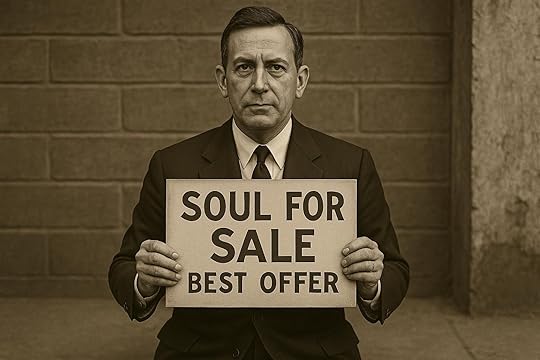
With due respect, my view is that we might lose our soul – as in “lose sight of,” “can’t find,” “abandon,” “trade it off for baseball cards,” but that it can almost always be found again, a year from now or on our deathbeds. We might mortgage our soul – take out loan on our soul which we’ll be paying for until we pay it back through, say, good deeds. Which we might never do, but which we can do. But to sell it? Nah. We (N.B. the possible exceptions in the next paragraph) will always have our soul.
Are some people irredeemable? So evil that they can never retrieve their souls from the Lost and Found? Those are God’s Grace questions. I’m idealistic enough to think that everyone can be ultimately loved and forgiven. I’m realistic enough to think that some people really have sold, not just mortgaged, their souls. And that some people are “born” to be ‘soul less”? No matter their environment.
I’m not smart enough to know the answer to those big questions. But I’m convinced that most of us have the opportunity become more soulful. That is, full of soul.
This is what haunts me.
'Why, Richard, it profits a man nothing to give his soul for the whole world... but for Wales?'
This indictment, spoken softly and directly, follows the words of Jesus, in Mark 8:36:
For what shall it profit a man, if he shall gain the whole world, and lose his own soul? (KJV).
The next line in the Bible is verse 37:
Or what shall a man give in exchange for his soul
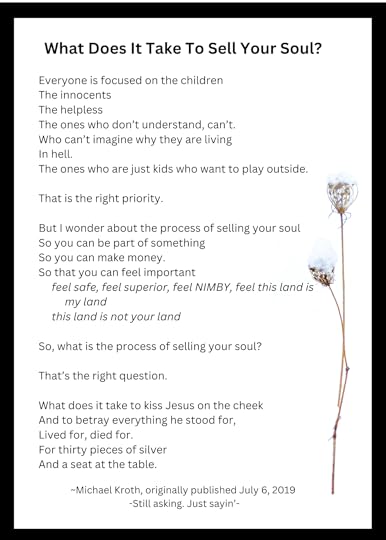
I have thought a lot about what it takes to sell our souls –
please see below a poem I wrote in 2019
– or even if a person can do that. Isn’t the soul always a part of us, even if we ignore it, even lose sight of it in the midst of everything else that is bludgeoning our sense right and wrong? I think the portal to the soul is opened through our practices which strength virtue in our lives, our sense of humanity, our love for nature, and all the gifts we have been given, unearned.
The most complete answer might be, “How can I be, and continue to become, a better person?”
We know what a better person would be, instinctively, because we do have soul as a deep reservoir inside us, just waiting for us to jump in and drink.
“How can I be, and continue to become, a better person?” It’s a question I ask myself often, and I think it’s the never-ending quest for all of our lives.
Notes
1
Newell, J. P. (2021).
Sacred Earth, sacred soul: Celtic wisdom for reawakening to what our souls know and healing the world
(First edition. ed.). Harper One. p. 23
2
Dickinson, Emily.
The Complete Poems of Emily Dickinson.
Edited by Thomas H. Johnson, Little, Brown and Company, 1960. Poem 1101.
3
Cousineau, P. (2021).
The art of pilgrimage: the seeker's guide to making travel sacred.
Conari Press. (2012)
4
Cousineau, P. (1994). Soul: An Archeology.
Harper.
5
Cousineau, P. (1994).
Prologue.
Harper, p. xix
6
Cousineau, P. (1994).
Prologue.
Harper, p. xix
7
Cousineau, P. (1994).
Prologue
. Harper, p. xix
8
Cousineau, P. (1994).
Prologue
. Harper, p. xxi
9
Cousineau, P. (1994).
Prologue
. Harper, p. xxxiii
10
Jung, C. G. (2009).
The red book: Liber novus
(S. Shamdasani, Ed. 1st ed.). W.W. Norton & Co, pp. 128-129
11
Bolt, Robert.
A Man for All Seasons: A Play in Two Acts
. London: Heinemann, 1960. Also adapted by Bolt for the screen in
A Man for All Seasons,
directed by Fred Zinnemann, Columbia Pictures, 1966, starring Paul Scofield, Wendy Hiller, and Robert Shaw.
12
Bolt, R. (1960).
A man for all seasons: A play in two acts
(p. 91). Heinemann. Also adapted by Bolt for the screen in Zinnemann, F. (Director). (1966).
A man for all seasons
[Film]. Columbia Pictures.
13
Goethe, J. W. von. (2000).
Faust: Part I
(P. Wayne, Trans., p. 59). Oxford University Press. (Original work published 1808)
14
Rand, A. (1943).
The Fountainhead
(p. 577). Bobbs-Merrill.
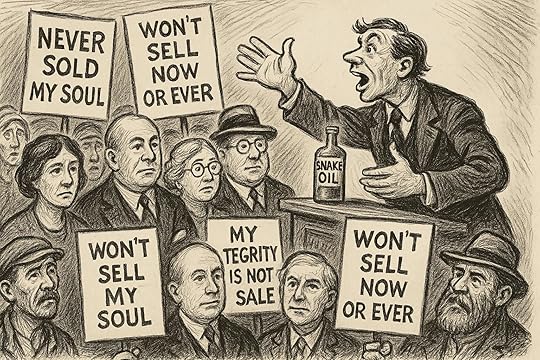
“My friends, it is wise to nourish the soul, otherwise you will breed dragons and devils in your heart”
~C. Jung,
The Red Book
, p. 130)
March 2, 2025
Let the Lights Shine
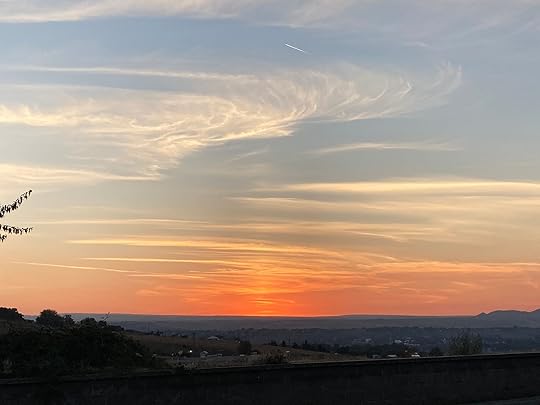
The slow swing of arms and body
Pushing the air, welcoming the wind
Now lifting one leg, then another
Nestling with our sleeping puppy
Breathing in and out together
One of us sighs, then the other
A step, then another, then another
The path, covered with snow and ice
Continuing at the pace I can
A cerulean sky and
Forest boughs laden white
Surround us
Turning the page, the last pages
Racing to the end, how will it end
Wishing it would never end
Chanting, then silence, candlelight
Praying for ourselves and each other
For peace on Earth, goodwill for everyone
A small, peaceful chapel resonating
With divine peace, surrounding a candle-lit Cross
The unpretentious, the virtuous, the authentic
The spiritual
Lights in the darkness
Of the menacing
The destructive
The heartless
The self-aggrandizing
The mean-spirited
dark era we have just entered.
Let the lights shine
---------------------------------------------------
Let the lights shine
Today, we seem a long ways from and in a much darker time than the “…shining city on a hill” that Ronald Reagan spoke about in his
Farewell Address to the Nation
. Where he said,
The past few days when I've been at that window upstairs, I've thought a bit of the ``shining city upon a hill.'' The phrase comes from John Winthrop, who wrote it to describe the America he imagined. What he imagined was important because he was an early Pilgrim, an early freedom man. He journeyed here on what today we'd call a little wooden boat; and like the other Pilgrims, he was looking for a home that would be free.
I've spoken of the shining city all my political life, but I don't know if I ever quite communicated what I saw when I said it. But in my mind it was a tall, proud city built on rocks stronger than oceans, wind-swept, God-blessed, and teeming with people of all kinds living in harmony and peace; a city with free ports that hummed with commerce and creativity. And if there had to be city walls, the walls had doors and the doors were open to anyone with the will and the heart to get here. That's how I saw it, and see it still.
One may not agree with everything or even much that Reagan did, or condone mistakes he made (as all Presidents do), but he was a person who believed in our democracy and our country. He had, I believe, Presidential character and integrity. He was a leader defending our country from tyrants.
Today, we seem a long ways from the "torch", John F. Kennedy spoke of in his
Inaugural Address
in 1961. When he said,
Let the word go forth from this time and place, to friend and foe alike, that the torch has been passed to a new generation of Americans--born in this century, tempered by war, disciplined by a hard and bitter peace, proud of our ancient heritage--and unwilling to witness or permit the slow undoing of those human rights to which this nation has always been committed, and to which we are committed today at home and around the world.
Let every nation know, whether it wishes us well or ill, that we shall pay any price, bear any burden, meet any hardship, support any friend, oppose any foe to assure the survival and the success of liberty.
One may not agree with everything or even much that Kennedy did, or condone mistakes he made (as all Presidents do), but he was a person who believed in our democracy and our country. He had, I believe, Presidential character and integrity. He was a leader defending our country from tyrants.
Both these addresses are worth watching and reading again.
Today, things seem very different, don't they?
---------------------------------------------------
We can be the light in dark times
We may be lights under bushels, but we can shine brightly against the dark even if we are mere candles. Together, the light may shine bright.
Sometimes, when I am blue just reading the latest headlines (watching or reading the news is often simply too much to bear, is too heartbreaking), I retreat to what brings me joy, peace, hope, and love. Poetry is one source. Daily contemplative work is my inner light, my own rock especially when the world seems crumbling. Music is another. Friendship and family top my list. Our Tuesday Candlelight service. Taking walks with our dog. Those kinds of things. You have your own deep sources to pull from.
Here are two songs that I love to sing in church.
Both songs call
us
to be means of a better world. There are many versions of these songs, here are two. Click to watch and listen.
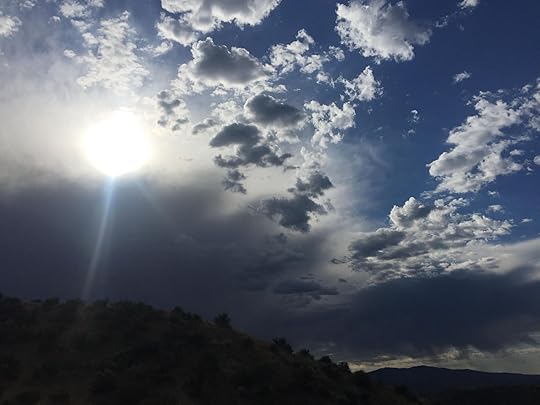
February 20, 2025
Haiku Narratives with Amy, Davin, and Michael - February 2025
February, 2025 Haiku Narratives
Curator's Note
We started over
five
years ago, and since then Davin Carr-Chellman, Amy Hoppock, and I have been writing and sharing haiku's monthly with each other. It has been an enriching and enjoyable way to develop our individual haiku writing practices.
It goes like this
Each person shares a haiku they have written with each other. Usually, as you'll see below, we put them on cards or bookmarks which we can keep ourselves, and often make more to share with others. We either mail these to each other (how nice to get a haiku, hand-addressed, in the mail!) or send them electronically. We each then write a narrative response to each other's haiku, including our own, and then we get together to share our responses. The poet reads their own haiku, the others read their responses to it, and then the author reads their own narrative about it. In that way, we independently think about each haiku and then learn from each other.
Five Years and Counting
Our first meeting to share haikus in this way was in
September, 2019
.
How about that!
It is a lot of fun!
We enjoy doing this so much we thought you might enjoy being a part of the conversation as well, so we started recording them in May, 2020, and had been exchanging and discussing our haikus almost every month for nearly a year before that. If you watch the clip here, you will see our discussions are very informal and that we laugh a lot.
This is our Forty-Fourth recording
(You can watch them all
here
. I'll stop counting once we hit 50 or something like that)
, and we hope to continue. Please let us know what you think, and share this with anyone you think might benefit.
This Month's Haiku Narrative Video Recording
Check It Out:
This is a recording (our forty-fourth) of our monthly haiku reading and narratives.
You can see them all here:
Haiku Narratives with Amy, Davin, and Michael
February, 2025 Haikus
Davin's Haiku
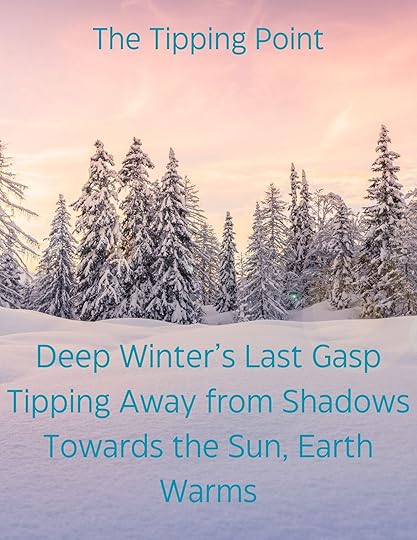
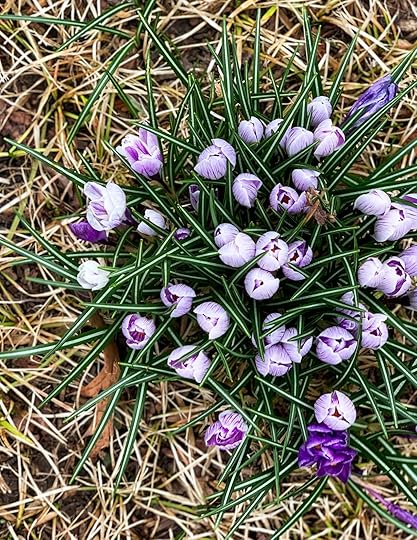
Amy's Haiku
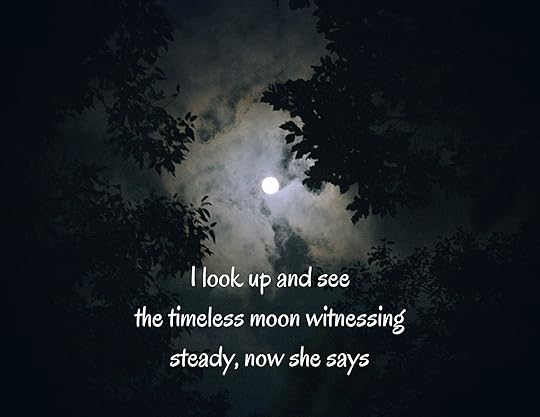
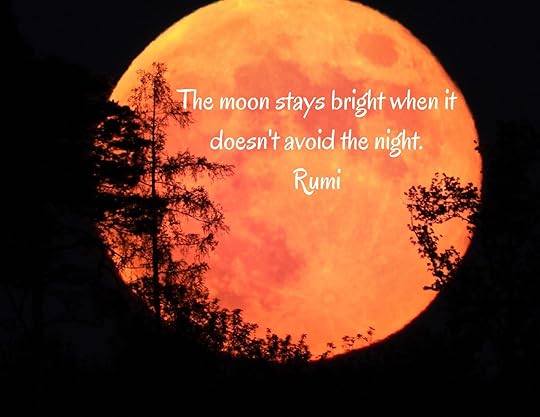
Michael's Haiku
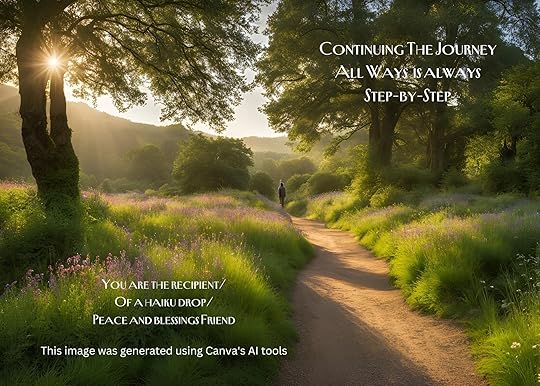
Check These Opportunities Out Too!
Our Book!
We are very excited about our book,
Framing the Moment: Haiku Conversations
. Here is a short description and video describing how and why we created the book, and how to order one or more.
About Us
February 9, 2025
The Elegant Haiku
Silence speaks to us
Listening in deep quiet…
Hear what you long for!
~Patricia Leyko Connelly
1
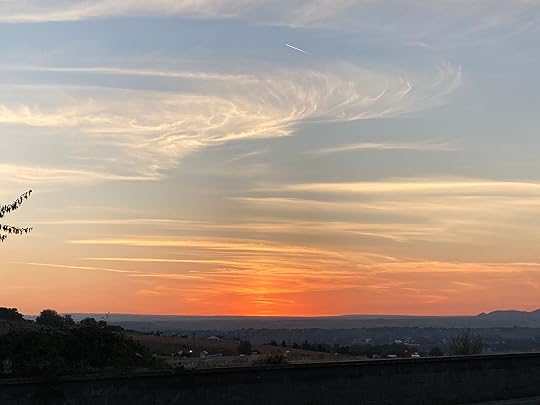
Haikus are elegant, as reading Patricia Leyko Connelly’s poem demonstrates. Just a few words in length, a haiku carries rich meaning. Each word must carry its own weight and contribute to the larger, but still slender, verse. Together, the few syllables comprising haikus
2
represent the Big Bang of the written word. A tiny haiku explodes with timeless, deep, and vast import. Some are humorous, some deadly serious, all are robust. Using another naturally occurring metaphor, each haiku is pregnant with meaning both for the one who conceived it and for the ones to whom it is delivered. The creation process for these evocative morsels continues as people read, reread, ponder, and consider them. Such is the generative destiny of all forms of art.
Haikus are an elegant form, perhaps the most elegant form, of poetry. Poetry as a genre lends itself to elegant expression through the written word. Haikus
check all the boxes for the characteristics of elegance
, and the practice of writing and reading haikus regularly
elegancifies
(see
this
for a definition) how we experience life and who we become as a person. Well-conceived and expressed haikus: 1) are timeless, 2) embody “simplicity plus capaciousness”
3
; and 3) are built on detailed description of observed phenomena wrapped subtly into a package of just a few, well-designed words which encapsulate underlying, generative, and profound questions and ideas. As in all practices, while anyone can write a haiku, mastering the craft requires consistent practice and growth over considerable time.
Judith Valente, along with Fr. Paul Quenon and Michael Bever, wrote a book titled,
The Art Of Pausing: Meditations For The Overworked And Overwhelmed.
4
In it, the authors wrote haikus which speak to “one of the 99 names of God referred to in sacred texts.”
4
Here are two which Judith wrote for the book:
God, the Friend
Day of solitude
Six wild turkeys come to stay
No one is alone
~Judith Valente
God, The Eternal
Pre-dawn silence
Earth murmurs ancient secrets
We listen, or not
~Judith Valente
In both poems, aspects of nature are included. Deeply felt words and expressions – solitude, Earth murmuring ancient secrets, listening, aloneness – are included. A turn of phrase – “no one is alone,” “we listen, or not” quickly brings a different perspective or an insight which gives the occasion a different interpretation.
This is what a timeless, subtle, well-and-parsimoniously-crafted, personally-interpreted-but-universally-relatable - yes
elegant
- haiku looks like.
As with all practices, we “become” what we do. One becomes a marathoner by running marathons. “I have run a marathon” means one has completed a marathon, but there is something closely related to one’s identity after making marathon-running a part of life rather than a one-off experience, impressive as it is. I have completed three marathons, years ago now, and I can accurately say I have run marathons, but it is the person who trains for and completes marathons as an ongoing part of life who has become a marathoner. Marathoner is who they are.
One can dash off a haiku a day, as I do too often, or one can make haiku writing a part of daily experience. One can approach life with, as Patricia Donegan calls it, a “haiku mind.”
5
She said,
“
A fine haiku presents a crystalline moment of heightened awareness in simple imagery, traditionally using a
kigo
or season word from nature. It is this crystalline moment that is most appealing. However, this moment is more than a reflection of our day-to-day life—it is a deep reminder for us to pause and to be present to the details of the everyday. It is this way of being in the world with awakened open-hearted awareness—of being mindful of the ordinary moments of our lives—that I’ve come to call ‘haiku mind.”
The haiku mind, as she described, is “the awareness to tune in to the vastness of the moment…when we can pause and relax in the moment, that is our haiku mind: the awakened, openhearted awareness that we can tap into. Every good haiku,” she wrote, “captures such a moment and is a reflection of our haiku mind.” She uses haiku, “not just as a literary form, but also as an awareness practice”.
In this sense, writing haikus can become a path for contemplative work and the present moment experience of simply emptying of minds so we can richly notice the world right in front of us. This too is elegant, and the process of creating the haiku from quieting, becoming aware, interpreting that awareness of direct experience through the spare form of a haiku, elegancifies our own being and becoming as well.
Haiku’s, with their minimalist structure, intimate revelation, and detailed-while-nuanced expression are parsimoniously sublime.
Haikus – reading or writing them – and other manifestations of elegance are available for everyone
As I previously reported
, I asked Google alerts to send me links whenever a story about elegance popped up in the news. By far, the stories which come to me are about items or experiences that I couldn’t afford, nor could most folks I know afford, in a million years. High class fashion, expensive cars, celebrity celebrations – you get the idea – are what get reported and are what many of us think about when we think about the word elegance. If “expensive” were one of the principal attributes of what it means to be elegant then most of the world could never experience elegance.
But anyone can, it turns out. Writing or reading haikus can cost almost nothing. Think of the attributes of elegance and see if you can name some other ways that people of any income level can experience it. For me, Tai chi comes to mind. Tai chi originated in ancient China and is a practice involving slow, meditative, specific movements. As one becomes more proficient, more movements, known as ‘forms’, can be added to the routine. I have completed many times a wobbly version of the 24-movement routine from memory, which is a standard for beginners. My tai chi practice has waxed and waned over the last few years, but I count it as one of my anchors for a lengthy health span. Tai chi ties so much together – it’s meditative, simple-but-challenging, spiritual, something which can be practiced and improved over a lifetime. It is elegant and it is the opposite of the elite materialism of expensive consumption.
Inexpensive elegance is found in arts, crafts, and other physical items and I bet you could find some at an art fair or other places.
What are some examples of elegance that you could incorporate into your life?
-------------------------------------------------------
Afterword
I wrote
my first haiku on January 21, 2019
when I began reading
The Art of Pausing: Meditations for the Overworked and Overwhelmed
, by Judith Valente, Brother Paul Quenon, and Michael Bever. Judith Valente, writing in the introduction,
Pauses Written On Our Days
, recommended writing a haiku poem every day. I immediately began writing a haiku every day. She recommended finding one or more people to share haikus amongst each other. “The haiku exchange,” she wrote, “is a way of building community and recognizing that none of us is alone, has a lock on truth or insight. After reading that, I very quickly reached out to Kelly Anderson and we began exchanging haikus, and soon added Davin Carr-Chellman. Kelly moved on to another art form, painting, and now makes beautiful, whimsical works of art. Amy Hoppock joined Davin and me and we have continued exchanging haikus monthly since September, 2019. We have made, as of this writing, 44 monthly recordings we call
Haiku Narratives
, where we share our reflections of each other’s poem. We even wrote a haiku book together,
Framing the Moment: Haiku Conversations
.
6
The foreword to the book was beautifully written by . . . .
Wait for it . . . .
Judith Valente.
Since January 21, 2019, I have written a haiku most days. From the start, I made a pledge to myself that I would not worry about quality or how I might be judged by others or by myself. As a beginning haiku-ist I nearly always write using the traditional 5-7-5 syllable structure or a close iteration of it. I find the structure is freeing and the constraint forces me to be both creative and disciplined at once. Perhaps I will write haikus, as many do, in a less pre-set format as I continue to grow. To develop into deeper haiku writing I will need to, more and more, do as the master haiku writer Basho said, “To learn about the pine tree you must become one with the pine and drop your self-centered view”
7
I stay close to nature in most of my haikus, but not always. I am not well versed in the history or the style of of haiku writing. I am clearly a journeyman here and slowly learning the craft, but I have
become
a haiku writer and it is part of who I am.
References
1
Connelly, P. L. (2023).
Sacredness Surrounds Us in Every Season: Contemplative Reflections in Haiku Prayers, Photos and Long Poems,
p. 59.
2
For a discussion about the number of English syllables or Japanese
onji
, sound symbols, found in haikus, see Chapter 8,
The Form of Haiku
, in Higginson, W. J., & Harter, P. (2013).
The haiku handbook: how to write, teach, and appreciate haiku
(25th anniversary ed.). Kodansha USA.
3
House, P. (2015). What is elegance in science?
The New Yorker.
https://www.newyorker.com/tech/annals....
4
Valente, J., Quenon, P., & Bever, M. (2013).
The art of pausing: meditations for the overworked and overwhelmed.
ACTA Publications, pp. 11, 74, 158.
5
Donegan, P. (2008).
Haiku mind: 108 poems to cultivate awareness and open your heart
(1st ed.). Shambala, pp. xi, xiii, xv.
6
Hoppock, A. V., Kroth, M., & Carr-Chellman, D. (2021).
Framing the Moment: Haiku Conversations.
7
As quoted in Donegan, P. (2008).
Haiku mind: 108 poems to cultivate awareness and open your heart
(1st ed.). Shambala, p. xii.
-----------------------------------------------------
2019 Haiku Published in Profound Living
I was so taken with writing haiku, one-a-day, that I shared some of them in Profound Living. Looking back, I published a LOT of them. Here are some from 2019. Remember – I’m just a wet-behind-the-ears-eager-beginner here.
Three Haiku,
https://www.profoundliving.live/three-haiku
Imperfect Am I
https://www.profoundliving.live/imperfect-am-i
I Have A Floppy-Eared Dog
https://www.profoundliving.live/i-have-a-floppy-eared-dog
Cracked Windows
https://www.profoundliving.live/early-morning-prayer
Branches Break Fog-Day
https://www.profoundliving.live/branches-break-fog-day
Black Pavement Ahead
https://www.profoundliving.live/black-pavement-ahead
The Art of Pausing – My Experience
https://www.profoundliving.live/the-art-of-pausing-my-experience
Heveled
https://www.profoundliving.live/heveled
Neighborly Fence-Talk
https://www.profoundliving.live/fivehaiku
Haiku Hodge Podge
https://www.profoundliving.live/haiku-et-al
Fun with Haiku
https://www.profoundliving.live/i-ll-take-a-cloud-float
I Wore My Raincoat
https://www.profoundliving.live/i-wore-my-raincoat
So I feel alive
https://www.profoundliving.live/so-i-feel-alive
Poetry from the Profound Bartender
https://www.profoundliving.live/post-title68cf131c
Profound Silence
https://www.profoundliving.live/profound-silence
Painted Blue’n Gray
https://www.profoundliving.live/painted-blue-n-gray
A Lake of Diamonds
https://www.profoundliving.live/a-lake-of-diamonds
Soon the whole field flows
https://www.profoundliving.live/soon-the-whole-field-flows
Fall Haiku
https://www.profoundliving.live/a-comforter-of-leaves
Moon Smiling
https://www.profoundliving.live/moon-smiling
At 5:00 a.m. Books are Written
https://www.profoundliving.live/at-5-00-a-m-books-are-written
What a
re some examples of elegance that you could incorporate into your life?