Madeline Smoot's Blog
April 21, 2024
Book Haul — 2024
It was a wonderful time to see fellow authors, visit with librarians, and to basically network my heart out.
But one of the other great joys of trade shows like TLA and ALA is the opportunity to catch up on what the industry is currently doing.
Enter the book haul.
This year, I tried to be quite discerning, so I only came home with around 40 ARCs. (Advanced Reader Copies – the pre-publication versions of books publishers put out before the actual book goes on sale.) I brought home everything from picture book to adult, but I focused primarily on Middle Grade and YA from a wide range of publishers.
And of all those books, here are the 8 I’m most excited to read:
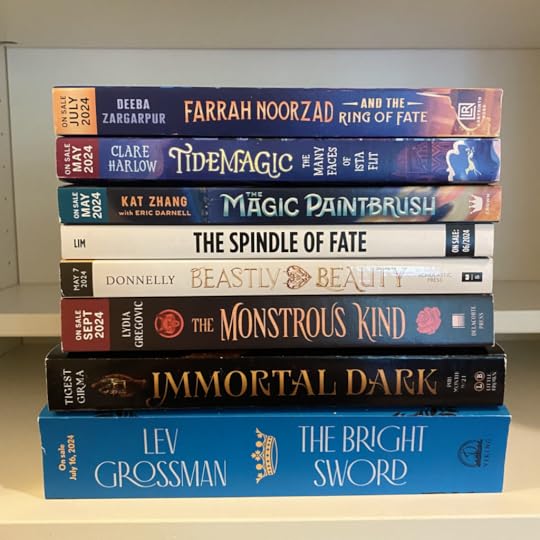
Starting off strong with the middle grades:
Farrah Noorzad and the Ring of Fate (Random House): a fantasy inspired by Persian mythology and Islamic folklore. The Random House rep made it sound amazing!Tidemagic, The Many Faces of Ista Flit (Random House): a fantasy mystery. The Random House rep, also made it sound amazing.The Magic Paintbrush (Random House): a fantasy inspired by Chinese folklore. The Random House rep made this one sound amazing too. (What can I say? The Random rep was really good at pitching middle grade fantasies!!)The Spindle of Fate (Feiwel & Friends/Macmillan): fantasy based on Chinese folklore – but very different from the The Magic Paintbrush above.And then moving onto YA/Adult books:
Beastly Beauty (Scholastic): a re-telling of primarily the Beauty and the Beast fairy tale, but also with elements of the Cupid/Psyche myth. I’ve already read this one, and I also think it’s an excellent book on discussing emotions, how they can dominate your life, and also how to start dealing with them in a healthy manner.The Monstrous Kind (Delacorte/Random House): a gothic fantasy with horror elements. Thriller and horror were trending heavily in the YA spaces this year. This was one with more fantasy elements to it than a contemporary thriller or horror novel. I’ve already read this one too, and it’s an interesting take that’s a bit Game of Thrones meets Walking Dead set in a Regency Romance world.Immortal Dark (Hachette): vampire fantasy. They’re pitching this as Cruel Prince meets Ninth House, but the jacket copy gives more of a Vampire Academy/Bloodlines vibe to me. I haven’t read it yet, though this is what I’m starting tonight. Or maybe tomorrow. I don’t love reading about vampires at night…The Bright Sword (Viking): adult King Arthur retelling. I know I should be focusing on kids books right now, but I am always a sucker for a good Arthurian tale. I am intimidated by how long it is though.And while my top 8 reads are all fantasies, there were plenty of other genres of books this year too. Like I mentioned, thriller and horror were huge in YA, but there were also still plenty of romances, especially ones featuring queer characters. Middle grade had a nice range of books with plenty of fantasy and mysteries for me, but also good contemporary things, especially ones around familial relationships. Chapter books seemed very school-centric this year. Picture books were also a nice mix this year with no one type of picture book seeming to dominate the space.
Of course, when it comes to our own writing, publishing trends aren’t really relevant. As always, write the story you want – even need – to tell. Worrying about the market will only stifle your creativity. Still, it can be a fun to see what publishers are doing. It never hurts to know where their tastes have been trending.


April 12, 2024
TLA Is Days Away
That’s right. In less than a week, librarians will emerge from their stacks and squint there way out of dusty libraries into the sunlight of San Antonio. And they will swarm together in a noisy, riotous, fun-loving bunch. If you think librarians are quiet, meek, and demure, then you’ve either a) never met one, or b) never seen them gather at one of their annual conferences.
Next week, I’ll be joining loads of other authors as we brave the Texas Library Associations annual conference. I’ll be giving away books (if they sign up for my newsletter!) and signing books and networking my heart out.
Because when you come down to it, librarians are one of your two biggest allies as an author. (The other is booksellers.)
Librarians are experts. They’ve read everything (almost) and so when they recommend something, people listen. They are on the front line of the censorship battlefields, and they are the ones talking up books to school kids one library hour at a time.
Embrace (metaphorically) your local librarians, but also if the opportunity ever presents itself, find your way to large gatherings of them. Apply to speak on panels or do presentations. Ask your publisher to arrange signings. Simply attend as an attendee and network between sessions and on the trade floor.
None of us would be where we are with out librarians. Don’t let these untapped resources pass you by.
April 5, 2024
Ask Not What Your Community Can Do for You (Or Something Like That)
But community is so much more than what other people can do for you. Community is not just about receiving support, but also providing it.
It’s like a more localized version of the Kennedy quote: “Ask not what your country can do for you – ask what you can do for your country.”
We’re just going to think on a more local, community scale, even if geographically your community consists of people from all over the internet.
So, here are my top 3 ways you can build your community while giving back to them too:
Volunteer— This can be with an organization devoted to writing (like SCBWI) or a reading or literacy group, but this can also just be within your own community. You have wisdom that goes beyond issues of craft – although you have wisdom there too! Share what you know with the members of your community.Share other’s success— When one author wins, we all win. So when someone in your community gets a book deal or publishes a book or wins an award, help them share the word about this success. Raising the profile of children’s books is always a good thing.Support your community’s accomplishments— Show your support whenever you can. Do things like go to local events (like book signings, launch parties) or online events when you can to support your community. When possible, buy your critique partner’s book when it comes out.Basically, think of all the things you would like your community to do for you, and then do it for them.
Community is about giving and taking and striking the right balance between the two. Be there for your community so that when you ask, they’ll be there for you.
March 29, 2024
Marketing Comes for Us All
At some point in your authorial career you’re going to have to tackle the dreaded M-word.
No, not magic, although that would be pretty cool if we all got wands and the ability to move objects from across the room at the flick of a wrist just because our book released.
No. I’m talking about MARKETING of course.
Now 125,000 years ago (dates are approximate), I went to college a fresh-eyed young Madeline and actually got a business degree in Marketing. So, the prospect of having to do marketing on my books is not exactly the dreadful monster it is for some.
But …
It still wasn’t exactly my favorite thing to do. Let’s face it, just like you, I’d rather be writing. Or reading. Or laying out a book. Or cleaning my house. Or weeding cacti out of the yard. By hand. With no gloves.
You get the idea.
For a long time, marketing to me (especially in the age of social media) was a lot of just sort of yelling into the void and hoping someone heard. And, that’s of course because I was looking at it all wrong.
I was talking about books and my books and publishing, but I wasn’t talking to anyone in particular. I wasn’t building a community.
And that, my fellow writers, is what’s at the heart of all good marketing: BUILDING COMMUNITY.
I went to a webinar recently led by the lovely author/entrepreneur Rebekah Manley. The focus was on media and publicity kits, but she too stressed the importance of community in all aspects of life – including the professional. Especially the professional. In fact, she literally called community your greatest asset.
For some time now, I’ve been attempting to build a community – ever since I started the very first version of this blog, Buried in the Slush Pile, nearly 20 years ago. It’s what I’m trying to do with my Monday morning newsletters and over on my social media.
I’m building my community of writing friends and peers – those that are just starting on their publishing journey and those with dozens of books out. We’re all in this writing and publishing boat together. And isn’t that a rather lovely place to be?
As Rebekah points out, “Your community got you through the writing process. What made you think you’d carry the torch by yourself after publication?”
At its best marketing is simply a continuation of that process of building and communicating with your community.
Build your community and then add me to it.
***
If you would like to join my community, you can find me at the following socials:
Facebook: @authormadelinesmoot
Instagram: @madelinesmoot
Or even better, join my newsletter (and get the free Submissions Checklist) here>>
March 22, 2024
The Importance of Industry Experience
There are so many facets to the publishing experience.
There’s being a children’s book author or illustrator and the experience that comes from creating books for kids to consume.
Then there is actually working for a publisher in some capacity whether that’s as an editor (like me!) or in marketing or sales or the like. That’s a very different way to experience a children’s book.
And finally, there’s working in a bookstore or as a librarian – in other words, as someone that actually puts books into a child’s (or the adult in their life’s) hands.
All of these roles are key to the publishing industry as a whole – And all of them are WILDLY different. The experiences that you earn in any of these different roles is both invaluable and varied.
And they make your writing and publishing career richer for the experience.
I spent years working in bookstores (first Barnes & Noble and then BookPeople), and little things like where CBAY put the barcode on the back of the book directly came from that experience. I’m also really good at handselling books. I had to be after seven years on the sales floor.
Author Joy Preble has also spent a fair amount of time in a bookstore eventually becoming the kid’s buyer for Brazos Books. I asked her how she thought bookselling had impacted her writing, and she told me: “I honestly think it was my extra reading that impacted me most as a writer because so much extra access to books through early reader copies allowed me to study and deconstruct what was selling to the publishers. So while I can’t say it changed what I write, it definitely helped me hone my craft.”
She also got to see first-hand what publishers were pushing and industry-trends while also seeing what customers were actually buying. As Joy put it, “bookstore work allowed me to see what customers gravitated to and why, and what they might actually purchase, if a book was hand sold to them.”
Joy got quite a bit during her time in a bookstore – just like I did!
What I’m trying to say is that I highly, highly recommend that you try to experience as many parts of the industry as you can.
Volunteer at your local library or a literary book festival.
Get a part-time job on the floor of your local independent bookstore.
Intern with a small publisher.
And write, write, write those books.
You’ll find the experiences rewarding.
February 9, 2024
Sometimes You Just Gotta Say Enough Is Enough
I know the temptation.
That temptation to just change one more little word.
To read through the manuscript one more time — Just In Case.
The temptation to tinker endlessly with a manuscript because it just doesn’t feel perfect.
I get it. I do. I’ve had that moment too. So what do we do to get past it?
We have to trust. We trust:
Our critique partners and editors and beta readersThe feedback we’ve gottenThe revision plans we’ve made andThe revisions we’ve written. And ultimately, we have to trustOurselvesWe have to trust the drafting and revising process and the progress our book has made.
And then, after we’ve run that final draft past our writing friends and run through our checklists and publishing or submission questions …
We just have to press send on that query or publish on that book.
Because in the end, no more tinkering. Enough is enough.
February 2, 2024
A Picture Book Has How Many Pages?
If you type “how many pages does a picture book have” in a search engine, nearly every result will tell you that there are 32.
So, are Picture Books 32 Pages?
Yes, and also no.
Wait, hear me out.
Ok, technically, yes, picture books are 32 pages. Like almost all print books, picture books come in a page count that is a multiple of 8. So, although you will see a picture book that has 24 or 48 pages, the standard for a picture book is 32 pages.
That’s not what I’m talking about though.
You see, oftentimes when I see picture book manuscripts from authors, they have broken up the story into 32 pages. And this makes sense because picture books are 32 pages.
Except they’re not.
The story portion of the picture book is only 30 pages. You have to set aside a page for the title page (that first page with the book’s title, exactly like it sounds) and another page for the copyright page. In picture books, you’ll also usually find the dedications on the copyright page too.
And that leaves your story only 30 pages of the children’s book. And that 30 pages includes any back matter like glossaries or information pages – meaning if you have those, your story may not even have 30 pages.
So, when you are breaking up your story to see if you have enough for a full picture book, you want to break it up over 30 pages rather than 32.
Because although yes, picture books are 32 pages, only 30 of those pages are for you.
January 27, 2024
New Year, New Writing Goals – Part 4
We may have answered all of questions and set great goals, but the thing is we have to follow through. And that’s the hardest part, even harder than figuring out our goal in the first place. So, we’re going to have to
Stay Motivated.First we’re going to keep the parts of our goals small to keep from being overwhelmed. The overall goal might be big – like self-publish a book series – but the individual tasks for that can be broken down into chunks that are small. Don’t become overwhelmed because if you have trouble starting, you’ll have even more trouble finishing.
Then if you can, do the hardest thing first so that you get it over with, or do the easiest things first to build up to the harder tasks. I know this is contradictory, but one way works better for some, and the other works better for others. Do what works best for you.
And finally, and most importantly, reward yourself. We all like rewards. When we work we do it for the reward of money. When we volunteer, we are rewarded with positive feelings. So when you reach your goal, or even as you reach milestones towards it, you’ll want to reward yourself. And I don’t mean here that you are going to reward yourself with the satisfaction of a job well-done. I mean something concrete. This doesn’t need to be expensive. It can be a snack, a movie that you stream, even something small. The point is to have some sort of tangible thing that you will enjoy.
So, take a second to pick a reward for yourself. Of course, this can change, but pick something for now.
Now that you’ve got your first goal started, spend some time this coming week thinking more on your other goals for this year. Because in the end, we want goals for this year. We just want to level up our goals and make them even better than last year.
January 20, 2024
New Year, New Writing Goals – Part 3
So far in our goal setting we’ve figured out what we want and how we’ll do it, but there’s one final question.
Question 3: When will I do it?The truth is all the plans in the world won’t get you to your goal if you can’t find a time to implement them.
You need to honestly evaluate your schedule and see if your goal is reasonable after all. These days writing can feel like a luxury or something we do after all the bills and household tasks are done. If that’s the case, then maybe drafting 2 books this year is going to end up being one too many. Take an assessment of what your life is going to allow right now, and if it isn’t as much as you would like, that’s ok too. I’m not going to tell you to get up an hour early or write through your lunch. Those are all great things, but they may not be what you are up for right now. And again, that’s fine. Sometimes we need our sleep and to stare at memes during lunch. Not every second of your day has to be in pursuit of productivity. However, your goals need to reflect that reality.
But once you do know what kind of writing your schedule will allow, schedule it in.
Personally I like to color block my days so I can visually see when I can write. I’ve also been known to set a timer for a certain amount of time like 30 or 50 minutes and then spending that time dedicated to writing. You do what works for you.
This year, I also blocked out what days I want to work on what project. I am not one of those people that can work on multiple projects at the same time on the same day. So, when I have multiples going on (like right now), I need to figure out when I can work on them.
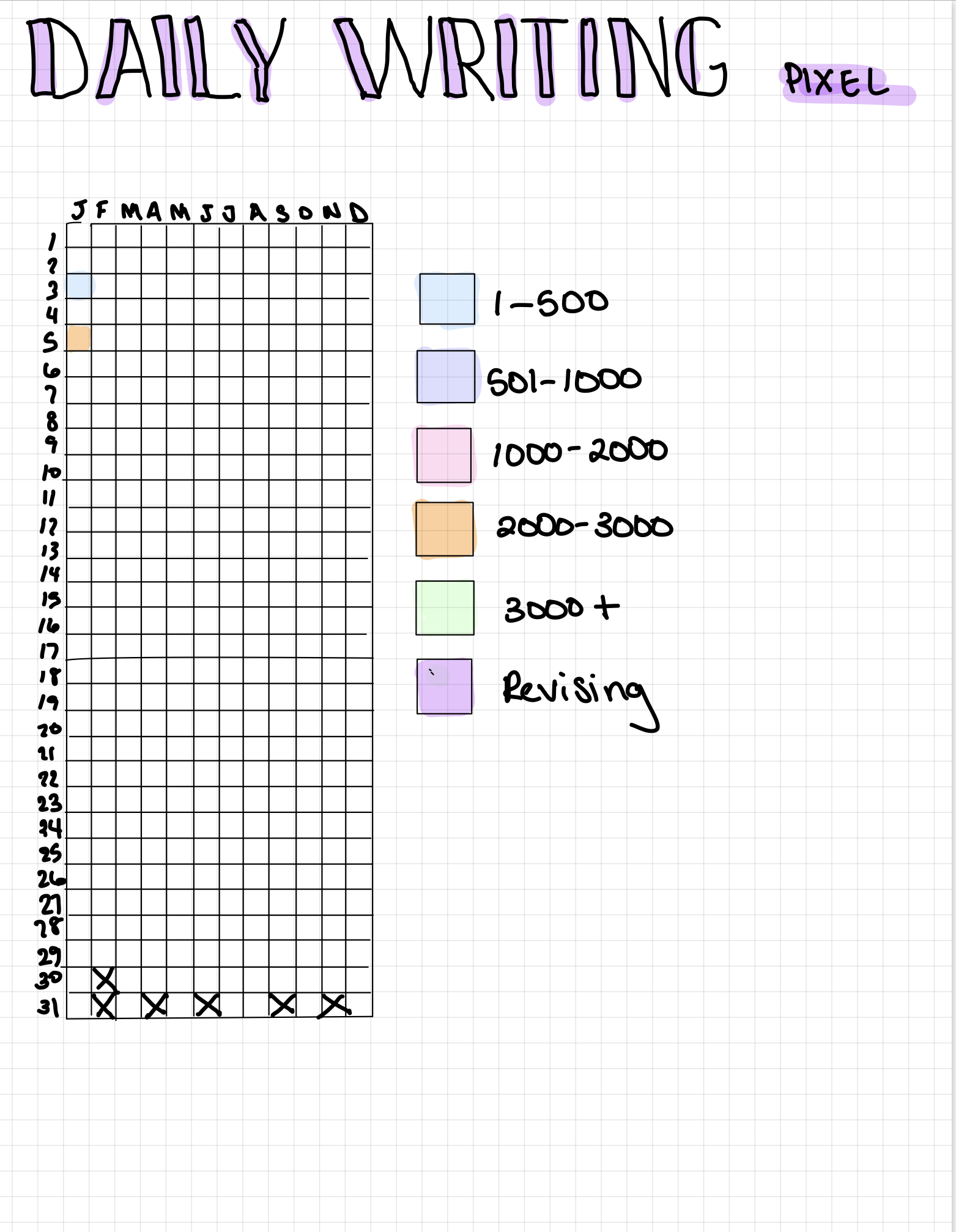
I’m also not someone that usually writes everyday, so I’ve already blocked out in black the ones I know I won’t be writing.
Again, my preferred method is very visual and very bullet journal inspired. You might just want a list of dates or a block of time on Tuesdays that you want to set aside. That absolutely works too.
And finally, have a time frame for your goal. Goals shouldn’t go on indefinitely. All of my goals are set for this calendar year. If I haven’t reached them by New Year’s Eve, then I didn’t hit that one, and I’ll either need to do it again next year or re-set it or choose a different goal altogether. You don’t want a goal to kind of drift along indefinitely. That’s soul sucking and also means it probably either isn’t realistic or actionable.
So start looking at your schedule and figure out when you can work on your goals. Also, set a time limit for completion. Again, these are not indefinite. It may take time, years even, but your goals should expire at some point. Dreams may have no expiration date, but goals certainly do. Make yours one that leaves you full of hope, like a dream.
January 13, 2024
New Year, New Writing Goals – Part 2
Last time we thought about what we wanted to achieve with our goals. This week we’re going to ask ourselves the next question in our goal setting:
Question 2: How will I do it?We made goals that are actionable, but how exactly are we going to do them?
We’re going to make an action plan. We want to figure out the step by step things we’ll be doing to achieve our goal. Here’s my example for a goal to write a chapter book series:
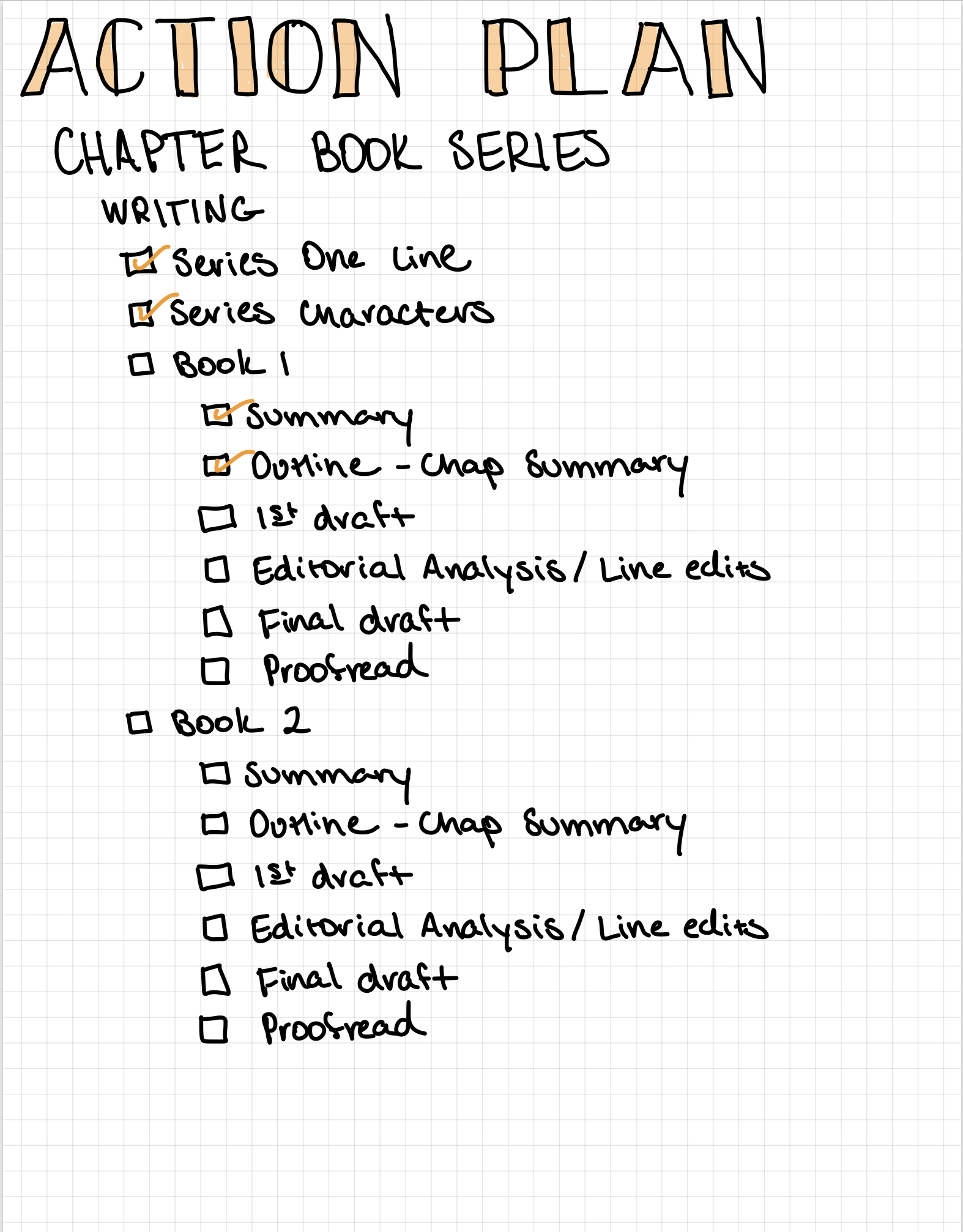
Now, let’s be honest, my action plan looks like a glorified to do list. That’s just how my brain works.
But you don’t have to do it this way. You can do whatever works for you.
You can chunk your book into parts or chapters or by word count or whatever. If you’re a pantser, then maybe your steps are brainstorming, drafting, and revising. These can be as broad or as specific as you need. If you find something like this overwhelming, do a simpler list. If you need even more detail so you don’t forget something, then do that too.
And once we actually have our plan, we’re going to hold ourselves accountable to it. And we’re going to do that by keeping track of our goals.
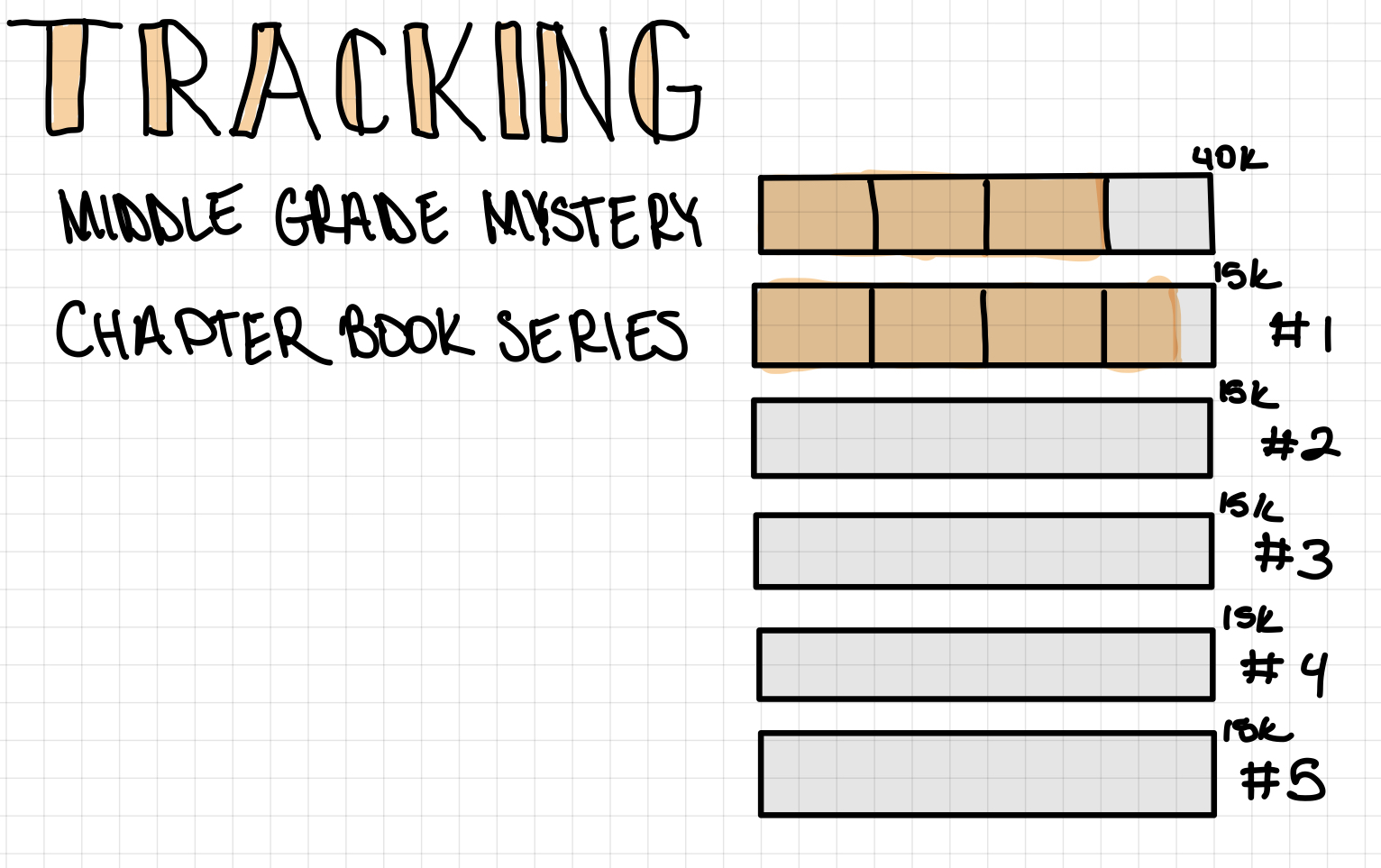
You can keep track any number of ways. You can measure how much of your book you’ve written in words in a bar chart like this.
You can pull inspiration from the bullet journal people by having a day in pixels page like this to track pages or words written. Mine here tracks words. Good thing my goal isn’t to write every day. But if it was, this would be a good tracker. You could track hours spent writing, words written like mine, or pages written.
Or if you like your spreadsheets, you can track your word count in one like this. This shows the amount of words written each day (most unimpressive for the beginning of the year. I also have a bar chart showing progress on my specific project.
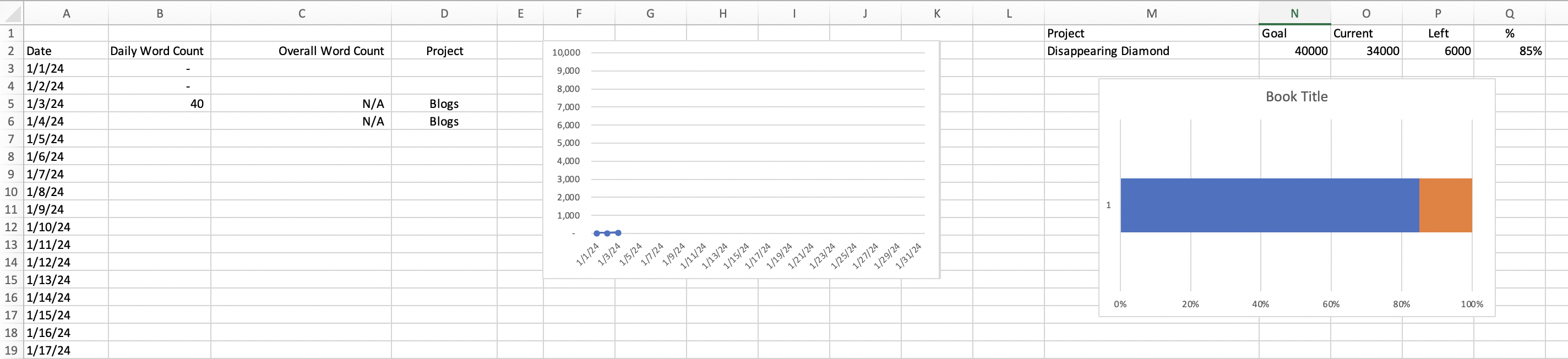
So, now take that goal you wrote down before and spend a couple of seconds thinking about how to turn it into a bunch of bite-sized steps you can accomplish. Remember, we picked goals that are doable, so this is going to be a bunch of doable steps too. Then determine how you’re going to track. Is it a to do list you check off? A chart or picture you fill in? Whatever works best for your brain is what you should do.
Let’s make these goals happen!