
A.J. Stewart's Blog
February 17, 2017
Heisman Trophy
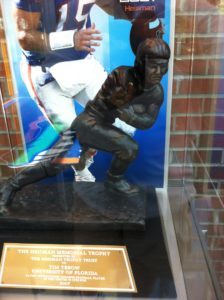 The Heisman Trophy is an award given to the best player in American college football each year. The trophy was created in 1935 by the Downtown Athletic Club, formerly of New York City, to recognize the best college player east of the Mississippi River. After the club’s athletic director, John Heisman, died in 1936, the club named the trophy in his honor, and extended the award to cover college player nationwide.
The Heisman is a recognizable trophy because it isn’t your standard cup. Rather it is a sculpture of a player running with the ball, with one arm outstretched, fending away the tackle of an imaginary oncoming player. The fend is often referred to as a stiff-arm, hence the name of the novel that the Heisman features in, Stiff Arm Steal.
Although the trophy is named after John Heisman, the sculpture isn’t actually Heisman at all. The model for the trophy was a New York University football player named Ed Smith, and was created by artist Frank Eliscu. Although Smith modeled for the sculpture, he didn’t know that the sculpture went on to become the Heisman Trophy until almost fifty years later. Smith was awarded his own Heisman trophy by the Downtown Athletic Club in 1985.
These days the trophy is awarded by the Heisman Trophy Trust, based in New York City. The Downtown Athletic Club is no more. It was run out of a building the club had built and was completed in 1930, in downtown Manhattan, less than a half mile from the World Trade Center. The club ran into financial trouble in the 1990s, and after the 9/11 attacks was within the area cordoned off from the public for an extended time to allow for the clean up. The club building wasn’t damaged, but the enforced closure resulted in the bankruptcy of the club. The building now houses condos, because that’s what all old buildings seem to do. The award has been overseen by the Heisman Trophy Trust since 2006.
Only one player has won the award twice—Archie Griffin of Ohio State University, in 1974 and 1975.
Although I’m sure a lot of my readers would wonder why anyone would care about such a thing, consider this: Not many Heisman Trophies have been sold on the open market, but those that have generally fetch a couple of hundred thousand dollars, and as much as four hundred thousand.
Want one now?


The Breakers
The Breakers is Palm Beach wrapped up in a building. It’s old money, expensive and stuffy. It has views to die for, and the walls ooze old-fashioned class.
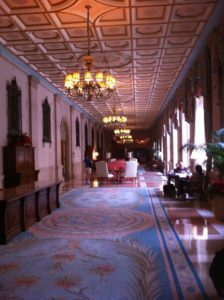 That’s a quote from Offside Trap. The Breakers is one of those places that both define and defy Palm Beach. It’s a hotel in the old tradition. Henry Flagler built the hotel — one of a number of places he built that just happened to coincide with the stops along the train line he created from St. Augustine to Miami — opening in 1896. He had already built the Royal Poinciana Hotel on the Lake Worth side of the island, but guests had begun asking if there were any rooms overlooking the breaking waves on the ocean side, and Flagler knew a good thing when he saw it, so The Breakers became a reality.

The original hotel was built of wood and burned down twice, before being rebuilt in concrete by Flagler’s heirs in 1926. Modeled after the Villa Medici in Rome, the new hotel build required the services of 75 artisans from Italy, according the hotel’s website. What those artisans did is anyone’s guess. I think a fair bit of lute playing was involved. But the end result was a European luxury in the steam of South Florida.
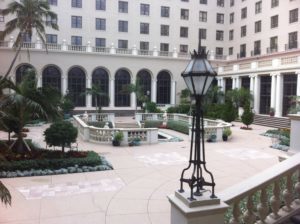 Interesting baseball fact: In 1915/16 The Breakers hosted members of the Lincoln Giants, a pre-Negro League baseball team, to play a series against an Indianapolis team hosted by Flagler’s other hotel, the Royal Poinciana. The Indianapolis Freeman newspaper reported that the series was so popular that the head waiter at the Royal Poinciana had to call in extra waiters from Atlanta. Because no oil baron worth his salt can enjoy a ball game if he has to wait for his mint julep.
 If you ever fancy a thousand-buck a night room and some expensive stone crab and fancy drinks in plush surrounds with grand ocean views, The Breakers will certainly fit the bill.
Not surprisingly it is not really Miami Jones’ kind of place. But Ron’s a big fan of the seafood bar, and it is where he met the Lady Cassandra, so the place has done well by him.
If you are so inclined, here’s a video of the old dame that shows she’s still got the stuff.
February 8, 2017
King Tide is out now!
“Ten Little Indians visits the Sunshine State”
“Another Miami Jones success!”
“Can’t write them fast enough for me!”
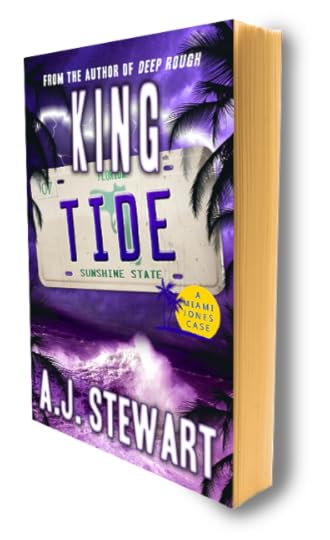
The new Miami Jones novel, King Tide, is out today and the first reviews are in. Looks like folks are enjoying it. If you haven’t got your copy yet, you can find your preferred retailer here.
November 2, 2016
Contest November 2016
I’m not crazy, I like to read, and you keep telling me I can’t write them fast enough. So here’s a chance to get your hands on a great book in the meantime. if you’d like to go into the draw to win the new Jack Reacher novel, there are two ways to enter:
Leave a comment in the comments section below.
You can enter by liking my Facebook Page here.
That’s it. Entries close midnight, Friday November 4. I’ll let you know winners in the next email.
And by the way, if you like to listen to your books, the first Miami Jones novel is coming to audiobook (Amazon, Audible and iTunes). More on this next time.
September 16, 2016
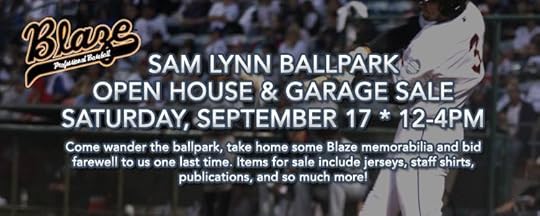
Vale Bakersfield Blaze
 If you build it, they will come. If you don’t, they will leave.
I’m paraphrasing that fantastic movie Field of Dreams, of course. Because today another town has shuttered its ballpark and lost its team.
Bakersfield, in California’s Central Valley, has had a professional ball club since 1941. And since then the club has played its home games at Sam Lynn Ballpark. Its the kind of ballpark that harks back to another era. The seating was sparse and the food selections were minimalist by today’s standards, but there were hotdogs and beers, so what more could you want for?
The field was built on the old fairgrounds when all the games were played during the day, so when the lights arrived and night games became the norm they realized that the batter was facing due west, right into the setting sun. It was decided to build a large scoreboard in center field to block the sunset, and in that country town just-git-‘er-done way, that’s what they did. Only later did they find out that the sun actually set in the height of summer just to the left of center field. So they started the games at sundown.
In the Miami Jones series I often portray the minor leagues as a cut throat business: players desperate to make it to the Majors, or desperate to not be cut altogether. Such is life for the minor league clubs, too. They don’t get the press or the coverage of the major league teams, they aren’t filled with star names – stars of the future maybe, but not the present. Often such teams are the life blood of a town, the talking point at the local cafe, the source of consternation for the old timers who remember the good old days when winning records were the norm and pennants flew high.
I had the good fortune to visit Sam Lynn ballpark a couple of years ago. It was a warm night, the sun burned into our eyes as we sat behind home plate (a position few can afford at any major league stadium). The beer was cold and the dogs lukewarm and the banter was genial. I recall the ATM machine stopped functioning in the club store and the club General Manager had to be summoned to fix it, because the Assistant General Manager was busy calling the game from the announcer’s booth. My son was called upon with some other kids to participate on the field in a between-innings game of some sort, but a last minute technical snafu prevented it from happening. The kids got free popcorn and tickets to a future Blaze game, so they were all pretty pleased with the outcome.
As for the baseball? It was Class A Advanced, three rungs and a thousand miles from the bigs. The players all had those massive forearms that ball players have, and they ran hard and swung harder. It was baseball up close. Foul balls left the facility altogether, and when the catcher ripped off his mask to catch a popup foul, his sweat sprayed through the wire onto the first row of seats.
There were more errors than you see at big league games. And that is all part of the attraction for me. Major League Baseball, like all top flight sports, is about the pursuit of perfection. Even the outfield grass is perfect. But minor league ball is more human. You hear the effort from the batter as he sprints to first, and the groan as he slides in. It is real and raw. And very, very human.
But we don’t live in a world that wants human. We want bright lights and distraction. Human is what we do every day. Baseball is a diversion from regular life, a different plane of existence, where the players are not just guys giving it their all, but rather distant gladiators to be adored or despised.
There were numerous attempts to get a new ball park up and running in Bakersfield over the past decades, but as often happens they came to nothing, and the owners and the MiLB saw greener pastures elsewhere. Bakersfield may rue the loss of their team, but then the club came dead last in California League attendance in each of the last ten years, so perhaps the mourners will be few. Cheap nuts and even cheaper admission didn’t cut it. And this in a period where the league overall has enjoyed growing attendances. Clearly people want more. They don’t want old. They don’t want raw. They never have.
Groups of wealthy investors have been buying up minor league clubs, but not to the detriment of baseball. I’ve watched games in the last few years at clubs like the San Jose Giants in Northern California, the Bridgeport Bluefish in Connecticut and the Port St. Lucie Mets in Florida (of course you know, where Miami Jones finished his minor league career). These clubs have stunning facilities in wonderful boutique stadia. And whilst the price of admission and the cost of a beer don’t compare to Sam Lynn Ballpark, they are a far cry from the lofty wallet-emptying prices one sees in the big league fields. And the people come.
Minor league ball has a proud tradition and will continue to hold an important role in the towns in which they play. Better facilities for players and fans alike, comfortable seats and craft beers and bobbleheads for the kids. The lights are bright and the food is nigh-on restaurant quality. It’s like the major league, just in miniature.
And maybe that’s what I miss. I miss the sun in the eyes, and the floodlights that don’t quite capture the entire flight of the ball. The hokey between innings entertainment, and the sound of crickets as you leave the game.
And maybe in some way, that’s why Miami Jones lives on.
The Bakersfield Blaze and the High Desert Mavericks have both been closed down by the MiLB. The California League will drop from ten to eight teams in 2017, and it is planned that two new teams will be added to the Carolina League.
The Bakersfield Blaze will have their farewell open day at Sam Lynn Ballpark tomorrow, September 17, 2016. If you’re in the neck of the woods, drop in and visit an old ballpark, before she becomes nothing more than a smile on an old man’s face.
July 15, 2016
Why we’re dropping Google Play books, for now
I am always keen to make sure my readers have the best possible experience. From pricing to flexibility in ereaders, I have always been keen to try new things that traditional publishers won’t do.
Take for example, DRM. That’s digital rights management. It is a process that encodes your book, just like a DVD, so that you can’t take it and read it on another company’s ereader device or app.
I don’t do DRM. I don’t like the fact that a company can tell you that you don’t “own” the book you bought. Like a regular paperback book, I believe you should be able to take your book wherever you go. Major publishers, like record companies and movie distributors will tell you these technologies fight piracy. The data suggests they do close to nothing against piracy but make it harder on consumers – trying playing your US DVD on a British friend’s DVD player. Tragic.
So in the spirit of pushing the boundaries, we decided early on to go with Google Books, or as it is called now, Google Play. (There is now a Google Play Books and a Google Books. Yeah, that’s reader friendly). We thought that those innovators at Google would shake up the ebook world – deep pockets, big brains, all that.
In short, they haven’t. I don’t know if it is lack of focus or lack of interest, but the ebook store on Google has lumbered from one horrible iteration to the next. We waited for the interface to get better. It didn’t. We waited for them to stop randomly changing prices on books, often resulting in higher prices for Google readers. They didn’t.
Google themselves recently stopped allowing new publishers to join their program, perhaps in tacit admission that the system just didn’t work. We waited for things to happen. So far they haven’t.
As a result the latest Jacaranda Drive book, Deep Rough, will not be offered for sale on Google Play.
You will still be able to use Android version of Kindle or Kobo to read on Google and Android devices.
Our current library of books will stay on the store, unless something gets worse, which we don’t expect. So those readers will still have access to their books.
Hopefully Google recommits to the ebook world and develops a system that works for readers, publishers and authors. If and when they do, we’ll be ready and waiting to provide readers with the best experience possible.
Cheers
AJ
May 31, 2016
Some books flow like a river, some like a glacier
Some days the story flies so fast from me that my fingers can’t keep up the pace. When I used to write every first draft free hand on a series of legal pads I would end up with hand cramps on those days. Despite the pain those are good days. But some days drag. The story is there on the wind, a diamond in the rough, and it’s like excavating stegosaurus bones to get it out. Those days are hard. Those days I wonder if the story just isn’t very good. I mean, if I have to struggle to get it out, surely it will be a struggle to read, right? And this isn’t 10th grade English Lit, people. These novels are not supposed to be hard reading. They are supposed to be fun. Sometimes funny. Sometimes not. Perhaps nostalgic and occasionally thought-provoking, but never hard.
It took me a long time to learn that the ease of the writing and the quality of the work are in no way bound together. Some writers rocket through first drafts and others plod. Most have at least the occasional day of both. Some work is almost ready to roll after one draft, other work takes many, many drafts to get right. I know from my own experience, and from that of other writers, that sometimes the story that flows is your best work, and other times the story that has to be dragged kicking and screaming from you turns out to be gold.
I’ve done both. I once wrote a novel that took 7 years to finish. I once completed a first draft that was close to publishing ready in 10 days. There’s no telling how it will go. There’s no planning for it. This is the great unknown of art. Until it is done, and until someone has read it—until many someones have read it—I can’t know. I can guess, my editor can guess. But I can’t know. The best we can do is take our collective experience and make judgement calls on what is working, and what is not. And more important, what our readers will read.
Burned Bridges fell into this abyss. It was a new series, a new group of characters and a very new direction for me. The overarching story came quickly. The finer story took some time. Some of those good days and bad days. In the end it was long, very long for me. Almost 140,000 words, or close to twice the length of the first Miami Jones novel. I finished it and gave it to my editor.
She loved it.
Sort of. She loved where the characters were going, but didn’t feel she knew they well enough. She couldn’t see the equivalent of Miami and Danielle and Longboard Kelly’s in her mind’s eye. And she felt there were actually two great stories there, and that they would benefit from being told separately.
But there was a problem. We had slated a launch for the book for this summer. I’d had even told my reader’s group about it. But it was clear that a good book could become a great book with a lot more work. It wasn’t coming out any time soon, at least not if we wanted it to be great.
Now, of course, great is a value judgement. One person might find a book great, but other might think it stinks. But as Truman once said, the buck stops here. It doesn’t stop with publishers or editors or fans or even Amazon, dammit. It stop with me. It’s my name on the front. So while a given reader might not think one of my books is great, I had better think it is. Because when it all comes down to it, I know how it feels at the other end.
I’m a reader. I get lots of reading suggestions from my readers, and have expanded my list as a result. I read every day. Fiction and non-fiction. And as a reader I know one thing.
I don’t have time for less than great.
I start a lot of books. I don’t finished many. And it’s not always because a book isn’t good. Sometimes it’s not you, it’s me. I just don’t connect with the story or the characters. That connection is ethereal and rare. I understand the value of it. It’s that feeling that drives me. Because at this point I know that there are thousand and thousands of readers who have found that connection with my work, or my work has found that connection with them.
And that’s too important to lose. So I can’t put out a book that I don’t think that you’ll think is great. As I say, I can’t know that you’ll think that. With every new book I’m not returning to the well, I am creating a new well from scratch. Each work stands alone. So I have to give each one my best shot.
I think Burned Bridges is a diamond in the rough. My editorial team thinks so too, and I trust them completely. I think there’s a great book in there, or maybe two. But there’s a lot more work to be done.
I’ve been working on this book for almost a year. It’s a long time and a lot of work to say: no, it’s not ready.
But it’s not ready.
So until further notice it isn’t coming out. The marketing has been cancelled and the editing plan has been put on hold until I chip away at the rocks and find that precious Stegosaurus. And that’s not a metaphor to be messed with!
Miami Jones 6 (7 if you count Three Strikes) has been written while this hoo-ha has been going on. Miami Jones 7 (or 8, if you prefer) is being written now. In the afternoons I am working on Burned Bridges, and I hope it gets done by year’s end. If it doesn’t, if it isn’t great, it won’t.
Miami Jones 6 – Deep Rough – will be out in June. I hope you love it.
July 1, 2015
The writer’s desk
I get quite a few emails asking about how I write, what sort of an environment I have, where my special space is etc etc. The bottom line is I don’t: I don’t believe in special places, or getting in the mood or waiting for the muse. I used to. I also once took 7 years to write a novel. And that folks, ain’t a career in the making. A professional writer just needs a place to do his or her work. It can be nice, consistent and special, but it doesn’t have to be. Stephen King says he wrote his first publish novels on top of a washing machine in the laundry room. Whilst I am sure he has a (much) nicer place now, the point is made. It’s about getting the work done, nothing more, nothing less.
I have a dedicated office, for which I am thankful, but writing is something I do anywhere and everywhere. I wrote a novel years ago in half hour chunks whilst commuting on the ferry in San Francisco. I wrote another primarily in the Starbucks section of my local grocery store. A laptop, headphones to block out the hubbub, and I’m off.
Writing for me isn’t like a job, it is a job. I work as many hours as most folks do. Granted, I don’t spend any of that time getting berated by my boss or playing office politics (My boss is very nice at communicating and only goes hard on me when I am falling behind my deadlines, and she has been like this since before we even got married; and politics is a non-issue – our cats and I know what the pecking order is, and who comes first, and there just isn’t any debate about it). I do spend a lot of time staring at a yellow pad dreaming about where a story is going, and a bit of time actually typing words. The thinking is 80% or more of my work, and for that reason I don’t really think of myself as a writer, but rather a storyteller. 100% of my creative time is crafting story, only about 20% of it is actually writing the damned thing.
In case you wanted to see, here is the before picture of my desk. This is a process I go through (or my wife makes me go through) after each novel:

And this was the same desk at the end of editing the last novel.

It says something about how my brain works, but I’m not getting into what it says.
Cheers
AJ
May 19, 2015
Win the Signed Trade Paperback Set, Books 1-5
 The first four Miami Jones novels are now available in an ebook box set on Amazon – other retailers soon. We have also finished rebranding all the books to give the series a coherent theme, and the paperback versions of books 1 and 2 are now in final production and will be available shortly (books 3 and 4 are available now).
So I’m giving a lucky reader a chance to win a signed trade paperback copy of each of first four books (Stiff Arm Steal, Offside Trap, High Lie and Dead Fast) as well as the upcoming new novel Crash Tack (due for release in July). Yes, the old fashioned books made from paper!
To be in the running, simply leave a comment in the comments field below this post. I’ll announce the winner in the next Reader Crew email, on this site, and on Facebook.
April 18, 2015
Cover reveal for Crash Tack
I’m still working hard on the next Miami Jones adventure, Crash Tack, but I thought you might like to see the new cover. This story delves into the world of yacht racing, and is due out for the start of summer 2015. Hope you like it! You can read more on it here.


