Kari Ferguson's Blog
April 27, 2021
In defense of what?
Some of you may have heard about the Hank Smith debacle that occurred on Twitter last week, which peaked with him calling a current BYU student (and former student of his own) “Korihor,” or the Mormon equivalent of “anti-Christ,” to the leader of an aggressive, alt-right fundamentalist group of Mormons.
I am not here to get into why that it was heinous and completely out of line because my friend Meg Conley has done that so well on Instagram. But I do want to share my participation in and thoughts about the debate.
The main argumentBasically, Hank Smith got upset when someone who had left the church said they believed Joseph Smith to be a conman and/or a pedophile (note: it is recorded that he did marry girls aged 14, 16, and 17 at a time when the average female marrying age was 21-22), but that these same people still believed some doctrines of the Church of Jesus Christ of Latter-day Saints and remained Christian. For some reason, Hank did not think that should be “allowed” and remained firm in his stance despite many people countering him. Here are a few such tweets:
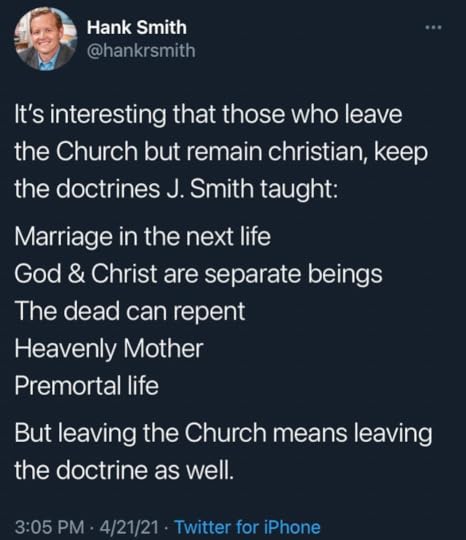
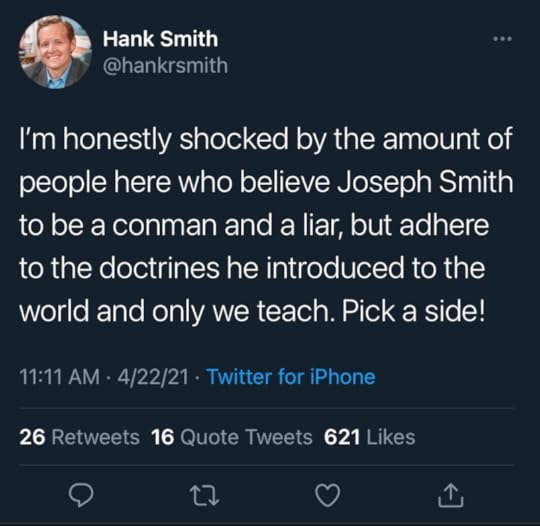
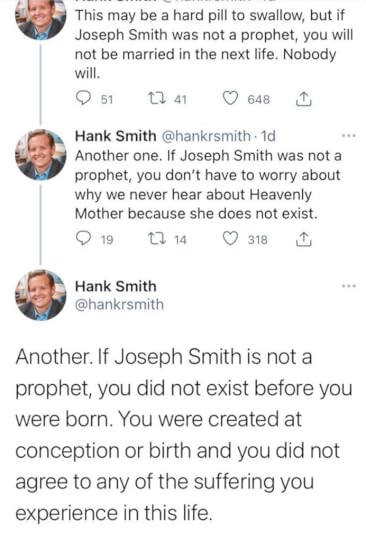
As someone who has been reading a lot of books and doing quite a bit of research about religions, religious history, and the sociology of religion for a book of my own, I took issue with these posts and their claims. I responded with my own tweet:

I then posted a screenshot of his first tweet that listed the doctrines he found to be “Joseph Smith specific.” Hank quote tweeted my tweet, inviting me to “prove” my claims, and I posted screenshots of research I had done of examples of other religions (past and present) that believed these doctrines. However, despite saying he was willing to be proven wrong, Hank doubled down, changed the parameters of his argument so that my evidence didn’t fit (in his mind), and continued to quote tweet me despite my asking multiple times for him not to do so.
How Hank continued to go wrongQuote tweeting is basically what I did with the above tweet; you “retweet” or copy someone’s tweet and add your own commentary to the top of it. This allows people that you follow to link directly to the original tweet and the original person who posted it. It’s different than using a screenshot of something someone said, for example.
What is the problem with quote tweeting? Well, in the case of Hank Smith (who has over thirty thousand followers), it means that he is broadcasting my personal profile and information to all of those followers, many of whom would not otherwise be following or aware of me at all.
As a result, this meant that members of the radical LDS fundamentalist group, deznat (short for “Deseret Nationals”), saw my tweets about and to Hank personally. Hank and I as individuals were having a relatively polite conversation, besides him changing the argument as we were discussing. But his followers started to get in on the conversation, arguing, posting rude things, commenting, and demeaning me personally.
I told him that I didn’t want to argue with him (and his random friends and fans) because I didn’t particularly care about him—it didn’t really matter to me that he believed these things. I just didn’t want him spreading false and incorrect information to these 30k+ followers who take him at his word.
My friend, Meg Conley, got involved at this point by explaining this information to Hank (after I once again asked him to stop quote tweeting me and to stop starting arguments on my threads where none had previously existed):
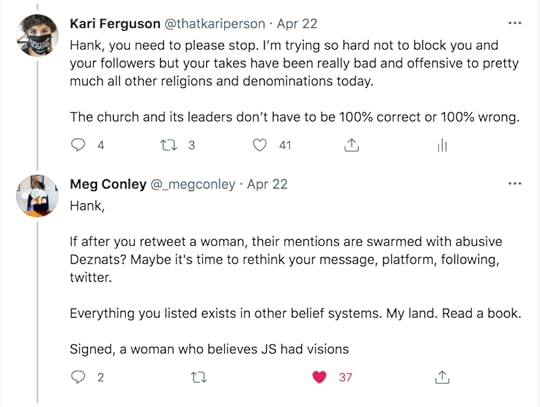
He then proceeded to fight Meg and me, claiming that he “didn’t follow any of these people and they didn’t follow him.” My friend Jaclyn later researched and took screenshots proving the opposite.
Others join the fightMultiple other friends and twitter acquaintances began to get involved, urging Hank to stop because he was making himself and his university look bad. He was proving himself to be a professor who publicly proclaimed false information and didn’t know much about world religion at all. Friends (some really smart LDS scholars or professors themselves) attempted to engage his followers who argued with and mocked us.
It became apparent that Hank and his followers had focused on fighting and quote tweeting primarily female responders and tweeters, leaving the males alone or merely discussing back and forth nicely with them on ongoing threads. My husband and many other sympathetic males were involved in defending us and noted this as well.
This went on all day. It was exhausting. We were receiving rude direct messages and were the subject of mockery on the accounts of other Hank followers, deznat accounts, and radical orthodox accounts. One such post shared photos of enraged, yelling women with a comment like “I bet this is what Kari looks like all the time.” I am sure there were many more, but they didn’t quote tweet or tag me, and I have most of those accounts blocked anyway.
When Hank quote tweeted and went after another one my friends, Heavenly Mother researcher and expert Rachel Hunt Steenblik (who had not even referenced him by name in the tweet he used) I got fed up. I once again asked him to stop and told him that I was reporting him to twitter for harassment. This comment, of course, resulted in more of his followers making fun of and otherwise harassing me. But Hank stopped picking fights with me.
His big mistakeUnfortunately, he decided to join in on a fight that had been picked with another one of my gentle, lovely friends, Calvin. Now, Calvin is a gay student at BYU who has endured harassment and threats from this deznat group over and over again because of his sexuality and commitment to the church. This is what the leader and founder of the deznat group said after Calvin tweeted his support of Rachel, Meg, myself, and others:
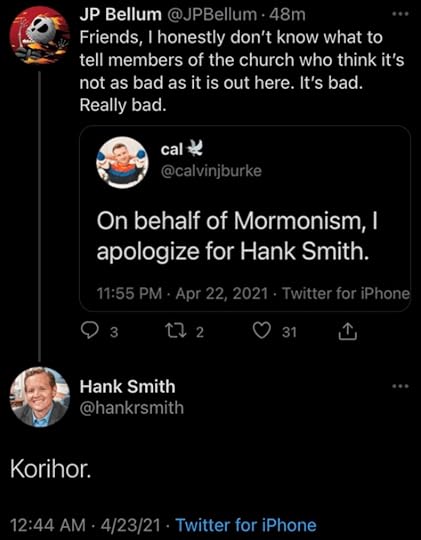
From this point, things got crazy. Hank was blocking people left and right. He put his account on private. People called for BYU to discipline or fire him. He retracted his “Korihor” comment and said he that owed Cal an apology. He sent me and many others personal (yet likely copied and pasted) apologies privately. His Instagram account went on private.
Meg and Rachel began sharing their experiences on Instagram, receiving both more support and more vitriol. Some called them liars and asked if they even belonged to the church. Which reminds me that Hank at one point tweeted that the difference between us was that he believed in Joseph Smith and I did not. Excuse me? You don’t know me?!
What was it really all about?But I want to go back to the beginning. This all (apparently) began because Hank didn’t like what someone said about Joseph Smith and thought that people who leave the Church because they don’t like Joseph Smith need to to leave the doctrines of the church behind as well. He was trying to protect Joseph Smith. But he could not understand that many of the ideas Joseph consolidated as Mormon doctrine were not original to him. Sure, Joseph may have changed or put them all under one denominational “roof,” but these ideas are not copyright protected!
In his attempt to go to bat for Joseph Smith (who I doubt would himself have claimed to have come up with all of those ideas on his own), Hank over and over again tried to gate-keep the goodness of the gospel. Hank did not want ex-Mormons to have the same blessings as Mormons. He tried to tell people what they could or could not believe, despite these beliefs occurring “in the wild,” outside of LDS theology.
In this crusade to protect Joseph Smith, Hank overlooked truth, history, facts, and free agency. He overlooked God’s love and all of our divine natures and individual worth.
Hank does not get to decide what anyone else can or can’t believe or what blessings, inspiration, or knowledge God will or will not bestow on someone.
Leave them aloneSince writing my poetry book, “For and in Behalf of,” I have had a keen awareness of those who have left the church. They do not deserve this vitriol and policing by someone of their former faith. They can keep what they know or think is true. They can separate it from Joseph Smith because these truths are eternal. They are not Joseph Smith’s truths. They are God’s truths. And God can tell whoever He wants whenever He wants whatever He wants about those truths.
The Church doesn’t own beliefs. It teaches them. The beliefs are all around us, actually. That’s what makes it so beautiful. Cultures and religions throughout history have shared and experimented with these truths, molding and shaping them to their needs, history, and teachings. God truly does love all of His children.
I hope Hank realizes this someday.
So what now?People have asked me if I think he should lose his job. Well, frankly, I don’t think that people who haven’t studied religion other than LDS theology should be teaching religion at a university level period. This is its own debate (and BYU already said it didn’t care).
I told Hank, “I don’t care about you or arguing with you” at one point in the conversation. Yes, maybe harsh, but true. I don’t really care if Hank works or doesn’t work at BYU. I don’t care if or how he gets in trouble for all of this mess. I just don’t. It’s his life and all of this his doing. He should be held responsible, yes, but I’m not going to name the terms.
But I do think that he had no right to spread falsehoods and misinformation to his audience of 30k+ on twitter. He misused that responsibility and hurt so many more people than he even knows or can apologize to. That’s what I’m upset about. That’s why I felt I had to say something.
He also gave permission for other members to argue, demean, and mock people who weren’t even necessarily fighting Joseph Smith or saying he wasn’t a prophet. In doing so, he created and incited a “twitter mob,” and that’s unacceptable.
I do think Hank should get off social media. That seems like at least one step in the right direction.
I don’t think Joseph Smith needs his “protection” anymore.
The post In defense of what? appeared first on Of Faith & Great Anxiety.


January 26, 2021
Back to Scrupulosity

At this point, I can’t really remember what I have and haven’t said on the blog regarding scrupulosity and my experiences. I also wrote an entire book basically on this subject, so there’s that as well. But I have been asked to once again discuss my experiences, so if I repeat, I apologize. Here goes.
Do What They SayI had scrupulosity growing up but didn’t know it. I read the scriptures about people repenting and thought that it sounded a lot easier to just not do bad things than have to repent later, so I tried to be really good all the time.
While this made life so easy for my parents, it reinforced my OCD. I wasn’t going to swear, cheat, do drugs, drink, smoke, have sex, whatever. I didn’t even have a boyfriend in high school. I went to church. I went to seminary. I read my scriptures and prayed. Why? Because that was what I had been taught to do, and I did what I was taught to do because I wanted to go to heaven. I didn’t want to have to meet with the bishop and repent.
Moving ForwardBut, like I said in my book, college brought new friends and new opportunities to explore my identity and my world. I watched R-rated movies. I got a boyfriend. But I still did most big things as the Church instructed.
In fact, for about 35 years I have done what the church told me to do. I accepted callings, went visit teaching, served a mission, had kids, got married in the temple, went to the temple regularly, kept the Word of Wisdom, and all the rest. Because I was a good person and had scrupulosity.
But then I went to therapy. I learned that it was all part of my OCD. I didn’t have to kill myself for church. It was something my OCD wanted me to do.
Some Produce and Some ChangeDuring this time, I went to the local Farmer’s Market, bought some produce, and received my cash change. We sat down by the playground so the kids could play. And then I started wondering if I had been given the correct change. What bill had I used? A ten or a twenty? Did he give me the change for a twenty when I only gave him a ten? What do I do?
This, weirdly enough, was a turning point in my life. I agonized in my head over what I should do to be “honest.” But then I started to think about my therapist. What would he do? And what would be the consequences of my actions?
One of the things I (my OCD) thought was “If you aren’t honest, then you won’t be able to get to the Celestial Kingdom!” But therapy-mind said, “but maybe there is nothing to be honest about. Maybe you did get the correct change.”
And eventually I arrived at a middle road that has changed my entire life. I thought, “maybe it’s okay if I don’t get into the Celestial Kingdom.”
My Own PathThis one simple thought changed everything. I was killing myself to try and be perfect in order to live up to all of these standards when maybe that’s not really what I wanted in the first place (or last place, as it were).
Now I evaluate my choices personally, as a living breathing individual. I take into account my personality, my needs, my family, and my life. I do what is healthy for me and my mental health. I analyze and think through things that used to be easy choices because “the church” had already made them for me. And sometimes I make the same choice as “the church” but other times I don’t. I don’t. And I say, “maybe it’s okay if I don’t get into the Celestial Kingdom.”
And I keep living my life.
The post Back to Scrupulosity appeared first on Of Faith & Great Anxiety.
January 22, 2021
Odds and Dogs
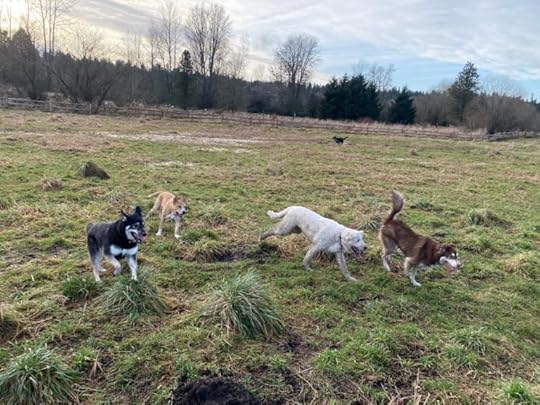
I wanted to thank everyone who has left feedback on my blog in the last little while. I do read the feedback usually (I get a bit of spam, so you know). But I am so appreciative of the new readers we get after all these years and the impact that my words have on you. I’m glad that I can help make people feel a little less alone or strange. Frankly, I’m pretty crap at in person relationships (besides my marriage), so having a blog or writing books works well for me. I can handle this level of contact and back and forth.
But this month in particular I received two comments, one about scrupulosity and one about dogs and fecal contamination issues. Since scrupulosity is a bigger talking point for me at the moment, I’ll start with the dog comment.
A lovely reader from Scandinavia asked me about my poop contamination and the fact that I have a dog. Do I still have contamination OCD? Yes. I am on medication still, but I still have issues with poop and need to make sure I am completely wiped, etc. I was terrified of being able to handle having a dog for this reason. Dogs don’t wipe. Dog’s don’t wear underwear or diapers. I mean, they do have dog diapers, but those are for emergencies and not everyday use.
Let’s Talk PoopHonestly, it was hard at first. It was difficult to pick up dog poop and carry it with me on walks, even if it was in a little bag. It was not great when he peed on the carpet when we were training him. It was awful when we hadn’t yet figured out that he was intolerant of chicken and had diarrhea all over our West Elm couch and his crate. Multiple times. Yes, that was truly awful. But, remembering something that therapists often told me, I handled it. I was presented with terrible situations like diarrhea all over our couch twice during Christmas vacation when we had a guest at our house, and I handled it. Why? Because I had to.
OCD likes to convince us that we absolutely, under no circumstances, can deal with the thing that we fear. Hard pass. But what if? What if it happens? Most of the time, it doesn’t happen because the fear is irrational. We know that, but we still can’t get over it. But what if the fear is rational? Maybe unlikely, but still rational?
Well, then if it ever happens, you have to deal with it or you die. I mean, that’s the alternative to not dealing with it, right? Maybe you pass out, maybe you have a panic attack, but those reactions are also “handling” it in an extreme way. Somehow, you make it through.
I remember having to “make it through” before I got treatment at all and when I didn’t even fully realizing what was going on. It was like I had to make a checklist in my mind of all the things I “had” to do in order to get through this seemingly impossible situation. I had to get dressed. I had to get in the car. I had to drive to the store to buy bleach and disinfectant. I had to come home and do the laundry. I had to spray the house. I had to wash my hands. It was A very detailed and very thorough plan or plans, but I got through those times as well. Why? Because I wasn’t going to die.
Of course, there were also times when I considered not going through it. There were times when I thought dying would be the easier option. And those times and those feelings were incredibly real and convincing. Luckily, I had a family who cared for me, and who I could talk to about it. I had a mother who talked me through my options, if I refused to go back to what my life had been. I had a husband who took me to get help.
But it is possible to get through it without using the death option.
You Just Do ItBut back to the dog. I got through those extremely hard times. I washed the couch cushions and sprayed them so much. Like literally so much. We still use that couch. Granted, I tend to keep to one specific spot on that couch, but I recognize that compulsion. I own that.
And I love the dog, so I continue to deal with it and take care of him. I really do love that dog. He is silly and dumb and barks at all the other dogs, but I love him. I try to keep his butt off “that” couch but he still gets up there and cuddles us. By having to pick up his poop and accept that he sits all over the house with his gross bottom, my tolerance has increased. I’m not as worried about it. I’ve accepted it.
Of course, (real dog talk here) if poop is hanging down from his bum hole or off his tail (this has all happened), I will wipe it with a wipe. I really will. He hates it. But I can’t have that.
So, you know, you find your level and you challenge yourself. But the dog has helped me, so much. He gives me a reason to get out there and walk. I usually am too self conscious to just take a walk. I walk him and don’t watch where I step on the sidewalk. I used to always watch where I stepped (for dog poop). Now, if I see it ahead of me, I avoid it, but I look out at the world when I walk.
It’s changed my life, and it’s changed my family’s life for the better to have a dog. He does bark a lot, though. So, lovely Scandinavian reader who probably knows Moomintroll and because of that I love you, please get that dog and name him after a Moomin character.
Okay, sorry, I realize I’m not getting scrupulosity on this post. But stay tuned!
The post Odds and Dogs appeared first on Of Faith & Great Anxiety.
January 20, 2021
A New Start
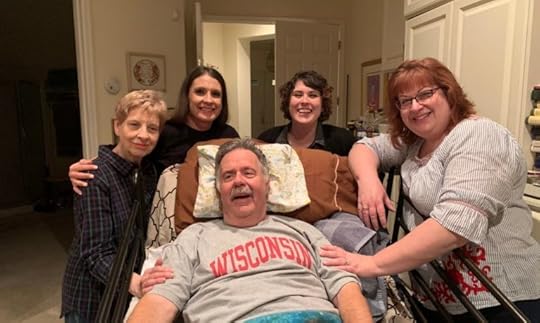
It’s Inauguration Day here in the United States, a day for which so many of us have been waiting for a very long time.
I’m aware that I haven’t blogged in months. The truth is, that last post caused a lot of self reflection and backlash. I do not regret writing or posting it. I stand by the things I said, and I am grateful that we now have President Biden at the helm of our country. But my posting it led to a lot of decisions and changes in my life.
A BreakShortly after writing it, my Facebook became a hostile place, with friends and family on both sides vehemently arguing. Some of my nieces called me toxic, and I decided to take a break from my family for awhile. I realized that boundaries are healthy, especially with people who demean you or your beliefs. There are times when things get so heated and uncomfortable that the best thing to do is separate yourself from the situation and cool off.
I blocked my family and didn’t call my parents every week as normal. It was like I was doing a fast from negative energy, and it was great.
People have gotten very excited lately about “free speech” and “cancel culture.” But the thing is, it’s okay for people to block or not talk to other people sometimes. You have a right to free speech on a Constitutional, government level, but I have the right not to listen to you. I don’t have to give you a platform. I can “cancel” and call out people in my life who are abusive to me and who I am as a person. I can do that. It’s called choosing your friends and standing up for yourself. It’s allowed.
So I blocked my family. Not forever, not permanently, good grief. My husband and I agreed it would be until at least after the election and things settled down.
But ThenBut then my dad got very sick. In the end of September, he started forgetting things, like how to drive home from the post office or how to unlock his phone. He gave my mom the car keys and told her she needed to drive from now on. More and more things got lost in his mind, to the point that my mom had to put post it notes all over the house telling him what or how to do certain everyday things. Wash your hands. Take your medicine. Put in your hearing aids. Brush your teeth.
The thing was, he knew that something was happening. It wasn’t like dementia. It was quick, and he knew that he was losing his mind. He called my husband to tell him, and they spoke about what was going on. He went to doctors and a neurologist. Based on the symptoms, they determined that he likely had Creuzfeldt-Jakob disease, a super rare and terminal brain disease that gradually destroys your brain and memory until you go into a coma and die. Most people die within a year of diagnosis.
By the time this diagnosis was on the table, my family (my daughter, husband, and myself) had contracted COVID-19. I was the one currently ill, laying in bed, researching this awful disease and crying, knowing that my dad was probably dying. On a Monday morning in mid October, I broke my ban and called my mom. She began crying, and so did I. And then my dad, who had been napping, got on the phone, saying in broken speech that he felt like he needed to pick up the phone and see who was calling. He couldn’t speak like he used to. He sounded like a child, sounding out and trying to find the right words, but he told me that he loved me and was glad to hear my voice. He cried, and my dad never cries. He was broken, and we all knew it and cried together for the past and what was lost.
We spoke a few more times on the telephone coherently, and he told me how he understood now what it was like to have a brain that didn’t work. He told me it felt like his brain was rewinding. He said he hoped that he would be able to get better so he could help people going through similar issues.
But we knew he wasn’t going to get better.
Progression and RegressionIn early November, my brother and sister went out to see him and help pack some things out of their storage unit. My brother sent me videos of my dad at the table, trying to dance and sing along to old songs my brother used to break dance to, as well as to the Beatles “Let It Be.” The next day my sister and mom called to say that the neurologist was pretty certain dad had CJD. In private, my sister and I determined that I needed to come out that next weekend to help my mom.
By that next Saturday, my dad was bed bound and my mom had decided to use hospice care to keep him at home. I arrived to see my dad in a hospital bed and diapers, my two sisters helping to change and feed him. He recognized me and could still speak a little bit, but he mostly communicated with his eyes and squeezes of his hand. The next day, my sister from Texas left, and my oldest sister and I stayed to help my mom take care of him for the next week. We played him music, read to him, and talked about the past. We read stories that people had sent him and showed him their photos. He said silly things and still knew my mom, squeezing her hand, complimenting her, and knowing “their song” when we played it.
But by the middle of the week, he couldn’t speak or eat anymore. He literally forgot how to swallow. He started to get unresponsive. We had my brother and sister call him one last time on FaceTime, and he tried so hard to tell them that he loved them. We would sit with him in the dark, playing music from the 1960s (I’ll always think of Dad when I listen to “Graceland” by Paul Simon now), holding his hand, and wetting his lips. We told him it was okay to let go, that we would take care of mom. And we prayed that he would pass quickly.
I left on Saturday afternoon after staying for one week. I hugged him and told him that this was the last time I would see him on this side of the veil. I thanked him for being a good dad and we both cried, him just a tear. He didn’t have much water left, after all. And I left.
The EndMy oldest sister stayed, and she texted us all the next night, Sunday, November 22, to tell us that he had passed. They had put him to bed, mom went to sleep in the same room, and she woke up a few minutes later to silence, rather than his rasping breath. And like that, he was gone.
My brother and his kids, then my sister and her husband, and then my brother again came to be with my mom through the month of December. And now we are living our lives, back in communication, and without our dad. Without him here, at least. But it’s okay.
We’re making it. It’s a new beginning.
The post A New Start appeared first on Of Faith & Great Anxiety.
August 25, 2020
Politics, Religion, and OCD
I did not grow up thinking I would be a political person or even a person interested in politics. I remember someone in high school saying “if you’re not a democrat when you’re young, you have no heart, and if you’re not a republican when you’re old, you have no brain.” Which is all rubbish, of course, because historically the parties have switched back and forth and changed their stance on many policies.
But I grew up in a wealthy Bay Area suburb with parents who were educated. We were well off. I didn’t have to worry about most things besides maybe what rich kids at my school were dealing drugs or getting in drunk driving accidents.
I went to BYU. But then I met and married someone from Seattle (not at BYU). Even so, I still tried to stay away from politics and political discussions for awhile. I voted for Romney. I tried to not think about things (like marriage equality, feminism, or human rights) because my religion and my upbringing dictated one thing and I didn’t want to have to grapple.
I lived my life. I had kids. But then I had my OCD breakdown.
A Change
This time was a turning point for me in many areas of my life, including politics. Suddenly, I identified with a minority group—those who have mental illnesses in general and OCD specifically. I had never really been part of a minority group before. I wasn’t poor. I was white. My parents and then husband financially provided for me. I was a woman married to a man. I was Christian.
I was privileged, but it took me becoming part of a misunderstood and marginalized group to realize it. Suddenly I began to think about other minority groups too. I interacted with them, these “sub”cultures that run counter to the mass majority of heterosexual, white, Christian Americans. I listened to them. At group therapy, for example, a black woman spoke about the racism and discrimination she faced on a daily basis (in addition to what she faced with her OCD). I began to understand what it meant to have the mainstream culture not think you were valid or serious or real. I knew a portion of what it felt like to be laughed at, mocked, or disenfranchised.
November 2016
Then Trump became president. I didn’t vote for Trump, and I didn’t think that it would be that big of a deal. After all, I was still heterosexual, white, and financially doing fine. But I began to see what was happening—what is happening—to the rights of those “other” groups. How they are labeled terrorists, killed by police officers or other whites for jogging or being in a drive-thru or any number of innocuous things, called “socialists,” or not seen as being worth the same as their white counterparts.
It’s easy to be white, Christian, LDS, and heterosexual in America. And as one of those people, it’s easy to become afraid of the “others.” You don’t understand. You think, “What is wrong them? Why can’t they just be like us?” without understanding the underlying foundations that have disadvantaged them from the get-go, often foundations that the white majority put in place.
We reject, overlook, and hurt these minorities and then are shocked when they want change. When they want equality. When they want reparations for the harm we have caused, often without even knowing it.
Repent? Us?
As white Latter-day Saints, we rally around the concept of repentance but balk when we are asked to make amends for harm our race or religion have caused. We feel as if we are being repressed when asked to change and not harm them anymore.
But it’s not enough to think you are not racist. It’s not enough to be nice. What are you proactively doing to help your neighbors, the “Samaritans” (the others) in our own country? What are you doing to repent of the wrongs that have been done by your people to others?
Fear and Stability
So many white Americans and white LDS Americans support and vote for Trump. It makes sense. They are afraid. Listen to the RNC right now. It’s horrifying. They fear “Antifa.” They fear black people. They fear poor people. They don’t want them moving into “their” neighborhoods. They do not want immigrants coming and taking “their” jobs.
They forget our violent colonization of this land.
They forget their own immigrant ancestors.
They forget “the captivity of [their] fathers.”
Protestors don’t want your suburban “paradise.” They don’t want your cookie cutter lawns and houses. They don’t care about that. They want to be able to live without fear of being discriminated against, killed, or otherwise harmed. They want an equal chance to have the same things that you take for granted—home loans, education, food, health care. They want life, liberty, and the pursuit of happiness—things that the white majority so often have taken from them or prevented them from having.
“Not me,” you say. “I’m not like that.” And then you vote for Trump? Why? Because he has your back. Because he will lower your taxes, you who make more than enough money to feed and house your family. Because he will “protect you” from these enemies that don’t actually exist.
“the thing you fear never happens”
In order to overcome OCD, we have to learn to tolerate uncertainty. We have to learn to live with fear. And 99% of the time, the thing we fear isn’t even real. It never happens.
This is true for Trump supporters too. The “democrats” aren’t going to push you into communism. They aren’t going to force you to live life in a way that will negate your being. They aren’t some big bad wolf that wants to blow your house down. These are lies. These fears aren’t real. Uncertainty is a reality. But we survive. We thrive when we accept it.
A lot of people support Trump because they are looking out for themselves. Trump looks out for himself too. That’s about all he looks out for—him, people like him, or people he knows will support him. Not because he cares about them as people but because he wants to retain power. He doesn’t have a stance. He doesn’t have morals. The GOP doesn’t even have a platform this year.
Or, maybe they support Trump because they are a cop or support the police. Again, this relates to the fear. But even so, Biden isn’t going to demolish cops. Biden actually proposes more funding for police. And anyway, “defunding the police” doesn’t mean abolishing police. Seattle still has police. We have not descended into anarchy.
What would Jesus do?
Didn’t Christ want us to take care of the poor? Didn’t he want us to welcome the naked and the outcast? Wasn’t He a refugee, an immigrant, one of the outcasts Himself? Didn’t He go around giving away free healthcare to all who needed it, not just the rich and well off?
I honestly can’t understand how Christians can support Trump. To me and to most others who cannot in good conscience support Trump, it seems like you are simply looking out for yourself and those like you. It feels like you are saying by your vote that nobody else matters. Minorities don’t deserve the same rights as you. You want to be “nice” and “kind” but not when it actually comes to policies and things that will positively affect change for the lives of those unlike you.
My parents and most of my siblings are in this camp. They say I have “different life experiences” and don’t understand where they are coming from. They tell me to pray about it. That we just have different beliefs and we should respect each other.
But I believe in love. I believe in the fact—the fact—that all of us are equal and God’s children, no matter what color our skin is or what mistakes we have made. I believe that an immoral person who has shown himself to be a racist and sexist misogynist and destroyed so many agencies and programs that strive to better the earth itself and the people on that earth cannot be a good president for the America of today.
This is not the America of 1950, and that was not a good America for everyone either.
I know people are converted to their politics. They are converted to their cults. They fear the “other.” But we don’t have to. You don’t have to. You can question things. You can determine what you actually believe.
And if you believe in the hate rhetoric and fear mongering, I truly feel sorry for you. If you “seeing see not; and hearing hear not, neither do [you] understand,” you won’t be the first.
But it doesn’t have to be that way.
The post Politics, Religion, and OCD appeared first on Of Faith & Great Anxiety.
August 5, 2020
Medication for OCD Update

I have been on fluoxetine for my OCD for awhile now. If you are familiar with the past few years on the blog, you might know that I was on medication, went off, had a breakdown, and got back on medication. I think I’ve stayed on since that point.
However, as many of us who are on antidepressants can attest, one common side effect is weight gain. Unfortunately, my body in the last few years has really embraced that side effect. In fact, that’s why I went off my meds awhile ago in the first place. I wanted to see if I could lose the weight without the medication—and it worked pretty well, except for the whole “mental health breakdown” thing.
Weaning off the meds
So, at the beginning of the year, I thought, “I’m going to wean off the medication again.” I was going to group therapy. We had moved to a more stable environment. I thought it would be fine. I started taking my pills every other day, then maybe 2-3 times a week.
Then the pandemic happened, and I quickly realized that weaning off a medication on my own during a global crisis when my whole family was with me in the house all the time was not such a good idea. I was sleeping so much, cranky, etc. It was not great.
I went back on the medication at the dosage I had been taking (one pill a day). But I was still a bit depressed about the whole weight gain thing. My husband and I talked, and we decided that it would be best for me to talk to a psychiatrist/mental health professional about the best method to wean off my medication.
Seeing a doctor
Luckily, the Pacific Northwest has this great service called Zoom+ care where you can get same day appointments to see doctors online, and they also have specialist doctors. I made an appointment to have a video chat with a mental health doctor.
We discussed my mental health history, what medication I had been/currently am on, etc. And somehow, by the end of the call, instead of weaning off my fluoxetine, I had a prescription for wellbutrin (and was instructed to keep taking my fluoxetine).
The doctor explained that it would hopefully help with weight loss while also working with the fluoxetine to keep me stable in regards to my mental health.
…and?
I’ve been on both fluoxetine and wellbutrin for about a month now. I can’t say that I’ve seen huge (or any?) improvements on the weight front, sadly. Also, it’s negatively affected my sleep. I have a follow up appointment this week to discuss all of these things and see what she thinks I should do!
My advice: don’t wean off medication on your own. Talk to a professional. They may have other ideas, or, at least give you a proper way to wean off your medications that will minimize withdrawal symptoms.
Have you taken fluoxetine with wellbutrin? What happened?
The post Medication for OCD Update appeared first on Of Faith & Great Anxiety.
July 23, 2020
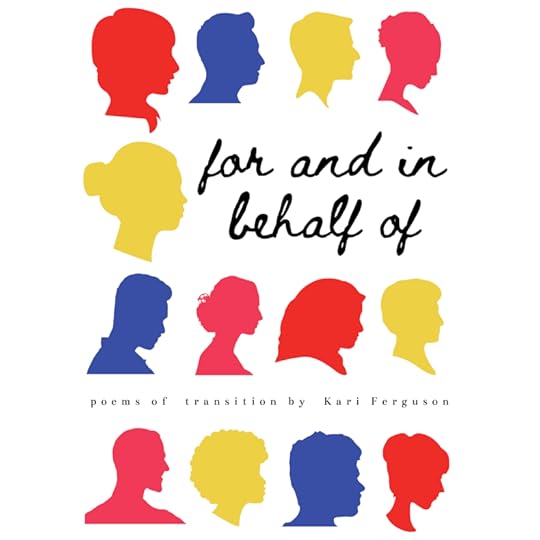
For and In Behalf Of

Shortly after I published my book, The OCD Mormon, in the fall of 2017, I went to Utah to do some events to publicize the book. One of my old roommates from BYU came to one of the events, and we went out for dessert afterwards to catch up and chat.
She had left the Church in the years between BYU and 2017, and in the course of discussing some of her experiences and some of my mental health journey (that led to my writing my book) she casually recommended that I write about the mental health of those who have left the Church.
Another Project?
When I got back from Utah, I continued to think about our conversation. I decided that she was right: I should write about the mental health of those who left the Church. Members of the Church tend to write off those who leave, dismissing them from their lives or trying not to think much about them. Also Church-PTSD is a real thing.
However, we are taught not to engage in “anti-Mormon” conversations, read “anti-Mormon” literature, or support groups that go against our beliefs. But after hearing some of the stories from my friend, I began to understand that sometimes in our fervor to “stay strong” in the gospel and support the Church, we end up hurting others—friends, family members, and acquaintances—and causing them and their mental health harm. I thought that this couldn’t be right or good. This isn’t what Christ would want us to do or be like.
The Survey
I began my research by crafting an online survey that I shared and asked friends to share about leaving the Church. On the survey, I wrote:
“I am hoping to compile the answers to write a book addressing how leaving the Church of Jesus Christ of Latter-day Saints affects a person’s mental health, specifically in relation to how leaving a community and ideologies you may have grown up with can affect your emotions/stress level (positively or negatively) and how the reactions of family or friends can affect your mental health as well. The “why” you left the church is so personal, and that is not really what I’m interested in for this project—more how the shift from active to not active in Church has affected you and your mental health for good or bad or both.”
Questions included:
Was making the decision to leave difficult or easy? Did it affect your mental, physical, or emotional health? How so?What has been the reaction of your parents? Spouse? Children? Fellow Church members?Who has been the most and least supportive of your decision?What has surprised you the most about your emotional or mental state since leaving the Church?What has been the most difficult and most beneficial thing about leaving the Church?What do you wish current members knew about interacting with or talking to/about those who have left the Church?
Responses
I had over 150 individuals respond to the survey. Even now, I find it hard to describe how I felt when reading their answers. Shocked? Surprised? Horrified? Sad? Embarrassed? Amazed? It changed me, reading those answers. And then I felt bad that it changed me because according to Church leaders, I shouldn’t be reading things from “anti-Mormons” or “post-Mormons,” right?
But I had read them, and I couldn’t go back to a time I hadn’t. And I did feel shocked that members of the Church in many cases had treated family members and friends who left so horrifically. I was surprised that most people reported better mental health having left, many almost immediately. At Church, we are told so often that life is miserable or certainly not as joyful without the Church, but that was not what people actually living that life reported. That was not how they felt.
There were terrible stories of how they were treated after leaving, but there were also beautiful and hopeful stories. There was sadness at not having the community, the songs, and the certainty anymore. But there was also freedom and stories of people taking control of their own lives and learning how to accept their spouses and children as they were.
Writing Processes
I spent the fall of 2017 writing a book aimed at members to teach them how to support and communicate with those who have left, tentatively titled “No Offense” and then “Moved with Compassion.”
Probably not surprisingly, no Church or Church-related publishing companies I queried wanted to take on my book. The project got shelved, and I felt as if I had failed that community. They had changed my opinion, but maybe that was as far as it went.
However, after I opened my bookstore, I found myself sitting at the counter in slow moments with a notebook, writing poems based on those stories. I brought the notebook to Church and jotted poems down during Sacrament meeting. And then I wrote to BCC Press to see if they would publish a poetry book based on the surveys.
BCC Press never responded, so I put my poetry project on the shelf too. Another year passed. We moved twice. I sold and started a new bookstore (this time online). But one Sunday I took out that notebook and started reading those poems. I took to twitter to ask if anyone would be interested in reading them, and people were.
Once again, I read those surveys, opened that notebook, and wrote more poems. I decided that I would publish it myself and sell the book on my bookstore website.
On my own
And so I am. I’m working on the layout and printing options. It’s going to be simple and beautiful, and hopefully a worthy offering to those who shared their stories and experiences.
It is a book not only for those who have left the Church, but also for current members to understand their point of view. It is not necessarily going to be an easy book to read emotionally or spiritually, but I feel like it is important.
How can we truly love others if we refuse to hear their stories and understand their point of view? How can we comfort and mourn with those who mourn if we don’t know how or why their pain was caused? Wouldn’t Christ listen to their stories? Wouldn’t He want to hold their pain? Doesn’t He?
Order your own copy
Right now, the “book” (it is going to small, pocket-sized most likely but over 100 pages) is on sale for preorder. I expect to mail them off before September 1. If you would like a copy, please order online (and use code ZINESHIP for free shipping). Also feel free to share this post and the book itself with friends and families.
Thank you!
The post For and In Behalf Of appeared first on Of Faith & Great Anxiety.
July 3, 2020
Dogs and Contamination OCD
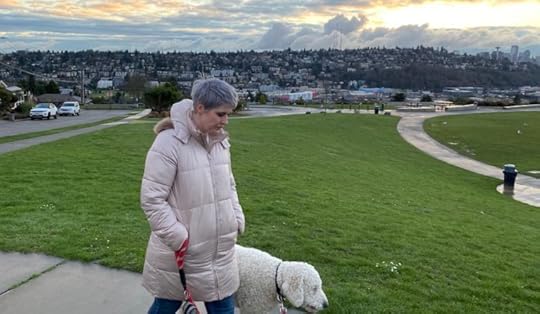
I never thought that I would be able to have a dog.
I wanted a dog so much growing up, but my parents always told me that they already had a dog (before I was a born) so they weren’t getting another one. Once I was married, we started having kids and then moved a lot and we just never thought about it. Then my contamination OCD kicked in and I had a profound fear of poop.
Anti-poop
I was convinced I could never have another child (diaper changes?! potty training!) let alone a dog! How could I deal with a dog? Dogs poop multiple times a day and you have to pick it up with a little plastic bag and then…carry it with you until you find a garbage can!? I remember seeing people carrying those little bags of poop and thinking “oh, heck no. There is no way I could ever do that.”
But not only do they poop, but it’s not like they wear underwear or pants. They just sit in your house, on your rug, with their poopy bottoms! Poop would get everywhere!
So obviously I could never have a dog.
A Higher Cause
But then my son got diagnosed as being on the autism spectrum disorder, and we researched the benefits of getting a dog for him. I had tried homeschooling (and failed). We had tried going to therapy with him (and failed). We were feeling a bit desperate.
We researched dogs, and I quickly decided I didn’t want a slobbery dog or a dog that shed. My son wanted a Great Pyrenees. I did a google search for something like “Great Pyrenees doodle” and someone was actually selling Great Pyrenees Golden Doodle puppies up the road from where we had just bought our cabin. We communicated, she sent pictures, and suddenly we were at Petco buying a leash and a dog crate with an appointment to pick up our puppy on a Saturday morning.
So how has it been?
Honestly, it’s been amazing. Yes, I sometimes have hard times.
Hard times have included:
when the dog had chronic diarrhea (after some experimentation we found out he isn’t tolerant of chicken)
when the dog poops/has diarrhea in his crate. This is disgusting. It requires a full crate clean out and dog bath.
when the dog had diarrhea on our West Elm couch during Christmas vacation when my brother was visiting. Twice (on different days). This was a nightmare. But we literally took off all the couch cushion covers, washed and sanitized them, and let them dry. We still have this couch. I consider it a great OCD exposure victory.
when the dog’s poop sticks to his butt. I have used butt and sanitizing wipes on my dog. I am not proud of it.
when the dog eats something gross and the poop won’t fall and you have to pull the poop out of his bottom or it just stays there, hanging, and he runs around trying to get it off…. this is also really nasty. I use a poop bag to grab it. And then often have to wipe his butt.
when he vomits. Luckily, vomit doesn’t freak me out as much, and it’s mostly just like regurgitated dog food pellets. But it’s still gross.
when I have to pick up a gross poop and it’s big and goopy and gets on my hand.
This makes it sound terrible to have a dog, but it’s really not. Yes, he poops. But the plastic poop bags go over your hand and USUALLY you can pick up the poop without making any direct contact. Yes, sometimes you get a speck of poop on your hand. I freak out about this, but it’s actually a really good exposure for me to finish our walk before going home and thoroughly washing my hands.
I mean, I always wash my hands after getting home when I’ve picked up dog poop, but like those are times when I am VERY thorough.
The Good Bits
But honestly, having a dog has been extremely good for my OCD. It’s constant exposure. It is wearing down my contamination OCD. I still don’t like the dog to sit on the couch or my bed, but I’m used to him being there and have accepted his inherent dirtiness. He is part of our family.
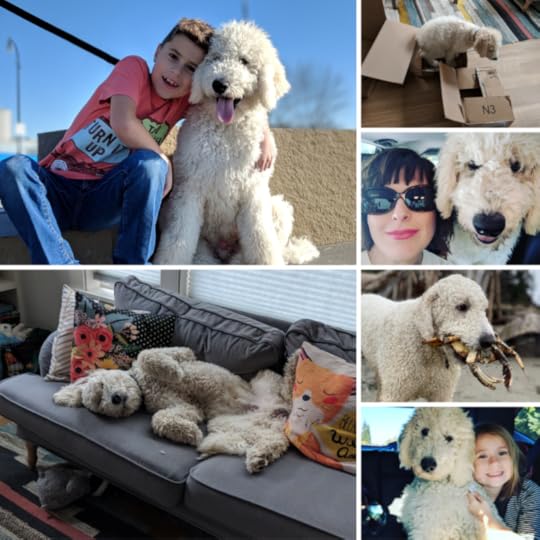
Also, having a dog is really the best because they are the most loyal, obedient, and kind creatures. Milou (we named him after Tintin’s dog) is gentle and usually most my quiet “child.” He sweetly cuddles, plays with the kids, and gives us an excuse to go on multiple walks a day. We love him. Plus he is so fluffy. He’s like cuddling a shag carpet.
Does having pets help your OCD? Why or why not?
The post Dogs and Contamination OCD appeared first on Of Faith & Great Anxiety.
July 1, 2020
Coronavirus / Covid-19 and OCD
I think it was at my February OCD Group in Seattle that someone asked me how I felt about the coronavirus, especially in light of my contamination OCD.
Now, this was the beginning of February, so there was no quarantine or stay-at-home orders in the USA yet. Covid-19 wasn’t really on our radar in a big way. I answered honestly, which for me at the time was that I wasn’t too worried about it because my contamination OCD doesn’t care so much about me catching illnesses or getting sick but rather whether or not I spread an illness or disease to someone else unknowingly.
Also, I knew that if I allowed myself to freak out about the coronavirus, it could be a sticky OCD slope. I didn’t want my OCD to latch on to it and make life even harder than it inevitably would be.
Don’t Let OCD Take Control
Of course, it’s not a past tense event. It’s still happening. We are still in the midst of this pandemic. So I guess I can start switching to present tense…. I still have to be careful to not allow my OCD and anxiety to get over excited and hyper-vigilant regarding the coronavirus.
I know that if I “clicked” into panic mode and starting worrying excessively about hand washing, for instance, I would very quickly fall back into my compulsions. That’s a place I don’t really want to go.
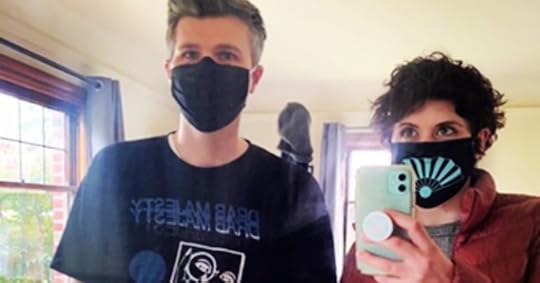
In March, Seattle was the epicenter of cases. I tried hard not to freak out but rather stocked up on things like tissues, hand soap, and lotion (since I know how raw and dry hands can get when over washed). We tried to do what was asked and what was logical—we quarantined and stayed away from others. I still mostly do online grocery shopping with delivery. We wear masks when we are outside. We limit our interactions with people outside of our immediate family.
Sanitizer?
However, based on my past experiences with my contamination OCD, I have not allowed myself to do things like buy/use hand sanitizer or sanitize my groceries. I remember Jon Hershfield saying (at an OCD Conference we went to) something like “that’s for other people,” when it came to hand sanitizer. I try to remember that when it comes to things I know my OCD could get excited about.
Words of Warning
When it comes to my advice for others (with or without OCD) in dealing with a worldwide pandemic, I would say to be careful. Follow the advice of medical experts. For those of us with OCD, that also means to follow the advice of your therapist or doctor.
Wear a mask when you go outside!
Avoid crowds, reunions, big events, unnecessary shopping trips, etc.
Keep doing home church.
Wash your hands when you come back from being outside/touching things and before you eat. Use lotion.
Be respectful of other people. Be smart!
How has Covid-19 affected your OCD?
The post Coronavirus / Covid-19 and OCD appeared first on Of Faith & Great Anxiety.
June 26, 2020
Back to 2018 and 2019
Yes, it is true. I want to take you back to 2018. Honestly, 2020 hasn’t been so great and 2019 wasn’t totally awesome, either, so why not?
The beginning of 2018 found me sick with influenza b, planning ADAM conference (Anxiety Disorders and Mormonism), and getting released as Relief Society President/talked to by the Bishop (see last post). ADAM conference in SLC was great. On a post conference high and while flying between America and England (so my husband could speak at a programming conference immediately following ADAM), I started to make plans for more conferences.
Summer Conferences
First off was AnxietyTech, which my husband suggested we plan. We organized and planned it for July 2018 in San Francisco. I still am not sure how we got it going so fast, but let’s just say that it wasn’t financially successfully (though it was appreciated). I had also started planning ADAM Teen in Utah for August of 2018 but quickly realized that I couldn’t do it all. I was having a really difficult time getting everything ready for AnxietyTech while also trying to plan, organize, and promote ADAM Teen (and having two kids in summer and purchasing/fixing up a family cabin in Oregon). Due to low ticket sales and lots of stress, I decided to cancel ADAM Teen.
ASD
I don’t necessarily thrive on failure, so that cancellation was an embarrassment—but it also allowed me to breathe a little. I realized I couldn’t do it all. Also during this year, we were dealing with some behavioral issues with my son. I had homeschooled him for about a month but soon realized it wasn’t healthy for him or me. He was diagnosed as being on the autism spectrum, and we were beginning to understand and accept what that meant.
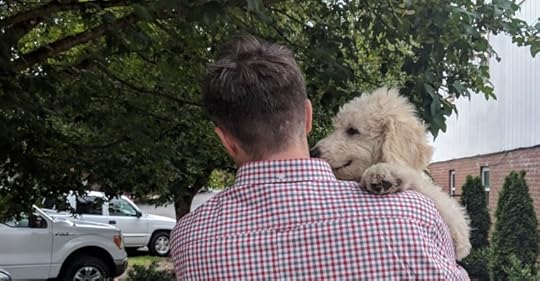
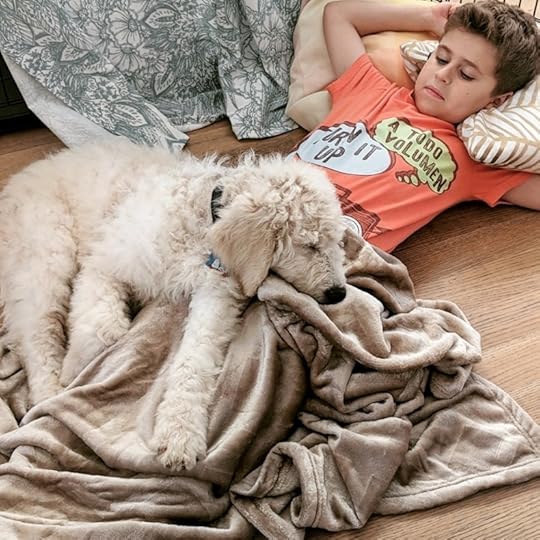
In August, we decided to get a dog as an unofficial “therapy animal” for our son, who didn’t want us to touch or hug him. So, when ADAM Teen was supposed to be happening, we were bringing home a goldendoodle Great Pyrenees puppy. My family went to San Diego while I stayed home to potty train him in peace.
Children’s Literature
Also around this time, my husband and I had gone on a Portland date and visited Powell’s Books where I saw and purchased the book, Wild Things: The Joy of Reading Children’s Literature as an Adult. I remember reading it in bed at our new old cabin, feeling myself falling in love with learning about the authors of children’s books.
Jump to my having a new puppy in the house (and no children around), and I found myself sitting outside in the garden with the pup, reading a biography of Margaret Wise Brown. I started researching graduate programs in children’s literature. I felt like I had found a new passion, and I wanted to pursue it whole-heartedly.
I applied to a distance learning program with the University of Roehampton in England, starting in September. It was a two year masters in Children’s Literature, and I could do it from my home! I got accepted and started my second masters degree.
Bookstore?
By October, I was planning and dreaming about what I should do with my new passion (and someday with my new degree). I thought about starting a publishing company to reimagine classics with female heroines. I went to the Portland Book Festival in November and purchased a book about starting a publishing company. In it, I read that it can be helpful to have your own storefront to sell your books when you have a publishing company. The seed had been sown, and a short time later I was walking the dog downtown Vancouver, Washington, when I saw the perfect bookstore space for lease.
I kept walking by, peeking in the windows, and around Thanksgiving, I contacted the leasing agency to look inside myself. At lunch afterwards, I was already sketching out my bookstore layout. By the end of December, I had the keys to the store in my hand.
My husband convinced me eventually that I couldn’t start a publishing company, start a bookstore, work on a masters degree, have a brand new puppy, and be a mother and wife all at once. I had to pick one of my passions. Since I had the keys, I obviously choose the bookstore. My course coordinator was graciously understanding, and I finished my program by getting a postgraduate certificate in Children’s Literature (since I had finished a semester of courses).
dickens
I threw myself headlong into getting the store (called dickens) ready and had it open by mid-March. Obviously, this blog took a back seat (or got shoved into the trunk). I worked at the shop, I bought the books for the shop, I was the shop. Eventually I hired part time workers so I could be more of a mom (and we could go on vacation sometimes), but then we discovered that money became tighter. It was tough.
Also that spring/summer (now we are in 2019), we found out that someone was going to buy the house on Vashon Island that we had started building. We moved to Vancouver from Vashon because that house was taking so long to build (and I needed to be able to access therapy without the aid of a ferry).
Vashon, part two
We were so happy! We were going to be done with that place that had caused us so much stress! But then the deal fell through. We went up to look at the house. Somehow we decided that we should just suck it up and move into that house. We had designed it. Some of my husband’s family lived on Vashon now so the kids could play with their cousins. We had a dog who needed a space to run and the lot was huge. Plus, my husband wanted me to step back from being at the bookstore all the time. We decided to move in time for the new school year.
I put out the word that I need to sell the bookstore. We held our second AnxietyTech conference in New York. I found out I was pregnant. I started packing up our house. We got a second dog (that lasted about two months). I had a miscarriage and ended up in the ER in the middle of the night by myself in Vancouver because the pain was so bad I thought it might be ectopic (my husband was with the kids on Vashon and I had been back to finish packing up). Luckily I was okay, but things were rough.
Eventually we had sold our house and the bookstore. My husband got a new job at Amazon in Seattle. But our Vashon house was a disaster. Our builder was not an honest, good dude. He scammed us out of so much money, built a shoddy house, and got the building funded by a sketchy investment firm that claimed we owed them a ton of money or they would foreclose on us.
Seattle
We decided we had to just pay them. But we hated the house. I got sick. It was Christmas time. My husband hated commuting from an island to Seattle. My college roommate lived in Seattle and told me the house across the street from them was on sale. We visited it, put in an offer, and it was accepted.
We then had to sell our Vashon house (that we had just bought), complete the bookstore sale, and move in less than two months. Somehow we did it. I still can’t believe it and we lost a ton more money, but we did it. We moved. And then coronavirus happened.
So you know, it’s been a bit of a marathon. More OCD/mental health related content soon, promise.
The post Back to 2018 and 2019 appeared first on Of Faith & Great Anxiety.