Suzanne J. Bratcher's Blog
July 1, 2021
How To Accept MS–Again

Starting a Blog Post
Blogging about How To Accept MS? Not Now!
I didn’t plan to blog about my Multiple Sclerosis until October. The Gold Doubloons, book three in my Jerome Mysteries trilogy, is due to my publisher mid-September. This blog was supposed to wait until that book was finished. But instead of plotting clues, I’ve been in bed for the last eight days. All I can think about is my MS.
Denial
So what happened? Too much travel, the result of three deaths in my family and a writer’s retreat I was determined to go to, used up every bit of my strength, including what few reserves I had. I knew three trips in three months was a lot for me with my MS, but I was sure I could handle it. I would take naps, pace myself, use my hiking poles for short walks and my wheelchair for longer distances. Sure I’d be tired, but the writer’s retreat would energize me after the sorrow.
Anger
But things didn’t work out that way. By the time I got to the writer’s retreat, I was so exhausted my blood pressure shot up, and I narrowly escaped a trip to the Emergency Room. As I lay in bed in a hotel room instead of talking writing with my colleagues, I got angry. I had spent the weeks between my trips resting like I was supposed to. How dare my MS interfere with my getaway?
Bargaining
I was smart enough to realize being mad would keep my blood pressure high. So I started to figure out how I could work with my MS. I went through the retreat program and identified the high-priority sessions. In between, I would rest. By the time I got home, I would be ready to write.
Depression
Again, things didn’t work out as planned. When I got home, I collapsed. I was in my own bed this time, but I wasn’t working on The Gold Doubloons. Anger gave way to frustration and finally to depression. I write slowly–because of my MS–and I became convinced that not only would I never finish that book, I would never write again.
Sound Familiar?
I’m sure you recognize the steps I went through as the stages of grief that precede acceptance. I was diagnosed with MS fourteen years ago–surely I should have accepted the disease by now. But as my MS progresses, it steals more pieces of my life as I knew it. First, it took away hikes into the dramatic canyons of the West, then leisurely strolls on the rolling trails of Arkansas. Now it promises a wheelchair. That’s just my walking. MS continues to offer me many reasons to grieve.
How to Accept MS–Again
Am I caught in a never-ending cycle? I hope not! Recently I encountered a definition for acceptance that short-circuits my looping grief process. A meditation course in acceptance on Headspace (an app I use on my phone) suggests that to accept we stop resisting what is so we can be open to possibilities we haven’t noticed. When I put this concept into practice, I went straight to the question, “Now what?”
Here’s how it’s working so far.
I’m exhausted from too much travel. Now what? Rest.
My writing schedule is off track. Now what? Wait.
I can’t get into story mode. Now what? Write about MS.
Surprise! The Gold Doubloons is stirring in my head again. I bet tomorrow…
What about You
Because you’ve read this far, I imagine you have MS or another chronic health condition. How do you accept each new challenge?
The post How To Accept MS–Again appeared first on Suzanne Bratcher.


October 20, 2020
A Sacred Migration Route?

The first time I heard the term sacred migration, I was staring at an antique rug hanging over the fireplace behind an old trading post deep in Hopiland. The rug featured a swastika. When my host noticed my consternation, he laughed. “It’s not what you think it is! This rug traces the legendary path of the sacred migration of the pueblo peoples. An unknown weaver created this rug a hundred years before anyone heard of Adolf Hitler. If you look closely, you’ll see a pronounced difference between this symbol and the Nazi symbol.”
I studied the square-shaped symbol with the two lines that crossed in the center, but it looked the same to me. My host explained. “This symbol sits flat on one leg. Variations of this straight version appear in ancient cultures all over Eurasia. In modern times it’s a symbol of good luck in Hindu and Buddhist countries. When Hitler appropriated the swastika for his empire, he tipped it on one corner.
The Sacred Migration of Pueblo MythologyAccording to pueblo mythology, we live in the Fourth World, humanity having failed miserably in the first three worlds. After the Third World ended, Masaw, guardian of the Underworld, led the People up into the Fourth World by the sipapu. Just before he disappeared, Masaw told them the clans must migrate to the ends of the land in the four cardinal directions: west, south, east, and north. The clans split up, starting in different directions, but each clan completed the great swastika that took them to all four directions. Later they learned these migrations were intended to purify them of evil before they settled in their homeland.
The Sacred Migration in Kokopelli’s SongAs I wrote Kokopelli’s Song, I organized the plot spatially, sending my characters on a migration of their own. Interestingly, I found an important archaeological or cultural site at each of the four directions.
Amy, Mahu, and Diego all enter the story at Santa Fe, New Mexico, their sipapu. Danger surrounding the mystery sends Amy and Diego west to Old Oraibi, an important cultural site. A narrow escape at Old Oraibi sends them south to El Morro National Monument. There Amy and Diego get separated, and Amy travels east to Cochiti pueblo. Eventually the two find each other at Chimney Rock National Monument, north of Cochiti.
The story ends where it began a thousand years ago–at Chaco Culture National Historic Park. The ruins in Chaco Canyon tell us it was an important ceremonial center. People living across the four corners states (Arizona, New Mexico, Colorado, and Utah) walked great distances to attend ceremonies. So it’s not much of a stretch to claim it for the center of the ancient civilization in my story.
The SitesOver the years I’ve visited each of these sites, most of them more than once. As I considered how each place might fit into the story, I got a few surprises. Those surprises led me to books, which led me to speculation, which led me to another piece of the story. In the next few blog posts, I’ll share more details about these fascinating destinations. So get ready for a bit of a travelogue!
The post A Sacred Migration Route? appeared first on Suzanne Bratcher.
October 7, 2020
Research Behind My Fiction

Research and my Writing Process
I decided to be a fiction writer when I was a eight, but I was sixty-eight when I held my first published novel. Because I couldn’t make a living writing fiction, I became a teacher. During those sixty years I taught English, wrote lesson plans, and graded papers. I went to graduate school and wrote a thesis. Later I wrote a dissertation. Then I wrote more lesson plans and graded more papers–this time for college students. To fulfill my job requirements, I also wrote professional papers and two textbooks.
My dream of writing fiction persisted. I took a correspondence course in children’s fiction, attended mystery conferences, and read books on the craft. I wrote poetry and short stories, but I had to retire before I could focus on full-length fiction. By that time I had written hundreds, maybe thousands, of pages of nonfiction. Research was built into my writing process: before I wrote a word, I researched my topic.
Research and Kokopelli’s Song
When I started writing fiction, I followed the same process. A story idea sent me searching for information. Kokopelli’s Song grew out of my curiosity about an unanswered archaeological question: Why did the keepers of the ceremonial center in Chaco Canyon dismantle and burn the four hundred kivas? When I learned burning cleansed a place of evil, I glimpsed ancient evil of great magnitude.
A story question began to take shape. “What if evil banished a thousand years ago found a way to enter our time?” Of course, a story requires a hero to battle evil: shamans who had passed the old stories down and boy and girl twins born to fulfill a prophecy. Enter a shaman from each cardinal direction and Amy and Mahu Sekaku.
Research and the Jerome Mysteries
The Copper Box started with my love of Jerome, Arizona, “the largest ghost town in America.” I gathered my information about Jerome first hand–on many visits over several years. I wandered in and out of shops, stayed in the hotel, ate at restaurants, and heard all sorts of ghost stories. Two characters who visit Jerome to lay personal ghosts to rest emerged from my imagination. Say hello to Marty Greenlaw, antiques expert haunted by her sister’s death and Paul Russell haunted by his wife’s death.
My interest in the mines that started Jerome, “the billion-dollar copper camp,” sparked the idea for The Silver Lode. As I researched mining from the late 1800s until 1950, I ran across information about a rich silver lode discovered in Virginia City, Nevada in 1850. I wondered what would have happened in Jerome if someone found a silver lode. Since one was never found, the discovery would have to be a secret. Meet one of Paul Russell’s students, an old man with letters from a long-dead brother, and budding geologist Scott Russell.
Research and my Work in Progress
The story I’m working on now is the third in the Jerome mysteries: The Gold Doubloons. I’ve always loved the Verde Valley, so one year while I was teaching at Northern Arizona University, I rented out my house in Flagstaff and house-sat for friends in Rimrock. Every time I made the commute, I passed the entrance to Montezuma’s Castle. Whenever I took the shortcut, I passed Montezuma’s Well. The peace of the well and the ancient aqueducts drew me there almost weekly.
The Sinagua, the people who built the pueblo and the well, caught my imagination. As I read about them, I discovered that archaeologists agree they abandoned their homes about a hundred years before Coronado came through the Verde Valley searching for the Seven Cities of Gold (Cibola). Experts agree the name “Montezuma” grew out of the ignorance of tourists in the 1800s. But I started to wonder about a connection between the name and Coronado, who knew all about Cortez and his conquest in Mexico.
A story began to bubble up, a story about an ambitious archaeologist who wants to build her career by proving the sites were named by Coronado and his men. Of course she would need evidence to disprove the prevailing theory. Spanish coins from the era would work–gold doubloons. Enter Dr. Julie–Paul Russell’s college friend–and treasure-hunter Reed Harper, Marty and Paul’s foster son.
So, How much is Fiction and how much is Fact?
I love to explore, so my settings are real places. I try to include enough details in my descriptions to cause readers to feel like they are right there. As I write the story, I do my best to weave the facts I’ve learned into the scenes I’ve imagined so seamlessly that a reader or two might wonder, “Did this really happen?”
The post Research Behind My Fiction appeared first on Suzanne Bratcher.
September 28, 2020
Just Who Is This Kokopelli?

So who is this Kokopelli in my folklore fantasy? If you’re from the Southwest, you’ve no doubt seen variations of the flute player image above in flashing neon over casinos, on hotel letterhead, as decoration on T-shirts, as earrings, necklaces, and key chains.
When I was researching my book, I found a surprising number of books about Kokopelli. They ranged from scholarly works to a rock art guide for hikers. As I sifted through fascinating theories about Kokopelli’s identity, three themes appeared.
A Trader
Archaeologists agree the humpbacked figures with flutes probably represented traders. Macaw feathers from South America and shells from the Pacific Ocean found in central New Mexico prove that trade was common. The hump probably represented a pack filled with goods for trade.The flute the trader played let villagers know he came with peaceful intentions. This image is the one splashed across the modern-day Southwest.
A Fertility Symbol
Other Kokopelli petroglyphs show a reclining figure holding a “flute” that’s clearly a phallic symbol. Archeologists agree this second version symbolized of abundant life, both plant and human. In Hopiland Kokopo’lo’ is a humpback katsina (benevolent spirit being) who participates in a series of night dances. His female counterpart, Kokopo’lmana appears in the Racer Ceremony. Neither of them carry a flute.
A Talking Cicada
Yet another version of Kokopelli appears in various Hopi folktales as a talking cicada. Many scholars believe the cicada was the original insect model for early Kokopelli petroglyphs.
In Kokopelli’s Song
As I wrote my story, Kokopelli stepped on stage in a new role: as an elusive figure who guides Amy on her hero’s journey. When she leaves home, her grandfather promises her whenever she loses her way, she’ll hear Kokopelli’s song. The haunting tune, played on a red cedar flute, is the song of creation, the song that guides people along the path the Creator has planned if they listen for it.
Further Reading
If you’re interested in studying Kokopelli, I recommend three books that taught me most of what I know: Kokopelli: the Making of an Icon by Ekkehart Malotki ; Hopi Kachina Tradition: Following the Sun and the Moon by Alph H. Sekakuku in Cooperation with the Heard Museum; and Kokopelli: Flute Player Images in Rock Art by Dennis Slifer and James Duffield.
The post Just Who Is This Kokopelli? appeared first on Suzanne Bratcher.
August 21, 2020
KOKOPELLI’S SONG, Chapter 1
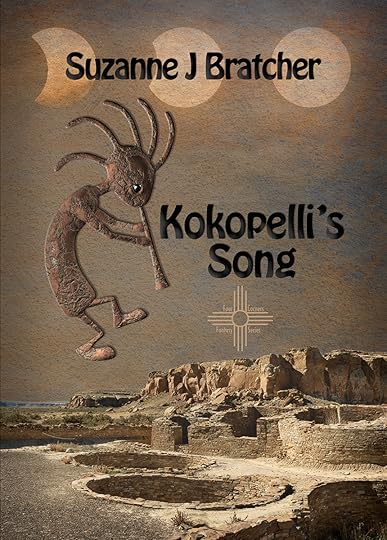
I. SIPAPUNI [Place of Emergence or Doorway]
Out on the windswept mesas of Hopiland and down in the pueblos dotted along the Rio Grande, storytellers preserve the history of the People in the times before our Time began. Each generation has its own storytellers, but the stories remain the same, passed from the old to the young.
Today, science books tell of a Big Bang, but storytellers gather the people around them and speak of music. They say the Creator sang the First World into being: the sun, moon, and stars, the oceans and land, the plants and animals, and, of course, the First People. When all was finished, the Creator taught the First People to sing. “As long as you sing the Song of Creation,” he said, “the world will be in harmony, and you will be happy.”
At first, all was well. The People sang as the sun rose in the East, while it shone directly overhead, and as it set in the West. They sang when the moon and the stars appeared in the dark canopy of Tokpela, the endless void. As they sang, they lived in harmony with creation, and they were happy. Then came a time when some of them stopped singing, then more and more. When the People fell silent, they began fighting and killing—animals and people alike. The First World fell into disharmony, and eventually the thread of life ran out.
In the midst of the Chaos, the Creator called the last of the Singers together. Heaving a great sigh, he said, “I have decided to destroy this world and try again. To keep you Singers safe, I am sending you to the Ant People.” When the Singers were deep in the earth with their brothers the ants, the Creator destroyed the First World with fire.
Then he sang the Second World into being. It was even more beautiful than the first, and the Singers were happy and multiplied. As long as they sang, the world was in harmony and all was well. But then, just as before, some of the People fell silent, and disharmony crept into their hearts. As before, more and more people forgot, and finally the thread of life ran out. Again, the Creator sent the last Singers to safety with the Ant People. And again, he destroyed the world—this time with ice.
A third time the Creator sang the world into being, and a third time the pattern was repeated. But this time when the thread of life ran out, rather than sending the last Singers to the Ant People, the Creator sealed them in hollow reeds that would float. Then he destroyed the Third World with water. For many days, the Singers drifted on Endless Water. Their food ran out, and still they had not found the place of emergence into the Fourth World. Just before they starved, they found it—the Sipapuni.
Storytellers say the world those Singers emerged into is our world. They say this Fourth World is the last chance the People have to learn to live in harmony with Creation. They say it is our last chance to keep singing.
Chapter 1
In her tiny room above the Delgado Gallery, Amy Adams punched her pillow for the third time. She flipped to her side and stared at the digital clock. Green numbers blinked three a.m. She needed sleep, but her mind trudged around the endless loop again. Grandmother Adams lied. Mahu was her twin brother. Taáta was her Hopi father. Grandmother Adams lied. Mahu was her twin brother. Taáta—
Pottery smashed on the ceramic tile downstairs. Not a small pot, one of the decorative water jars that reached her shoulder. Amy lay still, held her breath, waited for the next sound.
Mahu was down there, asleep, or maybe awake, on the long leather couch reserved for customers who wanted to consider an outrageously expensive purchase.
Amy listened for the next sound. Silence.
Heart pounding, she threw off the scratchy wool blanket and sat up. Fear like glacial runoff pumped through her veins. Not because she believed Mahu had broken a pot, but because she knew her twin was in danger. She felt it as surely as if the two of them had never been separated to grow up in different worlds.
Just like she knew Mahu was in danger, she knew whoever was with him meant evil.
Her bare feet hit the cold floor. She ran out of the room, down the dim hallway. She shivered in the sleep shirt that came to her knees, but she didn’t have time to care. In that moment, Amy was Kaya again, the older sister, the firstborn twin. The need to protect snapped at her heels, urging her to go faster, faster.
The narrow staircase cut straight down into inky darkness. Kaya Amy didn’t pause to grope for the light. Instead, she threw herself down the steps, racing to get to Mahu before someone hurt him. Before she reached the bottom, she knew she was too late.
Still she ran through the gallery, darting through a confusion of light and dark, evading ghosts of tiny bronze cowboys riding tiny bronze horses, ducking around shadows of rugs hanging from the ceiling, swerving to miss chairs carved from twisted roots and iron tables laden with painted pots.
She found Mahu on his side under the long window, backlit by the watery light of the streetlamp that illuminated the shop front. His flute and backpack lay beside him. For an instant, Amy thought she saw Kokopelli, the humpbacked flute player of the ancient petroglyphs. Then the vision was gone, and she saw her twin again.
One arm was hidden beneath his body, the other was flung back, hand clenched into a fist. A ceremonial arrow with a turquoise-inlaid shaft protruded from his chest. Not shot from a bow, stabbed in like a knife. Blood seeped from the wound, soaking his shirt. Fragments of a huge ceramic vase lay strewn around him, the one she’d heard break, the one he must have slammed into as he fell. More blood seeped from his head, spreading onto the ceramic tile floor, gathering in a pool.
“Mahu!” she cried. “Mahu!”
No answer. Only silence—silence that scared her more than a groan or even a scream. Crouching beside him, she whispered, “Mahu. Mahu.”
His long dark hair, as straight as her own, fanned out across his face. Tenderly, almost as if he slept and she didn’t want to wake him, Amy pushed back his sticky hair. The uncertain light of the streetlamp flickered across his face, one moment revealing the face of her twin, the next the face of a stranger. Not dead, she prayed. Please, please—not dead.
She wanted to find his pulse, needed to find it. At first she tried to move him, pull the closer arm out from under his body, but he was too heavy. Reaching across, she grabbed the other arm. His wrist felt warm. The fist relaxed, releasing a scrap of cloth.
As her fingers pressed and moved, pressed again, the air behind her stirred. No sound, but a warning. For the length of a heartbeat, she crouched there, clutching Mahu’s limp hand, and held her breath.
Then fingers brushed her hair.
Amy scrambled to her feet. She dodged a hand that plucked at her shoulder, lunged for the outside door. Too late, she remembered it was locked at night. But when her shoulder hit the glass, the door let her out as easily as it did customers hurrying for the next shop, dumping her into the snow-filled night with a cheery tinkle.
Cold slapped her face and sucked the air from her lungs. Ignoring the icy needles that pricked her bare arms and legs, Amy sprinted across the stone courtyard. As she passed the frozen fountain, her feet slipped. For one breathless moment she thought she would fall. But she didn’t have time.
Throwing her weight forward, she found her balance and kept running. She reached the tall wrought iron gate that should be locked. But like the door, it swung open as soon as she touched it. Behind her the gallery door tinkled again. Mahu’s attacker.
Slipping but never quite falling, she ran along the empty street past dark shops toward the hulking outline of St. Francis Cathedral. But the hope of sanctuary mocked her. Like the shops that hadn’t been broken into, it would be locked.
The gate squeaked behind her, followed by footfalls. Not bare feet like hers, feet in boots. Snow swirled around the streetlamps, transforming the moonless night into a chaos of flickering orange and yellow light. Each breath of frigid air seared her lungs, yet she ran. Faster. Around the corner. Into an alley.
Mahu’s battered pickup waited beside the dumpster. She had wondered when he tucked the keys behind the driver’s seat. ‘No one wants this bucket of bolts,’ he said with the gentle smile that transformed the unfamiliar teenager into her five-year-old twin. ‘Besides, I always believe in leaving an escape route.’
She thought he was kidding. She yanked at the door and wondered. Had he known he was in danger? Why hadn’t he warned her? She pushed the thoughts aside. No time to wonder.
Amy jerked open the driver’s door. The screech disturbed the snow’s silence. Had her pursuer heard? The cab’s overhead light shone like a beacon, signaling her location. She clambered in, reached for the keys with one hand and slammed the door with the other, extinguishing the light.
Her fingers found the ignition key, big and square. She slid it into the steering column and jammed one numb foot on the clutch and the other on the gas pedal. The engine coughed. For one frozen second she thought she’d flooded it.
It coughed a second time and then roared into life. As she pulled around the dumpster, a dark shape in a hooded sweatshirt reached for the passenger-side door. Simultaneously jerking the steering wheel and flooring the gas, she aimed the pickup at him with such force that he lost his grip and fell heavily against the dumpster.
Tires sliding on the snow, the truck lurched out of the alley into the street. Headlights could wait. She had to get away. Now. Amy swung onto Old Pecos Trail, heading for the interstate where cinder trucks would be spreading precious traction.
Unless Mahu’s attacker had parked in the same alley, she had a few minutes lead. She needed to reach the highway first. Even if he figured out where she was going, there were enough exits from the highway to throw him off track.
Amy sped around one corner, passed the cathedral, and pulled on the headlights. Ice crystals danced in the yellow light, rushed at the windshield, momentarily blinding her. She drove recklessly, hoping to find a patrolman to pull her over, return to the gallery with her, get help for Mahu.
Nothing but snow. Snow the wipers pushed at ineffectually, snow that covered her tire tracks almost as soon as the pickup made them. The streets were empty and silent, trails through an invisible city. Up a hill, sliding back, down a hill, slipping forward.
At last she saw I-25, as empty as the city streets. Amy steered madly up the entrance ramp, ignoring the clatter and clamor of the engine, willing the old pickup to keep moving. Then she entered the highway, driving on cinders already disappearing under new snow.
She pressed hard on the gas. A quick glance in the rearview mirror showed nothing but darkness. Amy exhaled the breath she’d been holding and slowed to a less frantic speed.
Heading south, she would soon leave Santa Fe behind. Amy longed for the open highway with nothing but a few exits to a string of pueblos, all off the road, shut up, sleeping out the storm. She checked the gas gauge. Half a tank. Enough to reach Albuquerque, but Mahu was lying on the gallery floor, bleeding, dying. She had to stop, had to find help.
Amy took the next exit. Cerillos Road. At the bottom of the ramp a darkened gas station occupied one corner. Across the street an all-night drugstore spilled light out into the snow. Amy parked in the deepest shadows, rested her head on the steering wheel, and tried to think.
Headlights on Cerillos Road briefly illuminated the cab, dumping her abruptly back into the present. Amy blinked. Sitting up, she pushed her tangled hair out of her face and looked down at herself. In the drugstore sign’s dim neon light, she saw her nightshirt, stiff with blood. Mahu’s blood. Panic welled up inside her. She couldn’t go to the sheriff. Couldn’t trust a man wearing a brown uniform.
Something tugged at her memory. Something scary. Something she didn’t have time to think about right now.
One thing was certain—brown uniform or not, the sheriff would say she was a runaway. He would say she belonged to Grandmother Adams until she was 18. He would call the house in Virginia, and Grandmother Adams would come for her. She couldn’t go to the sheriff, but she could call 9-1-1.
She looked at her hands, as if wishing for her cell phone hard enough would make it materialize. Her cell was in her jeans pocket, jeans that hung on the chair beside her bed.
Amy’s right hand was empty. Her left hand clutched a scrap of fabric, the piece Mahu had been holding. She knew it was important, but not now. She tucked it behind the seat where she’d found the keys and opened the glove compartment. Did Mahu have a cell phone? He had to have one. Everybody had a cell phone.
The light in the glove compartment was burned out. She rummaged in the dark, searching by touch rather than by sight. A tire gauge, a tiny spiral notebook, a broken pencil, a twisted bandana. No cell phone. With increasing urgency, she groped under the seat. No cell phone. She ran the tire gauge along the narrow space between the seat and the back window. Still no cell phone.
She found it at her feet on the filthy floor under the rubber mat. An icon indicated a missed message, but Amy didn’t care about messages. Hands shaking, she punched in 9-1-1.
“Santa Fe County Emergency.”
Doing her best to sound like a grown woman instead of a panicky teenager, Amy said, “I need to report someone badly hurt.” A voice in her mind whispered, Please don’t let Mahu be dead. Don’t let him be dead. “At 121 San Francisco Street.”
“Your name?”
“There was a break-in. Send an ambulance to the Rebecca Delgado Gallery.” She grabbed a breath, hurried on. “Send it now. Before he dies!”
Amy heard the hysteria rising in her voice. Before the woman could ask any more questions, she broke the connection and turned off the phone. She knew cell phone calls could be traced, and she didn’t want to be found. Couldn’t be found. Not yet.
All she needed was a week. Five days really. Just until their birthday, hers and Mahu’s. Once she was eighteen, she would have time to find the missing part of herself, the part of her Grandmother Adams had taught her didn’t exist, the part that lived in her dreams. She could find out who she was, where she belonged, where home was. But Mahu had to live.
Amy dropped the phone in her lap and laid her head on the steering wheel. “Please, God,” she whispered, “please let him live!”
Gradually the shock wore off, or maybe it started to set in. Amy shivered uncontrollably. Hands shaking, she turned on the engine and, without much hope, the heater. Lukewarm air stirred the winter air that leaked in around the windows, under the doors. Pulling her aching feet up under her, she tried to think. She needed help. Someone to bring her warm clothes and shoes. Someone to help her get away.
She didn’t know how long it would take the sheriff to identify Mahu or how long to find his pickup, but she did know if she wanted to keep free from Grandmother Adams, she needed to get away from anything connected to Mahu.
But who? Who would help her?
The post KOKOPELLI’S SONG, Chapter 1 appeared first on Suzanne Bratcher.
April 25, 2020
Kokopelli’s Song – Audiobook
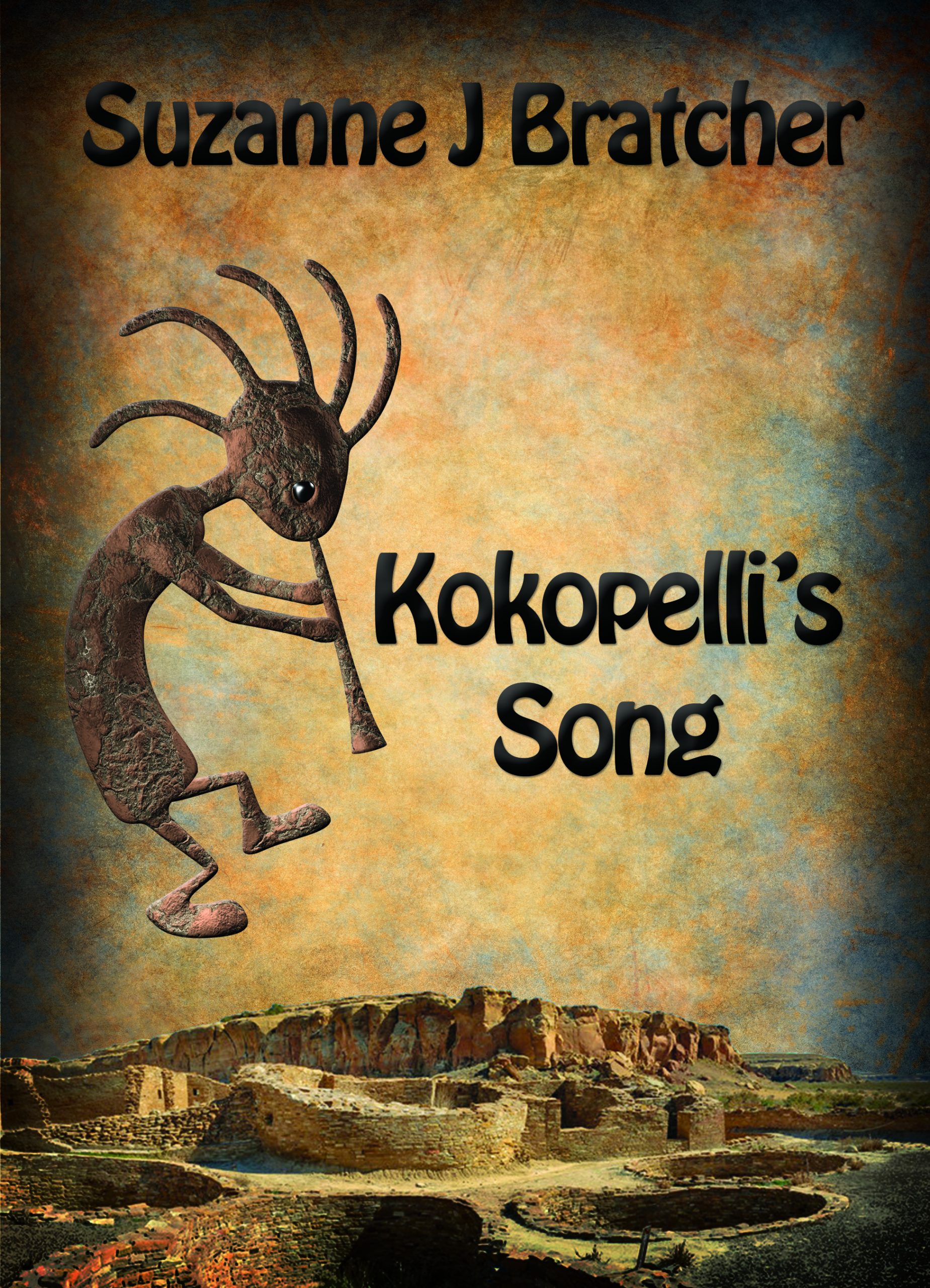 Kokopelli’s Song is a Young Adult Fantasy novel that I will soon be releasing as an eBook. In the meantime, I have recorded the chapters and will be publishing them one at a time every Monday and Thursday until we reach the end of the book. After the introduction, each chapter’s reading will also include an activity for readers to complete.
You can learn more about Kokopelli’s Song and watch the video book trailer by clicking HERE.
(Click the image to view it larger.)
The post Kokopelli’s Song – Audiobook appeared first on Suzanne Bratcher.
April 21, 2020
Free YA Audio Book: Kokopelli’s Song
On Monday, April 27, the free YA audio book I’ve been promising is about to begin. Thursday, April 30, I’ll read Chapter 2. Every Monday and Thursday after, you can listen to a new chapter. I’ll also post an activity you can do if you want a glimpse behind the scenes. I first imagined this YA fantasy when I visited Chaco Culture National Historic Park in New Mexico. Go to the website below to get a taste of why I became so fascinated with these thousand-year-old ruins and the people who gathered there for a wide variety of ceremonies.

Chetro Ketl great kiva plaza
https://www.nps.gov/chcu/index.htm
What’s Next for this YA fantasy
When the audio version Kokopelli’s Song is complete, I’ll post it to YouTube. Later you can expect an eBook and then a print version of this YA fantasy. The story is an imaginary adventure that draws on my research and Hopi mythology. Readers/listeners ten and older will enjoy the story. I hope you have as much fun with it as I’ve had!
Watch the trailer here:
The post Free YA Audio Book: Kokopelli’s Song appeared first on Suzanne Bratcher.
July 29, 2019
Silver Lode – Video Book Trailer
The Silver Lode – now available from Suzanne Bratcher …
Learn more on the book’s description page – The Silver Lode.
The post Silver Lode – Video Book Trailer appeared first on Suzanne Bratcher.
April 4, 2018
PLOTTER OR PANTSTER? YES!

If you’ve ever been to a fiction writing conference, you’re familiar with the debate: do you plan first and then write, or do you forget the outline and write from the seat of your pants? Think about your own writing process. You may not write for publication, but when you write a letter or a memo for work or a story about your childhood, do you plan first, or do you just start writing?
Until last week I was certain I was a plotter. Once I have the germ of an idea for a novel, I draw a story arc, divide the arc into three acts, divide each act into scenes, and list goals for each scene. Of course I’m a plotter. Or am I?
PLANNING A BOOK TALKLast week, I gave my first book talk on my first published novel, The Copper Box. I had an hour, including a few minutes for questions. I decided to focus on the age-old question: “Where do writers get their ideas?” True to my plotter nature, I checked on Google for the optimum length of time to read aloud to an audience (five minutes). I decide to read three selections of five minutes each. That brought me to fifteen minutes. To leave fifteen minutes for questions, I needed to talk about the central idea in each excerpt for ten minutes.
Remembering the prime directive for all writers—show; don’t tell—I searched for Jerome memorabilia that would show where I got the idea for each passage. I chose a copper box, a glass paperweight filled with tropical fish, and a kaleidoscope. Next I made an outline of my presentation, including bullet points of what I would say about each excerpt. Then I practiced, timing with the stopwatch on my phone. Finally I got the presentation to 45 minutes, including a place to stop early if the audience was looking bored, and we all wanted to go home. I was ready.
THE PRESENTATIONOn the day of the presentation, I entered the room armed with my outline, my book with the passages carefully marked, and my memorabilia. Excerpt #1 was the copper box. I showed the three-inch by six-inch box I bought on the internet and read the excerpt.
Across the road a sign welcomed visitors to Jerome, the Billion Dollar Copper Camp. Copper for pennies. Copper for boxes. Old mines. Be careful girls! Someone stepped on Marty’s grave, and she shivered. “I don’t believe in ghosts.”
I explained how I kept the little copper box on my desk for inspiration as I wrote the novel. A woman dressed in a green silk shirt and white pants raised her hand. Little did she know she was about to present me with a dilemma that would challenge my self-image as a writer. “I understand why you chose copper,” she said, “but why a box? Why not a plate or a picture frame or a wind chime?”
I shrugged. “The box popped into Marty’s mind when she was driving into town. Marty couldn’t remember what happened to her sister, but she knew if she found this little copper box it would solve the mystery.” Oops…even to my own ears that sounded a lot like an answer a pantster would make. And so it went. The same question about each of my show-and-tell items, the same answer: that’s just what the character thought or said.
FACING FACTSThat night, I faced facts. Am I a plotter or a pantster? I guess I’m both. I plot first, and then I write from the seat of my pants. That’s what I thought until this morning. I sat down at the computer with an outline for an entirely different blog on the topic of writer’s block. But as I started to write, last week’s presentation popped into my mind. I wrote Plotter or Pantster? Here I am at the end, without ever writing a single bullet point. Hmm… Am I a plotter or a pantster? Yes! How about you?
Note: A version of this blog first appeared on the ACFW blog:https://www.acfw.com/blog/plotter-or-...
The post PLOTTER OR PANTSTER? YES! appeared first on Suzanne Bratcher.
October 11, 2017
WHAT IS CHRISTIAN FICTION?
 SCRIBBLING TO A FINAL DRAFT
Well, that was embarrassing. You really got “Suzanne’s Scribbles” yesterday! In case you’re wondering what on earth I was trying to say, here’s what I meant for you to read.
WHAT IS CHRISTIAN FICTION?Last month I had the pleasure of visiting with two book clubs that chose The Copper Box as their September book. I thoroughly enjoyed hearing comments from readers who didn’t know me except through the book. In both groups, the conversation focused on my writing process and on Jerome. I got lots of affirmation and some helpful critique. However, no one commented on the faith element in the story.
Curious, I said, “Tell me how you felt about the fact that my book is Christian fiction.” One reader exclaimed, “I didn’t think this was Christian fiction!” I looked around the group, and most of the women were nodding their agreement.
DEFINITIONSI was a little taken aback, not quite sure why they were surprised. Surely anyone reading The Copper Box knew Paul and Marty were Christians! Or had I gone wrong somewhere? I asked, “What do you think Christian fiction is?”
The answers clustered into three categories. One definition was fiction that includes the plan of salvation and a character who doubted God becomes a believer by the end. A second was fiction based on a Bible story. A third was fiction about the end times.
When I agreed with all the definitions, one reader said, “Your book doesn’t fall into any of those categories. So what makes it Christian fiction?”
MY FICTIONAfter a bit of thought, I said, “My novels are about ordinary Christians facing extraordinary situations.” I’ve been writing for years. In fact, The Copper Box isn’t my first novel; it’s just the first one to get published. In reality, it’s the sixth or seventh. A few years ago when I finally felt confident enough about my writing to start looking for an agent, I kept getting rejection after rejection. The odd thing was, they were all encouraging. The responses boiled down to “You write well, but I can’t sell this book.”
Finally an agent who represents both mainstream and Christian fiction took the time to talk to me on the phone. She said, “Have you thought about writing Christian fiction?” At that point, I had the same perceptions the book club members had. I knew I wasn’t writing in those categories, so I asked her the same question, “What is Christian fiction?”
She said, “Christian fiction crosses all the categories mainstream fiction does, but it’s written from a Christian world view. It includes romance, historical, suspense and thriller, fantasy, mystery, even speculative.” At that point I was focusing on romantic suspense, so I asked her for the names of some authors I could read. She gave me quite a list that included Colleen Coble, Brandilyn Collins, Lynette Eason, Dee Henderson, Dana Mentink, and Sandra Orchard. I started reading. It was like coming home. I found stories about Christian characters having all sorts of adventures. My writing started to open up. I began to write like I think.
My life is built on my faith. I “talk” with God informally about everything that happens to me. Over the years I’ve memorized a lot of scripture, so passages often occur to me as I’m thinking. When I started writing fiction for a Christian audience, my characters began to think and talk about the spiritual dimension of the conflict they faced. In The Copper Box, Marty and Paul are both struggling with guilt from the past. The theme of the story came straight out of the Letter to the Philippians: God wants us to put the past behind and move forward into whatever God is calling us to. Both Marty and Paul had to let go of the past if they were going to be able to explore a future together.
YOUR TURNWhat do you think Christian fiction is? Which Christian authors do you like?
The post WHAT IS CHRISTIAN FICTION? appeared first on Suzanne Bratcher.