M.K. Dymock's Blog
March 23, 2023
FREE THRILLER Two-Days Only


December 31, 2022
A 30-Second Ski Lesson from a Ski Instructor: Part 2
Subscribe to the Newsletter
With the success of my first 30-second ski lesson, I am adding another to the series. The biggest difference you can make in your skiing happens before you snap into your boots—in fact it happens before you even go up the mountain. Most skiers don’t realize you ski from your feet up.
All skiing happens from your feet. If you’re not in the proper footwear, it doesn’t matter what your skis you’re riding or what skills you possess, your skiing with falter.
I plateaued in my skiing for a few seasons at an intermediate level. I could ski down any groomed run on the mountain but fell apart a foot off-piste. I kept figuring eventually I’d get better, and I did but only fractionally. I finally broke down and took a lesson. My biggest takeaway from that lesson was that my boots were about two to three sizes too big for me—and that a lot of folks are skiing in the wrong sized boot.
Spend 30 seconds to tell if your boots are too big:
When you press your shin into the front of your boot, does your heel pop or slip around? Do your toes jam into the boot? You may think this means you need a bigger boot (I did), but what it really means is your foot is slipping around. If it easy to get your foot in your boot, you might need to go shopping.Now that you know you need a new boot, it’s time to go to the boot fitter (unfortunately, this part takes more than 30 seconds and a few dollars). Don’t just go to you local ski shop; a lot of those workers don’t really know what they’re doing on fit. Go to a shop with a professional boot fitter. They will ask you a few questions and do some measuring before you try on several boots.
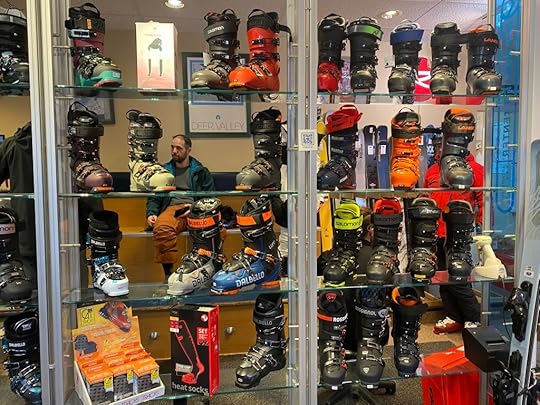
Once you find the right boot, you’re only half way there and why you need a boot fitter. The most important thing they’ll do is create a custom footbed molded to your foot (these can be transferred from boot to boot). They can also tighten and loosen parts of the boot to fit you better. For instance my left foot is bigger than my right foot (not an uncommon occurrence). One boot never fits right but with adjustments, I have two working boots.
As much as these fitters are experts, don’t get talked into a boot that doesn’t feel right. I’m an expert skier but short in height. Everyone kept trying to put me in stiffer boot that I never felt right skiing in. I now ski a lower flex and am much happier.
Another tip to get the right boots is to buy them from REI first before fitting them. That way if it doesn’t feel right, you can return them. Still take them to a professional fitter.
For an outdoor adventure without ever having to get outside, check out the Lost Gorge Mystery series!
 Follow on Pinterest!
November 22, 2022
5 Tips for Teaching Your Kids to Ski
Subscribe to the Newsletter
I’ve written a popular blog post on the 5 Mistakes Parents Make Teaching Their Kids to Ski. I figured it would be helpful to give you tips on how to teach your kids to ski. Let’s face it, careening down the mountain yelling at your little one, “Pizza,” probably isn’t getting you very far. Use these tips to improve your kid’s ski day.
Ski Tip 1: Teaching the 3- to 4-Year-Olds a WedgeFor my entire first season of ski instructing, I taught kids ages 3 to 4. At that age, everything has to be a game. Even teaching the kids to make a pizza didn’t make any sense to them. Most of them thought pizzas were round. After a week of desperation, I came up with the game of Mouse/Elephant Door. Little ones have a hard time separating their body parts into separate movements, making the wedge tough to learn. This helps them visualize that.
The front of their skis are the mouse door and the back of the skis are the elephant door. They have to keep their tips close together but not touching. If they close their tips, they squish their mouse. If they open their skis too wide, the elephant runs over their mouse. If they don’t open the back of their skis enough, their elephant can’t get in the door.
Ski Tip 2: Teaching the 3- to 4-Year-Olds to TurnI talked above about the difficulty for the little ones to separate the parts of the bodies. This is very apparent when it comes to turning. Shifting all their weight from one foot to the other is hard enough for a three-year-old but adding skis ups the balance challenge.
To master this skill, we’re taking the mouse/elephant game to a new level. I take them to a nice wide part of the hill where they have time to ski across for more than a few seconds. We talk about how mice make tiny steps and elephants make big loud steps. As they cross the hill, I’ll have them lift their upper hill ski and make mouse and elephant steps. This teaches them to get their weight on their downhill ski.
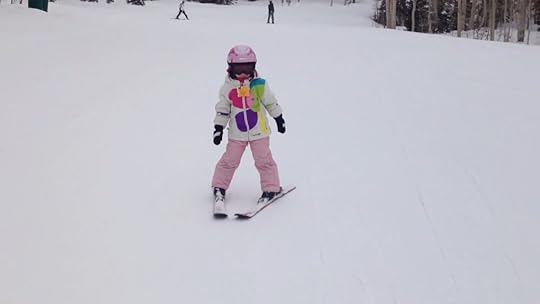 Ski Tip 3: Teaching 5- to 6-Year-Olds
At this age, the mouse/elephant game may not work on them, but they’re now better able to understand making a wedge and feeling how that movement helps them stop. Honestly, green light/red light is and will always be a great motivation for all ages learning to stop. I’ve yelled “stop” at kids going too fast only to have them ignore me. The second I yell “red light,” bam, they stop.
Once again, kids have a hard time separating parts of their body. If you have a minute, watch kids turn. Often their hands mirror their legs. If they’re trying to turn left, their right arm will make a possible fist and rotate their arm. Use this to their benefit. Have them pretend like their riding a bike or a motorcycle with their hands on the handlebars. Make sure you’re demonstrating this as well; kids always copy you.
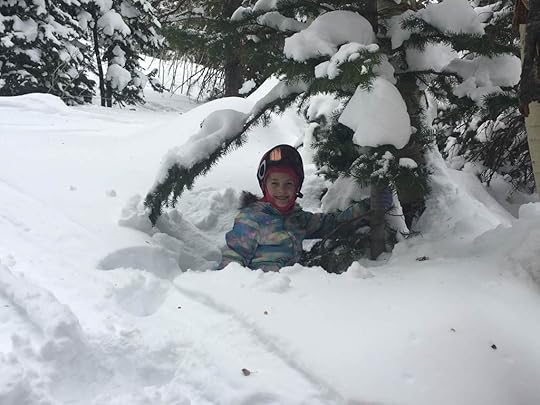 Ski Tip 4: Teaching 7 to 11
I’ll be honest, kids this age pick up skiing fairly fast as long as they can watch you and you break the steps down for them. Motivation, however, can make it challenging. Learning to ski isn’t always fun, and they can plateau once they get comfortable in a wedge. However, one thing that always motivates them is making it a competition.
I give them points for everything (this can sometimes work on some of 5- and 6-year-olds). Put on their skis by themselves, five points. Tap their upper foot traversing the hill, a point each. You might think tracking a bunch of kids’ points all day might get old, but they honestly don’t notice if you do or don’t. With the younger ones, I’ll tell them they got 80 points when they ask, whether they do or don’t. I make the older ones track their own points.
What do they get with these points? Not a whole lot. They’re excited at the mere fact of collecting them. Of course, I always carry candy in my pocket but I don’t make any rewards contingent on skiing.
 Ski Tip 5: Make it Fun
It doesn’t matter what age anyone learns to ski, keep it fun. When someone is learning, skiing isn’t exactly fun. It’s challenging and scary and it’s really hard. I sing songs, I play make-believe, I tell made-up stories, I play ski games.
Who can ski up hill the farthest after a J turn.Who can spray the farthest snow with a hockey stopCops and robbers with me being the robber and having them chase me downHow many barrels can they go aroundCan we ski a run entirely in the treesI’ve skied doing the Hokey Pokey Not a Tip but a Good Lesson
Kids are born with perfect hearing (usually). What they’re not born with is the ability to discern different noises. If you’ve talked to your kid and had their attention on everyone and everything but you, you’ve experienced this. All noise comes at them at the same level. This is a reason they also hone in on their TV shows with such intensity. They really can’t hear you talking to them while they’re focused on it. If you don’t have your kids attention, get on their level and look them in the eye. This pulls all their focus on you so they can hear you.
For an outdoor adventure without ever having to get outside, check out the Lost Gorge Mystery series!
Follow on Pinterest here!
November 10, 2022
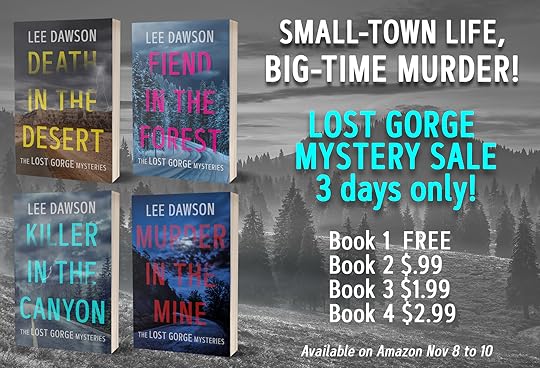
Mystery Series Book Sale (this week only)
October 5, 2022
Adventures Abound at Channel Island National Park
Subscribe to the Newsletter
While I love hiking and camping at my favorite national parks, Channel Islands ups the adventure to a whole new level. Sure, there’s hiking and camping but add on snorkeling, diving, and kayaking through caves; and you’ve got a whole new level of fun. Come explore above and below the ocean at this unique park
The Channel IslandsThese series of islands are just off the Southern California coast and include the popular Catalina in the south. This blog focuses on the northern islands that make up the park, most specifically Santa Cruz, the largest of the islands. The northern islands can be seen on a clear day from the Santa Barbara/Ventura area, which can be an odd day.
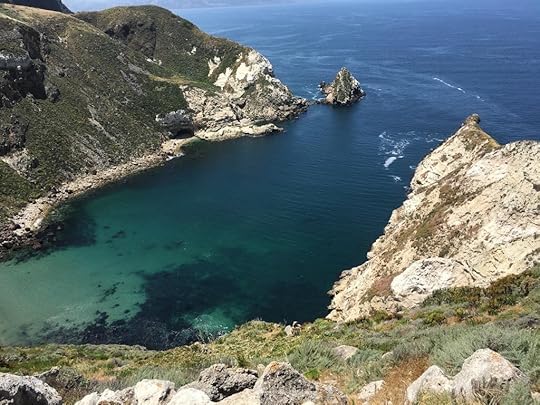 The clear blue waters off the sharp cliffs knows no equal. Sea Cave Kayaking
Let’s get to the best part first! This adventure is truly one-in-a-million. If you’re smart, you’ll sign up for the full-day option. The day starts at 7 am at the Island Packers Ferry, which will carry you across the channel to Santa Cruz Island. They have both afternoon and morning paddles. If you can time it, try to do your kayaking at low tide. On my first trip, we able to get into a small cavern in complete blackness that couldn’t be accessed in high tide.
During the off-hours of your kayaking adventure, you’ll have a few hours to explore the island. The first time I went on a hike to an overlook of the cliffs. On the second, I went snorkeling through the amazing kelp forests around the Scorpion Point Pier.
Reach out to Santa Barbara Adventure Company for a guided tour.
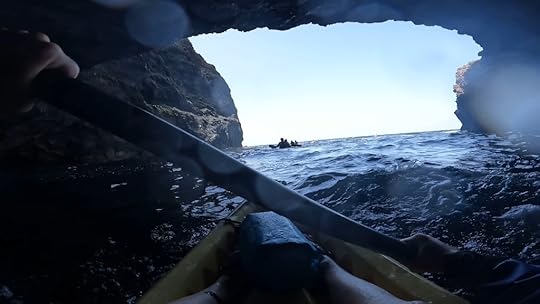 It’s was a rough sea the day we went but still worth it.Wildlife in the Park
I got ridiculously lucky my first trip out on the ferry. On the way out, we spotted a huge pod of dolphins jumping the ferry’s wake. Before this trip, I had no dream to see dolphins but I teared up at the sight of them—absolutely stunning. We also saw a few seals resting in the caves.
Then, just when I thought I could relax on the way back, two blue whales (my first ever whales) crossed our path. We were only able to spot their backs and spray out their blowholes but it was majestic.
On the island lives the Channel Island fox, a species found only on these islands. They were almost instinct until a breeding program brought them back. On my first trip, we were excited to spot a single one. On my second a year later, we had to guard our food closely as they stalked us at lunch. No need to be afraid, however, as they’re the size of a large house cat.
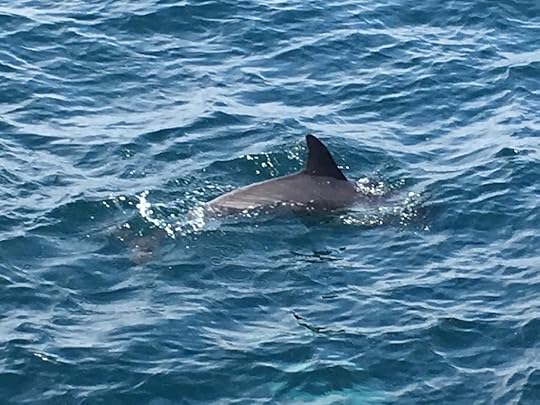 Hundreds of dolphins jumped the ferry’s wake.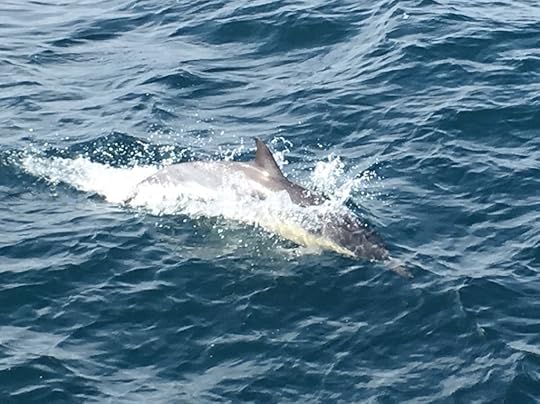
 The Channel Island fox is only found on the islands. They are just larger than an average house cat.History on the Island
The islands were the ancient home of the Chumash people, who were believed to inhabit the island for thousands of years. Later, vast sheep ranches utilized the natural barrier the island offered. The ranch houses on Santa Cruz still remain. One has been turned into a small visitor center teaching about the island and all its inhabitants. (There is a large visitor center at the harbor but it closes before the main ferries return.)
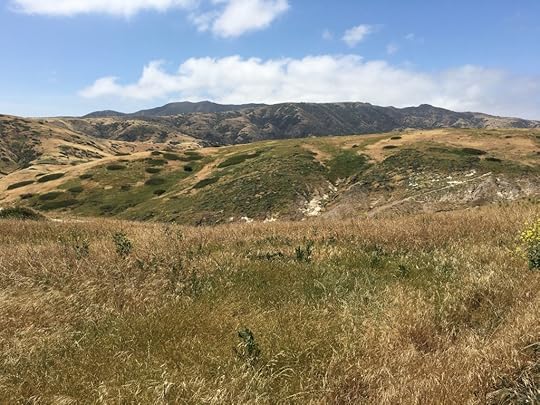 Imagine the sheep herds the island supported.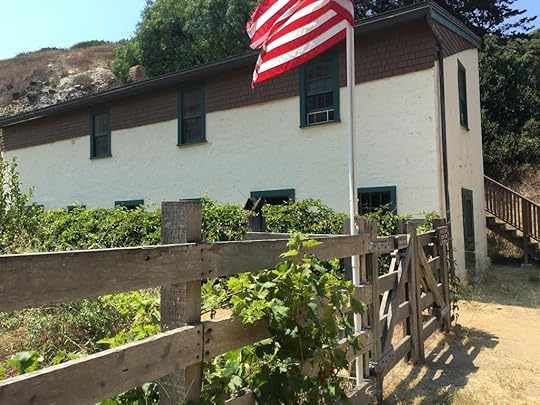
 Camping
While I haven’t yet camped there yet, I intend to one of these days. Keep in mind, all camping is backpacking and you have to haul your gear in from the ferry. Santa Cruz has the largest established campsite and is only a quarter mile from the pier. Check each island for water availability and book your permits early. All garbage must be carried out.
Getting ThereDefinitely one of the more remote parks to access between the drive and the ferry ride, but the ferry is part of the experience. I like to fly into Burbank airport; it’s so much easier to out of than LAX. If you do, stop at Granville restaurant for their mac and cheese. I can’t go to Burbank without a quick pop in there.
During peak times the ferry can sell out so make sure to buy your tickets ahead of time from Island Packers.
At the end of a full day, I always stop at Andrea’s for seafood. It’s affordable and delicious.
Follow on Pinterest here!
August 14, 2022
A Weekend at Capitol Reef National Park
Subscribe to the Newsletter
Most travelers through Utah’s red rock spend less than a day at this oasis in the desert. It only serves as a quick one-off between Arches and Bryce for tourists hitting the Big Five. To be honest, I’m completely okay with that but if you do decide to linger, here are a few spots worth hitting.
Friday EveningIf you’re like me and your adventure can’t start until after you get off early on a Friday, hit the Chimney Rock Loop for an amazing sunset. The full loop is 3.5 miles with most of the climbing at the start. If you don’t get off work early enough for the entire hike, go counterclockwise or right at the fork. The best views of the sunset are just up the mesa.
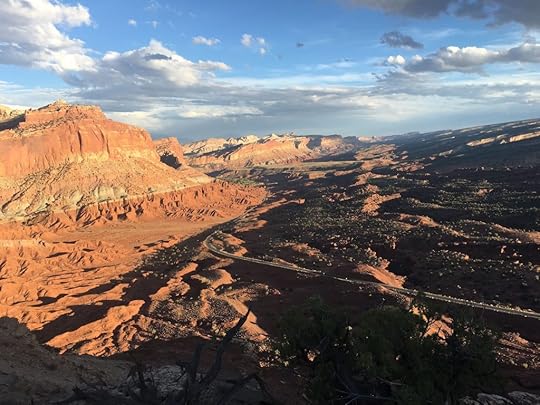 The sunset from Chimney Rock Loop.
Like a lot of small towns in southern Utah, there are a surprising amount of good eateries in town. On one trip we had a great time staying at the Thousand Lakes RV Park (not-so-aptly named). They have a delicious chuck-wagon dinner for a reasonable price.
Saturday MorningI hope you slept well last night because you’re in for a big day today. Climb out of your sleeping bag in the cool dark morning while the stars are still twinkling. Cassidy Arch is probably the second most popular hike of the park and well worth the sunrise climb. With no shade across the desert rock, this 3-mile hike is best done in the morning if visiting in the summer. But, honestly, most hikes are best done in the morning or evening if visiting in the summer.
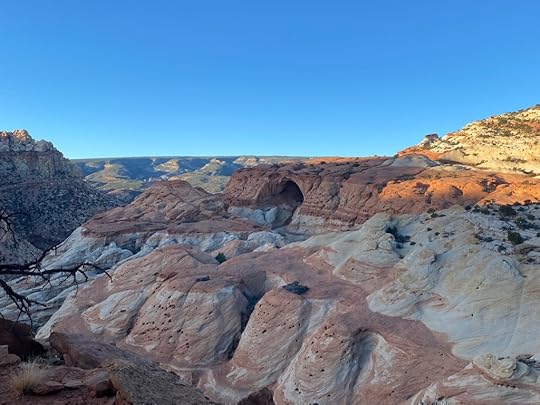 It’s not a long hike to your first glimpse of this magnificent arch.
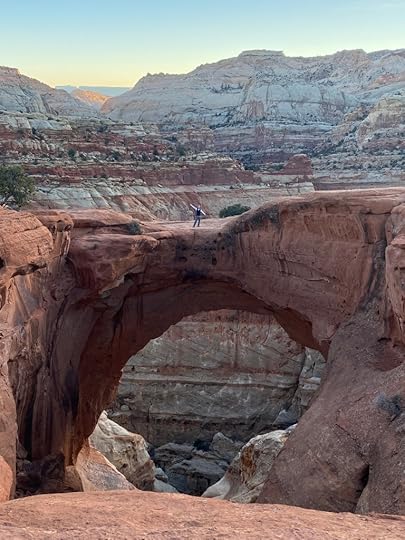 As amazing as that first glimpse is, nothing compares to experiencing it up close. Fun fact: the tree on the left serves as the first tie for rappellers descending into the depths below.
If hiking before dawn isn’t enough to draw you out of a comfy sleeping bag, I have an even better reason. After your hike, head as fast as you can to the Gifford Homestead. These old farm buildings are the remnants of the pioneer settlers who established the tiny town of Fruita (aptly named). They established several fruit-ladden orchards along the Fremont River.
These orchards still produce today, providing the homestead with local fruit for the best homemade pies you’ll ever get in a national park. If you get there early enough, this individual sized pies will come out warm. Do yourself a favor and get the little servings of ice cream to go along with.
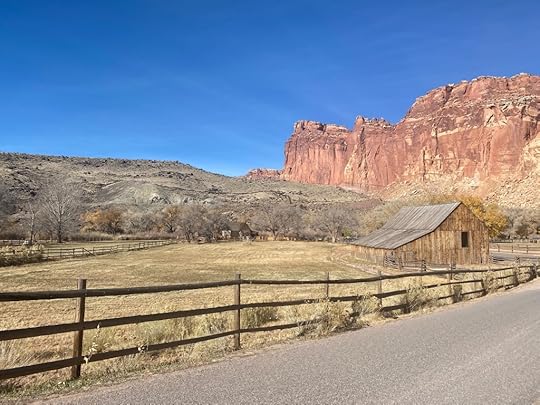 The Gifford Homestead. The pies, along with several other delectable treats, can be found in the old farmhouse.
 Saturday Afternoon
As I mentioned before, trails and shade in Capitol Reef don’t go hand in hand. There are a few trails where the water cut through the high rocks, making some shadier canyons. The Capitol Gorge Trail carries you through one these canyons down what once was a roadway. You can still see some old power lines and names of the pioneers carved in the rock.
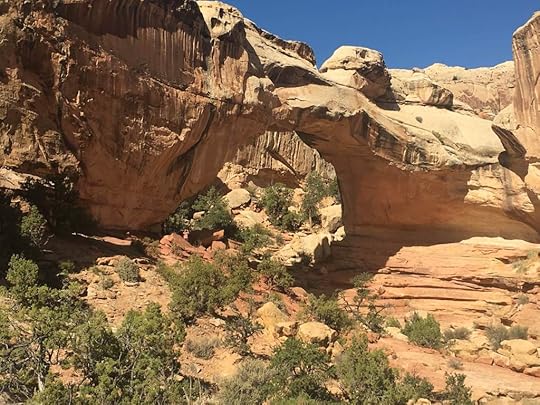
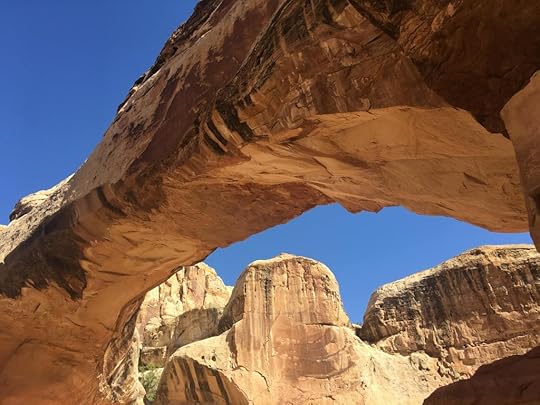
Saturday EveningTired yet? That’s alright because your last hike of the day to Hickman Bridge is an easy one and the most popular in the park. This 1.7 mile hike takes you right under and through this awesome bridge.
 Sunday Morning
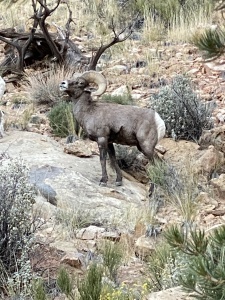 Bighorn ram
I’d encourage you to once again pull yourself out of that cozy sleeping bag for another dawn hike (and pies). While the views on the Golden Throne trail aren’t quite Cassidy’s Arch equal, they are still jaw-dropping. Going early in the morning also gives you the best opportunity to spot the Bighorn sheep herds that frequent the park.
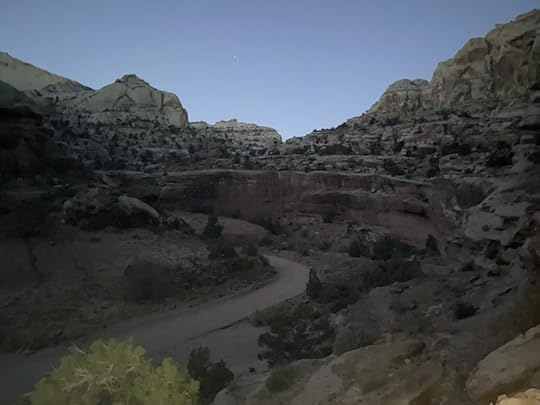 Starting up the Golden Throne trail at dawn.Camping at Capitol Reef
This park has one of the most beautiful and welcoming campgrounds in the state, but it’s definitely hard to get into during peak seasons (March through October). There are some BLM spots outside the park and a few RV parks in town if necessary.
May 23, 2022
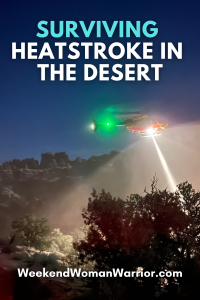
Surviving Heatstroke in the Desert
Subscribe to the Newsletter
I’m rather embarrassed by this but I feel it’s important for others to learn from my mistakes. In mid-May, I hiked in the beautiful but very remote Needles District of Canyonlands National Park. Unfortunately, my backpacking trip ended with a helicopter ride out due to heatstroke.
I planned this trip for a year and dreamed about it for many more. We had packed in only about 2.5 miles the night before and spent a beautiful day hiking Chesler Park in the Canyonlands Needles District. Our giant loop took us around 12 miles with very little shade and no clouds. The temperatures that day were in the high 80s by the afternoon but much cooler in the morning. I didn’t know this then but according to a park ranger, the sand and rock can get 10 to 20 degrees hotter.
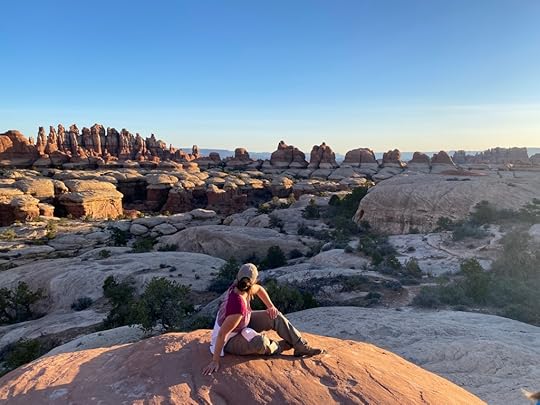 At dawn when the temperatures were cool but the sun hinted at what was to come.
We returned to the campsite around 3 pm. While I felt hot on the trail, I didn’t feel sick and I had drank lots of water infused with Nuun tablets. Once back to my tent, I drank a lot more electrolyte water. Despite being done and as the day wore on, I felt worse and worse. I had a headache, nausea, and dizziness. I still wasn’t too worried as I figured once the sun went down, I’d bounce back.
Unfortunately, I only worsened until about 7 pm when I started to throw up. I got clammy and shaky and my stomach tightened, making it impossible to drink or stand. That’s when I got scared. I have an InReach GPS and I set off the SOS rescue signal. Luckily, I was with three women with level heads who kept watch on me. It took a few hours for the first ranger to reach us. I tried to walk out to meet him (I mistakenly thought they would bring a stretcher and wanted to save time), but immediately grew dizzy and had to return to the tent.
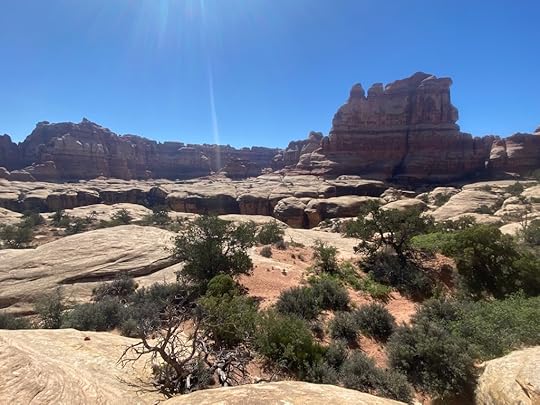 Mid-day without an inch of shade in sight. I faltered a bit then but stopped to eat lunch and felt ready to take on the last three miles (also the most grueling). At this point, the air temps were probably around 80.
Not long after the ranger arrived, I started to finally rebound and the tightness and shaking abated. An EMT gave me an anti-nausea pill, which helped a lot. A helicopter was already en route as Canyonlands takes heatstroke seriously, having lost a visitor last year to it. The man sadly made a lot of mistakes, including hiking in 100-degree temps with no ability to message for help.
I was given the choice to stay put for the night, get a ride to the trailhead, or be taken to the hospital in Moab. By that time, I was feeling a little better but was scared about staying the night and walking out the next morning. (I collapsed once due to heatstroke years ago.) I asked to go to the trailhead.
Once there, I was able to sleep in my car where we had a cooler full of Gatorades and water. By the next morning, I felt a lot better but was still dizzy and nauseous and relieved I didn’t have to hike out. My companions hiked out under the moonlight and met me at the trailhead.
What I Did WrongI should’ve started earlier. While we were on the trail by 6 am, I didn’t understand how much hotter 85 degrees would be in the desert. I should’ve drank a lot more electrolyte water the previous day. While I drank lots on the trail, it wasn’t enough.Beyond my electrolyte water, I didn’t have anything else to alleviate my heat. I took a salt pill but not until after I got sick. I should’ve planned better.I changed the plan. I originally intended one loop where I would drop out early if necessary (there’s a trail that cuts the loop in half). A ranger recommended we go a different route, which meant I couldn’t drop out early. I should’ve known my limitations and not changed the plan.I actually gave blood the Tuesday before and I’m not sure if that weakened me.What I Did RightI have my InReach GPS anytime I go into the backcountry and have for years. This was the first time I had to use it. I got out instead of pushing through due to misplaced pride. The ranger said that it’s really hard for the body to rebound on the trail and it’s better to get out. I think if I’d ended the hike at my car versus the backcountry, I would’ve been fine. I just couldn’t control my temps still out in the desert.I trained a lot for this hike, including taking my pack and practicing with weight on steep inclines. I’m still surprised I went down so hard.I’m grateful to my companions for their aid and patience. I’m grateful to the rangers, EMTs, and pilots for their skills. I’ll never forget the helicopter buzzing the red rock canyons in the moonlight and wished I could’ve sat up and enjoyed it more. I’m grateful to enjoy the backcountry and will return but more prepared and humbled.
For an outdoor adventure without ever having to get outside, check out the Lost Gorge Mystery series!

Follow on Pinterest here!
 Save for later!
March 11, 2022
Tips for Surviving Your First RAGNAR
As I was the slowest member of my team, this post won’t be tricks on how to train better (other than starting to train more than four weeks out, my bad). This post will have little tips and tricks to survive your first RAGNAR and not die in the darkness on the trail.
Just in case, you stumbled on this site with no idea of what RAGNAR is, here’s a quick summary. RAGNAR is a relay running race that can last 24 hours with races happening all over the country. Each team member is assigned different legs of the race. Some road races can cover hundreds of miles with team members following the race along in a car. Other trail races are in one place with team members camping out while waiting their turn.
Should I Do RAGNAR?Heck yes, if you want to. The hard part is you need a team and getting people to run miles in the middle of the night isn’t always easy. If you have the chance, go for it. It’s a lot of fun and a great way to build friendships. Some teams go to win and some go for the experience. I am a way slow runner (11-minute mile) and was the slowest on my team but I finished and had a blast doing it.
Crazy enough, the 3 am four-mile run I did was by far my favorite time in the race. There was something magical about running through the desert with only the few feet of sand lit in front of me.
What Do I Even Wear?I know it’s technically one race but trust me, you’re going to need a change of clothes. We had about six hours between each leg and walking round in clothes I just ran up a mountain in was not ideal nor comfortable. Even if it’s just clean underwear and a top, it’s well worth it. Some brought PJs; some didn’t. I had a run at 3 am so I just slept in my running clothes.
Take extra shoes—especially if you’re trail running. You might be in deep sand or deep mud. I also took shoe gaiters, which wrap around the shoe and your ankle to prevent dirt from falling in a shoe. Try these out before you go. Mine rubbed me pretty raw.
What to CarryFor my run, I carried water (bring extra, both my belt and vest hydration broke), phone, buds, and sunglasses or a headlamp. I also slipped in a credit card so that immediately after my race, I could hit up the base area and buy massages, food, and other fun stuff.
Getting ThereGet there early! We thought arriving the day before the race would be sufficient to get a campsite. It. Was. Not. We ended up camping up a hill a half-mile from the starting line in the sand. It was a little disheartening to know that when you finished your race, you had more to go. Not to mention, the walk to the bathrooms. (We had to haul all our gear in with a cart as cars weren’t allowed.)
This is why I carried a credit card with me so I didn’t have to add on another mile to my race to get a drink or some food.
Be sure to check your race’s location. While we could easily get into our race venue with a car, parking required a four-wheel drive.
[image error]March 2, 2022
Getting Hit On on Goodreads
They don't ask about books or anything reading related. They compliment my looks (not books) or start off with an innocuous, 'how's it going' message that escalates.
I have never received anything similar from another woman. It has gotten to the point, I reject most friend requests from men. Occasionally, I accept one if it looks like the man has an active reading list, but every time I still get the personal message.
I'm to the point, I will refuse any and all friend requests from men, which I hate to do.
Goodreads is NOT a dating site.