
Juho Pohjalainen's Blog: Pankarp - Posts Tagged "races"
Orcs - Fantasy, Racial Familiarity, and Mundanity
I've seen a lot of discourse about fantasy racism these past couple days, especially with the context of orcs. This got me thinking about such racial matters in general. I thought I'd throw in my own two cents.
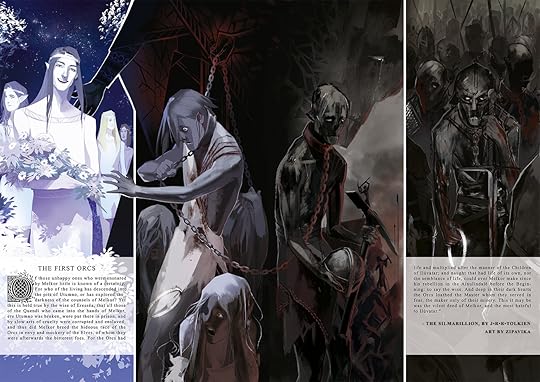
Tolkien - the father of modern fantasy - spawned his nonhuman races out of the old human mythology, fairy tales, and shared consciousness. Elves were like humans except far more magical and spiritually connected to the world; orcs were then the result of basically Lucifer himself getting his grubby hands on some elves; dwarves were the creation of a different god, dwellers under the earth, resilient as stone and greedy for gold and other shining metals; finally, the hobbits just sort of showed up, pudgy little folk with a love for idyllic life and peace, the closest to regular human. Some of them had in common with real-life nationalities and cultures - according to Tolkien himself, dwarves have more than a touch of Jewish in them, orcs Mongolian, and hobbits of course are basically British countryside dwellers - but these had a fairly minor role in their creation, helped by the man himself disliking allegory. All of them were also quite insular and had little to do with the businesses of other races: the Council of Elrond, the races coming together to address a grave issue, was an anomaly that was noted in-universe. On the whole they had strongly mythical roots, and drip with magical and fantastic flavour. All was well.
Then Dungeons & Dragons poached them into its great big fantasy patchwork. Now any player could roll up an elf, a dwarf, or ahobbi halfling; and every DM liked to use orcs as their basic mooks. Half-elves were codified into a race of their own, and soon after, so were the half-orcs... with fairly disturbing implications for the latter, at first. Gnomes were brought along from elsewhere, the enemy ranks swelled with kobolds and gnolls and others, and soon the world teemed with all manner of fantasy races great and small - and they quickly grew a familiar, even a mundane, sight in any fantasy setting.

And once you grow familiar with something, the next step is to explore and expand - to stretch its definitions, to ponder its identity, and to deconstruct what it all means. It didn't take long before the players wanted to be the orc rather than kill it, be it in a game of flipped perspectives where the whole party took up the role of the bad guys, or as a singular heroic individual who's fled home and wants to do good things, or a half-orc whose parents actually loved one another, or an orc wizard, or really just about anything else. At this stage, your imagination is the limit.
By now it seems like D&D's become the new standard bearer of fantasy - the introduction of the concept for most people, the originator of new ideas, and the wellspring of new fantasy and literature. It's next to impossible to write a fantasy story without it having been influenced by D&D in some way or the other - either by embracing it, or by consciously rejecting it. In it, magic and fantasy are a pretty standard fare, all over the place and accessible to everyone. The new races it added later on - genasi, tiefling, and dragonborn among others - followed this trend, each having their cultures and their nations and each blending in with humans just fine. It all tends towards the melting-pot feel, very much a modern concept... and indeed tied to modern sensibilities and attitudes in many other ways as well, the interpretations of morality and good and evil, the ideas of equality and inclusiveness.
All of this finally culminates to the topic of the present - racism. The big question on everyone's lips is, are orcs racist? Do they have to be racist? How to fix it?
But I reject these, and instead bring forth a whole other issue: What difference is there between these races, and plain old humans? How are they not just humans with tusks or pointed ears and other meaningless window-dressing?

The metamorphosis - the mundanization - is now complete. Through the twists and branches of a hundred-year-old evolutionary tree, the roots of mythology are now forgotten. Through intense familiarization and numerous deconstructions and parodies, the magic and fantasy is lost. "Fantasy" is no longer a description, but a genre, with medieval technology and various squat bearded and pointy-eared and green tusked people. The "orc" is no longer a strange mythical horror, he's your neighbour. The cultural counterparts and allegories, once a minor footnote, have grown to the forefront of their identity - because at this point, what else is there?
This is the great underlying issue for me - the dragon that gnaws at the tree of fantasy. I solve it by taking several big steps back. I grab all the nonhuman races and hide them back into the corners of the earth. You have to go looking for them, and therefore they remain fantastic and weird.

But where Tolkien tapped into mythology for his inspiration, I tend to look outward, into the realm of science fiction. My races tend to be substantially more different from humans, with many physical and mental traits that we might find utterly alien, just as they would never understand many facets of humanity.
Peal is not human, and I emphasize this inhumanity whenever it would be relevant. His size, his senses, his natural habitat, the faiths and superstitions drummed into him as a youth, all serve to separate him from humanity even after he's spent many years living among us. He still considers us weird or disgusting in many ways, while we in turn often find his way of thinking difficult to understand. It is a constant theme in the stories starring him - how humans might be viewed from an outsider's perspective.
I still have elves and orcs around, but you're not going to see them any more than you're going to see bugbears, which is very little indeed. I hope that I can maintain their fantastic elements forevermore.
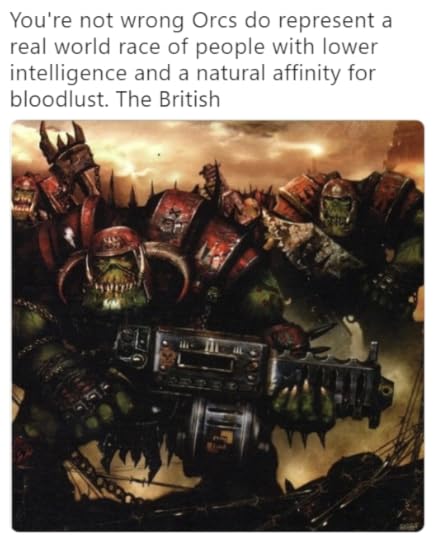
Tolkien - the father of modern fantasy - spawned his nonhuman races out of the old human mythology, fairy tales, and shared consciousness. Elves were like humans except far more magical and spiritually connected to the world; orcs were then the result of basically Lucifer himself getting his grubby hands on some elves; dwarves were the creation of a different god, dwellers under the earth, resilient as stone and greedy for gold and other shining metals; finally, the hobbits just sort of showed up, pudgy little folk with a love for idyllic life and peace, the closest to regular human. Some of them had in common with real-life nationalities and cultures - according to Tolkien himself, dwarves have more than a touch of Jewish in them, orcs Mongolian, and hobbits of course are basically British countryside dwellers - but these had a fairly minor role in their creation, helped by the man himself disliking allegory. All of them were also quite insular and had little to do with the businesses of other races: the Council of Elrond, the races coming together to address a grave issue, was an anomaly that was noted in-universe. On the whole they had strongly mythical roots, and drip with magical and fantastic flavour. All was well.
Then Dungeons & Dragons poached them into its great big fantasy patchwork. Now any player could roll up an elf, a dwarf, or a
And once you grow familiar with something, the next step is to explore and expand - to stretch its definitions, to ponder its identity, and to deconstruct what it all means. It didn't take long before the players wanted to be the orc rather than kill it, be it in a game of flipped perspectives where the whole party took up the role of the bad guys, or as a singular heroic individual who's fled home and wants to do good things, or a half-orc whose parents actually loved one another, or an orc wizard, or really just about anything else. At this stage, your imagination is the limit.
By now it seems like D&D's become the new standard bearer of fantasy - the introduction of the concept for most people, the originator of new ideas, and the wellspring of new fantasy and literature. It's next to impossible to write a fantasy story without it having been influenced by D&D in some way or the other - either by embracing it, or by consciously rejecting it. In it, magic and fantasy are a pretty standard fare, all over the place and accessible to everyone. The new races it added later on - genasi, tiefling, and dragonborn among others - followed this trend, each having their cultures and their nations and each blending in with humans just fine. It all tends towards the melting-pot feel, very much a modern concept... and indeed tied to modern sensibilities and attitudes in many other ways as well, the interpretations of morality and good and evil, the ideas of equality and inclusiveness.
All of this finally culminates to the topic of the present - racism. The big question on everyone's lips is, are orcs racist? Do they have to be racist? How to fix it?
But I reject these, and instead bring forth a whole other issue: What difference is there between these races, and plain old humans? How are they not just humans with tusks or pointed ears and other meaningless window-dressing?
The metamorphosis - the mundanization - is now complete. Through the twists and branches of a hundred-year-old evolutionary tree, the roots of mythology are now forgotten. Through intense familiarization and numerous deconstructions and parodies, the magic and fantasy is lost. "Fantasy" is no longer a description, but a genre, with medieval technology and various squat bearded and pointy-eared and green tusked people. The "orc" is no longer a strange mythical horror, he's your neighbour. The cultural counterparts and allegories, once a minor footnote, have grown to the forefront of their identity - because at this point, what else is there?
This is the great underlying issue for me - the dragon that gnaws at the tree of fantasy. I solve it by taking several big steps back. I grab all the nonhuman races and hide them back into the corners of the earth. You have to go looking for them, and therefore they remain fantastic and weird.
But where Tolkien tapped into mythology for his inspiration, I tend to look outward, into the realm of science fiction. My races tend to be substantially more different from humans, with many physical and mental traits that we might find utterly alien, just as they would never understand many facets of humanity.
Peal is not human, and I emphasize this inhumanity whenever it would be relevant. His size, his senses, his natural habitat, the faiths and superstitions drummed into him as a youth, all serve to separate him from humanity even after he's spent many years living among us. He still considers us weird or disgusting in many ways, while we in turn often find his way of thinking difficult to understand. It is a constant theme in the stories starring him - how humans might be viewed from an outsider's perspective.
I still have elves and orcs around, but you're not going to see them any more than you're going to see bugbears, which is very little indeed. I hope that I can maintain their fantastic elements forevermore.


More on "evil races"
These past couple days I've been gunning down a lot of Nazis... but unlike when I was a kid, my heart's not really in it anymore.
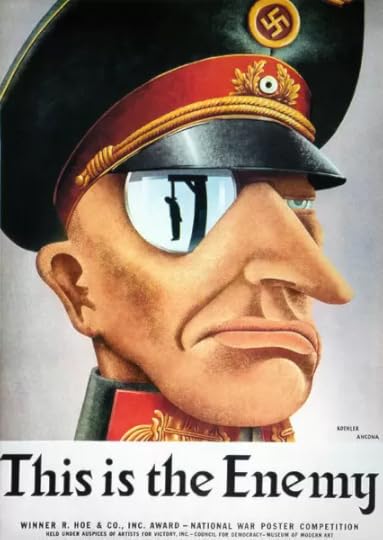
They're supposed to be the closest the human race has to demons from hell - you should be able to mow them down in dozens and not feel a twinge of regret. But I just can't. What's going on?
Reflecting on it, I'm pretty sure that Humankind: A Hopeful History is to blame. It taught me more about the essential kindness of our species, the love and compassion and hope that lies in the core of even the war and other atrocities we commit. More specifically, it pointed out that even the German soldiers in WW2 fought not for the Nazi ideology, nor against the French and Americans and other enemies, but simply for the love they felt to their fellow soldiers. And I now feel that they do it even in video games - such as Wolfenstein, which I've been playing - and that even though the game gives me no other choice but to kill or be killed, I feel pretty bad doing it now.
Does this mean I can no longer enjoy a lighthearted action romp, videogame shoot-'em-ups or Indiana Jones movies? That you'd have to either establish the enemy as humongous dickbags beyond the uniform they wear (show them gun down civilians, or at least sneer at the main hero), or take the whole thing as a black comedy? Or else be forced to accept the moral greys of things, and not being able to just feel good about an evil being defeated? Perhaps it's not so bad, anyway: all of those options would almost-invariably be deeper and more satisfying than just turning your brain off for a while.
Or you could instead use your brain in finding justification. Make it work.
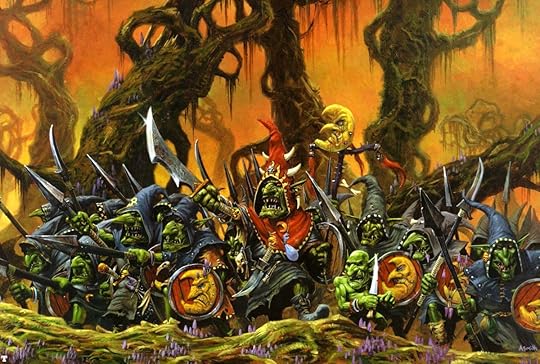
Great many fantasy enthusiasts in these past couple years have started to reject the notion of evil races entirely. I've written on the subject before myself, both on the nature of evil, and on races such as orcs and their ilk: I like nonhuman races that are inherently alien to us, rather than just humans with some green paint and tusks; and I don't like to throw the word "evil" around lightly. If I am now to create a race that would qualify as most definitely evil, then it'd be more an exception than a rule for me, perhaps just a mental exercise rather than something I'd legitimately write about. But I'm thinking about it now, so here we go.
Looking back at the Humankind book, it's been made apparent that us humans are actually pretty nice folk when you get down to it. We don't like to kill each other; we instinctively jump to the help of one another when we're in trouble; we like to make friends and be social, and more often than not, try to do the right thing. The book calls it "Homo Puppy".
Creating an "evil" race would therefore be a simple matter: just remove this puppiness.
The members of this race don't particularly care to help anyone, even one another. They're not here to make friends and have no problem with killing. No moral compunctions get in the way of their selfish desires and actions. By the standards of humans, they could each of them be diagnosed as sociopaths.
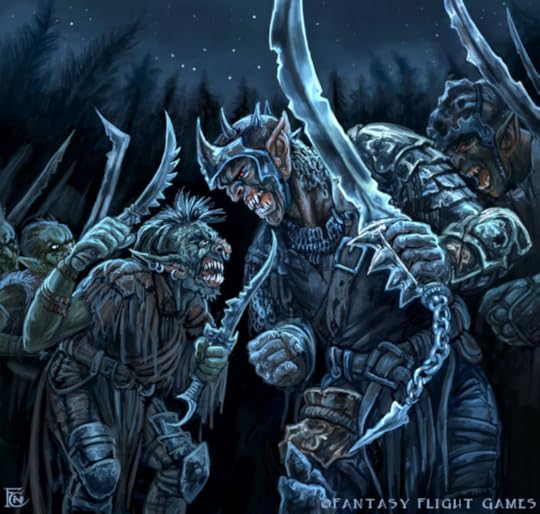
How would they survive, then? By breeding like rabbits and growing fast. This will have the added benefit of them always coming in swarms, giving the heroic badass protagonist plenty to cut down in gory action scenes.
And how did they come to be in the first place? They don't seem the type to thrive by cooperation: rather, evolution (or some warrior-god) would have come up with them as an extreme illustration of the ideal of Survival of the Fittest: plenty of them are spat out into the world, but only the strongest, the toughest, or the most cunning of them ever survive to continue their bloodline. Strongly individualistic, looking to do things on their own and shun aid whenever possible: clever, self-sufficient, and very fast learners - those that weren't, would never make it to adulthood.
If any of them manage to make it out alive of your heroic massacre, you best beware: they'll learn from their mistakes and come back so much stronger and cleverer. Always confirm kills.
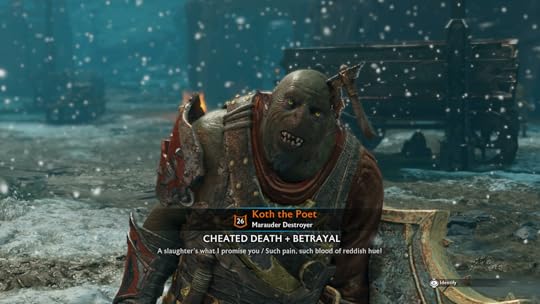
Yet for all of this... if you are the type that would like some moral greys and diplomacy in your stories, none of this still precludes making friends with a few. If met in peacetime, they might enjoy your company on an intellectual level, not rush into killing you - look for alternatives - even help you out in a pinch if there's something to it for them. Golden Rule is rooted less in compassion, far more in greater long-term payoff - they could most definitely understand it, and help people in return for assistance to themselves. Just that they'd be rather more mercenary about it.
But even so, the world would most assuredly be better off without them. So don't feel bad if you need to kill a bunch in a war. They're like double-nazis that way.
...Say. A lot of modern research suggests that neanderthals were quite smart and inventive individually, but had very little instinct in sharing their discoveries or helping each other out in general. The Humankind book above compared them to powerful modern computers, while humans were older and slower machines but with a working WiFi. That's got a lot in common with what I just went on about.
Were neanderthals the real-world orcs? Were they all killed off because they were a bunch of evil conquering psychos, possibly in the service of a dark lord?
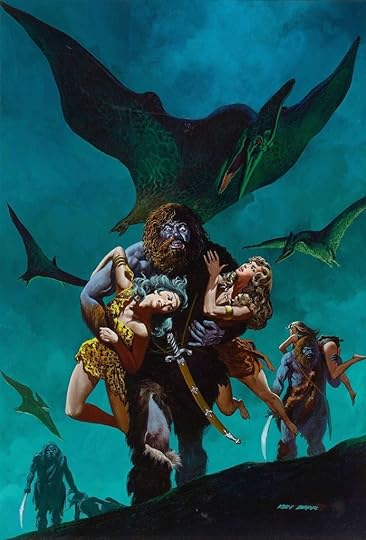
If so, that just goes to show that if you live in a fantasy world, you better get on killing evil now and kill them fast, before they run out altogether. Get going while the going's good.
(I have absolutely no relevant education or decrees. My only trait is overthinking.)
They're supposed to be the closest the human race has to demons from hell - you should be able to mow them down in dozens and not feel a twinge of regret. But I just can't. What's going on?
Reflecting on it, I'm pretty sure that Humankind: A Hopeful History is to blame. It taught me more about the essential kindness of our species, the love and compassion and hope that lies in the core of even the war and other atrocities we commit. More specifically, it pointed out that even the German soldiers in WW2 fought not for the Nazi ideology, nor against the French and Americans and other enemies, but simply for the love they felt to their fellow soldiers. And I now feel that they do it even in video games - such as Wolfenstein, which I've been playing - and that even though the game gives me no other choice but to kill or be killed, I feel pretty bad doing it now.
Does this mean I can no longer enjoy a lighthearted action romp, videogame shoot-'em-ups or Indiana Jones movies? That you'd have to either establish the enemy as humongous dickbags beyond the uniform they wear (show them gun down civilians, or at least sneer at the main hero), or take the whole thing as a black comedy? Or else be forced to accept the moral greys of things, and not being able to just feel good about an evil being defeated? Perhaps it's not so bad, anyway: all of those options would almost-invariably be deeper and more satisfying than just turning your brain off for a while.
Or you could instead use your brain in finding justification. Make it work.
Great many fantasy enthusiasts in these past couple years have started to reject the notion of evil races entirely. I've written on the subject before myself, both on the nature of evil, and on races such as orcs and their ilk: I like nonhuman races that are inherently alien to us, rather than just humans with some green paint and tusks; and I don't like to throw the word "evil" around lightly. If I am now to create a race that would qualify as most definitely evil, then it'd be more an exception than a rule for me, perhaps just a mental exercise rather than something I'd legitimately write about. But I'm thinking about it now, so here we go.
Looking back at the Humankind book, it's been made apparent that us humans are actually pretty nice folk when you get down to it. We don't like to kill each other; we instinctively jump to the help of one another when we're in trouble; we like to make friends and be social, and more often than not, try to do the right thing. The book calls it "Homo Puppy".
Creating an "evil" race would therefore be a simple matter: just remove this puppiness.
The members of this race don't particularly care to help anyone, even one another. They're not here to make friends and have no problem with killing. No moral compunctions get in the way of their selfish desires and actions. By the standards of humans, they could each of them be diagnosed as sociopaths.
How would they survive, then? By breeding like rabbits and growing fast. This will have the added benefit of them always coming in swarms, giving the heroic badass protagonist plenty to cut down in gory action scenes.
And how did they come to be in the first place? They don't seem the type to thrive by cooperation: rather, evolution (or some warrior-god) would have come up with them as an extreme illustration of the ideal of Survival of the Fittest: plenty of them are spat out into the world, but only the strongest, the toughest, or the most cunning of them ever survive to continue their bloodline. Strongly individualistic, looking to do things on their own and shun aid whenever possible: clever, self-sufficient, and very fast learners - those that weren't, would never make it to adulthood.
If any of them manage to make it out alive of your heroic massacre, you best beware: they'll learn from their mistakes and come back so much stronger and cleverer. Always confirm kills.
Yet for all of this... if you are the type that would like some moral greys and diplomacy in your stories, none of this still precludes making friends with a few. If met in peacetime, they might enjoy your company on an intellectual level, not rush into killing you - look for alternatives - even help you out in a pinch if there's something to it for them. Golden Rule is rooted less in compassion, far more in greater long-term payoff - they could most definitely understand it, and help people in return for assistance to themselves. Just that they'd be rather more mercenary about it.
But even so, the world would most assuredly be better off without them. So don't feel bad if you need to kill a bunch in a war. They're like double-nazis that way.
...Say. A lot of modern research suggests that neanderthals were quite smart and inventive individually, but had very little instinct in sharing their discoveries or helping each other out in general. The Humankind book above compared them to powerful modern computers, while humans were older and slower machines but with a working WiFi. That's got a lot in common with what I just went on about.
Were neanderthals the real-world orcs? Were they all killed off because they were a bunch of evil conquering psychos, possibly in the service of a dark lord?
If so, that just goes to show that if you live in a fantasy world, you better get on killing evil now and kill them fast, before they run out altogether. Get going while the going's good.
(I have absolutely no relevant education or decrees. My only trait is overthinking.)
Pankarp

Pages fallen out of Straggler's journal, and others.
...more
- Juho Pohjalainen's profile
- 349 followers

