Clarissa Gosling's Blog
February 22, 2021
Fae Bargains - available now!
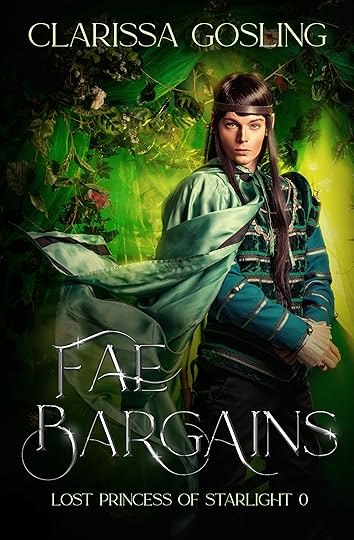
Faerie punishments usually spell death.
For Evan, it could offer freedom.
As reluctant heir to the Moonlight Court, Evan would take forest games over a royal crown any day. But when he’s caught sneaking humans into faerie for fun, the fearsome Huntsman of the Forest delivers a fateful ultimatum: give up the throne to serve as Guardian of the gates between realms or face the wrath of the combined Courts of Faery for breaking the Treaty of the Yews.
With a chance to escape the dreaded role he was born to finally within reach, Evan is willing to do whatever it takes to claim the Huntsman’s bargain. But it’s easier said than done when his mother, the domineering Queen of Moonlight, orders him to go on a last royal mission that pits him against his heart.
With his future on the line, can Evan complete this final task…or will he unwittingly set into motion the greatest betrayal known to faekind?


August 31, 2020
Self-publishing 17: Blurbs & cover copy
For the next instalment of my series on self-publishing here is a short post on book blurbs.
[image error]
Once you are preparing to upload your manuscript and sell it you need to have a blurb – this is the few paragraphs of text that show on the book page on each retailer and give the readers a taste of the story and hook them in to purchase it.
Man, these are harder to write than the book itself. Summarising the key characters, conflicts and world into less than a hundred and fifty words is a different skill to writing the novel. So don’t expect to be good at it the first time you try, or the fiftieth time you try.
Personally I like to write a version of the blurb early in my drafting process, then I can have that and the cover printed out to look at and inspire me while I am writing the story. I will then revise it as it gets closer to the launch of the book, to make it as strong as I can. Then, if I feel that the book isn’t preforming as well as I had hoped I can tweak the blurb to emphasise different parts of the story or to have a different feel. Blurbs aren’t set in stone and you can change them to see which does better.
Things to include in your blurb: the main character, the world, their goals, the conflict, and the stakes. All within a hundred and fifty words. This is a tall order and writing good blurbs is difficult. Somehow it is easier to write good blurbs for someone else’s story, so find other authors who you can critique each other’s blurbs so that they can all get stronger.
Look at other blurbs within your genre to see how they describe their book, and the keywords they are using. See how they hook the readers in at the beginning, and their call to action at the end. Then apply that to your story.
Think about how you can use bold and headings to draw the eye to the most important parts. You can use the kindle book description generator to create the code to make the blurb look as you wish it to on the sales site. This is especially important for Amazon where, if you’re not careful, you end up with one block of text.
NB The blurb on your retailer and the copy on the back cover of your paperback don’t have to be the same. Often they might start out the same, but as you refine the blurb for the retailers you won’t always update the text on the back cover – this requires you to get updated image files from your cover designer, and so is more difficult than updating the text on the retailers.
Blurbs are something that I am very much a novice at, so I would advise you to look around for more advice and study what other people have used successfully. They are vital though, as a good blurb and a good cover are two of the most important marketing tools you have to sell your book.
August 24, 2020
New books coming soon!
If you’ve been following me on social media you will have seen hints that I have been working on a series about fae. And earlier in the year I mentioned it in my post on my publishing plans for the year I am now pleased to announce that the first book in the Lost Princess of Starlight series will be Fae Fair, which I plan to release at the end of April next year. (The preorder is available on most retailers.)
But, if you can’t wait that long, then a prequel novella will be released in an exclusive anthology next month.
Fae Bargains
Faerie punishments usually spell death.
For Evan, it could offer freedom.
As reluctant heir to the Moonlight Court, Evan would take forest games over a royal crown any day. But when he’s caught sneaking humans into faerie for fun, the fearsome Huntsman of the Forest delivers a fateful ultimatum: give up the throne to serve as a guardian of the gates between realm or face the wrath of the combined Courts of Faery for breaking the Treaty of the Yews.
With a chance to escape the dreaded role he was born to finally within reach, Evan is willing to do whatever it takes to claim the Huntsman’s bargain. But it’s easier said than done when his mother, the domineering Queen of Moonlight, orders him to go on a last royal mission that pits him against his heart.
With his future on the line, can Evan complete this final task…or will he unwittingly set into motion the greatest betrayal known to faekind?
Read this prequel novella to the
August 17, 2020
Think Like A Writer In 10 Minutes A Day
Guest post by Katharine Grubb from 10 Minute Novelists
Are you a writer? Or are you not one? Do you see yourself as a writer?
Have you fallen in love with the written word? Have you ever savored a story, wondered how words came together, longed to see your name on a cover?
Have you ever thought you’d like to create something, anything, with words, but you don’t know how?
[image error]
The first step? See yourself as one. Then, as you get used to this new “identity”, you can take steps to physically and emotionally set yourself up to be productive. This will mean creating a writing space, organizing your time, seeking inspiration, and writing regularly without fear.
I made this jump from non-writer to writer back in 2006. I had five children, all eight years old and younger, and decided that it was time to restart my lifelong dream to be a writer. Once I saw myself as a writer, grew in organization and discipline, and conquered my fears, I finished projects and published them. Since 2006, I’ve written ten books.
My newest book Think Like A Writer In 10 Minutes A Day is for the hesitant writer who hasn’t made that jump yet from non-writer to beginner. This book is for that critical first step: to think like one.
The three sections in it: Logical Thinking, Emotional Thinking, and Resistant Thinking gently helps the wannabe organize their space and time, rein in their emotions, and fight discouraging thoughts that creep up. Each section has several exercises, all short and doable in small increments of time, so that newbie writers can work at their own pace.
Brenda Ueland said in If You Want To Write: “Everybody is talented because everybody who is human has something to express.” If you have a desire to write, even if you don’t have a clue what it would be, then the next step is to see yourself as a writer, think like one, and begin your journey.
Think Like A Writer in 10 Minutes A Day will be released late summer 2020. Sign up here for pre-order information.
[image error]
Katharine Grubb is an almost-done-homeschooling mother, poet, hybrid author, camping enthusiast and confident home cook who thinks that she is the funniest person in her family. She is the founder and CEO of 10 Minute Novelists and lives in Central Massachusetts, USA, with her husband and a ever-varying number of her five mostly-grown children. She is the author of Write A Novel In Ten Minutes A Day (Hodder & Stoughton, 2015.)
August 10, 2020
My ideal week: 2020 version
I find the start of a new school year to be a good time to work out how I’m going to structure my week and to come up with a vision of what my ideal week would look like. I start with the big things that can’t be moved, add in all the everyday things that need to get done, and then work out what time is left and what I want to do in it.
[image error]
This year is unusual, as everything is more up in the air than it often is. As far as I know the schools will be returning to business as usual at the start of term next week. But there is a real possibility that at some point in the future everything will shut down again and I will be home-schooling the children again. So what do I plan for? Do I make a weekly plan for them going to school and going back to all their normal activities? Or do I make a plan for continuing home-schooling and trying to work alongside them? Or do I do both? Of course, I am working out what to do in both scenarios.
I like to know what is going to happen and what I will be doing. So this uncertainty is difficult for me. I struggle to make any decisions at all as I don’t know what things are going to be like next week, next month, or next year. Well, maybe next week I can guess at, but the others are too up in the air to even do that. And my controlling nature can only handle that by stopping thinking about the future at all. So for the last few months I have been not daring to look further ahead than a few days, or a week. As that is about as far ahead as I can make decisions with any certainty that they will come to pass.
I’m trying my best to keep on top of all the things that are going on and what we are meant to be doing, but I rely on the calendar alarms on m phone to remind me. And I’m not going to apologise for that. Technology is a great tool and it is there to help us.
My current idea for when (assuming they do) the children return to school is to split the time they are away into three sessions of about an hour and a half: two before lunch and one after. Then in the mornings I can do the first session of either drafting or editing, whichever is my primary task that week; the second session can be social media, maintaining my blog & website, admin and promotions; and the third session can flex depending on what I have to do that day. It also gives me the flexibility to swap out one of these sessions a day with doing chores, seeing friends, or jobs round the house. And I’ll have another session some evenings to return to my primary task of either editing or drafting.
If the children return to home-schooling then I think we can switch back into the schedule that we had for that before, as it seemed to work. I will need to prioritise what I do more as I will have less time to commit to editing or drafting. And those two tasks are more difficult to do in smaller pieces of time as they benefit from focused attention. But I will manage.
That’s what I keep telling myself. I will manage. I will publish these books and succeed as an author. I will see my dreams happen. Despite COVID-19 and all the current uncertainty. I don’t need to worry about what I’ll be doing three months from now; I need to worry about what I’m doing today. What is the next action to take to get to where I want to go? Then do it. Over and over, and then I will get there. Too much planning can be a handicap as you end up spending all your time thinking about the different permutations of what might happen and never actually working on the things to get there.
So I am trying to turn this uncertainty into a blessing by stopping myself from planning too far ahead, as I can’t right now, and forcing myself to focus on the next step. What is the next action to get where I want to go? That I can answer, even if I can’t answer what the schools will be doing.
July 26, 2020
Self-publishing 16: ISBNs
To isbn or not to isbn? The answer to this isn’t as easy as you might think.
[image error]
Every book needs to have an international standard book number, as an ex-librarian (gosh that sounds weird to say!) I know it is important and ties into your book being able to be catalogued and added to the systems as an official book. An ISBN is made up of series of sections, one of which is unique to the country, language or geographical region the book is from, one of which is unique to the publisher, and one of which is unique to the book. So every ISBN holds within it the details of the publisher who published the book and where it was published. Ebooks also have isbns, and these are not the same as the print book isbn. In fact every different version of a book should have its own ISBN: ebook (mobi – for kindle); ebook (epub – for every other retailer); paperback; hardback; large print; audio book; pdf (if you make it available in a pdf). So for one set of book content there will be a number of different ISBNs associated with the different versions of it. If all of those are made available by the author/publisher, which they might not be and they may only be produced if the sales of other version were high enough. (I plan to look at producing other versions of books in a future episode of this series, so I’m not going to go into this subject here as it does deserve its own post.)
As a self-published author there are generally two ways to get an ISBN for your book: The easy way and the expensive way!
The easy way is that when you upload your book to most retailers they will provide an ISBN for you.
The expensive way is to purchase ISBNs to use yourself and then allocate one to each of your versions of your book.
The benefit of the easy way is that it is free with most of the retailers to get an ISBN from them. The downside of this approach is that then the retailer is listed as the publisher, and the same version of the book through different retailers will have different ISBNs. For ebooks this doesn’t matter so much, as on the upload page you can list your own publisher name and that is normally listed on the sales page of the different retailers. But for paperbacks, if you use their ISBN then the company printing the books will be listed as the publisher, ie Amazon for a lot of them.
The benefit of the expensive way is that your publisher name is listed as the publisher of record for your books, and you can use the same ISBN for the same version of your book available from different retailers. The downside is that you have to purchase the ISBNs. How you purchase ISBNs and what they cost depends on where you are based. Because each different ISBN agency has a different code within the ISBN. You can find a list of the different ISBN agencies that sell ISBNs (https://www.isbn-international.org/agencies) and from there you can find the details of how to purchase ISBNs where you are and how much they will cost.
The costs of ISBNs vary, from being available for free, to costing $125. Most of the ISBN agencies offer tiered pricing where the bundles over severe discounts on the bulk pricing. So, for example the current USA prices are one ISBN for $125, while 10 costs $295 and 100 are $575. So the more you purchase the cheaper they all are individually, but you need a larger outlay at the start.
From what I have seen there does seem to be a move within the international ISBN agencies to move towards this bundled pricing model. It was the case that in the Netherlands you paid a one-off fee to be registered as a publisher, and then there was a lower per item cost for each ISBN. They were still bundled, and I think there was a discount for buying more at one go, but the individual prices were much lower than the US ones as you also had the registration cost as well. Now they have switched to the American model and the publisher cost has gone and the individual prices have gone up. Which is a shame, as I had researched how to do it the old way, but not made the step to register myself before they then announced the changes and stopped new people being able to register. Well, technically you could register still, but then only purchase smaller bundles of ISBNs and then they all had to be used before you could buy more, which meant it wasn’t economic for me to register at that point.
With these options you need to decide how much it is worth it to you for your publisher name to be listed as the publisher of record for your books. Is it worth the cost of the ISBNs. Or would you rather go with the free option to keep initial costs down. Certainly when you are first starting off those costs of the ISBNs are eye-wateringly high. And at that point you are likely to be unsure how this will work for you, and what sales you are likely to get. The question of how big a bundle you want to go for is difficult, as the bigger the one you go for the less the per item price is, yet the higher the overall price is. If you don’t know if you will recoup your costs adding another expense on is a risk. Yet, being the publisher of record is a step towards professionalism and taking this seriously as a career.
As with many of these questions related to self-publishing there is no right or wrong answer, and what you choose doesn’t have to stay that way. Personally I have used the free ISBNs so far, though I do plan to reassess that when I have more books out and have a better idea of how much it costs me to produce a book, and what my likely income is from each of them.
July 12, 2020
Valuing myself through a low FODMAP lifestyle
For the last few years, or so , I have been struggling with my digestion. And so at the end of last year I started seeing a dietician. On their advice I have been following a low fodmap exclusion diet. For those of you, probably most of you, who aren’t sure what that means it is cutting out the sugars that are known to be undigested by some people and to be fermented in the gut. This includes lactose (found in milk and dairy products), fructans (found in wheat products, onion, garlic and some fruits and vegetables), fructose (found in honey and fruits where that it more abundant than glucose), galactans (found in beans) and polyols (sugar alcohols found in artificial sweeteners and some fruit and vegetables).
[image error]
As you can see from this is quite a lot of different things to cut out, but I did it. And I must admit the children have been great at helping me with this. Whenever we have something new they look at me all worried, and ask if I can eat it. And they have adapted to the change of food in the house well. The fact that I cook meals, rather than eating lots of ready prepared things helps, as I am much more in control of the ingredients and can amend those, and restrict what we have much easier.
Then, after eight weeks of cutting out all of these types of food I then have done a series of tests where I re-introduced limited amounts of these on a strict schedule to then see how my body reacted to them. Doing this when the whole world shut down with an international pandemic was probably not the best time to choose to do this, but I had already started.
I did find the testing phase difficult, as the mental struggle to eat things that may (and, for me at least, mostly did) bring the symptoms back. That was far harder than the cutting out the food in the first place. And it took much longer than I had anticipated. In fact having started this whole thing in the second week of January I have only just finished. As someone who plans and likes to know what I am doing and what I am going to be doing, as much as possible, that has been another challenge as well. The whole unknowable of what the end of the process would look like. So I am doubly glad to have finished and have a way forward. Polyols I will need to cut out completely, fructose I have no reaction to so I can eat normally, and the other groups I need to limit and keep track of, but I can have small amounts.
However much I might complain about the restrictions I do feel better on it. Of the five types of foods I was cutting out I reacted to four of them, though only polyols was a strong reaction. I knew that cauliflower was evil as I’d seriously stopped liking it since I was pregnant the second time. One of the reasons I think I hadn’t really linked these was that they are on the low level side, and appear at a time after I’ve eaten them rather than straight away.
At home we have worked out how to swap all these foods out, and what I can have instead, but it is difficult to eat out. And, when we are allowed to travel again, it will be more difficult to visit and stay with anyone. I can choose to be really picky, and then have a limited amount of things I can choose from, or to eat without regard to the limitations and then suffer from my gut for up to a day or two after. So, anyone who I am likely to come and visit – prepare for a long list of things I can’t eat, or that I can only have small amounts of.
Now it is more a test of how much I value myself as to whether I pass on these details to anyone we visit/stay with. Going to them with a long list of restricted foods, especially when so many of them are such common ingredients (like onion or garlic). Dairy and wheat, though likely more common, are not as daunting because they are more known to be an issue and so there are far more options readily available for their replacement.
I know that if I eat lots of these common foods then I will feel the repercussions, but equally asking other people to go out of their way to help me is something I find difficult. When we have visitors I am happy to adapt what we eat to their dietary requirements, but I have never before been the one asking for the same. Until now. And while I am certain that anyone we do visit will be happy to do the same for us it is still uncomfortable to ask them. And yet I must, as it is important to keep my body running as well as it can. So I know I need to do it, yet it is the next daunting step in this process. One benefit of the current coronavirus situation is that this I am unlikely to to need to do this anytime soon!
June 29, 2020
Self-publishing 15: Amazon
Whether you choose to publish your ebooks exclusively to Amazon, and so join their KDP Select and make your books available through Kindle Unlimited, or you decide to make you ebooks available wide across multiple retailers, you need to learn how Amazon works.
[image error]
Amazon is a search engine, which people visit when they are looking to buy. Originally it only offered books, but now it has almost everything you might need. And it has over 50% of the print book market in the US and a much much higher proportion of the ebook publishing. Though, of course, those values change in every territory.
The key thing about Amazon, that differs from pretty much every other bookstore, online, or physical, is that Amazon personalises what it shows the customer, to try and give you what they think you are most likely to buy. As an indie author this is revolutionary, because we don’t need to buy table space at the front of the shop like in a bricks and mortar store – yes, those books are chosen because publishers pay for the booksellers to put them there. Those piles are not a sign that the workers like them or that they are the best recent books, it is purely which ones the publishers have chosen to push in that way. Though increasingly indie authors are paying to advertise with Amazon, as well as other online stores.
Now, if you’re looking on Amazon to find a book to buy there are a few ways you can go about it. The first is the search bar in the top of the screen. You can also browse through the different categories, or you can look through the Amazon bestseller lists for each category. All of these are controlled by the algorithm behind the site. Now, the exact details of that algorithm is a secret, but we can work out some things about it.
One of which is that the value of a sale/borrow decays over time. So that a sale today is worth more in the rankings today than a sale yesterday. And a sale from three months ago is worth even less. This is why many people talk about the “30 day cliff” in Amazon rankings, where your rank jumps down thirty days after your book was published, and then 60 days, and 90 days. This is because the algorithm favours newer books.
Bestseller lists
Amazon updates these hourly, and they are, as the name suggests a list of the best selling books in each category and sub-category and sub-sub-sub category. If Amazon separated it out then you can find a list of the best selling books in that sub-sub category. There is also a list of Hot New Releases – these are just the books on preorder and those published in the last three months. These are both available for print books (though that does include many ebooks and audio), ebooks, and audio books.
If your book reaches the number one spot in a sub-category bestseller list, or new release list, then your Amazon book page, and search results, will show the orange flag saying it is a bestseller, or hot new release. And when you look on the details of a book on Amazon it will tell you the book’s overall rank against all books on Amazon, and also the best ranks it has in three sub-sub categories.
Given that the different categories and sub-categories and sub-sub-categories contain differing numbers of books some of these are more competitive than others. So when you are setting up your book it is important to research which categories and sub-sub-categories are relevant and also have less books in, or books with higher ranks (and so less sales). When you upload your book to sell on Amazon there are a limited number of categories that you can choose, and these don’t always correspond to the ones that are shown to consumers. There are also some categories that only get added when you have a certain keywords in your book details, for example But once your book is uploaded you can contact the customer services and ask for them to add up to ten categories.
Browse lists
These are accessed by clicking through the different categories, or clicking on the category breadcrumbs when viewing a book. And this is where Amazon tries to put in front of you books that it thinks you will like. At the higher levels of category, as well as the Bestseller and New Release headers, there are Recommended for You and then
Search results
This is what you get back after searching in the top bar. You can search within a category, or sub-sub-category, or just the site as a whole. The search results seem to favour newer books with more sales. Often even if you search for the exact title of an older book it doesn’t rank highly. If you want your book to be listed higher in the search results then you can pay for advertising. Books that are being promoted have a Sponsored tag in the results listing so you can identify them.
International view
Now, as each Amazon store operates independently, they all have their own bestseller lists and differing search results. In fact they also have their own categories, as not all of the US ones are copied across to the other sites. So you do need to go through all the different Amazon sites that matter to you and optimise your categories etc for that site. If you are primarily based in the US and have a primarily US audience then this doesn’t make much of a difference to you. For me, I feel the US, and UK sites are definitely worth making the effort for. Possibly the Dutch and German sites too. Though I have made sales on all the sites except Mexico and Italy.
Overall
In order for your book to reach more people you want it to be listed as high up all of these listings in every store as you can. In order to do that you need to have recent sales. But needing sales so that your book is more visible and therefore will be sold more is a bit of a catch-22, or a chicken and the egg situation. Without a known name it is difficult to get traction, especially on a first book. I have no answers for bow to best do this, as I am still working on it myself.
Whole books have been written on how Amazon works and what the best way is to boost your book up the rankings without abusing the system, or placing your books where they don’t belong. So, this is barely an overview. If you’re interested in the technicalities of what you can do and how to learn more about how your book is positioned and how to improve that then I recommend you read more from David Gaughran, Dave Chesson at Kindlepreneur, and K-lytics. (I am not affiliated with any of these sites, but I have learnt from all of them. Any inaccuracies here are all from me and are no reflection of their depth of knowledge!) You can also spend time poking round the different Amazon sites, but watch out that you don’t spend too long doing that!
June 8, 2020
It’s life Jim, but not as we know it
[image error]
Things here in the Netherlands have started to open up again after what has been described as an “intelligent” lockdown. Primary schools have been back for a few weeks with half sized classes, as the children did half school at school and half school at home. From today they are now back full-time. Except my son still has one day a week home school as there aren’t enough teachers. (NB This is a national problem that the Teaching Unions have been complaining about for some years. In the time we have been going to school here we have had numerous strikes to raise attention and try and secure further funding to the sector. That has been partly successful, but the situation is exacerbated by the current crisis. Vulnerable older teachers are staying at home instead of being in front of the classroom, and there is not enough supply teachers willing to risk a new workplace to cover them all.)
The different sports clubs and activities that we do are mostly beginning again, though not always in the same way as before or at the same times. My daughter’s ballet class is now on the pavement outside the sports centre, as sport is OK to take part in again outside, but not inside. Beavers and Cubs were restricted to outside meetings, though now they can go inside but not for running about games and exertion.
It is a minefield trying to navigate what the rules are for all the different activities and how they are changing. Turning up at the right place with the right things at the right time is a manoeuvre. And then you often need to make your way through cones or taped barriers to follow the procedure once you’re there.
One of the difficult things about this pandemic, as an ex-pat, is the fact that you are so distant from your family and friends back home. If anything happened to my parents, or my sister what would I do? What could I do? With the quarantine rules how could I be of any help if I were able to go there? Would they still need my help in two weeks time when I was able to do anything with them?
Fortunately, so far, they are all in good health, but that’s not guaranteed to continue. For now, we hold them in our prayers and continue to watch the situation there from here.
Though the other side of the experience has been the necessity of learning about the different ways that lockdown has been implemented around the world. How restricted are people, what shops are allowed to continue open, how far apart should you all stay, when are masks needed. The answers to all of these are different in every country. And the reaction to the populace has been different too, in terms of how well, or not, they have abided by those rules. Of course all I can really judge is what I see happening here, and what is reported on the news. One of which is incredibly localised, and the other of which is sensationalised and likely biased. So it’s not necessarily a good judge of the world situation.
From what I have seen, I do think we are lucky to be in the Netherlands, and that the response here has been thought through and fairly well implemented. And most importantly of all, it’s had the support of the majority of the people here. The intelligent lockdown treats everyone as able to make their own decisions. Working at home was advised, staying at home was advised, avoiding public transport was advised, but there was no set rule. Schools were shut, gatherings of large numbers of people were banned, places where people met up were closed, but overall they gave out guidelines and trusted the people to follow them. And the results on the rate of infection can be seen.
Where do we go from here? Things are opening up, but it will take a long time for them to return to normal, if they ever do. We have cancelled the summer holidays we had planned, and are instead looking at going within the Netherlands. Partly as we have been at home for so long it will be nice to see a different four walls. Though how that will work and what we will be able to do once we are there I’m not sure. But it will become clearer closer to the time. For now we’re trying to take each day at a time and see where we get to. International travel and events with large crowds are going to be a while yet, so I am focusing on what I can do here and the benefits of where we are. That is the key to staying positive about the whole situation.
Having the kids around had started to feel like the norm, and they are aren’t here, though the respite is welcome, it feels weird. Just as well we only have four weeks left of school before the summer holiday starts then!
May 25, 2020
Self-publishing 14: social media
[image error]
As a self-employed entrepreneur (which is what being a self-published author is) you need to engage with your audience in order to raise their interest in your products. In this case your books. And social media is one way to do that. It is not the only way, and there is certainly no obligation for an author to have a presence on any social media platform.
A benefit of using social media to develop your platform is that these channels are free to use. The downside is that it can take a lot of time to post regularly and to interact with others on there to develop a following. And each platform that you use takes up more and more time.
There are a multitude of different social media platforms, and you do not need to use all of them. Choose which ones appeal to you and where you think your audience is likely to be. Start small and then build up to more as you become more comfortable. It is easy to get overwhelmed with multiple platforms, so think carefully about what your goal is with each. Repeating the same thing through every platform can work, but also think about giving each platform it’s own content as they do ave distinct audiences and ways of use.
Possible social media platforms to use are Instagram, Twitter, Reddit, Facebook, SnapChat, TikTok, YouTube, Tumblr, Weibo, LinkedIn, Pinterest, Medium, Flickr, Quora, numerous blog platforms, and many many others. Facebook, Twitter and Instagram are probably the most well known sites to use as an author, though there is a strong writing presence on Reddit too. The #authortube community on YouTube is growing and Pinterest is increasingly mentioned as a place that authors can use with success. The important thing to decide is which do you want to do. As all of them require time and effort, time and effort that you will be putting into something other than writing your book.
With each social media platform you will need to investigate how the site works, and how users interact with them. On Facebook, for example, you have the ability to create a page for your author business, or a group (or both). Then there are many readers groups and genre groups run by others that you can join. Running your own reader group takes a lot of time and effort on your part, especially if you are doing it on your own. But if you create an engaged group of superfans, then it can be worth that as they then encourage other readers to discover your books and to help build the community. Posting about your books in other groups can come across as very spammy, so before you do this make sure that you are within the rules of the group and how others use the group.
Look at those sites you could use and see how other authors are using them. Think about what you could post and how that would fit into your current work schedule and life rhythm. Start small with one platform and then, if you want to, expand to more.
They all benefit from continuing engagement, by posting regularly and interacting with others on the site. Many of them use hashtags and/or groups so that your content can have a wider reach than just those that follow you. Though most of them use algorithms to show only the most relevant content to others. So your content will never be shown to all of your followers, though the more other people interact with it the more widely it will be shown. The exact details of how all these algorithms work are closely guarded secrets of the different platforms.
Though with all of these the important thing is not just the raw number of followers you have. While it can look impressive to have thousands of followers that is meaningless if you never get any interaction on your posts. The ideal is also to build up followers who are readers, rather than other authors. This can be hard to identify and develop relationships with potential readers without coming over as pushy. Finding that balance is difficult and ever changing.
While most of these tools were developed to share things immediately, there are increasingly tools that allow you to schedule posts in advance. For example, for the #mayfaereads challenge I’m co-hosting on Instagram at the moment I am using Facebook Creator to batch create my posts a few at a time. I took all my photos over a couple of days and have uploaded them into FB Creator and am going through a few days at a time writing the captions. This means that I can organise them in advance to post and have them post at the time I think I will get the most engagement, rather than when I have time to post them. Do remember if you use a post scheduler that you still need to go into the site frequently and interact with your followers and react to those people who have commented on your posts.
For many of these sites it is possible to set your account up as a business account, rather than a personal account, often free of charge. That gives you access to statistics about how engaged your audience is, splitting them into demographics, and being able to judge how well different content has performed. Using this data you can then be smart about what you post and when you post. For example I can see that photos of me generally get a higher interaction with Instagram than other photos. So I plan to keep posting photos of me, though not every one!
And, of course, another benefit of having a business account with these platforms is that you can then run paid advertising. Facebook, Instagram, Twitter, even Pinterest and I’m sure many other of the social media platforms too, allow you to boost posts to reach a greater audience, as well as set up specific adverts to serve to an audience you create. These are very easy to spend money on, and take time to learn how to do well. I am still in the early stages of getting to know some of these platforms and am in no way qualified to give advice. For anyone interested in these then there are plenty of books on the subject, or training courses that can help. As I have no personal experience I am not going to point you in the direction of any as I don’t want to be held responsible for any issues you might have later. At the moment I don’t feel in a place with my publishing career to dive deep into paid advertising, though I have dipped my toe in a little with my expat books. Once I have more books out then I will, no doubt, experiment further.
Whole books can, and have been, written about social media marketing, so this is just the tip of the iceberg. Once you are comfortable with the basic tools from each platform that you are using then you can work out what else you can do. One way to learn how to be successful using a particular social media platform is to follow and analyse what other authors are doing that are more successful than you.