Gary Mesick's Blog
February 19, 2025
Saturday Night Live Was Always About How to Live Without the Beatles
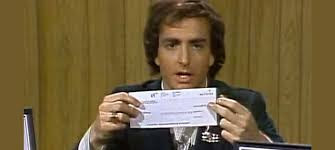 Lorne Michaels offers the Beatles $3000 to reunite on SNL
On April 24 1976, Lorne Michaels appeared on Saturday Night Live to offer The Beatles $3000 to reunite for a performance on his show. This was in response to a full-page ad in the New York Times offering them $1,000,000 to do a show in Shea Stadium (and/or elsewhere).
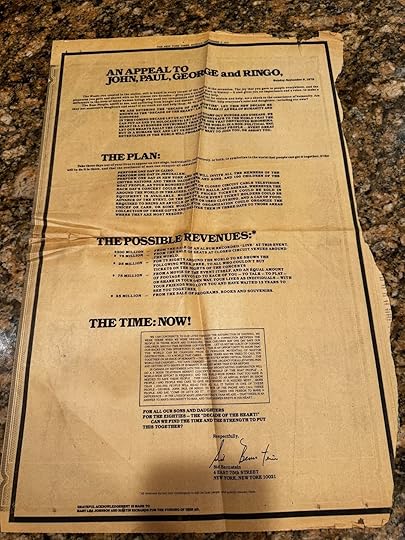 Sid Bernstein's offer to the Beatles in the NYTimes
It was taken as a joke--and a running joke at that, since, when George Harrison showed up on SNL as a musical guest, one skit had Michaels explaining to him that he would only receive $750 for coming, since $3000 was for all four of them.
Very funny.
But watching the Saturday Night Live 50th reunion show this week, it struck me that the show's counter-culture roots tapped into a hunger born from the breakup of The Beatles. What do we do now?
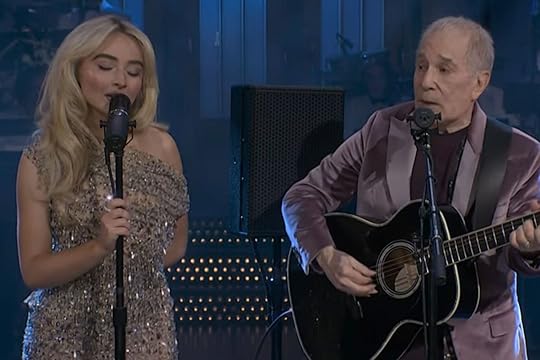 Paul Simon with Sabrina Carpenter "Homeward Bound"
The special began with Paul Simon (who once immodestly said that the two greatest living songwriters were both named "Paul"). Simon reminisced that he first performed "Homeward Bound" on SNL with George Harrison.
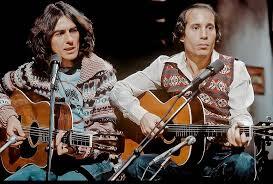 The ghost of George Harrison hovered over the SNL 50 opening
And the night ended with Paul McCartney (the other Paul) doing the final medley from the last album The Beatles recorded together (Abbey Road, not Let It Be--which was just the last one released).
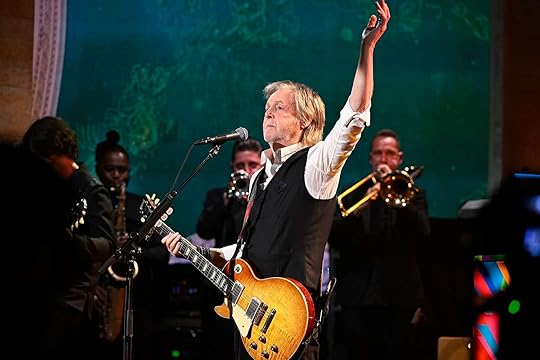 And in the end, the love you take...
So, bookends (back to you, other Paul :-) ).
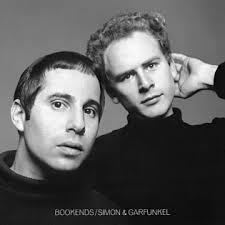 Simon and Garfunkle's Bookends, 1968
I want to believe somebody putting the show together did this consciously, but it doesn't matter. There it is. And perhaps it would be even more remarkable if they didn't realize it, but it was so embedded in their thinking that it just happened.
SNL began in 1975, just as Saigon fell and the US had to face that it had lost a war. Watergate had left our faith in institutions shattered. And we were in a deep recession, with high unemployment and rising inflation.
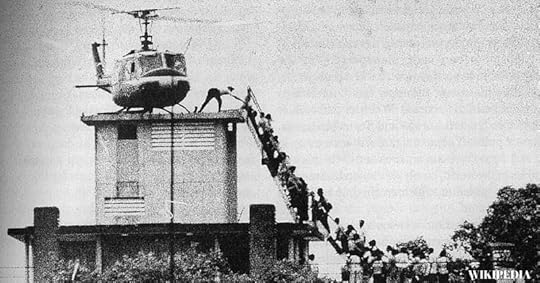 The fall of Saigon, April 1975
In the 1960s, the Baby Boomers had rallied around The Beatles. The Beatles didn't just dominate the music charts; The Beatles defined the decade. Everything else--the British Invasion, the Second British Invasion, and all the other bands--including the Rolling Stones--were just copies (at least in the minds of Americans).
And then they were gone.
SNL from its very beginning was backward-looking. Maybe the most obvious example is how John Belushi took his new-found stardom to Animal House, in which the Boomers mocked--1962 from that distant vantage point of 1978.
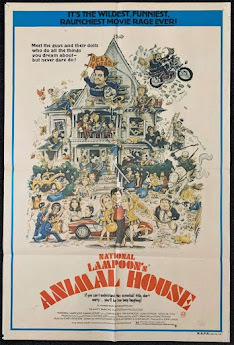 Double-Secret Probation!
In addition to casting Belushi, producer Ivan Reitman's original choices for the roles of Boon and Otter were Bill Murray and Chevy Chase, tripling down on the SNL cast. But weren't they just a little too old, even then? We were all too old for such college pranks--and what are the SNL skits other than college humor by people just a bit too old? Here we are, on the verge of adulthood. What do we do with our youth? And how, in God's name, will we ever replace the hole The Beatles left in our lives?
Even from 50 years on, it seems to be a question to which we Boomers have never found the answer.
Oh, yeah. Bob Dylan, too. But that's another story.
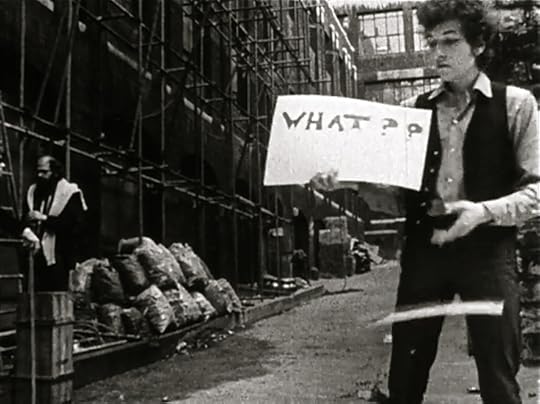 Subterranean Homesick Blues.
Look out, Kid, it's something you did...


September 27, 2024
Embracing Rejection: Part 5 When Has a Journal Served its Purpose?
 We all have different reasons for submitting poetry (or any other writing, for that matter) to journals.
 It may be just to get your poem in print, in which case any journal will do. It may be to get your work seen, in which case journals with a wider circulation and readership would be better.
And it may be to build your reputation as a writer, which is kind of like the "long game" of getting your work seen. You want more and more people to see your work, even anticipate it, perhaps eventually look for it in bookstores.
I include myself in this last group, and if you are still reading, I will assume you do, too. You have been working hard at becoming a better poet--reading good writing, trying to emulate it, getting constructive suggestions from people whose opinions you value. But you also must work hard at becoming a better known poet.
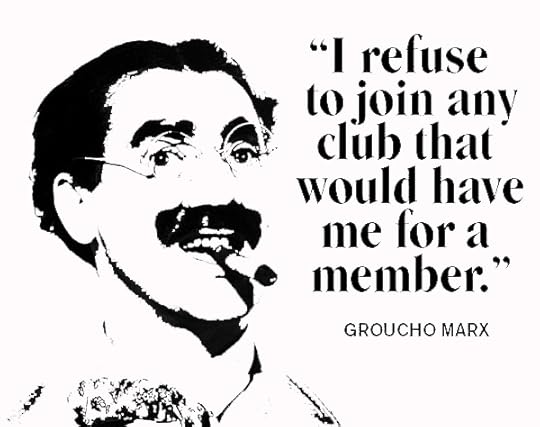
And that means you might have to let go of the journals that have--finally!--published your work. I know. It's hard. After all, you have endured so much rejection before finally finding a sympathetic editor. How can you let go now? Why not just keep sending them your good stuff and be happy. Are you really such a snob that you refuse to submit your poetry to any place that would have you as a contributor?
_________________________________________________________________________
Are you really such a snob that you refuse to submit your poetry to any place that would have you as a contributor?
_________________________________________________________________________
It's an option. But it likely won't grow your audience or your reputation. For that, you need to seek out more widely-read, more respected, and more selective journals.
Fine. You are convinced. You will start submitting to The New Yorker (or at least the journal on the next rung beyond your current reach). But why let the others go?
They have served their purpose in publishing you. You can list them in your publishing credits, and no one is going to be doubly impressed when they publish you again. Besides, you should keep your powder dry and save your great poems for a greater destiny. And that means embracing rejection all over again.
_________________________________________________________________________
And that means embracing rejection all over again.
_________________________________________________________________________
Remember when you first started thinking about getting your work published? If you were like me, you may have overreached and sent it off to places you knew, journals you had actually read, only to find that you rated nothing more than a form rejection.
So you licked your wounds and reduced your expectations and set your sites on something smaller. And then smaller still. And smaller still.
Now that you have had some success, you need to run the process in reverse. Raise your expectations a little at a time. And each time you find success, raise them again. It likely means more rejection at each new level.
But you've learned how to deal with that. Aren't you glad you're now having to learn to deal with some success?
August 30, 2024
Some Poems Worth Your Time: "Journey of the Magi" T.S. Eliot
I have always liked this poem, and if I had to choose one Eliot poem, this would be it. It is an overtly religious poem, though it manages to avoid easy answers. It is about anything except easy answers, I would say. I have written a few poems that try to give voice to religious and historical figures. But I doubt I will ever come close to the effect Eliot has achieved here.
As it is in the public domain, here is the text of the poem:
Journey of the Magi
T.S. Eliot
A cold coming we had of it,Just the worst time of the yearFor a journey, and such a long journey:The ways deep and the weather sharp,
The very dead of winter.’
And the camels galled, sore-footed, refractory,
Lying down in the melting snow.
There were times we regretted
The summer palaces on slopes, the terraces,
And the silken girls bringing sherbet.
Then the camel men cursing and grumbling
And running away, and wanting their liquor and women,
And the night-fires going out, and the lack of shelters,
And the cities hostile and the towns unfriendly
And the villages dirty and charging high prices:
A hard time we had of it.
At the end we preferred to travel all night,
Sleeping in snatches,
With the voices singing in our ears, saying
That this was all folly.
Then at dawn we came down to a temperate valley, Wet, below the snow line, smelling of vegetation;
With a running stream and a water-mill beating the darkness,
And three trees on the low sky,
And an old white horse galloped away in the meadow.
Then we came to a tavern with vine-leaves over the lintel,
Six hands at an open door dicing for pieces of silver,
And feet kicking the empty wine-skins,
But there was no information, and so we continued
And arrived at evening, not a moment too soon
Finding the place; it was (you may say) satisfactory.
All this was a long time ago, I remember,
And I would do it again, but set down This set down
This: were we led all that way for
Birth or Death? There was a Birth, certainly,
We had evidence and no doubt. I had seen birth and death,
But had thought they were different; this Birth was
Hard and bitter agony for us, like Death, our death.
We returned to our places, these Kingdoms,
But no longer at ease here, in the old dispensation,
With an alien people clutching their gods.
I should be glad of another death.
August 17, 2024
Three Poems Selected by Abstract Magazine
Abstract Magazine has selected three poems for publication. This is an on-line publication, so if you don't want to miss them, please subscribe.
The poems are
"Cape Alava" (based on a hike I took long ago at the northwest tip of the Olympic Peninsula)
"Design of Everyday Things" (drawn from my experience as an aide de camp, where part of the job was knowing which way every door would swing before the general's arrival) and ...
"Takeout" (the inspiration for which was a bunch of crows eating from a Chinese takeout container in the middle of the road).
September 8, 2023
Fugge il Tempo now live on BoomerLit
My poem, "Fugge il Tempo," is now live in the online journal BoomerLit. You can read it here...
April 11, 2023
Some Poems Worth Your Time: Stephen Crane's "In the Desert"

This Stephen Crane poem has two obvious virtues with respect to its use here. First, it is in the public domain. Second, it is incredibly short. So here is the poem in its entirety:
In the Desert In the desertI saw a creature, naked, bestial,Who, squatting upon the ground,Held his heart in his hands,And ate of it.I said, "Is it good, friend?""It is bitter--bitter," he answered;
"But I like it"Because it is bitter,"And because it is my heart." This poem is a parable. That is, it tells a story to reveal some kind of truth or lesson. The story is simple: the speaker tells of his encounter with a creature eating his own heart, and the conversation that follows: a simple question and the creature's short but complex answer.
But if the poem is a parable, what is the truth or moral lesson? Are we supposed to see ourselves in the creature? Are we supposed to see ourselves in the speaker? And what is it we are asked to see?
The speaker doesn't say whether the being he encounters is even human. The speaker remarks on the creature's nakedness and his bestial nature. The speaker says the creature was "squatting on the ground," which must have struck the speaker as unusual posture, since he remarked on it. And the speaker finds the creature in a desert--a place devoid of cultivation (no green pastures here) or civilization (no cities, either).
All of this puts some distance between the creature and the speaker. And yet, they can converse with one another. And what are we to make of the speaker calling him "friend"? Does this mean the speaker recognizes a common kinship with the beast? Or is the speaker drawing a line between them, asserting that he is a more civilized, less brutish being (not combative, but coming in peace)? It's probably a bit of each, as they share enough in common to communicate. But the speaker is the storyteller, the one who enters into the desert only temporarily, and who is not normally naked or bestial or squatting, and who has never tasted his own heart. The speaker is the urbane, educated, peaceful version of the species.
But the speaker has questions. Or at least one question: Is it good? The creature--beast that he is--still has the capacity to understand the question can be interpreted in multiple ways, and so he answers multiple questions. It tastes bitter, he says. So, in that sense, no, it isn't good. But he still likes it--both for its bitter taste and for it being his own. So in that sense, is it good?
Maybe not. Maybe it's just the fallen nature of the creature that causes his heart to be bitter in the first place, and for him to like it nevertheless, being unwilling to let go of it and choose something else. It is his. He is it. And the creature wallows in his own bitterness.
So do we conclude that all people are beasts who squat naked in the desert, feasting on their own bitterness? Or do we conclude that only the unwashed hoi polloi do so?
When the speaker recounts the story, he uses one odd turn of phrase, "And ate of it." To my ear, this sounds biblical, and invokes the Genesis story. And a heart is very much the size (and color) of an apple. So perhaps we are to see that as an echo--or the consequence--of The Fall. And perhaps in asking his question, the speaker is claiming to be untainted by it, still blissful in his ignorance, even as he seems to be the more intelligent of the two. Or is he? After all, the creature sees the layers in the question, even as he is squatting in the dirt. So perhaps Crane is showing us that for all our civilization seems to insulate us from uncomfortable truths, they are truths nevertheless. And only this creature (much like Frankenstein's monster) is the truly insightful one here.
Another reason I offer you this enigmatic poem because it's one you can memorize. There aren't many words, and none of them are difficult. So use this to amaze your friends and show them your edgy side.
Oh, and if for no other reason, you should know this poem because it provides the title for a Joyce Carol Oates novel (Because It Is Bitter, and Because It Is My Heart, 1990)
March 14, 2023
A Life Lesson From the Seoul Train

I had just finished four wonderful years teaching English at West Point, and so the Army decided to send me on what was archly referred to as a “punitive tour”—an assignment meant as a counterbalance to a previous assignment that was, oh, perhaps a good fit for one’s skills, or in a desirable location, or just plain fun. Or perhaps all three. Whatever the Army’s rationale, I was ordered to leave my family stateside while I reported to South Korea and Camp Casey, well north of Uijeongbu (where M*A*S*H was set) and within shouting distance of the Demilitarized Zone and North Korea.
Amid the war games and training exercises, I spent much of my free time in Korea trying to complete the dissertation I hadn’t finished while teaching at West Point. But occasionally, I got out to see the country beyond the gates of Camp Casey. And so I went to Seoul for a weekend in the Spring.
I was alone. And I didn’t read or speak the language. But I had a good map and some useful suggestions as to where I might want to go. So I boarded a train and memorized the name of the stop I needed, and I held on tightly to the stanchion as the train left the station.
We picked up more passengers at each stop, but it seemed none of them got off. Whatever the actual situation, the train was seeming more and more crowded as we continued along the route.
The station signs were identified in both the local Hangul script and in the Roman alphabet, so it was clear when it was my stop, and as the doors opened, I let go of the stanchion and tried to move. But I was stuck in the crowd that pressed against me.
“I need to get off,” I announced, hoping to get a little cooperation. But no one obliged. Meanwhile, more people got on the train, and I knew the doors wouldn’t stay open forever.
“I need to get off!” I said, more firmly. By this time, I knew I had precious little time. But no one on the train seemed to care.
Finally, I shouted, “I NEED TO GET OFF!!”
From somewhere in the car, I heard a reply in English, “Well, then, get off!”
With that, I wove through the crowd that, while thick, wasn’t blocking my exit at all. And I was on the station platform before the car doors closed behind me and the train pulled away.
I think I ended up going to a park. But that’s not what I remember about the trip. I remember the advice of a stranger, who was obviously tired of my complaining about needing to do something but not actually taking any steps toward doing it.
I include the incident here for those who may be lamenting that they need to write more, or finish a novel (or dissertation!), or submit their writing for publication.
I’m aware that it’s not always as simple as “Well, then, get off!” or, in the words of the Nike ad, “Just do it.” But once you confront the stark reality of beginning, and taking that first (or next) step, you may find that you can just—keep going. Or you may discover what the real impediment is and turn to address that. Or you may discover that it really wasn’t all that important in the first place and you’d really rather do something else instead.
February 27, 2023
An(other) Argument for the Humanities
 Bonus points for the literary allusion
 in this illustration
This recent lament for the humanities comes from Harvard Magazine. The author, James Engell, was a favorite professor of mine--and my dissertation advisor. His article includes charts and data that drive home the point that interest in majoring in the humanities has been falling for decades. And he makes an argument that society is the worse for it.
I remember the Head of the English Department at West Point, Peter Stromberg, making a similar argument while I was there. And I agree with them both that the world needs more humanities education.
And why not? When I was at West Point, we all took a core curriculum that was heavily weighted toward STEM courses, and for the seven (of 42) classes I could choose, I chose humanities (specifically philosophy, history, and literature). And then, when it came time for graduate school, I again chose a humanities degree (English).
But--and this is a huge caveat--I had a luxury other people don't usually have. My West Point and Harvard educations were paid for by the taxpayers (the Great American Public, as we used to say at West Point). At West Point and Harvard, I got tuition, room, and board--and a stipend (half a lieutenant's pay at West Point and full captain's pay at Harvard). My value proposition was very different than those who have to come up with the cash themselves (or through their parents or grandparents). I had no student loans whatsoever.
And I also had a job. In fact, after West Point, I was required to serve five years in the military in exchange for my education. And it was no unpaid internship. I got paid. And again, after Harvard, the Army required me to teach and then serve for an additional six years. You can imagine the bewilderment of some of my Harvard classmates when I explained to them that, in exchange for a graduate eduction, I was forced to get a job using that education--while they were worried about how they would ever land such a thing.
So there's that.
And then, once I retired from the Army and looked for work, I realized that all those STEM classes allowed me to make a very decent salary while living in my home town. And that salary allowed me to raise my children and to pursue teaching and writing--not full-time, mind you, but enough, or nearly so.
But let's think about West Point for a moment, since it was the source of those STEM courses. When I attended, the core curriculum there was the same for everyone--and that core curriculum was about 80% of our education. We had precious little choice in the matter. And amid the calculus, differential equations, probability and statistics, chemistry, physics, computer programming, electrical engineering, civil engineering, and systems engineering, we also were required to take composition, literature, philosophy, psychology, foreign language, history, and law. And boxing. Don't forget boxing.
I am grateful for the education I got there (not so much for some of the sideshow around it). And I think it's because of the core. I don't know how many people need to major in the humanities, but I think we as a society would benefit if people who claimed a college education had more humanities. And colleges could require it--even of their data scientists and engineers.
Click here to read Engell's piece in Harvard Magazine.
January 25, 2023
Embracing Rejection, Part 4: Where to Submit Your Stuff?

The dirty little not-so-secret concerning the state of contemporary literature (and art) is that teaching lies at the center of it all. Most writers and artists are subsidized by their positions teaching others how to be artists, who in turn look for teaching gigs to…
If this sounds like a Ponzi scheme to you, trust your instinct. The last students to get creative writing degrees when the programs shut their doors behind the last tenured professor to retire will be left holding the bag--filled with student debt. This isn't to say that some artists don't manage to make money from their art. Some even make enough to live on. And some grow rich. But not you. Or me. We are slugging it out in the slush pile, hoping for a few publication credits to add to our brief biographies.
But every cloud, right? The silver lining here is that there are thousands of small journals out there. There have to be, since schools need them in order to train their students, and they all need one another, since they can't just publish their own writers all the time. This symbiotic relationship between the various writing programs doesn't leave a lot of room there for you and me, but it leaves some. And there are blessed souls out there who are on a mission to democratize art who have set up their own independent journals, apart from the colleges and universities that underwrite most of them. And I have found them to be more receptive to my particular style of poetry.
But with thousands of journals to choose from, where to begin? When I started, I used Poet's Market (the niche version of Writer's Market). The book was updated annually with contact information and a description of what the publication was looking for. Today, I look to the web for this, since it's updated continually. Poets and Writers maintains a good list (www.pw.org), and there are many others that will give you a good idea of what's out there. But for the last decade, I have relied on Duotrope (www.duotrope.com). It costs $50 a year, but it has a list of 4,000 journals, the information is accurate, and it includes links to their websites.
Still, 4,000 journals is overwhelming. How to narrow it down? You may have a few journals you have come across already. Start there. And (if you are using Duotrope) you can try several ways of filtering your search results until you get a manageable list. They even include some lists of their own to help you: the most competitive, or least competitive, or shortest response time, or ones that pay, or ones that don't require a fee.
Here is a shortcut that may or may not work for you. Look at the list kept by Clifford Garstang. (His current list is here: https://cliffordgarstang.com/2023-literary-magazine-rankings-overview/). He keeps a ranked list of journals, based upon their representation in the Pushcart Prize results each year. It's a kind of moving average that takes into account past years. And the result is generally 200 or so journals. Because these journals have submitted poems for prize recognition--and have achieved some recognition--they are more competitive than others.
If that seems like too large a pool to swim in at the start, consider some of the least competitive journals. Duotrope allows you to search by acceptance rate (journals with an acceptance rate between two numbers). Remember, I said the rule of thumb was 1%. So maybe you search for journals with acceptance rates of 5-10%, or more.
Then, once you have your subset, read through the descriptions on Duotrope. Then visit the sites and read whatever is available there. Order a copy of the journal (subscriptions will often allow you to jump the line or submit "out of season.") And build your list.
Keep track of when the various journals are open for submissions, and put your packets of poems together. Then send them out! And good luck!
January 20, 2023
Two More Poems Accepted for Publication

The Main Street Rag has accepted two more of my poems for publication: "The Critic Over My Shoulder," and "The Analog Manifesto." They seem to like my work, and I always enjoy the publication (the issue shown in the picture features another of my poems).
For the record, I did get busy submitting my work to journals, as I said I would. I sent out 40 packets of poems averaging five poems each (so 200 here in the first couple weeks of the year).