
Tracy Stanley's Blog: Ten tips for writing a book
August 24, 2025
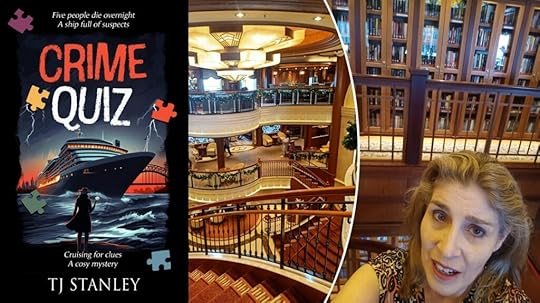
Inspiration for Crime Quiz
I have my friend Debbie to thank for the idea for the opening scene in Crime Quiz. She’d just returned from a cruise off the coast of Western Australia where the passengers were woken at 5.00am in the morning by an announcement that five people had died overnight.
At first, I didn’t believe her, who would do that? I then laughed, before thinking about all the gossip that must have spread faster than a pandemic, the following day. It got me thinking and then, when a week later I went on my first cruise, which happened to be hosting a literary festival, the idea took on a life of its own.
It will be released onto Amazon next month and is currently available for pre-order.
The post Inspiration for Crime Quiz appeared first on Tracy Stanley.


Launch of Crime Quiz
Do you like cosy mysteries and guessing who done it before you turn the last page? Perhaps you like cruises too? Or maybe you don’t. Doesn’t really matter as long as you love a good story.
Last December I went on my first cruise which happened to be hosting a literary festival. I sailed from Sydney to Hobart and back. I enjoyed the cruise, loved the festival and started plotting a mystery while I was inspired by other authors.
The result of these scribblings is Crime Quiz, which will be available initially on Amazon in September. Here’s a link to the description on ‘the Zon’.
The post Launch of Crime Quiz appeared first on Tracy Stanley.
January 19, 2025
Learning, laughter and letting go of your writing fears…
Lessons from literary leaders as I sailed from Sydney to Hobart, with a thousand plus other avid readers and authors.
The discovery…
I squealed with delight. A literary festival on a luxurious Cunard cruise had popped up in my Facebook feed. Not only did it include a conference with renowned writers including Sir Alexander McCall Smith, Fiona McIntosh, Dr Anita Heiss, Anne Buist and Graeme Simsion, Sue Williams, Paul Cleave and Nick Mckenzie, but the cruise was sailing out of spectacular Sydney Harbour on a balmy summer’s evening before heading south to Hobart. I’d never been to Tasmania, (well, except vicariously as I wrote my novel Alone with a Tasman Tiger). I was keen to visit, if only for a few hours. I felt like I’d won the trifecta.

It was my first cruise, an experience I’d avoided as my husband doesn’t like anything on-water, a phobia resulting from crossing the English Channel too many times as a child.
Logically, I had to go without him.
Sensibly, I had to be prepared. Kwells and Ginger were purchased and packed.
Importantly, I was coming for the learning. Notebooks, pens and refills went in my bag before the medications.
The Queen Elizabeth was impressive. I could easily have whiled away the hours being pampered in the spa, sipping cocktails by the pool or listening to beautiful music on the stairwell.

There was also a magnificent library to linger in and a daily program chock full of activities. But I was there for the author plenary sessions and workshops; a conference that happened to be on a cruise ship.
A few snippets from my scribblings below.
Sir Alexander McCall Smith is a prolific writer, and engaging teller of tales with a sharp wit, perhaps best well known for his series, The No. 1 Ladies’ Detective Agency. This series was inspired by his life in Rhodesia (now Zimbabwe) and the people he met in neighbouring Botswana. He has authored over 100 books which is amazing, particularly given he didn’t start writing until he was 50.He credits some of his success to Laura Bush, teacher, librarian and wife of former US President George W. Bush who promoted his books.
Dr Anita Heiss delivered an inspiring hip-hop poem before exploring how storytelling can be a vehicle for bringing people together. She also facilitated a workshop showing participants how to kick-start their creative juices.
There’s a perennial debate in the author community about the value of writing by the seat of your pants, aka ‘a pantser’ or ‘a plotter’, someone who uses outlines to help plan their novels. It was great to have speakers from each camp.
Fiona McIntosh was an unashamed ‘pantser’, talking about the value of just starting and writing intuitively. She wrote her first book in five weeks with the publisher coming back after two weeks with a three-book deal. Graeme Simsion on the other hand is a plotter, and showed us how to map out a novel using old-fashioned cards. He thinks in scenes, a process that encourages your writing to show and not tell. He reminded us to be conscious of when we are creative each day, and to make sure we work then and also that creativity has an incubation time. It was also valuable to learn how he co-writes with his wife Anne Buist.
Sue Williams is a travel writer who shared with us incredible stories from Australia and Africa. She showed us how to start a travel memoir with the key being, not to start at the beginning and instead choosing a compelling event that you can link back to at the end. She also encouraged us to make fun of ourselves when writing.
The cruise combined inspiration with practical advice on getting the words down. I loved it and was applying a great deal of what I learnt directly into my novel plotting. And I was also given a few ideas about murder mysteries set on ships. Perhaps a husband goes missing overboard?
The post Learning, laughter and letting go of your writing fears… appeared first on Tracy Stanley.
December 13, 2022
Travels with my husband
When I think of travel, I’m reminded of Jean Paul Sartre’s lament that L’enfer, c’est les autres or Hell is other people. I know that I’m not using his famous quote in the exact context, but you get the picture. Unless you’re planning on visiting the outback or the never-never* you’re going to be with other people. Possibly lots of them. I mention this now to foresee the inevitable tension when we, my husband and I, arrive at the airport, our point of embarkation for our grand adventure, and the gathering point for hordes of other nervous, excited and often-times loud, other travellers.
The explorer’s mindset
If you’re reading this, you may also be longing for far-off places. You are certainly not the only person who dreams of being an explorer, a discoverer of new places and taster of new culinary and other experiences. Perhaps you even envisage yourself as a modern-day Emily Creaghe who crossed the rugged Gulf of Carpentaria in 1882 as part of an expedition, or more recently, Jessica Watson who was the youngest person to sail solo and unassisted around the world. What a dangerous and indeed inspiring way to live. Even if we can just experience a tea-spoon’s full of this type of thrilling adventure – we’re satisfied.
Being familiar with the journey of last century travellers Freya Stark or Alexandra David-Néel we know that our travel itinerary is modest. Realising this fact, I felt reassured it would never be as risky. Freya and Alexandra, were two formidable female travellers from early in the last century, who thank goodness were both writers, as we can vicariously visit exotic places with them, that even today appear on government travel warning websites. I’m thinking here of Afghanistan and the less stable countries of the Middle East. They travelled for the most part, in blissful ignorance of the dangers they would face. Or perhaps they did know and this was the attraction.
Waiting for take-off
The pandemic was frustrating for my husband, as it surely was for many other people. As he’d officially retired a few months previously his plan was to travel and write. So, unable to go anywhere, he returned to work to occupy the time he should have been travelling. The enforced land lubber status was destroying his adventurous ambitions for his retirement. He was all too aware of quietly arriving ailments such as a bothersome back and a kinking knee – all reminding him of his advancing age. The clock was ticking loudly in his head.
My husband, in general, is not a fan of other people. He’s sliding into his natural persona of grumpy old man, beautifully. He’s adamant that it’s not him who’s grumpy, it’s other people who are irritating, dithering or too noisy. The irony is that my husband imagines himself as a free spirit. Open. Tolerant. Worldly. Sigh.
A change of habits
There is a challenge in travelling with others, well anyone really. After thirty plus years of marriage, you would have thought that I’d be used to the close and personal contact required for trapsing across the continent… But no. Travel requires intimate, often 24-hour close proximity. It can be an intense experience when you’re removed from the comfort of your daily habits and customs, you’re confronted by multiple decisions on how to travel, e.g., walk, bus, taxi and where to stop, eat and drink. And then we have the challenge over choosing accommodation. Self-outing here that I like to have my accommodation booked in advance, whereas he, when it’s practical, likes to rock into town and choose somewhere that meets his criteria for charming, quiet, inexpensive, with delightful hosts and not too far from the railway station. This idea is lovely but the stress of not finding this little nugget, both pre-anticipated and experienced first-hand on arrival, removes the joy of travelling for me. It’s just too easy to arrive to discover that a local literary, food tasting or cycling festival has meant that the only accommodation available is 13 miles out of town and not accessible by public transport.
Just bring hand luggage…
But let me not get too far ahead of myself. I need to mention my other half’s fantasy of travelling for several months across countries of varying temperatures – with only hand luggage. Yes, this is something you can do, if your spouse has checked in luggage that includes, shampoo, Gaviscon tablets, mosquito repellent, an extra t-shirt and pair of socks, first aid kit, spare battery charger, you get the idea. Curiously one thing that he always packs, which I think is completely unnecessary, are peanut butter sandwiches. Did I mention that my spouse likes to pack light, taking only the barest of essentials? But still, there’s room for sandwiches which is absurd given that the trolley passes every three hours, and that snacks can be obtained through the gentle push of a button. He reminds me, however, that on many flights, food is served at ridiculous times, ‘Chicken or beef at 2.30 in the morning sir?’ Also, that, with more and more low-cost carriers not providing food at all, having a couple of surreptitious sandwiches tucked away can save money. I know that economy-class airline food is not gourmet, but it more than meets basic sustenance requirements. And sitting for hours on end as we cross ocean after ocean and an occasional land mass, does not burn calories.
I need alone-time
Self-declaration. I love being on my own; I need time alone – and travelling together makes this nearly impossible. We are in each other’s company 24 hours a day. I think I must be an introvert although this would surprise many. I’d rather be in the outback with kookaburras for company, than queuing with dozens of others in need of a steaming cappuccino – and I love cappuccinos. It’s hard work being an explorer and with all those decisions and other people, indeed a stressful experience.
Getting balance
Travel is such a sensory-rich, learning adventure. Away from your daily habits you do things differently. You smell, and taste and feel new experiences and meet new people and see new places. You learn a lot about each other, and if you spend a bit of time reflecting, will appreciate that you are learning a lot about yourself. I’m aware that there’s a contradiction, indeed a balancing act, of wanting to explore new places, and experience new things while longing to stay put, seeking solace in the quietness of the never-never, with time to ponder and renew.
Read our travel diaries. We’re mostly together but sometimes apart.

We’ve priced the e-book version of our book at 99cents or pence, just for these last days of 2022. You can pick up your copy in all the usual places including Amazon, Barnes and Noble, Kobo and Apple.
References
*The Never Never is the name of a vast, remote area of the Australian Outback, as described in Barcroft Boake’s poem “Where the Dead Men Lie”
Jean Paul Sartre – Hell is other people https://www.lepoint.fr/philosophie/sa...
Australia.museum – for information on Emily Creaghe
https://en.wikipedia.org/wiki/Freya_S...The post Travels with my husband appeared first on Tracy Stanley.
February 21, 2022
Change lessons applied to politics

There’s a question keeping me awake at night. How can I influence people’s attitudes so that they change their behaviour and vote for a different political party?
I’ve worked in change management for the last 20 years and have recently been selected as a senate candidate for Queensland in the upcoming federal election. I thought it’d be interesting to apply a framework for change management to the first stage of the political process, which is around raising awareness of the party’s policies and encouraging voters to reflect on what changes would most improve the quality of life for all Australians. And then, prompting them to vote in a way in alignment with this objective. How we drive change in government processes and policy once elected, is a big topic and worthy of another article in its own right.
The vision thing
All change practitioners know that change programs need a clear and compelling vision. Our party, The New Liberals (TNL), has not only described our vision and values but also our policies. As we approach a new election, we have an equivalent of John Kotter’s ‘burning platform’ scenario with flimsy governance accountability and a snail like approach to addressing important issues such as climate change, water management, job security and housing affordability to name a few. This platform refers to the growing discontent with the transparency, accountability and decisions made by the current party. There’s a groundswell of support for change, as evidenced by the emergence of many independent candidates and new parties.
Communication plan
It’s considered wisdom that any CEO will say that if they had to do their change plan again, they would have communicated more. Here in Queensland, our task is to communicate with the 3.6 million voters spread across this vast and beautiful state. Also, to have enough communication actions in place so that every voter hears from us at least six times. It’s a scary goal, not dissimilar to the BHAG, i.e. that is the big, hairy and audacious goal first mentioned by Jim Collins.*
We’ve been using social media as well as considering where best to spend our limited resources on paid advertising. We know we need to keep our messages simple and to use the channels that are most credible with every voter in the state. I want to do this creatively, so it gets attention and gets people thinking.
What’s in it for me? WIIFM
In addition to communicating a vision, every aspiring politician and party needs to clearly articulate the ‘What’s in it for me or the WIIFM’ benefits. This is a tricky process because voters have different needs depending upon their location, employment status and life circumstance. Communicating the WIIFM is best undertaken on a face-to-face basis but this is a tough ask given the volume of voters, geographic spread and the need for limited contact with the present COVID situation.
Three categories of voters
There are understood to be three categories of voters. These include, loyal supporters who will vote for you, and need to be thanked. The next population of voters are open to changing their mind and need to be convinced, so the policies, values and particularly the what’s in it for me, needs to be clearly articulated. The final category are often called the ‘Rusted on’ voters. These are people who have always voted the same way and there is nothing that would encourage them to vote differently. I was pleased to read that this population has been reducing over the past decade from around 60% to about 25% now. For some candidates, it’s not worth bothering to address the rusted on voter because they will never change their mind. But to me, this is a challenge. To identify what is it about their socialization and their thinking that makes them feel so comfortable with one particular party or person. I know that the voting process is not necessarily logical. Voters need to like the candidate as well as supporting their party’s policies. Our challenge is that often politicians espouse a certain value and then do not behave in a way that is consistent with that value, causing disenchantment. And rightly so.
Stakeholder support
Creating change champions is common in organizational change programs. For those running for elected office, change champions are enthusiastic volunteers who distribute pamphlets while chatting to constituents and talk to their neighbors, friends and family members about the party and its values. This population needs to be properly trained, thanked and celebrated. There are also other stakeholders such as donors and the media. There’s controversy around these stakeholder groups. Obviously, any politician wants to get their message heard by their constituents, and the media provides a wonderful platform for doing this.
Measurement
Measuring the effectiveness of our engagement and communication activities will ultimately be determined on Election Day. The election process will come around again all too quickly, and it’s important that short term measures are identified and learning captured as you go along.
Useful measures include: the number of likes, comments, questions and shares on social media; traffic to our website; number of radio interviews and column inches; people signing up to join the party and donations made.
Closing messages
Highlighting three takeaways from my blog, I would say that, the vision for political party is exactly the same need as the vision for any project inside an organization. Secondly, a comprehensive and channel appropriate communication plan is key for increasing your discoverability among your target population. Finally, there’s a need to have a partnership and engagement strategy to leverage those people who are fans and supporters of your party to maximize your reach. Of course, the ultimate measure of how well we do in this area will be when we make it into Parliament House.

For more information on The New Liberals policies and candidates, please visit the links below
The New Liberals (TNL) Policies
The New Liberals (TNL) Candidates
Reference
The term BHAG comes from the 1994 book “Built to Last: Successful Habits of Visionary Companies” by Jim Collins and Jerry Porras.
The post Change lessons applied to politics appeared first on Tracy Stanley.
October 31, 2021
Favourite Change Tools, Templates and Processes
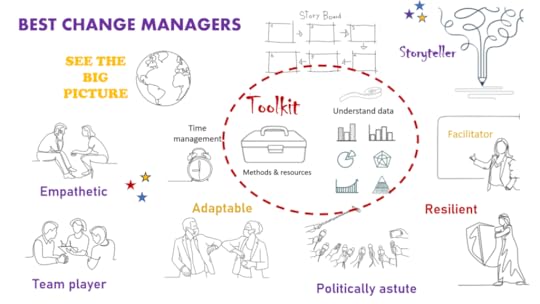
It was not my intention in writing Change Stories to discuss the myriad of processes, tools and templates that a change manager carries in their metaphorical tool kit. I told all my interviewers that I only wanted to hear their stories. Well, as things go, tools, templates and processes were frequently mentioned in our interviews so I decided to include a section on them in my book.
Some of the favourite resources mentioned follow along with a few interviewee comments. They are listed in alphabetical order.
When I was running design teams, I would have technical people with me, that were jumping to the solution very quickly. Part of my job was to stop that and to say that we are not yet at the point. We need to keep analysing the problems. Because when you keep analysing problems more deeply, you see what you thought was the problem may not have been the problem. Neil
Competing Values Framework, developed by Robert Quinn and Kim Cameron, provides a classification of four corporate cultures, giving insight into how a company operates, how employees collaborate and what the corporate values are.
Design Thinking/Human Centred Design has a deep focus on understanding the people, (or users) for whom the products or services are being designed. It uses an iterative process to understand users, challenge assumptions and redefine problems, and is most useful for tackling ill-defined problems. It has five phases: Empathise, Define, Ideate, Prototype and Test.
Helps you to focus on employee experience. Takes you through the phases including developing personas of different employee groups, mapping the moments that matter and then developing a prototype. Elaine
McKinsey’s Seven S Model is a tool that analyses an organisation by looking at seven key internal elements: strategy, structure, systems, shared values, style, staff, and skills.
Microsoft Teams allows team conversations, files, meeting creation, and apps to be together in a single shared workspace, and you can take it with you on your favourite mobile device.
Net Promotor Score is a tool that measures customer experience.
Obeya means big room in Japanese. The idea is to bring people involved with all parts of a production process into one place so that they meet face to face to improve communication and prevent compartmentalising or phasing work to homogeneous departments. Lyn
OCI is an Organisational Culture Inventory that shows how employees interact with each other, what they have in common, and what is expected of them in terms of behaviour. Behavioural standards influence productivity and effectiveness in the long term, as well as the engagement of each employee individually.
OCAI (Organisational Cultural Assessment Inventory) is a cultural assessment toolbased on the Competing Values Framework and is a quick culture tool where you distribute 100 points between four Competing Values.
Prosci is a change management methodology developed by the consulting firm of the same name. Prosci’s model of individual change is called the Prosci ADKAR Model, an acronym for awareness, desire, knowledge, ability, and reinforcement.
Pulse check isa short, quick survey that is sent out to employees on a regular basis. It is essentially a check-in, providing a pulse check on topics such as communication or employee satisfaction. Usually its limited number of questions makes it quick and easy to complete the survey. It can be a key measure of employee attitudes during change programs.
We used pulse checks. Their managers were constantly communicating the changes to them, to get them on board, what it means for employees to do what they do throughout the change. What I mean by that is, that it’s not just to communicate with them, but to engage with them. Ingrid
RACI Chart is amatrix of all the activities or decision-making authorities undertaken in an organisation set against all the people or roles. At each intersection of activity and role it’s possible to assign somebody responsible, accountable, consulted or informed for that activity or decision.
SCARF Model involves five domains of human social experience – status, certainty, autonomy, relatedness and fairness – and how these affect (for better or worse) human interactions.
Scenarios. If you talk about a likely or possible scenario, you are talking about the way in which a situation may develop. You can then think through how you might respond.
Stakeholders and Decision Making. A stakeholderis a person or group who is affected, either negatively or positively by successful project completion.
I’ll send that out to make sure the key stakeholders are across it, I’ll meet with them if I need to talk it out, looking at some of the board minutes which make it look like it was a really short discussion. Here was the issue. Here was the decision. The paperwork behind it is where the detail is. Most people don’t want to read the details. But the project registered decisions within an Excel-based tool. It doesn’t matter what the tool is. We have a registered system and we record the key decisions and then we’ve got documentary evidence with the detail around what the issue was, what the options were, what the decision was. Lionel
Steering committee is the most senior decision-making body on a project.
There was a steering committee, with representatives from the different areas and we had regular sessions with project updates for about nine months. Neville
Survey Monkey is an online survey tool that enables the creation and management of professional online surveys.
Systems Thinking is a holistic and analytical approach to organisational analysis that focuses on the way that a system’s parts interrelate.
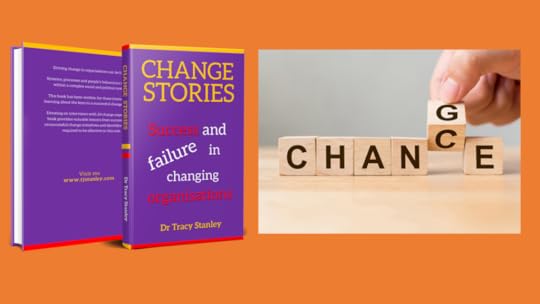
You an pick up your copy of Change Stories: Success and Failure in changing organisations here.
The post Favourite Change Tools, Templates and Processes appeared first on Tracy Stanley.
September 29, 2021
Measuring organisational change
Why measurement matters in change management
If you want to change something, measuring the rate of a change from where you are to where you want to be, not only tracks your progress but helps you to evaluate the effectiveness of the actions that you’re taking to achieve the desired outcome. Some things are easy to measure but aren’t necessarily great indicators of behavior change. For example, it’s easy to measure attendance on a training course, but harder to measure the extent to which the skills have been acquired and continue to be applied correctly over time. Every change manager needs to assess what should be measured, when’s the best time to do this and what’s the impact of the measurement. Too much measurement or inconvenient timing can fatigue the person providing the evaluation.

In my book of Change Stories: Success and failure in changing organisations, I asked all those I interviewed how they measured the effectiveness of their change programs. Here are a few of the examples they provided.
Measuring changes to safety culture
We had a few different measures. One was conducting a safety culture assessment, prior to actually commencing the engagement and then again at the end. We assessed individuals’ attitudes to safety, and looked equally at anecdotal feedback that came from leaders around what they could see changing within the organisation.
There were lots of good news stories where people mentioned somebody who had been quite resistant, and all of a sudden, there was this, almost like a switch had gone off and they had completely shifted and started to become more engaged in becoming more of an advocate, in terms of working safely.
We undertook regular surveys and had a high completion rate – which is also a sign that the project is going well. We combined surveys with face-to-face consultation. Fiona
No negative pushback in the media and talent retained
We delivered it within the timeframe that needed to be delivered. Funding was secured. We demonstrated that the changes were in place. We retained the talent that we had identified as needing to be retained and we didn’t get any negative pushback in the media. We were able to sit at the executive table with the sponsors who said, ‘You guys equip us’. They said yes when we needed to send out a letter with their signature. Samantha
Reporting on change readiness and change challenges
It’s important to establish change metrics early. These need to be relevant to the outcomes you want to drive, and should be around adoption and the employee experience, i.e., how ready people are for change, and how supported they feel. These metrics are very different than the usual project metrics of on-time or on-budget delivery. It’s about ensuring the right metrics are in place to measure that people are adopting new ways of working, embracing new technology and effectively performing as a result of the change, and ultimately the organisation is realising the benefits and outcomes they set out to achieve.
We work with the business to establish and track these metrics through reporting to the senior leadership team. As a change manager, how you influence in that space is important. Otherwise, how do they define the success of a project? Is it about delivering on time or is it about people using new technologies or adopting change and not reverting back to old ways of working? It’s that benefits realisation piece. Some questions that you can explore with the appropriate leaders and stakeholders include:
What’s the impact of this change?Does it impact the whole organisation, or does it hit across a small part of the organisation?How many people? The entire organisation, a few divisions, or one team?What are the change risks associated with it?What is the change leadership capability of the people leading it?How will we know we are successful? What will people be doing differently? Leanne
So a range of business, project and behavioural measures can be identified and tracked to enable the impact and effectiveness of a change initiative to be demonstrated. These stakeholder measures could include qualitative information such as anecdotal feedback, and quantitative data such as user adoption, while business measures could relate to revenue or business growth.
You can learn more about measurement the keys to success in organisational change programs in my book, Change Stories: Success and failure in changing organisations.
The post Measuring organisational change appeared first on Tracy Stanley.
May 2, 2021
What makes a great job? The CLARA model.
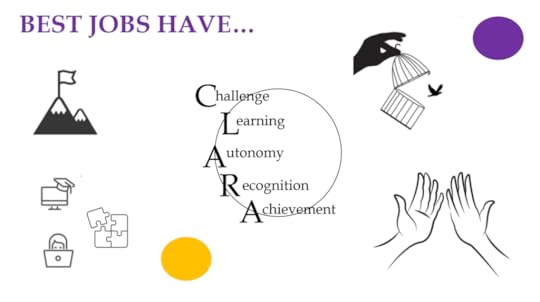
What’s the best job you’ve ever had? How old were you and what were you doing? And importantly, can you remember why the job was great?
I’ve been interested in what engages people at work for a long time and spent four years undertaking research into the drivers of engagement for my PhD. One of the outcomes from the research was the identification of the key attributes of a great job and the creation of a simple framework I’ve named the CLARA model.
The five elements of the CLARA model include Challenge, Learning Autonomy, Recognition and Achievement. The importance of each is described below.
CHALLENGE
Challenging jobs stretch us and bring out our best
Tough challenges force us to think and work harder. A challenge in your job could take many forms: solving a nutty problem, introducing a new system, or working with stakeholders with competing interests. These challenges typically get your brain sparking as you try to find the solution. To respond to the challenge, you draw on existing knowledge and seek new knowledge from other sources such as other people or web-based sources like Google.
It’s not surprising that when our job stops challenging us, we might look around for a new one.
LEARNING
Learning and mastering a skill is a wonderful and empowering thing
A logical extension of problem solving is learning. It will surprise few readers that when you’re engaged you love to learn. Learning can come when you’re working on your own, thinking deeply about a problem or when we’re discussing the problem with others. These are often the times when we’re most ‘in the zone’.
Here’s an example of learning from one of my interviews.
When I’m really sitting down and looking at a problem and I’m not sure what the solution could be and you might have an idea. And you often go into those trances where you are thinking – will this work? – yeah – where you are just thinking about your problem. It often happens because there are a lot of complicated things that are happening. Wallace
AUTONOMY
Autonomy is a staple of life – Give your team members freedom
This finding will surprise no one. Many researchers before me have reported how important autonomy is, particularly if you have a bit of experience. People love freedom: freedom to decide when and how work will be undertaken. Autonomy and freedom are all about having control, self-expression and the power to drive your work in the direction you think best. It’s also about the freedom to make mistakes.
Below are reflections from a few people who shared their work experience with me:
If I want to do something – I can just do it. There are no show stoppers. You can do it. It’s essentially up to you. John
He (my manager) really understands that and is letting me go off to do what I really need to do … We are super autonomous in what we do. Sally
ACHIEVEMENT
It feels great to achieve things – even little things
Jobs have different activities and objectives. The job could be one big project or many smaller tasks. Being able to put a tick on a To Do list or write the words DONE on a project status document gives a buzz of accomplishment. It feels great to achieve things, even little things. As these moments can often be fleeting it’s important not to miss them in the daily hustle and bustle of a work day..
Examples of times when those I interviewed experienced a sense of accomplishment included:
When you’ve got a good job where you don’t have anything that’s going to hold you up, where you can just be powering through it and everything is just running well, but also you’re feeling busy and that you’re accomplishing something. Ralph
At the end of the day you’re able to help people with tasks that they don’t do every day, that’s not their main task in their role. And they’re able to go away feeling that they’ve accomplished something. I feel like I’ve given them the best customer service I can. Marie
RECOGNITION
We all want to be recognised
Everyone, and I mean everyone, regardless of how much experience they have appreciates a quiet nod or a few words of appreciation in recognition for a job well done. It’s like a super energy bar, adding a spring to your step. However, recognition moments can be easily missed in the busy-busy daily thrust of attending meetings, participating in phone calls and writing reports. A timely moment for a positive shout-out to a staff member can easily pass while everyone is on the daily treadmill of emails and presentations.
It’s hard to overstate how important recognition is. In a large organisation it’s possible to feel lost and invisible. Being recognised is a sign that you are valued. And we all want to be valued. Knowing that the things you do are appreciated makes a big difference to how you feel in showing up for work each day.
How did you go?
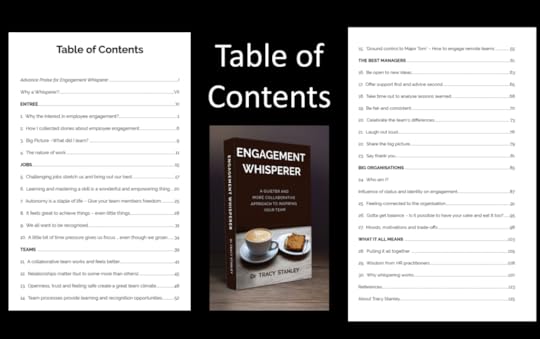
If you’d like to know more about what engages people then invite me in to chat with your managers and/or buy my book Engagement Whisperer: A quieter and more collaborative approach to inspiring your team.
Email me here: Tracy AT tjstanley.com
The post What makes a great job? The CLARA model. appeared first on Tracy Stanley.
April 10, 2021
The best change agents
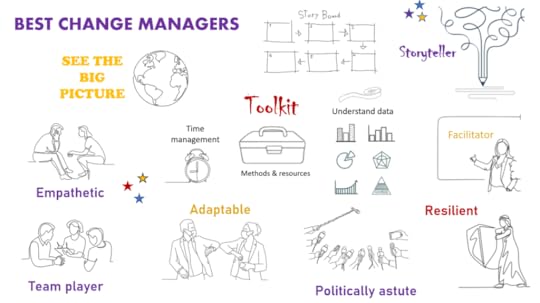 Drawings from iStock photos
I struggled to create an infographic that reflected the diversity of skills needed to be a great change agent. There are so many.
When I wrote Change Stories: Success and failure in changing organisations it was not surprising that the chapter that looked at the characteristics of the best change managers was one of the longest. It’s important to understand what these capabilities are, and how to develop them because, in the words of Erin,
In Australia, demand for change management has outstripped supply. It’s probably the same in project management. It’s a big challenge to recruit and develop capable change managers. And I guess that will always be the case. As we get more mature and as the profession grows, we need people who are capable and experienced and who can work across different organisations.
People come to the change management profession and learn their craft by many different paths. They could come from project management, organisational development, training or communication, to name a few of many paths. Whatever the path a broad skill set is required across the following ten areas.
Relationship development, empathy, compassion and resilienceGravitas – credible, self-aware, professional and confidentPerspective and insights – sees the big picture, is curious and comfortable with ambiguityAttitude – has a learning mindset, is innovative and admits mistakesMethodology – broad knowledge of frameworks, tools and processes, and which to applyProject management – across resourcing, risks and time managementUnderstanding data – requirements, testing, traceability and measurementUnderstanding businesses and disciplines – has broad organisational experienceCommunication, coaching and skills developmentPolitically aware.I’ve shared below a handful of observations about why these competencies are important.
Resilience. Flexibility. Adaptability.
Things change. Scope changes. Patience is needed. The reason why I say patience is that for some organisations, their maturity of change is very low. And we have practitioners with a high level of change maturity who get frustrated going into an organisation with a low level of maturity. I remember one practitioner saying ‘That it is all well and good when you talk about best practice and high performing teams, but in my organisation, they don’t even know how to communicate, before we even think about change management’. So my response was, ‘Why don’t you start there? Carrie
Credibility with senior managers
They’ve got to be able to talk to leaders at very senior levels. Identify who those people are. They can’t just rely on, ‘The PM will tell you who to talk to’. They have to be able to identify key areas and key problems. They have to engage with that person, to develop a rapport. So when they tell me about the impact assessment, I want them to tell me that out of this analysis should come clarity on what we need to communicate with people. I ask,
What strategies did you put in place?
How did you actually do that? Lyn
Planning and resourcing
What good change managers do well include communication planning, working closely with the project manager to ensure that the risks around the changes are discussed and understood. Ensuring that the resourcing for the project management activities – in terms of not just the people but also the budget – all that is in place and we have what they need to implement the change plans. Lionel
Change management as risk management
I see change management as a risk management activity. And I talked about those discussions that you might need to have with senior stakeholders to tell them. Oftentimes they have difficult discussions and you have to get messages understood to get support. Framing it in the context of risk as a project manager is usually pretty effective. Lionel
Good facilitator
Being an engaging workshop facilitator. Not just sending out information, but getting people to practise whatever the thing is they need to do. Elaine
Build resilience
Possess and foster resilience in others. Understanding people’s reactions and how they deal with change. Neil
Understanding other disciplines
I think having a high-level understanding of what goes on in other disciplines helps us to think differently, and allows us to be the effective advocates for end users. Helen
Doesn’t use a standard approach
I am firmly of the belief that there is process – but every project and program is different. Don’t have a cookie cutter approach. Hannah
Understands business
They are very good at understanding our business and culture deeply. Oscar
Politically astute
In large organisations there are political considerations. You need to be politically astute. There are often more enemies within than outside the organisation. People can white ant you. You need to have people watching your back. Nigel
Use multiple communication channels
Use multiple channels for communication and many times. Similar or same message because not everyone gets it the first time. You need to communicate with the right people at the right time and don’t raise unnecessary expectations. Oscar
Understands complexity
Because change management is complex, it looks different in every organisation, because of what you’re trying to change in the strategy, objectives and culture and leadership style in that organisation. What makes a great change manager is to be quite eclectic in their approach. Fiona
Broad range of experience
Great change managers have a broad range of experience working within different organisations and industries, and across many different types of change. They learn from their experiences, are curious, and continue to invest in their own professional development through on-the-job learning, peer-to-peer networking and keeping informed on best practice insights through their research and other development activities. Leanne
Works well with people across disciplines
I think they need to be able to operate and engage with a broad range of people. I’ve been in organisations where you’re working with tradies and engineers, right through to very technical and non-technical people. You need to be able to build relationships with people from a base grade right up to senior leadership. Leanne
Knowledge of data testing and interpretation
If you’re working in technology, you need to understand data testing and interpretation. Helen
Are curious
People who have a generally curious mindset can deal with change. They are quite flexible in their mindset and the way they like to work. Samantha
Know when the project is going off the rails
A good change manager knows when the project is going off the rails. You get this sense. Your intuition tells you that this is not going to end well. Your clients could be concerned about what stakeholders are doing. And you’re watching them, and you’re like, ‘You know what? No, just let’s just leave them be for a minute, I think it’s gonna come good’. And it does. It’s that kind of thing. You got to also know when to leave them alone. Ingrid
Tells it like it is
Don’t be shy to tell the powers-that-be, such as the steering committee, in simple straight language but with evidence. Some people are reticent to state their true opinion. They always try to skirt around some of the issues and paste over the cracks. Don’t make it nice, because if you don’t tell it the way it is, you know, you’re doing a disservice to yourself. Neville
Appreciates that change is hard work
It’s necessary to use your coaching skills to gather leader views and knowledge where complex changes cross multiple divisions and teams. It’s getting the data in such a way, to position it and say this should be both the plan that we could present moving forward and be able to change as well. I used to work with a PM who said, ‘You just deal with the fluffy stuff’. And I said, ‘This fluffy stuff is hard work and I’m putting together a plan based on all these bits of information, to support people who don’t ultimately understand what the change is, leaders who can’t articulate it, perceptions of gains and losses and I’m trying to piece that all together,
‘Right. I’ll give you fluffy stuff.’ Therese
Interested in learning more?
For more insights on the many competencies required to be a successful change manager, you can buy my book of Change Stories here.
References
(2020) Stanley, T. Change Stories: Success and failure in changing organisations
The post The best change agents appeared first on Tracy Stanley.
March 16, 2021
How creating an environment for creativity is like a greenhouse
 Image by Rafael Rex Felisildsa on Unsplash
There’s something in the air tonight.
Heard this expression before? It alludes to something encouraging people to behave in a certain way. It’s not easy to see, although people’s actions give you a clue. And you certainly can feel it.
Well the ‘it’ is the environment – and there are many things that influence the environment at work, which in turn influences people’s openness to being creative. Let me explain.
If we think of creativity as being the act of creating new things, then we would see people being creative when they are:
Attempting to solve a problem in a different way;Looking for new ideas in different places;See differences or similarities between two completely random ideas.Open to asking naïve and seemingly stupid questions; or simply byTaking a risk.Creating an environment for creativity is a bit like setting up the greenhouse. You create this structure, this environment, so that seedling plants get the sunshine and water that they need as well as protection from harsh environmental conditions. (As illustrated in the image below).
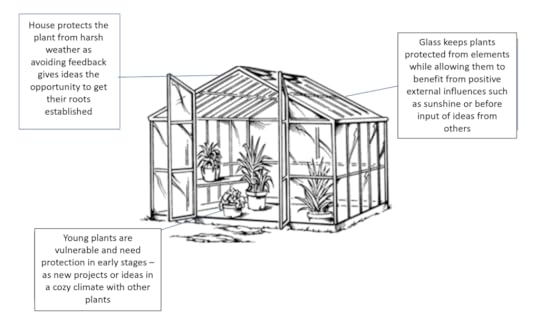
How you feel in any environment will influence how you behave. Let’s have a look at behaviours.
Leadership behaviours
As a leader you want to create an environment where people feel safe to explore different ideas and approaches to solving a problem. In a creative work environment, your team members will be curious, ask lots of questions and seek out new information. They will experiment, with failure being recognised as a learning point from which they capture knowledge and continue with the problem-solving process. Failure should not be seen as fatal. With a need to solve increasingly difficult problems, your team will benefit from an environment where collaboration and continuous learning is the normal way they work.
Team member behaviours
Behaviours that build a great climate for creativity include helping each other, seeking help when you need it and rethinking or reframing a problem so that it can be viewed differently. These behaviours often happen together and are typical of a team working in a collaborative manner. While new ideas can be discovered accidentally most will come out of a process that is intentional and deliberately undertaken.
How challenges stimulate creative thinking
Many things influence the work environment. The nature of work undertaken and the types of challenges faced will reveal areas where creative thinking skills are particularly useful. Facing a problem could be a catalyst for the application of problem-solving skills. Indeed, solving problems is one of the characteristics that often make a job valuable.
Solutions to problems often emerge through discussions with colleagues about the source of the problem and possible ways forward. Challenging problems help your team develop a range of skills, and if they are successful in solving a challenging problem, they receive a wonderful sense of accomplishment.
You’re a role model
As a leader and coach your behaviour is key. Your team will watch you closely and are likely to model your behaviours. If, for example, you track trends, are curious, and spend time exploring different ideas, then your team are likely to copy you. Offering encouragement and resources signals support for new ways of doing things. As a role model, your approach should be to empower rather than to instruct. Always aim to offer support first and advice second.
Autonomy is important for ownership
Giving your team members freedom and autonomy in how they undertake their work is very important for creativity. As a leader, your relationship with your team members and their positive attitudes towards new ways of working is a key influencer on their willingness or openness to exploring new ideas. Resist the urge to meddle or micro-manage in their activities and give praise and feedback to encourage further exploration of an idea. Your goal should be to empower them to make decisions. And listening, of course, is very important too.
Along with autonomy it’s important for you as a leader to remove those things that may limit your team’s capacity to undertake their work. What’s the culture like in your organisation to investing in not-yet-approved ideas? And is there enough time to play with these ideas and for ideas to gestate?
Wrapping it up
If you want to build a work environment where creativity flourishes, think about the conditions essential for new ideas to flourish. These include a safe place where new ideas can be explored without harsh criticism, where there is positive input from others and a cosy, collegial environment. Encourage behaviours such as asking questions, looking for answers in unusual places and taking risks.
If you create the right conditions many new ideas (or plants) will establish stronger roots, before they are exposed to tougher, real world conditions.
References
The post How creating an environment for creativity is like a greenhouse appeared first on Tracy Stanley.
Ten tips for writing a book

Keep a diary
Embrace imposter syndrome
Identify your audience – Who are you writing for?
What voice do you want to write in?
Develop an outline before you start
Read ...more
- Tracy Stanley's profile
- 6 followers

