Linda Sammaritan's Blog
November 19, 2025
The Quality of Our Soil
Jesus is a storyteller, and His early audiences consisted mainly of farmers and fishermen. No surprise then, when He chose to share a parable describing four types of soil.
First, soil along the road.Packed hard under all the feet and hooves and wheels straying onto it. Farmers knew seeds would just lie there, never sprouting. Other animals would eat those.
Second, rocky soil.Plenty of dirt. But fragile little rootlets wouldn’t be able to get past the stones under the surface. They’d remain fragile, easily killed off by heavy rains or scorching sun.
Third, thorny soil.Lots of good dirt. But the sprouts and roots would share space with thorns and weeds, and we all know who usually wins that war unless the farmer helps out.
Last, good soil.Well-plowed, well-watered, weeded, rocks removed. Seeds grow roots and sprout and flourish to maturity, ready for a bountiful harvest.
If we had any church upbringing at all, we learned what those soils symbolized. Back when Jesus was teaching along the Sea of Galilee, His disciples needed the explanation as well.
God is the farmer, the seeds are His Word, and we are the soil. And more often than not, we contain obstacles that prevent growth. Okay. I got it. We all hear what Jesus had to say, but not all of us respond to His Good News the same way.
Some of us pay no attention. Not interested.

Jesus will solve all of our problems!
Until. He doesn’t.
Forget it, then. One more great-looking opportunity that didn’t turn out to be so hot.

We have our list of things we would love to do for Jesus. But life keeps getting in the way. Pretty soon, the joyful to-do list turns into a ball and chain, link upon link of “Christian” obligations, not to mention the kids’ sports schedules, more tasks piled on at work, and we really should network within our communities if we hope to grow our retirement nest egg.


Is this fair?
I didn’t ask to be thorny soil. Or rocky soil. Or so hard that His Word just bounced off of me. But maybe I’ve been looking at this from the wrong angle all these years.
What if…it’s possible for all of us to be(come) good, fertile soil?
God says He wants all of us to be saved (1 Timothy 2:4). So, excellent farmer that He is, God can improve the soil of our lives.
Back in America’s pioneer days, families created a new farm field by chopping down trees to form a clearing. They dug out rocks from the earth and piled them as boundaries for the field.

They plowed hard, dry soil, either behind a horse or pulling a plow blade themselves.

Once seed was sown, they inspected the field frequently and pulled out weeds and volunteer vines from the woodlands that had once stood there. Backbreaking, seemingly endless work.


If men and women and children could do that, of course, God can do it!
One difference though.God doesn’t force us to give up what we started with. We choose to surrender ourselves to Him, which means we can pretty much count on pain as He clears out the forest of sin in our lives. When He digs deep to remove hidden rocks, it feels like surgery without anesthesia. When He pulls out the thorns that have become our comfortably-rooted companions, He leaves us bleeding and sore.
Are we willing?Do we want Jesus to harvest a crop from us that is thirty times the amount of seed He planted in us? Sixty times as much? A hundred times?
Then every single one of us is going to have to let the Lord work on our imperfections. Moments of pain interrupted by moments of blessed showers and new growth. It will be a daily challenge. And the harvest will be worth it.
The post The Quality of Our Soil appeared first on Linda Sammaritan.


October 14, 2025
The Half-Finished House, the Half-Finished Novel, the Half-Finished Faith
Perhaps the walls were up but the roof wasn’t shingled, and six months later when you passed it again, nothing had changed. Did you wonder what happened? Maybe the builder went out of business. Maybe the owner didn’t count the cost and ran out of money for the project.
If no one ever returns to complete the house, tangles of weeds will surround it, and a once pristine window will be no more than a gaping hole outlined with shards of glass. A half-finished house is useless. No one but wild critters can live there. However, if someone counts the cost of repairs and gets to work, a gleaming new home will result.
What do people do with gleaming new homes? They live in them!
Some writers keep a library of half-finished novels in their file cabinets.Those are the writers who have thousands of stories in their heads, and they spend a lifetime writing their stories only to get bogged down in the middle over and over again. They give up and start another new story. When asked, they explain, “The plot wasn’t working,” or “My characters were boring.”
They hadn’t counted the cost of writing their story. I don’t mean a monetary value but the effort in planning the desired result to offer their reading audience. Since they didn’t know where to go with it and no immediate answer popped into their minds, they gave up. They didn’t push through to “The End,” maybe because they never planned what the ending would be. Half-finished manuscripts are useless.

As a “pantser,” I could easily fall into the above trap. Pantsers are writers who “fly by the seat of their pants,” or, in this case, “write by the seat of their pants.” I don’t plan every point in my plot lines. I want to discover where the story will go and how the characters will grow as I blaze a trail into the wilderness of my novel. But I do plan one thing—the ending. It’s my way of counting the cost of writing the whole book. Every word I write follows a compass with the intended ending marked as True North.
Occasionally, I’ve set aside a project unable to create a clear path for my characters. I’ll give it a rest stop for a while and come back to it, but having counted the cost, I’ve finished several novels, and four of them are published!
What do people do with published novels? They read them!
Have you known people who rejected their faith in Christ?Maybe other “Christians” were mean to them. Maybe difficult circumstances in life caused them to decide God doesn’t exist after all—the world is too awful. Their faith had been partially worked out, but they abandoned it.
Our faith walk follows a parallel pattern to building a house or writing a book. We need to count the cost. Life on earth is not easy, so we have to plan on how we might handle both blessings and hardships. Our selfish natures are in as much danger of sinking into our comfortable prosperity as they are when we fall away by shaking a fist at God because He allowed bad things to happen. If we haven’t accepted that obstacles will block our walk with the Lord, we’ll tend to abandon our partially-built faith.
Half-finished faith is useless. But if we plan for our faith journey with its end point of meeting our Savior face to face, we’ll gain God’s benediction of “Well done, good and faithful servant.”
What do people do once they’ve completed their faith walk? They enter the gates of heaven!

The post The Half-Finished House, the Half-Finished Novel, the Half-Finished Faith appeared first on Linda Sammaritan.
September 14, 2025
Fear and Love–Can They Really Exist Together?
Fear and Love. The Bible contains lots of verses referring to both emotions, and the verses seem to conflict with one another.
1. All of John’s letters expound on love. “Perfect love casts out fear” is an example. (1 John 4:18)
2. “The fear of the Lord is the beginning of knowledge.” (Proverbs 1:7)
That second one. I’ve heard many a pastor explain the word “fear,” saying it really means “holy awe.” Or “reverence.” I agree.
But it’s a both/and.
Yes, we are in utter awe of the God of the universe. Those who experience His majesty find themselves face down on the ground, overcome by His Presence. We worship.
That matchless awe points to the fact that so much power—more power than we can describe or truly understand—can knock us out of existence with a little
poof
of His breath.

THAT’S a feeling of fear.
But what about those verses on “God is love?” How can He be love if we’re terrified of His power?
Here’s an earthly demonstration of fear combined with love.
My son is one of the best fathers I know. He’s raised his children where his yes means yes and his no means no. His two oldest are teenagers now, but this little incident happened when they were toddlers.

The girls were experimenting with those little slots in the wall. What might fit?
Their daddy noticed the dangerous activity. After gently removing likely tools from their hands, he looked each little girl in the eye, a very solemn expression on his face. “No.” And he pointed to the socket.
His babies burst into tears. Both of them. A double, instant eruption.
They had done something wrong. Daddy wasn’t pleased. He gathered them in his arms and kissed them until their tears dried.
As far as I know, they never played with an electric socket again, not because they were scared of their father, although they respected his authority. Their desire to please him easily outpaced their fear. They loved their father. They knew he loved them.
His children aren’t perfect. Sometimes, the fear portion of fatherhood needs to be put to use. If a punishment is in order for some huge act of disobedience, he applies specific disciplinary guidelines. He and the child move to a different room for privacy, and they discuss what went wrong with the child’s behavior. Dad explains the seriousness of the “crime,” and makes sure the child knows why he or she will be receiving serious consequences. Lots of hugs before and after consequences are administered.
This is the relationship our Father in heaven wants with us.
God loves His Only Begotten Son, Jesus, and He loves us, His adopted children, far better than my son loves his children. We know He loves us. We also know rebellion results in negative consequences, and we know the power He wields.
Fear and love exist together.
Like my granddaughters, we want the approval of our Father. We want to please Him, and while we fear His disapproval when we do something wrong, it’s the disappointment in ourselves that breaks us. We deserve punishment, and we fear it, but that loneliness when we feel separated from our Father is even worse. We want His love back.
But we’ve never lost it!
Every good parent understands how much they love their child even when administering punishment, and God is the best parent of all.
Of course, He still loves us!

The post Fear and Love–Can They Really Exist Together? appeared first on Linda Sammaritan.
August 10, 2025
As the mother of three sons, I’ve experienced plenty of w...
As the mother of three sons, I’ve experienced plenty of worry. Mothers of daughters probably worry even more. It’s a natural response to uncertain situations, right?
Right. Worry brings on feelings of helplessness. Synonyms for worry: distress, anxiety. Overwhelming stress is an awful feeling.
However, if I’m a Christian, I’m told by Jesus NOT to worry. Peter offered specific instructions (1Peter 5:6-7).
Humble yourself under God’s mighty hand.Cast all your anxiety (worry) on Him.What Does THAT Look Like?How can I turn my helpless worries into helpful concern for the person I’m worried about?
First, we need to see the difference between “worry” and “concern.” I’ve already defined “worry.” It does nothing positive for anyone. In fact, in Old English, it means to tear at something like a cat “worrying” a mouse.

“Concern” is a different story. A synonym for concern is “care.” We want to be involved with someone we care for without getting tangled in our own feelings. Staying calm does not mean we’re indifferent. Indifference would mean we didn’t care.
When we follow biblical instructions by humbling ourselves before God (Lord, I can’t fix this!) and casting our worries on Him, then:
We receive comfort from the Holy Spirit, andHis comfort transforms our distress to calm concern.Final result: peace for ourselves and an ability to calmly assist others.

Let’s return to one of my once-upon-a-time teen sons.
The kid is out way past curfew. I’m lying in bed, sleepless, waiting for the police to knock on my door. At some point, the Lord gets my attention. Knowing I have no power to control the situation in the moment, my imagination of the car in a ditch changes to prayer for his safety—whether in a ditch or at a party. God reminds me HE knows where my son is that very minute. HE has things under control.
Well, I trust God with my son. I stop hyperventilating over his absence. My prayers for him continue (worry becomes concern), and I drift into peaceful sleep—until I hear the front door open. Yeah, that boy is not happy to see Mama Bear approaching!
Do You See the Progression?Naturally, we worry. We fret. Then, Jesus invites us to tell Him all about it and hand over the worry to Him. He comforts us, and we calm down. We still have no solution to the problem, but we understand that God does. The person we’re praying for is in His hands, and our worries are, too. We can be peaceful while we wait. Even if the answer to our prayers isn’t what we hoped for, we still know:
God’s got this.

The post appeared first on Linda Sammaritan.
July 16, 2025
That Golden Glow
Many of you know I spent my teen years on a New York beach. That was back in the late Sixties and early Seventies. We shunned the new product called “sunscreen.” No, we wanted dark tans or at least, that golden glow enhanced by baby oil or carrot oil with sweet scents of orange blossoms. If the label on a bottle of tanning lotion advertised any number greater than SPF 4, we didn’t want it.
Bronzed skin proclaimed our excellent fitness, our outdoorsy nature, and our ability to relish the good life just like Madison Avenue taught us. And besides, all that vitamin D was truly good for us, right?

flickr.com/photos/abbeyroadprograms/
With my fair skin and freckles, it took all summer to create that golden glow.A great tan was my summer quest as if it were the holy grail. If I wasn’t babysitting, I was at the beach, chatting with my friends, lying on my back on a towel, then rolling to my stomach after a half hour, than back again. I might as well have been a marshmallow toasting over the campfire.
My grandmother warned me. “You’ll get wrinkles before you’re fifty. You’ll get age spots.”
Yeah, yeah, yeah. Grandma had a few wrinkles. Age spots, too. Granted, she was an old lady in her seventies.
But Grandma was right. If I hadn’t moved to the Midwest, sun damage could have been far greater. Without the sand and the ocean breeze, sunbathing lost its appeal. Ohio was just plain HOT! So was Indiana. Add running after three little boys during my twenties and thirties, who had time to lie out in the sun?

Gods411.com
However, by that age, I had learned about the eternal Golden Glow.
Many Christians have learned the secret to gaining it. This glow is much healthier than that false, athletic appearance people search for. Instead of “taking in the rays,” we soak in God’s Word. We can relax wherever we are. No beach necessary. We exchange listening to the latest pop music on a boombox for the Holy Spirit’s voice. We chat with our best Friend, Jesus. Every moment spent under the Light of Christ brings a golden glow to our souls.
Psalm 34:5 is a real experience. We look to Jesus, and we are radiant. We glow with joy! The longer we bathe in His Presence, the deeper the glow, our faces upturned to absorb Christ’s radiance. We reflect His Light.
A perfect example in my own life occurred when I visited my old hometown after a twenty-year absence. I was there to visit a a critically ill relative, the only one left in Westhampton. With my parents retired to North Carolina, my mom’s old friend invited me to stay in her home. Eleanor* was a lady who had no trouble speaking her mind (as did my mother—no wonder they’d been great friends!), and she’d watched me and my brothers growing up in those teen years. She knew all about the hot water we used to get into. Along with her own sons, I might add.
Eleanor was a lifelong atheist. She and my dad used to exult in debates, much to her husband’s discomfort and my mother’s offended sensibilities. In Mom’s opinion, politics and religion should be banned from all social gatherings.
credit to Steve Wickham
One evening after returning from the hospital, I enjoyed an extended conversation with Eleanor. I shared several stories about my life on the “frontier” in Indiana. Yes, many residents of Long Island feel Philadelphia is the border between civilization and the wilderness! Especially those of her generation.
Upon finishing some episode about my family, she lifted her chin and pondered my face. “You’re very different from the girl of years ago. You have…a serene glow about you.”
That Golden Glow! I had it!“That’s Jesus,” I said. “I could never be so calm in this crisis without Him.”
The words were out of my mouth before I even considered the repercussions of speaking them to an atheist who had been gracious enough to open her home to me, a near-stranger. I waited for the old gleam in her eyes indicating the verbal battle about to begin. Like father, like daughter.
But she remained thoughtful. “I wish I could know such tranquility.”
“You can,” I assured her.
For a moment I thought I saw a twinkle of argument, but she chose to retreat. She shook her head. “No, I don’t think so.”
Conversation was done. Eleanor said something about preparing for bed. The Holy Spirit stopped me from speaking further. Let her chew on it a while. Weeks later, I wrote her a letter, sharing a little more of my testimony and inviting her to contact me with any questions. She never did.
Had I failed? Absolutely not! I had spoken of my love for Jesus, His love for me. I had glowed. And she saw it! That is all Jesus asks of us.
Forget the “healthy, tanned-body-glow” message form the glut of television ads. Let’s go for that golden glow radiating the love of Christ.
People notice!
*Name changed to protect the family’s privacy.
Click here for my latest newsletter
The post That Golden Glow appeared first on Linda Sammaritan.
June 25, 2025
How Can We Overcome Evil with Good?
A long, long time ago and not so far away, I was a recent college graduate teaching in a Christian school, although I didn’t know God all that well. By the end of my first year, I was in love with Jesus, I thought all born again Christians were perfect people, and I eagerly awaited how God would use me in school, in church, and in my community.
[image error]
Wasn’t I adorably naïve?
Then I discovered (gasp!) not all Christians agree on everything.
I’m not talking an argument over whose peach pie is tastier at the church summer fair—Mabel’s or Edna’s. No, to my total disillusionment, I realized Christians don’t agree on ethical issues.
One day, a much-admired mentor shared her ideas on a topic of morality. I held the opposite opinion. Shocked, I struggled to bite my tongue before vicious words of judgment spewed from my lips. I’m so grateful the Holy Spirit held me in check. But in my immaturity, I stepped away from the friendship. She didn’t seek reconciliation. Nor did I.

As a mature Christian, I would have handled the situation differently.
I would have prayed first. Asked Jesus about it. My friend loved Him, too. How could we be on opposite extremes of such an important issue?
I would have studied the Bible. Was I right? Was she? I already knew scriptures to back up my view, but with the extra research, I would have figured out which verses she used to justify her stance. Once a person sees another’s point of view, anger dissipates. We may not agree, but we trust the other is honestly seeking answers just as we are.
Jesus always understood what people were thinking. He knew why they believed as they did. He knew some of them were fully evil and some were misguided, and to the latter, He offered grace.
I’m not as wise and discerning as Jesus.
In our world and in our nation, so many are angry with one another. Even Christians. Regardless of which side of the social issue they promote, they honestly (and indignantly) believe they’re right.
Do you know the illustration of the elephant and the blind men? They fight over what an elephant is.
“An elephant is a rope of muscle with hair on one end,” says the man holding the tail.
“No! An elephant is a long tube of muscle strong enough to lift me,” says the man hanging onto its trunk.
“You’re both ridiculous!” says the third blind man patting the elephant’s ear. “It’s obviously as flat as a pancake and mostly circular in shape.”

Each man was correct. But only for one part of the elephant. Christians are just as limited in experience as those blind men. We’re right—to a point—in how we comprehend what’s good and what’s evil.
When I log on to social media, anger is my first reaction to all the mean-spirited posts.
Obviously, I’m not alone, but Satan loves to see nonbelievers attacking believers. Even better, Christians sniping at one another makes for great entertainment in his book.
I can throw my own rotten tomatoes, adding to hell’s delight, or I can pour water on the fire in an attempt to overcome evil with good.
Jesus is Light.
And we want to reflect Light because we belong to Christ. Within His singular Light, we enjoy unity. We can offer His goodness and grace to an angry world.

When Christians set aside differences, (scroll to the Divine Appointment in the link), we glow like individual little candle flames dotting the globe. We offer hope to all who see our Light. It’s amazing how bright we appear in darkness, allowing souls in deep despair to see Jesus. Let’s be one of those little candles. Maybe we’ll err on the side of grace, but we’ll show the kindness of Jesus.
THAT is how we overcome evil with good.
www.facebook.com/lindasammaritan
The post How Can We Overcome Evil with Good? appeared first on Linda Sammaritan.
May 18, 2025
The Magic of Fragrance
For the last several years, I’ve been buying laundry detergent for sensitive skin, so no fragrance is mixed in with it. My clothes are clean, but coming out of the washer, they have no scent at all. Last month, I decided to go back to a detergent of my childhood, one that never irritated my skin. I’ll even put in a plug for it—Tide, Original.
The washing machine went through its paces, and I did chores nearby. When I opened the lid to transfer wet sheets into the dryer, I was transported to my mother’s kitchen of sixty years ago, where the comfortable scent of Tide wafted in from the laundry room. The blessing of memories from a wonderful childhood!
While writing my World Without Sound series, I drew from scents I experienced fifty years earlier. Salt air on the beach, spaghetti sauce heating on the stove, and a meatloaf in the oven. Not all the “scents” were a positive smell, let’s call them “odors,” but they carry me back all the same. Diesel exhaust from the school bus, canned tomato soup, and ammonia-washed floors in the hospital.
Certain Bible verses cause the same kind of phenomenon in my soul.
I call them “spiritual fragrances.” Like, whenever I read 1 John 4:4, I’m transported to my first year of teaching. The teachers performed the praise song from this verse.
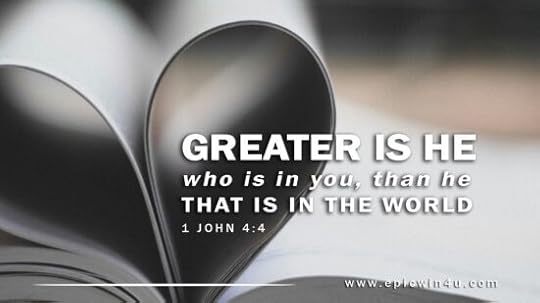
As a baby, born-again Christian, I looked at everything in my world the way infants take in their surroundings outside the womb. And those fourteen words in a simple praise chorus filled me with amazing joy. For the first time, I realized John wasn’t preaching only to the first century church. He was preaching to me, too! Every time I sing this little praise song, the stage and the audience of parents and students and heavenly joy flash into focus once again.
Am I alone in this sensation?
Do any of you find yourselves in the past because of a particular aroma?
Does a Bible verse hold so much significance that you are transported to the time when you first embraced those words?
I’d love to hear about it because sharing God’s Word is one way Christians build up each other’s faith.
The post The Magic of Fragrance appeared first on Linda Sammaritan.
April 13, 2025
Broken and Restored
For those of you who are old enough, do you remember how kids used to search for glass bottles, and the bottling companies would pay them a nickel apiece? Then the bottles would be washed and reused. Later, those companies decided it was cheaper and more convenient to institute a “no deposit-no return” policy. Customers should throw away cans and plastic and glass bottles instead. How sad.
Like discarded bottles, we, too, can be recycled into something fresh and beautiful.
God’s renewed creation.
Also, like glass, the price of renewing a human soul is costly.
Jesus sacrificed beyond what we can understand so we could be made into new and better people.

You can see from the above chart why industry would rather not recycle it. It’s an expensive, complex, and potentially dangerous process. Even so, the glass can be broken, crushed, melted, and reformed into something brand new and beautiful.

So, in my poor analogy, the bottle companies paid a huge price to recycle,
like Jesus paid to recycle us.
But we (the bottles) need to beware! Notice what the bottles had to go through.
Broken? Ow! Sometimes, God has to break us, like a rancher breaks a horse, if we are ever to be obedient.
Crushed? Even worse. Doctors can set bones, but they can do no more than to replace crushed limbs with artificial body parts. Only God can choose to restore a crushed portion of the human anatomy, and no one except God can restore a crushed spirit.
Melted? And reformed? An amazing amount of heat is required to liquefy glass, at which point the glass worker can reshape it–into something plain and useful or into a work of art. God can use the searing heat within HIs power and melt the soul down to its very essence, and when He reshapes it, we may not recognize ourselves when God has put the finishing touches on His renewed creation.
Or He can reform us like the biblical metaphor of the potter and the clay. The Potter forms the lump on the wheel (me) into something beautiful. If He’s not satisfied with His work, He slams me back into a lump and starts over. PAIN.
Will the process be worth it? Oh, yes!
God starts with our brokenness. We find ourselves in a time of life that hurts. Big hurts. Small hurts. We howl in our pain. We want relief. As Christians, we have only one way to find such relief. Tell Jesus. Beg Him for help.
Jesus pulls us onto His lap and lets us babble and wail over every hammer blow to our souls all the way down to every paper cut. He walks alongside us for days, even years, until we have spewed out all the pain, real and imagined. Once we are depleted, Jesus can speak.
He knows we’re ready to listen.
He shares His Word. A whisper. A challenge. He offers possibilities of peace restored to our souls. When we follow His suggestions, we naturally draw closer to Him. We rediscover joy! All of our sobs and whines and tears have melted into a beautiful new color of life, and we find ourselves made into something new.

While Jesus is the Master Artist in creating within us new beauty, He offers us an apprenticeship in His workshop. He teaches us techniques in listening to others’ brokenness and pain. He gives us the endurance to walk for miles with a friend on their journey toward a mended life. He passes on the wisdom of His Word for us to share with those in need, so He can restore their broken souls, too.
Which leads me back to the broken glass analogy.
Nancy Head wrote a simple poem on brokenness. I share it with her permission.
BROKEN BREAD
We grow from broken toys to broken hearts.
Broken is usually not a happy word.
It means damaged, inadequate, alone.
But broken bread fixes cracked hearts.
It feeds and fills.
Broken bread restores.

As we enter Holy Week on the Church calendar, let us remember:
Jesus said at the Last Supper as he held the bread, “This is My body broken for you.” HE is the One who fixes broken hearts. HE is the One who restores us and gives us eternal life!
The post Broken and Restored appeared first on Linda Sammaritan.
March 9, 2025
Not Tall Enough Yet
My three-year-old grandson wanted to find a toy he’d misplaced. Maybe it was on the table? Not whining, he’d made a matter-of-fact statement. He wasn’t tall enough. Only the top of his head matched up with the forty-inch height of that modern table unlike the traditional thirty inches found in dining rooms for centuries.
“Is it there, Nona?”
He knew I was plenty tall enough to see everything on the table. Sure, he could’ve scrambled onto a stool to see for himself, but he was content to let me take care of things. His world is filled with toys at sofa cushion-level and below. Let the adults deal with the rest!
Why CAN’T we adults live in the same state of acceptance?
We live on earth, unable to see or grasp heavenly things. Of course, we can’t understand all that happens in our lives. We’re not “tall enough.”
Why didn’t God prevent this illness? Why doesn’t He save our loved ones from sure destruction if they don’t turn to Him? God, who can see everything, including heaven, knows the answers to our questions. He is capable of keeping both heaven and earth in order. Like my little grandson, can we accept the fact of our lives that we’re not “tall enough?” Let God take care of things?

This is the Sovereignty of God.
A.W. Tozer in The Knowledge of the Holy describes how God’s sovereignty includes His attributes of being “all-knowing, all-powerful, and absolutely free. He is free to do whatever He wills, anywhere, at any time to carry out His eternal purpose.” *
Some people cry, “Not fair!”
Why is this not fair? God knows everything and sees everything in our world, in distant worlds, and in the supernatural world invisible to the human eye.

He knows how the tiniest components of a living cell work together and build upon each other until a mother can behold her newborn.

He sees beyond what our most powerful telescopes can show us.
Even more intangible is His ability to know the hearts and minds of men. While we rail at Him for allowing evil into the world, He knows why He has allowed what He has allowed.
We humans can’t see what God sees.
In my puny comparison above, my grandson couldn’t see what the grown-up could see. I had the knowledge of what existed on the table. I had the power to manipulate what was on the table. The three-year-old was glad to depend on my “sovereignty” in that moment to let him know if his toy was there or not (and would I get it for him?). He trusted my abilities.
Can we trust God’s abilities?
Can we say, “I’m not tall enough?” By next year, my grandson will probably be able to see everything on the tabletop, but as human beings, we will never attain the complete power and knowledge that God owns.

We can know Him better and grow taller and see more at a new height than we could see previously. As we stretch higher, we’ll recognize how God used for good what we didn’t understand before.
He is trustworthy, and even though we can’t see all that’s ahead, it’s okay. We’ll see more as we grow in spirit.
We’re just not tall enough yet.
__________
* Aiden Wilson Tozer, The Knowledge of the Holy (New York: Harper Collins, 1961) p. 108.
The post Not Tall Enough Yet appeared first on Linda Sammaritan.
February 11, 2025
Love Multiplies
Have you ever looked at one of the Apostle Paul’s run-on sentences and wondered, “What is he talking about?” Here’s an example from the New American Standard Bible, a wordy description of how love multiplies. Paul declares God equips every Christian with a specific ministry to help build up the Church. If you get lost in the grammar, just skip to where I try to give you the gist of it!
Ephesians 4:14-16 (Yes, it’s all one sentence!)
“As a result [of our growth in service], we are no longer to be children, tossed here and there by waves and carried about by every wind of doctrine by the trickery of men, by craftiness in deceitful scheming; but speaking the truth in love, we are to grow up in all aspects into Him who is the head, even Christ, from whom the whole body, being fitted and held together by what every joint supplies, according to the proper working of each individual part, causes the growth of the body for the building up of itself in love.”
Say what?

In a nutshell, as far as I can make out, when Christians love each other, study the Word together, use their individual, God-given strengths to support one another, and reach out to those in need, we are doing exactly what God wants us to do. We are building His Church and expanding His influence in the world. Love multiplies. But—
Exactly how do we build the Church?
I know! I know!
There are two basic ways we can all help.
1. We tell others about how much we love God, and He loves them, too.
2. We serve others as a testimony to Christ’s goodness.
Umm. Not exactly. Sure, we can say the right words, serve others because we should, but we might be missing the love, the essential ingredient to building God’s Church. What good is it to smile and be a cheerleader for God if we don’t do something to show the listener what Christ’s love looks like?

Ask yourself with me:
Am I doing the job Jesus wants me to do?
A little while ago, a good friend of mine asked me if I put action into the words on my blog. You know what? While my heart honestly yearns toward Jesus, my actions are much slower to comply. Yes, I speak and write of Jesus to family, friends, and my blog audience. But do I actively wade into the muck of an acquaintance’s needs ? Do I come alongside and love a stranger as God gives me opportunity? Do I see a neighbor in crisis and sacrifice my time to meet her need?

Answer the question with me:
(Yes?), but I could be more aware of the Spirit’s nudging?
Remember the boy who gave his lunch to help feed the five thousand? Five fish and two loaves of bread would never feed that many. But Jesus took his heartfelt, little offering and multiplied it miraculously.
He can do the same with our efforts. What we have to give doesn’t seem to matter, but Jesus can multiply our offerings like He did two thousand years ago.

We have objections.
“My love can do nothing for this grieving person.”
Wrong. Love the person who needs you. Just come alongside. Be available. Watch what God does with your compassion.
“My ignorant advice won’t help this situation.”
Wrong. Share God’s Word that goes along with the advice you have to give. Watch God move.
“I’m no Bible scholar. How can a single Bible verse from me alter another’s life?”
What? The Bible verse contains God’s words, not yours! Watch how Jesus uses His Word via your mouth!
Henri J. Nouwen speaks about how “little” we are—little love, little knowledge, little possessions. Yet, God gave us these little gifts so we could give them away. We discover that the more we give away, the more we have—and the more we have, the more we will give away.
Love multiplies.
The post Love Multiplies appeared first on Linda Sammaritan.