Jane Bow's Blog
October 9, 2014
Good Morning Canada, Who Are You?
When three invitations to present my new novel,
Cally's Way
, arrived from Edmonton, my husband and I packed the trunk of our second-hand Volvo with books and hit the road.
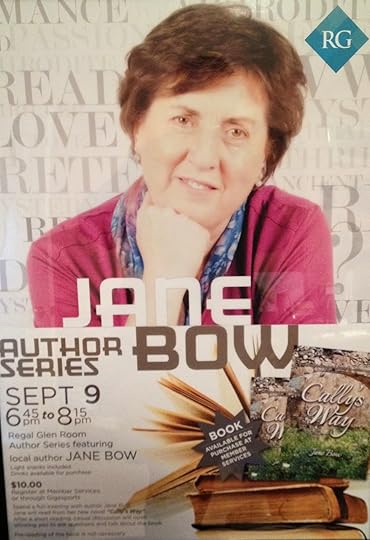 Poster at Royal Glenora Club, EdmontonCanada today is very different from the country I knew growing up as the daughter of diplomats. Then, we were respected across the world as a thriving democracy and an international peacekeeper.
Last month our prime minister did not attend the U.N.'s summit meeting on climate change. Today's Canada muzzles its scientists, harasses PEN Canada, which champions freedom of speech, does not even try to meet carbon reduction targets. Toronto, our biggest city, is run by a confessed drug addict.
What happened? How did that Canada become this Canada? Maybe driving across the country would yield some answers.
Days 1 & 2 - Behind the Pines
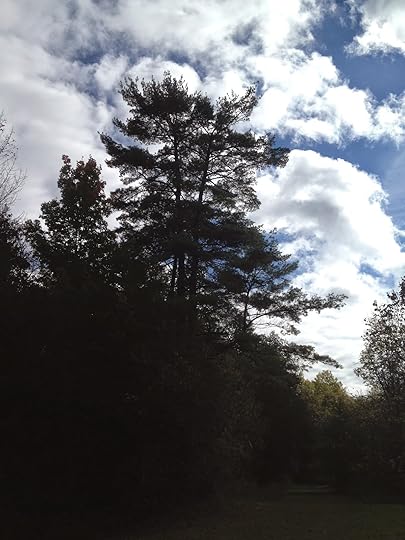
Fall is touching central Ontario's sugar maples with red, orange, yellow, gold. Further north, pines that inspired Canada’s Group of Seven painters find purchase among the Canadian Shield’s granite crags and cliffs.
Chi-chi bakeries populate Muskoka Lakes towns where some of the country’s wealthiest families own summer homes, but drive north for a couple of hours and the scene changes.
Motels, gas stations, small businesses along the highway have been abandoned. Those that remain are suffering, their grocery shelves as bare as some I have seen in the third world. But, noticing my walking sticks, a store owner stops mopping the floor to help me.
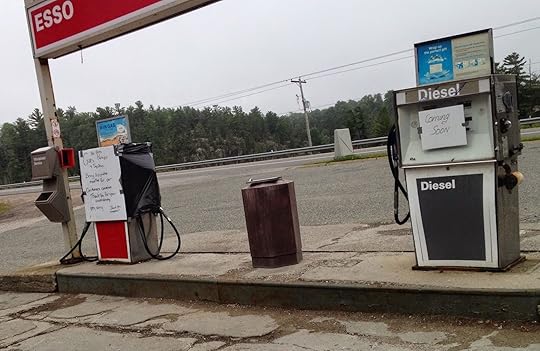 No gas today. Sorry for the inconvenience.Trees, trees and more trees line the highway. Cold, wind-whipped rain makes clear how powerful are the forces of Nature up here. Slide off the road or hit a moose and without help you will surely perish.
Billboards and signs offer clues to what goes on behind the trees:
Fishing and hunting lodges will fly in their clientele
When I was a junior reporter in Thunder Bay, I spent a weekend at one of these wilderness lodges, helping in the kitchen, exploring the river, playing penny card games late into the night. Forty-two years later the smell of frying bacon still takes me back into that wild peace.
You are now entering a First Nations reserve
A few years ago, while working in a Moose Factory school, I visited a Cree fishing camp on the mighty Moose River just south of James Bay. Hidden by brush, the camp was invisible until our canoes landed. We feasted on grilled, freshly caught fish, learned how to make a duck blind and mud decoys, then sat, silently waiting for the sound of wings. Knowing that each of us was one tiny breathing participant in the great dance of Nature. What a gift!
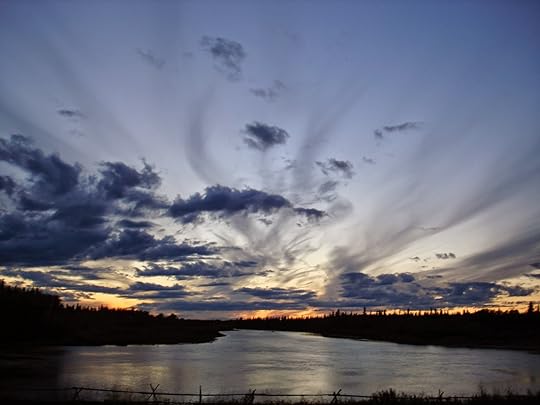 The end of a Moose Factory day
Violence against women must stop
Testimony during a murder trial I covered for the Chronicle-Journal in 1972 took me into a wilderness hunting camp near Long Lac. The accused was a slight, shy eighteen-year old boy. Waking in the night, hearing one of the older women crying for help in another tent, he found her struggling under a large, very drunk man -- his uncle. He yelled, tried to wrestle the attacker. Could not pull him off. Finally, in desperation, he picked up the closest object, an axe, and buried in his uncle’s head. A court full of white men sent the boy to prison for life. Where, I wonder, is he now?
Impossibly blue Lake Superior, stretching as far as the horizon, is framed by red granite cliffs polished by the rain.
Barrick Mine
Just for a moment, the wall of trees breaks. A building and pond are dwarfed by a pile of gravel as high as a hill.
Further west, more trees -- deciduous, cedar, pine -- all vying for every square inch of earth remind me of other parts of the world, where people of different races and faiths are battling each other for control of land they call home. When the rain lets up, blackened skeletal trunks appear where recent forest fires destroyed everything. Under them, light new-green growth has already begun.
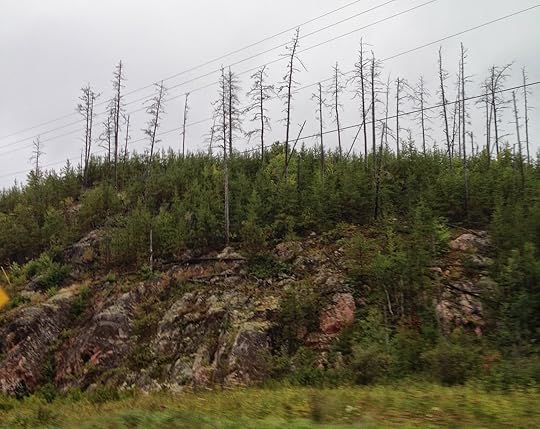
Highways up here are new and beautiful. Cities we are passing through -- Sault Ste. Marie, Thunder Bay, Dryden, Kenora -- all have fast food joints and big box stores. Is this where the money up here has gone?
Day 3 - Flatlands
Manitoba’s highway signs, in French as well as English, remind us that Francophone Canada does not live only in Quebec.
Fields here are huge, seas of yellow sunflowers. Rolled up hay bales advance like extra-terrestrial creatures from a humanless horizon. Platoons of silver silos wait for the grain and seed trucks throwing up dust along the side roads.
Welcome to big agro, farms owned by companies. You don’t need to be a farmer to feel the enormity of the change this has brought. Wooden homesteads nestled into little groves of planted trees lie empty now.
Above it all the prairie sky is the most magnificent living canvas I have ever seen.
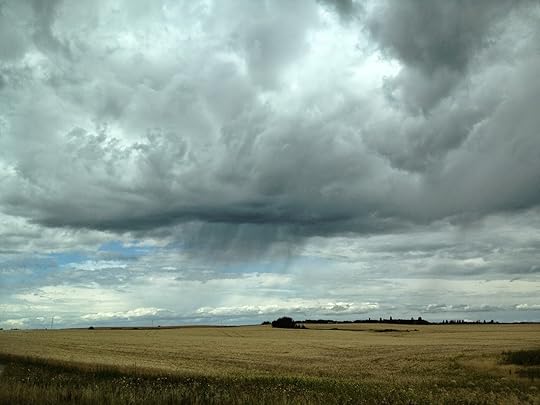
Everything here is big. Trains so long you never see the last car carry cylindrical black tanker cars, and goods containers piled one on top of the other. A man I meet later in Edmonton, whose company is involved with the oil industry, tells me some of the chemicals being transported are lethal. I thank God the land is flat, the rail lines straight.
(Two weeks later, while writing this, I read that a train, derailed and on fire near a rural Saskatchewan village, is belching toxic smoke. Heaven help the people and flora and fawna there. Heaven help us all.)
Prairie villages and towns each have their own character. How did Mozart get its name? Langeburg's central park is decorated with a painted Volkswagen. A hand-painted sign at the entrance to Churchbridge, Saskatchewan boasts of the two NHL hockey players it has produced.
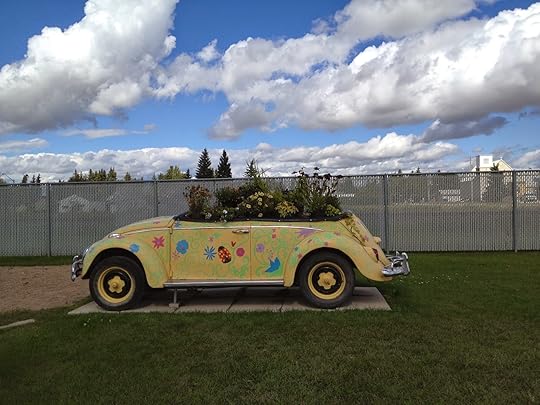 Langenburg's park
We can’t find an affordable place to stay in Saskatoon so we keep driving, arriving late at North Battleford’s lovely Gold Eagle Lodge. Next door, in the casino, people are shoving money into one-armed bandits, sitting around dimly-lit poker tables. It's 10 pm and the restaurant is nearly empty, but the Gold Eagle's “pig’s wings” are among the finest restaurant ribs I have eaten.
Day 4 & The last Crossing
Winding through low, tawny hills, the North Saskatchewan River valley has been an awesome passageway as long as humans have travelled between the Rocky Mountains and Saskatchewan. As we follow it, heading for Alberta, gigantic farming and construction machines and filthy oil tanker trucks rule the road. We are glad when Edmonton's skyline appears.
The North Saskatchewan River cuts right through Edmonton. We walk along its banks. Readers welcome me and Cally’s Way. By the end of the festivities I am number two on the Journal’s fiction bestseller list, and it is time to head home.
Alberta’s southeastern cattle ranges come alive, thanks to Guy Vanderhaeghe's historical novels, particularly The Last Crossing. Then, at Wild Horse, we find a lone guard defending Canada's border.
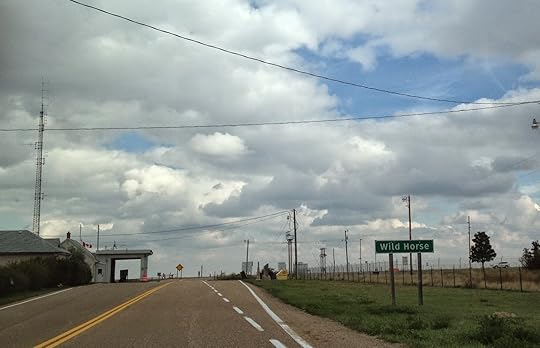
Highways are under construction all across Canada and the United States. City exit ramps are clogged with cars, pick-up and transport trucks. At the Ambassador Bridge border crossing in Detroit trucks are lined up for more than a kilometer, engines idling.
Driving the last stretch, through acres and acres of new windmills in south-western Ontario, I try to make sense of what we have seen:
People we met everywhere on our trip were kind, generous-hearted, very different from each other. I feel grateful to live among them. More and more stuff, some of it dangerous, is moving across our awesome landscape of lakes and forest, prairies and mountains. This is not healthy. Neither are our politics. But how, I wonder, can Canadians struggling through windswept, six-month winters in isolated places, and working dawn to dusk in the growing season, find the strength or the time to relate to the lives of other Canadians thousands of kilometres away? How can an Albertan from Vermilion know what concerns someone trying to make a living in Windsor Ontario? Canada became a country because the British needed to defend against incursions from the south. We forced the aboriginal peoples onto reserves, forged a federation of provinces and territories, built railways, and have been making it up as we go along ever since.
Today the Canada we cherish -- clean air and water, freedom of speech and open debate, consumer choices -- needs our protection. So please, wherever you live, get out and vote, but for people and parties that stand for a free, environmentally responsible Canada.
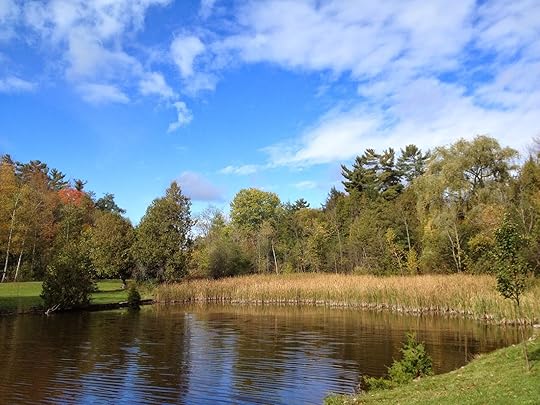 Peterborough City Council wants to destroy this to build a bridge.
Thanks for taking time to read this,
Jane
 Poster at Royal Glenora Club, EdmontonCanada today is very different from the country I knew growing up as the daughter of diplomats. Then, we were respected across the world as a thriving democracy and an international peacekeeper.
 Last month our prime minister did not attend the U.N.'s summit meeting on climate change. Today's Canada muzzles its scientists, harasses PEN Canada, which champions freedom of speech, does not even try to meet carbon reduction targets. Toronto, our biggest city, is run by a confessed drug addict.
What happened? How did that Canada become this Canada? Maybe driving across the country would yield some answers.
Days 1 & 2 - Behind the Pines
Fall is touching central Ontario's sugar maples with red, orange, yellow, gold. Further north, pines that inspired Canada’s Group of Seven painters find purchase among the Canadian Shield’s granite crags and cliffs.
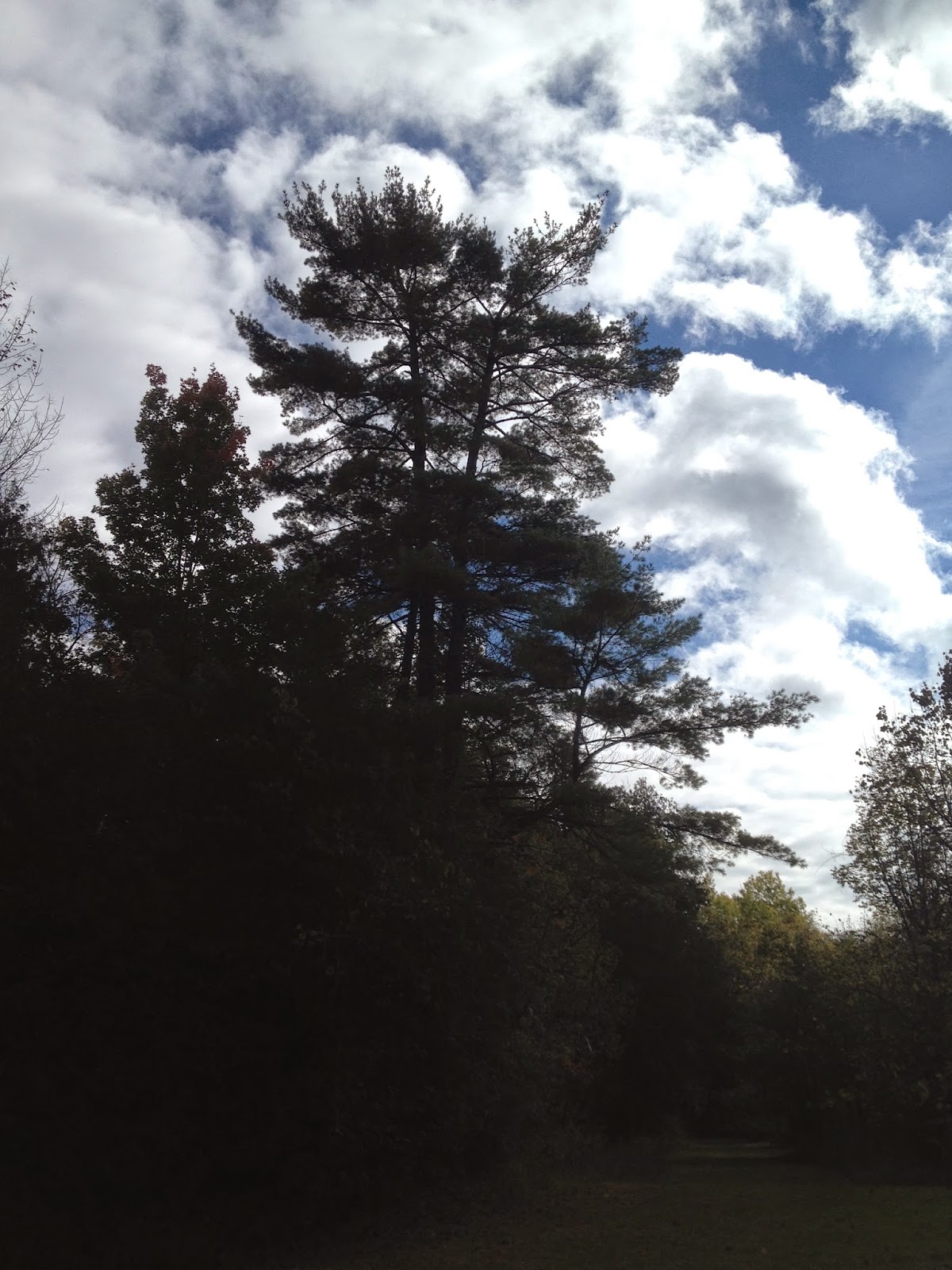
Chi-chi bakeries populate Muskoka Lakes towns where some of the country’s wealthiest families own summer homes, but drive north for a couple of hours and the scene changes.
Motels, gas stations, small businesses along the highway have been abandoned. Those that remain are suffering, their grocery shelves as bare as some I have seen in the third world. But, noticing my walking sticks, a store owner stops mopping the floor to help me.
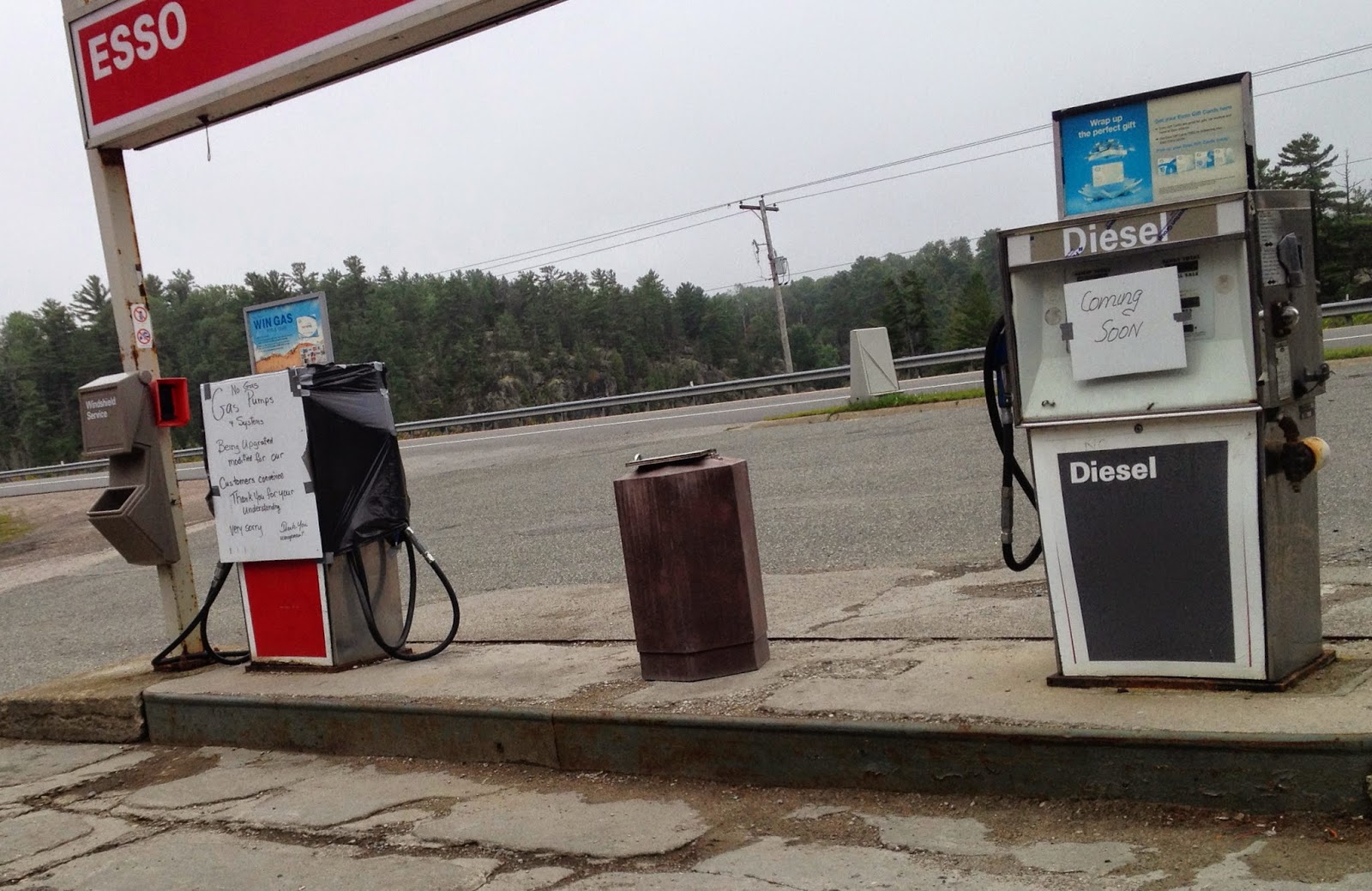 No gas today. Sorry for the inconvenience.Trees, trees and more trees line the highway. Cold, wind-whipped rain makes clear how powerful are the forces of Nature up here. Slide off the road or hit a moose and without help you will surely perish.
Billboards and signs offer clues to what goes on behind the trees:
Fishing and hunting lodges will fly in their clientele
When I was a junior reporter in Thunder Bay, I spent a weekend at one of these wilderness lodges, helping in the kitchen, exploring the river, playing penny card games late into the night. Forty-two years later the smell of frying bacon still takes me back into that wild peace.
You are now entering a First Nations reserve
A few years ago, while working in a Moose Factory school, I visited a Cree fishing camp on the mighty Moose River just south of James Bay. Hidden by brush, the camp was invisible until our canoes landed. We feasted on grilled, freshly caught fish, learned how to make a duck blind and mud decoys, then sat, silently waiting for the sound of wings. Knowing that each of us was one tiny breathing participant in the great dance of Nature. What a gift!
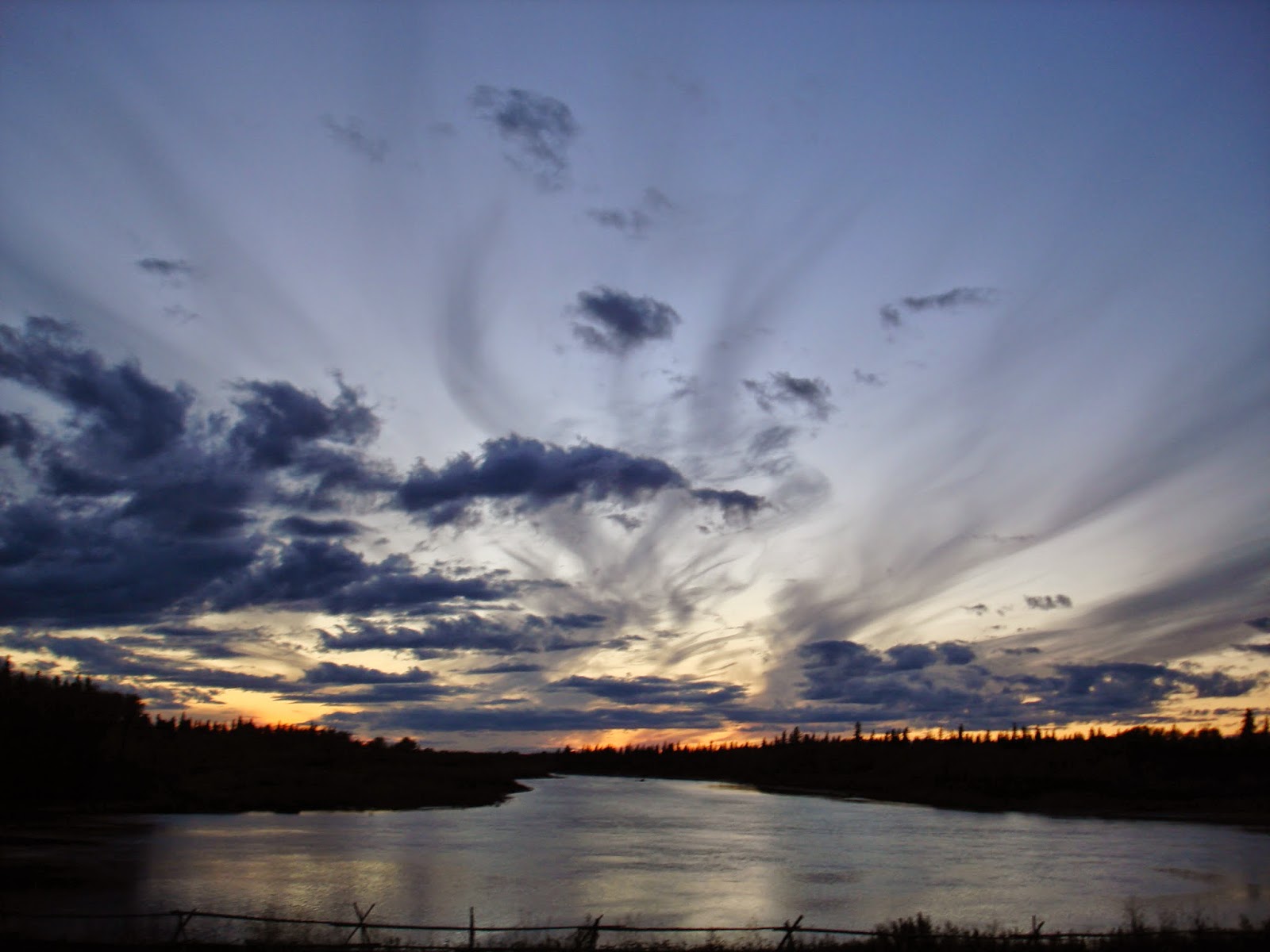 The end of a Moose Factory day
Violence against women must stop
Testimony during a murder trial I covered for the Chronicle-Journal in 1972 took me into a wilderness hunting camp near Long Lac. The accused was a slight, shy eighteen-year old boy. Waking in the night, hearing one of the older women crying for help in another tent, he found her struggling under a large, very drunk man -- his uncle. He yelled, tried to wrestle the attacker. Could not pull him off. Finally, in desperation, he picked up the closest object, an axe, and buried in his uncle’s head. A court full of white men sent the boy to prison for life. Where, I wonder, is he now?
Impossibly blue Lake Superior, stretching as far as the horizon, is framed by red granite cliffs polished by the rain.
Barrick Mine
Just for a moment, the wall of trees breaks. A building and pond are dwarfed by a pile of gravel as high as a hill.
Further west, more trees -- deciduous, cedar, pine -- all vying for every square inch of earth remind me of other parts of the world, where people of different races and faiths are battling each other for control of land they call home. When the rain lets up, blackened skeletal trunks appear where recent forest fires destroyed everything. Under them, light new-green growth has already begun.
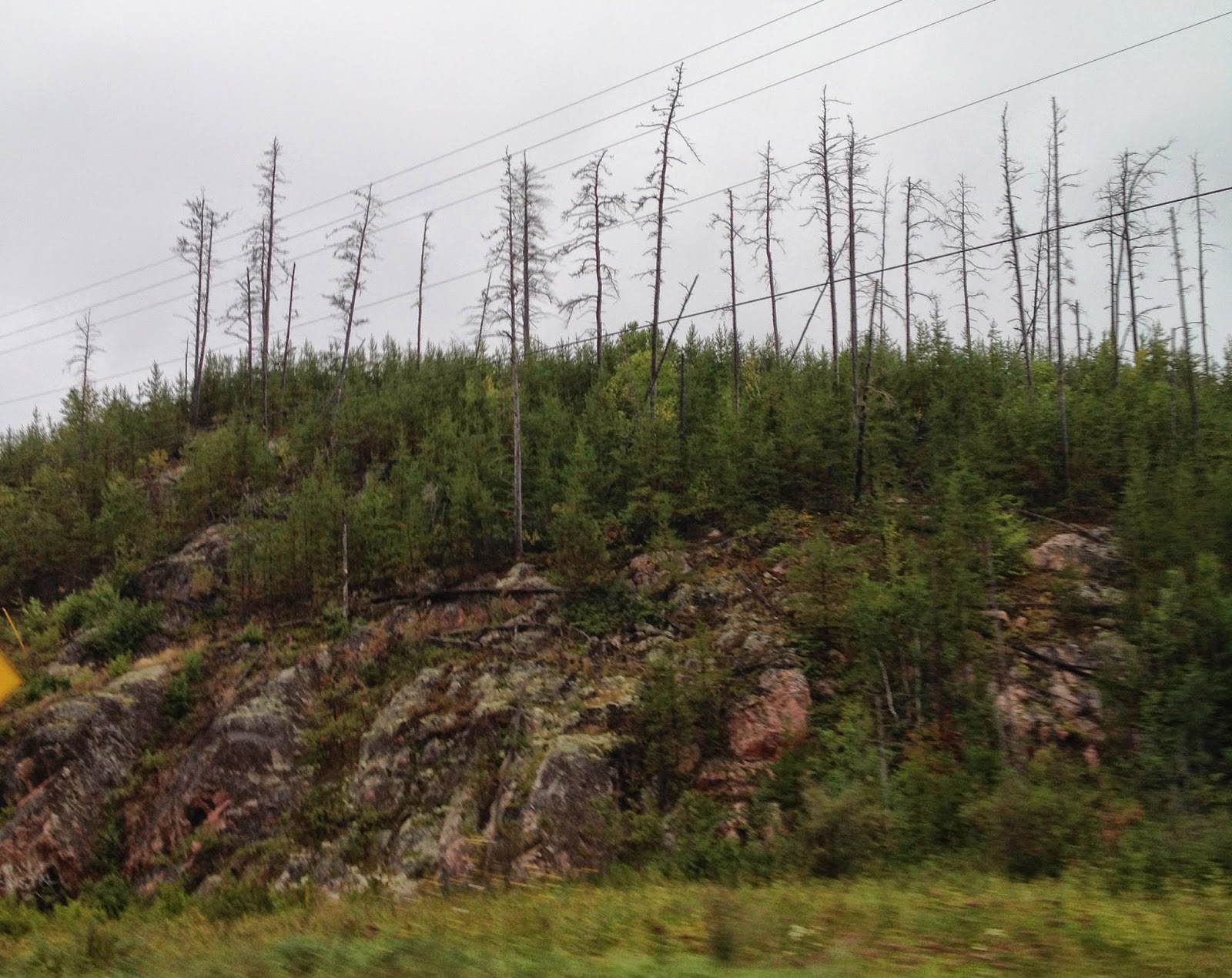
Highways up here are new and beautiful. Cities we are passing through -- Sault Ste. Marie, Thunder Bay, Dryden, Kenora -- all have fast food joints and big box stores. Is this where the money up here has gone?
Day 3 - Flatlands
Manitoba’s highway signs, in French as well as English, remind us that Francophone Canada does not live only in Quebec.
Fields here are huge, seas of yellow sunflowers. Rolled up hay bales advance like extra-terrestrial creatures from a humanless horizon. Platoons of silver silos wait for the grain and seed trucks throwing up dust along the side roads.
Welcome to big agro, farms owned by companies. You don’t need to be a farmer to feel the enormity of the change this has brought. Wooden homesteads nestled into little groves of planted trees lie empty now.
Above it all the prairie sky is the most magnificent living canvas I have ever seen.
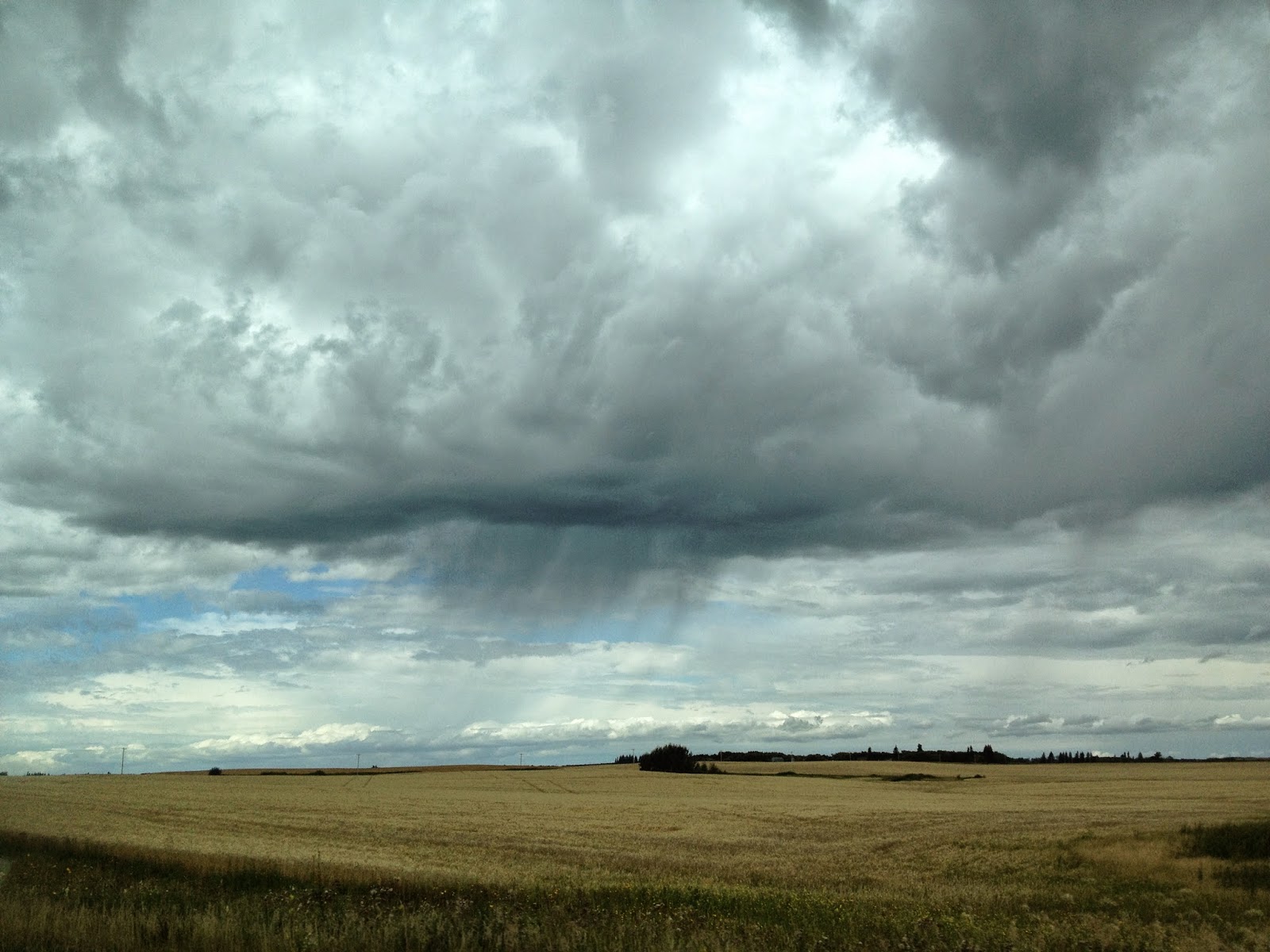
Everything here is big. Trains so long you never see the last car carry cylindrical black tanker cars, and goods containers piled one on top of the other. A man I meet later in Edmonton, whose company is involved with the oil industry, tells me some of the chemicals being transported are lethal. I thank God the land is flat, the rail lines straight.
(Two weeks later, while writing this, I read that a train, derailed and on fire near a rural Saskatchewan village, is belching toxic smoke. Heaven help the people and flora and fawna there. Heaven help us all.)
Prairie villages and towns each have their own character. How did Mozart get its name? Langeburg's central park is decorated with a painted Volkswagen. A hand-painted sign at the entrance to Churchbridge, Saskatchewan boasts of the two NHL hockey players it has produced.
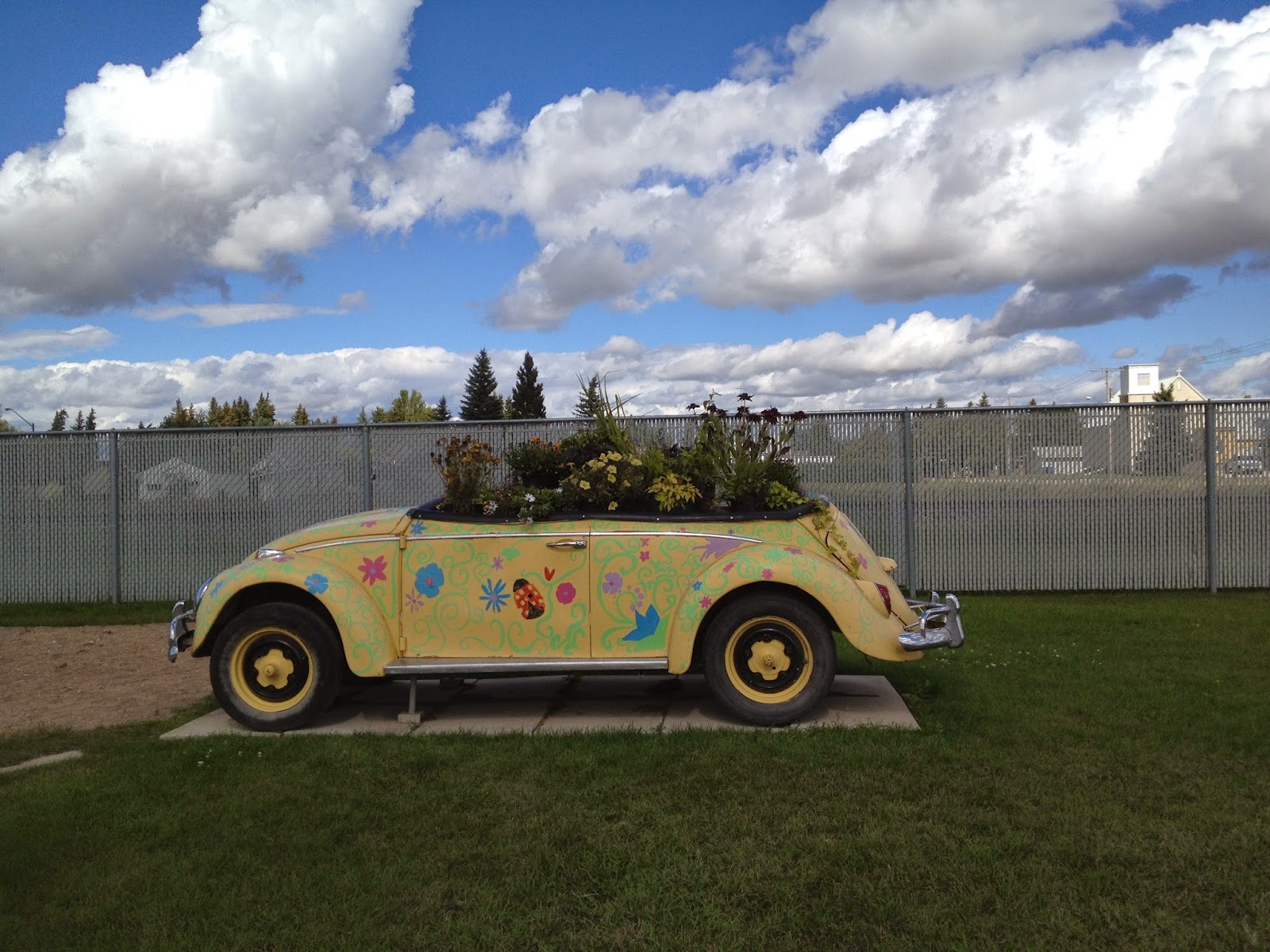 Langenburg's park
We can’t find an affordable place to stay in Saskatoon so we keep driving, arriving late at North Battleford’s lovely Gold Eagle Lodge. Next door, in the casino, people are shoving money into one-armed bandits, sitting around dimly-lit poker tables. It's 10 pm and the restaurant is nearly empty, but the Gold Eagle's “pig’s wings” are among the finest restaurant ribs I have eaten.
Day 4 & The last Crossing
Winding through low, tawny hills, the North Saskatchewan River valley has been an awesome passageway as long as humans have travelled between the Rocky Mountains and Saskatchewan. As we follow it, heading for Alberta, gigantic farming and construction machines and filthy oil tanker trucks rule the road. We are glad when Edmonton's skyline appears.
The North Saskatchewan River cuts right through Edmonton. We walk along its banks. Readers welcome me and Cally’s Way. By the end of the festivities I am number two on the Journal’s fiction bestseller list, and it is time to head home.
Alberta’s southeastern cattle ranges come alive, thanks to Guy Vanderhaeghe's historical novels, particularly The Last Crossing. Then, at Wild Horse, we find a lone guard defending Canada's border.
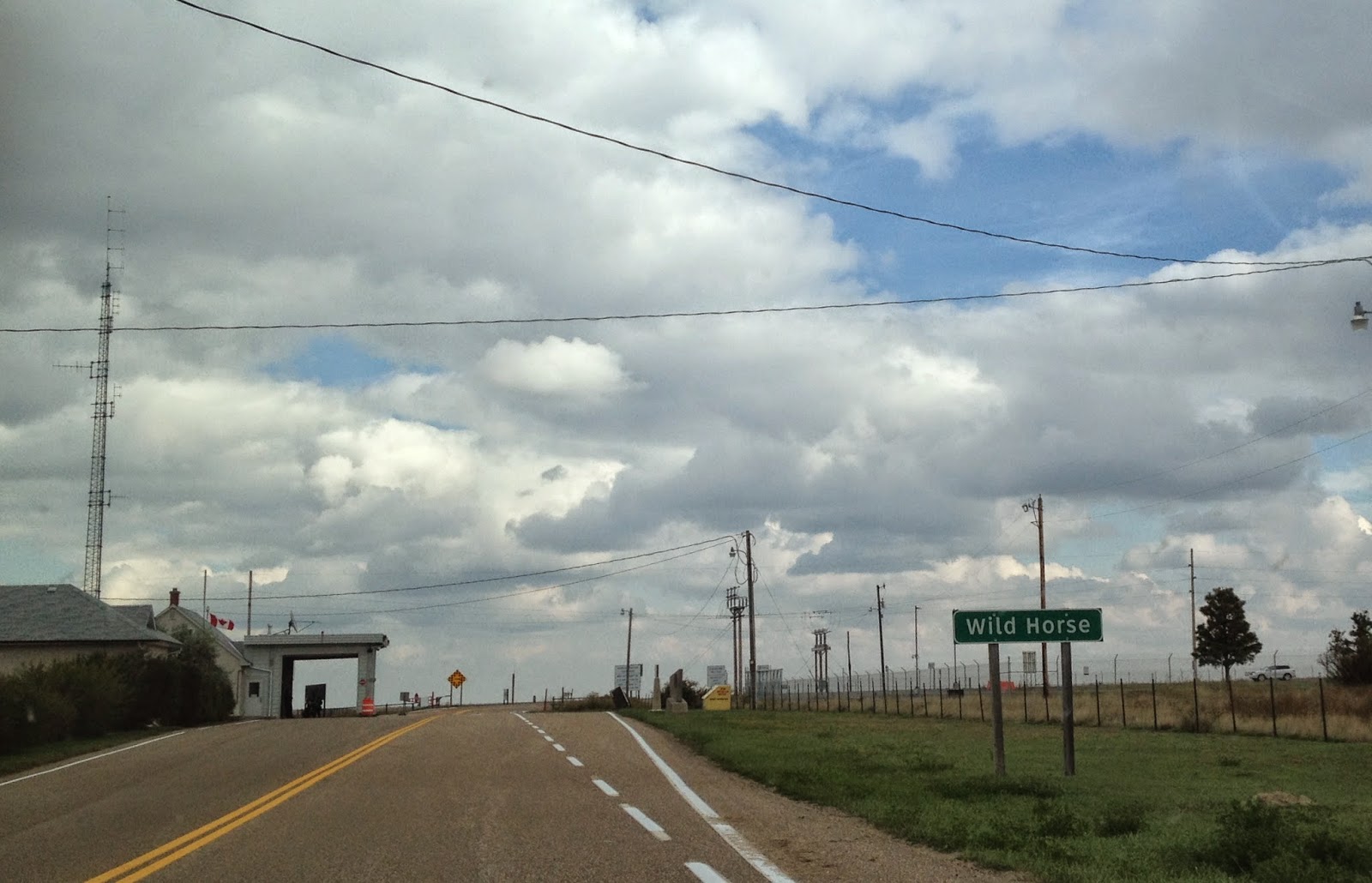
Highways are under construction all across Canada and the United States. City exit ramps are clogged with cars, pick-up and transport trucks. At the Ambassador Bridge border crossing in Detroit trucks are lined up for more than a kilometer, engines idling.
Driving the last stretch, through acres and acres of new windmills in south-western Ontario, I try to make sense of what we have seen:
People we met everywhere on our trip were kind, generous-hearted, very different from each other. I feel grateful to live among them. More and more stuff, some of it dangerous, is moving across our awesome landscape of lakes and forest, prairies and mountains. This is not healthy. Neither are our politics. But how, I wonder, can Canadians struggling through windswept, six-month winters in isolated places, and working dawn to dusk in the growing season, find the strength or the time to relate to the lives of other Canadians thousands of kilometres away? How can an Albertan from Vermilion know what concerns someone trying to make a living in Windsor Ontario? Canada became a country because the British needed to defend against incursions from the south. We forced the aboriginal peoples onto reserves, forged a federation of provinces and territories, built railways, and have been making it up as we go along ever since.
Today the Canada we cherish -- clean air and water, freedom of speech and open debate, consumer choices -- needs our protection. So please, wherever you live, get out and vote, but for people and parties that stand for a free, environmentally responsible Canada.
 Peterborough City Council wants to destroy this to build a bridge.
Thanks for taking time to read this,
Jane


Good Morning Canada, who are you?
When three invitations to present my new novel,
Cally's Way
, arrived from Edmonton, my husband and I packed the trunk of our second-hand Volvo with books and hit the road.
Poster at Royal Glenora Club, EdmontonCanada today is very different from the country I knew growing up as the daughter of diplomats. Then, we were respected across the world as a thriving democracy and an international peacekeeper.
Last month our prime minister did not attend the U.N.'s summit meeting on climate change. Today's Canada muzzles its scientists, harasses PEN Canada, which champions freedom of speech, does not even try to meet carbon reduction targets. Toronto, our biggest city, is run by a confessed drug addict.
What happened? How did that Canada become this Canada? Maybe driving across the country would yield some answers.
Days 1 & 2 - Behind the Pines
Fall is touching central Ontario's sugar maples with red, orange, yellow, gold. Further north, pines that inspired Canada’s Group of Seven painters find purchase among the Canadian Shield’s granite crags and cliffs.
Chi-chi bakeries populate Muskoka Lakes towns where some of the country’s wealthiest families own summer homes, but drive north for a couple of hours and the scene changes.
Motels, gas stations, small businesses along the highway have been abandoned. Those that remain are suffering, their grocery shelves as bare as some I have seen in the third world. But, noticing my walking sticks, a store owner stops mopping the floor to help me.
No gas today. Sorry for the inconvenience.Trees, trees and more trees line the highway. Cold, wind-whipped rain makes clear how powerful are the forces of Nature up here. Slide off the road or hit a moose and without help you will surely perish.
Billboards and signs offer clues to what goes on behind the trees:
Fishing and hunting lodges will fly in their clientele
When I was a junior reporter in Thunder Bay, I spent a weekend at one of these wilderness lodges, helping in the kitchen, exploring the river, playing penny card games late into the night. Forty-two years later the smell of frying bacon still takes me back into that wild peace.
You are now entering a First Nations reserve
A few years ago, while working in a Moose Factory school, I visited a Cree fishing camp on the mighty Moose River just south of James Bay. Hidden by brush, the camp was invisible until our canoes landed. We feasted on grilled, freshly caught fish, learned how to make a duck blind and mud decoys, then sat, silently waiting for the sound of wings. Knowing that each of us was one tiny breathing participant in the great dance of Nature. A great gift.
The end of a Moose Factory day
Violence against women must stop
Testimony during a murder trial I covered for the Chronicle-Journal in 1972 took me into a wilderness hunting camp near Long Lac. The accused was a slight, shy eighteen-year old boy. Waking in the night, hearing one of the older women crying for help in another tent, he found her struggling under a large, very drunk man -- his uncle. He yelled, tried to wrestle the attacker. Could not pull him off. Finally, in desperation, he picked up the closest object, an axe, and buried in his uncle’s head. A court full of white men sent the boy to prison for life. Where, I wonder, is he now?
Impossibly blue Lake Superior, stretching as far as the horizon, is framed by red granite cliffs polished by the rain.
Barrick Mine
Just for a moment, the wall of trees breaks. A building and pond are dwarfed by a pile of gravel as high as a hill.
Further west, more trees -- deciduous, cedar, pine -- all vying for every square inch of earth remind me of other parts of the world, where people of different races and faiths are battling each other for control of land they call home. When the rain lets up, blackened skeletal trunks appear where recent forest fires destroyed everything. Under them, light new-green growth has already begun.
Highways up here are new and beautiful. Cities we are passing through -- Sault Ste. Marie, Thunder Bay, Dryden, Kenora -- all have fast food joints and big box stores. Apparently there is money here now.
Day 3 - Flatlands
Manitoba’s highway signs, in French as well as English, remind us that Francophone Canada does not live only in Quebec.
Fields here are huge, seas of yellow sunflowers. Rolled up hay bales advance like extra-terrestrial creatures from a humanless horizon. Platoons of silver silos wait for the grain and seed trucks throwing up dust along the side roads.
Welcome to big agro, farms owned by companies. You don’t need to be a farmer to feel the enormity of the change this has brought. Wooden homesteads nestled into little groves of planted trees lie empty now.
Above it all the prairie sky is the most magnificent living canvas I have ever seen.
Everything here is big. Trains so long you never see the last car carry cylindrical black tanker cars, and goods containers piled one on top of the other. A man I meet later in Edmonton, whose company is involved with the oil industry, tells me some of the chemicals being transported are lethal. I thank God the land is flat, the rail lines straight.
(Two weeks later, while writing this, I read that a train, derailed and on fire near a rural Saskatchewan village, is belching toxic smoke. Heaven help the people and flora and fawna there. Heaven help us all.)
Prairie villages and towns each have their own character. How did Mozart get its name? Langeburg's central park is decorated with a painted Volkswagen. A hand-painted sign at the entrance to Churchbridge, Saskatchewan boasts of the two NHL hockey players it has produced.
Langenburg's park
We can’t find an affordable place to stay in Saskatoon so we keep driving, arriving late at North Battleford’s lovely Gold Eagle Lodge. Next door, in the casino, people are shoving money into one-armed bandits, sitting around dimly-lit poker tables. It's 10 pm and the restaurant is nearly empty, but the Gold Eagle's “pig’s wings” are among the finest restaurant ribs I have known.
Day 4 & The last Crossing
Winding through low, tawny hills, the North Saskatchewan River valley has been an awesome passageway as long as humans have travelled between the Rocky Mountains and Saskatchewan. As we follow it, heading for Alberta, gigantic farming and construction machines and filthy oil tanker trucks rule the road. We are glad when Edmonton's skyline appears.
The North Saskatchewan River cuts right through Edmonton. We walk its banks. Readers welcome me and Cally’s Way. By the end of the festivities I am number two on the Journal’s fiction bestseller list, and it is time to head home.
Alberta’s southeastern cattle ranges come alive, thanks to Guy Vanderhaeghe's historical novels, particularly The Last Crossing. Then, at Wild Horse, we find a lone guard defending Canada's border.
Highways are under construction all across Canada and the United States. City exit ramps are clogged with cars, pick-up and transport trucks. At the Ambassador Bridge border crossing in Detroit trucks are lined up for more than a kilometer, engines idling.
Driving the last stretch, through acres and acres of new windmills in south-western Ontario, I try to make sense of what we have seen:
People we met everywhere on our trip were kind, generous-hearted, very different from each other. I feel grateful to live among them. More and more stuff, some of it dangerous, is moving across our awesome landscape of lakes and forest, prairies and mountains. This is not healthy. Neither are our politics.
But how, I wonder, can Canadians struggling through windswept, six-month winters in isolated places, and working dawn to dusk in the growing season, find the strength or the time to relate to the lives of other Canadians thousands of kilometres away? How can an Albertan from Vermilion know what concerns someone trying to make a living in Windsor Ontario? Canada became a country because the British needed to defend against incursions from the south. We forced the aboriginal peoples into reserves, forged a federation of provinces and territories, built railways, and have been making it up as we go along ever since.
Today the Canada we cherish -- clean air and water, freedom of speech and open debate, consumer choices -- needs our protection. So please, Canada, get out and vote, for people and parties that stand for a free, environmentally responsible Canada.
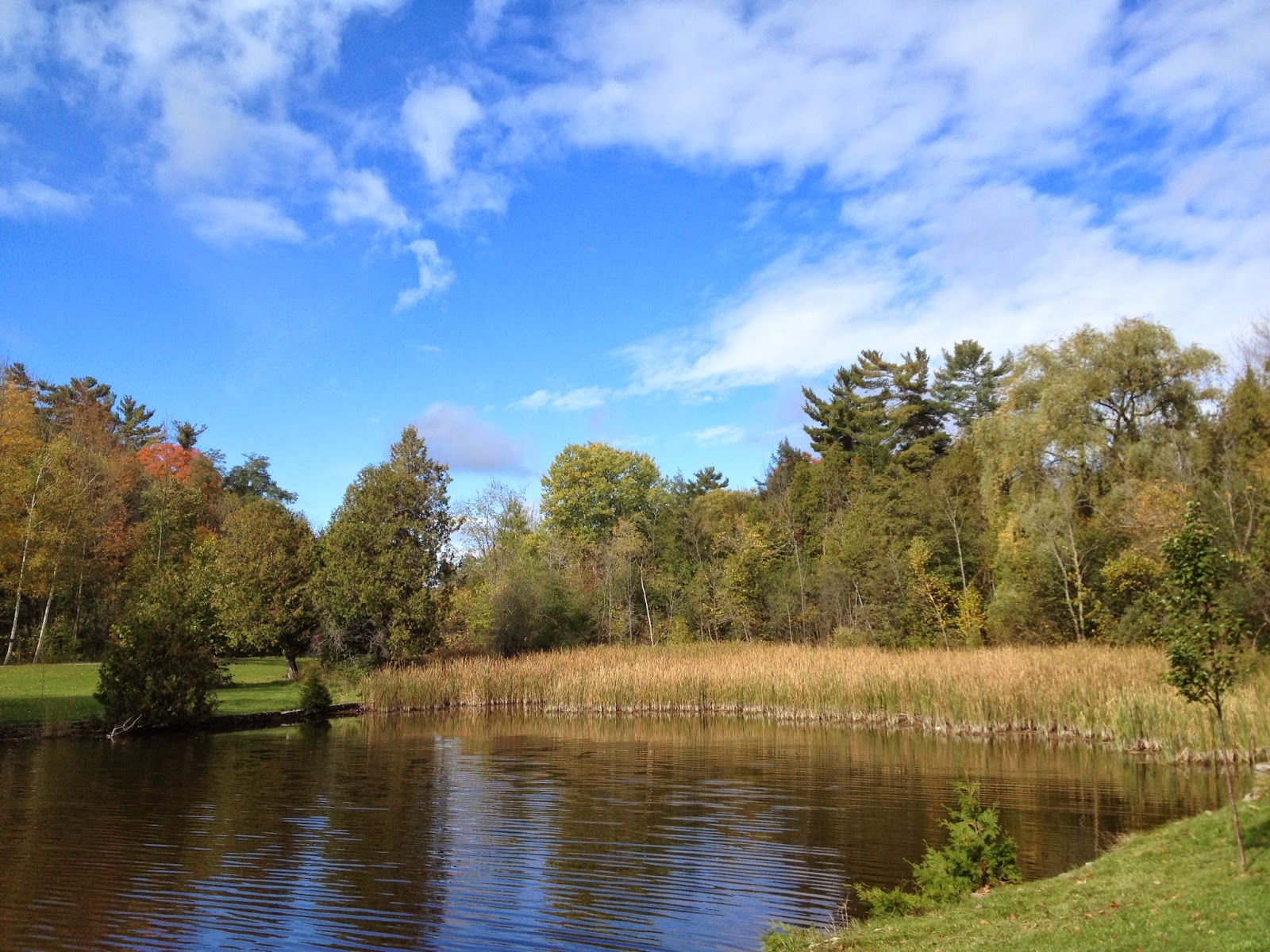
Peterborough City Council wants to destroy this.Thanks for taking time to read this,
Jane
Poster at Royal Glenora Club, EdmontonCanada today is very different from the country I knew growing up as the daughter of diplomats. Then, we were respected across the world as a thriving democracy and an international peacekeeper. Last month our prime minister did not attend the U.N.'s summit meeting on climate change. Today's Canada muzzles its scientists, harasses PEN Canada, which champions freedom of speech, does not even try to meet carbon reduction targets. Toronto, our biggest city, is run by a confessed drug addict.
What happened? How did that Canada become this Canada? Maybe driving across the country would yield some answers.
Days 1 & 2 - Behind the Pines
Fall is touching central Ontario's sugar maples with red, orange, yellow, gold. Further north, pines that inspired Canada’s Group of Seven painters find purchase among the Canadian Shield’s granite crags and cliffs.
Chi-chi bakeries populate Muskoka Lakes towns where some of the country’s wealthiest families own summer homes, but drive north for a couple of hours and the scene changes.
Motels, gas stations, small businesses along the highway have been abandoned. Those that remain are suffering, their grocery shelves as bare as some I have seen in the third world. But, noticing my walking sticks, a store owner stops mopping the floor to help me.
No gas today. Sorry for the inconvenience.Trees, trees and more trees line the highway. Cold, wind-whipped rain makes clear how powerful are the forces of Nature up here. Slide off the road or hit a moose and without help you will surely perish.Billboards and signs offer clues to what goes on behind the trees:
Fishing and hunting lodges will fly in their clientele
When I was a junior reporter in Thunder Bay, I spent a weekend at one of these wilderness lodges, helping in the kitchen, exploring the river, playing penny card games late into the night. Forty-two years later the smell of frying bacon still takes me back into that wild peace.
You are now entering a First Nations reserve
A few years ago, while working in a Moose Factory school, I visited a Cree fishing camp on the mighty Moose River just south of James Bay. Hidden by brush, the camp was invisible until our canoes landed. We feasted on grilled, freshly caught fish, learned how to make a duck blind and mud decoys, then sat, silently waiting for the sound of wings. Knowing that each of us was one tiny breathing participant in the great dance of Nature. A great gift.
The end of a Moose Factory dayViolence against women must stop
Testimony during a murder trial I covered for the Chronicle-Journal in 1972 took me into a wilderness hunting camp near Long Lac. The accused was a slight, shy eighteen-year old boy. Waking in the night, hearing one of the older women crying for help in another tent, he found her struggling under a large, very drunk man -- his uncle. He yelled, tried to wrestle the attacker. Could not pull him off. Finally, in desperation, he picked up the closest object, an axe, and buried in his uncle’s head. A court full of white men sent the boy to prison for life. Where, I wonder, is he now?
Impossibly blue Lake Superior, stretching as far as the horizon, is framed by red granite cliffs polished by the rain.
Barrick Mine
Just for a moment, the wall of trees breaks. A building and pond are dwarfed by a pile of gravel as high as a hill.
Further west, more trees -- deciduous, cedar, pine -- all vying for every square inch of earth remind me of other parts of the world, where people of different races and faiths are battling each other for control of land they call home. When the rain lets up, blackened skeletal trunks appear where recent forest fires destroyed everything. Under them, light new-green growth has already begun.
Highways up here are new and beautiful. Cities we are passing through -- Sault Ste. Marie, Thunder Bay, Dryden, Kenora -- all have fast food joints and big box stores. Apparently there is money here now.
Day 3 - Flatlands
Manitoba’s highway signs, in French as well as English, remind us that Francophone Canada does not live only in Quebec.
Fields here are huge, seas of yellow sunflowers. Rolled up hay bales advance like extra-terrestrial creatures from a humanless horizon. Platoons of silver silos wait for the grain and seed trucks throwing up dust along the side roads.
Welcome to big agro, farms owned by companies. You don’t need to be a farmer to feel the enormity of the change this has brought. Wooden homesteads nestled into little groves of planted trees lie empty now.
Above it all the prairie sky is the most magnificent living canvas I have ever seen.
Everything here is big. Trains so long you never see the last car carry cylindrical black tanker cars, and goods containers piled one on top of the other. A man I meet later in Edmonton, whose company is involved with the oil industry, tells me some of the chemicals being transported are lethal. I thank God the land is flat, the rail lines straight.
(Two weeks later, while writing this, I read that a train, derailed and on fire near a rural Saskatchewan village, is belching toxic smoke. Heaven help the people and flora and fawna there. Heaven help us all.)
Prairie villages and towns each have their own character. How did Mozart get its name? Langeburg's central park is decorated with a painted Volkswagen. A hand-painted sign at the entrance to Churchbridge, Saskatchewan boasts of the two NHL hockey players it has produced.
Langenburg's parkWe can’t find an affordable place to stay in Saskatoon so we keep driving, arriving late at North Battleford’s lovely Gold Eagle Lodge. Next door, in the casino, people are shoving money into one-armed bandits, sitting around dimly-lit poker tables. It's 10 pm and the restaurant is nearly empty, but the Gold Eagle's “pig’s wings” are among the finest restaurant ribs I have known.
Day 4 & The last Crossing
Winding through low, tawny hills, the North Saskatchewan River valley has been an awesome passageway as long as humans have travelled between the Rocky Mountains and Saskatchewan. As we follow it, heading for Alberta, gigantic farming and construction machines and filthy oil tanker trucks rule the road. We are glad when Edmonton's skyline appears.
The North Saskatchewan River cuts right through Edmonton. We walk its banks. Readers welcome me and Cally’s Way. By the end of the festivities I am number two on the Journal’s fiction bestseller list, and it is time to head home.
Alberta’s southeastern cattle ranges come alive, thanks to Guy Vanderhaeghe's historical novels, particularly The Last Crossing. Then, at Wild Horse, we find a lone guard defending Canada's border.
Highways are under construction all across Canada and the United States. City exit ramps are clogged with cars, pick-up and transport trucks. At the Ambassador Bridge border crossing in Detroit trucks are lined up for more than a kilometer, engines idling.
Driving the last stretch, through acres and acres of new windmills in south-western Ontario, I try to make sense of what we have seen:
People we met everywhere on our trip were kind, generous-hearted, very different from each other. I feel grateful to live among them. More and more stuff, some of it dangerous, is moving across our awesome landscape of lakes and forest, prairies and mountains. This is not healthy. Neither are our politics.
But how, I wonder, can Canadians struggling through windswept, six-month winters in isolated places, and working dawn to dusk in the growing season, find the strength or the time to relate to the lives of other Canadians thousands of kilometres away? How can an Albertan from Vermilion know what concerns someone trying to make a living in Windsor Ontario? Canada became a country because the British needed to defend against incursions from the south. We forced the aboriginal peoples into reserves, forged a federation of provinces and territories, built railways, and have been making it up as we go along ever since.
Today the Canada we cherish -- clean air and water, freedom of speech and open debate, consumer choices -- needs our protection. So please, Canada, get out and vote, for people and parties that stand for a free, environmentally responsible Canada.
Peterborough City Council wants to destroy this.Thanks for taking time to read this,Jane
August 14, 2014
Travelling in Crete - The Food!
One morning, while I was writing Cally’s Way on my mountainside terrace, an old woman wearing a kerchief stopped by on her way to the steep vacant lot next door, where herbs and artichokes grow in profusion. Pulling a sprig of fennel out of a cloth pouch attached to her apron, she smiled.
“Very good with potatoes.”
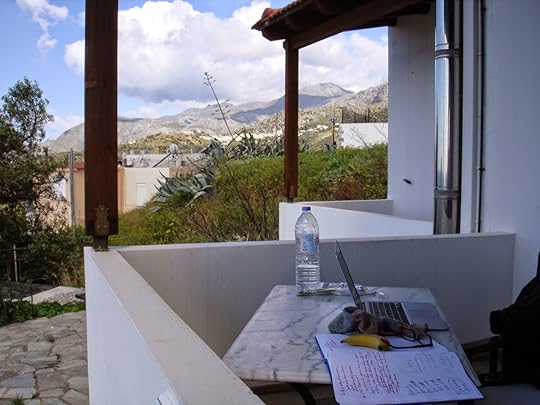 Field climbs to right beyond terrace
I watched her spend the next half hour climbing, bending, squatting, reaching and twisting as she filled her bag with fresh greenery before walking back up the mountainside to prepare dinner. She is well into her eighties, a typical Cretan grandma.
Artichokes merit their own trip to the vacant lot. Cretans put them in casseroles but I can’t wait that long. Boil, then strip and dip is my method. The impossibly lush heart of this tough and prickly mountain plant needs only lemon juice or salted and peppered olive oil.
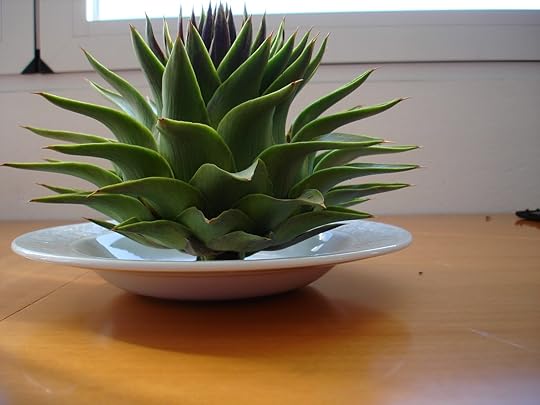 An artichoke from next door
At the bottom of the mountain fishermen bring their daily catches to the Plakias fish shop. You can eat fresh sea bream, sardines and other lovely fish, or squid, sometimes cuttlefish. Or, why not buy a newspaper cornet of shrimps? Poached for a couple of minutes, they still hold the flavour of the sea.
Local lettuce, tomatoes, onions, or a bag of horta (a mixture of greens) and a bottle of local Cretan olive oil are available anywhere. Add a $6-bottle of wine from Sitia, on Crete’s north coast, and Presto, you have one of the tastiest, healthiest, most economical dinners in the world!
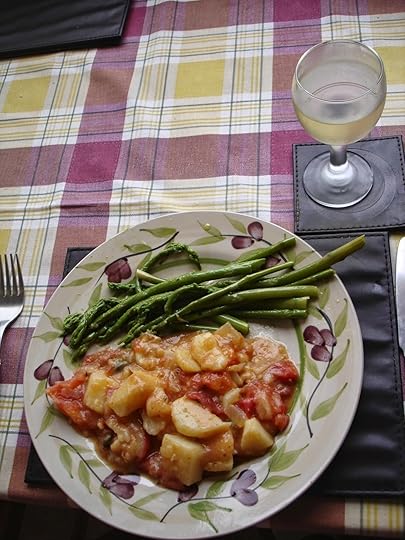 Cuttlefish stew - Yum!Then there is the meat. Lambs gambol about on the mountainsides, and a few days before Easter shotgun blasts make clear the connection between raising and eating animals. Roasting lamb on an outdoor spit is a Greek tradition that goes back thousands of years.
Why is lamb on a spit so good, I asked my friend Nikos, who ran Nikos Souvlaki in Plakias for many years.
“Because, where was this lamb three weeks ago? Out on the mountainside eating oregano, thyme, rosemary!” (Those who have read my new novel, Cally’s Way, will recognise this interchange.)
One of the best places to find this meal is at Le Vieux Moulin Taverna in the inland town of Agyroupoli.
If you want a gastronomic treat and have a few extra Euros, drive up to Milia, high in the western White Mountains. A 16th Century village, Milia was built as a summer pasturing place and then abandoned until World War II, when it served as a hiding place for its families during the Germans’ brutal occupation of Crete. After the war it was abandoned again until two of its owner families rebuilt the village as a totally organic, locally sustainable mountain resort. A two-minute video here will give you a tour.
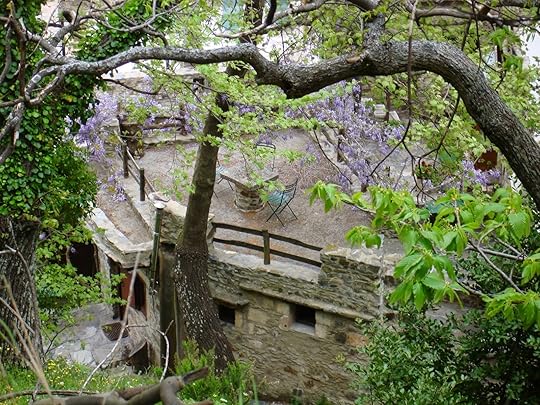 Milia in spring, from a hiking trailMilia features in my novel Cally’s Way. How could it not, when the book intertwines the story of Cally, a young woman trying to find a way to make a life in a world that promises very little security, with that of her grandmother Callisto, a runner in the Cretan Resistance, who lived in a high mountain village? A story summary and reviews are here. Read a sample chapter here (click on cover.)
And happy eating, wherever you are!
Why not share your experiences by commenting below?
Thanks for visiting,
Jane
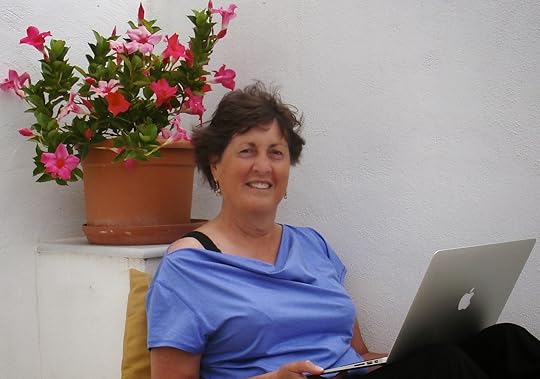
“Very good with potatoes.”
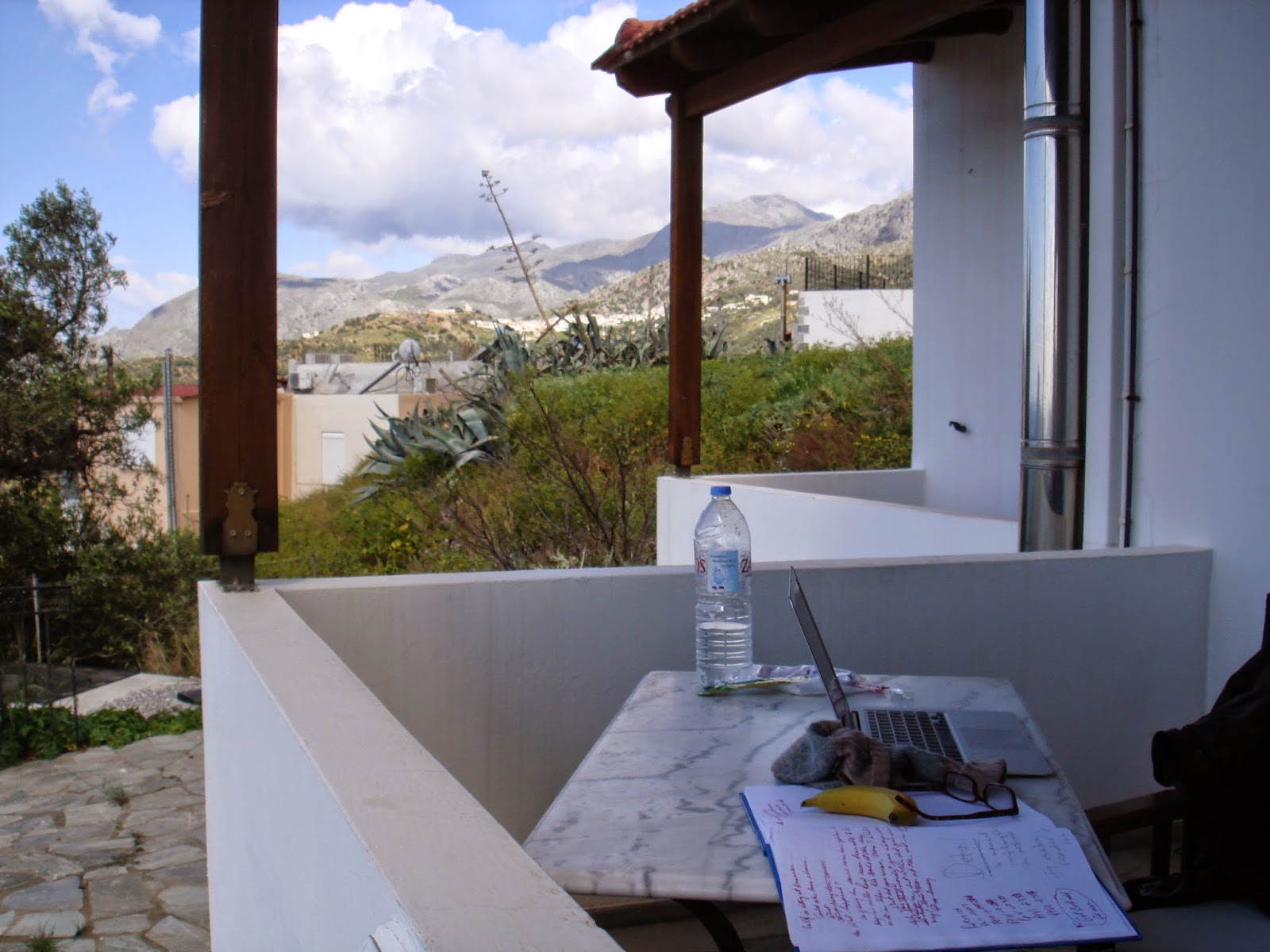 Field climbs to right beyond terrace
I watched her spend the next half hour climbing, bending, squatting, reaching and twisting as she filled her bag with fresh greenery before walking back up the mountainside to prepare dinner. She is well into her eighties, a typical Cretan grandma.
Artichokes merit their own trip to the vacant lot. Cretans put them in casseroles but I can’t wait that long. Boil, then strip and dip is my method. The impossibly lush heart of this tough and prickly mountain plant needs only lemon juice or salted and peppered olive oil.
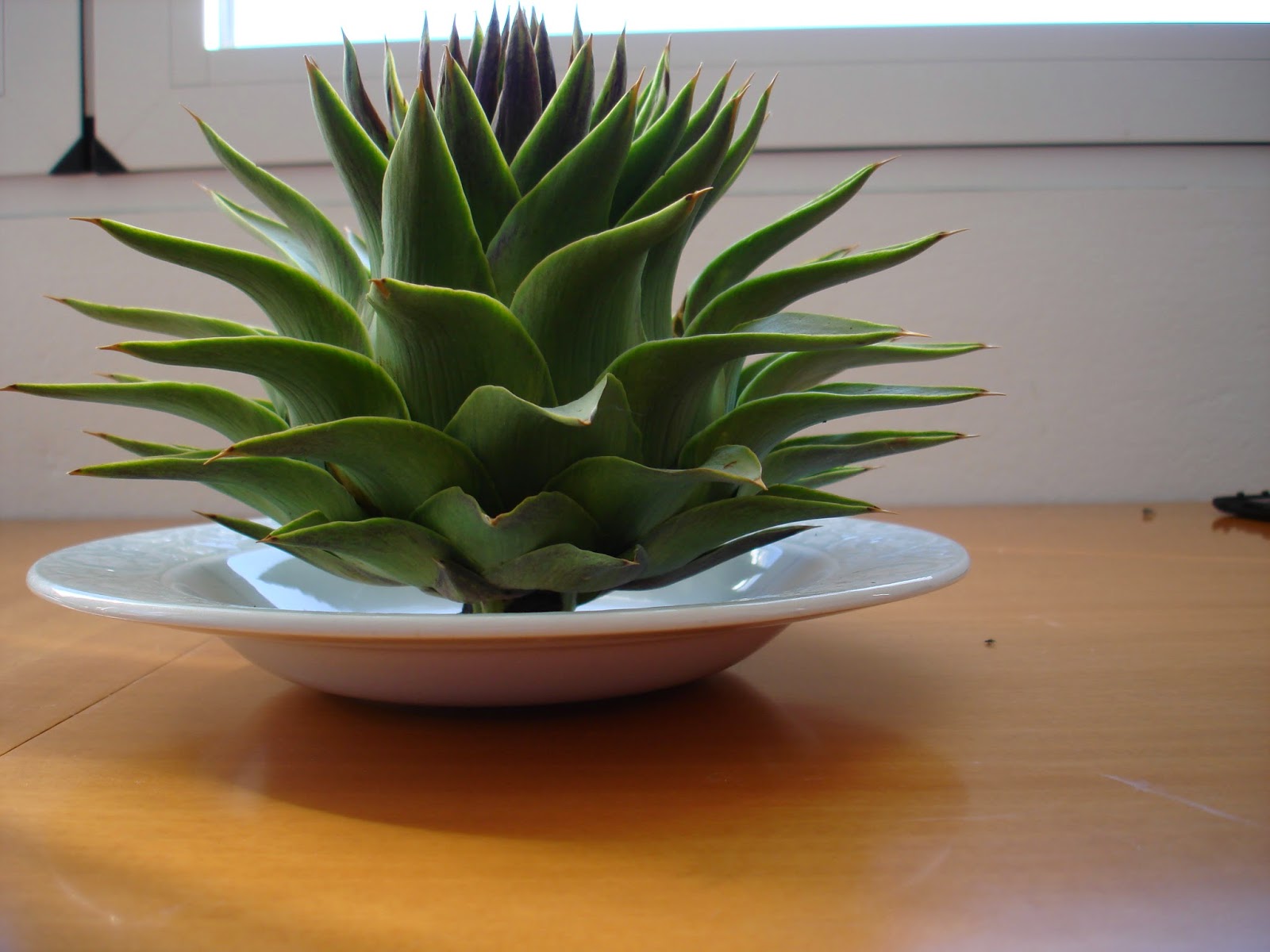 An artichoke from next door
At the bottom of the mountain fishermen bring their daily catches to the Plakias fish shop. You can eat fresh sea bream, sardines and other lovely fish, or squid, sometimes cuttlefish. Or, why not buy a newspaper cornet of shrimps? Poached for a couple of minutes, they still hold the flavour of the sea.
Local lettuce, tomatoes, onions, or a bag of horta (a mixture of greens) and a bottle of local Cretan olive oil are available anywhere. Add a $6-bottle of wine from Sitia, on Crete’s north coast, and Presto, you have one of the tastiest, healthiest, most economical dinners in the world!
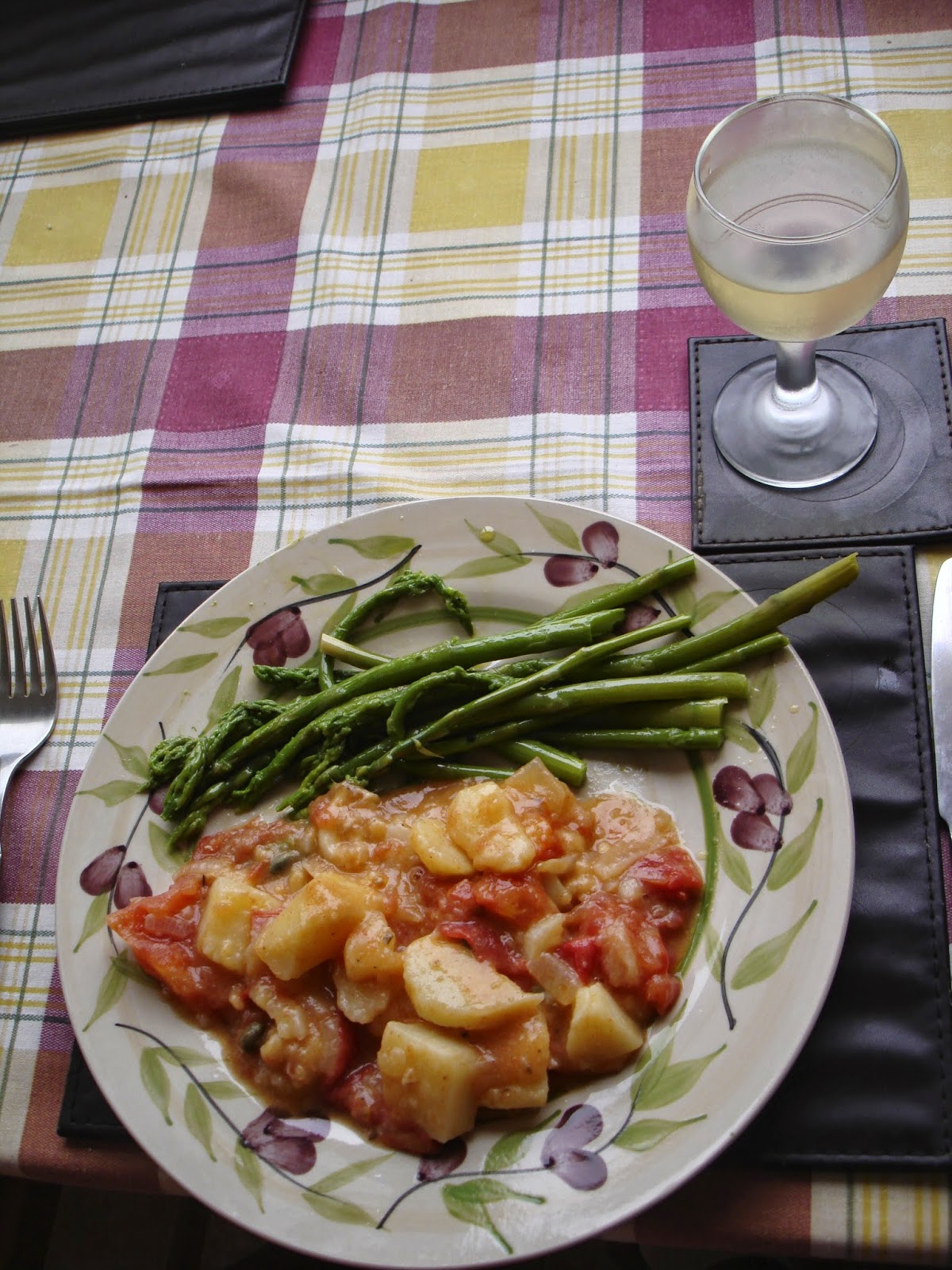 Cuttlefish stew - Yum!Then there is the meat. Lambs gambol about on the mountainsides, and a few days before Easter shotgun blasts make clear the connection between raising and eating animals. Roasting lamb on an outdoor spit is a Greek tradition that goes back thousands of years.
Why is lamb on a spit so good, I asked my friend Nikos, who ran Nikos Souvlaki in Plakias for many years.
“Because, where was this lamb three weeks ago? Out on the mountainside eating oregano, thyme, rosemary!” (Those who have read my new novel, Cally’s Way, will recognise this interchange.)
One of the best places to find this meal is at Le Vieux Moulin Taverna in the inland town of Agyroupoli.
If you want a gastronomic treat and have a few extra Euros, drive up to Milia, high in the western White Mountains. A 16th Century village, Milia was built as a summer pasturing place and then abandoned until World War II, when it served as a hiding place for its families during the Germans’ brutal occupation of Crete. After the war it was abandoned again until two of its owner families rebuilt the village as a totally organic, locally sustainable mountain resort. A two-minute video here will give you a tour.
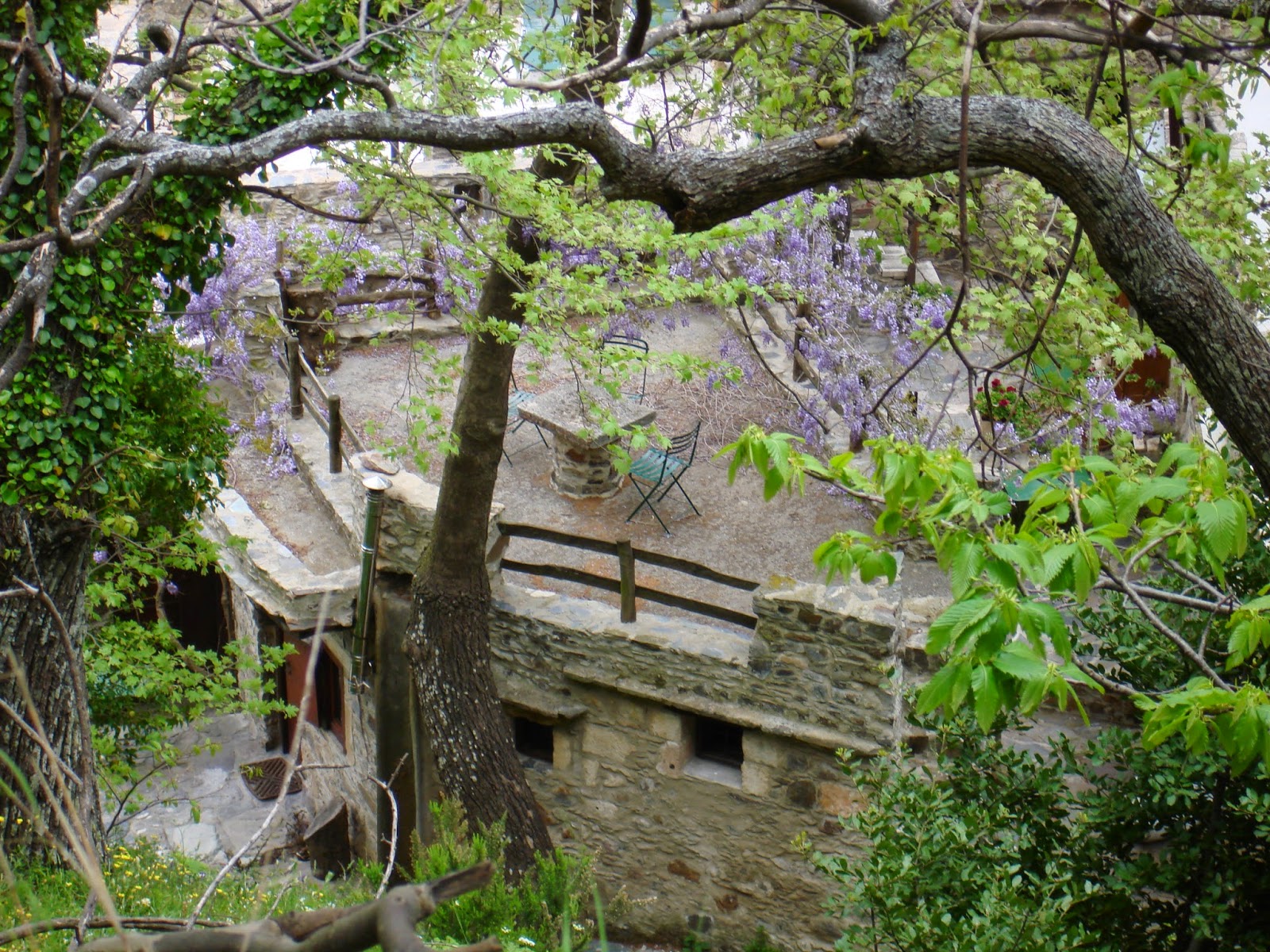 Milia in spring, from a hiking trailMilia features in my novel Cally’s Way. How could it not, when the book intertwines the story of Cally, a young woman trying to find a way to make a life in a world that promises very little security, with that of her grandmother Callisto, a runner in the Cretan Resistance, who lived in a high mountain village? A story summary and reviews are here. Read a sample chapter here (click on cover.)
And happy eating, wherever you are!
Why not share your experiences by commenting below?
Thanks for visiting,
Jane
July 22, 2014
Travelling in Crete - The World War II Story
Crete’s World War II story interests readers of Cally’s Way because it is told from the point of view of women.
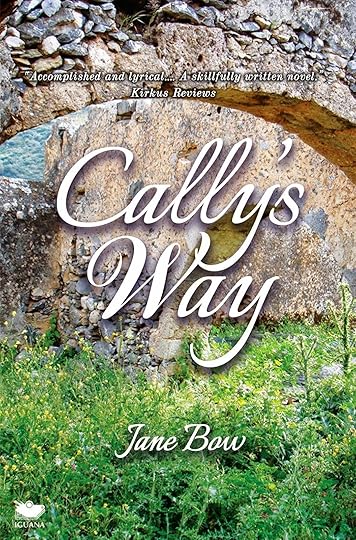 Buy HERE or HERE
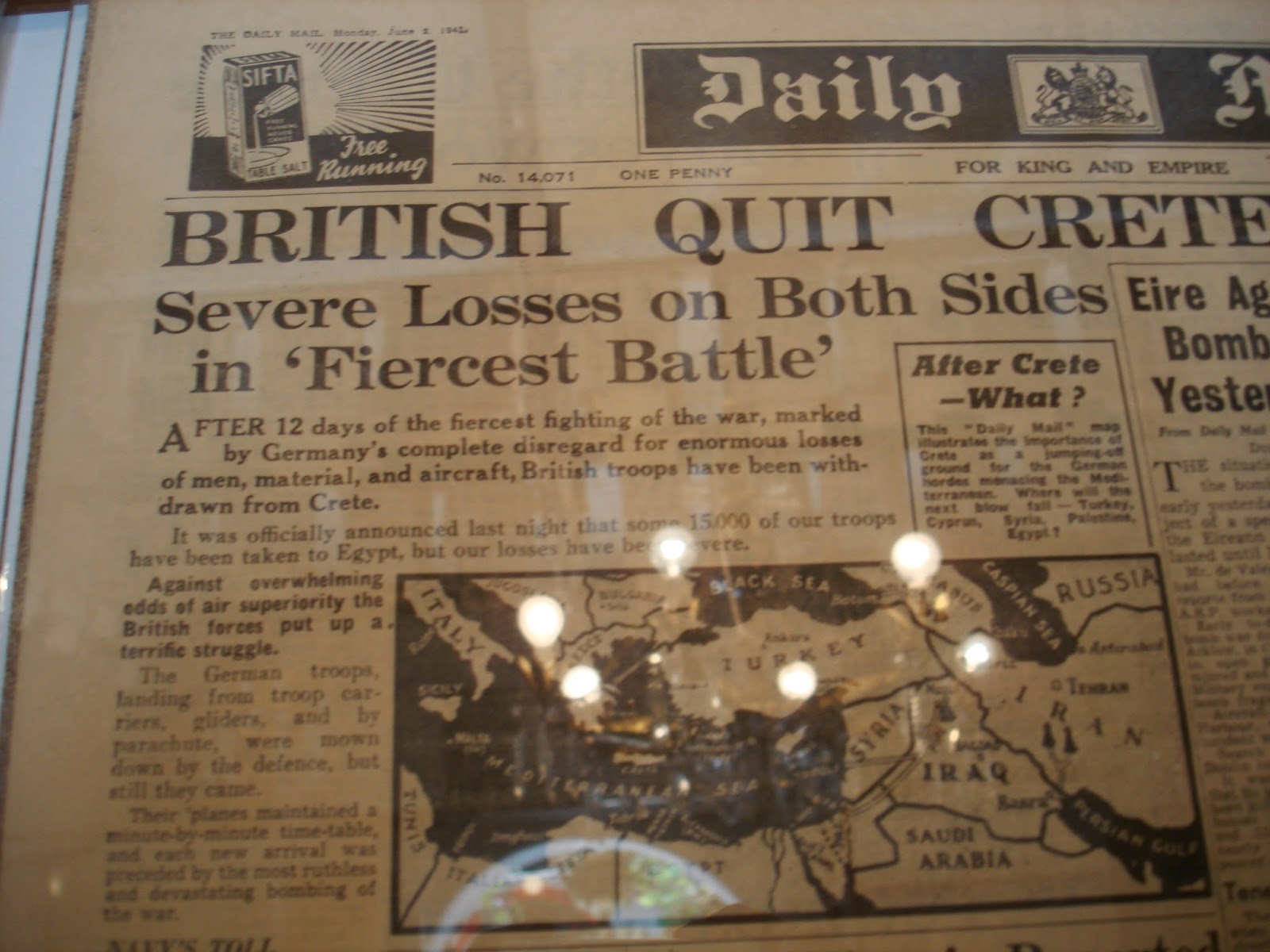
On May 20, 1941, when hundreds of German paratroopers floated down out of Crete’s blue morning sky in the Second World War’s first airborne invasion, most of the island’s men were away fighting with the Greek army on the mainland. Only a few thousand Allied troops from Britain, Australia and New Zealand, and the local people were there to defend Crete. Grandfathers fought with ancient swords left over from the Turkish wars, grandmothers with pitchforks. Women hoisted rifles, manned machine guns.
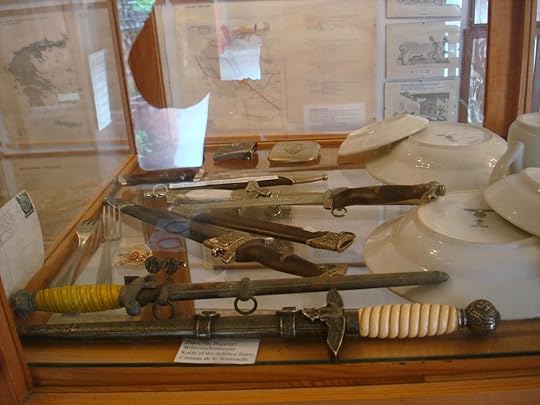 Knives and dishes used in WWII. Plates have swastika on bottom.
Twelve days later the swastika was flying in Crete but, situated in the eastern Mediterranean, south of Europe, north of Africa, just west of the Middle East, this island has been invaded again and again for more than two thousand years. Even its monks were militant resistance fighters.
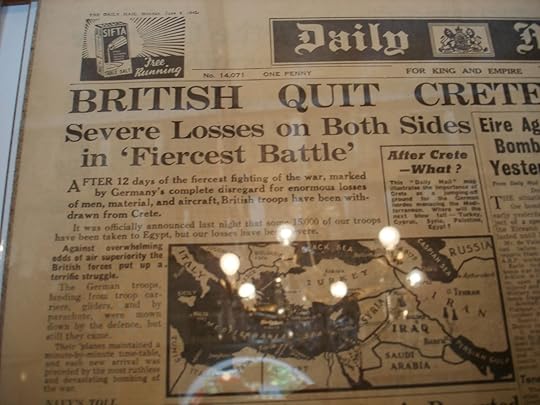
Callisto in Cally’s Way is fictitious, but the hair raising submarine rescues at Limni Beach, just below Preveli Monastery, really happened. And so did so much else in the book. Teenaged boys and girls became messengers, nurses, hiding and helping Allied soldiers who were trapped on the island. When they were caught, whole villages suffered gruesome reprisals.
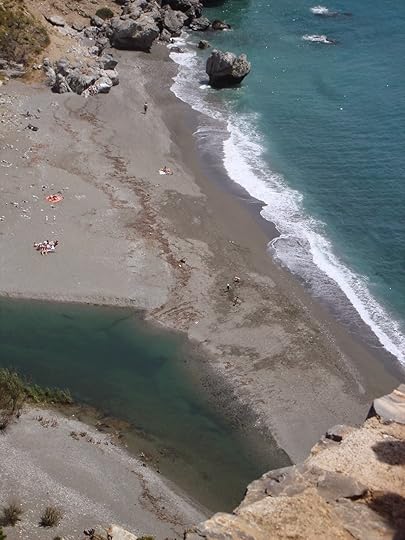 Limni Beach from cliff top.
Unsung Cretan WWII heroes must include the girl who carried food past German patrols to two Australians hiding in the Koutaliotis Gorge, and the girl who rowed a British soldier fifty miles out to Gavdos, an uninhabited island off the coast. Machine gun fire, strafing the boat from the air, opened the soldier’s side. The girl made him lie in the sea water flooding into the boat, to stop the bleeding and keep the wound clean.
Seventy three years later, travelling in Crete, you’ll find old ladies dressed in black out on the mountainsides, filling pouches attached to their aprons with horta, edible greens. They were there; they remember.
You’ll also find busloads of German tourists hiking, swimming, frequenting the tavernas, bringing badly needed Euros into the Cretan economy. How do the Cretans feel about this?
The elderly curator of Sougia’s war museum, who fought as a teenager, smiled when I asked him:
“Those Germans are not these Germans.”
Pragmatic #forgiveness: what an example for so many parts of the world right now!
Tell me what you think. Comment below, or on FB at Jane Bow's Novels, or on Twitter @JaneBow2
Thanks for visiting me here,
Jane
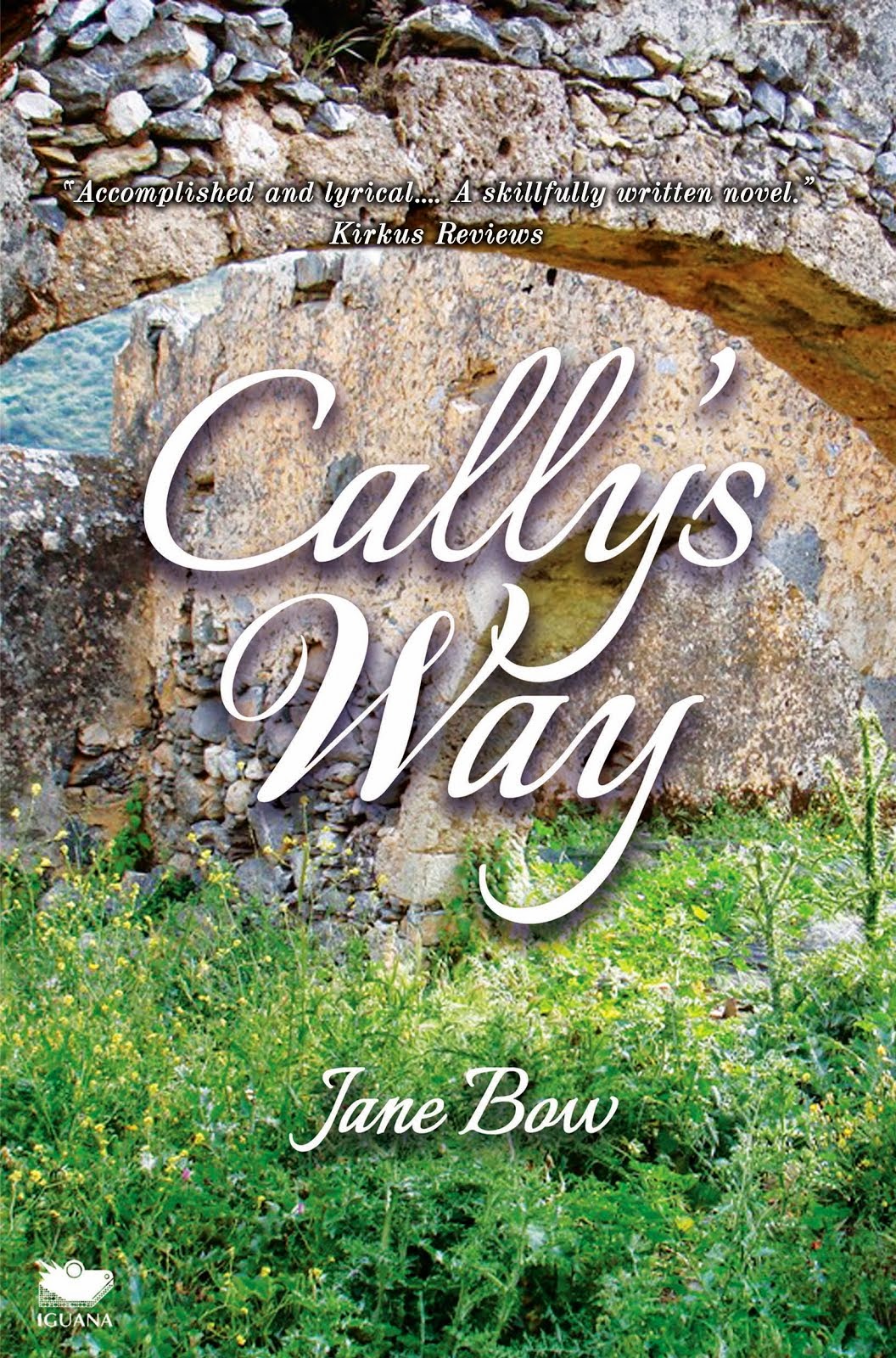 Buy HERE or HERE
On May 20, 1941, when hundreds of German paratroopers floated down out of Crete’s blue morning sky in the Second World War’s first airborne invasion, most of the island’s men were away fighting with the Greek army on the mainland. Only a few thousand Allied troops from Britain, Australia and New Zealand, and the local people were there to defend Crete. Grandfathers fought with ancient swords left over from the Turkish wars, grandmothers with pitchforks. Women hoisted rifles, manned machine guns.
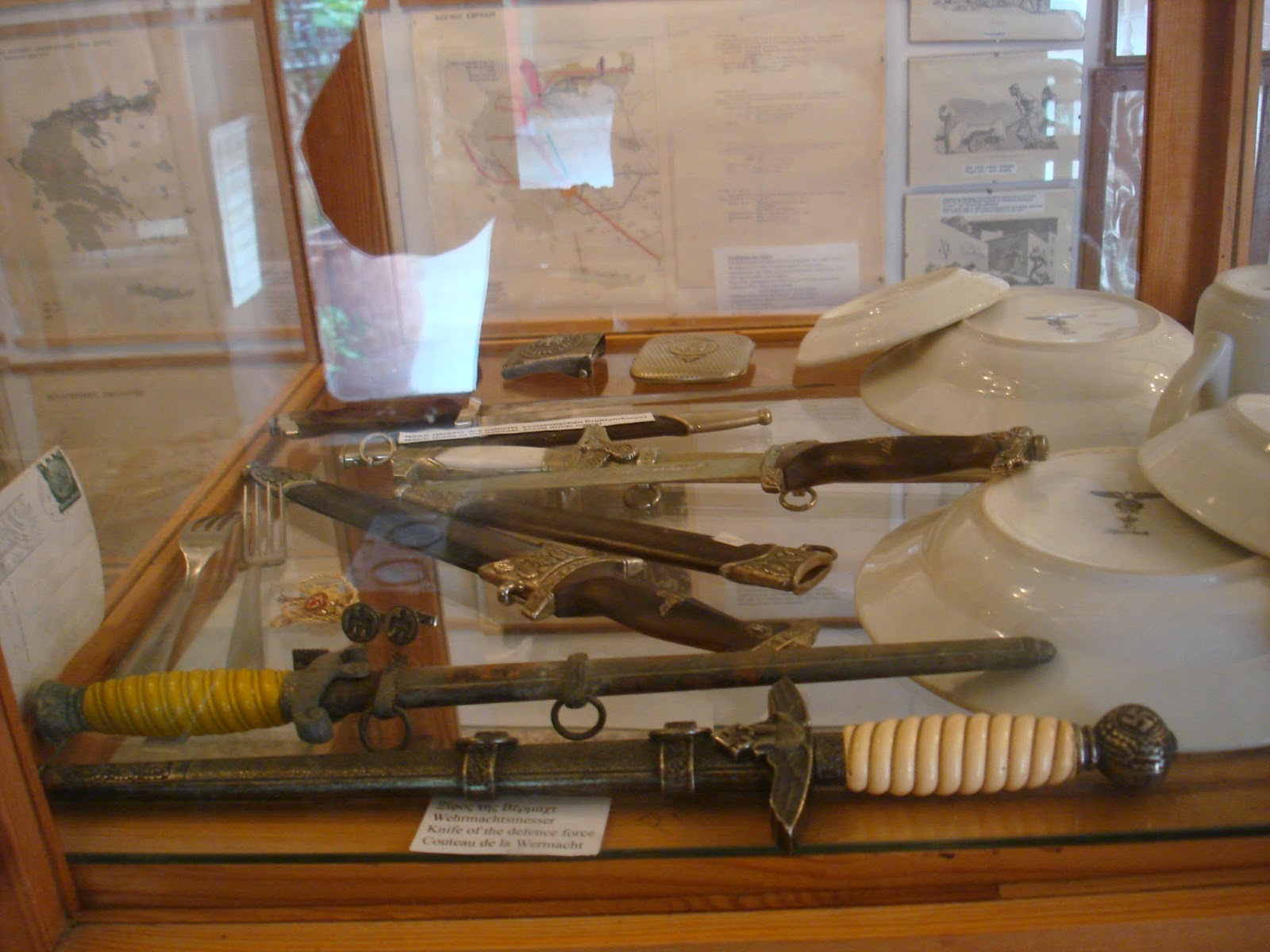 Knives and dishes used in WWII. Plates have swastika on bottom.
 Twelve days later the swastika was flying in Crete but, situated in the eastern Mediterranean, south of Europe, north of Africa, just west of the Middle East, this island has been invaded again and again for more than two thousand years. Even its monks were militant resistance fighters.
Callisto in Cally’s Way is fictitious, but the hair raising submarine rescues at Limni Beach, just below Preveli Monastery, really happened. And so did so much else in the book. Teenaged boys and girls became messengers, nurses, hiding and helping Allied soldiers who were trapped on the island. When they were caught, whole villages suffered gruesome reprisals.
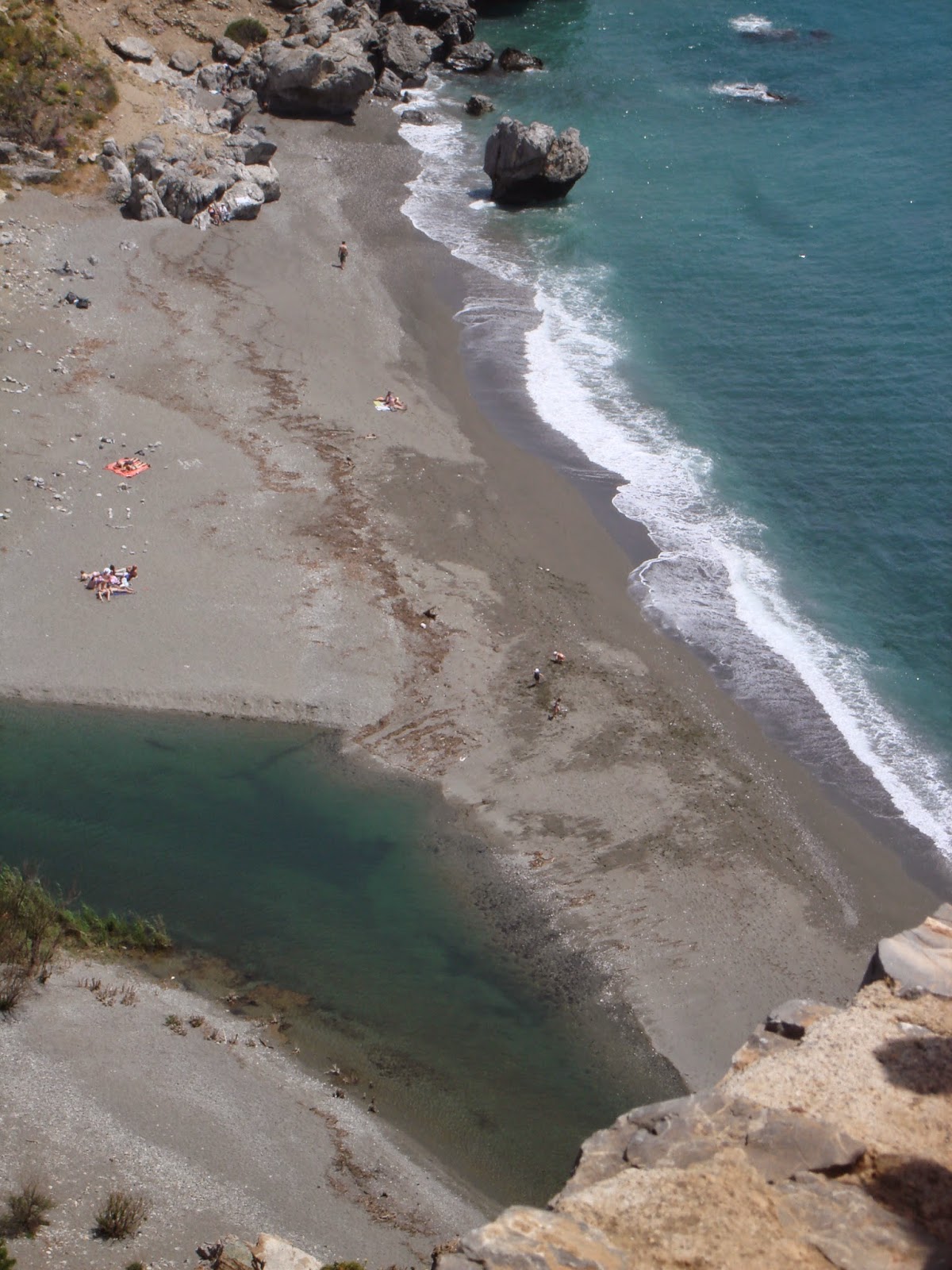 Limni Beach from cliff top.
Unsung Cretan WWII heroes must include the girl who carried food past German patrols to two Australians hiding in the Koutaliotis Gorge, and the girl who rowed a British soldier fifty miles out to Gavdos, an uninhabited island off the coast. Machine gun fire, strafing the boat from the air, opened the soldier’s side. The girl made him lie in the sea water flooding into the boat, to stop the bleeding and keep the wound clean.
Seventy three years later, travelling in Crete, you’ll find old ladies dressed in black out on the mountainsides, filling pouches attached to their aprons with horta, edible greens. They were there; they remember.
You’ll also find busloads of German tourists hiking, swimming, frequenting the tavernas, bringing badly needed Euros into the Cretan economy. How do the Cretans feel about this?
The elderly curator of Sougia’s war museum, who fought as a teenager, smiled when I asked him:
“Those Germans are not these Germans.”
Pragmatic #forgiveness: what an example for so many parts of the world right now!
Tell me what you think. Comment below, or on FB at Jane Bow's Novels, or on Twitter @JaneBow2
Thanks for visiting me here,
Jane
June 24, 2014
Travelling in Crete: a novelist's thoughts (1)
One of the reasons it takes 12 years to write a novel (Cally's Way) is that you fall in love with the place where it is set, in my case Crete. If you travel there this summer, go off the beaten track. And prepare to come back changed.
 Crete's south coast, a land of myth and history
The first time I went to Crete, in 2001, I knew nothing, except that:
a) it is the southern-most Greek island and therefore, hopefully, was warm in March, and
b) it was home to the peaceful pre-Greek Minoan culture that worshipped the Great Goddess and produced world renown statues of her, alabaster pottery and gold jewellery.
My teenaged daughter and I rented a mountainside apartment overlooking the sea in Myrthios, away from tourist resorts along the main, north coast highway. In the mornings I holed up in the kitchen, meditating then making notes on what I was reading, thinking, seeing, feeling, with no idea why.
My daughter sat on the balcony working on her correspondence courses or reading The Cretan Runner, a page-turner of a war memoir by George Psychoundakis, who was a shepherd until World War II, when hundreds of German paratroopers floated down out of the sky. During their brutal occupation of the island, the Cretans mounted a powerful, imaginative Resistance, working with British commandos hiding in the mountains.
In the afternoons we drove our tiny Fiat up hair-raising, unguard-railed mountain roads, looking for the villages Psychoundakis described, imagining the stories he told of unnamed, unknown heroes, some of them boys and girls.
Sometimes we explored ruined Minoan palaces. King Minos (who owned the mythical Minotaur) built his famous palace at Knossos, but it's always clogged with tourist buses. I much prefer Phaistos, near the south coast, where the first linear writing was discovered on the Phaistos disk. It is so easy to imagine the famous bull jumping spectacles there, in a stone courtyard still clearly preserved 4,000 years later.
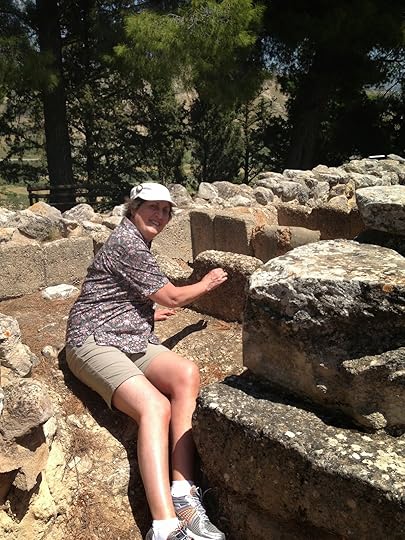 The ancient stone block archive at Phaistos
If the day was hot, we explored beaches along the south coast, swimming in the Libyan Sea beside the 14th Century Venetian fort at Frangocostello, or at Skinaria, a beach tucked away behind the headlands that nudists (now prohibited) favoured, or at fabulous, palm studded Preveli, once known as Limni Beach, where two daring submarine rescues of Allied troops took place. (See Cally's Way.)
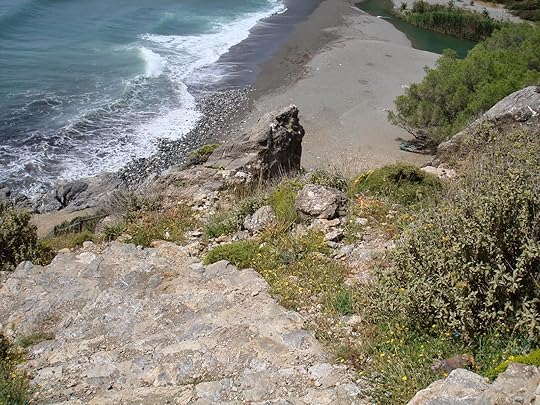 Preveli beach from the headland above.
I spoke no Greek but for some reason, smelling the sea air and the herbs on the mountainsides, watching the clouds over Plakias Bay, listening to the staccato rise and fall of the language in the villages, nodding hello to black-clad women of my age with whom I had nothing in common, I felt utterly, viscerally at home.
Why? Was it because my formative years were spent in Spain, at the other end of the Mediterranean?
Too thin a reason, by itself.
Was it because the Greek myths, many of which were born on this island, and the Greek language lie at the root of our Western civilization? Psychology, archeology, logic, democracy -- so many of our fundamental social concepts are defined by Greek words.
No. If this was the reason, why doesn't every English speaking Western tourist feel at home here?
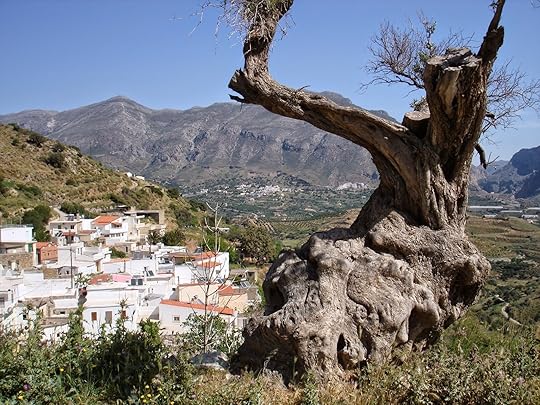 An ancient olive tree lives on the mountainside
Was it something less nameable then? Something to do with genetic predisposition or re-incarnation?
Hard to conjure that, but when I was a child in Spain my father used to take me to look at the paintings in Madrid's Prado. My favourite artist, at age nine, was El Greco. Not until I went to Crete did I find out that El Greco was Cretan.
Life itself is a miracle, so who knows what the full answer is. What I do know is that:
a) the great power of love features in all my novels,
b) I love this island, its people, its rock, its air, its sea, and
c) love and creativity are two faces of the same force.
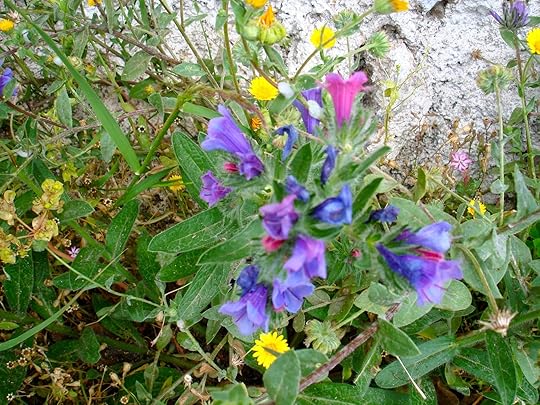 Flowers in a Cretan ditch
One morning, that first year in Crete, the World War II part of Cally's Way dropped into my head fully formed. I have been returning to the island to write every year since then.
And now, published this spring, the book's characters have come to life in the very place where they were born! Tourists from all over Europe can find Cally's Way at Carol's Workshop in Myrthios. Happy me!
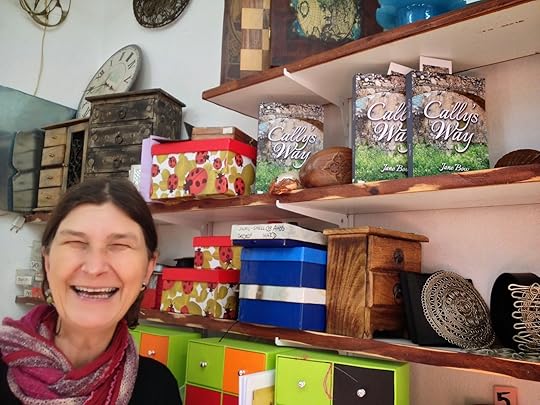 Carola Poppinga, with Cally's Way at Carol's Workshop.
What makes a place feel like home? I'd love to hear your thoughts. Comment below, or on Facebook at Jane Bow's Novels, or on Twitter @JaneBow2.
Thanks for visiting me here,
Jane
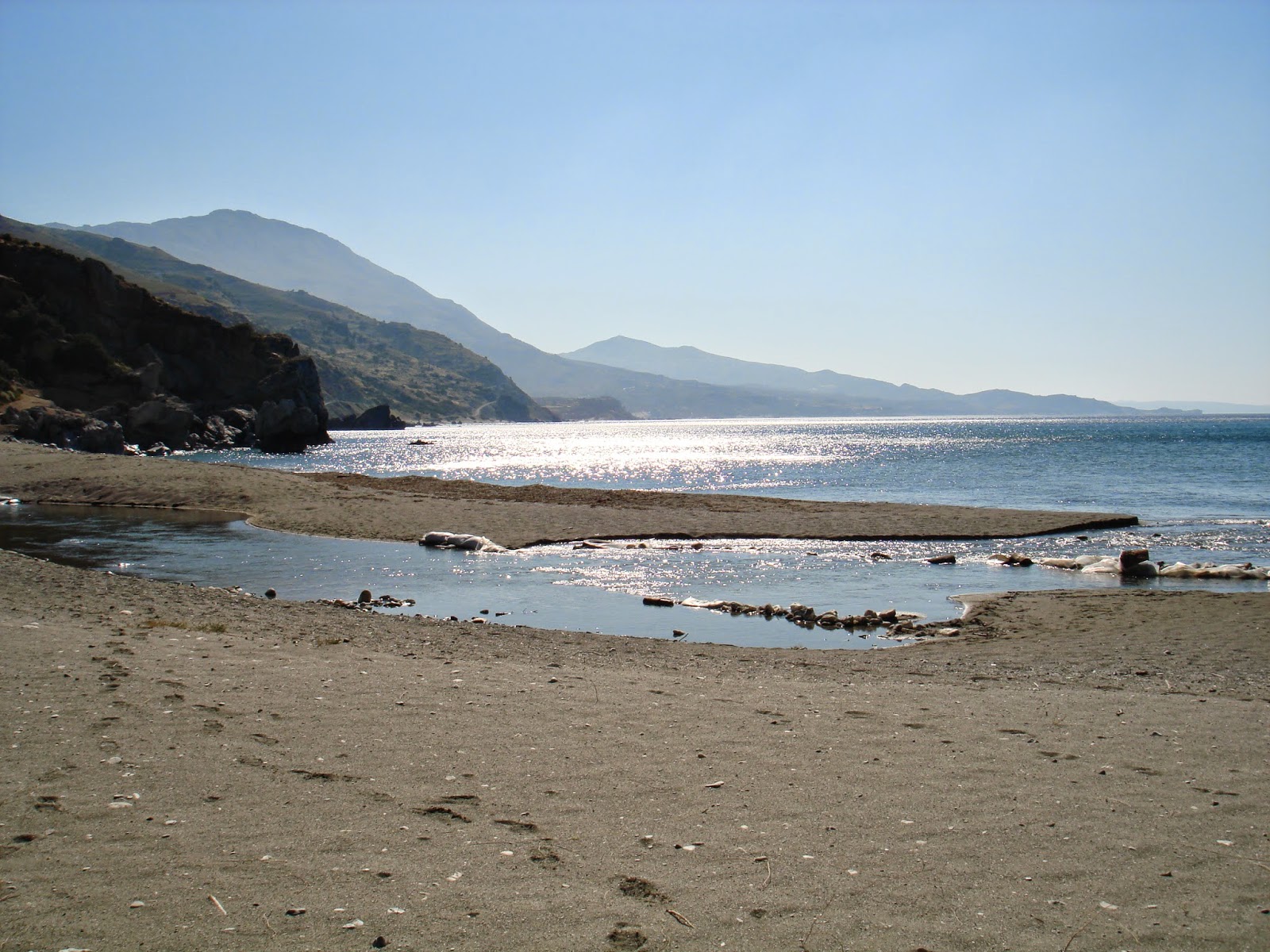 Crete's south coast, a land of myth and history
The first time I went to Crete, in 2001, I knew nothing, except that:
a) it is the southern-most Greek island and therefore, hopefully, was warm in March, and
b) it was home to the peaceful pre-Greek Minoan culture that worshipped the Great Goddess and produced world renown statues of her, alabaster pottery and gold jewellery.
My teenaged daughter and I rented a mountainside apartment overlooking the sea in Myrthios, away from tourist resorts along the main, north coast highway. In the mornings I holed up in the kitchen, meditating then making notes on what I was reading, thinking, seeing, feeling, with no idea why.
My daughter sat on the balcony working on her correspondence courses or reading The Cretan Runner, a page-turner of a war memoir by George Psychoundakis, who was a shepherd until World War II, when hundreds of German paratroopers floated down out of the sky. During their brutal occupation of the island, the Cretans mounted a powerful, imaginative Resistance, working with British commandos hiding in the mountains.
In the afternoons we drove our tiny Fiat up hair-raising, unguard-railed mountain roads, looking for the villages Psychoundakis described, imagining the stories he told of unnamed, unknown heroes, some of them boys and girls.
Sometimes we explored ruined Minoan palaces. King Minos (who owned the mythical Minotaur) built his famous palace at Knossos, but it's always clogged with tourist buses. I much prefer Phaistos, near the south coast, where the first linear writing was discovered on the Phaistos disk. It is so easy to imagine the famous bull jumping spectacles there, in a stone courtyard still clearly preserved 4,000 years later.
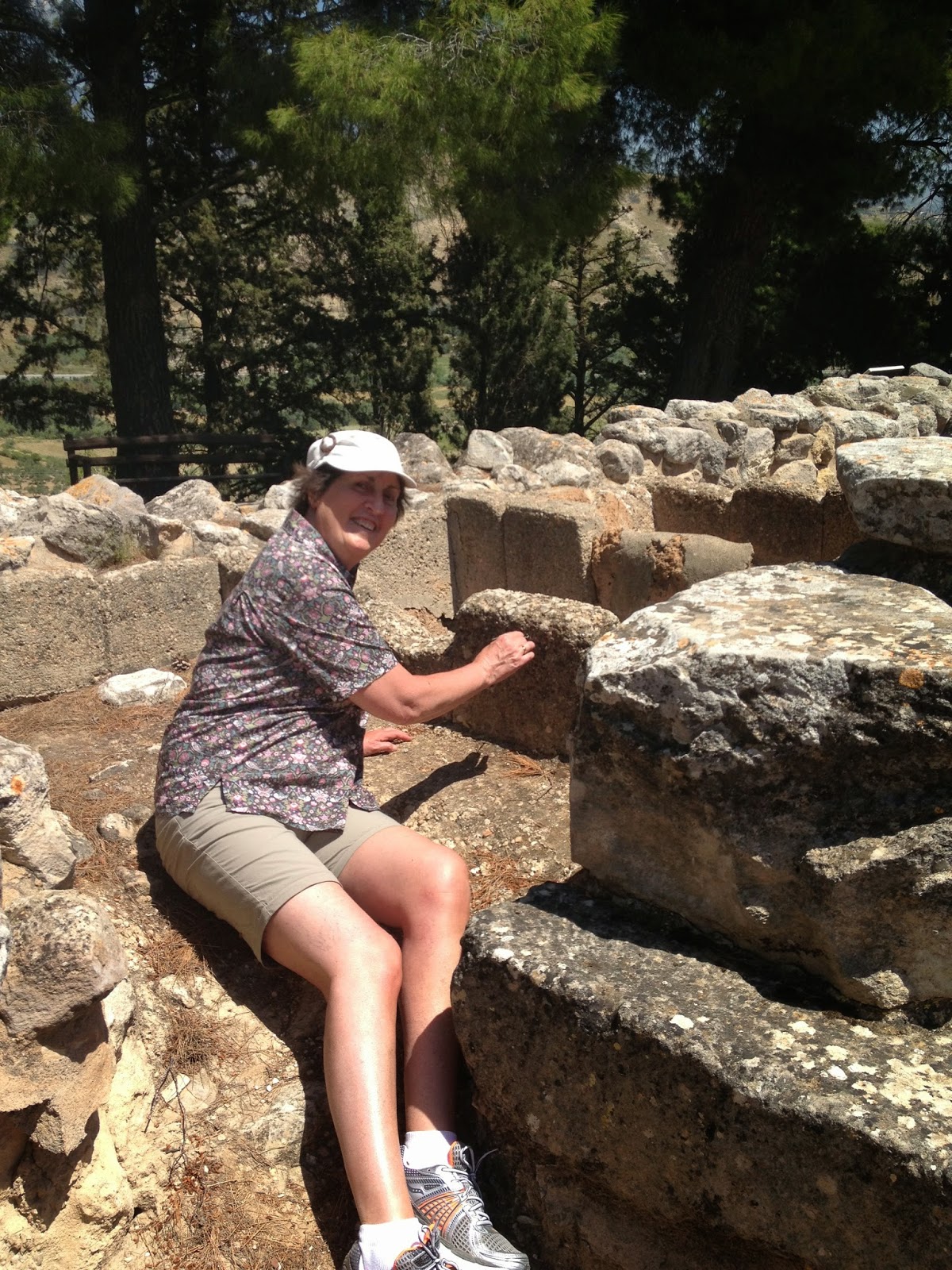 The ancient stone block archive at Phaistos
If the day was hot, we explored beaches along the south coast, swimming in the Libyan Sea beside the 14th Century Venetian fort at Frangocostello, or at Skinaria, a beach tucked away behind the headlands that nudists (now prohibited) favoured, or at fabulous, palm studded Preveli, once known as Limni Beach, where two daring submarine rescues of Allied troops took place. (See Cally's Way.)
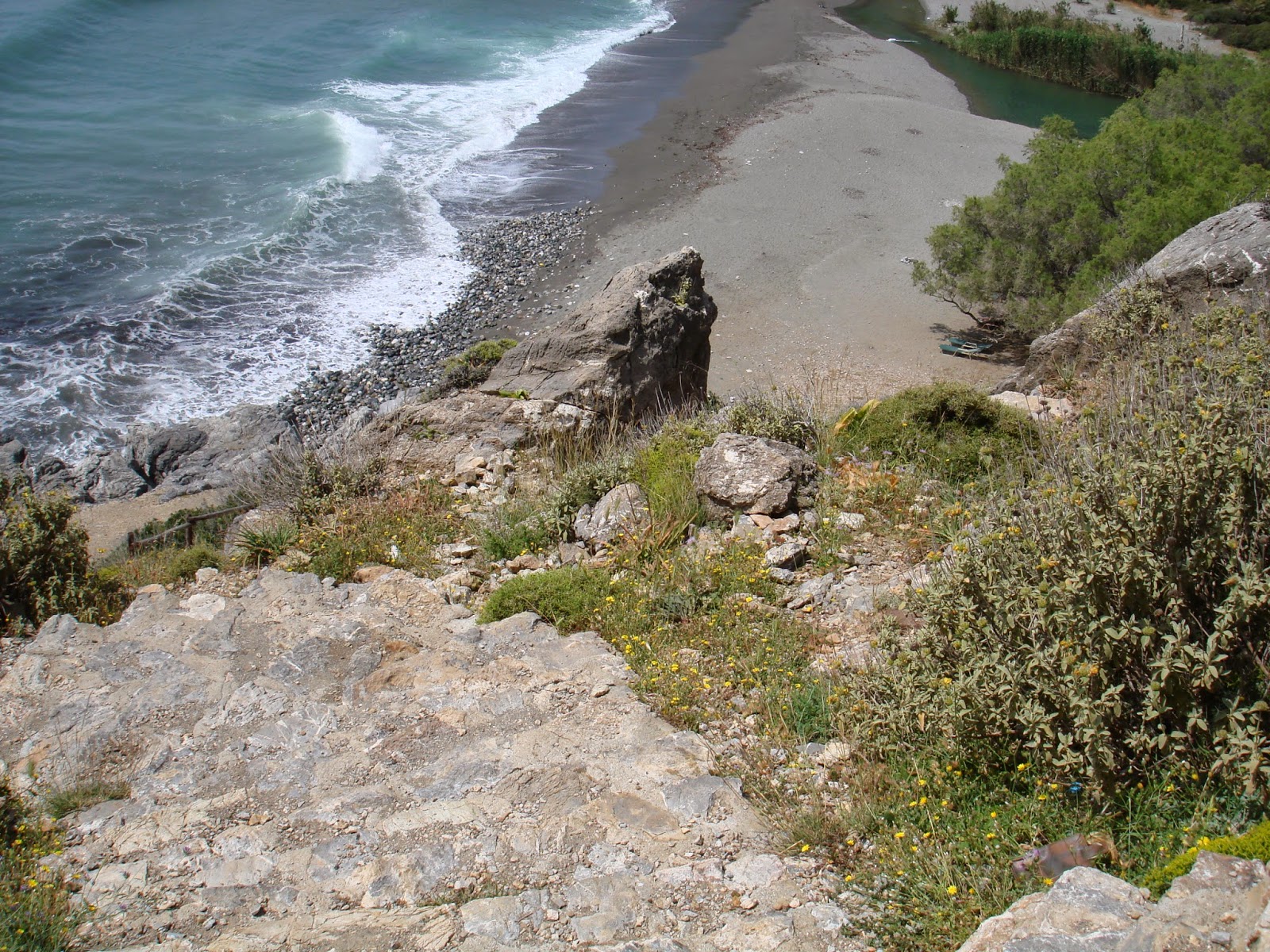 Preveli beach from the headland above.
I spoke no Greek but for some reason, smelling the sea air and the herbs on the mountainsides, watching the clouds over Plakias Bay, listening to the staccato rise and fall of the language in the villages, nodding hello to black-clad women of my age with whom I had nothing in common, I felt utterly, viscerally at home.
Why? Was it because my formative years were spent in Spain, at the other end of the Mediterranean?
Too thin a reason, by itself.
Was it because the Greek myths, many of which were born on this island, and the Greek language lie at the root of our Western civilization? Psychology, archeology, logic, democracy -- so many of our fundamental social concepts are defined by Greek words.
No. If this was the reason, why doesn't every English speaking Western tourist feel at home here?
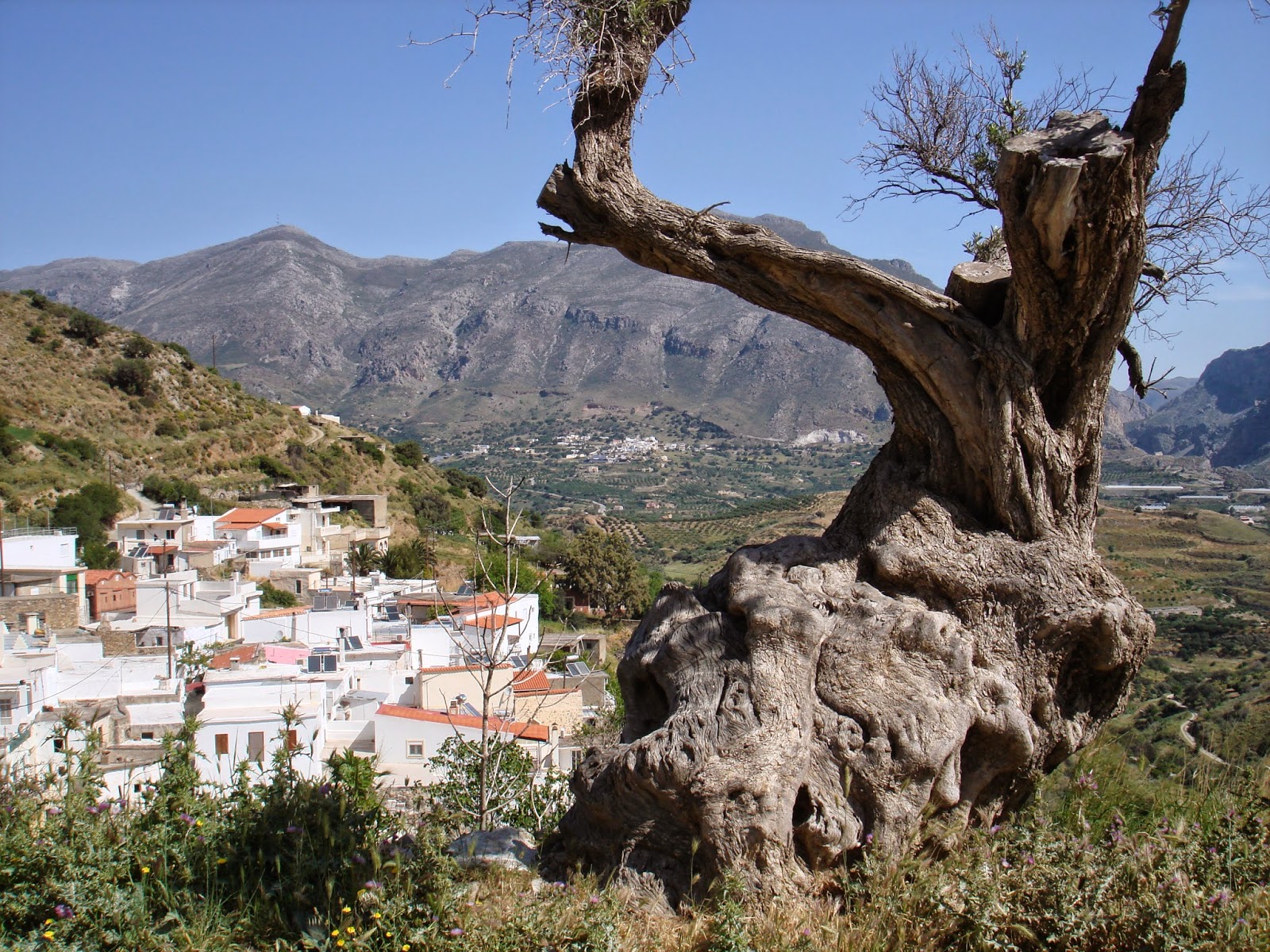 An ancient olive tree lives on the mountainside
Was it something less nameable then? Something to do with genetic predisposition or re-incarnation?
Hard to conjure that, but when I was a child in Spain my father used to take me to look at the paintings in Madrid's Prado. My favourite artist, at age nine, was El Greco. Not until I went to Crete did I find out that El Greco was Cretan.
Life itself is a miracle, so who knows what the full answer is. What I do know is that:
a) the great power of love features in all my novels,
b) I love this island, its people, its rock, its air, its sea, and
c) love and creativity are two faces of the same force.
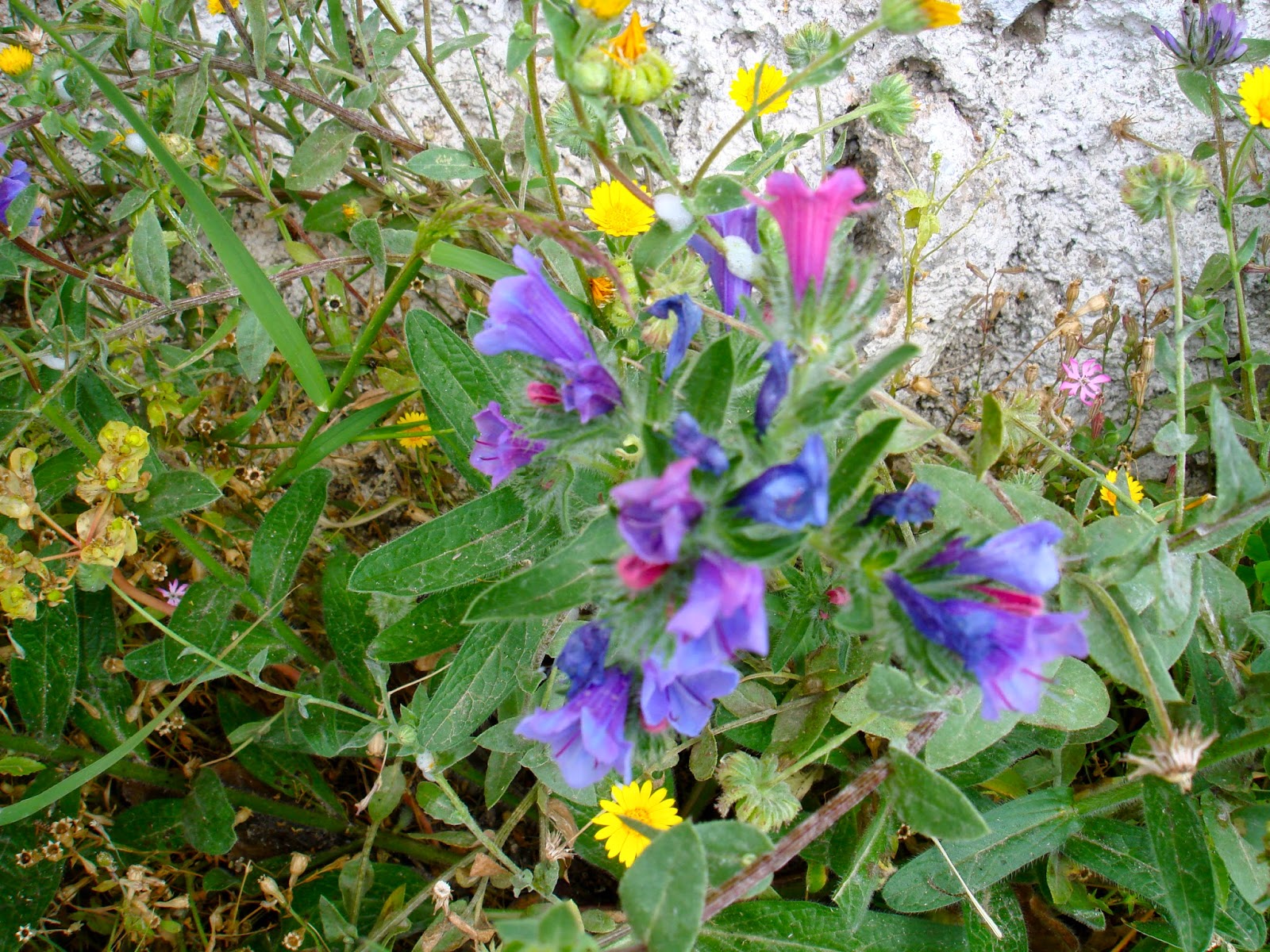 Flowers in a Cretan ditch
 One morning, that first year in Crete, the World War II part of Cally's Way dropped into my head fully formed. I have been returning to the island to write every year since then.
And now, published this spring, the book's characters have come to life in the very place where they were born! Tourists from all over Europe can find Cally's Way at Carol's Workshop in Myrthios. Happy me!
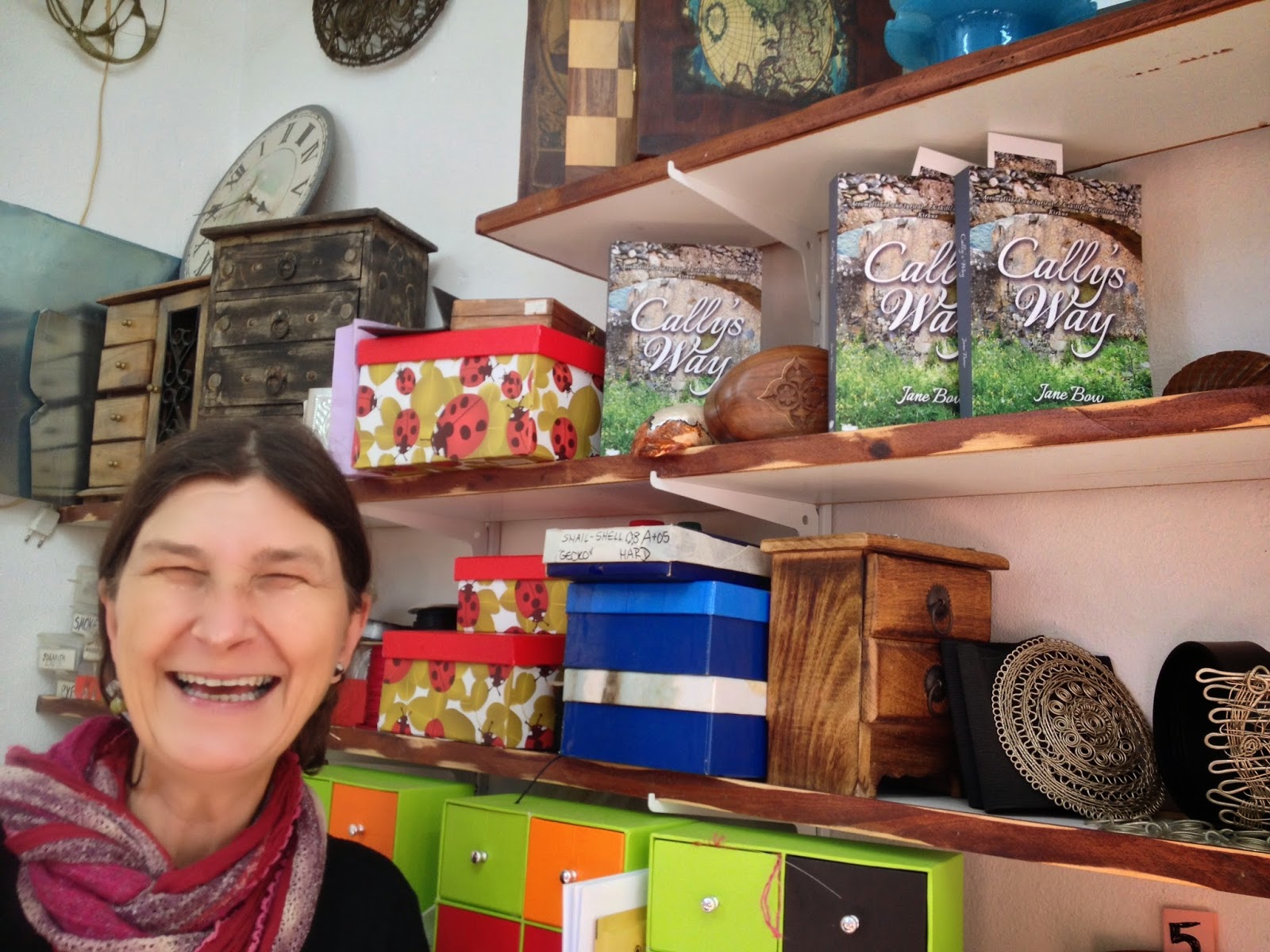 Carola Poppinga, with Cally's Way at Carol's Workshop.
What makes a place feel like home? I'd love to hear your thoughts. Comment below, or on Facebook at Jane Bow's Novels, or on Twitter @JaneBow2.
Thanks for visiting me here,
Jane
June 17, 2014
Decisions Are Rocks
Once we make major life decisions, they become solid, like the ground, or a mountain, creating the contours, peaks and valleys of our lives. When I chose the man with whom I am spending my life, I gave my future a unique and distinct shape. A different choice would have made a different life.
I’m thinking about decisions and rock because my new novel, Cally’s Way, is about how both shaped so many lives seventy years ago in Crete, during World War II. The Cretan people had a harsh choice to make: to use courage, strength and guile to resist the German occupation, or to collaborate. Click here to sample their landscape in the Kourtaliotis Gorge.
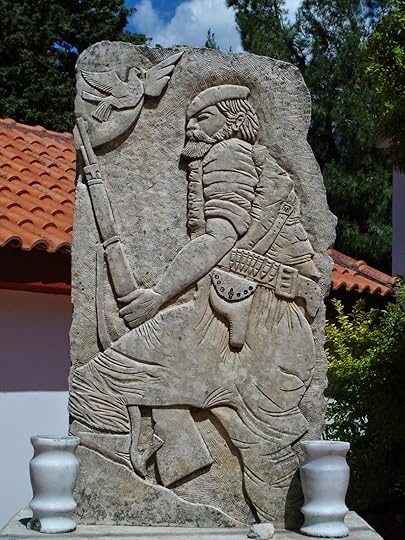 Monument to Cretan Resistance.
Meanwhile we have just returned to Canada from Crete, driving from Toronto’s airport to Peterborough, Ontario on a concrete highway, eight lanes congested with cars and trucks, the air tinged pink by smog.
“I know,” a bright light in the highway department must once have decided, "let's buy prime farmland along Lake Ontario, chop down the woods, reroute streams, and cover it all with concrete.”
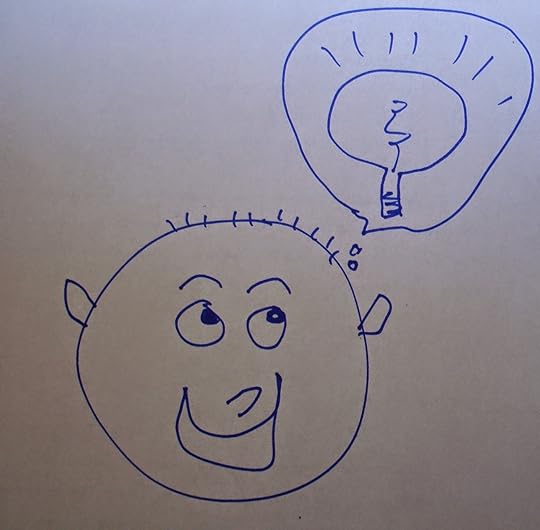 A highway department decision-maker
Concrete high rises, some new, others shabby with age, line the route.
A highway department decision-maker
Concrete high rises, some new, others shabby with age, line the route.
Decisions like these are the bedrock of seedy, soul destroying landscapes all across America. But, wanting to move more and more stuff, to endlessly grow our economies, we keep on making them. Here in Peterborough (a place that has not grown since we came here in 1979,) City Council has just decided to build a bridge right through one of Canada’s most beautiful city parks, in the name of hoped-for progress.
Rights to rip open the ground for mines, to destroy virgin forests for wood, to pollute whole watersheds and ecosystems to get oil out of Alberta's tar sands and move it to markets are being granted all across Canada. Decisions that render us uglier, sicker and poorer. Different choices would make a different future.
Once made, changing big decisions leaves scars. Divorcees hurt, their children suffer. Landscapes cry. Look at Detroit, riddled with crumbling freeways, boarded up houses, decaying high rises full of broken windows.
And yet. In Detroit homies cruise outside a corner liquor store while inside the proprietor is full of humor, toughness, generosity. Down at the bus station, outside the locked gate in the wee hours, the old boys at the taxi stand are trading jokes, the air full of laughter. Hurt people are resilient, capable of new decisions, strong growth. Nature can recover.
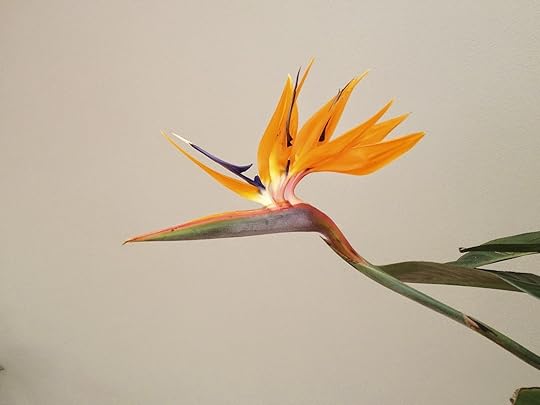 Bird of Paradise in Myrthios, Crete
Could it be then that hope can only come from the decisions we individuals make, moment to moment?
Take the hours I spend on Facebook, Twitter and other electronic devices. These disconnect me from the life flowing around me, while making me so intense! And disconnected, distracted or fractured attention spans are easily manipulated.
I can, however, also make choices during my day to restore balance, create harmony and connection. All I need is to do it. Because in the end my father, who fought in World War II to preserve our rights to freedom of choice in thought, expression and action, had it right:
“Make your own decisions,” he said, “because if you don’t, life will make them for you.”
Sometimes, like Cally in my novel, we need history to slap us into wakefulness, snap us out of the complacency that can lose us everything, before it’s too late.
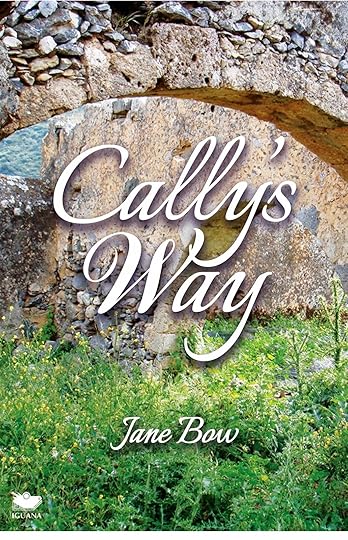 Available in print & ebook at Iguana Books, Amazon, Chapters & all other retailers
I’m thinking about decisions and rock because my new novel, Cally’s Way, is about how both shaped so many lives seventy years ago in Crete, during World War II. The Cretan people had a harsh choice to make: to use courage, strength and guile to resist the German occupation, or to collaborate. Click here to sample their landscape in the Kourtaliotis Gorge.
Monument to Cretan Resistance. Meanwhile we have just returned to Canada from Crete, driving from Toronto’s airport to Peterborough, Ontario on a concrete highway, eight lanes congested with cars and trucks, the air tinged pink by smog.
“I know,” a bright light in the highway department must once have decided, "let's buy prime farmland along Lake Ontario, chop down the woods, reroute streams, and cover it all with concrete.”
 A highway department decision-maker
Concrete high rises, some new, others shabby with age, line the route.
A highway department decision-maker
Concrete high rises, some new, others shabby with age, line the route.
Decisions like these are the bedrock of seedy, soul destroying landscapes all across America. But, wanting to move more and more stuff, to endlessly grow our economies, we keep on making them. Here in Peterborough (a place that has not grown since we came here in 1979,) City Council has just decided to build a bridge right through one of Canada’s most beautiful city parks, in the name of hoped-for progress.
Rights to rip open the ground for mines, to destroy virgin forests for wood, to pollute whole watersheds and ecosystems to get oil out of Alberta's tar sands and move it to markets are being granted all across Canada. Decisions that render us uglier, sicker and poorer. Different choices would make a different future.
Once made, changing big decisions leaves scars. Divorcees hurt, their children suffer. Landscapes cry. Look at Detroit, riddled with crumbling freeways, boarded up houses, decaying high rises full of broken windows.
And yet. In Detroit homies cruise outside a corner liquor store while inside the proprietor is full of humor, toughness, generosity. Down at the bus station, outside the locked gate in the wee hours, the old boys at the taxi stand are trading jokes, the air full of laughter. Hurt people are resilient, capable of new decisions, strong growth. Nature can recover.
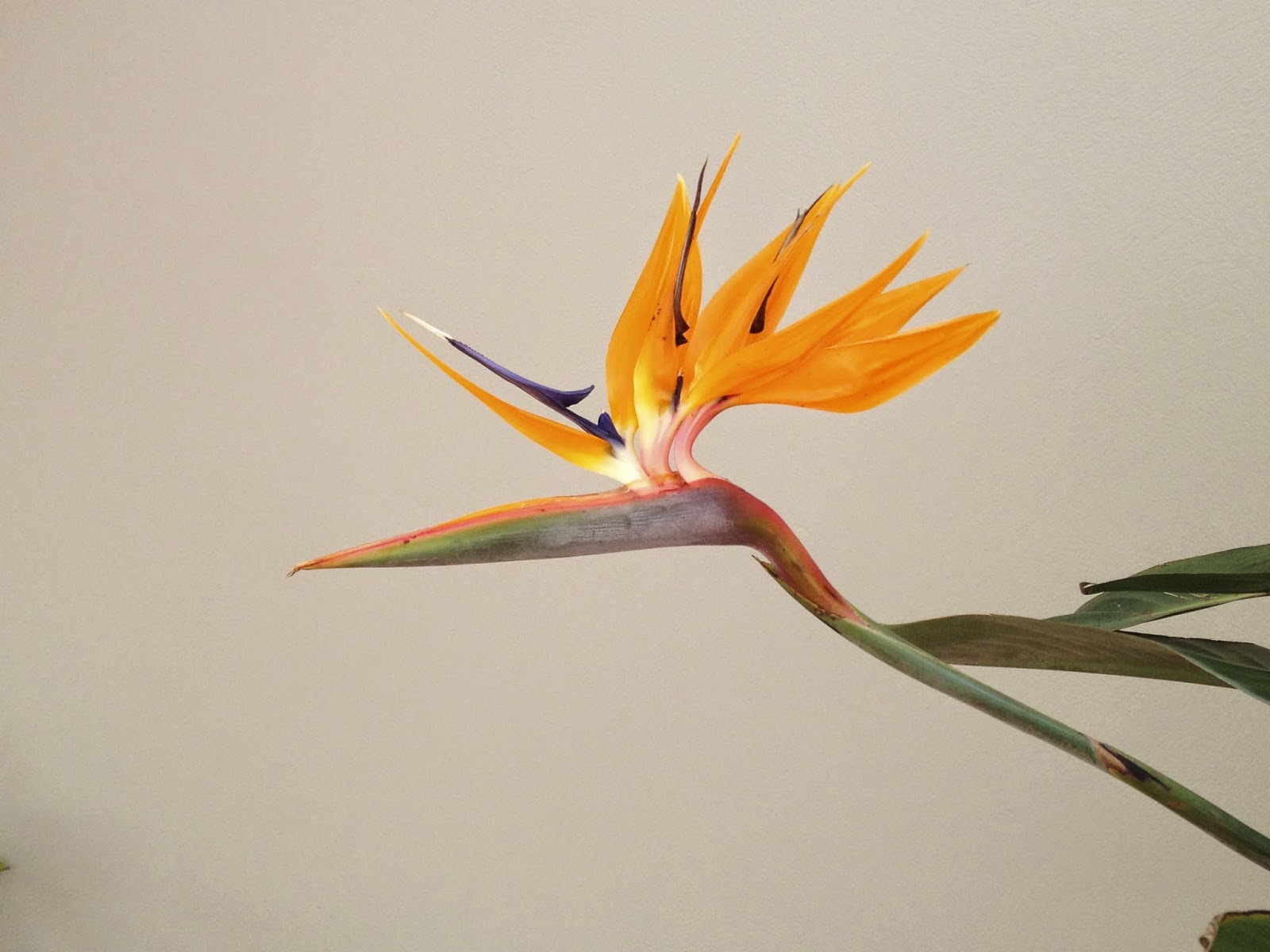 Bird of Paradise in Myrthios, Crete
Could it be then that hope can only come from the decisions we individuals make, moment to moment?
Take the hours I spend on Facebook, Twitter and other electronic devices. These disconnect me from the life flowing around me, while making me so intense! And disconnected, distracted or fractured attention spans are easily manipulated.
I can, however, also make choices during my day to restore balance, create harmony and connection. All I need is to do it. Because in the end my father, who fought in World War II to preserve our rights to freedom of choice in thought, expression and action, had it right:
“Make your own decisions,” he said, “because if you don’t, life will make them for you.”
Sometimes, like Cally in my novel, we need history to slap us into wakefulness, snap us out of the complacency that can lose us everything, before it’s too late.
Available in print & ebook at Iguana Books, Amazon, Chapters & all other retailers May 8, 2014
Mothers And Daughters
Mothers and daughters, mothers and sons, is there a bond more powerful? More influential? Full of hitches and glitches, joy, pain and confusion, a mother’s love gives shape to her child's life. Protecting, nourishing, nurturing a new little human, is there a greater challenge, or gift?
Every mother is her mother’s child, however, and Mother Mary is the only saint I know of who had a kid. Action and reaction, the messy, muddled motherhood continuum goes on and on, creating through its tapestry of trial and error the flawed, unique beauty that is every living soul.
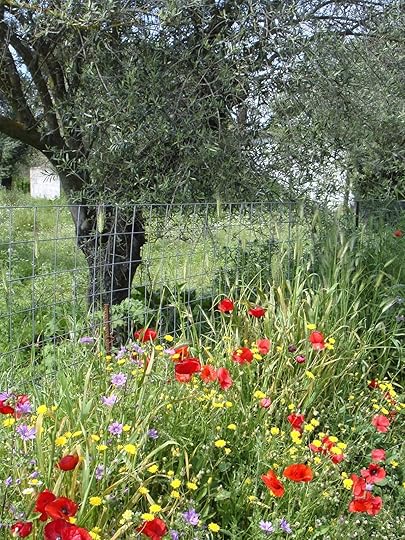 New life in the Cretan countryside
Cally’s Way, my new novel set in Crete, is all about the mother-daughter bond, and the fact that, through it, historical horrors create our identities whether we know about them or not. When the novel opens, 25-year old Cally knows very little about her mother, who has just died. Here is her first encounter with the enduring power of motherhood:
“Apparently no one in Crete wore motorcycle helmets. She hugged Oliver’s back, watching over his shoulder as he gunned the engine up the mountain road, twisting around hairpin bends, the bike’s headlight cutting a swath through the darkness, higher and higher... the sea now thousands of feet below... They crested a steep hillock on the edge of the village of Sellia. There was a church at the top.
A great palm tree stood guard over a wrought iron gate. Inside, waist-high marble tombs decorated with crosses, angels, doves were lit by oil lamps in glassed-in shrines at their heads: rows and rows of tiny lights flickering under the moon and stars. Cypress trees at the top of each row, sculpted nearly horizontal by the mountain winds, looked like Japanese ink drawings against the sky. She had never seen anything like it.
“Cretans like to build their graveyards as close as possible to God,” said Oliver.
Beside the oil lamps inside the shrines, people had placed a few flowers, some fresh, others plastic, and a crucifix or a prized medal or a candlestick or a toy. Always a photograph, several in ornate silver frames...
Something squeaked in the darkness above her... There it was again, a single squeak in the trees. A bat? Strangely, she felt no fear. Death, all around her, was beautiful in this nighttime world of flickering souls and answering stars. Removed from light, bright day life, the departed connected with eternity, and were free to come alive. To be with you.”
 A Cretan grave
On Mothers’ Day this Sunday I would like to celebrate every mother because, no matter who or where she is, she is doing the best she can with what she’s got in every moment.
Also, this year please help me send loving energy to the 234 mothers and daughters caught up in Nigeria’s latest kidnapping horror.
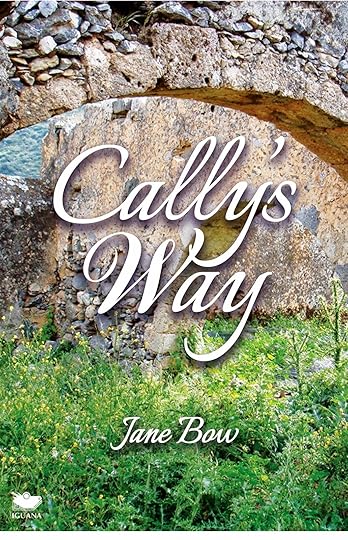 A summary & reviews are here; you can buy it here or here.
Every mother is her mother’s child, however, and Mother Mary is the only saint I know of who had a kid. Action and reaction, the messy, muddled motherhood continuum goes on and on, creating through its tapestry of trial and error the flawed, unique beauty that is every living soul.
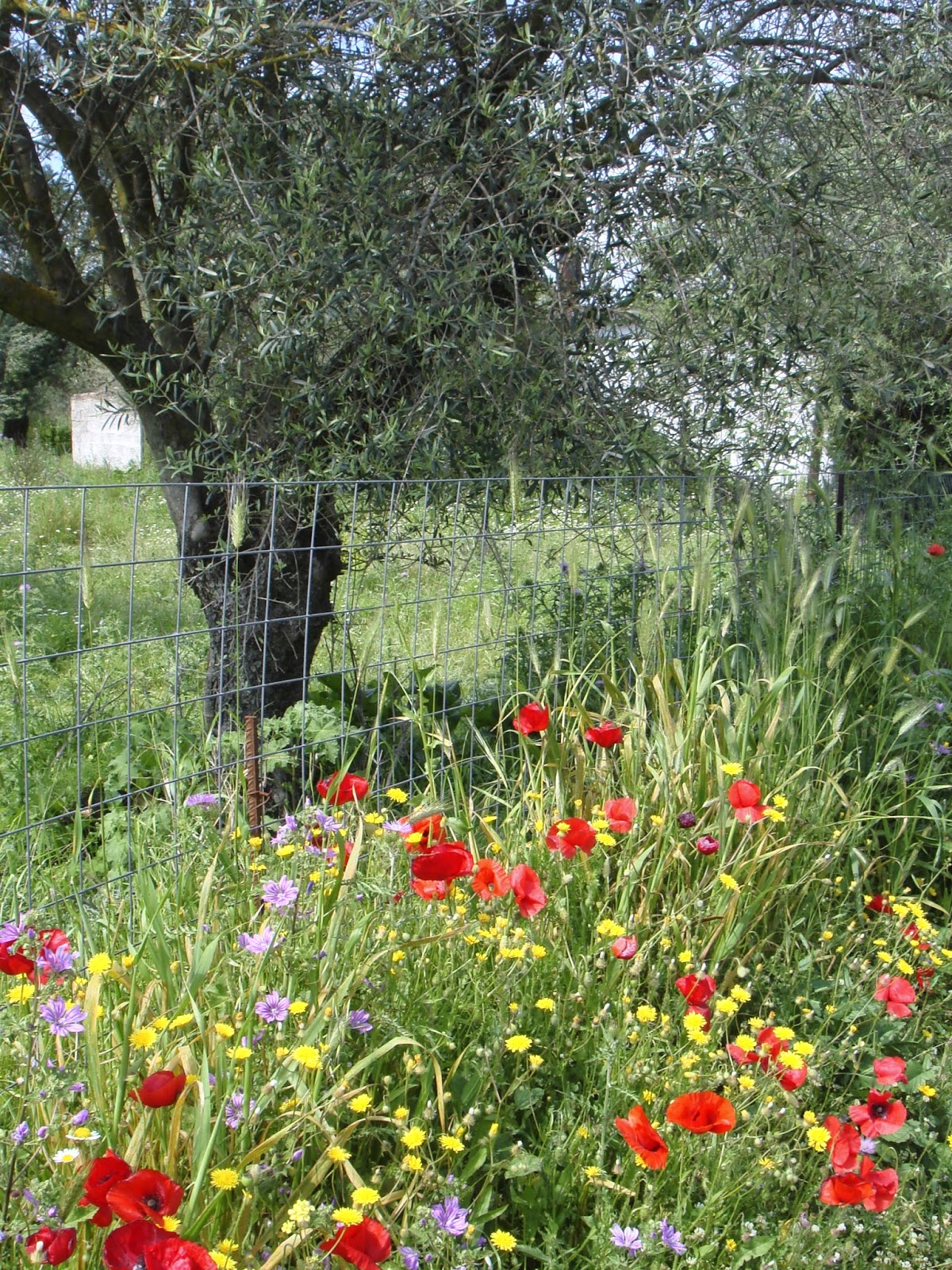 New life in the Cretan countryside
Cally’s Way, my new novel set in Crete, is all about the mother-daughter bond, and the fact that, through it, historical horrors create our identities whether we know about them or not. When the novel opens, 25-year old Cally knows very little about her mother, who has just died. Here is her first encounter with the enduring power of motherhood:
“Apparently no one in Crete wore motorcycle helmets. She hugged Oliver’s back, watching over his shoulder as he gunned the engine up the mountain road, twisting around hairpin bends, the bike’s headlight cutting a swath through the darkness, higher and higher... the sea now thousands of feet below... They crested a steep hillock on the edge of the village of Sellia. There was a church at the top.
A great palm tree stood guard over a wrought iron gate. Inside, waist-high marble tombs decorated with crosses, angels, doves were lit by oil lamps in glassed-in shrines at their heads: rows and rows of tiny lights flickering under the moon and stars. Cypress trees at the top of each row, sculpted nearly horizontal by the mountain winds, looked like Japanese ink drawings against the sky. She had never seen anything like it.
“Cretans like to build their graveyards as close as possible to God,” said Oliver.
Beside the oil lamps inside the shrines, people had placed a few flowers, some fresh, others plastic, and a crucifix or a prized medal or a candlestick or a toy. Always a photograph, several in ornate silver frames...
Something squeaked in the darkness above her... There it was again, a single squeak in the trees. A bat? Strangely, she felt no fear. Death, all around her, was beautiful in this nighttime world of flickering souls and answering stars. Removed from light, bright day life, the departed connected with eternity, and were free to come alive. To be with you.”
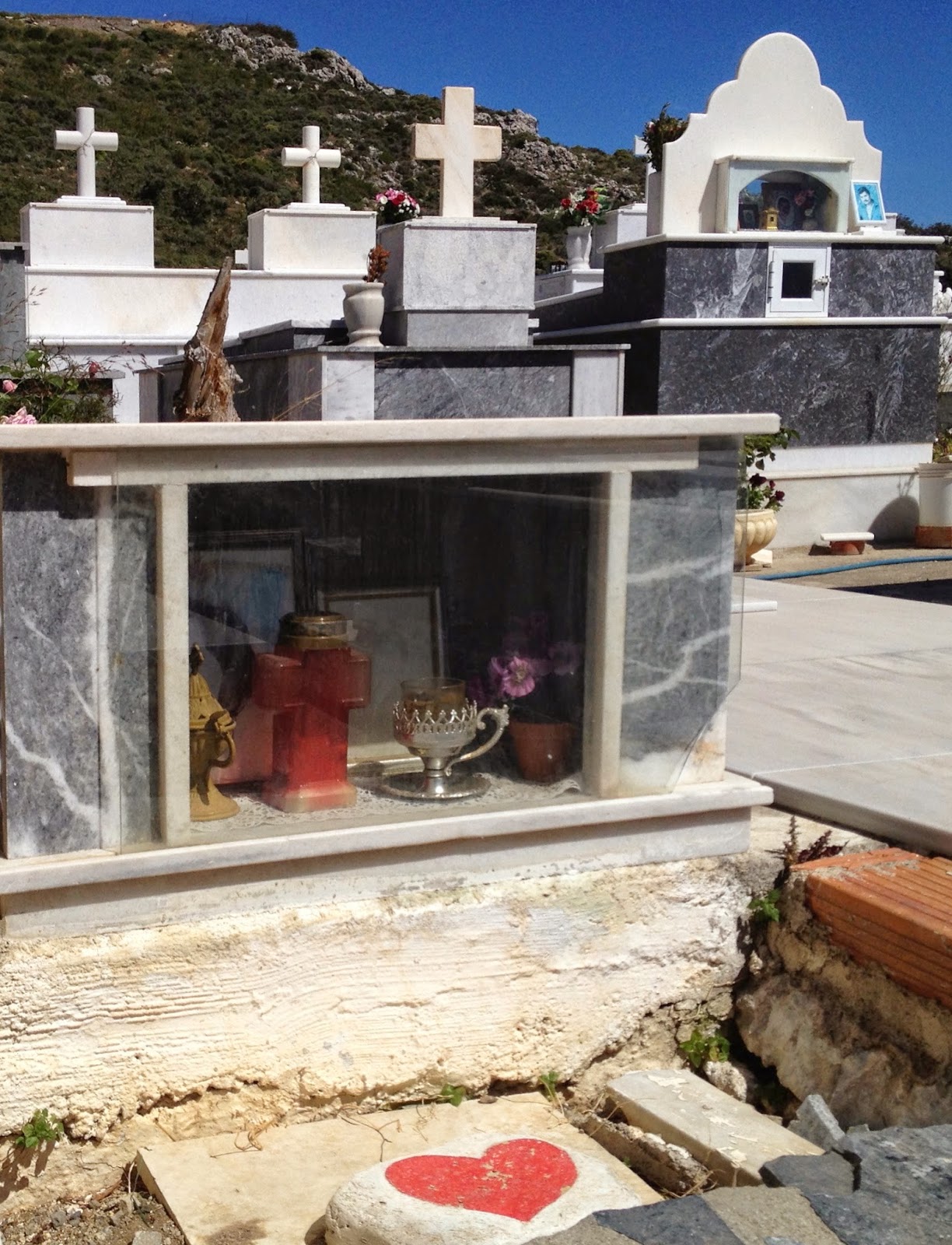 A Cretan grave
On Mothers’ Day this Sunday I would like to celebrate every mother because, no matter who or where she is, she is doing the best she can with what she’s got in every moment.
Also, this year please help me send loving energy to the 234 mothers and daughters caught up in Nigeria’s latest kidnapping horror.
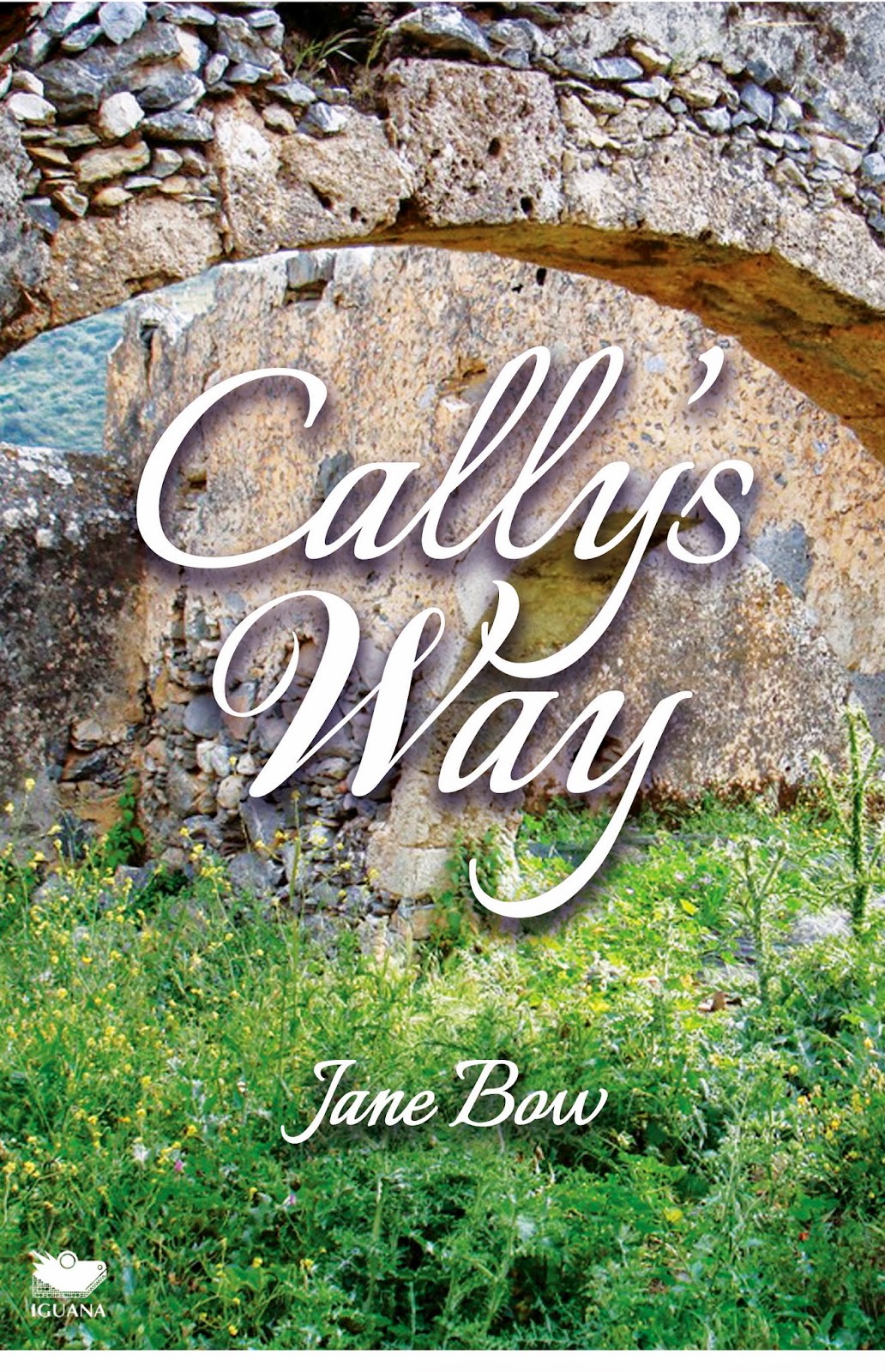 A summary & reviews are here; you can buy it here or here.
 March 6, 2014
Cally's Way Honoured by Kirkus Reviews
Kirkus' editors have chosen to feature the Cally's Way review in April's Kirkus Review!
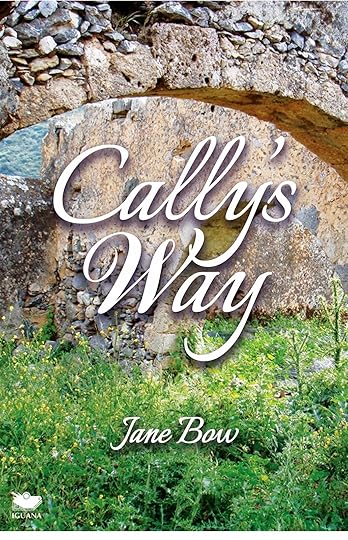 Buy it by clicking on Amazon, Chapters or Iguana Books Set in Crete, Cally's Way is a self-discovery adventure about sex and love and loss, mothers and daughters, and the way historical horrors shape our identities whether we know about them or not. Kirkus' review calls the novel "accomplished and lyrical," and "romantic," but also "tough-minded" and "harrowing," addressing "important questions like whether it's possible to avoid being implicated in the modern world's sins."
Cally's Way interweaves the 2002 story of Cally, a 25-year old business graduate, with the World War II story of Callisto, her grandmother, who was a runner in the Cretan Resistance.
Cally's mother was born on Crete but has always refused to talk about it. Now she has died, leaving one instruction: that before she starts her first job, Cally should visit her mother's homeland.
On Crete's south coast she meets Oliver, a reticent, very attractive U.S. Army deserter, and a night of love awakens feelings Cally has never known. Then, waiting for her plane in Athens airport, she learns from a television that the company she is about to work for is killing people with water pollution. These two events demolish Cally's fragile equilibrium, setting her on a new, uncharted path, back in Crete, that strips her of even her clothes. It also takes her deep into the mountains on a motorcycle, and into the history of Crete's brutal Nazi occupation, before leading to deep love, a horrific family discovery, and a future she never would have imagined.
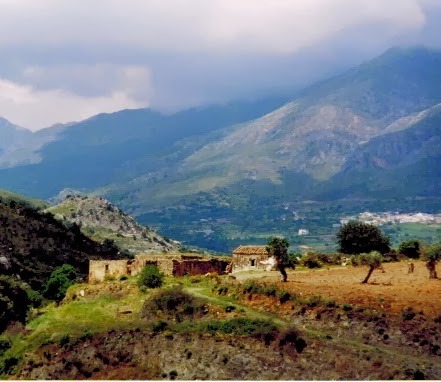 Preveli Valley ruin where escaping Allied soldiers hid
Cally's Way is also about the ancient beauty of Crete, where "Aphrodite, ruthless as ebony, old as art, danced a whole sequence of choices above the morning waves."
Bestselling British author Hilary Boyd, who reviewed Cally's Way, likes "the scent of wild thyme on the Cretan hills, the taste of a freshly picked orange, the sweetness of golden honey. Cally, like us, is seduced by it all... but at the same time... we are held in suspense by the island's cruel past."
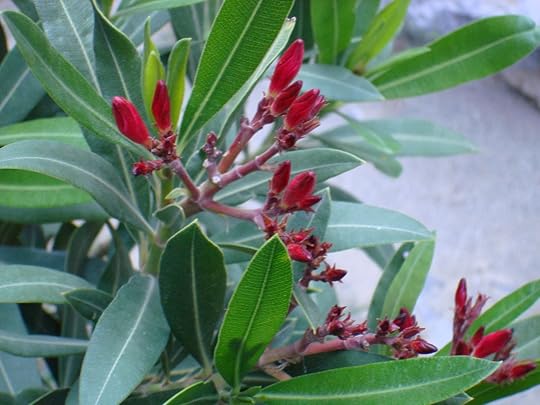 Early oleander buds near Cally's cave
"One of the most striking aspects of Cally's Way is how the horrors of war have been contextualized within the framework of day-to-day existence," writes Rethymnon Bugle editor Kate Brusten. "The questions posed by Cally's journey of self-discovery are ones any reader will be able to connect with. This book is highly recommended."
"Cally's Way resonates deeply, with surprising connections among the violent and tragic occupations of the Second World War, post-war Communist paranoia and our current occupations and insurgencies," writes Robert Begiebing, award-winning novelist, Norman Mailer Center mentor and Professor of English Emeritus of Southern New Hampshire University, who also reviewed the novel. "A satisfying and revelatory read."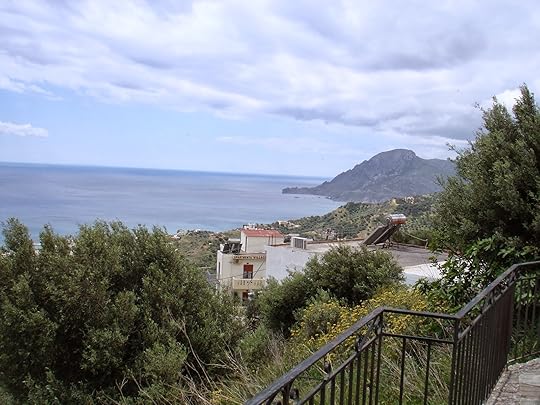 The Dragon's Head in Plakias Bay
You can read the first chapter here.
To see the full reviews, click here.
You'll find Cally's Way at any online retailer (see links above, under cover photo.) Chapters in Peterborough, Ontario, has the book in stock.
If you enjoy Cally's Way, why not help spread the word by posting a sentence or two about it on Amazon or Goodreads, or right here?
Thanks for your visit,Jane
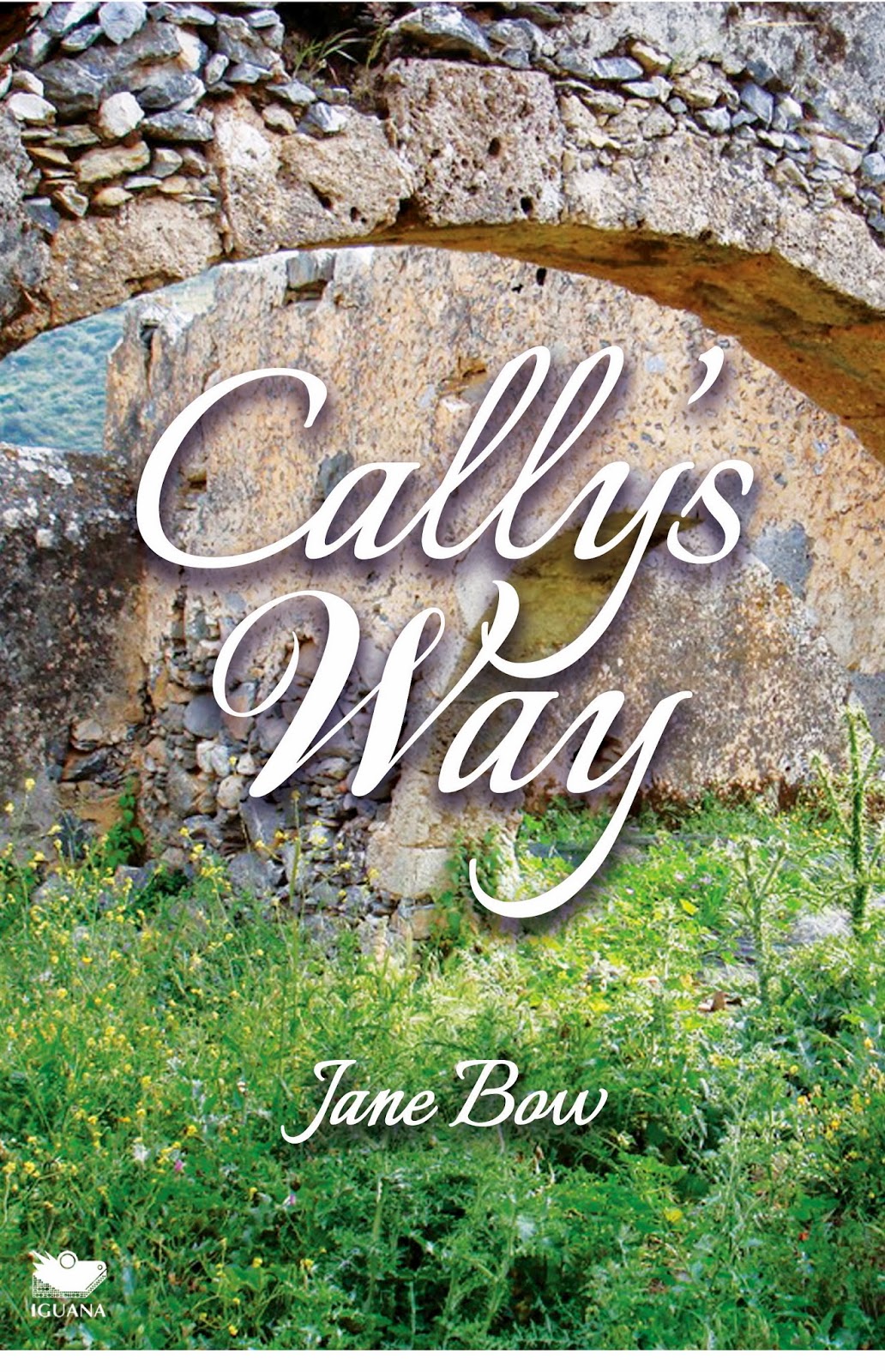 Buy it by clicking on Amazon, Chapters or Iguana Books Set in Crete, Cally's Way is a self-discovery adventure about sex and love and loss, mothers and daughters, and the way historical horrors shape our identities whether we know about them or not. Kirkus' review calls the novel "accomplished and lyrical," and "romantic," but also "tough-minded" and "harrowing," addressing "important questions like whether it's possible to avoid being implicated in the modern world's sins."
 Cally's Way interweaves the 2002 story of Cally, a 25-year old business graduate, with the World War II story of Callisto, her grandmother, who was a runner in the Cretan Resistance.
Cally's mother was born on Crete but has always refused to talk about it. Now she has died, leaving one instruction: that before she starts her first job, Cally should visit her mother's homeland.
On Crete's south coast she meets Oliver, a reticent, very attractive U.S. Army deserter, and a night of love awakens feelings Cally has never known. Then, waiting for her plane in Athens airport, she learns from a television that the company she is about to work for is killing people with water pollution. These two events demolish Cally's fragile equilibrium, setting her on a new, uncharted path, back in Crete, that strips her of even her clothes. It also takes her deep into the mountains on a motorcycle, and into the history of Crete's brutal Nazi occupation, before leading to deep love, a horrific family discovery, and a future she never would have imagined.
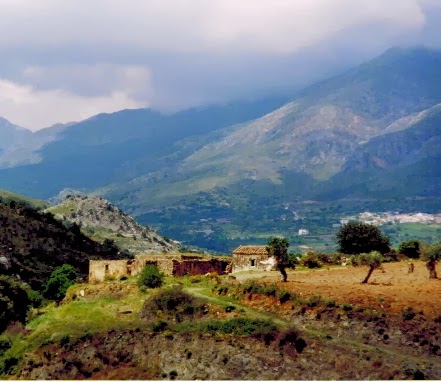 Preveli Valley ruin where escaping Allied soldiers hid
Cally's Way is also about the ancient beauty of Crete, where "Aphrodite, ruthless as ebony, old as art, danced a whole sequence of choices above the morning waves."
Bestselling British author Hilary Boyd, who reviewed Cally's Way, likes "the scent of wild thyme on the Cretan hills, the taste of a freshly picked orange, the sweetness of golden honey. Cally, like us, is seduced by it all... but at the same time... we are held in suspense by the island's cruel past."
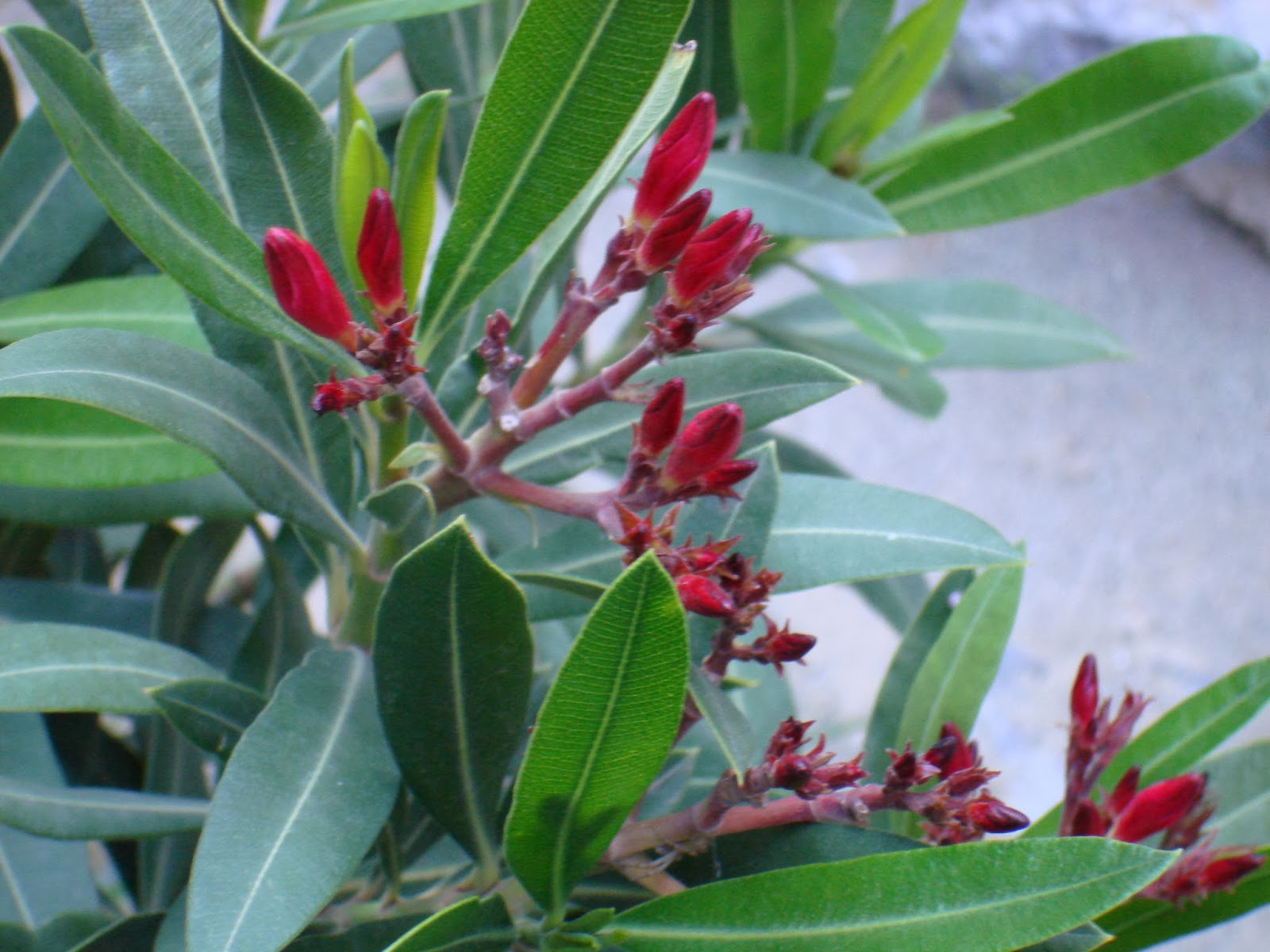 Early oleander buds near Cally's cave
"One of the most striking aspects of Cally's Way is how the horrors of war have been contextualized within the framework of day-to-day existence," writes Rethymnon Bugle editor Kate Brusten. "The questions posed by Cally's journey of self-discovery are ones any reader will be able to connect with. This book is highly recommended."
"Cally's Way resonates deeply, with surprising connections among the violent and tragic occupations of the Second World War, post-war Communist paranoia and our current occupations and insurgencies," writes Robert Begiebing, award-winning novelist, Norman Mailer Center mentor and Professor of English Emeritus of Southern New Hampshire University, who also reviewed the novel. "A satisfying and revelatory read."
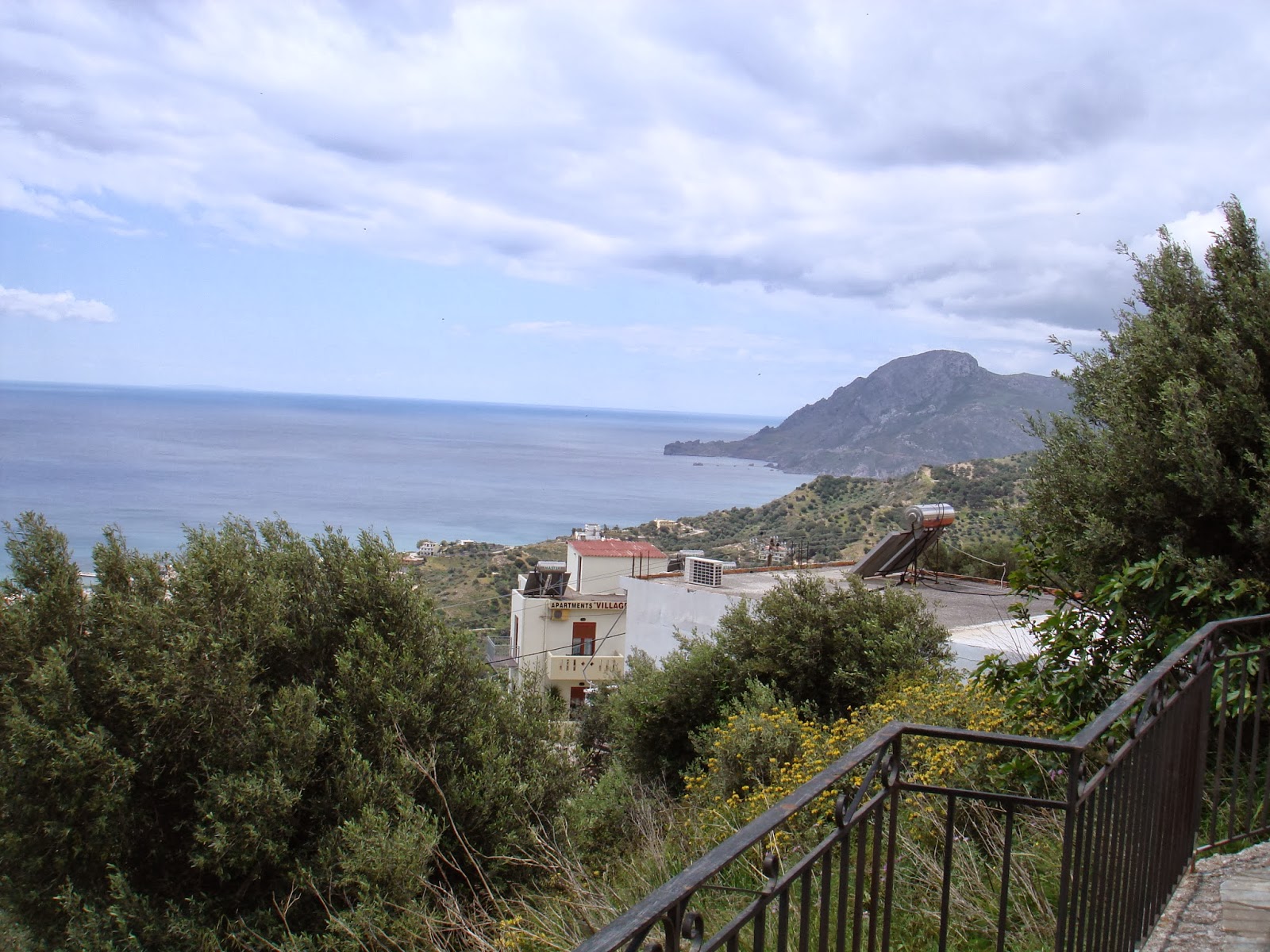 The Dragon's Head in Plakias Bay
You can read the first chapter here.
To see the full reviews, click here.
You'll find Cally's Way at any online retailer (see links above, under cover photo.) Chapters in Peterborough, Ontario, has the book in stock.
If you enjoy Cally's Way, why not help spread the word by posting a sentence or two about it on Amazon or Goodreads, or right here?
Thanks for your visit,Jane
Cally's Way is out in Print & as an Ebook!
Goodreads Giveaway ends March 24.Click here to try to win one.
Buy it by clicking on Amazon, Chapters or Iguana Books Set in Crete, Cally's Way will appeal to the readers around the world who visit this blog. Kirkus Reviews calls the novel "accomplished and lyrical," and "romantic," but also "tough-minded" and "harrowing," addressing "important questions like whether it's possible to avoid being implicated in the modern world's sins."
Cally's Way interweaves the 2002 story of Cally, a 25-year old business graduate, with the World War II story of Callisto, her grandmother, who was a runner in the Cretan Resistance.
Cally's mother was born on Crete but has always refused to talk about it. Now she has died, leaving one instruction: that before she starts her first job, Cally should visit her mother's homeland.
On Crete's south coast she meets Oliver, a reticent, very attractive U.S. Army deserter, and a night of love awakens feelings Cally has never known. Then, waiting for her plane in Athens airport, she learns from a television that the company she is about to work for is killing people with water pollution. These two events demolish Cally's fragile equilibrium, setting her on a new, uncharted path, back in Crete, that strips her of even her clothes. It also takes her deep into the mountains on a motorcycle, and into the history of Crete's brutal Nazi occupation, before leading to deep love, a horrific family discovery, and a future she never would have imagined.
Preveli Valley ruin where escaping Allied soldiers hid
Cally's Way is also about the ancient beauty of Crete, where "Aphrodite, ruthless as ebony, old as art, danced a whole sequence of choices above the morning waves."
Bestselling British author Hilary Boyd, who reviewed Cally's Way, likes "the scent of wild thyme on the Cretan hills, the taste of a freshly picked orange, the sweetness of golden honey. Cally, like us, is seduced by it all... but at the same time... we are held in suspense by the island's cruel past."
Early oleander buds near Cally's cave
"One of the most striking aspects of Cally's Way is how the horrors of war have been contextualized within the framework of day-to-day existence," writes Rethymnon Bugle editor Kate Brusten. "The questions posed by Cally's journey of self-discovery are ones any reader will be able to connect with. This book is highly recommended."
"Cally's Way resonates deeply, with surprising connections among the violent and tragic occupations of the Second World War, post-war Communist paranoia and our current occupations and insurgencies," writes Robert Begiebing, award-winning novelist, Norman Mailer Center mentor and Professor of English Emeritus of Southern New Hampshire University, who also reviewed the novel. "A satisfying and revelatory read."
The Dragon's Head in Plakias Bay
You can read the first chapter here.
To see the full reviews, click here.
Chapters in Peterborough, Ontario, has the book in stock. Other bookstores can order it from Iguana Books, the publisher.
Enjoy the book, and then why not post a short review on Amazon or a Goodreads, or right here?
Thanks for your visit,Jane
Buy it by clicking on Amazon, Chapters or Iguana Books Set in Crete, Cally's Way will appeal to the readers around the world who visit this blog. Kirkus Reviews calls the novel "accomplished and lyrical," and "romantic," but also "tough-minded" and "harrowing," addressing "important questions like whether it's possible to avoid being implicated in the modern world's sins." Cally's Way interweaves the 2002 story of Cally, a 25-year old business graduate, with the World War II story of Callisto, her grandmother, who was a runner in the Cretan Resistance.
Cally's mother was born on Crete but has always refused to talk about it. Now she has died, leaving one instruction: that before she starts her first job, Cally should visit her mother's homeland.
On Crete's south coast she meets Oliver, a reticent, very attractive U.S. Army deserter, and a night of love awakens feelings Cally has never known. Then, waiting for her plane in Athens airport, she learns from a television that the company she is about to work for is killing people with water pollution. These two events demolish Cally's fragile equilibrium, setting her on a new, uncharted path, back in Crete, that strips her of even her clothes. It also takes her deep into the mountains on a motorcycle, and into the history of Crete's brutal Nazi occupation, before leading to deep love, a horrific family discovery, and a future she never would have imagined.
Preveli Valley ruin where escaping Allied soldiers hidCally's Way is also about the ancient beauty of Crete, where "Aphrodite, ruthless as ebony, old as art, danced a whole sequence of choices above the morning waves."
Bestselling British author Hilary Boyd, who reviewed Cally's Way, likes "the scent of wild thyme on the Cretan hills, the taste of a freshly picked orange, the sweetness of golden honey. Cally, like us, is seduced by it all... but at the same time... we are held in suspense by the island's cruel past."
Early oleander buds near Cally's cave"One of the most striking aspects of Cally's Way is how the horrors of war have been contextualized within the framework of day-to-day existence," writes Rethymnon Bugle editor Kate Brusten. "The questions posed by Cally's journey of self-discovery are ones any reader will be able to connect with. This book is highly recommended."
"Cally's Way resonates deeply, with surprising connections among the violent and tragic occupations of the Second World War, post-war Communist paranoia and our current occupations and insurgencies," writes Robert Begiebing, award-winning novelist, Norman Mailer Center mentor and Professor of English Emeritus of Southern New Hampshire University, who also reviewed the novel. "A satisfying and revelatory read."
The Dragon's Head in Plakias BayYou can read the first chapter here.
To see the full reviews, click here.
Chapters in Peterborough, Ontario, has the book in stock. Other bookstores can order it from Iguana Books, the publisher.
Enjoy the book, and then why not post a short review on Amazon or a Goodreads, or right here?
Thanks for your visit,Jane
Beat March's Blues with Cally's Way!
Coming March 17!
History, love, war, self-discovery from Iguana Books
Readers around the world visit this blog to read articles and stories about life in words. They will enjoy my new novel. Kirkus Reviews calls Cally's Way "accomplished and lyrical," and "romantic," but also "tough-minded" and "harrowing," addressing "important questions like whether it's possible to avoid being implicated in the modern world's sins."
Set in Crete, Cally's Way interweaves the 2002 story of Cally, a 25-year old business graduate, with the World War II story of Callisto, her grandmother, who was a runner in the Cretan Resistance during the Nazis' brutal occupation of the island. It's a story of love, after Cally meets Oliver, a U.S. Army deserter from the Gulf War, and Callisto meets Robert, a Scottish soldier who has escaped from a German POW camp.
 Preveli Valley ruin where Allied soldiers hid
Cally's Way is also about the ancient beauty of Crete, where "Aphrodite, ruthless as ebony, old as art, danced a whole sequence of choices above the morning waves." Bestselling British author Hilary Boyd liked "the scent of wild thyme on the Cretan hills, the taste of a freshly picked orange, the sweetness of golden honey. Cally, like us, is seduced by it all... but at the same time... we are held in suspense by the island's cruel past."
Early oleander buds
"One of the most striking aspects of Cally's Way is how the horrors of war have been contextualized within the framework of day-to-day existence," writes Rethymnon Bugle editor Kate Brusten. "The questions posed by Cally's journey of self-discovery are ones any reader will be able to connect with. This book is highly recommended."
"Cally's Way resonates deeply," writes Robert Begiebing, award-winning novelist, Norman Mailer Center mentor and Professor of English Emeritus of Southern New Hampshire University, "with surprising connections among the violent and tragic occupations of the Second World War, post-war Communist paranoia and our current occupations and insurgencies... A satisfying and revelatory read."
The Dragon's Head in Plakias Bay
Print and ebook editions of Cally's Way will be available at Amazon, Iguana Books, and other online distributors on March 17. So bookmark this page to come back for links. And then please tell me what you think. Post a short review on Amazon or a Goodreads, or here.Thanks for your visit,Jane
History, love, war, self-discovery from Iguana Books
Readers around the world visit this blog to read articles and stories about life in words. They will enjoy my new novel. Kirkus Reviews calls Cally's Way "accomplished and lyrical," and "romantic," but also "tough-minded" and "harrowing," addressing "important questions like whether it's possible to avoid being implicated in the modern world's sins."
Set in Crete, Cally's Way interweaves the 2002 story of Cally, a 25-year old business graduate, with the World War II story of Callisto, her grandmother, who was a runner in the Cretan Resistance during the Nazis' brutal occupation of the island. It's a story of love, after Cally meets Oliver, a U.S. Army deserter from the Gulf War, and Callisto meets Robert, a Scottish soldier who has escaped from a German POW camp.
 Preveli Valley ruin where Allied soldiers hid
Cally's Way is also about the ancient beauty of Crete, where "Aphrodite, ruthless as ebony, old as art, danced a whole sequence of choices above the morning waves." Bestselling British author Hilary Boyd liked "the scent of wild thyme on the Cretan hills, the taste of a freshly picked orange, the sweetness of golden honey. Cally, like us, is seduced by it all... but at the same time... we are held in suspense by the island's cruel past."
Early oleander buds"One of the most striking aspects of Cally's Way is how the horrors of war have been contextualized within the framework of day-to-day existence," writes Rethymnon Bugle editor Kate Brusten. "The questions posed by Cally's journey of self-discovery are ones any reader will be able to connect with. This book is highly recommended."
"Cally's Way resonates deeply," writes Robert Begiebing, award-winning novelist, Norman Mailer Center mentor and Professor of English Emeritus of Southern New Hampshire University, "with surprising connections among the violent and tragic occupations of the Second World War, post-war Communist paranoia and our current occupations and insurgencies... A satisfying and revelatory read."
The Dragon's Head in Plakias BayPrint and ebook editions of Cally's Way will be available at Amazon, Iguana Books, and other online distributors on March 17. So bookmark this page to come back for links. And then please tell me what you think. Post a short review on Amazon or a Goodreads, or here.Thanks for your visit,Jane