Dhyanesh S's Blog
October 26, 2025
Surasamharam—Taraka or Surapadma?
Surasamharam, or the slaying of Surapadma, is a festival celebrated in various parts of South India to commemorate the victory of Lord Skanda. It is the culmination of the week-long Skanda Shashti Vratam, the main festivities held in the Tiruchendur temple. But what is the story behind it?
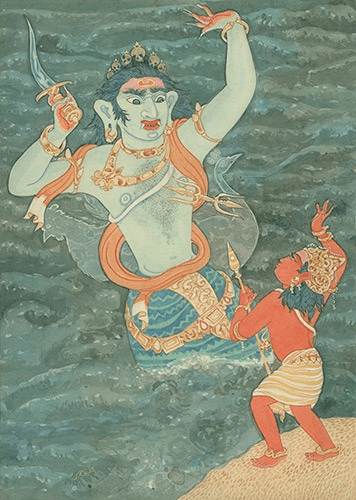
The Puranas recount the tale of how Skanda, also known as Murugan or Kartikeya, was born from the tejas/Shakti of Shiva. His birth was necessary to put a stop to the chaos and destruction caused by the Asuras and to restore balance to creation. The Skanda Purana tells us the primary Asura was Tarakasura. But the Kanda Puranam, composed by Kachiappa Sivachariyar (which itself is a southern version of the Skanda Purana) says that Surapadma was the one Skanda was destined to vanquish.
Why does this inconsistency arise between versions of the same Purana? It must be understood that the Puranas were not static texts written by a singular author, but a living, breathing, expanding work of literature passed down orally throughout Bharata. While some details may have been lost to time as the Puranic tradition was passed down in northern regions, the same stories would have survived in other parts.
When the pieces of this puzzle are put together, it becomes evident that Skanda defeated three brothers named Surapadma, Tarakasura and Simhamukha. And this battle took place on the shores of Tiruchendur, a short distance south of the ancient port of Korkai.
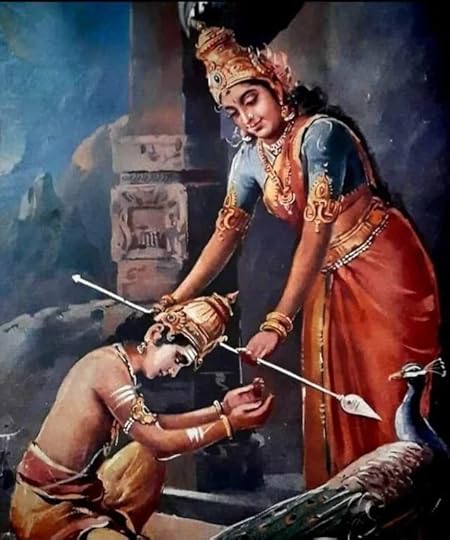
But to win this war against the ferocious armies alone as a young boy, Skanda needed a celestial weapon. His mother, Parvati, created the Vel for him. It was not a mere spear, but a unique weapon infused with the same Shakti from which Skanda was born. What really was the Vel?


May 4, 2022
The Great Peaks of Bharata
The Puranas bear mention to the seven Kulaparvatas (mountain ranges) of our land – Mahendra, Malaya, Riksha, Suktimat, Sahya, Vindhya and Paripatra. Let us explore their locations and significance.
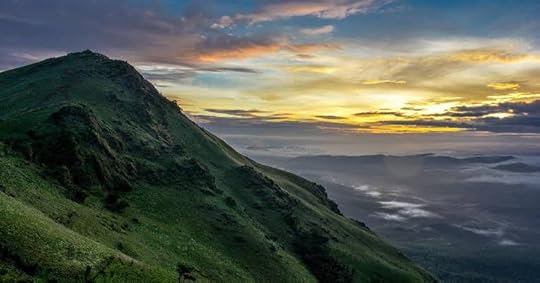
Malaya and Sahya are the Southern and Northern half of the Western Ghats. Malaya extends down to the Southern tip of Bharat. Some theorize that the mountain ranges extend into the sea where the sunken island of Kumari Kandam lies.
Both the Sahya and Malaya are known for their Rudraksha trees and Sandalwood in the Puranas. The rivers Vaigai (Kritamala) and Tamraparni flow from the Malaya, and the Krishna, Godavari and Kaveri originate in the Sahya.
The Mahendra is the portion of the Eastern Ghats between the Godavari and Mahanadi rivers. The Suktimat range extends from the Godavari to the vicinity of Modern Mysore. Lord Parashuram is said to live in the Mahendra Hills, performing penance until the Kalki Avatar arises.
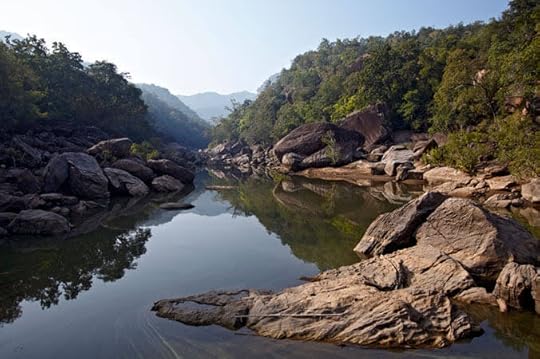
The Riksha mountains comprise of the modern Satpura. The rivers Payoshni and Tapti spring from these hills. The Vindhya range is known to all, starting from Gujarat and ending in the Gangetic Valley near Varanasi. The Narmada and Mahanadi originate in this range.
The Paripatra is the Aravalli range and its connection with the Vindhya near Gujarat. The curvature of that region is what owes to its name. Patra, meaning vessel. The Kshipra flows from these hills, on the banks of which the city of Ujjain is situated.
The geographical extent of our ancients needs to be studied more so that we can discover more interesting secrets of our land.
I have referred to Markandeya Purana’s Chapter 57 while writing this. It is available on the Wisdom Library website, and I would encourage you to read it and share your opinions and findings. I have created the map according to that text and the borders of Bharata are for representative purposes only
March 31, 2022
Multiverse in Ancient India
The concept of multiple universes arose in India long before the west caught up. There are many types of Multiverses, but I’ll only be discussing parallel universes today.
Parallel UniversesThe parallel universe theory may be one of the most famous types of Multiverses. It says that there are infinite universes that are strikingly similar to ours, bearing a copy of you and me. In the Puranas, it is mentioned that they all have a Brahma, Vishnu, and Shiva of their own. A tale from the Bhagavata Purana bears testament to this.
Once, or infinite times in different universes, Lord Krishna was playing with his cowherd friends. Lord Brahma didn’t like the incarnation of Lord Vishnu mingling with mortals, so he abducted the boys and kept them in his realm.
Lord Krishna knew that Brahma had done that, so he made exact copies of those boys appear. They lived in the original boys’ houses under the care of their parents. Maybe that act meant that he brought the parallel universe versions of his friends to our earth.
A year passed on earth, and the cowherd boys’ families lived happily with the copies of their children. Lord Brahma returned and was shocked to see the boys playing with Krishna! He saw two versions of the same boys, one set asleep in his custody, the other living with Krishna. Shocked, Lord Brahma knelt before Krishna, accepting his defeat.
The cowherd boys created by Krishna were replaced by many Vishnus, each from a different universe. They disappeared too, and Krishna conjured a thousand parallel universe copies of Brahma. Our Brahma was speechless. Lord Krishna had broken his hubris, showing him that he was a fraction in perspective of the Multiverse.
It is not just the Bhagavata Purana that has the knowledge of parallel universes. The Yoga Vasishta written by Maharishi Valmiki has various information about parallel universes.
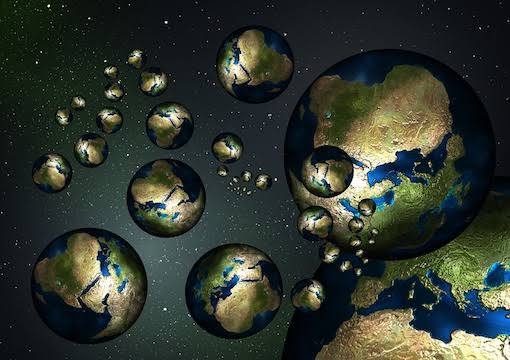
I saw countless creations, though they did not know of one another’s existence. Some were coming into being, others were perishing; all of them had different shielding atmospheres (from five to thirty-six atmospheres). There were different elements in each; they were inhabited by different types of beings, in different stages of evolution, with different natures and cultures; some had other universes within them; in some there were creatures you would not believe possible to exist; in some there was apparent natural order, and in others there was utter disorder; in some there was no light and hence no time-sense.
Yoga Vashishta, Section VI-2, Chapter 58-59
These words by Sage Vasishta are proof that the ancients knew about parallel universes. Deeper research of the ancient texts may reveal more shocking facts. The question is: how many people are willing to explore?
March 6, 2022
Spacecrafts of the Ancients
Image Credits: mysteryofindia.com
Many instances occur in the Itihasas and Puranas where flying chariots called Vimanas are mentioned. What are they, and how many types are there?
Vimana as an aircraftIn the Ramayana, the Pushpak Vimana has a central role in the abduction of Sita. It was made by the divine architect, Vishwakarma, who gave it to the God of Wealth, Kuber. It was later usurped by Kuber’s half-brother, Ravana. It is said to resemble the mountain Meru, which probably meant that it was conical.
The Ramayana isn’t the only text to have a clear mention of Vimanas. The Bhagavata Purana narrates the story of King Shalva, who prayed to Lord Shiva to obtain an indestructible Vimana. A Danava called Maya built the aircraft under the instruction of Lord Shiva. Shalva used the Vimana to attack Dwaraka, the city of his arch-enemy, Lord Krishna.
The aircraft is mentioned to be made of ayas, which is mistakenly translated as iron. The closest meaning is metal, which suggests that the ancient Indians made these Vimanas with a metal or alloy unknown to us. What could that substance be, and how useful would it be for present-day space travel?
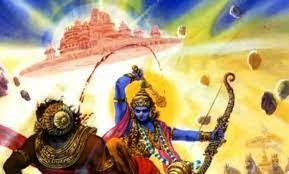 Krishna slays Shalva – Image Credit: booksfact.com
At one moment the magic airship built by Maya Danava appeared in many identical forms, and the next moment it was again only one. Sometimes it was visible, and sometimes not. Thus Shalva’s opponents could never be sure where it was.
– Bhagavata Purana, 10.76.21
The verse above is a clear indication that this Vimana had advanced camouflaging and holographic technology. The examples of the Pushpaka and Shalva’s Vimana are just the instances of aircrafts in the ancient texts, which navigate within the earth’s atmosphere, occasionally entering the mesosphere. Let’s move on to interstellar travel…
Vimanas in Space TravelThe Puranas mention Lokas, commonly translated as realms. Common Lokas include; Devaloka, the abode of the Devas; Satyaloka, home of the creator Lord Brahma and his wife, Saraswati; Dhruvaloka, the starry realm of Dhruva and many more. Vimanas are used to travel between these realms in the Puranas. Is this proof of space travel in the ancient texts?
Once, three Asura brothers prayed to Lord Brahma to get three invincible fortresses. One city moved around Devaloka, the other traversed the sky (space) and the third hovered over the earth. Intriguingly, these fortresses were built by the same Danava who built Shalva’s Vimana — Maya. Are Maya and Vishwakarma, renowned architects of their time, aerospace engineers capable of building space cities?
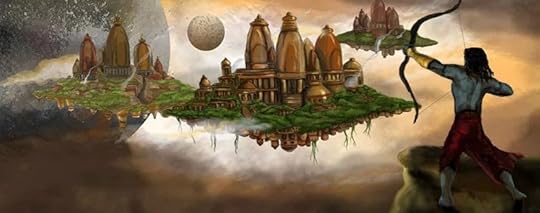 Tripura Fortresses – Image Credit: glorioushinduism.com
The noble-souled Yayati got into a Vimana, and went to Devaloka accompanied by the messengers of Devas.
– Skanda Purana 1.15.94
This verse describes the earthly King, Yayati leaving for Devaloka to be crowned as the King of Devas. What other proof is needed to certainly say that ancient Indians travelled from earth to other planets and solar systems with Vimanas? Are there descendants of ancient space travellers still out there on unknown planets?