Denise Domning's Blog
November 9, 2020
Cuteness Overload
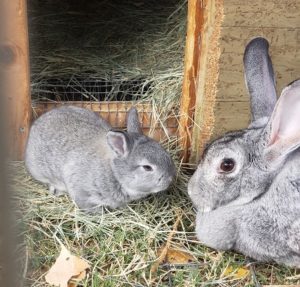 The cutest thing that’s ever lived on the farm (okay, ever lived on the farm in the last 3 months) made its appearance two weeks ago. Not that I knew about his or her arrival until almost a week ago. Goes to show how casual I’ve gotten about the rabbits.
Six weeks ago Christina and I took the outside temperature and convinced ourselves that it was, indeed, below 90 degrees. At least at that moment. This has been the hottest summer I’ve ever experienced up here. I swear it hit 90 somewhere in June and stayed there, well, until six weeks ago. The temperature is important because rabbit bucks (male rabbits) go sterile when the temperature is above 90. This means my two does, Babs and Bitsy, went all summer without producing any babies. It was now the middle of September and the weather was refusing to cool down. But we decided that 88 degrees was below 90 and Buddy should at least try to do his duty.
Which Buddy seemed to do. He mounted both girls and proceeded to fall off at least two times from each. Falling off is indicative of completion but not necessarily of success. Given that, I fully planned for the girls to visit their guy again in a few days, but the heat returned with a vengeance. When another hot week passed, I gave up on giving the girls a second visit with their guy and started counting the weeks from September 17th.
By the way, the weather did finally cool off. We’ve had two full weeks of fall during which half the trees have turned while the other half are still full leafed out in green. This week winter arrived with a killing frost. Welcome to Arizona.
Five days before the girls should have been due, Christina did a little rabbit inspection. She reported that Bitsy totally enjoyed having her belly rubbed while Babs rejected being petted at all. Since we have no real history of how the bunny girls behave when that far pregnant, we figured it could go any way or not at all. Just in case, I put lots of grass in their little mobile homes. Both girls went in to arrange their nests, which gave me hope.
Their official due date arrived. No babies. I waited until the latest day before I finally and hopelessly swept my hand through the grass that they’d turned into nests. Bitsy had added a few tufts of fur to hers, Babs had not. There were no babies in either nest.
I threw up my hands at that. At least now it was definitely cooler than 90 degrees, so we once again put the bunny girls in with their guy, and started the clock again. Two days later, Christina opened Bitsy’s coop and gave a cry. Buried in the hay was one very large baby bunny. Being late and a singleton, I guess Bitsy had to keep him in the oven a little longer.
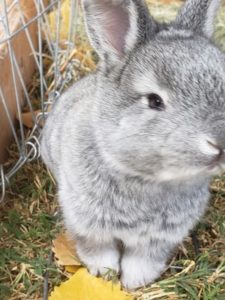 Day after day, we’ve watched this Baby Huey of a rabbit become an absolute Chunk, which is his–he has to be a boy!–official name. He is so unbelievable roly-poly that we have to woman-handle him constantly. I’ve already decided that, because he’s an only kit, I have to keep him. If he is a boy, I’ll probably use him to replace his father, Buddy. He’s bound to be much more comfortable with us as often as we’re handling him. Buddy remains nervous and standoffish even after a year.
And if Chunk turns out to be a she? Then I’ll have a third mama. If that’s the case, then I’ll be building her her own mobile coop. But not too soon. Babs’ and Bitsy’s other babies had each other to cuddle with and find comfort when I separated them from their mothers. Chunk is all alone. Who could leave this cute thing all alone in a big coop? Not me.


November 2, 2020
Kali Update
I was very concerned about what might happen to my llama Kali after he lost Scout. After all, the two llamas had been together their whole lives, or so I was told by my friend Su, who owned Scout and Kali before me. Their original owners got them as little llamas, which are called crias (I had to look that up), and raised them to be pack animals for camping trips. Let me say that, having grown up spending most summer weekends camping with my family in the wilds of Colorado, I can see the attraction of having a critter to carry all that stuff.
What concerned me most is that Kali had not seen Scout die or be buried. How would he handle Scout simply disappearing? I’ve seen all sorts of animal grief. Elsie stood on the grave of her herdmates and called for them for 3 days. The pig Lonely Girl squealed and cried for a full day after realizing she was all alone. Mari, my second oldest ewe, watched as her son was shot, then returned to grazing. It wasn’t much, but hey, she’s a sheep. I’m surprised she even recognized he was her son. Even turkeys grieve. Tom knows exactly what’s happening as I take his flock up to the barn in the week before Thanksgiving. When I’m done, he’ll lead the remaining members of the flock up to what remains for a last glimpse.
So, with no idea what to expect from a llama, I kept an eye on Kali that first morning. He spent most of it wandering the back of the property. I sent the sheep back there, in case he was lonely. By mid-afternoon, Kali had left the back pasture and walked directly into the middle pasture. It was the first time he’d crossed that boundary. He explored the fence line, nibbled a few leaves from a cottonwood, checked out the chicken tractor where the Red Rangers are living now, then began to walk along the fence that separated him from the next pasture, where the rabbits are.
I went down to check on him. Much to my surprise, he made his way toward me. While Scout lived, Kali kept his distance, sidling away if I got close. This time, as he drew nearer he met my gaze. He stopped a few feet from me. I reached out. He backed away, but not as far as he had done in the past. I walked passed him to open the gate to the front pasture, and left it open behind me, just to see what he’d do.
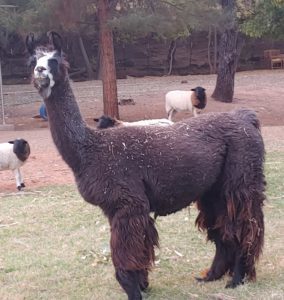 He was through the gate in a flash, then headed straight toward the gate that leads to orchard and garden. Yikes! I trotted after him, wondering how I was going to get him back inside the pastures. I do have a lead and a halter, but I was going to have to catch him to put those on him. Those long legs of his meant I was talking two steps to every one of his.
He was out of the pasture and into the orchard in no time, then headed for the barn. I’d almost caught up when he reached the steep concrete driveway that leads up to the house. Just when I thought all was lost, he stopped. I realized he’d just caught sight of the men working on the deck. Apparently, that was more people than he wanted to confront, because he turned around and loped past me in that strange camel-like stride of his as he returned to the safety of the more familiar pastures.
Since then, he continues to become more friendly. He’ll take food from my palm now. He loves rabbit food, which is mostly alfalfa, and chicken food, which is very tasty but really bad for him. He has also discovered that he loves pole beans. I let him stay in the front pasture without thinking about how tall he is. Before I realized it, he’d s eaten all the scarlet runners and Aztec long beans down to the top of the stretch of 8 foot fence that separates my pasture from the orchard. And then had the same reaction that most people have when they eat too many beans. I’m keeping him out of that pasture now, at least until all the beans are down.
But the strangest change has been how he now leaves his droppings. Llamas choose one spot to leave their pellets. But in his new freedom, Kali seems to have decided that he doesn’t want to be confined to just one spot. Instead, he’s created a potty space in each pasture. And bless him, if he didn’t choose the exact right spot for each one–the place where the ground most needed some fertilization.
So, much to my joy, Kali is doing just fine without Scout. If this is llama grief, then I approve.
October 27, 2020
Black Eyed Peas and Collards
Now here’s a title that ten years ago I would never have dreamed I’d use. To explain why I have to go into my genetics. You see, my maternal line comes out of Norway. In fact, although my maternal grandparents were born in the US, both of them spoke Norwegian as their first language. My grandmother wasn’t exposed to English until she left school after the 8th grade. (Her “yelly” definitely “yiggled.”) Even more importantly, the area in Norway from which my maternal line springs is the northernmost area of Scandinavia. One of my mother’s cousins has spent years researching our history and she believes we’re actually Laplanders.
This history, and the culture that comes with it, was far more influential in my upbringing than my more muddled paternal side, which consisted of Polish, Bavarian, and French Canadian ancestors. As with anyone, with the history comes food. Fans of Garrison Keillor may recall his many references to Scandinavian food as “carrier food,” meant to carry butter, sugar, or salt to the gullet. I can testify that this was the sort of cooking that went on in my mother’s kitchen. Worse, my father suffered from ulcers, which were then thought to be caused by eating food that was too spicy. So bland, white, carrier food is what I grew up on. The only peppers we had were green bell peppers. Vegetables didn’t stray too far from carrots, celery, canned corn, canned peas, and canned green beans, and lots and lots of mashed potatoes. Not much fish, though, but that may have had more to do with my mother growing up in a landlocked area of Wisconsin. Although, she was fond of peanut butter and sardines on crackers. Neither I nor my siblings could be convinced that this was delicious. My grandmother did her best to convince us of the same thing with Lutefisk, with the same result.
All of this is a long way of saying that until two years ago, I’d never so much as seen black-eyed peas much less considered eating them. As for collard greens, while I’d definitely heard of them, I had no idea what they were. I’d had cabbage, of course. I think cabbage has its own level in the carrier food group pyramid; shredded cabbage soaked in well-sugared mayonnaise is what passed for cole slaw in my grandmother’s house. I started growing chard when I first moved up, but frankly it took me a few years to actually eat it myself. Then I wondered why I’d waited so long. Apparently, chard is just another name for “spinach.” Now, I use chard in everything.
Given that experience, I now wonder why it took me so long to look at other foreign foods, black-eyed peas being a case in point. I bought my first bag of dried peas about a year and a half ago. I wanted black beans, which until then had been my staple bean for soups, chilis and even refried beans, but my local grocery store was sold out. Feeling reckless, I scanned the many different varieties of beans, and my gaze fell on the black-eye peas. The label promised ease of cooking, so I took them home only to discover that my new partner not only knew what they were but had eaten them often. With no excuses left, I cooked up my first pot and discovered they have a wonderful nutty taste.
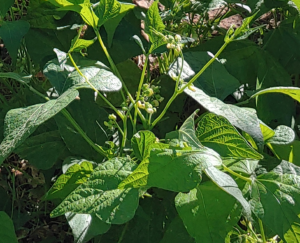 After that it was just a matter of coming up with dishes that used them. My favorite recipe book–the internet–offered up an Indian-flavored dish including turmeric and ginger, which I immediately bastardized by adding spicy Andouille sausage. Everyone liked that well enough that the dish now makes a regular appearance on my table, and I was such a fan I knew I had to add the peas to my garden. I discovered by chance that I could use store-bought peas as seeds, when a pan of soaked and drained peas ended up in the refrigerator for a couple of days. When I pulled them out, I had a whole pot of lovely pea sprouts.
So I took a good handful of peas out to the garden and put them into the ground and was stunned at how attractive a plant they are. Their blooms look like any pea blossom but they start out a pale waxy yellow and lighten into pure white. I’ve already decided these plants are going to show up even my rose gardens. They’ll make a great border plant. Pretty, tough, and fruitful, and unbelievable easy to grow. Drop a pea and a plant shows up. It doesn’t get better than that.
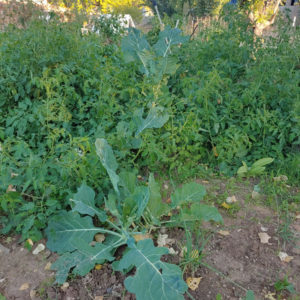 As for collard greens, well, I picked up a six pack at the local garden nursery in early spring and planted them with my yellow squash. They started out looking pretty healthy, then between the hot dry summer and cabbage loopers weakened so much I considered pulling them. But every time I’d reach for them I’d see that they’d added a new leaf or become a little greener. After I replaced the dying squash plants with tomatoes, the collards immediately perked up. Maybe they don’t do well with squash?
Because I wasn’t expecting anything of them, I ignored them until I started planting a row of nasturtiums just beneath their bed. To my surprise the weak little plants had become three feet tall and were sporting large, very healthy looking leaves. Of course, I had to pick some leaves but I had no idea how to fix collard greens and I’d been told they were really tough. Everyone I spoke to agreed they were tough and that a pressure cooker was needed. Since I was already using the Insta-pot to cook the black-eyed peas, two weeks ago I took the plunge. I added a few slivered leaves to the peas in the Insta-pot.
And now I know why people eat them together. All I can say is that there’s something about that combination that just makes my stomach happy.
For what it’s worth, here’s my Way-Northern European take on Black-eyed Peas and Collard Greens.
1 cup dried black-eyed peas, soaked at least 4 hours in salted water
1 bay leaf
1/2 medium onion
1/2 tsp salt
4 large collard leaves, stems removed and sliced thin (chiffonaded?)
6 tablespoons olive oil
12 oz Andouille Sausage, sliced into bite-sized pieces
2 cloves garlic, minced
3/4 large onion, chopped
1 piece of fresh turmeric, about 2 inches long, minced
1 tablespoon minced fresh ginger
1 red bell pepper, diced
1 Poblano pepper, diced
1 dried cayenne pepper to season the pot
2 cups diced tomatoes, canned or fresh
salt and pepper to taste
a good handful of cilantro, chopped
Soak the peas for at least a few hours (up to 8) in 6 cups of water plus a 1/2 tablespoon of salt. Drain and rinse, then put peas in the Insta-pot. Add enough water or chicken broth to cover, bay leaf, salt, onion and collard greens. Use the “Manual” setting on the pot and set to cook for 20 minutes. While the pot does its magic, put the olive oil in a big saute pan over medium heat. Add the sausages, garlic, onions, turmeric and ginger and cook 5 minutes until onions soften. Add the peppers, and tomatoes.Season with salt and pepper. Cook another 5 minutes. If it becomes too dry, you can add chicken broth or water, but it’s better to wait until the peas and greens are done, and use the water from them as part of the dish.
I don’t wait for the Insta-pot to count down and vent slowly. The minute the timer runs out, I vent the pot and remove the peas and greens, and add them to the pan. If you’ve guessed right, there’ll be just enough water left with the peas to loosen up your sausage mixture. Mix well, add the cilantro, and serve.
October 19, 2020
Farm Merger
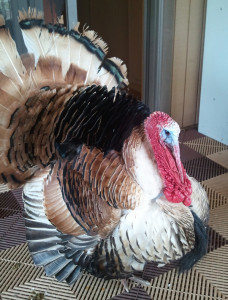 Tom on the porch
Over my years on the farm I’ve seen a lot of cross species mergers. There was my second Jersey cow Cissy, who was certain she wanted to be a dog and live on the porch. I will say that no one, especially the dogs, thought this was a good idea. My ancient old turkey Tom was the next farm critter to seek out the dogs as flockmates. Not only did he patrol the farm with Moosie and Bear, he roosted on the porch right above where they slept. He did this for about a year while I raised a new flock for him to shepherd. Tom did his best to convince me that he should also be allowed in the house, just like the dogs, but I wasn’t willing to go that far. How do you housebreak a turkey? He didn’t give up easily. He could spend hours tapping on the sliding glass door when his canine buddies were out of reach.
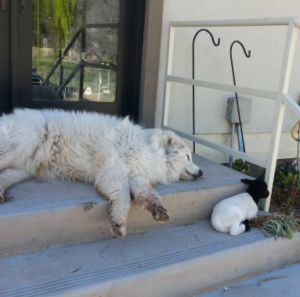 Bear and Peanut
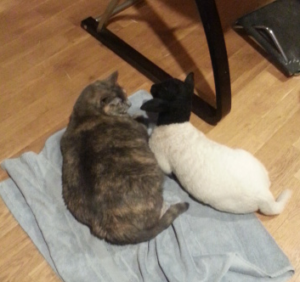 Peanut and Fat Girl
Of course there was Peanut, the orphaned ram lamb, who did get to live inside the house. For a while he considered being a cat, but they just weren’t interested in flocking with him. The dogs suited him better, as they tended to stay together and both Moosie and Bear liked him. Then, maybe because Peanut was species-uncertain, after he had migrated to spending days outside with his siblings, he bonded with Miss Piggy’s piglets. I’ll never forget the day I found him in the orchard with his eyes closed and his forelegs tucked under him. There was a piglet at either side and each little pig was gently running one of Peanut’s ears through its mouth. It was clear that all three of them thought they were getting the best of that encounter.
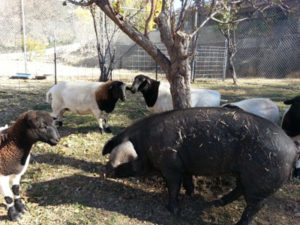 Lonely Girl with her new herd
After Peanut came Lonely Girl. That was the final little–or not so little as she weighed out at 350 when all was said and done—gilt from my last herd of pigs, the Old Blacks. (I’ll never do that breed of pigs again. I think having their ears over their eyes made them far too skittish.) There is nothing hogs– related or not– like less than to be the only one left from their herd. More importantly, they know exactly what it means when they hear the shot that makes them a true orphan. Their grief is so extreme that I’ve promised myself to never again leave only one alive, even if it means twice the work. (If you’re interested, you can find Lonely Girl’s story in these three posts: Lonely Girl, 6 Sheep and Tiny’s Shadow.)
Now I’ve had another cross-species farm merger. A few weeks back I caught my flock of Blue Slate turkeys standing with the sheep. Every time the sheep moved as they grazed, the turkeys followed. That didn’t really surprise me. After all, both turkeys and sheep enjoy grass. I figured one flock was following the other, looking to see if this grass was better. What did surprise me was how comfortable they looked together. The next week I caught the turkeys trying to follow the sheep out of the gate that leads to the creekside pasture. I nixed that right away. While the sheep won’t go sloshing through the creek to visit whatever’s on the other side, turkeys will. For the record turkeys do a pretty good duck impression when necessary. I chased the birds back inside the gate and thought that was the end of it.
A week or so ago I again caught the turkeys with the sheep as the sheep were making their way toward the creek. Only this time two of the toms were riding on the backs of my bigger ewes. The hens were right up next to the lambs, picking things out of their wool. And the sheep were loving it! Tiny, who did lose all her wool this year and has the sleek, short-haired coat a Dorper is supposed to wear, had her eyes closed as the tom on her back used his beak to sift through her hair.
I groaned. Once again a priceless moment that ought to be recorded for posterity and I had no camera on me. Certain I’d never again have the opportunity to record this unbelievable moment, I chased the turkeys back into their pasture and sent the sheep down below.
Then a miracle happened. A few days back I heard the turkeys chatting with each other, and they sounded close. Because turkeys aren’t hesitant about walking into an open doorway just to explore a new space, I went out onto the porch to see where they were. Earlier that morning I’d brought the sheep into the orchard for the day. That’s always a risky proposition. Although there’s plenty of good grass for them to eat, they’d much prefer to clean up my garden for me. The last time I’d tried it, Rosie showed me and her flockmates every spot where she could breach the fence and I’d lost a few greens and a lot of broccoli.
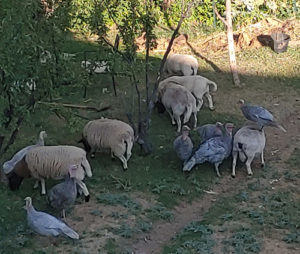 I could see all the sheep from the porch. They were quietly grazing, including the sheep on whose back one of the hens was perched. The bird’s head moved up and down quickly as she worked her way through the thick wool, pulling out every tasty morsel of whatever it is that’s in there. Although I couldn’t believe it possible, the sheepie girl acted as if this was completely normal.
No excuses this time! I ran in the house and came back on the porch to catch this photo.
Today, the turkeys were at it again, mingling with the sheep, cleaning up their wool with the sheep jockeying a little as if they were all waiting for their turn. Honestly, I didn’t need this sort of pressure. Will the sheep ever forgive me for Thanksgiving?
October 12, 2020
Good-bye Scout
 Today, the farm said an unexpected good-bye to Scout, the blind llama.
This truly took me by surprise. Scout, who arrived with his buddy Kali in mid-July, had been doing really well, or so I thought. He had been steadily getting stronger and was putting on weight, which was a blessing. I’d seen him both grazing and browsing (eating leaves off the trees). He’d even begun wandering out of the back pasture, following Kali to explore the center pasture. Although he was never friendly, he and I had found a comfortable routine. At feeding time, I’d start calling to him as I entered the pasture, to avoid startling him. Then, I’d drop his chunk of hay as loudly as I could and back away, clapping my hands, calling, “Come on, Scout. Here it is!” Nose to the ground, he’d follow the noise until he found his hay.
On Friday night after the llamas had eaten, I noticed that Scout had gone to sit in the dusty spot where the two of them took their dust baths. That was different. Saturday morning, he was still sitting there. I dropped his hay and called. He didn’t get up.
Radha, who adores Scout, ran to him and pressed her nose against his unexpectedly available muzzle. That would have usually caused Scout to stumble swiftly to his feet and try to escape her. Instead, he pointed his nose to the sky, his neck arched as if he meant to lay his head on his back.
That action was so reminiscent of what I’d seen while critters were dying that I dragged Radha away from Scout, then went to touch his nose. Now that should definitely have driven him instantly to his feet. He never allowed me to touch him. This time, all he did was turn his head to the side.
By then, Kali noticed what was going on and started toward us. Knowing just how violently protective he is of his blind buddy, I backed off and went to fetch Scout’s meal and a bucket of water. Much to my surprise, Scout nibbled at the hay I put in front of him. I left him, hoping this was nothing but certain it wasn’t. That evening I was determined to get Scout on his feet, to see if there was any obvious injury. It took a good amount of prodding, but he started to rise. Just as he reached his feet, his back legs began to wobble so badly that he instantly collapsed back onto the ground. It made me wonder if he’d broken a hip.
As Scout fell Radha, who had again come to spend time with her reluctant friend, immediately dropped into the livestock guardian dog’s “watch” position. Everything about the way she sat said that this animal– her friend– was in serious trouble and needed to be protected. Kali came rushing over and placed his feet on either side of Scout’s body. He looked from me to Radha, not quite threatening, but letting us know that we shouldn’t get any closer.
I sighed as I studied Scout. Unlike Kali, who looks like a normal llama, everything about Scout is misshapen. His hips are too high, his face is long and narrow. His teeth had grown every which way and poked at odd angles out of his mouth, no doubt making eating and chewing difficult for him. Flies crawled up and down his nose, intruding into his unseeing but open eyes.
Again, I sighed. Injured or not, I know that ruminants like cows, sheep, and llamas must walk to digest. The longer they are down, the sicker they get until they eventually die. I’d give Scout one more day to find his feet, then it would be time.
Once again, I left him with food and water. Sunday came and went. He ate a little in the morning, then didn’t eat anything that evening. He hadn’t taken any water at all. He still hadn’t taken any water by this morning. It was time.
Many thanks to Ernesto Castro from Tres Hermanas Ranch for bringing over his backhoe and helping to put Scout to rest. Farewell, Scout. May you enter your eternal green pastures walking easily, eating as much as you want, and seeing every last blade of grass in front of your nose.
October 5, 2020
Karaoke Cowards
The people at the retreat center across the creek from us are having way too much fun. I can’t speak to the extent of their dress, but we can hear their voices and often their drums. My neighbor Al wishes they’d come up with another rhythm once in a while, though.
The other night a group of us were enjoying dinner on the porch when the Blue Slate turkeys, who were already inside their nighttime shelter, began making that alarm sound of theirs. It’s a strange popping noise, very distinctive and loud enough to echo all the way up to us on the porch. That sound has just one meaning. Predator!
Within an instant of the turkeys’ warning, all the chickens, also secure in their coop for the night, went crazy. Bear and I heard it at the same time. My big dog leapt out of his doze and stared in the direction of the back pasture. After a moment, he looked at me and whined.
Bear still misses Moosie. When Moosie was alive, that whine was how Bear told his best bud that there was something out there that they could chase. It was an invitation Moosie never refused. Now that his partner is gone, my old boy turns to me, offering me that same chance, in case I might be interested in running across the fields with him. It’s an empty offer. Neither of us run much at all these days — me, because of my ankle and Bear, because he’s elderly and arthritic.
But, just as I always do when invited, I went to stand next to him. I looked down into the far field. Kali, the big brown llama, was standing at alert, staring at something beyond the perimeter fence. Scout, his blind partner, stood next to him. Scout’s ears were tilted forward as tried to track whatever Kali had seen by sound alone. The sheep, who were spending the night with the llamas, stood slightly behind the llamas. They, too, were staring out beyond the fence. As I watched, my entire flock turned as one and hurried toward the shelter of the barn at the same time, Kali moved aggressively toward the fence.
“Something’s out there,” I said to the others at the table behind me.
As I spoke, Bear turned and raced down off the porch. Radha and Rupie followed close behind him. I took a step but Christina beat me to it. She’s been forcing me to baby my ankle, which is exactly what I need to do. It’s much better this week and let me say, it’s wonderful to be able to walk with limited pain.
So I stayed where I was and watched as Christina chased after the dogs. The moment the dogs hit the back pasture, the sheep turned tail and raced to the back of the barn, as far from the creek as possible. Even I know this means nothing more than they saw Radha. The sheep don’t trust her any more than Tom does.
But Radha was interested in only whatever was across the creek. She raced the length of the pasture, Bear and Rupert huffing and puffing as they tried to keep up with her. Then all of a sudden she stopped and rose onto her hind feet, placing her paws atop the fence, as if she meant to climb over it.
What in the world was happening out there? I haven’t seen the javelina or the coyotes since last summer. I know the lion is still here after what she did to that deer a month or so ago.
I watched, even more worried, as Christina, who had no weapon, caught up to the dogs. Her arrival sent Kali into retreating toward the sheep, leaving Scout to circle in confusion. At the same time, Rupert suddenly sat down, then raised his head and let out a pained “Ow-woo-woo-woo!”
Christina looked from the creek to those of us waiting for her on the porch. I could see her grin as she shook her head.
A few minutes later and both dogs and human were back on the porch. “They’re having karaoke night at that center over there,” Christina told us, “and it’s pretty bad.”
There wasn’t anything to do but laugh. I shot one more glance at the back pasture. Although the llamas and sheep were now back where I could see them, they remained clutched together as they stared cautiously out into the distance, listening to something that I (perhaps gratefully) couldn’t hear.
September 29, 2020
Jujubes
I apologize for the late post. For the past eight weeks I’ve been struggling with what the podiatrist (yes, I went to see a doctor; unbelievable, I know) diagnosed as a strained ligament. She also told me that I would take months to heal. In the meantime, it hurts to walk, even though I’m braced and salved and am wearing real shoes. According to my farm assistant’s pedometer, we figure I walk anywhere from 7 to 15 miles a day. By the end of the day, which, on Mondays, is when I usually sit down to write my post, I’m toast. So, until this thing heals, I’ve given myself permission to be sloppy about when my weekly story gets done.
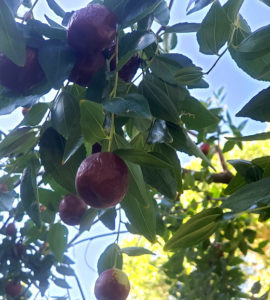 For all of you that have never heard of jujubes –not those sticky, overly sweet candies, but the actual fruit– they are more often referred to here in the US as Chinese dates. They’re low in calories and high in fiber and Vitamin C. They are a tiny apple-like fruit that starts out pale green, then darkens to a pretty reddish-brown. They’re ripe when they’ve lost about half their size and turned into a wrinkled little thing that sort of looks like a date. By that time the interior of the fruit has become soft and sticky-sweet. That’s when most people eat them, but not me, or my neighbor Elena, or Christina, my right-hand woman. We like them when they’re still crisp, half-green, half-brown. To us, they taste like caramel apples. Others have described them as being dry, not sweet enough, or like eating Styrofoam.
That so few others like them is just fine with me, since it means more fruit for those of us who do love them. And what’s not to love? They’re low in calories and high in Vitamin C and fiber. That’s a good thing since this time of year I stop and pick a couple–or three or four– fruit about ten times a day. If my sheep had their way, they’d pick the tree clean. Rupert likes them, but he likes everything. My chickens also like them, and so do all the wild birds. I was watching a Scarlet Tanager pick a tiny hole in each of a dozen fruit yesterday. Maybe he only likes the wrinkled ones.
Surprisingly, (or maybe not, since I still know relatively nothing about rabbits) my rabbits like them. Generally, Buddy, Babs, and Bitsy are pretty picky about what they eat. Arugula, turnips, radishes, no. Lettuce, honeysuckle, apple branches and leaves, yes. Their absolute favorite are branches from the tree that grew out of plum root stock. I actually encouraged this on purpose. I wanted a tree on the ditch bank that I didn’t care about, one that would hopefully distract the beaver that stole my nectarine and ate two of the three Elberta peaches I’d planted there. So I transplanted this little treelet, and it’s done great, maybe because the beaver’s moved on. The tree is now a good eight feet tall and, except for this year, has borne dozens of tiny sweet yellow and pink plums Apparently its bark and leaves taste as sweet to the bunnies as the fruit does to me. And to the sheep, but then sheep aren’t particularly discerning. After all, they’ll eat radish greens.
 Since I was sharing the jujubes with all my other critters, I thought I’d let the rabbits try them. I dropped a fruit into all three of their homes. Bitsy sniffed at hers, then hopped back into her hideyhole. She apparently waited until I was gone to eat hers. Buddy ignored his first few completely, far preferring his plum tree branch but now the fruit disappears by morning.
But Babs! She rolled hers around with her nose, then took a bite. Her eyes widened then she was nibbling like crazy. It’s weeks later and she now studies my hands when I open the top of her home, looking for her treat. I drop the fruit and she almost pounces on it. It’s gone in a flash.
Both she and I are going to miss our daily bit of sweet Styrofoam when the season is done. Next year will be even better. My five smaller jujubes are finally big enough to bear fruit!
September 21, 2020
Karma is a Female Dog
 Yes, this is how she sleeps in her little cubby
The turkey came home to roost for Radha today and she most definitely earned it.
As you may recall, I’ve been battling for months to get my hard-headed, dominant and determined, 1.5 year old Anatolian Shepherd to show me she can become some sort of livestock guardian dog (otherwise referred to as an LGD). Over the last six weeks, I’ve watched in relief as, little by little, Radha finally seems to be getting an inkling. It’s just so hard for her because everything that an LGD does is nothing that Radha likes doing. LGDs sit and watch. Radha wants to run and play. Actually, she wants something else to run so she can chase them.
I blame Mr. Headbutts for Radha’s behavior. He confused her. But who knew a ram lamb would make a best friend out of a dog that he should instinctively view as a potential predator? It’s important to note that their play was anything but gentle. It included both biting and some serious head butting. But because of him, Radha thinks of all the creatures on the farm as potential playmates. For good reason, none of the other critters living here are willing to step up to be her friend. The problem is that when she approaches any of the other critters, they all run from her in fear and Radha reacts like the predator she is.
It’s taken months of work on my part to get her to agree that only bad dogs kill birds. That’s when she launched her “catch and release” program. Rather than kill the bird, she caught the poor thing by the back end, held it for a moment–sometimes doing damage and other times doing no more than dampening feathers– then let it go. I girded my loins and once again started training. It was after I saw her catch and release Tom, my old and incredibly gentle tom turkey, that I found the answer. From then on every time I caught her chasing a bird, she found herself collared to a very heavy chain that was fastened around a post in the back barn. There she stayed, right in the middle of all the chickens, chained in place for an hour, far from her house, her people and Rupert.
At first, she resisted. She’s an escape artist, that one. Like Moosie, if she doesn’t want to be someplace, there’s no way to keep her there. But this time, nothing she tried worked, not even tearing up the fence that hangs on that post. It took six “time-outs” before she gave in and agreed to ignore all birds except those big ones that fly over the property. For the last four weeks, she had controlled herself very well, sometimes even looking at me as if to say, “See! I’m not chasing!”
Okay, it may not have been just my “training” that changed her. Something happened to Radha the day the llamas arrived. While she was fascinated with Kali, the brown llama, she was instantly drawn to Scout, the blind, gray-and-white llama. She immediately understood just how fragile he was and began guarding him within minutes of meeting him. Every dawn, she follows me to the back of the property to greet her friend Scout, her tail wagging happily. Let me say here that Scout is a whole lot less impressed with Radha. More than anything, he wishes she’d leave him alone and does everything, including kicking her, to try to drive her away. But Radha remains undaunted and always settles down into LGD watch mode whenever she’s near him.
Four weeks of good behavior on her part has not been long enough for those creatures she once tormented to have either forgiven or forgotten. Especially Tom. And since Tom attacked that Golden Eagle a few months ago, the old man has his mojo back. He’s done taking any you-know-what from a snot-nosed puppy who’s only lived here on the farm for the blink of an eye.
It can’t have been easy for gentle Tom to have gotten to this stage. After all, to the best of my knowledge that bird has never attacked any human, pig, cow, dog, cat, or sheep on the farm. He ignores the chickens and could care less about the ducks. Not even the new turkey hens have caught his eye, although he does police the four young toms, whom he seems to consider hooligans. But while they are already beating themselves bloody (I have another 2 months of this before Thanksgiving!), he hasn’t laid a talon or beak on them.
 A few weeks back Tom started following Radha whenever she came to the back pasture, making that odd, high-pitched sound that Toms make when they’re threatening each other. At first Radha didn’t notice him, but when he persisted, she started to get a little creeped out. Every time he’d come at her, she slink away, glancing back over her shoulder in worry. Last week Tom was relentless as he chased her and she finally understood he meant to hurt her. That had her dodging him and hurrying to exit from the pasture.
Today, he got her. She ran like a coward. Yes, payback, like karma, is a female dog and her name is Radha.
September 14, 2020
Oh to Cukes!
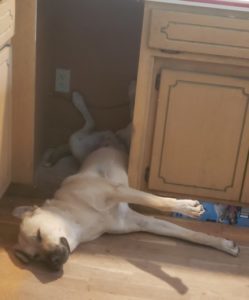 The title of this post was supposed to be “An Ode to Cukes.” I actually considered writing an ode, but after some research on the format, which I vaguely remembered from high school English class, I decided I would only embarrass myself if I tried. Instead, I’m inserting a picture of Radha here, because…well, because I cannot believe that dog sleeps like that. This is a ninety-pound Anatolian Shepherd who has a penchant for tight corners and small spaces. She looks dead, or at least uncomfortably stiff.
As for the cukes, yes, I’m still writing about cucumbers but none of the lines will rhyme. This will, however, be short, much like an ode. Seriously, how much can anyone say about a cucumber?
Let me clear. I’m not going to regale you about how much I love the taste of cucumbers, or how well they grow here. Actually, they usually don’t do well for me at all. A few years back I believe I wrote about how I was fighting off farmer ants that planted their aphid crops on the stems and leaves of my vines. No, what I’ve fallen in love with is the amazing colors of overripe cucumbers.
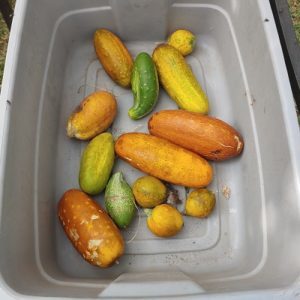 Like everything else I planted this year, my vines were set too close to each other. I did this mostly because I figured most of them would die. Nothing did and my garden is now a jungle. The cucumbers became a tangled thicket. I had no idea no idea how many I’d missed until a couple of weeks ago when I began discovering vibrant orange cukes the size of a small butternut squashes tucked into odd spaces. One gopher had the clever idea of burying the cucumber in dirt and eating the part that was underground.
Having never before seen a fully ripe cucumber, until that moment I hadn’t realized that orange is their ripe color, that we eat them when they’re underripe the way we eat green peppers. I’ll admit here and now that I haven’t tasted one of these orange beauties. I’m pretty sure they’re going to be bitter. But the chickens have no such hesitation and they’ve been feasting.
It was as I was cutting these up for the chickens that I began to gain an appreciation for the amazing colors and patterns on their skins. As you can see in the picture, some of the big orange dudes have ridges that look like scars. The cucumbers that are just barely past green are streaked with yellow and have pockets of blue that’s almost turquoise. It’s like they’re unraveling the green, separating it into the original colors. Who knew such a humble vegetable could be so beautiful?
Hence, my embarrassing and swiftly squelched desire to pen an ode. Instead, I’ll save seeds from a few of the orange ones to plant next year. That’s paean enough, I think.
Oh, and by the way, all of my knives and most of my tools have made at least one pass through the sharpening machine. Most of the knives need more work, but that thing really sharpens tools. I nearly fell over the first time I used a newly-sharpened billhook. I wasn’t prepared for the blade to slide through the branch like it was butter. Oh, for an Ode to Sharp Tools! (Far more useful than Grecian urns.)
September 7, 2020
Getting Edgy
Yeah, not that kind of edgy. Edge-y. As in sharpening knifes because last Saturday I had no sharp knives. None. Nada. Nil.
It was that day that my friend Mike brought fourteen Buff Orpington roosters by to turn into food. I can hear all of you who know what a Buff Orpington is groaning at that. Trust me, I’ve told Mike more than once that there’s no such thing as a “dual-use” chicken. There are only two types of chickens: meat birds or egg-laying birds, and never the twain shall substitute for the other.
But he bought a straight run of Orpington chicks with the idea of raising his own Orps, knowing that he’d get more roosters than he could keep. Indeed, he ended up with eight hens and fifteen roosters. He kept the gentlest rooster for his hens–wise move!–and brought the other boys here. If he was hoping for roasters, he was disappointed.
Let me say, they were worlds different from my Cornish hens that I’d done the previous week. I really liked those birds a lot , so much that I’ve ordered another batch to arrive at the end of September. Yes, those are, or are supposed to be the tiny little single-serving sized chickens. However, when I read that they make a great roasting hen, I let them grow an additional month and they exceeded all my expectations, coming in at around eight pounds each. More importantly and unlike the Cornish Cross, which are your standard supermarket chicken, they did a lot of grazing. saving me money on feed.
Mike’s Orp boys looked big enough with all their feathers intact, but once plucked it was clear that they were mostly bone, and not much flesh. That is, except on their legs. I’ve never seen Orps that tall! The upside to nice, thick bones is that they’re sure to make really good soup. I’ll be packaging them tomorrow and am a little worried that they won’t fit into the bags I use for my birds.
Hmm, note to self: order some turkey-sized bags just to have on hand. (I’d better order both small and large turkey bags because those Blue Slate toms of mine are also exceeding expectation. I tried to lift one the other day as I was “rescuing” them from a place they weren’t supposed to be. Yikes! He was over twenty pounds for certain and it’s only just September.)
Happily, Christina and my friend Laurie showed up to help with the Orps. That’s because both women are determined to nail the process. As Laurie started her first bird, she dropped her knife–a nice Chicago Cutlery fillet knife that I found at a thrift shop for pennies–in disgust. “It’s not sharp,” she complained.
It’s the same complaint I’ve had for all my knives over the last month. My life has gotten so busy that I haven’t had time to do lots of little jobs, like sharpen blades. In fact, in the kitchen I’m down to using a knife I don’t like because it is the only sharp knife left in my drawer. Time is the only excuse I’ve got for letting everything get so dull. (You may read that sentence any way you like.) After all, I have all the equipment I need: four nice stones, several steels, one hand-held thing with a slot that’s supposed to sharpen an edge, and a Ken Onion knife sharpening machine.
For the record I have no idea who Ken Onion is, or why he uses a Halloween font to inscribe his name on the front of his little machine. Also for the record, I’ve had that machine for maybe seven years and have yet to take the time to figure out how to use it correctly. Still, I plugged it in and showed it to Laurie, who immediately ran her knife across the belt only to discover that this made the edge even more dull.
Dang. We handed Mike the stone and gave him the task of keeping some edge on the knives while we got the job done. He did his part well enough that we were finished in record time. As we were cleaning up, Christina took a look at the little knife-sharpening machine, then revealed something astonishing. She actually knows how to sharpen knives!
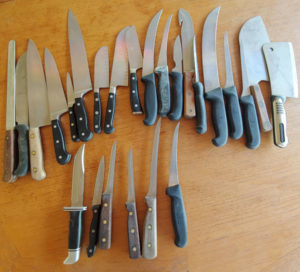 I almost dropped to my knees in relief. At last, someone who could teach me what I most need to know!
Sunday, she brought the set-up up to the porch along with the five knives she thought were “all” my slaughtering knives. We read the instructions together and she explained all the things I didn’t understand. It’s amazing the difference that makes. The five knives she did are wonderful.
Now that I know what to do I have no more excuses. Witness the knives I need to do and take heed. I’m setting it in stone–or perhaps steel. This week, I’m getting edge-y. By next week’s post, all my knives are going to be sharp.
Then I’m going to start on my tools, because apparently the machine does tools as well!