Mayra Calvani's Blog - Posts Tagged "cozy-mystery"
Meet Tracy Weber, Author of ‘Karma’s a Killer’
 Tracy Weber is the author of the award-winning Downward Dog Mysteries series. The first book in the series, Murder Strikes a Pose, won the Maxwell Award for Fiction and was nominated for the Agatha award for Best First Novel.
A certified yoga therapist, Tracy is the owner of Whole Life Yoga, a Seattle yoga studio, as well as the creator and director of Whole Life Yoga’s teacher training program. She loves sharing her passion for yoga and animals in any way possible.
Tracy and her husband Marc live in Seattle with their challenging yet amazing German shepherd, Tasha. When she’s not writing, Tracy spends her time teaching yoga, walking Tasha, and sipping Blackthorn cider at her favorite ale house.
Karma’s a Killer is her third novel. For more information on Tracy and the Downward Dog Mysteries, visit her author website: http://TracyWeberAuthor.com/
Q: Congratulations on the release of your latest book, Karma’s a Killer. To begin with, can you give us a brief summary of what the story is about and what compelled you to write it?
A: Karma’s a Killer is a light-hearted yoga and dog-related mystery. The story opens at a fundraiser for DogMa, a fictional Seattle animal rescue. While teaching a Doga (yoga for dogs) class, yoga teacher Kate Davidson meets an animal rights activist named Dharma who has a surprising connection to her past. Two days later, Dharma is arrested for murder. The case seems cut and dry, especially since Dharma’s ID was found at the scene and her skin is lodged underneath the victim’s fingernails. Dharma, however, claims she’s innocent, and Kate vows to ferret out the truth.
In this, the third of the Downward Dog Mysteries, readers learn the origins of Kate’s pogonophobia—the irrational fear of beards. They also discover why she has, at least up until now, been so terrified of commitment. Although most of the book is about Kate’s somewhat inept attempts at murder investigation, her German shepherd Bella and her best friend Rene get her into plenty of trouble along the way. But the most satisfying part of the book watching Kate rediscover herself.
Many things inspired me to write this book. I’ve had a fascination with animals my entire life, and wildlife rehabilitation plays a large role in the work, as does animal rescue. However the most intriguing prospect in writing this book was truly delving into what makes Kate such quirky character. I always knew that Kate had a back story and that she needed to reconcile experiences from her past. Karma’s a Killer gave me the perfect avenue to explore them.
 Q: What do you think makes a good cozy mystery? Could you narrow it down to the three most important elements? Is it even possible to narrow it down?
A: There are many important elements to good novels of any type. But with cozy mysteries, I think it boils down to relatable characters, engaging settings, and an intriguing mystery.
Recurring characters are especially critical, because they come back to visit the reader time after time, book after book. If your characters aren’t compelling, why would a reader waste their time hanging out with them?
Setting allows the reader to travel to places they might otherwise never visit. Well-developed settings immerse the reader in the “place” of the story using all five senses—perhaps even six. (See discussion on setting, below.)
Mystery is the backdrop of cozies—the guiding force of the story, if you will. Without an intriguing mystery, what’s the point?
Q: How did you go about plotting your story? Or did you discover it as you worked on the book?
A: My stories reveal themselves to me as I write, which means I never outline before I begin working on a book. Who has time to outline when you’ve got characters like Kate and Bella harassing you to hurry up and write them?
My process has remained relatively unchanged from book to book. I write the first draft by the seat of my pants, then sit down and get serious about plot, red herrings, and consistency in the second draft.
While I write the second draft, I outline what I’ve already written and identify plot holes and inconsistencies. I try to fix those in the third draft. After that, it’s only twenty-seven more drafts until the finished product!
Q: Tell us something interesting about your protagonist and how you developed him or her. Did you do any character interviews or sketches prior to the actual writing?
A: Like my plots, my characters reveal themselves to me as I write. Some, such as Bella (the German shepherd in my series) are loosely based on animals and people from my real life. Most, like Kate (my yoga teacher/sleuth protagonist) take shape in my mind over time. I get to know them much like I’d get to know any other friend. Minor characters are tougher. Sometimes I write descriptions and back stories for them. Most of the time, I don’t. In many cases, I come up with minor ideas for these characters or picture them in my mind. Then I do Google Image searches. The images and websites that come up inform my understanding of those characters.
Q: In the same light, how did you create your antagonist or villain? What steps did you take to make him or her realistic?
A: I’ve gotten better at this the more I’ve written, I think. I try to make my killers more multidimensional now than I did in the past. After all, we are all the heroes of our own stories. From the killer’s perspective, they had a perfectly good reason for committing murder. I try to see the story through their eyes, as well as through the eyes of my protagonist.
What drives a good person to commit a heinous act? What about that act changes them forever? What stays the same? How do they go back to their normal life now that they’ve ended another’s? No one is purely good or purely evil. The gray area makes writing interesting.
Q: How did you keep your narrative exciting throughout the novel? Could you offer some practical, specific tips?
A: For me it’s about something I’ll call consistent variety. I get bored when I read scenes that have essentially the same sentence structure paragraph after paragraph. It feels annoyingly repetitive to me, like the ticking of an out-of-time clock. Then again, there has to be a consistent voice that sets a work and its writer apart from the six million other novels vying for readers’ attention. I work hard to vary sentence length, imagery, tone, and rhythm within my work.
Additionally, I try to avoid information dumps and back story. Nothing bogs down a fast-paced story quicker than overly long descriptions, info dumps about the author’s research, or too much unneeded information about a character’s history. Show us who the character is now. Let their actions speak for them!
Q: Setting is also quite important and in many cases it becomes like a character itself. What tools of the trade did you use in your writing to bring the setting to life?
A: As I stated above, I use all five senses when describing a setting: smell, sight, taste, sound, and touch. I also use a sixth sense that I can only describe as energy: Some places feel light; others heavy; still others, prickly. And the energy of a space changes based on the perspective and mood of the character inside it.
In Karma’s a Killer, my editor noticed that I described to the same setting quite differently in two separate scenes. At first she suggested that I change it, but when I pointed out the mood of the protagonist in each scene and how her experience of the setting would change based on that mood, she agreed that I should keep it as originally written.
Q: Did you know the theme(s) of your novel from the start or is this something you discovered after completing the first draft? Is this theme(s) recurrent in your other work?
A: I write a mystery series, so most of my writing revolves around solving murder. But ultimately, my books are all about love, whether it be in the form of friendship, romance, family, or the unconditional love of an animal. The primary characters in my novels are often very flawed, but they all have one thing in common: the mistakes they make, the risks they take, the regrets they mourn, even the idiosyncrasies they struggle to overcome—all have their basis in love, with a little obsession thrown in for good measure.
My newest book, Karma’s a Killer, is also about reconciliation. How would you react if a woman who’d abandoned you thirty years ago showed up on your doorstep looking for help? What if you found out that much of who you are—good and bad—comes from her? What if you have villainized her your entire life? Would you still be willing to help? And if so, how would helping her change you?
Those were fun questions to explore in Karma’s a Killer.
Q: Where does craft end and art begin? Do you think editing can destroy the initial creative thrust of an author?
A: It’s an interesting question, and an author would answer it much differently than an editor, I suspect. The biggest risk in editing is destroying voice. An editor’s work is to make the narrative crisper, the sentence structure more varied, the plot more solid—all without losing the author’s unique voice. A good editor makes voice crackle. A bad one dulls it until it is unrecognizable.
Q: What three things, in your opinion, make a successful novelist?
A: Imagination, perseverance, and probably most important, luck!
Q: A famous writer once wrote that being an author is like having to do homework for the rest of your life. What do you think about that?
A: Writing is hard work, but I don’t think of it as homework—more like a time to play with my imaginary friends. If I thought of writing as homework, I’d probably never do it. It is much too challenging to stay motivated unless you love it.
Q: Are there any resources, books, workshops or sites about craft that you’ve found helpful during your writing career?
A: I’ve benefited greatly from workshops that I’ve taken with the Pacific Northwest Writers Association, Sisters In Crime, and Mystery Writers of America. I have a bookcase filled with books on the craft of writing, but I haven’t read a single one of them.
Q: Is there anything else you’d like to share with my readers about the craft of writing?
A: Writing is as much about perseverance as it is about talent. Don’t give up, and don’t procrastinate. Write every day. Write what you love. If you spend every day working on what you love most, even if you never get published, you’ll have had a good time. Isn’t that what’s most important?


Guest post: The Story behind ‘When Bunnies Go Bad” by Clea Simon
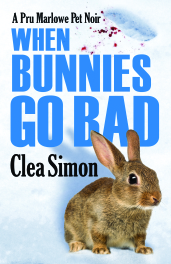 It’s hard to remember now, as the crocuses bloom and green buds begin to swell on the trees, but 14 months ago, we thought winter would never end. In the winter of 2014-15, Massachusetts, where I live, was buried under record snowfall of 110.6 inches. And what was worse, all but two inches of this snow came in rapid succession in what the Weather Channel called a “six-week-plus snow siege.” [link: https://weather.com/news/news/new-england-boston-record-snow-tracker] What that means, to you non-New Englanders, is that not only did we get nine-plus feet of snow, but that none of it – as it usually would between storms – melted. Instead it piled up. And piled up. And piled up.
Now, where I live, in Somerville, is pretty urban. Our house is right on the sidewalk, which legally we are obligated to clear. That meant that after every storm, my husband or I would be out there, shoveling – piling the snow higher and higher along the walk, with only a small cut-through for the steps up to our tiny front porch. Before long, our house was walled in by snow, the shrubs in front mostly buried with only one ancient forsythia bush still sticking its branches out, largely because it is on the side of our front porch, behind the snow wall. Soon the city was like a maze – high walls of icy, compacted snow funneling us all along increasingly narrow paths. Errands became major expeditions. We all became accustomed to backing up to the nearest crosswalk to allow oncoming pedestrians to pass. Carrying groceries home was crazy.
The snow didn’t only affect humans, however. As an animal lover, I’d done my research. I knew that the beasts around here usually do fine in this weather. Small critters, like mice, actually benefit, as they can burrow beneath the snow to the nearest bits of frozen grass or other greenery, out of sight of hungry hawks or other predators.
But how about the bunnies? How would they fare, given the immense amount of snow and the virtual walls of icy drifts that were cutting across the landscape? Where would they do their marketing, so to speak, with everything covered in a thick blanket of icy white?
I found out one night when the snow had briefly ceased. I was looking out my front window when I noticed a set of prints. Looking kind of like parallel semi-colons, they came up the steps from the sidewalk to our front porch, where they seemed to have looked around, exploring the planter that I never managed to put away and the small bench where UPS leaves packages. And then they hopped over to the side of the porch, behind the snow wall, and dropped off.
The local bunny was coming onto my front porch as a way around the wall of snow and hopping off the side to get to that forsythia!
Once I knew what was happening, I began a nightly ritual. Rabbits, I found out, are crepuscular – they like those twilight times when the light is low. And so soon after sunset, I’d start watching. I was rewarded by frequent sightings of our local bunny as he came cautiously up our steps and then turned right, to hop off by that forsythia. Sometimes I saw him nibbling on its branches. Other times, I only saw his footprints and droppings. And when spring finally arrived and I saw three rabbits in our yard, I knew Mr. Bunny, or Ms. Bunny, as I now believe her to be, had survived the winter in fine form. (The forsythia did, too.) And so when it was time to start another Pru Marlowe pet noir, there was little doubt in my mind. A smart resourceful rabbit had to be at the center of it – and is, in “When Bunnies Go Bad.”
Title: WHEN BUNNIES GO BAD
Genre: Mystery
Author: Clea Simon
Website: http://www.cleasimon.com
Publisher: Poisoned Pen Press
Purchase on Amazon
About the Book:
Winter is hard in Beauville, where the melting snow can reveal much more than last season’s dead leaves. So when a wealthy, obnoxious tourist and his ski bunny girlfriend surface in Pru Marlowe’s little Berkshire town, she knows she should stay out of their way. The bad-girl animal psychic has to focus on more immediate concerns, including a wild rabbit named Henry, supposedly tamed and illegally living with an eighty-four-year-old lady in her home. Henry, who seems to be acting out and hiding, avoids responding to Pru. Yet when Pru discovers the tourist murdered and his girlfriend’s high-maintenance spaniel falls to her care, she gets dragged into a complicated case of crime and punishment that involves some new friends, an old nemesis, and her own shadowed past. A recent museum art heist draws the feds into the investigation along with a courtly gentleman radiating menace, who represents secretive business interests in New York and shows a surprising awareness of Pru. Her on-again, off-again romance with police Detective Creighton doesn’t stop him from warning her to steer clear of the inquiry. The spaniel, however, lures her in. Pru lives in a world where only her crotchety tabby Wallis knows the whole truth about her past, her flight from Manhattan, and her unique gift that surfaced abruptly one day. Fearing the worst, Pru now comes dangerously close to being exposed. With everything in motion, Pru, Wallis, and everyone they hold dear will be lucky to escape…by a hare.

About the Author:
Clea Simon is the author of the Theda Krakow, Dulcie Schwartz, and Pru Marlowe pet noir series, as well as three nonfiction books. A former journalist, Clea lives in Somerville, Massachusetts, with her husband, the writer Jon Garelick, and their cat Musetta.
Talking Craft with Leslie Karst, Author of 'A Measure of Murder'
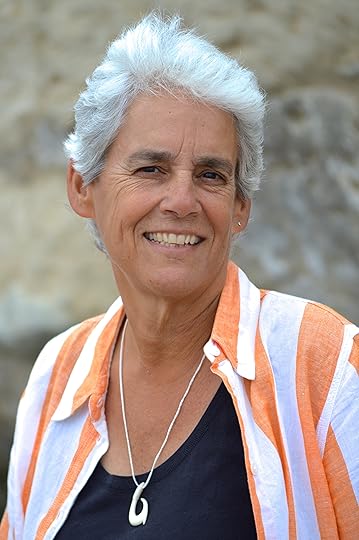 The daughter of a law professor and a potter, Leslie Karst learned at a young age, during family dinner conversations, the value of both careful analysis and the arts—ideal ingredients for a mystery story. Putting this early education to good use, she now now writes the Sally Solari Mysteries (Dying for a Taste, A Measure of Murder), a culinary series set in Santa Cruz, California.
Originally from Southern California, Leslie moved north to attend UC Santa Cruz (home of the Fighting Banana Slugs) and after graduation, parlayed her degree in English literature into employment waiting tables and singing in a new wave rock and roll band. Exciting though this life was, she eventually decided she was ready for a “real” job, and ended up at Stanford Law School.
For the next twenty years Leslie worked as the research and appellate attorney for Santa Cruz’s largest civil law firm. During this time, she rediscovered a passion for food and cooking, and so once more returned to school to earn a degree in culinary arts.
Now retired from the law, she spends her time cooking, gardening, cycling, singing alto in her local community chorus, reading, and of course writing. Leslie and her wife and their Jack Russell mix split their time between Santa Cruz and Hilo, Hawai‘i.
Q: Congratulations on the release of your latest book, A Measure of Murder. To begin with, can you gives us a brief summary of what the story is about and what compelled you to write it?
A: In A Measure of Murder, the second book in my Sally Solari series, Sally is busy juggling work at her family’s Italian restaurant, Solari’s, and helping plan the autumn menu for the restaurant she’s just inherited, Gauguin. Complicating this already hectic schedule, she joins her ex-boyfriend Eric’s chorus, which is performing a newly discovered version of her favorite composition: the Mozart Requiem. But then, at the first rehearsal, a tenor falls to his death on the church courtyard—and his soprano girlfriend is sure it wasn’t an accident.
 Although the prime focus of my Sally Solari mysteries is on food, cooking, and restaurants, there’s also a secondary theme to each of the books in the series: one of the human senses. The first, Dying for a Taste, concerns (obviously) the sense of taste, and A Measure of Murder delves into the sense of hearing—more specifically, music.
Music has long been one of my passions. I studied clarinet as a youngster, later fronted and wrote the songs for two different bands, and for the past seventeen years have sung alto in my local community chorus. So when it came time to plot the story about the sense of hearing, there was no question but that it should focus on music.
As with Sally, one of my favorite compositions is the sublime Mozart Requiem. But in addition, the piece is perfect for a mystery novel, as the Requiem itself is surrounded by secrets and mystery: who commissioned it, who completed it after Mozart died, which parts were composed by whom. So, truly, how could I resist?
Q: What do you think makes a good culinary mystery? Could you narrow it down to the three most important elements? Is it even possible to narrow it down?
A: Having been trained as a lawyer, I have no problem narrowing issues down to whatever elements are required by the situation. Here are my three:
Any good mystery requires that perfect balance between being possible to solve (i.e., the proper placement of clues) yet being sneaky enough to make the solution tricky, all without being unfair. To my mind, this is by far the most difficult aspect of writing the book.
But to make the story truly engaging, I believe it needs more than simply a clever whodunit. My favorite crime novels also incorporate themes and subplots that are woven into the mystery and which give the reader a glimpse into some new culture or way of life. Dorothy L. Sayers was a master at this, with her peeks into the worlds of London advertising (Murder Must Advertise), bell ringing (The Nine Tailors), and academia (Gaudy Night).
Lastly, a good culinary mystery must, of course, abound with food and cooking, the more delectably described the better. In the best of the genre, the food is at the heart of the mystery, but as long as the reader is left salivating and hungry, I’d say the author has done her job well.
Q: How did you go about plotting your story? Or did you discover it as you worked on the book?
A: I think of myself as an absolute plotter (as opposed to a pantser—someone who flies by the seat of their pants). I usually first come up with a basic idea, next a group of three to five suspects (one of whom will be my eventual murderer), and then a series of plot points and events that will occur during the book. Organizing these plot points into an effective story arc is crucial but rarely easy. With A Measure of Murder, I had compiled a multiple-page list of events and occurrences that I knew I wanted in the book, but which were in a completely random order. I printed out the list and cut the events apart with scissors, then spread them out on the dining room table. Over a period of several days I arranged and rearranged the order of events until I had a rough outline I was happy with. I then glued them back together onto new sheets of paper. A literal cut-and-paste job.
Things don’t always work out exactly the way you expect them to, however, when plotting a mystery novel. For example, I knew for a certainty before I started writing A Measure of Murder who would be the killer. But then about a quarter of the way through the first draft, that character forcefully informed me, “I am not your murderer.” Realizing they were absolutely right, I changed the plot accordingly. (But I also completed a brand new, detailed outline through the end of the story before continuing on with my writing, so I’m still most definitely in the “plotter” camp of writing.)
Q: Tell us something interesting about your protagonist and how you developed her. Did you do any character interviews or sketches prior to the actual writing?
A: Sally Solari is an ex-lawyer who, after losing her mother to cancer, reluctantly returns to the family fold to help her dad run his old-school Italian restaurant, Solari’s. She’s not yet forty and already experiencing erratic hormones and hot flashes. As a result, she can tend towards over-the-top emotions and sarcasm (though cycling and bourbon help). But she’s also smart, stubborn, and resolute, and rarely takes no for an answer. So when Sally sets her mind on tracking down a murderer, you do not want to be the one who gets in her way.
Perhaps I should have done some character sketches before I started the first Sally Solari mystery (Dying for a Taste), as this would no doubt have allowed me to avoid a fair amount of reworking of the manuscript. But instead I jumped right in. The idea for Sally came to me nearly fully-formed—she’s a conglomeration of many different people I’ve known over the years (including parts of myself). But having just turned in the m.s. for book number three, I can say that her character is still growing and evolving in my head, and in the stories, as well.
Q: In the same light, how did you create your antagonist or villain? What steps did you take to make him or her realistic?
A: I can’t really answer this question without giving away important spoilers. But I will say that several of the suspects—as well as the deceased—in A Measure of Murder are members of the community chorus Sally has joined. And having sung in my own local chorus for many years, I have a pretty good understanding of the dynamics that can arise within a tightly-knit group of artistic, passionate, and ambitious people. The egos, competitiveness, and romantic tensions that occur in the book, though sometimes perhaps slightly exaggerated, are all based on reality.
Q: How did you keep your narrative exciting throughout the novel? Could you offer some practical, specific tips?
A: Raymond Chandler once dismissively said of his time writing detective stories for pulp magazines, “When in doubt have a man come through a door with a gun in his hand.” Taken as a metaphor, this actually isn’t bad advice for the crime writer, since it’s good practice to periodically throw in a surprise to keep your reader on edge. But the way I see it, an engaging story is one that is constantly moving forward. Every scene should advance the plot in some way, and the end of every chapter should leave the reader eager to learn what happens next.
In addition, as I noted above, subplots and underlying themes serve to flesh out your mystery novel and make it more exciting. A Measure of Murder is, at its most basic level, simply the story of Sally trying to figure out whether the tenor was murdered and, if so, who did it. But other parallel plot lines keep the story moving forward as well: How will Sally juggle managing Gauguin, the restaurant she just inherited, as well as working at Solari’s, with all her chorus rehearsals? Will she be able to extricate herself from having to help her dad run Solari’s, and how will this effect her relationship with her father?
Q: Setting is also quite important and in many cases it becomes like a character itself. What tools of the trade did you use in your writing to bring the setting to life?
A: The setting for my Sally Solari mystery series is based primarily my own experiences. I moved to Santa Cruz after high school to attend UCSC, and never left. At the time I arrived here in 1974, it was still a sleepy beach town, home to Italian fishermen, ranchers, retirees, and summer vacationers drawn by its famous redwood trees and Boardwalk. But over the years, largely because of the advent of the university, Santa Cruz has experienced profound changes, and these days the town is teeming with hipsters and hippies and urban professionals. And along with these newcomers, the food movement has descended full-force upon the surprised old-timers.
As I witnessed (and participated in) the advent of this “foodie” revolution and its effects on our once-sleepy town, it hit me that the juxtaposition of these two cultures would make for a terrific backdrop to a mystery story: What would happen, I wondered, if a local Santa Cruz gal suddenly found herself caught between the world of her family’s traditional, old-fashioned Italian restaurant, and that of the newly-arrived, politically-correct food activists?
Q: Did you know the theme(s) of your novel from the start or is this something you discovered after completing the first draft? Is this theme(s) recurrent in your other work?
A: I was aware of the themes before I started writing the book. As noted above, the sense of hearing plays an important part in A Measure of Murder, with Sally not only joining the chorus to sing the Mozart Requiem, but also along the way learning the importance of truly listening in general—listening to your inner feelings, and paying attention to what’s going on around you.
In addition, themes that recur in all the Sally Solari mysteries concern family and the food movement, in particular, how the two create a conflict between Sally and her father. The Solaris are descended from one of the original Italian fishermen who arrived in Santa Cruz in the 1890s, and Sally’s dad is fiercely proud of the family’s traditional, old-school Italian seafood restaurant out on the Santa Cruz Wharf. But Sally is also very much aligned with the food-conscious folks who have arrived in town over the past two decades—even more so now, after inheriting her aunt’s trendy restaurant, Gauguin.
This dynamic between Sally and her father—who is hurt that his daughter no longer wants to work at Solari’s, and who thinks she now looks down on her family heritage—is very much at the forefront of both Dying for a Taste and A Measure of Murder.
Q: Where does craft end and art begin? Do you think editing can destroy the initial creative thrust of an author?
A: The two are inseparable, as far as I’m concerned. Most great art involves a certain amount of craft, in addition to “inspiration” or “muse” or whatever you want to call it. Even art that may appear spontaneous and free—such as a crazy drawing dashed off by Picasso on a scrap of paper—is generally the result of years of training and craftsmanship.
A first draft is to an author like the initial sketches or undercoats to a watercolorist. Once you have the basics down, the next step is to go back in and fine tune your work, adding highlights, details, embellishments. But there’s no reason editing can’t be as enjoyable as composing the first draft. In many ways, I actually prefer the revision process to the the initial getting-it-down-on-paper stage of writing. To me, that’s where much of the magic happens. Like the buffing of a shoe after its blacking has been applied, the editing process is when the book finally emerges from its rough finish to become a gleaming work of art.
Q: What three things, in your opinion, make a successful novelist?
A: Imagination, hard work, and perseverance.
Q: A famous writer once wrote that being an author is like having to do homework for the rest of your life. What do you think about that?
A: Ha! That reminds me of what I’ve always said about my past career as a research and appellate attorney—that it was like writing a term paper every single day of your life.
The life of an author is indeed similar to having homework all of the time, in that the work never ends. At any given time, you’re simultaneously promoting your last book, editing and revising the current one, and plotting and outlining the next one. But I never much minded homework during school and college, and I must say that the homework that comes with writing mystery novels is ever so much more fun than what I had to do as an attorney.
Q: Are there any resources, books, workshops or sites about craft that you’ve found helpful during your writing career?
A: I have to give a shout-out here to the wonderful organization, Sisters in Crime http://www.sistersincrime.org/, and its chapter, the Guppies (for the Great UnPublished http://www.sinc-guppies.org/). I truly believe I would not be a published author today but for the advice, feedback, generosity, and all around support I received from the SinC and Guppy members as I was learning the craft of mystery writing and wandering dazed through the labyrinth that is the literary publishing world. If you write crime fiction, I encourage you to check them out (and they eagerly accept misters as well as sisters!)
Q: Is there anything else you’d like to share with my readers about the craft of writing?
A: My advice to all aspiring authors is this: Never give up and never stop believing in yourself as a writer. As the fabulous developmental editor, Kristen Weber, said to me when I became discouraged after receiving more than eighty passes on the manuscript that ultimately landed me my publishing contract, “You can get hundreds of rejections, and many writers do. But remember: It only takes one yes.”
New release: ‘A Deadly Eclair’ by Daryl Wood Gerber
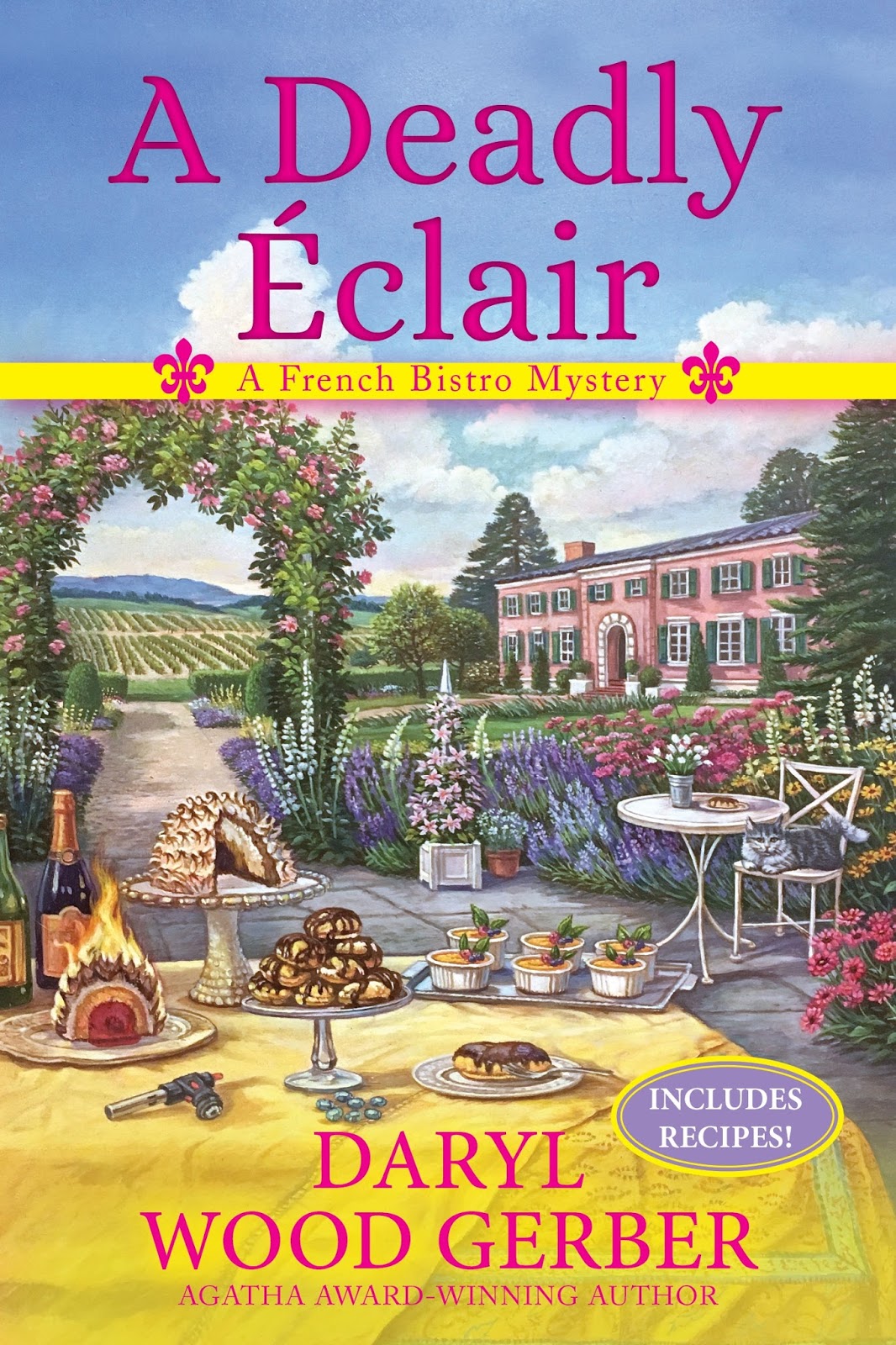
This wedding will be the talk of the town, as celebrity talk show host Angelica Edmonton, daughter of Bryan’s half-brother, Edison, has chosen the inn as the perfect venue for her extravagant nuptials. Anxious, Mimi is sure things are going to turn south—especially when Edison gets drunk and rowdy at the out-of-towners’ dinner—but by the evening, things begin to look up again. That is until morning rolls around, and Bryan is found dead at the bistro with an éclair stuffed in his mouth. And the fingers point at Mimi, whose entire loan is forgiven if Bryan dies.
Now it’s up to Mimi to clear her name and get to the bottom of things before the killer turns up the heat again. Murder, after all, is not a good addition to any menu….

On the Spotlight: One Taste To Many, by Debra H. Goldstein

Genre : MYSTERY (COZY MYSTERY)
Author : Debra H. Goldstein
Website : www.debrahgoldstein.com
Publisher : Kensington
Find out more on Amazon
A culinary cozy unlike any other, One Taste Too Many introduces Sarah Blair, a culinary-challenged, recently-divorced woman adjusting to her new status as “single,” her new studio apartment—which she shares with her Siamese cat, RahRah—and her new job as a law firm receptionist. When her ex-husband gets murdered and her twin sister becomes the top suspect, Sarah will have to add “solving crimes” to the list of challenges she’s taking on in her newly single life.
About One Taste Too Many: When Sarah Blair’s sister, a trained chef, is suspected of murdering Sarah’s ex-husband with one of her award winning dishes, Sarah mourns the rat’s death but leaves the sleuthing to the professionals until she realizes that she and her sister are their only suspects. Sarah’s efforts to find whodunit are complicated by her twin’s refusal to help—and a glitch in the rat’s will that forces Sarah to relinquish her beloved cat, the only thing she got in her divorce, to the woman who broke up her marriage.
Compelled to discover the true killer, Sarah soon finds that for a woman whose good china is floral paper plates, getting too close to the heat in the kitchen may be scorching. As a cook of convenience, Sarah will have to come up with just the right recipe to save her sister and avoid her own worse than death fate—being in the kitchen.
A fun, fresh twist on the culinary cozy mystery, One Taste Too Many stands out with its charming heroine: Sarah Blair, a cook of convenience. Moreover, One Taste Too Many is informed by Goldstein’s career as a former litigator and US Administrative Judge and her unique perspective on the inner workings of the perfect crime. A to-die-for tale with an irresistible plot and wholly relatable cast of characters, One Taste Too Many heralds the advent of a delicious new series.

ABOUT THE AUTHOR
Debra H. Goldstein is the author of the Sarah Blair Mysteries as well as Should Have Played Poker, a Carrie Martin and the Mah Jongg Players Mystery and the 2012 IPPY Award-winning Maze in Blue, a mystery set on the University of Michigan’s campus. Her short stories, including Anthony and Agatha nominated “The Night They Burned Ms. Dixie’s Place,” have appeared in numerous periodicals and anthologies including Alfred Hitchcock Mystery Magazine, Black Cat Mystery Magazine, and Mystery Weekly. A Judge, author, litigator, wife, step-mom and mother of twins, Debra is an involved community volunteer, MWA member, and serves as a national board member of Sisters in Crime, as well as being the SinC Guppy Chapter’s President.
Connect with Debra on the web:
A Chat with Mystery Authors Rosemary and Larry Mild
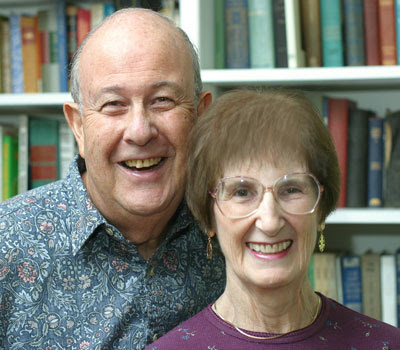
ROSEMARY AND LARRY MILD, cheerful partners in crime, coauthor mystery, suspense, and fantasy fiction. Rosemary and Larry have published award-winning novels, short stories, and essays. They co-authored the popular Paco and Molly Mystery Series; Hawaii adventure/thrillers Cry Ohana and Honolulu Heat; and three volumes of short stories, many of which appear in anthologies. After forty-plus years in Maryland, the Milds currently make their home in Honolulu, where they cherish time with their daughter, son-in-law, and grandchildren.
THE MILDS are active members of Sisters in Crime where Larry is a Mister in Crime; Mystery Writers of America; and Hawaii Fiction Writers. In 2013 they waved goodbye to Severna Park, Maryland and moved to Honolulu, Hawaii, where they cherish quality time with their daughters and grandchildren. When Honolulu hosted Left Coast Crime in 2017, Rosemary and Larry were the program co-chairs for “Honolulu Havoc.”
Over a dozen worldwide trips to Japan, China, Australia, New Zealand, Thailand, Cambodia, Burma, Great Britain, France, Italy, Israel, Egypt, and more have wormed their way into their amazing stories. In their limited spare time, they are active members of the Honolulu Jewish Film Festival committee, where Larry is the statistician and recordkeeper for their film ratings. Visit their website to find out more.
INTERVIEW
1. How many books, in total, have you written together?
Thirteen: ten novels and three books of short stories, with more to come.
We have also published three memoirs:
By Rosemary: Miriam’s World—and Mine, about our beloved daughter, Miriam Luby Wolfe, whom we lost in the terrorist bombing of Pan Am 103 over Lockerbie, Scotland, on December 21, 1988. And Love! Laugh! Panic! Life with My Mother.
By Larry: No Place To Be But Here, My Life and Times. It is not only my own story, but that of my family: how my two wives, three children, and five grandchildren have shaped my life as much as I have molded theirs. Tragedy is certainly no stranger as I dealt with death, cancer, murder, and global terrorism, not only on this written page, but in my own life.
2. How did you get started writing together?
Rosemary: Larry and I met on a blind date in October, 1986, at my house in Severna Park, Maryland. We came from rather different worlds. He had lost his wife to cancer. I’d been divorced for eight years, happily accustomed to having my own space, thank you. In the car, on our way home from dinner, he said, “When I retire I’m going to write a novel and I want you to help me.” Now neither of us had ever written fiction. I was an editor; he was an electrical engineer, and I’d only known this man for four hours. So I chirped, “Okay!” Instinct told me he was Mr. Right—and I‘d better not let him get away. True to his word, when we retired, he sat down and wrote Cry Ohana, Adventure and Suspense in Hawaii.
3. What is your process of writing together?
Rosemary: Larry inherited a creative gene from his grandfather Charles Gluck, who was an excellent artist. We have his paintings in our living room. Larry’s mind works in imaginative ways, so he makes up all our plots and writes the first drafts. Then he hands the manuscript over to me. I flesh out the characters and streamline passages to pick up the pace. I call it “judicious pruning,” an expression I learned as an assistant editor at Harper’s Magazine. Originally, Larry would reply, “I worked hours on those two paragraphs!” Then, with sleeves rolled up, we would negotiate. In our early days, I would not have received a doctorate in diplomacy. Today things go a lot smoother.
Larry: Our manuscripts are always better after Rosemary works her magic. She has this wonderful feel for people and human nature. She breathes life into my minimalist characters: physical appearance, sharpening the dialogue. Sometimes she adds a scene for more conflict. She’ll take an anecdote I told second-hand and turn it into real-time drama, like an ugly shouting match between two women in a crowded restaurant.
4. How do you get the ideas for your novels?
Larry: From life! From keen observation of people, from newspaper articles and books (I’m a voracious reader), from eavesdropping (Yes!) and from our own personal experience. We wrote Cry Ohana (ohana means family) when we were winter “snowbirds” in Honolulu, weaving in all the local places we knew, which gave the book authenticity and color. For instance, we have a chase scene in Chinatown during Chinese New Year, which we always attended, wading ankle-deep in firecracker paper. But we also leap into other times and places with our sci-fi novella Unto the Third Generation.
5. How do you get the ideas for the characters in your novels?
Rosemary: We draw many of our characters from real life. Most are composites of people we’ve known. When Larry and I started writing together, we hadn’t even considered writing mysteries—until we visited my psychoanalyst father, Dr. Saul K. Pollack, in Milwaukee. That visit set us on a happy new course. My father, a widower in his seventies, had a housekeeper/gourmet cook named Dorothy. She was sixty-three, with a beachball figure, waddle walk, honey curls, and good-natured, nosy-body personality. Dorothy had exquisite culinary skills and a unique way of expressing herself. “I have to take my calcium so I don’t get osteoferocious.” During our visit, my father pulled out a piece of paper from his desk drawer and handed it to us: his secret list of Dorothy’s 177 sayings. He thought we could submit it to Reader’s Digest. Back home in Severna Park, we decided Dorothy was too good a character to ignore. Forget Reader’s Digest. She belonged to us. We named her Molly, and her witty sayings Mollyprops. But we also needed a policeman, so Larry invented a semi-retired detective and named him Inspector Paco LeSoto. Larry actually met the real-life Paco when he was a field engineer for RCA. So Locks and Cream Cheese, our first mystery, was born. The lovable psychoanalyst Dr. Avi Kepple is patterned after my father.
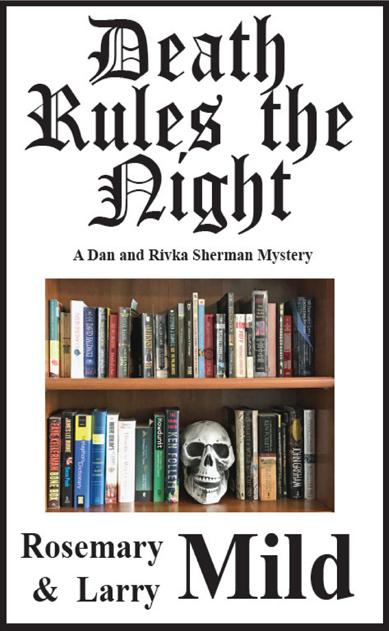
6. Tell us a little about the process of writing your latest novel, Death Rules the Night. How did you come up with the plot? How long did the writing process take?
Larry: Death Rules the Night is our fourth Dan & Rivka Sherman Mystery. Dan and Rivka think they’re buying into a pleasant, predictable life. Instead, they become unwilling, frightened sleuths in the wake of a mugging, robbery, kidnapping—and murder. I chose to set the crime inside the bookstore. A tell-all hair-raising book about the prominent Atkins family has disappeared. The real focus of the book is the Atkins family’s eighteenth-century house in Annapolis. The ancestors of three unhappy sisters and a reprobate brother date back to the American Revolution. I delved into research—as long as it didn’t overshadow the plot—touching on the Revolutionary War, the Underground Railroad, and Prohibition. How long did the writing process take? About a year. We always send our final draft to our eagle-eyed proofreader friend. That takes her a month or so.
7. Your popular Dan and Rivka Sherman Mystery series is filled with charm. Are there any autobiographical components in these wonderful characters—and if so, what?
Larry: We made Dan and Rivka a lot like us, but much younger: a Jewish couple in their early fifties. They abandon thriving careers to buy the fictional Olde Victorian Bookstore in Annapolis, Maryland.
Rosemary: Physically, Dan is his own man. Tall and gangly, he sprawls when he sits. He has bushy black hair and eyebrows. The only thing that’s thin about Larry is his gray hair. However, Dan’s personality is very much like Larry’s: analytical and practical, a born problem-solver. Rivka is a lot like me. Affectionate, addicted to chocolate, and feisty—I came out of the womb arguing. In Death Rules the Night Dan secures a manuscript copy of the tell-all missing book. One night an intruder breaks into the bookstore. Dan thinks that’s what he or she was trying to steal. Rivka despairs. “Oh, Dan, do you think the intruder is violent? Are we in some kind of danger? Forget trying to discover the Atkins family secrets. You are being so pigheaded!”
8. What’s the best part of writing with your spouse?
Larry: We’re never working in a vacuum. We always have each other to bounce off our ideas. When Rosemary read my first draft of Death Rules the Night, she said the plot seemed a little thin. I was able to immediately come up with a juicy, seductive subplot and we talked out the details.
Rosemary: Larry’s my soul mate. I’m convinced we knew each other in a previous life. Writing together gives us daily structure and the joy of seeing our books in print. Larry also formats all our books for Kindle, and we even have a talking book. Death Goes Postal, our first Dan & Rivka Mystery, is available as an Amazon Audible Audiobook.
9. What’s the most challenging part?
Larry: She could work a little faster. We’re getting “behinder” by the day. And when she edits out some of my favorite paragraphs, I call it slash and burn. She replies with a quote by Stephen King: “To write is human, to edit is divine.”
Rosemary: I know it’s aggravating for Larry to have to wait for me. You see, I have another creative life of my own: writing personal essays. In addition to my memoirs, I just published my essay collection In My Next Life I’ll Get It Right, my quirky takes on everyday life from the hilarious to the serious.
10. What’s next for authors Rosemary and Larry Mild? Any new books in the works?
Rosemary: Yes, two. Charlie and the Magic Jug is a collection of mystery and suspense stories—plus some delightful fractured fairy tales and our own Hawaiian menehune legends. Larry is also working on a new novel called On the Rails, A Boxcar Bertie Adventure.
\