Mayra Calvani's Blog - Posts Tagged "political"
Joel Fox, Meet author of 'The Mark on Eve'
 Joel Fox has spent over 30 years in California politics, serving on numerous state commissions, working on many ballot issue campaigns, and advising candidates. An adjunct professor at the School of Public Policy, Pepperdine University, Fox has authored hundreds of opinion pieces for numerous publications including the Wall Street Journal, Washington Post, USA Today and Los Angeles Times. Joel Fox is also the author of the Zane Rigby mystery series—Lincoln’s Hand and FDR’s Treasure— in which an FBI Special Agent must solve a puzzle from the past of an American president to solve modern day murders. A native of the Boston area, Joel Fox lives in Los Angeles.
Website / Facebook
Q: Congratulations on the release of your latest book, The Mark on Eve. What was your inspiration for it?
A: The idea for my book came from a Cape Cod legend in which a woman in colonial New England was suspected of witchcraft when her pirate lover’s ship went down in a storm. The pirate ship Whydah, captained by Sam Bellamy, was real. It sank in 1717 and was discovered and salvaged in 1984. I simply took some of the persons in the legend and changed the story by asking: What if the woman was not a witch but was be-witched to live forever? It allowed me to explore how she would manage through different periods in American history all the while maintaining suspense in the modern day story in which she tries to keep her secret while giving meaning to her long existence by helping a female governor run for president of the United States.
Q: Tell us something interesting about your protagonist.
A: Besides that she is over 320 years old! Since the pirate ship went down in 1717 I made her 25 years old at the time. The actual woman referred to in the legend, Marie Hallett, was supposedly 15 years old, but I wanted my leading lady to be older and more sophisticated as she made her way through the epochs of American history. Conveniently, having her as a 25-year-old means she would have been born in 1692, not coincidentally, the year of the Salem Witch Trials.
Q: How was your creative process like during the writing of this book and how long did it take you to complete it? Did you face any bumps along the way?
A: This book was written in two phases. I did an earlier draft a decade ago. I moved it aside to begin a mystery series I created featuring a senior FBI agent, Zane Rigby, who solved modern day murders by solving a puzzle related to a former American president. I picked up the book again and polished it off, making some changes. I guess you could say the decade long span was a big bump. However, I gained more confidence in my abilities over that time and I always liked the story in The Mark on Eve so I decided to go back to it.
My writing process consisted of waking up early in the morning, opening up a laptop computer and sitting in a comfortable chair in the corner of the bedroom with a low standing light so as not to disturb my wife. I figured I would not be distracted if I did not venture beyond the bedroom. I wrote most of the book this way, about two hours every morning. Toward the end I would write at my main computer and other hours of the day relying on adrenalin to get the job done.
Q: How do you keep your narrative exciting throughout the creation of a novel?
A: I believe in keeping the story moving. I rely on relatively short chapters and chapter endings that hopefully leave readers with the desire to see what happens next. In this particular book, I have a number of flashbacks in time so a chapter may end with a question but the next chapter takes place during another historical period, usually connected in some way to the previous chapter. The reader will get involved in that part of the story and read on to find out what happens in the modern day story.
Q: Do you experience anxiety before sitting down to write? If yes, how do you handle it?
A: I guess there is always some anxiety that the story will flow. However, what I often try to do is end the previous day’s work in the middle of a chapter so that I have some sense where I’m going. That way, I find it is easier to pick up the story and move ahead on the next day.
Q: What is your writing schedule like and how do you balance it with your other work and family time?
A: As I mentioned earlier I do most of my writing in the early morning when everyone is asleep and the phone is not ringing. Usually 5 to 7 a.m. That way I have a sense of accomplishment even before the sun is up and I don’t have to excuse myself from family to get involved in my writing. I also find early morning writing is more conducive to creativity. I think I might work out some of the problems I face with the writing while I’m sleeping.
Q: How do you define success?
A: I once told a writing instructor that I would consider that I was a successful fiction writer when someone pays me for my writing. As an act of encouragement, she sent me a few coins to build my confidence and said I was a paid writer. I appreciated the thought but I needed to receive payment from an independent source. Now that I have conquered that step, I look forward having readers tell me they enjoyed what I wrote. That is success.
Q: What advice would you give to aspiring writers whose spouses or partners don’t support their dreams of becoming an author?
A: I would encourage the spouse or partner to become a sounding board for the project. Be involved in discussing the plot and the characters. If that doesn’t work, perhaps the writing should be done while the partner is sleeping.
Q: George Orwell once wrote: “Writing a book is a horrible, exhausting struggle, like a long bout of some painful illness. One would never undertake such a thing if one were not driven on by some demon whom one can neither resist nor understand.” Do you agree?
A: There is no question that writing is as difficult as Orwell describes but it also has those exhilarating moments when you know you hit the right phrase or you are tickled by what a character says or the direction the plot is heading. In those moments you become a fan of your own writing and that helps propel you past the difficult demons that Orwell describes.
Q: Anything else you’d like to tell my readers?
A: Thanks for spending some time with me. I hope you are interested in joining Eve on her 300 year adventure and also checking out my mystery series at my website www.joelfox.com.


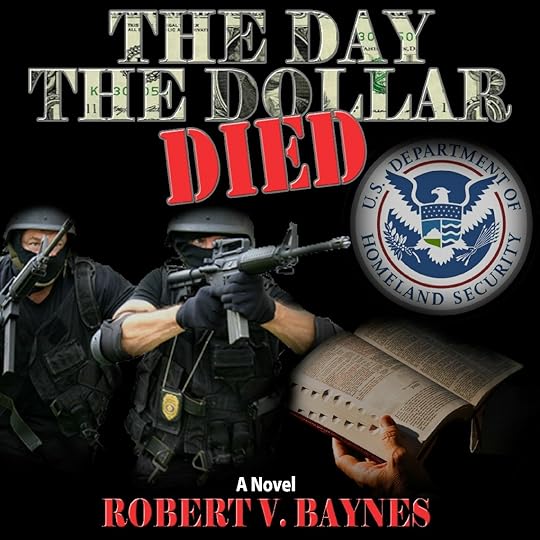
Interview with Robert V Baynes, author of ‘The Day the Dollar Died’
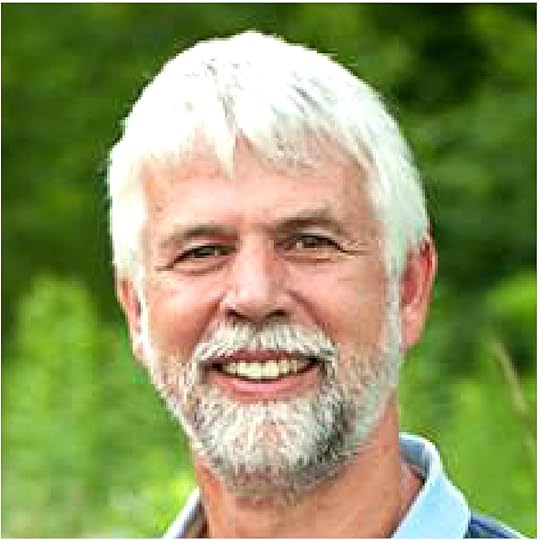 Robert V Baynes is concerned about the direction this country is headed. He wrote this first novel as a message to warn people of what could happen here if things continue as they are. In his spare time, he loves to spend time with his family. He also likes to vacation in new places, fish, read, garden and cook.
Twitter / Facebook / Website / Amazon
Q: Congratulations on the release of your latest book, The Day the Dollar Died. To begin with, can you give us a brief summary of what the story is about and what compelled you to write it.
A: My book is the story of an ordinary farmer and how his life has been very good in this country. Then things begin to change as the financial foundations of this country start to crumble. The main character, John, struggles with what to do and eventually loses everything he has worked so hard to build. He ends up having to make some very difficult choices to try to save his family.
I chose to write this book because I wanted to warn people of some of the dangers I see coming to this country if we do not change the direction we are headed.
Q: What do you think makes a good political novel? Could you narrow it down to the three most important elements? Is it even possible to narrow it down?
A: I think one of the most important aspects of a political novel is that it gets a message across. I think the authors’ point of view should be fairly obvious. I also think it is important for the novel to speak to current events. If it is not about current problems, people do not feel compelled to read it. Third, I think a political novel should be fairly easy to understand.
There could be other aspects, but I think these are the three I would narrow it down to.
 Q: How did you go about plotting your story? Or did you discover it as you worked on the book?
A: I knew the basic story line I wanted to go with when I started the book. However, much of the story came about as I wrote. I felt like I just saw the story unfold and I wrote it as I saw it.
Q: Tell us something interesting about your protagonist and how you developed him or her. Did you do any character interviews or sketches prior to the actual writing?
A: My protagonist came about as a mix between my personality, what I would like to be and just an ordinary farmer. I didn’t do a character sketch prior to writing, but I just wrote what I saw in my head.
Q: In the same light, how did you create your antagonist or villain? What steps did you take to make him or her realistic?
A: For the antagonist, I chose a character that has an almost opposite point of view as myself and then tried to picture why they would think that way. This was an interesting exercise to do.
Q: How did you keep your narrative exciting throughout the novel? Could you offer some practical, specific tips?
A:I tried to keep the narrative exciting by trying to make everything as realistic as possible. I always tried to think about how a person would realistically react in each situation. I also threw in a few twists.
For tips, I think some of the best writing is as realistic as possible and is descriptive enough that you could picture yourself there.
Q: Setting is also quite important and in many cases it becomes like a character itself. What tools of the trade did you use in your writing to bring the setting to life?
A: I tried to throw in cues about what the breeze was like or what the character might have heard. I tried to throw in subtle cues about the setting as the book went along.
Q: Did you know the theme(s) of your novel from the start or is this something you discovered after completing the first draft? Is this theme(s) recurrent in your other work?
A: I knew the basic theme of the novel from the beginning. I discovered many of the details as I wrote. I am currently working on my second novel and the theme is similar but changed.
Q: Where does craft end and art begin? Do you think editing can destroy the initial creative thrust of an author?
A:I think you need both art and craft to be a good book. They have to work together. A good job of editing would enhance rather than destroy the creative work of an author. A good edit, makes a book easier to read and understand.
Q: What three things, in your opinion, make a successful novelist?
A: First of all, they have to be someone who can tell a good story. They also have to be able to stick with one project for years or months until they can get a project finished and to market. Third, I think they have to be able to figure out how to publicize and market their work after that.
Q: A famous writer once wrote that being an author is like having to do homework for the rest of your life. What do you think about that?
A: That point of view certainly has a lot of merit. An author is also someone who gets to tell stories for a living. However, being an author does take a lot of work that is not always fuin.
Q: Are there any resources, books, workshops or sites about craft that you’ve found helpful during your writing career?
A:I can’t think of any resources I used to learn to write. I have been an avid reader all of my life, so I think that has helped me to be able to write.
Q: Is there anything else you’d like to share with my readers about the craft of writing?
A: Writing is like doing anything else. It take some work when you don’t feel like it and the more you do it and get good feedback, the better you can get at it.