Emily Smucker's Blog
August 1, 2025
Moving to Substack

TL;DR—I’ve decided to move my blog to the Substack platform. You can find it at https://emilysmucker.substack.com/
If you want to know more details, along with the journey that led to the switch, keep reading!
Why Substack?Sometimes I feel like I’ve given every website/social media platform a try at some point or another. Not just consuming content, but making content. If you dig deeply enough you can find little traces of me almost everywhere.
But blogging is my first and longest love. I’ve been doing this for twenty years, folks. Twenty years!
Yes, I’ve moved around somewhat. I started on Xanga, then moved here to WordPress a few years later—a good move, in hindsight, as Xanga eventually disappeared into the Great Void of the Internet.
Then, a little over six years ago, I added a “bonus blog” on Patreon. This allowed me to earn a little money from writing. It also gave me a platform to post more controversial content without worrying it would go viral and cause a firestorm in the comments.
(Yes, I have thin skin, but I’d rather be thin-skinned than be the sort of person who would rather have negative attention than no attention at all.)
When I started my Patreon, I’d never heard of Substack, as it was only two years old at the time. But as Substack gained popularity, I realized it might be a better fit than Patreon. In a nutshell, Patreon is a platform for paying content creators of all types, but it’s not really a blogging platform. Substack is designed as a blogging platform, and it’s much more intuitive for readers to use as well.
Additionally, if I used Substack, I wouldn’t have to blog on two platforms. I could put my free blogs and my bonus, paid blogs on the same platform.
..So I Though I Would Try ItOf course, I’ve spent many years building an audience here and on Patreon. The idea of moving it to a new platform was a bit daunting.
But at the same time…
I miss trying out new platforms. I miss the old days of the Internet when there were always new websites.
So I set up a Substack and had fun with it. I called it “Red Boots and Rabbit Trails,” playing on the Red Rubber Boots theme without having to call myself a “girl” at age 35, and set my profile pic of a female Mad Hatter drinking tea and wearing red rubber boots.
Then I re-posted my red rubber boots blogs, as well as my Patreon blogs, onto Substack as well.
Very quickly, I started having more fun blogging than I’d had in ages.
On Substack, folks are engaged. They like things. They comment. They somehow started to find me, even though I didn’t advertise my Substack at all.
Re-Branding as a Comedian?I did run into a slight issue when I set up my Substack, which was that I had to say what category of blog I was writing, and the options were pretty limited. There was no “thoughtful discourse” option. There was no “stories about my life” option.
Was my blog more “Faith and Spirituality” or “Literature”? “Travel” or “Humor”?
I chose “humor,” assuming it didn’t matter that much. What I didn’t realize was that
A. Substack has lists of the 100 “top” blogs and 100 “rising blogs in each category
B. Apparently, not many people choose to be in the “humor” category
Because next thing you know, without advertising my blog at all, I was on the “rising” list.
Even weirder, I continued to rise. The day before yesterday, when I announced on my Patreon that I was moving to Substack, I got up to number 15 on the list.

Yep, there I am, only a few places behind Garrison Keillor and Dave Barry.
What the actual bunnyslipper.
Sorry, future readers, if I’m not quite as funny as you hoped I’d be.
How Substack WorksIf you head over to my Substack at https://emilysmucker.substack.com/, you’ll be prompted to put in your email address and subscribe. If you don’t want to subscribe, just hit “no thanks,” and you’ll go right to my blog.
On my blog, you’ll be able to read my free posts and see previews of my paid-subscriber-only posts.
If you choose to subscribe, you can do the free option, where you’ll get my free blogs emailed to you. That’s essentially just like being subscribed to this blog.
If you pay, you’ll access the paid blogs too. Essentially, it will be like being subscribed to both my Patreon and this blog.
Fair warning—it does cost more than Patreon. On Patreon I was able to set the monthly rate at $1, whereas the lowest monthly rate on Substack is $5. However, I was able to make the yearly rate $30, essentially halving the base price.
But please don’t feel like you need to pay! I’ll still post just as much free content as I have been in the past.
What About the Girl in the Red Rubber Boots?All my years of blog archive will live here for now, but emilysmucker.com will become more of a personal website, and a place to purchase my books, than a blog.
What are you waiting for? Subscribe to my Substack today!


July 28, 2025
Why Read Old Books?

Do you ever finish reading a book and immediately want to talk about it with someone?
Whether I love a book or hate it, I often finish with a huge desire to yap about it…or hear someone else yap about it. Do they hate the same things I hate? Did the scenes that moved me also move them?
Usually, my medium of choice is Goodreads reviews. But this summer, when I re-read A Tree Grows in Brooklyn by Betty Smith in my snatched moments of free time but then spent long days harvesting grass seed and couldn’t peruse Goodreads immediately, I thought:
Wait a minute! I should listen to a podcast!
I’m not much of a podcast listener for some reason, but harvest is the one time out of the year when I become one. So I looked up the book and found a podcast of four women discussing books they’d read as children that stuck with them.
Perfect!
Because there are so many “stick with you” moments from A Tree Grows in Brooklyn.
Like the time a rich girl came to Francie’s school with the most beautiful doll the girls had ever seen, and said she wanted to give her doll away to one of them. And the girls, though they clearly were desperately longing for that doll, didn’t go up and take it, because the experience of taking charity in that way was so humiliating.
Or the way Francie’s father was such a complex character—an ideal father when it came to loving, emotionally understanding, and supporting his children, but such a failure at providing for his family.
Oh, so many things to discuss! I eagerly pushed “play” on the podcast.
The Discussion of RaceAfter some brief banter and explanations about when they first read A Tree Grows in Brooklyn, the podcast hosts launched into an extremely in-depth conversation about race. This was a surprise, because it seemed clear to me that the big theme of the book was poverty, and that seemed the logical place to start.
Still, the book does have an interesting racial context. It takes place in Brooklyn from the 1900s through World War I, and Francie is surrounded by people from many different countries. Her maternal grandparents were from Germany and her paternal grandparents were from Ireland, but she considers herself “American” because both her parents were born in the USA. Of her classmates, she is the only one with this distinction.
Everyone in Francie’s neighborhood has racial prejudices against everyone else, and slurs are not uncommon, but almost everyone is what we would now consider “white.” The group that’s “othered” the most is the Jewish people, but there’s a complex dynamic there—in some ways, Francie’s peers dislike the Jewish people, but in other ways they see them as “better” than themselves. And the Jewish people look down on Francie and her peers.
Then there are a few cultures, such as the Chinese, that Francie rarely interacts with but is fascinated by in a way that is potentially a little demeaning.
So overall, although race isn’t shaping the characters in the book the way poverty is, it’s still an interesting aspect to talk about.
Or so I thought.
But the podcast hosts didn’t seem interested in discussing the fascinating nuances of how race was viewed in Brooklyn in 1912. Nor did they seem interested in exploring how the thoughts and attitudes of back then influence modern thoughts and attitudes.
No. Instead, they were trying to answer one basic question: when it comes to race, is this book GOOD or BAD?
And this, frankly, baffled me.
Now look—I’ve grappled with racism in old books quite a bit, and I’ve read books by authors who were clearly racist. But Betty Smith does not come across as racist at all. Francie is just a young girl, seeing what she sees, and trying her best to make sense of it. Anything in it that would be “racism” today is just Francie observing her local reality.
And to their credit, the podcast hosts recognized this to some degree. But their ultimate assertion was that Betty Smith, while trying her best, was ignorant of the “right” racial beliefs. And that felt, to me, a bit demeaning. Especially given all of Smith’s fascinating insights in the book.
The hosts got really hung up on the slurs. I should note that the characters never said slurs for black people in the book. In fact, black people weren’t really in the book at all, as far as my memory serves. But there were slurs for Irish people, the Jewish people had slurs for non-Jewish people, etc. And using them was fairly common in that time and place.
But the podcast hosts thought they were quite jarring for our modern age. There should be an annotated version of this book, they said. With footnotes explaining the context of the slurs—that in that particular time and place, that’s how people spoke.
“What the bunnyslipper?” I said out loud to no one but the dusty fire extinguisher next to me in the combine. I was so baffled.
Has reading comprehension really fallen to this new low?
Do people today need a footnote to tell them what was common vernacular in that time and place?
Can’t they just…read the book and see that it was common vernacular in that time and place?
Depression-Era BrooklynAdding to my irritation during this segment was the fact that they kept referring to the time and place as “Depression-era Brooklyn.”
Excuse me. The years were stated multiple times in this book. Even by the end of the book, they were over a decade away from the Great Depression. There are four of you on this podcast. Did no one pipe up and say, “Um, excuse me, the depression was in the 1930s”? Or look it up afterwards and have a little “oopsie” note in there?
I was probably more irritated by this than I should have been. When combined with the blatant skipping over of the poverty angle in the book, it made me think, Wait, are you assuming that if there are poor people in the book, it has to be the Great Depression?
The Discussion of FeminismAfter exhausting the topic of the race, the hosts moved on to the next point of discussion. Is this book feminist?
Now, A Tree Grows in Brooklyn has many nuanced characters, most of whom are women. And it definitely deals with the grand topic of what it means to be a woman, as Francie is coming of age in the novel.
So, as far as these things fit into the “is this book feminist” question, some interesting thoughts were discussed.
But again, instead of having a nuanced discussion about the complex characters and the reality of being a woman, particularly a woman in poverty, the podcast hosts had one goal: to decide if it was GOOD or BAD.
And when that discussion was finally over, and I thought we might finally get into the meat of the book, the hosts said, “And now our final question: Would you give this book to a child to read?”
The New ReligionAs irritated as I was by the way the podcast hosts refused to grapple with the hard, complex, nuanced questions in the book and instead endlessly discussed whether it was “good” or “bad” on a few very specific metrics, it felt familiar.
In a religious context, such as the Mennonite world I grew up in, this type of “review” is common. Someone reads the book and then makes a judgment. Does the theology match our theology? Is there too much romance and kissing? Is there anything verging on fantasy? Is the language pure and clean? Is it GOOD or BAD?
And if there’s anything iffy that’s not iffy enough to be branded as BAD, it’s treated like the podcast hosts treated Smith’s depiction of race. We can forgive the author for being a bit spiritually deprived. They might not have been taught what we were taught. We just have to make sure everyone knows that we ourselves believe the right spiritual things, and are not putting our stamp of approval on those parts of the book.
Yes, the podcast felt like I was listening to a group of people from the Church of Not-Racist Feminists deciding whether to allow A Tree Grows in Brooklyn into their church library.
Why Do We Read Old Books?The whole experience made me realize that my motivation for reading old books is not necessarily the same as other people’s motivations for reading old books.
I mean, I guess it’s the same in some ways. We all wanted to read an objectively good, interesting book that happens to be old. But it seemed important to these hosts to deliberately read through the lens of modern morality and social norms.
Whereas when I read old books, one of my main objectives is to gain context about our modern morality and social norms.
I’m not interested in a footnote in an old book explaining that they didn’t understand all the racial nuances that we have now.
No, I want to read the old book to better understand the racial nuances we have now. Because everything we believe now came from somewhere, or is a reaction to something, and for me, the best way to understand has always been to read old books.
I often hear people say massively ignorant things about the past, and I think, do people not read old books anymore?
But now, after listening to this podcast, all I can think is, do people care about reading critically? About nuance? About learning more about rich human dynamics that don’t necessarily have easy answers?
July 8, 2025
Summer Magic
It’s almost 9 pm, and the sun is setting over the coast range, bathing the world in pinkish-gold light. The heat of the day dispels rapidly, and I shiver in the sudden cold breeze as I bike home from work, past my neighbors’ orchards, the fields I haven’t combined yet, and my cousins’ trucking business.
I hear the long, low whistle of a train, and it chugs past as I turn onto Substation and roll into the driveway. My mom is outside watering flowers.
Another magical summer day draws to a close.
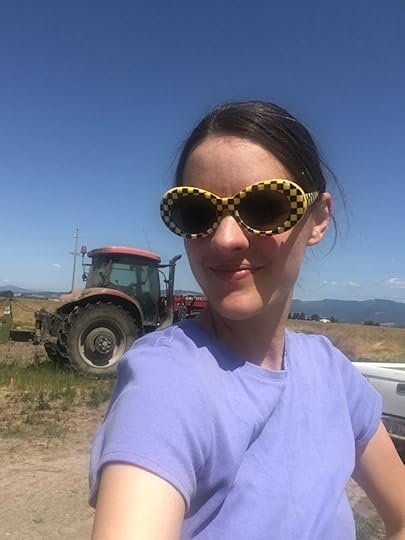
Working on the FarmDuring my college days, I started working on various farms in the area to earn cash in the summer, and while I enjoyed the pleasant monotony of putzing around the field on a combine all day, I didn’t always like the baggage that came with it. Like the farmer who used his combine drivers as free babysitters, bringing one or all of his offspring out to sit in my cab, fight with each other, and demand I tell them stories. Or the farmer whose combines were forevermore plugging up, requiring me to unclog them by hand using a giant wrench that hung on the back of the machine.
Once I graduated and no longer needed money so desperately, I thought I was done with the gig. But then a couple of years later, I started working for cousin Darrell up the road. His combine basically never plugged up, and I never had to babysit his kids, and next thing you know, I’ve been doing this for seven summers in a row.
Magically, in all my years living hither and yon, it’s always worked for me to come back to Oregon in the summer.
However, when I tell people about going back to Oregon and doing farm work, they always assume I’m working on my parents’ farm, and I find the truth rather hard to explain. Darrell is my dad’s first cousin, but the farm is the same one that my great-grandfather farmed, and also where he started his grass seed cleaning warehouse that eventually passed on to my dad. So in some ways, I did grow up on the farm I’m now farming, running around with my cousins, swimming in the creek, and tagging bags at the warehouse.
Growing up, I read books about farms and always imagined them having pretty defined borders. It wasn’t until I grew up that I realized:
Farmers own a lot of really random, disjointed fields. Darrell’s farm isn’t so bad, as you can draw a line all the way around it if you have to, although it makes a really weird shape. But I worked for a farmer once whose fields were miles away from each other.All the fields that surround me are part of someone’s farm.I grew up running through the fields next to my house, and the ones close to the warehouse, and not realizing I was actually on someone’s farm. It honestly wasn’t until I worked for Darrell that it occurred to me that the “back way” I constantly used to go to my friend Stephy’s house was actually a farm access road.
 Strawberry June
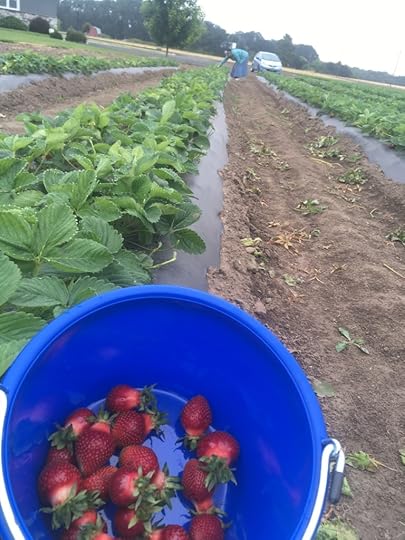
Every June, strawberry season arrives with gusto, and we pick buckets and gorge ourselves and it doesn’t matter because if we don’t eat them now they’ll just go bad.
Real strawberries, full of juice and flavor. Not those hard, tart, oddly dry ones they sell in the grocery stores all winter.
When I got to Oregon, my first week passed in a flurry of activity, and suddenly I realized that strawberry season was early this year, and I’d just missed it.
Crushing.
I should note that these last few years I’ve only worked three days a week in the harvest, using the other week days to keep up on my writing tasks, see friends, and do my laundry.
The following Tuesday, I went to the river with all the women are used to hang out with back in the day and their young children. “Who wants strawberries and cream?” called Heather, who is married to my childhood friend Preston.
Then she pulled out mason jar after mason jar of fresh sliced strawberries.
I’d heard that Preston and Heather were going to start a strawberry patch, which I was really excited about as it would be by far the closest strawberry patch to my parents’ house. But they just put in the plants this year and I thought they weren’t going to be open until next year.
“Do you have strawberries?” I asked incredulously. “Like, could I come pick some?”
“Yes!” said Heather. It turned out that they didn’t advertise opening this year because they didn’t know how many strawberries they would get, but then the strawberries arrived in abundance a week or two after the main strawberry season was over.
They literally live like, a two or three-minute drive away. Mom and I hopped over there before work the next morning and picked buckets in the chill air while Preston and Heather’s children wandered around the fields picking and eating berries as they pleased, living the magical childhood that everyone dreams of.
 Fun Jaunts with Friends
Maybe some day in the future I’ll get to the point where I can spend my summers focused on friendship and working in the harvest and leave my writing for the rest of the year. As it is, it’s a bit difficult sometimes to focus on fun times with friends while working two jobs.
Still, I’ve managed to make it work, mostly because my health has been pretty good.
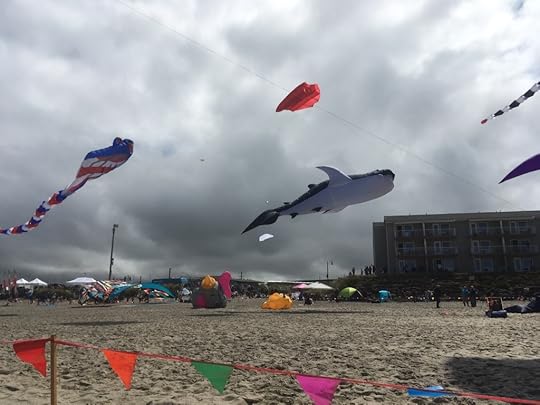
Of course, when your friends are grown with children a fun jaunt might be something like going and helping them plant their corn. But it might also be going up to Lincoln city to watch a kite festival on the beach.
 Turning 35
I turned 35 yesterday. My friends and I went out to the coast after church and had a picnic lunch. The weather was wonderful although it was windy and a layer of sand accumulated on everything, food included.
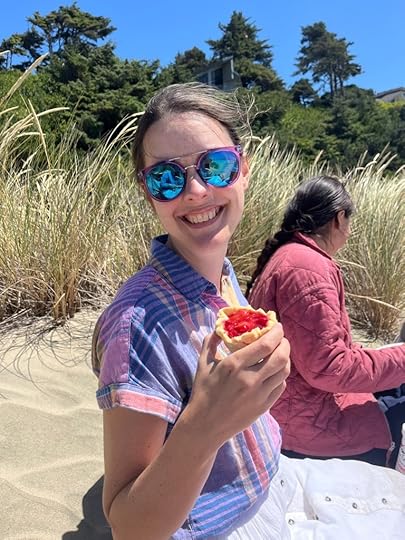
When I was young, I had some idea that growing older was a generally unpleasant experience. I’m not sure where this came from. Maybe it’s a lie I told myself to get through the terrible trial of enduring adolescence. Who knows.
As far as I can tell, being young has only one true advantage over being older, and that is the physical health aspect. People my age start to feel tired a lot and miss that boundless energy of their youth. But this is nothing to me, as I was far more tired in my youth than I am now.
But there is one truly terrible thing about getting older that I never thought about when I was a teen, even though, in hindsight, adults talked about it all the time.
That is the absolute panic I feel at how quickly time moves.
It really started ramping up in my 30s. Suddenly, I was the same age that I remember my parents being, and my peers had kids that were the age I clearly remember being. The fashions of my youth were in vogue again. The world had changed so much I felt despair that no one would ever again experience that type of childhood that I did.
As a kid, it felt like I was living in a singular point in time, whereas now I feel like I am existing in the long arc of history, which is actually much shorter than I ever imagined.
I find it inherently upsetting and unsettling, and it gives me that existential crisis feeling, but I’m not exactly sure why.
The Bucket ListA year and a half ago, when I was alone in Houston over Christmas, I made a bucket list of interesting things to do to get me through that time. I ended up completing the whole list and it really was a rather magical adventure.
Eager to re-create the experience, this last year I made a list of 34 things to do while I’m 34.
I started with a lot of energy, knocking things off the list one by one. I swam in a lake. I went to the chiropractor. I visited enchanted Forest.
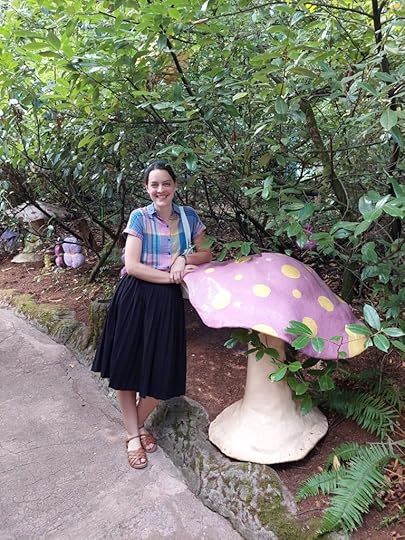
Then I started making plans to take a trip to New York City.
This was a pretty weird year for me all together. I stayed in Oregon until the beginning of October, then went back to Houston for two weeks, then took a complicated and convoluted trip back east that included stops in Pennsylvania, Maryland, and New York City, smooshing together a work trip and a friend’s wedding into one travel event.
It was all rather last minute and convoluted. I ended up calling an old friend and randomly asking if she wanted to go to New York City with me, and she couldn’t make it, but I realized after we hung up that I’d fulfilled a bucket list item to call someone I hadn’t spoken to in 5+ years. In the end it all worked out, as she had a friend in New York City that I sort of knew through the Internet, and I was able to arrange to stay with her.
Shout out to Alyssa!
As haphazard as the trip was, it ended up being phenomenal and one of the highlights of my year.
Then, a week after I returned from that trip, I moved up to Chattanooga at the beginning of November.
Once I was moved, my priorities changed. I wasn’t so concerned with doing fun unique things that were on my bucket list. Instead, I was much more focused on making friends and integrating myself into the community.
So that’s when I put the bucket list aside and didn’t really think about it much for the rest of the year.
Revisiting it now, I have one great regret.
You see, when I was in Iceland and went to the public pool, I had a hankering to go down the waterslide. Of course, it was only kids on the waterslide, but there was no rule against adults using it, so I climbed up the steps, stood at the top, looked into the dark yawning hole of the waterslide, and suddenly remembered how much I detest the feeling of falling.
I’d done a log flume ride at Enchanted Forest, and the memory of that final terrible plunge still gives me the heebie-jeebies.
So then, embarrassingly, I walked back down the stairs past all the eager 10-year-olds who were going the opposite direction.
I never really regretted that choice until I took a look at my bucket list the other night and realized “go down the waterslide“ was on it. I’d completely forgotten I put that there.
So in the end, I only completed 10 of the 34 things. I still have a hankering to do the others, and I suppose I’ll get to them someday.
But in general, I think I need to have a more limited scope for my bucket lists. Pick a time when I’m typically having a hard time, like February and March, and use the bucket list to spice my life up a bit.
You know, looking back at it now, between moving to Chattanooga, going to New York City, and going to Iceland, I have to say 34 was one of the best years of my life.
Cheers to 35!
June 4, 2025
The Last Days of the Iceland Adventure: Reykjavik, Blue Lagoon, and a Local Church
Sunday. We’d been in Iceland for over a week now, and here we were, back in the capital city of Reykjavík. What should we do? What should we see? What museums were worth checking out?
Personally, I had a hankering to go to church.
Here’s an interesting fact I realized: my trip to Iceland was the first time I’d ever taken a trip to a different country just to do it. For, like, a vacation and a fun time.
I love to travel, but in the past, there’s always been something else inspiring the trip. I went to Belize last year because Mom was speaking at a women’s retreat there. I went to Kenya to do some work with Open Hands. I went to Thailand to visit my sister Amy.
And on those sorts of trips, I always go to church on Sunday with whoever we’re visiting. This was the first time I had to go on Google and find a church to attend. But I looked forward to it. When Mom and her sisters-in-law went to Scotland a few years ago they made some of their most interesting connections at a local church.
Stephen and Annie were down for the whole “go to church” thing, but Stephen in particular didn’t want to go to a service in Icelandic. So I searched around and found a place called Reykjavik International Church that had a service at 2 pm.
This was nice in one sense, because we had a late start to our day and probably would have missed a normal 10 am service. But it did limit our day somewhat.
In the end, we decided to visit a famous church called “Hallgrímskirkja” first. Not to go to a service (they were all in Icelandic that day), just to go as a tourist.
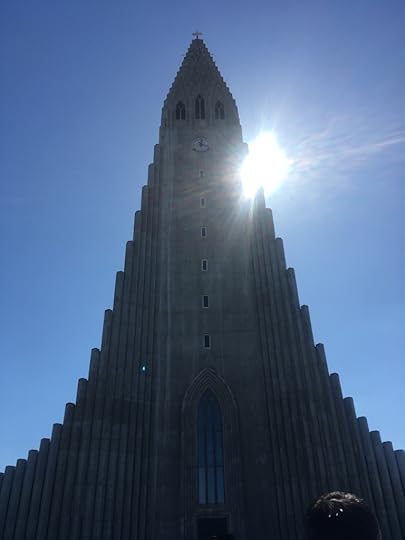
Hallgrímskirkja stood tall and imposing. We followed the crowd inside and rode an elevator to the top, where we saw the back side of the clock…
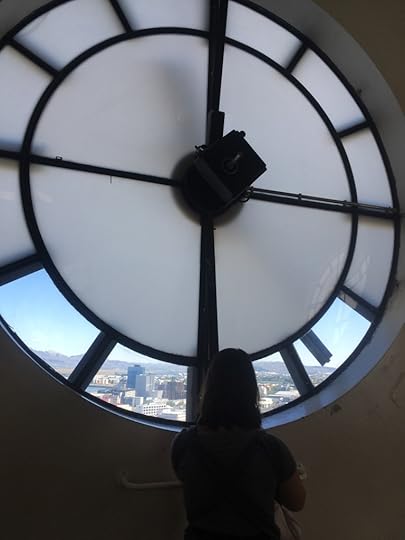
…and then walked up a flight of stairs to the bell tower…
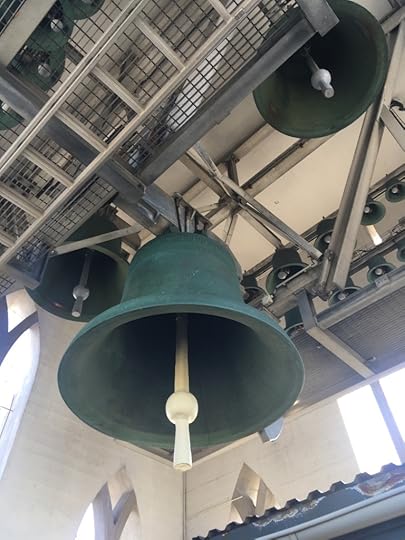
…where we gazed out the lancet windows at the city below us.
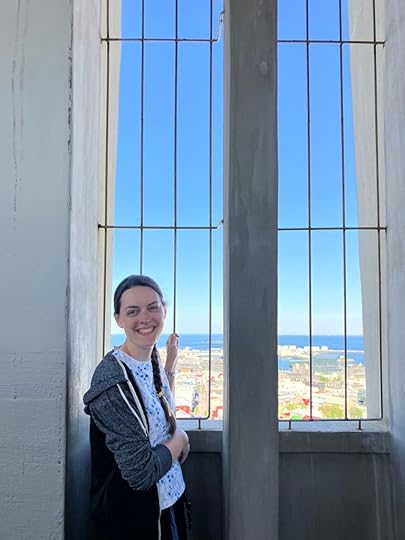
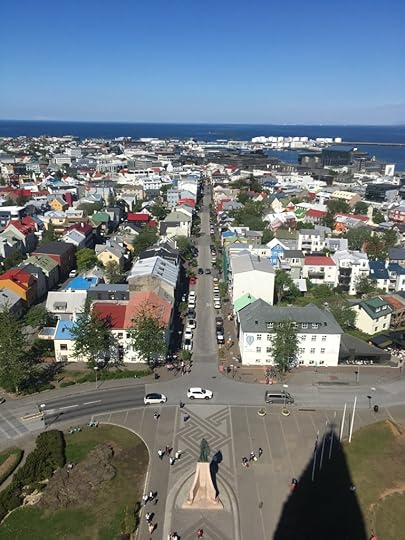
In general, I got the impression that Icelanders only like dull colors. They seemed to dress exclusively in black and gray, and their cars were mostly white or black. The only exception was the signature red roofs of the houses that dotted the countryside. Why red? My one guess was that red doesn’t show the rust, but who knows.
So I was pleasantly surprised to gaze from the top of the church and see that the architecture was more colorful than I’d realized.

When we came back down, we went into the church sanctuary for a while. The morning services were over, and most of the people inside seemed to be tourists, but an organist played a haunting tune for us.
Remembering the glacier boat driver, I made sure to sit in stillness for a moment and absorb the beauty.
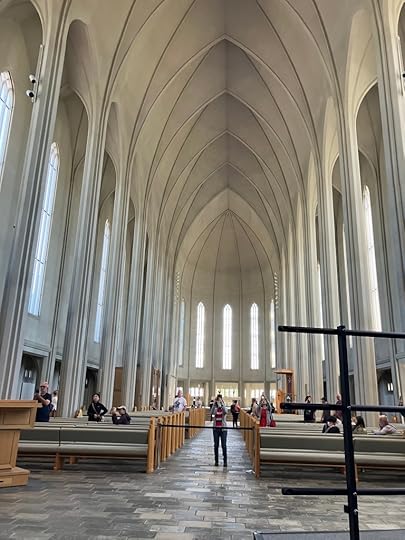
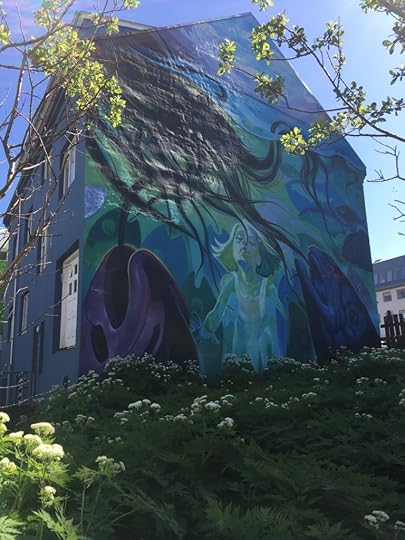
After touring Hallgrímskirkja, we had an awkward span of time to fill until the 2 pm service at the International church. For lunch I just ate leftover pizza, but Annie wanted to go a real restaurant. So we split up. Like every random town we’d been in so far, Reykjavik was remarkably walkable, so I opted to meander to the International church, admiring murals on the way.
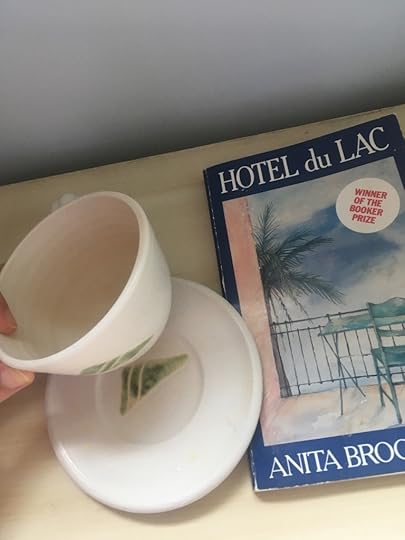
I ended up going into a super-trendy little thrift store and poking around. For a few bucks, I picked up a little book that looked interesting and a pottery tea cup.
And then, on to the church service! It truly was an International Church, with people from all over the world.
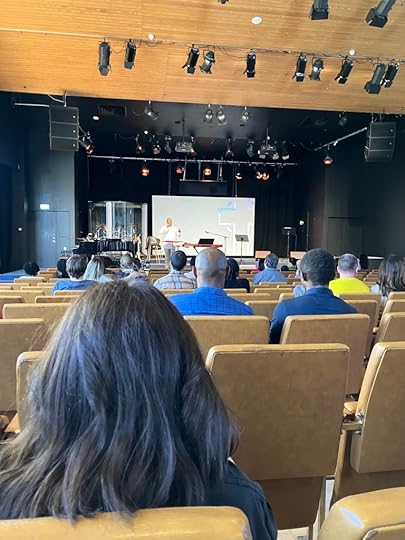
You see those men in blue about three rows in front of where we sat? One of them wore a beaded wristband with Kenyan flag colors. When I was in Kenya several years ago, I saw little booths everywhere selling those wristbands.
When the service ended around 3:15 pm, we were in a bit of a tight spot, because we wanted to spend time at the Open Air Museum which closed at 5 pm. But when the pastor announced that we could go downstairs for coffee and fellowship, we decided that we could spare fifteen minutes.
“Excuse me,” I said to the man with the wristband, “are you from Kenya?”
“Yes!” he said. And it turned out the other man in blue next to him was also from Kenya. They were getting their PhDs at Reykjavik University, studying geothermal energy, and hoping to eventually help Kenya transition to also using geothermal energy. Of course I told them all about my brother Steven, and then scrolled through my phone trying to find a picture of him.
I’m not the type of person that usually thinks to take pictures, which is unfortunate for times like this. When I did finally find a picture, it was of the Sunday afternoon we all decided to go to Wesley Yoder’s funeral. Steven, who’d come over for Sunday dinner in a t-shirt not even realizing there was a funeral to go to, had to borrow ill-fitting clothes from Dad.

Anyway, we all had a lively conversation and it was so much fun to meet people who actually lived in Iceland, albeit as transplants. Stephen Sells asked Peter (the Kenyan who was not wearing a wristband) what it was like to be a person of faith in Iceland, and Peter said it was hard, because Icelandic people get really uncomfortable if you talk about faith. But the International church was full of true believers and was growing. It attracted people from all denominations.
Unfortunately, we couldn’t stay long. Already we’d stayed a good 20 minutes longer than we’d planned. And so we left to go to the Open Air Museum.
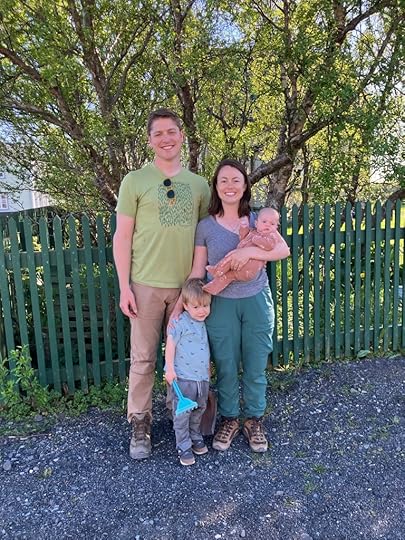
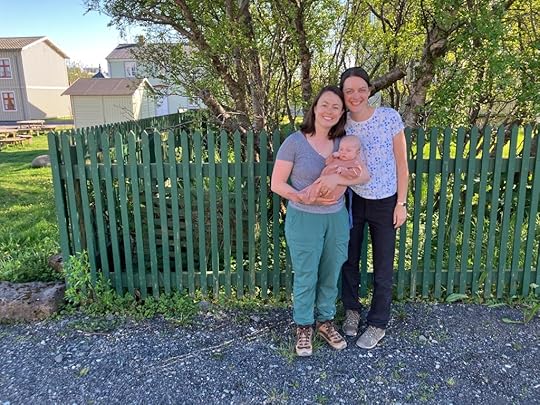
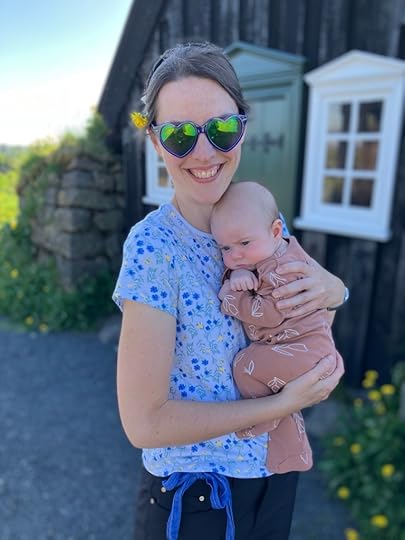
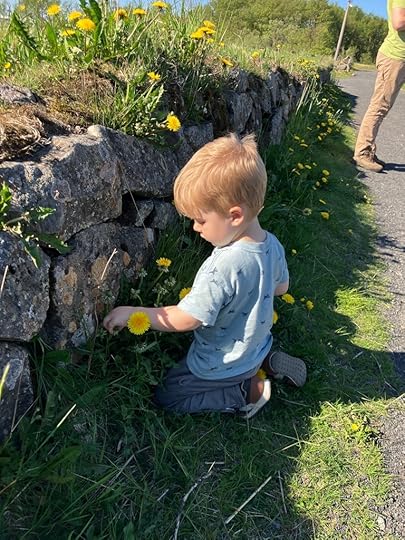
This museum was the best. We got in for free because unbeknownst to us it was National Museum Day. The museum was full of historic houses that had been moved to the area, and you could fully walk through them.
I love houses, okay? I could have stayed here for ages.
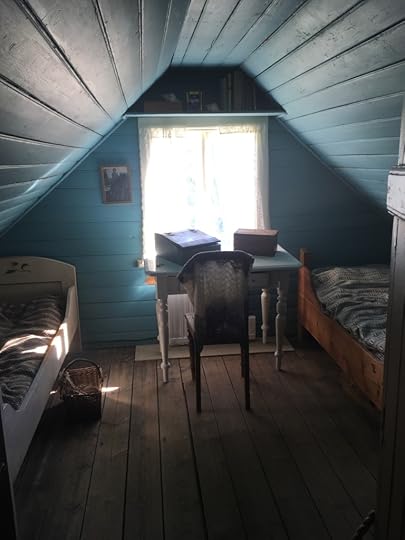
Just think of all the wonderful novels you could write in this room!
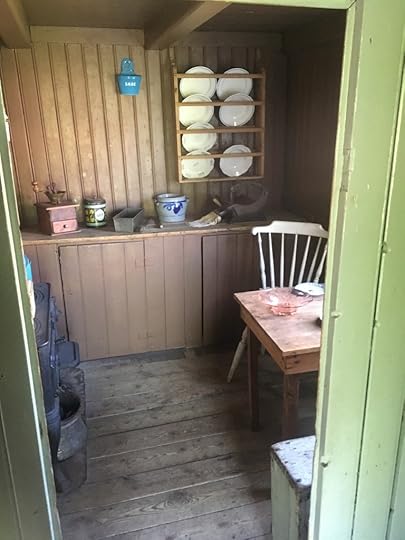
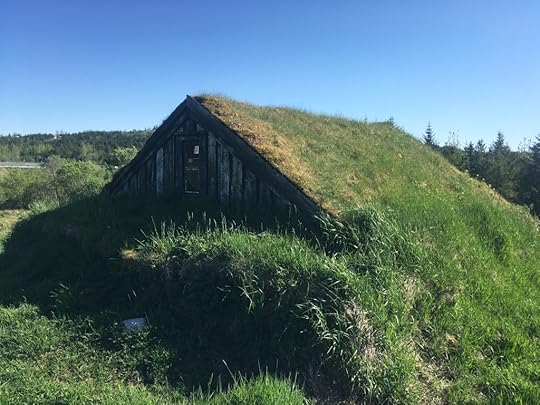
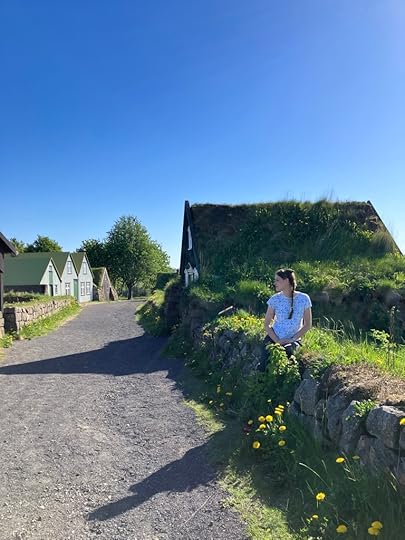
I didn’t get to see nearly everything I wanted to see. We weren’t even there for an hour before they went through and locked everything up. But we stayed on the grounds for a while longer, snapping pictures and letting Daniel play.
I absolutely recommend this museum if you go to Iceland, especially if you’re going with kids.
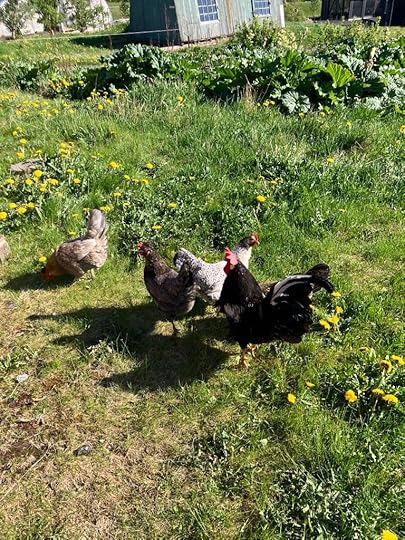
After that we went to a grocery store to buy hot dogs and yogurt. And then, since we had some time to kill before eating our late dinner and heading to bed, we went to the pool!
I talked in an earlier post about Iceland’s pool culture, and indeed, going to the pool felt like the most quintessential Icelandic experience of the whole trip. I think we might have been the only tourists there.
However, if you ever want to go to Iceland and experience the warm swimming pools, I feel as though I should tell you of some of the, erm, cultural oddities.
The rule in Iceland is that you have to go through the locker room and shower naked, with soap, before you can go in the pool. This is really important to them, and allows them to use less chlorine in the pools. There’s also an expectation that you will dry off completely, remove your bathing suit, and wring it out before going back to your locker to get your clothes. This leaves the locker area floor completely dry, so that people can walk around in their stocking feet (since no shoes are allowed in the locker room and must be left on a rack outside the door).
The locker rooms are sex segregated of course, so if you’re a woman, you’ll only be seen by women. But the reality of this system is that, even if you manage to strategically wrap yourself in a towel for most of the proceedings, you will see more naked people than you probably ever have before in all your life.
However, after researching it a bit, I discovered that Icelandic pools usually have private shower rooms you can request to use if you’re uncomfortable. At the pool we were at, it was called a “family shower room” or something of that nature. According to the Internet, if you request to use it they’ll let you, no questions asked, but I did not test this theory.
The pool was really fascinating, once I’d made it through the cultural shock of the locker rooms. The main pool was cooler than a hot tub but warmer than a typical swimming pool. It featured a water slide and a fountain, as well as a separate area for swimming laps. Most of it was outdoors, but you could swim into an indoor area through a vinyl strip curtain.
Then, there were three or four hot tub pools with water of varying temperatures. Due to the warm, balmy nature of the day, most of us were congregated in the coolest hot tub.
It really did remind me of the Roman baths. Everyone was there. Children played in the coolest pools while adults lounged in the hot tubs. And almost everyone spoke Icelandic except for two young women sitting near me who spoke English. I’m not sure why they were speaking English, since they both appeared to live there, but I got the impression that one of them might be a transplant. Nevertheless, I enjoyed eavesdropping on their conversation as they discussed:
How tourists find the whole “shower naked before getting in the pool” thing weirdHow many pools there are in IcelandHow record-breakingly warm the weather had been recentlyFinally, after an hour or two of basking in the water, we got out, showered, and drove back to our campsite. It was our first time staying at a campground two nights in a row, although since our camper was also our transportation, I just had to trust that no one would disturb the laundry I’d washed and laid out to dry on a dilapidated bush.
It really was lucky for me that we had such splendid weather for drying clothes.
Anyway, we ate a supper of hotdogs and then went to sleep in our camper van.
Speaking of our camper, it occurs to me that I never posted many pictures of it, or described the interior. So let me remedy that now.
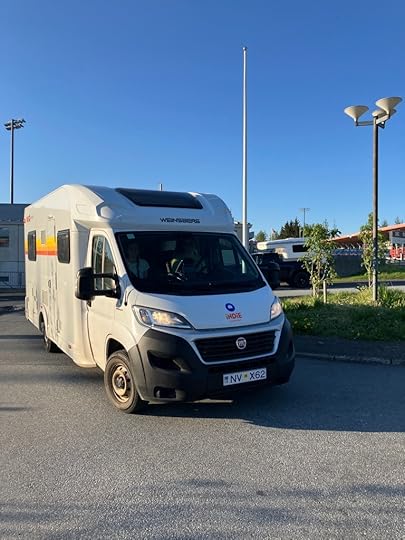
Although this vehicle was the first thing to come up when we googled “camper van Iceland,” and that’s what we called it the whole trip, I’m not quite sure it is small enough to actually be considered a “van.” Honestly, it was probably technically a small motorhome.
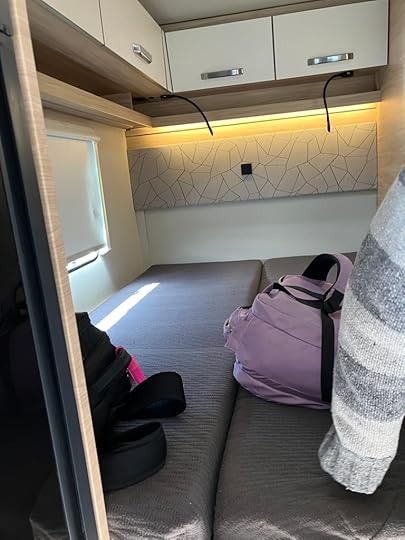
Look how clean this back bed is! This is a picture from the first day, before we’d even brought in all our luggage. This back bed was the only bed that stayed put permanently. Just to the right of it was a bathroom that we tried to use as little as possible, since our campgrounds all had bathrooms and showers.

Sorry for the blurry pic—but across from the main camper door was this kitchen area we used every time we didn’t have access to a campground kitchen.
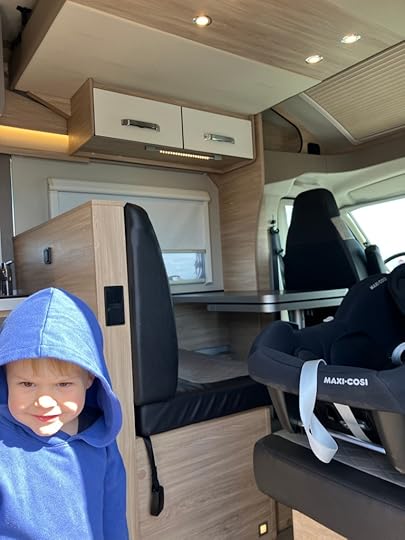
This is the front part of the camper. The bench seat to the left is where Daniel sat in his Paw Patrol car seat and Annie sat next to him. To the right was the seat where we put baby Hannah’s car seat. Above, you can see the upper bunk, which was pulled down at night.
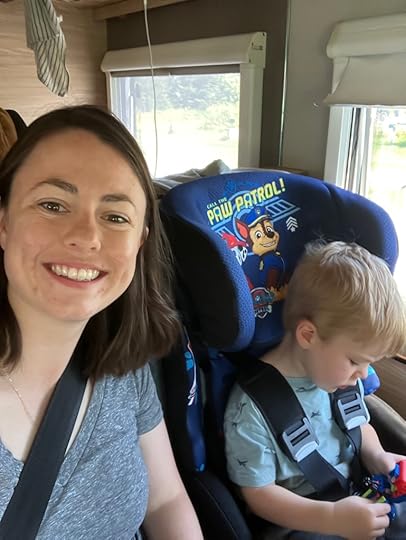
Daniel and Annie during the drive.
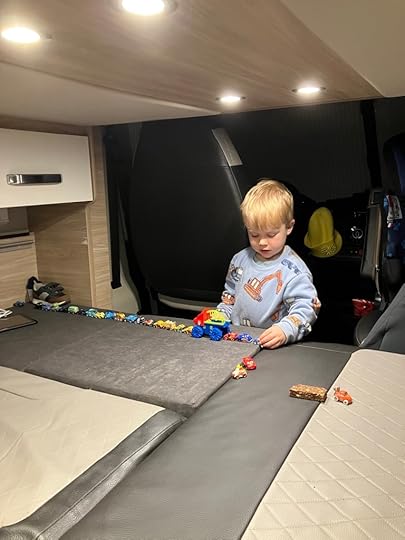
Here’s a picture of the night setup, with the table and bench seats converted into a bed, and the upper bunk (where I slept) pulled down.
Also note the yellow stocking cap on the gear shift, to remind us not to drive off without unplugging the power cord.
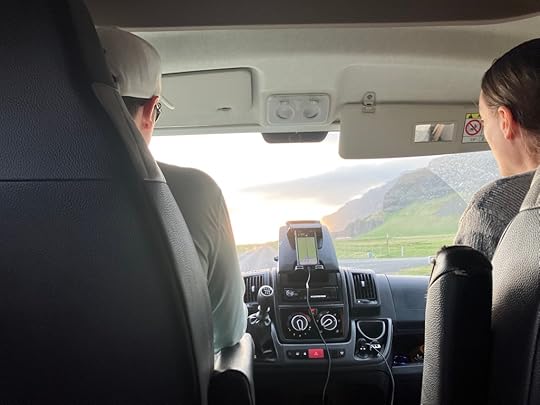
Stephen and I sitting up front, probably in a heated discussion of some sort. (I should note that by the end of the trip, Stephen was a great proficient at driving a manual. We had a full-circle moment our last day in Reykjavik, where we had to stop because someone in front of us stalled out, while we accelerated gracefully and did not stall.)
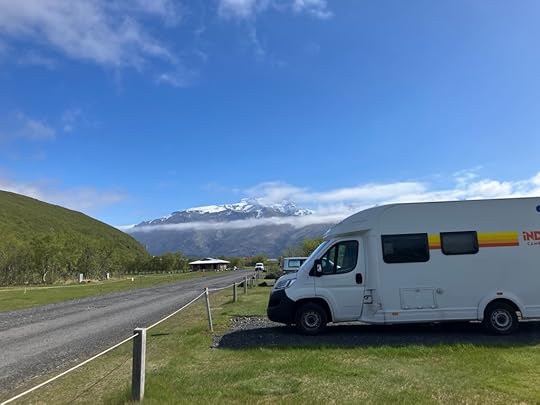
Our dear camper van at Vatnajökull National Park. Ah, the memories. We were very sorry to leave her when the journey was over.
The next morning was our last truly leisurely morning left, and we enjoyed a good breakfast of yogurt, eggs, bananas, and blueberries.
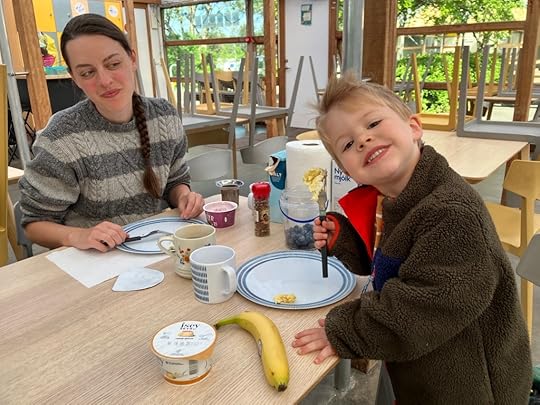
After which we packed up and headed to our last stop of the trip—Blue Lagoon.
Blue Lagoon is an interesting place. Here’s the story: in a barren lava field in southwest Iceland, they built a geothermal power plant, as they do in many barren places in Iceland that have abundant free hot water just below the surface. After the steaming hot water was used to create electricity, the still-warm water flowed into pools and was ignored as useless runoff.
But this water was unique, because it was full of silica. Not only did this tint the water a beautiful milky blue color, but someone with psoriasis once bathed in the pool and found it helped alleviate his symptoms.
That led to the creation of a man-made geothermal spa filled with the silica-rich runoff of this power plant. Called the “Blue Lagoon,” this spa has become one of the most famous (and certainly the most lucrative) tourist spots in Iceland.
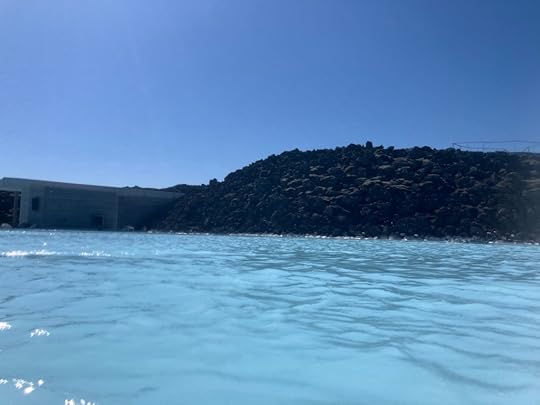
It’s also conveniently located near Keflavík International Airport, which is Iceland’s main airport, and the color of the water makes for stunning pictures.
I will say that if I was doing this trip alone, I would not have bothered to go to Blue Lagoon, as the tickets were pretty expensive. But I was fascinated by the pretty geothermal water, and when the Sells generously offered to gift me admission, I was delighted.
Like the public pools, Blue Lagoon also expected you to shower naked, with soap. But the experience was so different, being full of tourists instead of native Icelanders, that it was almost comical. Every single person in that locker room found a way to cover themselves as they went from the showers to the lockers, and the showers themselves had private doors, so there was no nakedness in sight.
But I’ll confess I kinda understood the perks of the Icelandic system, because at Blue Lagoon there was water all over the floor in the locker area.
When I got in the water, I trotted and splashed about for a while in perfect bliss before I realized an uncomfortable truth: the whole lagoon was in full sun, and I was not wearing sunscreen. So I walked around the place looking for something shaded. Finally I found an obscure corner, back beside the building where they gave expensive massages, that was in the shade. The water was also a bit cooler hear, which felt nice. So there I parked myself for an hour or more, relaxing in the blue and reading the book I’d gotten at the thrift store the day before.
I don’t recommend the book, but I had a good time nevertheless.
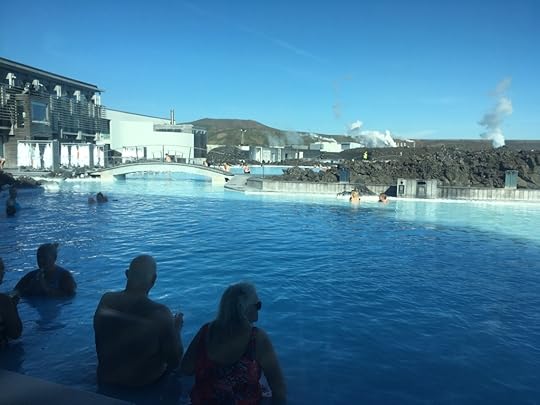
I didn’t get good pictures in the lagoon, so you’ll have to use Aunt Google if you want to look at it in all its Instagramable glory. At the end of the day I snapped this picture through the window of the café. By this point, the sun was setting behind the café and creating a nice area of shadow where many people congregated, but it does make the water look an uglier shade of blue than it actually was.
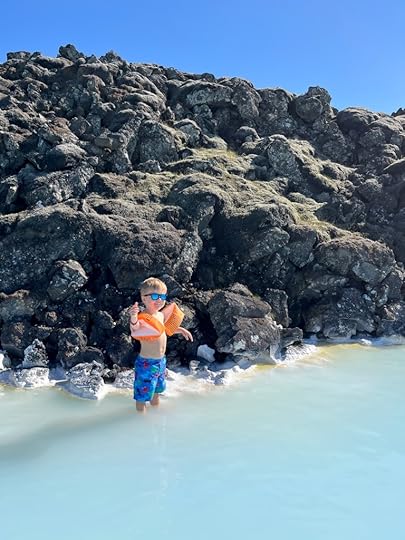
Here’s a picture Stephen took that gives a more accurate depiction of the water color. Poor Daniel found the water too hot for his liking.
Oh! Funny story I forgot to mention. When we were first checking in, they asked how old Daniel was.
“Two, almost three,” we said.
“Can you prove that he’s two?” they asked. (They don’t allow children under two in the pool.)
We looked at each other uncertainly. Daniel had a passport, but it was way back in the camper van.
Then Annie had a brilliant idea. “Can I show you a picture of him being born, and you can look at the date stamp?”
“Sure!” said the woman at the counter.
So Annie pulled up Daniel’s birth photos on her phone, and it worked, and somehow that struck me as the most hilarious age-verification tactic I’d ever heard of.
Overall, the lagoon was lovely. Although it’s not among the top places in Iceland I’d recommend, I do think it’s worth the trip if:
You go at a cold time of year. Many geothermal pools have a very cold walk between the pool and the locker room, but you can enter Blue Lagoon while still indoors and then walk outside through the water. I think the warmth would be much more satisfying on a cold day than it was on the blissfully balmy day we went. Also, I think it would be glorious to experience northern lights or snow while relaxing in the pools!You are on a short layover. Blue Lagoon is the closest tourist destination to the airport. I think it’s about a 20 minute bus ride.Saving money is not a huge priority as you’re planning your trip.After our afternoon at Blue Lagoon we went to Vogar Campsite, 15 minutes from the airport. Vogar Campsite was lovely in several ways. First, the Icelandic couple who owned it were very present, helpful, and chatty. Second, the place was full of free food, toiletries, gear, etc. left behind by previous adventurers.
Unfortunately, since were were at the end of the trip, we had plenty to leave behind but didn’t need to take anything. As did the other campers around us. So my one piece of advice if you’re doing a camper van trip in Iceland is this: Go to Vogar Campsite first!
Also, the owners saw us toss the broken power cord, rescued it, and fixed it. So if you happen to drive off without unplugging, you can visit Vogar and ask the nice people to help you.
I hauled my stuff outside to pack so that the Sells could have more space, and I did my best to entertain Daniel. Finally, finally, he was warming up to me. He seemed to enjoy watching me pack my underpants and telling me about his own Spiderman underpants.
The Sells, it must be admitted, found a way to pack an extraordinary amount of stuff in their carryon bags. They attributed this feat to the vacuum sealer system they got at Walmart.
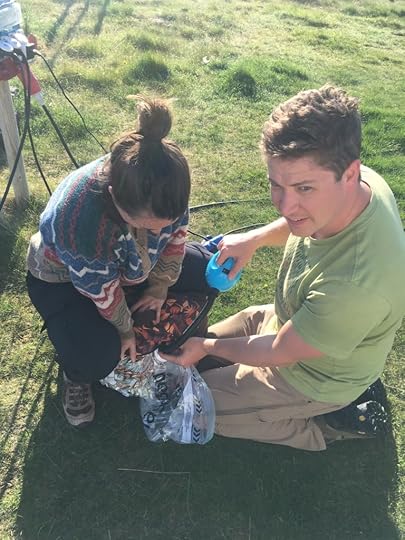
Advice from Annie: there’s no need to get the extra-large bags. Large bags will be plenty big enough.
The next morning we woke at 6:30 am, drank our tea, ate our breakfast, packed up our sleeping bags, and drove to the airport!
Stephen dropped us and the bags off and then went to return the camper van. Thus followed one of the most stressful times of the trip. Daniel, up earlier than usual and devastated to be leaving Iceland, absolutely refused to walk. He wanted Annie, who was already carrying Baby Hannah, to carry him too. I, of course, would not do.
Thankfully, we shortly found some little orange strollers provided by the airport, and I was able to push Daniel with one hand and pull my carry-on suitcase with the other. But when it was time to go through the metal detector, the stroller was not allowed, and I just had to pick him up and haul him through.
It was probably the most like a parent I’ve ever felt in my life.
There were almost no seats at the gate. When Stephen showed up, he sat in the stroller and read a book he’d bought about Norse gods.
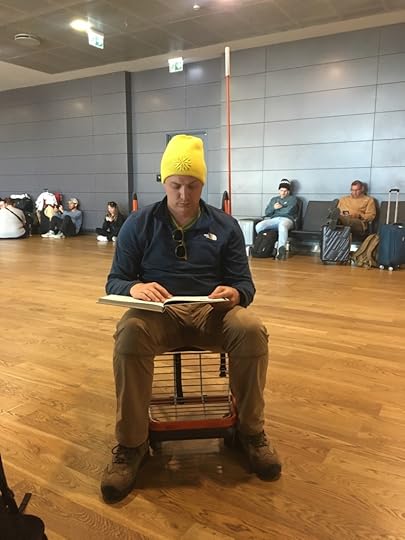
In general I enjoyed the journey back more than the journey there. Although we had a 6 hour layover in the JFK airport, and a 2-hour drive back from Nashville, I was able to go to bed around 1:30 am Eastern. So while I was awake for 23 hours, I never flew through the night, meaning I could go to sleep as soon as I got home and re-set my sleep schedule nicely.
The whole trip took 10 days. But what a 10 days!
There’s so much about Iceland that charms me, and I could write for ages about this or that interesting thing. For example, I am absolutely fascinated that Iceland, a country of 400,000 people, keeps its language intact and has a robust publishing industry. That boggles my mind.
Overall, I think Iceland is a place worth going to, and I had a truly magical time.
***
Order my book:
Print Version
Kindle Version
Follow me on:
Instagram: @emilytheduchess
Twitter: @emilysmucker
Facebook: facebook.com/emilysmuckerblog
YouTube: youtube.com/emilysmucker
Patreon: patreon.com/emilysmucker (This is where I post bonus blog posts, about more personal/controversial subjects, for a subscription fee of $1 a month [or more if you’re feeling generous/want to support my writing]. I try to post twice a month.)
May 27, 2025
The Golden Circle
That first morning in Selfoss, I could immediately tell it was going to be a lovely day. The Sells got up shortly after I did and went out to breakfast and then to a yogurt museum, while I did my usual procedure of eating a granola bar and drinking tea while working on my laptop in the campground dining area.
Then we bipped off to see a volcanic crater. But before we left the campground for good, I ran to the outdoor sink area with a plastic bin, some laundry detergent sheets, and a few stinky clothing items. No way was I spending $14 on one load of laundry. The sun was beating hotly through the camper van windows, so I put my black pants on the dashboard as we drove, hoping they’d dry quickly.
I was wearing my backup outfit of leggings and a knee-length black skirt, but when we reached Kerið crater, I got out of the camper and realized my fleece-lined leggings were far too warm for the balmy day. At the same time, wearing the skirt without the leggings would be chilly. So I decided to wear my damp pants.
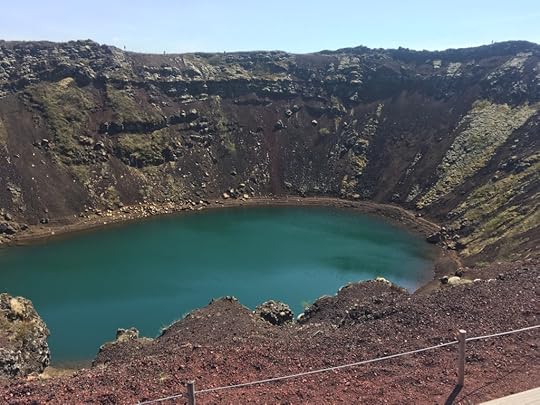
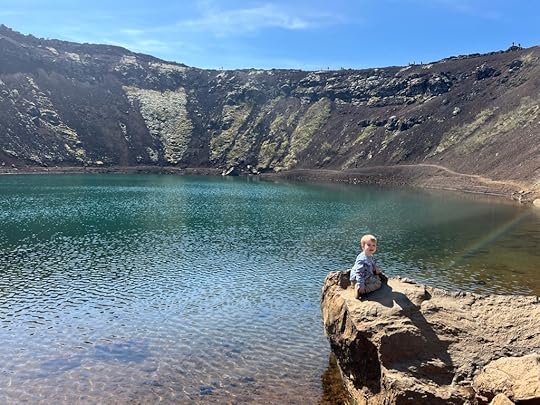
The cool thing about the crater was that you could hike all the way around it. The paths, the parking lot, everything was covered in the same type of red lava rock you can buy in bags at a garden supply center.
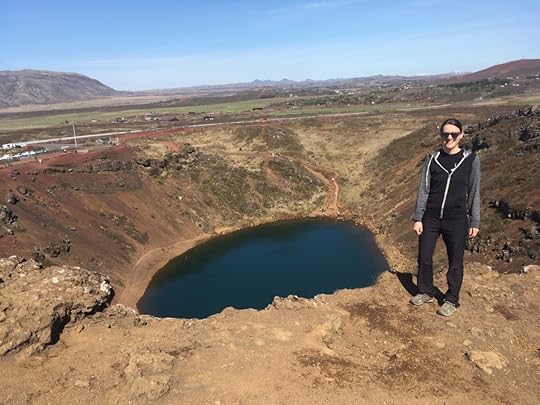
This pic cracks me up because there’s almost no sense of scale…it looks like I’m standing beside a puddle haha.
Although I confess this crater lake did look like a puddle when compared to Oregon’s Crater Lake.
Anyway, the day proved so nice that after a while I didn’t even wear a jacket, and when my pants fully dried I missed the pleasant coolness of the damp.
After the craters, it was on to the Strokkur geyser.
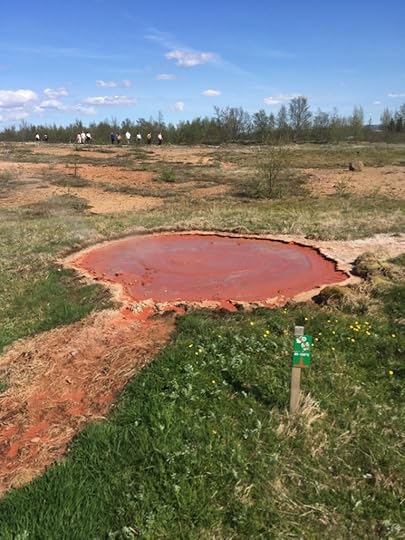
This was the first time I noticed that if you’re in an area with geothermal activity, there’s never just, like, one hot spring. The heat bubbles up from multiple points.
So as we walked toward the geyser, we passed a few hot springs, such as this pit of boiling red mud.
In my memory, the only other geyser I’d ever seen was Old Faithful, back when I was a teenager. Two things I recall from Old Faithful was that you had to stand pretty far back, and it gave you some warning before it blew, starting with little spurts before the full blast.
The first difference with Strokkur was that you could stand absurdly close to it. We concluded that the winds must be extremely predictable, because the tower of steaming water always fell to the north instead of west and on top of us.
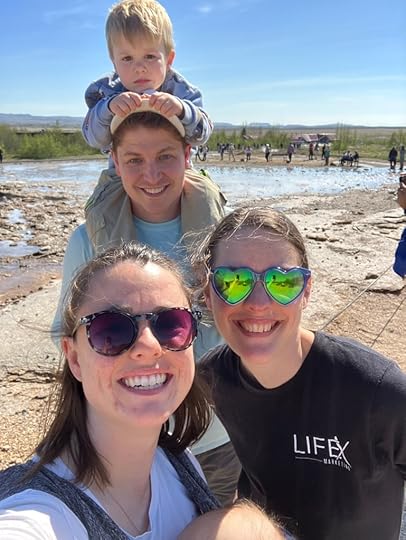
The second difference was that Strokkur blew often—Wikipedia claims it erupts every 6-10 minutes, but one interval was a mere 30 seconds.
And there were no warning spurts. It just exploded—ka-blam! like a Jack-in-the-box. I flinched and screamed every time.

Screenshots from the shaky video I took while flinching.
We went into the visitor’s center to use the bathroom and ended up staying a while because Daniel found a tractor to play on, with levers that actually moved!

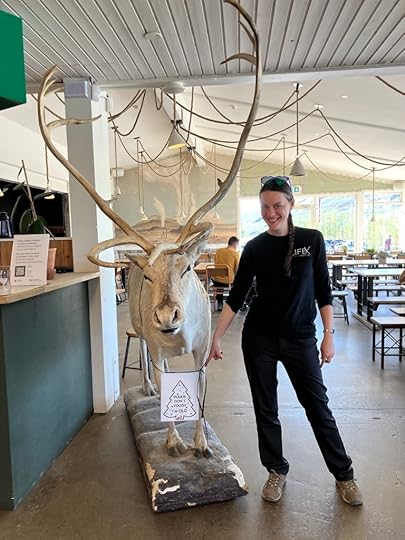
I pointed to the sign because I thought it was funny, but it sorta looks like I’m trying to be rebellious by pretending to touch the reindeer lol.
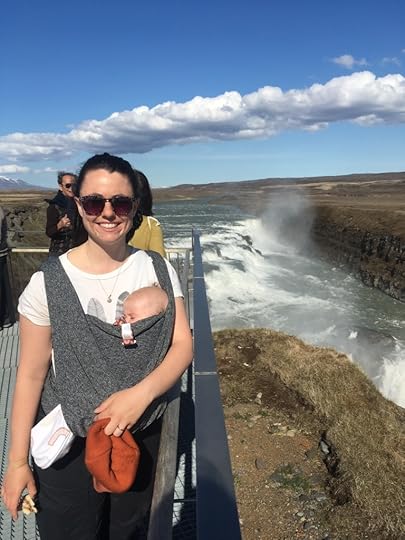
Then we went on to Gullfoss Falls. Or, I guess, just “Gullfoss” since “foss” means “falls.”
Gulfoss took my breath away.
From a platform at the top, we watched Gulfoss pour over layers of rock…
…before plunging over a fathomless precipice.
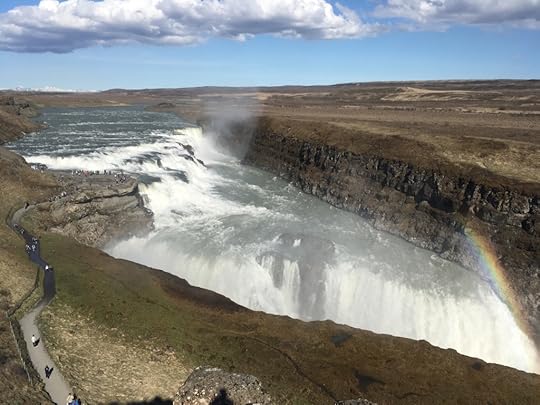
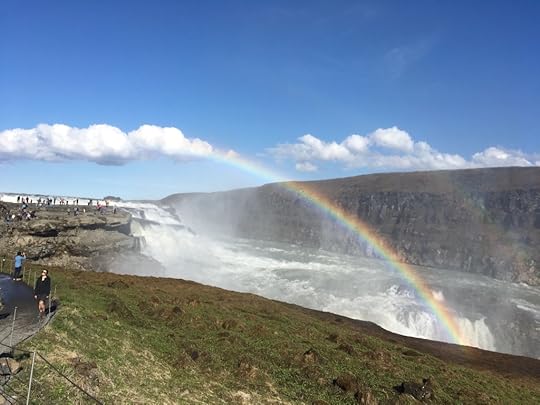
In the photo above, peep the folks on the rock to the left for scale. We wanted to get to that rock, so down the steps we went and along the path. As we approached the falls, the immense spray created a rainbow that framed it beautifully.
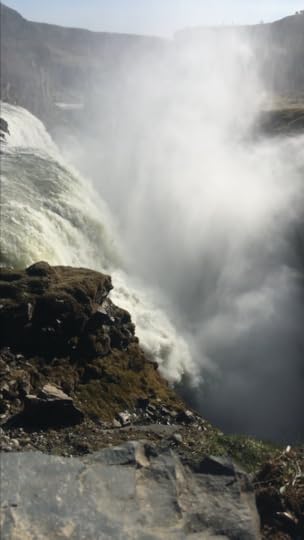
The top falls were immense, but it was the huge drop at the bottom that fascinated me. The water plunged into a canyon, and it was impossible to see the bottom through the massive clouds of haze.
Remembering the glacier boat guide, I sat down to watch the falls disappear into the canyon, and contemplated nature in silence for a few minutes.
Now that we were in the golden circle, everything was pretty close to each other, and we still had time for one more adventure.
“Hot springs!” I suggested. I’d been longing to visit hot springs since I arrived.
So we went to some hot springs in a tiny town called Laugarvatn. But it wasn’t quite what I expected…just an expensive swimming pool with a pretty view of the lake. It didn’t seem worth it to me. So I decided, instead, to take a walk around the lake.
I followed the gravel drive past the swimming pool complex, and there was a charming hot springs flowing out of a little grassy cave, along a stream into a round pool, and then on into the lake.
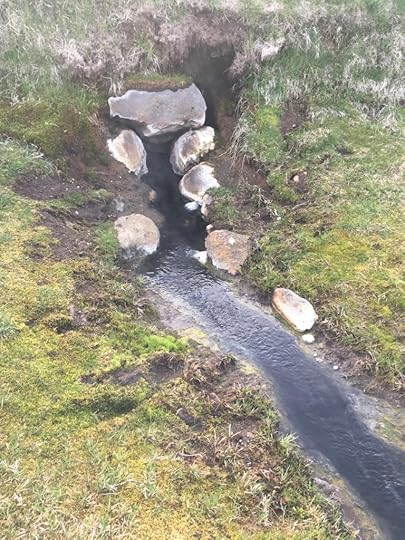
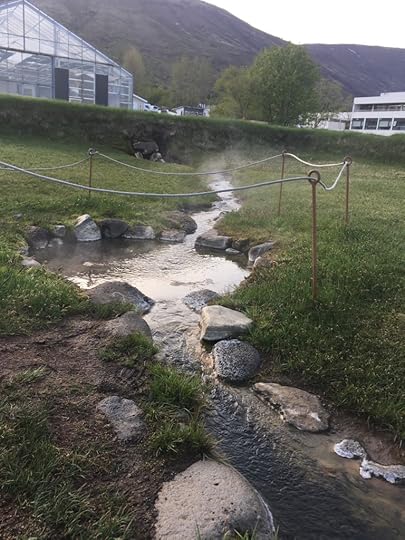
I later learned that this pool is called “Vígðalaug” and is over 1000 years old—by far the oldest manmade-ish thing I saw in Iceland.
You see, when the Vikings came to Iceland in 874, they were pagan, but they had some Christian influences, including some Irish priests who were already living on the Island when they arrived, and some later Christian missionaries. Over the next 100 years, enough people converted that religion became a huge point of contention on the island. Some people even suggested dividing Iceland into two countries—one Christian and one pagan.
But eventually, they decided to all be Christians, and in the year 1000 the pagans were baptized in this very pool of Vígðalaug.
You might think I’d like to take a dip in an ancient baptismal pool, but not only was it roped off, but it was full of the strangest looking algae I’ve ever seen in my life.
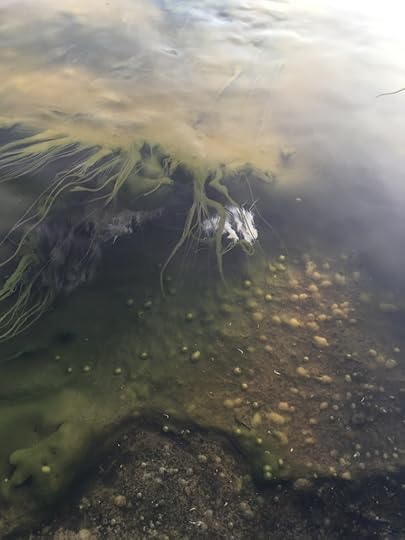
However, it flowed into the lake, and when I put my hand in the lake, the water was warm!
I ran off to change into my swimsuit.
When I returned and explored the lake a bit more, I discovered that there were multiple hot springs underneath the lake, observable by a slight bubbling on the surface. But when I tried to hop in and swim, I received a disappointing lesson in physics:
Hot water is a different density than cold water, and merely floats on the top instead of mixing nicely.
So I ended up sitting in shallow water next to one of the underwater hot springs, mixing the water by hand. If I stopped, the hot water on the surface felt scalding while the cold water tickled my legs below.
But I loved the experience anyway. And the view! Across the lake to the snowcapped peaks of…was this Vatnajökull, the ice cap in the east whose glaciers I’d explored the previous day? It was in that direction, at least.
Simone commented on my last post and asked me to talk a bit more about the “endless twilights.” Let me try.
It usually wasn’t until the evening—say, 8:30 pm—that we even noticed the sun getting low in the sky. Then we might think about getting out of the lake, and getting dressed, and waking Daniel up from his nap, and trying to find a place to get groceries.
We’d drive to the sketchy grocery store in town only to discover that they’d closed at 7 pm, and we’d look up restaurants and find out they all closed at 9 pm, only one random hotel restaurant was open until 9:30, so we’d go there.
Only to find that there were a mere five items on the menu—a random soup, the fish of the day, and three kinds of pizza. So we’d all order the fish of the day, and be absolutely blown away by the deliciousness of it all.
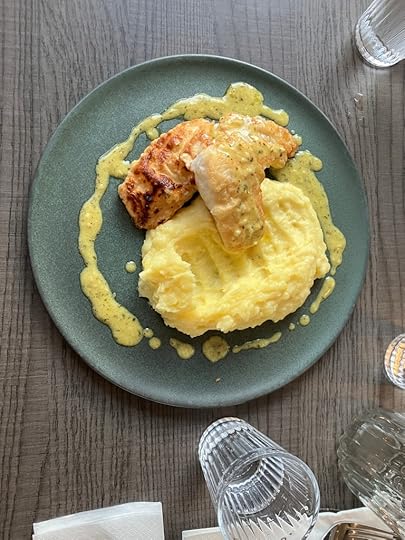
(Wowsers, I still remember that fish. Maybe because up until this point I’d mostly been eating hot dogs and peanut butter sandwiches.)
And we’d sit, and munch, and talk, as the golden hour sun out the window never set, and in this way, we’d all completely forget that it was almost 10 pm and we’d overstayed our welcome.
Until finally, someone would think to look at their watch, and then we’d pull out our phones to find a nearby campsite. And we’d get into our camper van and drive south, missing our turn and having to double back. And at some point as we were paying for our campsite and finding a place to park, the sun would set, but it would do so in such a gradual way, leaving such a quantity of light behind, that none of us would notice.
And it wouldn’t be until about 11 pm as I walked back from the showers that I’d notice, “oh yeah, it’s getting dark.”
“Getting dark” would have to be enough for us. We’d go to bed when the sky was “getting dark,” because it would never be DARK dark.
That’s what I mean by the endless twilight—the stretch between 8:30 pm and midnight when the world was bathed in a long golden hour that faded softly into a bright twilight that lasted for hours, and really never quite turned into darkness.
Our campsite that night was in a place called Borg, and it wasn’t much of anything but we didn’t need it to be. In typical Iceland fashion, it was in the middle of nowhere yet right next to a pool complex.
We woke the next morning to truly glorious, break-out-the-short-sleeves weather. We couldn’t believe it, and we paced around the camper van barefoot, feeling the spongy layer of moss beneath the grass.
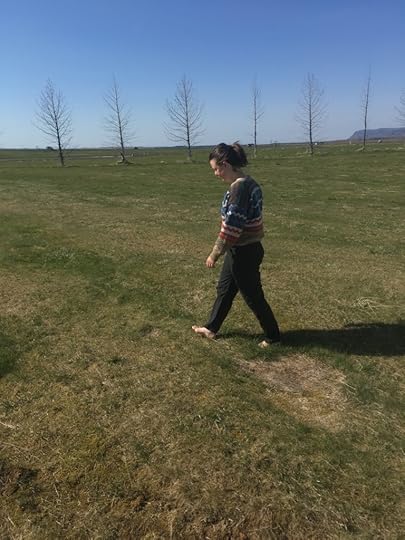
The main thing in the golden circle we still hadn’t seen yet was Þingvellir National Park (sometimes written as “Thingvellir.”)
Þingvellir is this magnificent area between tectonic plates, where you can literally see these canyons where the earth is pulling apart. Annie and I planned to hike around with the children while Stephen snorkeled between tectonic plates.
Unfortunately, Daniel was not particularly interested in hiking. First, he wanted to stay in the camper van and play with Legos. Then, when we finally got him out, he wanted to play on the large rocks that lined the parking lot.
At this point in the trip, Daniel had started to like me a little bit, but not enough for me to pick him up in such a circumstance and expect good results. So I offered to carry baby Hannah so Annie could carry Daniel.

My first experience baby wearing. Loved it!
I asked Annie to take a pic of me between tectonic plates, and Daniel decided he wanted to join too.
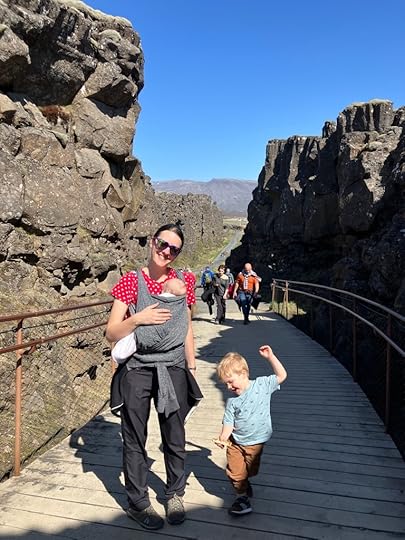
We hiked up to the visitor’s center, and learned some interesting history about Þingvellir. This area was the site of the old Icelandic parliament, which ran from 930-1798. In 1944, when Iceland gained independence from Denmark, the declaration of independence was signed at Þingvellir and there was a huge celebration.
I would have loved to spend more time at Þingvellir, hiking the trails and learning more of its history. But when Stephen finished his snorkeling excursion and we re-grouped, I was lured away from Þingvellir by the promise of something even more exciting:
Hot springs.
There was a free hot spring river called Reykadalur, Annie discovered, a 40 minute drive away. After hiking in about two miles, you’d come to a hot river where you could adjust the water temperature by moving further up or further down the river.
Yes please! Sign me up!
“But do you want to hike around here first? We can wait!”
I shrugged. “This will scratch my hiking itch.”
So off we went.
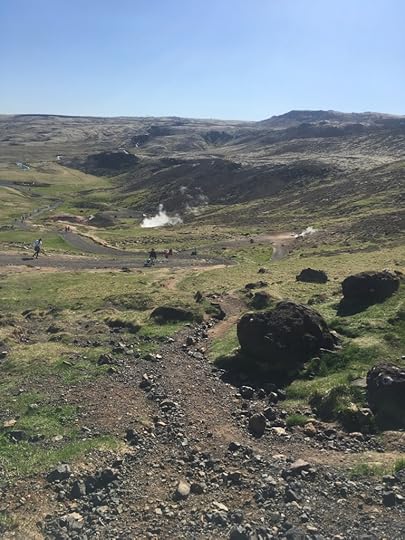
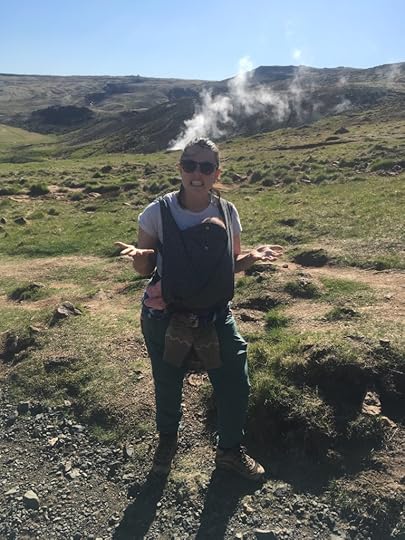
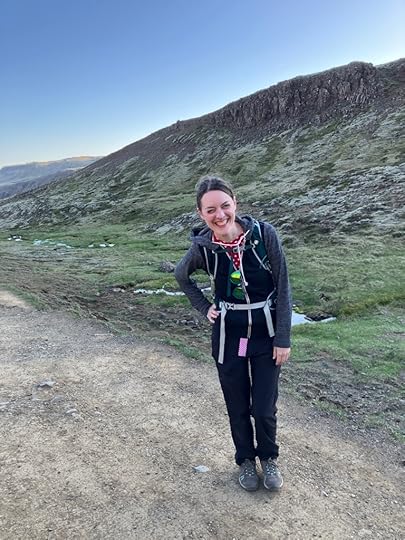
The hike was steep but very do-able. It wound up through these green hills dotted with plumes of steam.
“Look angry,” I said to Annie as I attempted to get a pic of steam rising out of her head.
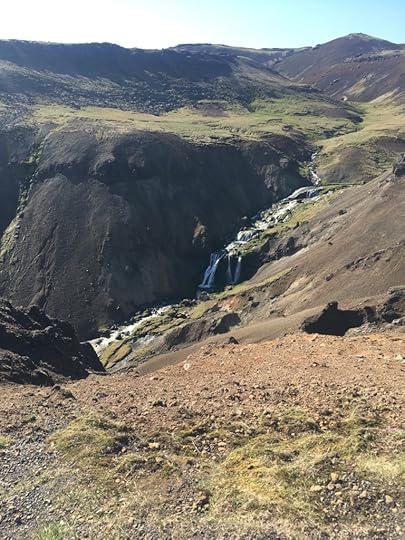
We also saw this waterfall on the hike, which looked impressive in person but predictably looks teeny-tiny in a picture.
Then, just as we were about giving up hope that we’d ever get there, we rounded a corner and there was a long boardwalk along the river with happy bathers in the water.
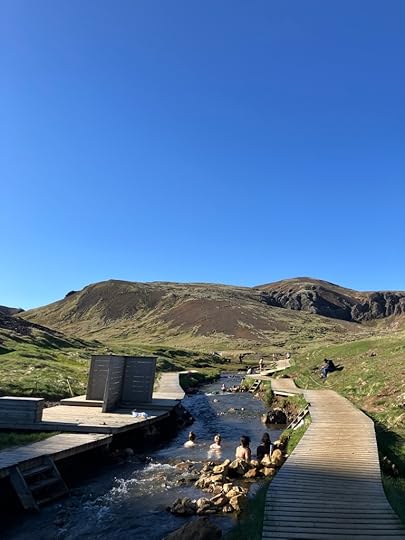
I was a bit unsure of what I was getting myself into since in Oregon, a lot of the hot springs are “clothing optional,” but thankfully the rule in Iceland seems to be “wear a bathing suit please and thank you.” The only sketchy situation were the “changing booths” which, as you can see in the above picture, only offered two walls of privacy. We all had to respectfully avert our eyes from that area.
But I came prepared with my swimsuit on under my clothes, and I hopped into the gloriously warm water and sat in the suspended timelessness of the golden hour.
Without my watch or phone, time seemed mystical, irrelevant. It wasn’t, because at a certain point grocery stores and restaurants would start to close. But it felt that way.
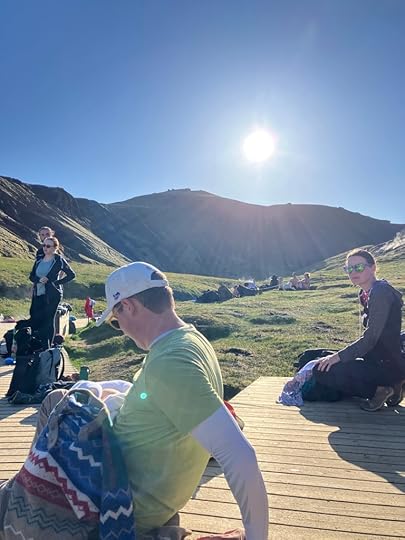
But eventually, we pulled ourselves out of the rushing warm waters, climbing across the slippery rocks and up onto the boardwalk to attempt to change back into dry clothes with dubious privacy.
It can be done, if you hold your towel strategically.
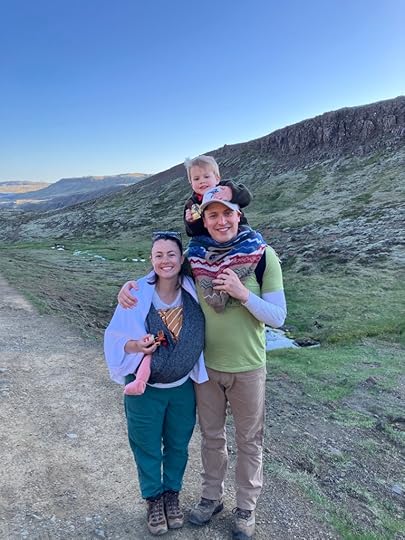
I took this pic on the way back down the mountain. “What a cute family!” I said.
Then they took a pic of me. “What a cute single person!” they said.
I laughed.
Back at the camper van and thoroughly hungry, we went to try to get dinner somewhere. But it was around 9:30 pm, and while we went to several places that said they were open, we found that their kitchens were closed with only the bar open.
“I’m sorry,” said one kind waitress. “Everything closes at 9. Everything. You could try the next town over…”
Instead of going to the next town over, we drove the 50 minutes back to the capital city of Reykjavik. Surely, surely, if anything was open this late it would be in Reykjavik.
And while it took some drama and trauma to find, including going to closed restaurants and being directed to other restaurants, we eventually found pizza. Pizza! Four boxes of it—a whole pizza each, if we wished. We piled the pizza on top of the camper van stove, drove to the Reykjavik campsite where it all began a week prior, stuffed our faces, and crashed into bed.
We’d done Vik, and the glaciers, and the Golden Circle…now all that was left was to explore Reykjavik, go to the Blue Lagoon, and fly home again.
May 22, 2025
East to the Land of the Glaciers
It was late when we pulled into our campsite at Vatnajökull National Park, and I felt a distinct chill in the air as I went to the bathroom to brush my teeth and give my phone as much charge as I could. It was too dark to tell that the chill came from wind blowing down the glacier.
At this point I wasn’t thinking about the glacier so much as my power problems. All my devices were dead. Unlike the previous campsites, this one did not have a communal dining area where I could work. “Let’s get up early tomorrow and book it for Höfn,” I suggested.
“But we’re in a national park! We should see at least a few things!” Stephen countered.
The truth was, so far on this trip, “let’s see a few things” always took much longer than we expected. And the hardware store in Höfn closed precisely at 5 pm. Besides, I needed to get some work done. So we compromised: We’d go directly east to Höfn and stop at one attraction on the way. When we got to town, we’d try to find a coffee shop or something where I could work for a few hours.
The attraction we chose?
Diamond beach, where chunks of glacial ice wash up on shore.
The next morning I woke, showered, and wandered up the gravel walk through the fog. Once again, I felt that distinct icy chill. I passed people gearing up in spiked shoes and helmets. It wasn’t until later that I realized I was literally at the foot of a glacier, I just couldn’t see it due to the fog.
I found the visitor’s center, which, while it didn’t have any place to work, did have outlets next to a display of children’s art. Better than the bathroom! I plugged in my devices and then sat at a chair a few meters away and wrote in my diary.
If I’m going to be honest, when I set off on this adventure I was a little worried that, staying in a camper with four other people, I’d become grouchy and irritable due to a distinct lack of sleep and alone time. Instead, I fell into a really healthy routine. After a day of adventuring I’d be so tired I’d put in my earplugs and fall asleep no matter how noisy everyone else was. Then I’d wake early and get an hour or two of alone time before the others were up and around.
We rolled out of the campground in the late morning, and the fog lifted as we drove east. “Look, there’s a glacier! And another!”
Later I discovered that all the glaciers were connected, flowing from the same giant ice cap.
I should note that way back when I learned about glaciers in grade school, I was very confused and could never picture what one would actually look like. I’d google pictures and still be confused.
It wasn’t until I visited Alaska in 2019 that I saw a real glacier. I’d hiked a mountain and was looking out across the landscape when I saw what looked like a river of snow sliding down between two mountains. Suddenly glaciers made sense to me: the snow that collects at the top of the mountains starts to slide down, due to gravity, and it all collects in the crevices to form what looks like a river of snow and ice.
So as we drove through Iceland, every time I saw something that looked like a river of snow I was like, there’s a glacier.
But I later learned it wasn’t quite that simple. Vatnajökull is a large pile of snow and ice—Wikipedia calls it an “ice cap” while a later tour guide called the whole thing a “glacier”—and all the glaciers we saw were little tendrils flowing from the main glob.
Here’s a screenshot of Google Maps so you can see what I’m talking about.

That big white glob in the southeast is Vatnajökull. Here’s a more closeup picture from Wikipedia.

So as you can see, each time I saw one of those tendrils flowing down I was like, “there’s a glacier!” with no clue how they were all connected.
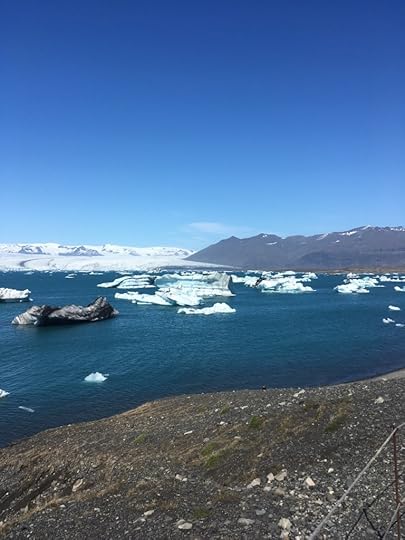
Diamond beach was a place where one of those glacial tendrils flowed into a bay and then on into the ocean. Huge chunks of glacial ice floated in the water. I quickly made tea and then walked along the bay with Stephen and Daniel while Annie stayed in the camper van to feed the baby.
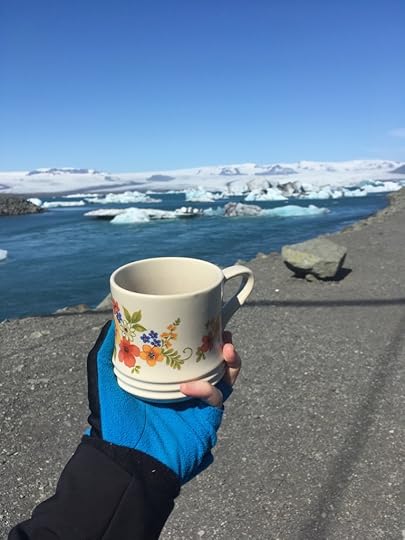
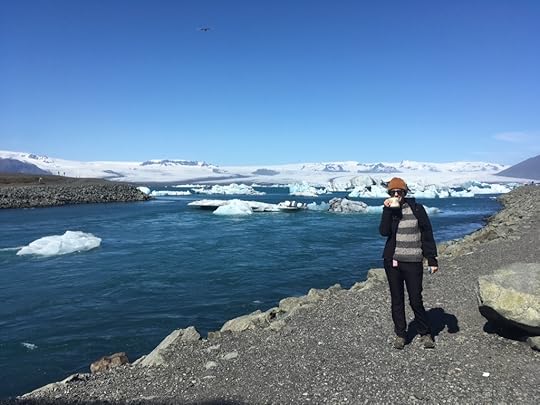
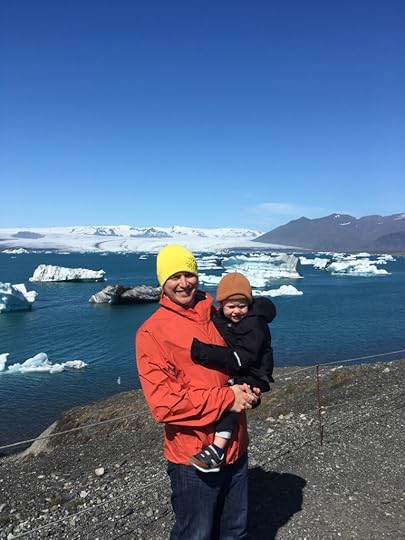
There were icebergs in the middle of the water, beanbag-chair-sized chunks floating swiftly toward the ocean, and a few teddy-bear-sized pieces washing up on shore. Stephen threw stones at one of the beanbag-chair-sized pieces, trying to break off chunks for us to look at.
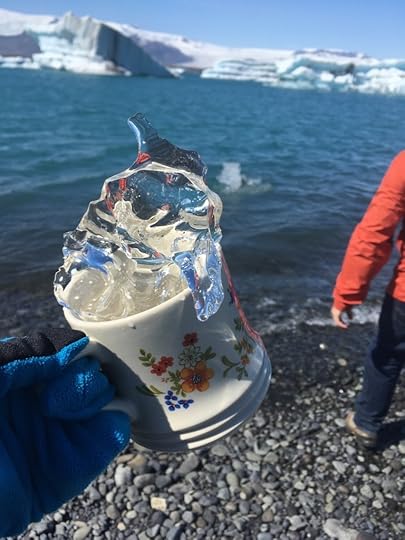
It’s hard to capture in a photo, but the glacial ice really did sparkle like diamonds in the sun. Turns out that ice that’s been compressed in a glacier for hundreds of years looks noticeably different than the ice from your home freezer.
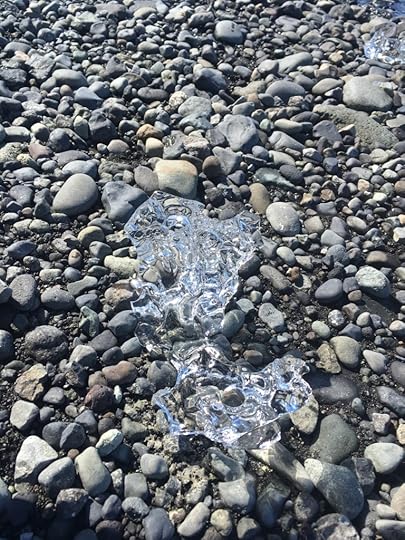
And yes, I ate pieces of it. I couldn’t resist.
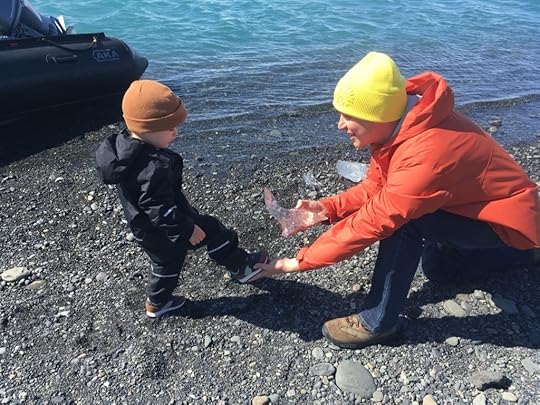
I thought this piece looked like Cinderella’s glass slipper, so Stephen and Daniel posed for a picture.
Then the bay ended at another black sand beach, where some of the larger, beanbag-sized chunks had washed ashore.
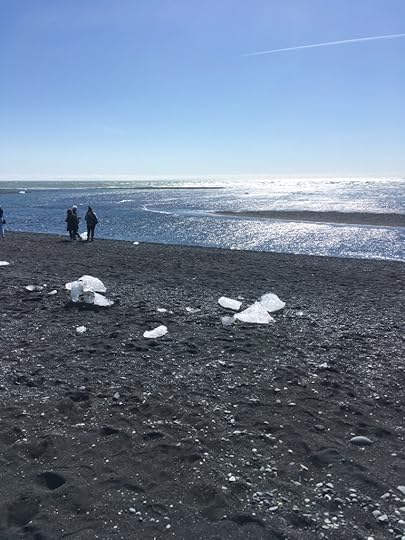
We were there for a while because it was just that gorgeous. But finally, on we went, bound and determined to find that hardware store.
Höfn was different than any place we’d been so far. For the first time since leaving Reykjavik, I got the feeling that I was in a place where real Icelandic people lived. We passed industrial-looking buildings with gravel pads outside littered with boats and old pallets.
Stephen took the broken cord into the hardware store, where they gave him the pieces he needed and then sent him to an electrician around the bay to put it together for him. Maybe that’s what made Höfn feel so real compared to Vik…there was an actual bay. Many of them, actually. The whole town was on a peninsula, with various inlets dimpling it here and there.
Also, there was no coffee shop, just a diner and a gas station. I’d assumed that if Vik, a town of 300 people, had a coffee shop, then the larger 2,000-person Höfn would surely have one. But I was starting to think Vik wasn’t a real town at all so much as a watering hole for tourists.
Annie wanted to find a playground for Daniel to burn some energy, but Google Maps showed absolutely nothing. But we did pass a swimming pool complex with a tall water slide. So the Sells dropped me off at the campground where I worked in the small communal dining area, and they went to the pool.
That evening, after plugging in the camper van (and putting a fluorescent yellow stocking cap on the gear stick as a reminder to not drive off without unplugging), eating a dinner of pasta, pesto, and questionable sausage (when I google translated the words on the package, the word “horseradish” came up), the three adults sat down to discuss the Future Of Our Trip.
The big question: should we continue around the ring road or try a different direction?
Pros of completing the ring road:
We’d gone this far, so we might as well finishPart of the fun was seeing new scenery on the drive, and if we turned back, we’d see old sceneryCons of completing the ring road:
We’d suddenly realized that most of the really cool things to see in Iceland are in the “Golden Circle,” an inland area east of the capital city of ReykjavikAlthough it looked on the map like we were almost halfway around the ring road, we were actually less than a third of the way around in drive timeDaniel, the toddler, was not doing so well on these long driving stretchesSo after much discussion, we decided the cons outweighed the pros. We’d retrace our steps the next day—Thursday—and try to make it to Selfoss, a town about an hour southeast of Reykjavik that marked the beginning of the golden circle.
Thursday morning I woke pretty early with all my devices fully charged (yay!) and went into the communal dining area to work while the Sells went back to the pool to try to get Daniel’s wiggles out before the trip. Around 9 am, Stephen texted me that they’d be ready to go soon. So I packed up, but they ended up being delayed, so I meandered along between the low-tide bay beds and the edge of town.
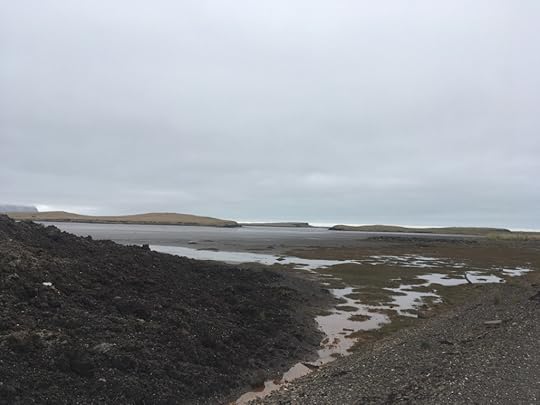
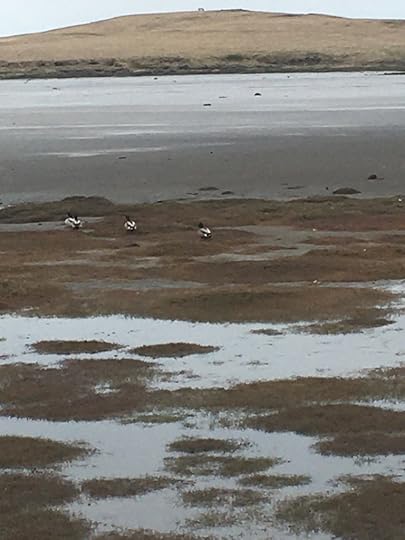
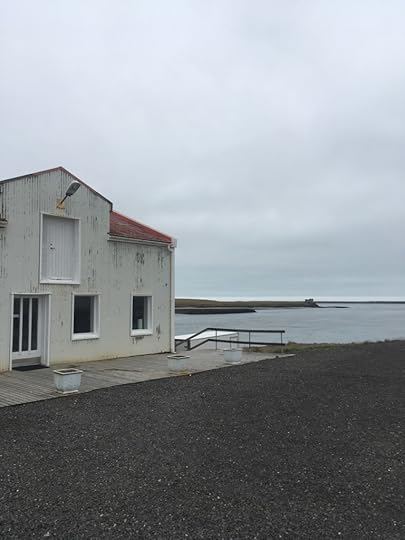
By the time they were ready to go I was back at the hardware store, so they picked me up there, and we were off, heading back west!
As we drove, Stephen told us about his experience that morning at the pool (He’d taken Daniel in while Annie waited in the camper van with the baby).
You may have wondered, before, why a town in remote Iceland with only 2,000 people and no playgrounds or coffee shops would have a large swimming pool complex with a waterslide. I mean, even a swimming pool in Iceland sounds bizarre. Who wants to go swimming in a place where it’s usually cold and snowy?
But for the Icelandic people, I discovered, swimming pools are the thing to do.
You don’t take your children to play at the playground, you take them to play at the pool.
You don’t meet your friend at a coffee shop to chat, you meet at the pool to chat.
Iceland has such a mind-boggling quantity of geothermal activity that these swimming pool complexes are everywhere, naturally heated by the earth or the abundant geothermal power of the country. They feature multiple pools with different levels of heat, from the hottest of hot tub temperatures to cooler, bigger pools for kids to play.
But even those pools are warmer than the typical American swimming pool, because they’re meant to be a warm place to play even in the bitter cold of winter.
Icelandic children get regular swimming lessons as part of their normal curriculum, so when Stephen was at the pool that morning it was full of school children. He said it was the most Icelandic experience he’d had so far.
On we drove. I didn’t mind going back through familiar scenery—in fact, it was fun to see it from the other direction. Look, the glaciers! But all was not well in the camper van. Poor Annie had barely slept all night, and she curled up in her seat to try to get some shut-eye with dubious success. Then the baby woke up hungry and began to cry.
Stephen immediately pulled off on a side road. It led to a business offering boat tours of a glacial lagoon. We quickly decided that Stephen, Daniel, and I would do the tour, giving Annie a chance to feed the baby and then get a good nap in the camper van.
Our tour guide was a young man named Matthias from the Czech Republic. He told me that most of the workers in the Iceland tourism industry aren’t from Iceland at all. He himself only spent half the year here.
“Do you speak Icelandic?” I asked.
“No,” he chuckled.
“How did you learn English so well?”
He shrugged. “American TV.”
I found it so interesting that the tourism workers were all foreigners, and I told him that this cleared up a mystery for me, as I’d wondered why the workers at the campground in Vik spoke Spanish to each other. Matthias said that half the people of Vik are actually from Poland—a fact I have no way to verify, nor do I know why Polish people might move there—but I found it interesting nonetheless.
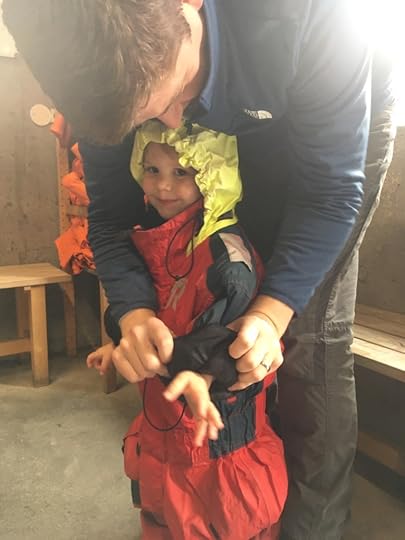
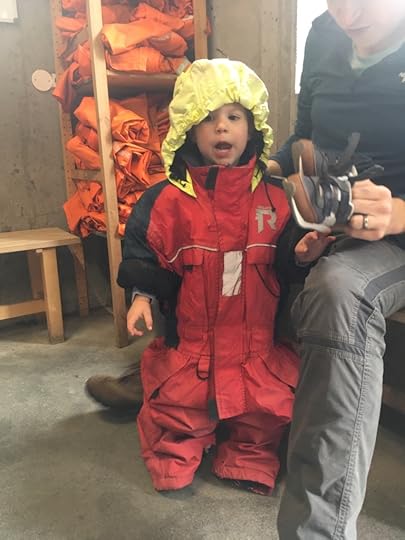
Daniel was given an outfit to wear that was adorably too big for him.
We walked over a small hill to a lagoon at the end of a glacier. There was a boat/raft there, and Matthias offered to get our picture, as he continued to do several times throughout the tour. I’m sure he thought we were a family, and I didn’t bother to correct him, but it amused me to wonder what he thought of this family where the husband did 100% of the childcare.
Oh yes, maybe I should have mentioned this before, but Daniel the 2-year-old did not like me. He was always convinced I was going to steal his toys. I blame my cousin Jason, who sometimes steals Daniel’s toys in a teasing way.
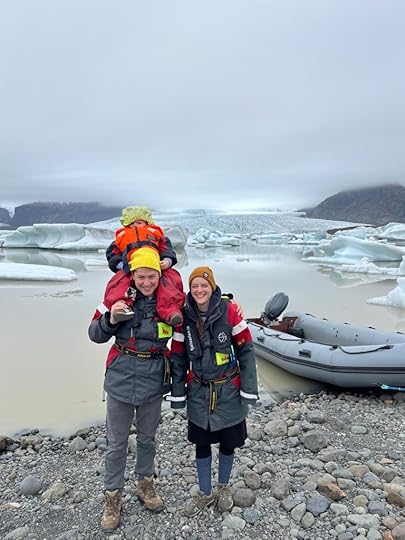
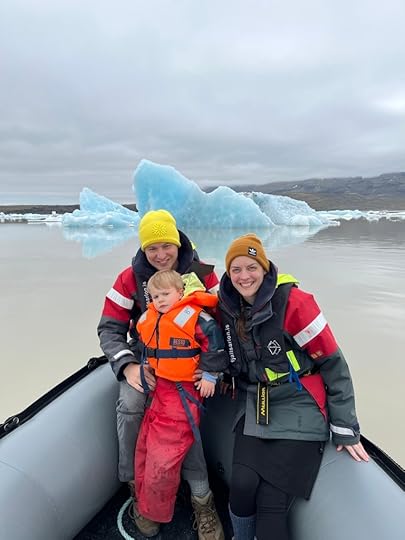
The lagoon was full of icebergs, some of which were this beautiful blue color you can see behind us in this picture here. Matthias told us that the blue ice was 500 years old, and was so compressed and compacted at the bottom of the glacier for so long that it looks blue. I felt vindicated upon hearing this, because I’d told Stephen a few days earlier that water is actually slightly tinted blue, and he didn’t believe me.
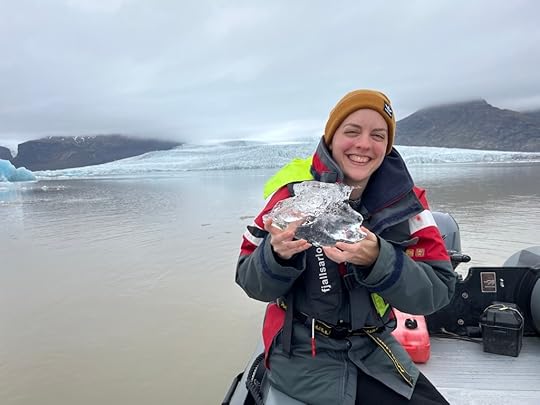
Me with a chunk of glacial ice.
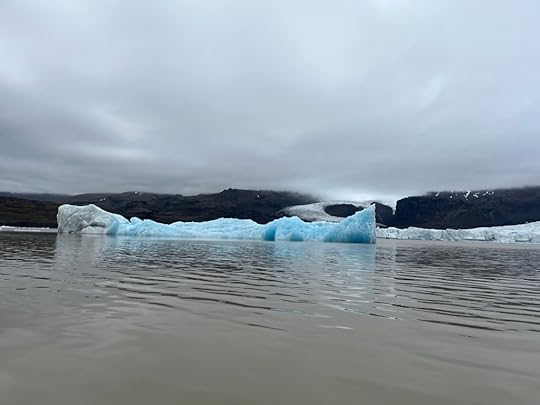
The lagoon was full of icebergs, and Matthias told us that we can’t get too close to them or stand on them because every so often they flip, and it’s dangerous.
The above picture is of an iceberg he pointed out to us that had flipped. The white part to the left was originally the floating part that showed above the water, and the blue part to the right used to be all underwater. But as some of it melted and the weight distribution shifted, it flipped 90°. It really gave me some perspective as to how much of an iceberg is really under the water!
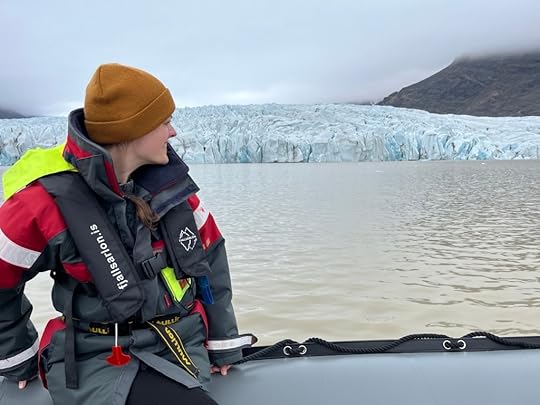
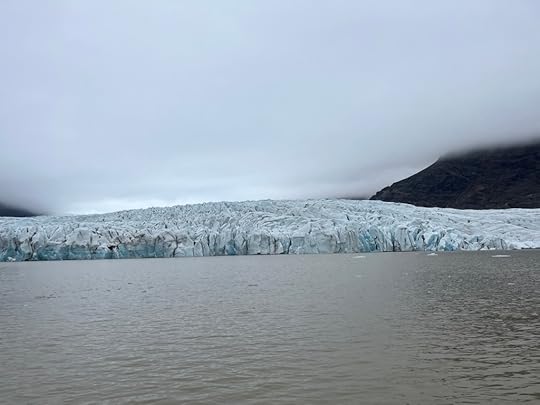
This is as close as we got to the glacier. We couldn’t get too close, because chunks break off every now and then, and it’s dangerous.
Matthias turned off the engine. “Let’s sit in silence for a minute and contemplate nature,” he said.
Poor Daniel contemplated nature so intently he fell asleep as we motored back.
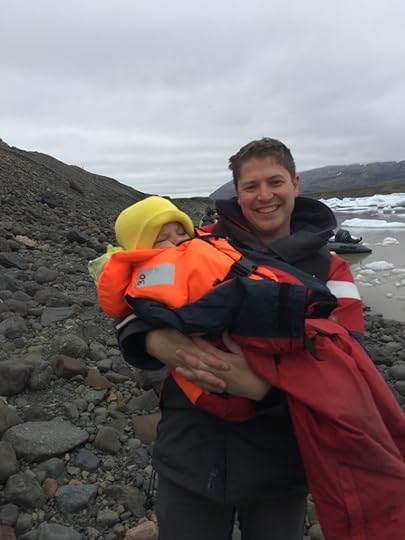
And then promptly woke up again, exceedingly grouchy, when we had to take off his suit to return it.
But Annie and the baby had nice refreshing naps while we were gone, and we made ourselves sandwiches and continued on.
Two unrelated thoughts were going through my head as we retraced our steps, driving once again through the wild volcanic barrens.
Thought 1: The weather has been remarkable
I’d been told to “prepare for every kind of weather,” warned about the drenching rain, and seen snow in the forecast in the week before we arrived. But every day so far had been nice, with no rain or snow, and only a few gray skies here and there. This day, Thursday, was gray and overcast, but Matthias had deemed it perfect because it kept the sun from reflecting off the glacier into our eyes.
Thought 2: I need to do laundry
My strategy was to do one load of laundry in the middle of the trip, and to that end I’d brought 7 t-shirts, 7 pairs of underwear, and 7 pairs of socks. I’d seen laundry machines at most of the campsites, but Höfn didn’t have any, so I hoped to do laundry that evening in Selfoss.
Since I assumed I’d be washing my pants that evening, I wore my “alternative outfit,” which was a skirt and fleece-lined leggings, and felt constantly irritated that I didn’t have a pocket for my phone.
Eventually Daniel reached such a level of crankiness that we decided to stop somewhere and let him burn energy and maybe nap. We were almost back to Vik, so we stopped at the black sands beach again.
After playing on the beach for a bit, Stephen took Daniel back to the camper van for a nap, and Annie and I decided to go get groceries. I was so excited. “I know the back way!” I said. “I saw it when we were in Vik before and I was up on the church hill!”
So we took the black sand trails from the beach, over the little bridge, and to the back parking lot of the grocery store/coffee shop/warm-clothing-supply-store complex.
Then, groceries in hand, we went back to the camper van for the long drive through the endless twilight to Selfoss.
At five hours of driving, it was our longest day yet. Five hours doesn’t seem long at all compared to the types of road trips I take with my siblings, but is quite tedious with young sleep-deprived children. But now, the long days of driving were behind us, as we prepared to spend the next few days exploring the sights of the Golden Circle.
At the campground in Selfoss, Daniel went to sleep immediately and the adults cooked and ate dinner. I went inside to see about laundry. There were machines, yes…but they each cost about $7 to run. $14 to clean my clothes, and who knows if they’ll be dry after the preset 45 minute dryer cycle?
Looks like I’ll be hand-washing underwear in the sink.
May 16, 2025
South We Go: Wandering Vik, Iceland
When you plan a trip in three days, and when you take along a baby and a toddler, there’s only so much you can plan. All we managed to do that first Sunday was get the camper van and drive 30 minutes to our campground in Reykjavik, and the only scenery we saw was fields of lava rock with mountains in the distance.
I slept like a baby (actually better than the baby) and woke promptly at 8 am. Getting out without waking anyone was a real challenge, as baby Hannah was sleeping in the stroller parked in the middle of the camper. I hopped from my bunk to the counter, then to the floor, squeezed past the baby, and grabbed my shoes and tea things from the closet. Then I pulled a sweater over my PJs and slipped out the door.
It was a drizzly, overcast day. I made myself tea in the hostel kitchen, sat next to a plant, and start writing a blog post on my phone.
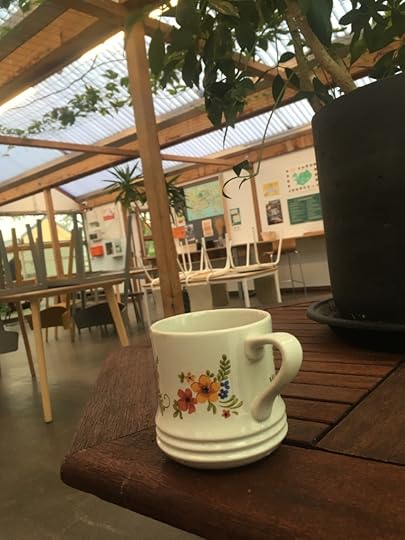
“Do you want some ponchos?” asked a man with dark hair and a pair of felt cherries dangling from one ear.
“No thanks,” I said. Then I re-thought my answer. “Wait…are you selling them?”
“No, I’m just giving them!”
Right. Like the Canadian couple, he was at the end of his trip, offloading things he didn’t want to drag home with him. “Okay, I’ll take them! Thank you!”
Eventually I returned to the camper for my laptop, thinking surely the others were awake now. But nope! Turns out I’d conked out a good three or four hours before everyone else and slept through a LOT of chaos.
It all worked out, though. As crazy as it may seem, I’m trying to also get work done on this trip as well as see the sights, and I was able to put in a few hours before everyone else woke up.
Still, by the time everyone had woken, showered, and eaten, it was long past checkout time, so we paid for another day and took our time.
The plan was to take the ring road around Iceland. But should we go North (clockwise) or South (counterclockwise) first?
“Obviously we should go North first,” I said. Being a clockwise girl, it had never occured to me that we might go counterclockwise around the Island.
But the nice Canadians who had showed us how to shift into reverse and given us their unused pasta recommended we go South first. “We did the ring road, and while the North was nice, we loved the South. We could have spent the whole time in Vik. Vik was amazing.”
Okay then. South it is. “That way, if we decide we don’t want to go North after all, we don’t have to,” I said. “We’re adults, we can do whatever we want.”
But first we had to get out of Reykjavik, and that was challenging. There’s nothing like a lot of stoplights to frustrate someone who’s not used to driving stick shift. Plus, we had errands to run, and we ending up visiting multiple pharmacies to find a medicine Annie needed. Hannah, who rarely cries, was inconsolable. It was too much. We pulled over in downtown Reykjavik for a break.
Annie focused on Hannah. Stephen focused on Daniel. I grabbed a PB&J and hopped out to wander and explore. Ah! The bay smelled just like home!
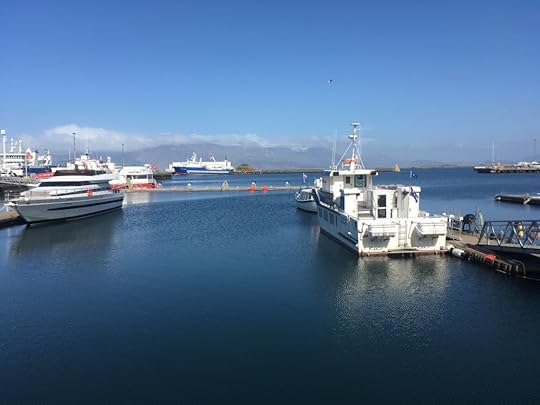
As I wandered between buildings, I saw what looked like a low fog along the ground. I came closer. Was that steam? What was it coming from? Then I saw a small stream that opened suddenly from the ground and cut through the pavement, growing wider and wider until it spilled into a bigger pool.
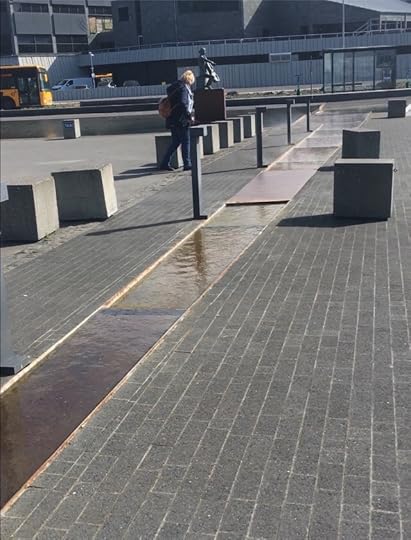
I stuck my hand in. It was hot! Geothermal water!
Still, I’m not sure why it was there. Do kids in Iceland wade in warm water during the winter like kids in other places wade in cool water over the summer? But surely you don’t want your child getting wet in cold weather!
Anyway. It was all right outside of this cool building.
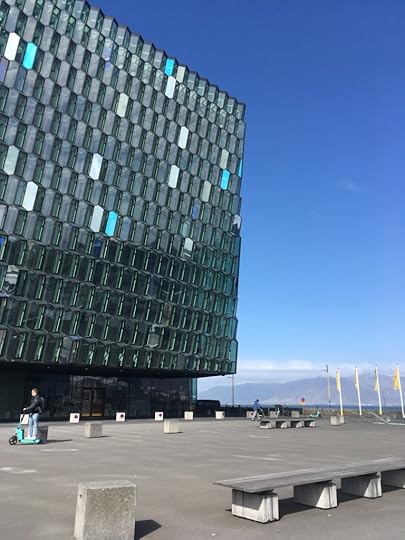
I had no idea what this building was, but I just looked it up now and realized it’s the Harpa concert hall.
Past the concert hall I walked along the bay, hopping from rock to rock until suddenly I saw this.
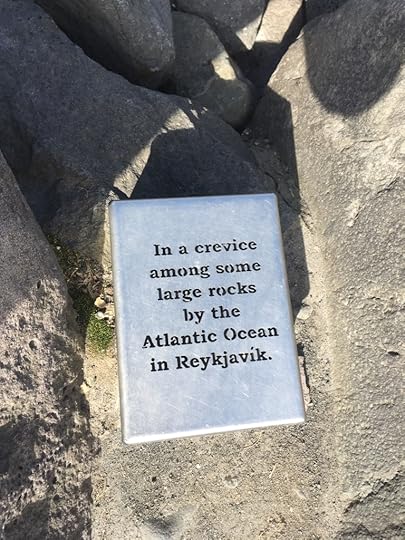
It was a geocache. But I didn’t sign the logbook because I didn’t have a pen on me. Of all times to not have a trusty pen in my hair.
Finally, after about an hour, the baby settled down, Daniel got his wiggles out by running around outside, and we drove South. Ah, nature and long straight stretches of road at last! We didn’t stop until we got to Seljalandsfoss, a famous waterfall you can walk behind.
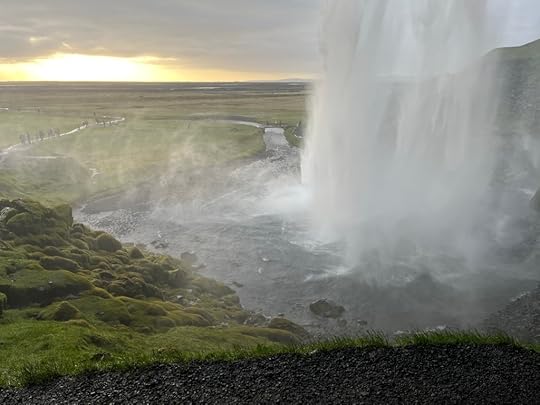
I pulled on the black free poncho, and Annie pulled the blue one over herself and Hannah. We walked out to the thundering falls. This is it! We are really, truly in Iceland.
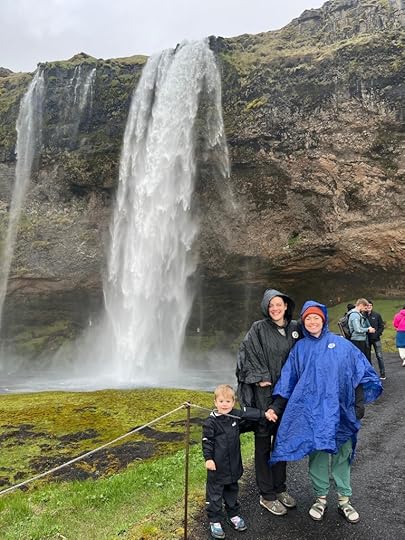
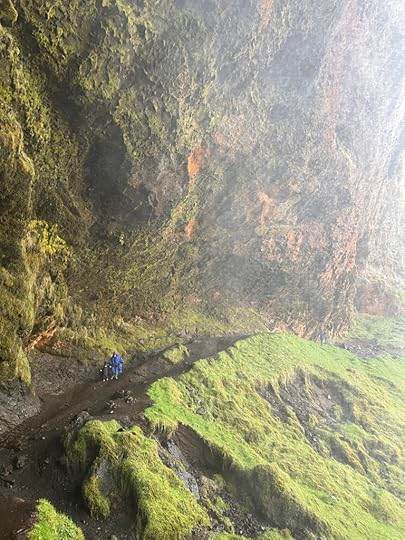
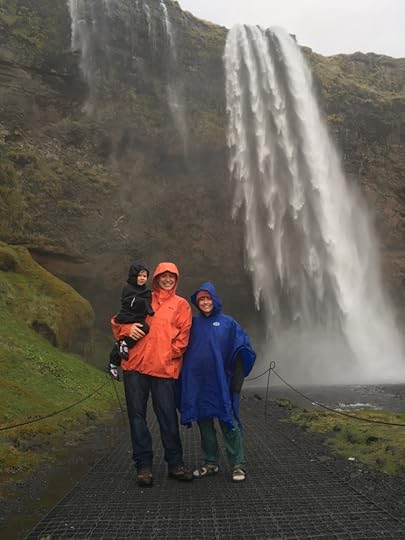
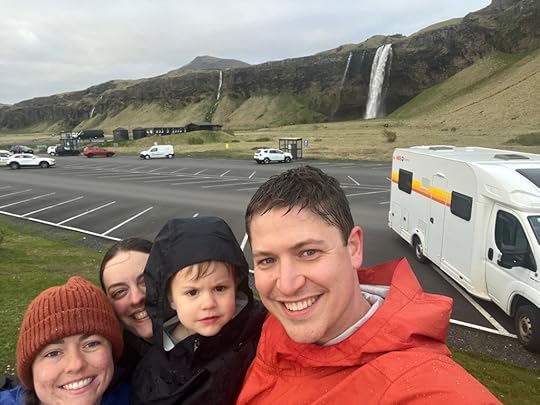
This is all of us in front of our home on wheels…except for baby Hannah who’s hidden away under a poncho somewhere.
We stopped at another waterfall briefly, and then went on, into the endless sunset.
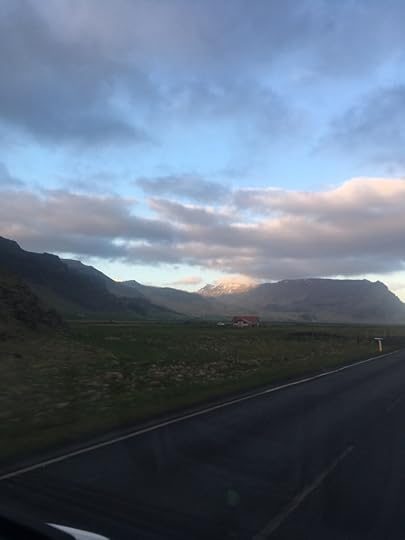
As we approached Vik, we saw a red-roofed church on a hill, bright and white in the deepening twilight. It was nearing midnight, and when we pulled up to the campground, we realized reception had closed at 11 pm. Oh well. We’d just pay in the morning. We found an empty spot, plugged in, set up the beds, and fell asleep.
The next morning I woke promptly at 8 am again, sneaked past the baby, and headed for the camp showers. But as soon as I saw it was a communal shower I decided I wasn’t quite that adventurous, and got ready in the bathroom instead.
It was time for a Charger Quest. In order to get work done I needed power, and they use a different sort of plug in Iceland. I had a vague idea that there might be a shop just south of the campground that would sell such a thing, and sure enough, when I looked across the field I could see the logo of the discount grocery store.
Walking through the campground and across two streets to the store, with the red-roofed church on the hill to my right, I started to get the idea that Vik might be small. Like, really really small. Smaller than Harrisburg, Oregon. Smaller than Halsey, even.
The grocery store ended up being part of a larger complex with a coffee shop and a huge store that sold every bit of warm weather gear you could want. Did Vik exist only to serve tourists?
I was easily able to find what I needed—a block that converted the Icelandic outlets to USB. Then I walked back to the campground, went into the communal dining area, made tea, and started working. Stephen joined me eventually, rubbing his eyes and making coffee, and then walked off to pay for the campsite.
He came back a few minutes later. “Reception closes at 11 am.” It was 11:10.
No problem—we’d just spend the day in Vik and come back to pay once reception opened again. Stephen pulled out of the campsite and drove over to pick me up in the communal area, inadvertantly forgetting to unplug the power cord from the camper van. And that, my friends, was the end of the power cord.
We headed off to the black sands beach. And it was glorious, reminding me of Oregon with it’s crisp breeze, dramatic waves, and cold, cold water on my bare feet.
At the same time, it was new and fascinating with its expanse of black, pebbly sand. Pictures can’t capture just how black the sand was, how smooth the pebbles were, and how satisfying it sounded when you clinked them together.
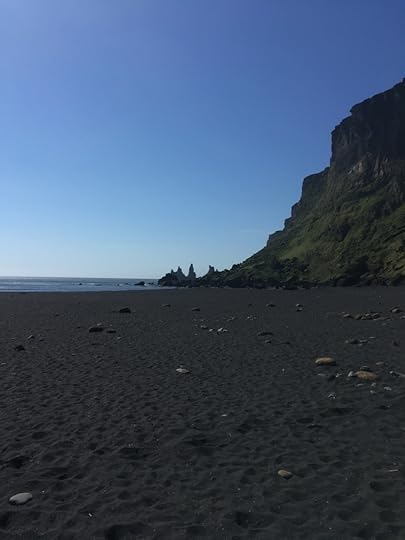
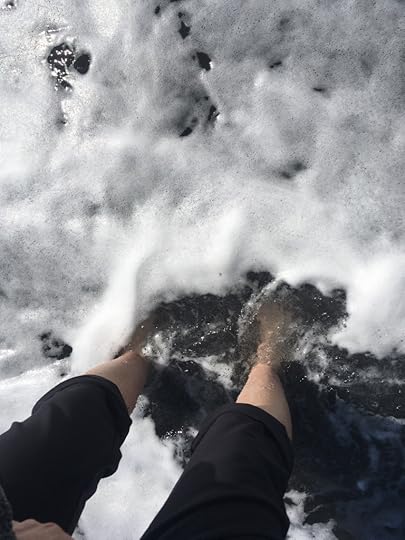
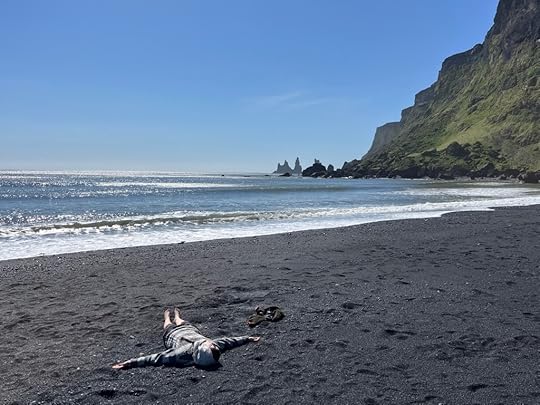
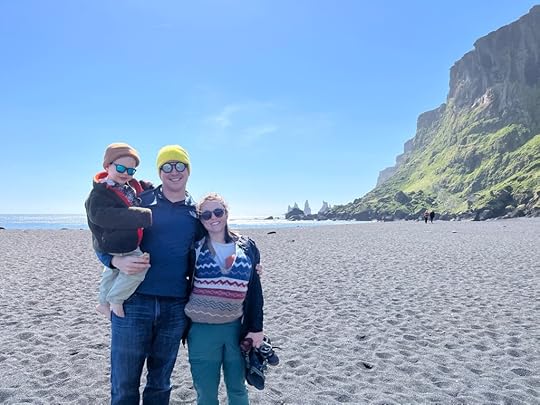
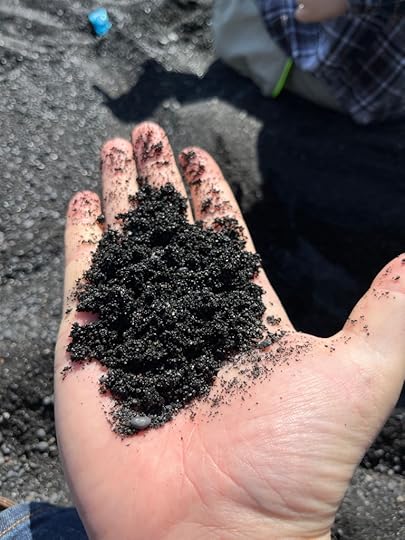
On the other side of The Big Cliff was an area where we were told we might be able to see puffins. So we got back in the camper van and drove there. Unfortunatly, there were no puffins. But there were views.
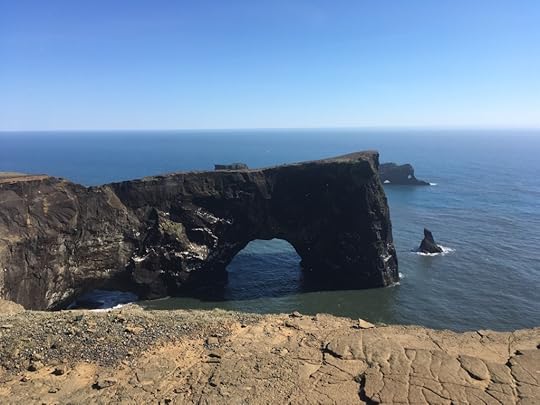
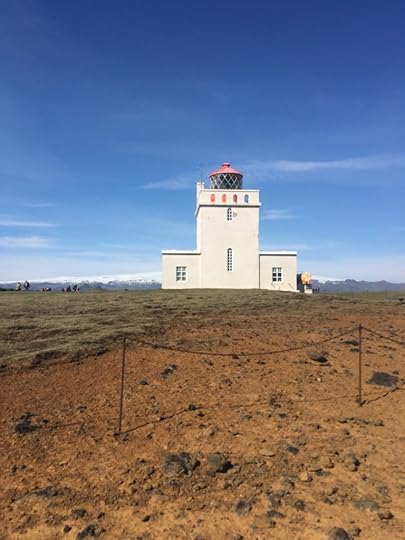
I’m realizing now that I didn’t take many pictures of this place, and I never bothered to get Stephen and Annie’s pictures either. But it was wonderful. We wandered the hills for a bit, looking at the succulents and other tiny mysterious plants that covered them.
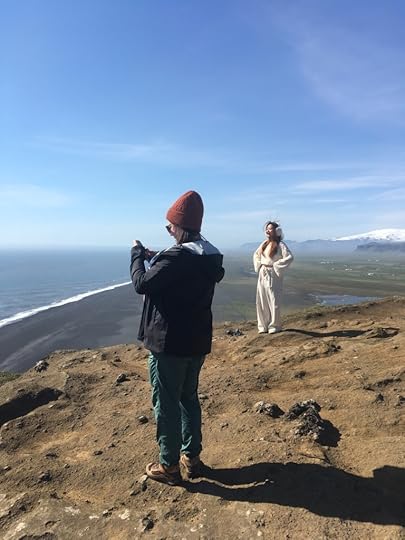
On this trip I made the decision to dress warm and practical instead of cute, and 98% of the people I’ve seen so far have made the same decision. The Icelandic people themselves seem to prefer basic black clothing. But every time I see someone deliberately looking great I’m fascinated.
Thus, I took the above picture of Annie while secretly actually taking a picture of the Girl in White.
“Imagine looking that cute while in Iceland,” I whispered to Annie later.
“I bet she’s even showered,” Annie whispered back. (She, too, was put off by the communal shower situation.)
By now, it was afternoon and we were ready to move on down the road. But first, we had to return to the campsite and pay. Guess what? We were too early.
It was 4:30 pm and reception didn’t open again until 6.
“I can burn an hour and a half in Vik, no problem.” I set off walking, leaving the others to take the camper van wherever they chose.
My first stop was the coffee shop, where I attempted to work for a while. Unfortunatly I’d burned through the power of all my devices. With my new power adaptor I couldn’t plug my laptop directly into the wall—I had to plug my battery pack into the USB port and my laptop into the battery pack. But with them both mostly drained I only was able to work ten minutes before the whole system died.
Still, I had a whole cup of jasmine green tea to finish, so I worked on this blog using my phone. And then, tea finished, I decided to walk to the church on the hill.
It was an easy walk. I went up the main street, turned down a short residential street, and there was a footpath up the hill. The whole hillside was flourishing with the most glorious lupines.

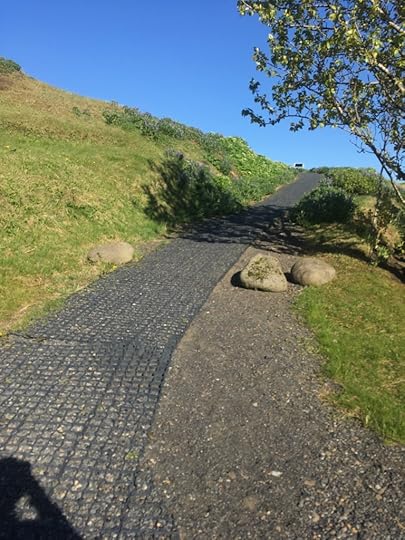
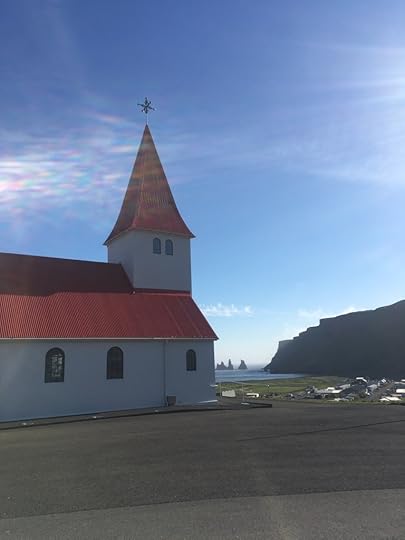
From the top of that hill, I could see the whole town of Vik. I could see the black sands beach, the grocery store/coffee shop/warm clothing complex, and the campground where we’d spent the night. I could see footpaths and bridges connecting these locations.
Then, I saw the most mysterious thing of all: behind Vik was nothing but a straight line sand and the ocean beyond. There was no bay. No harbor. No way for boats to land. How can a town exist along the Ocean with no bay? This puzzled me excessively.
It was 6 pm. Should I head back to the campsite? But I could see the campsite, and the camper van wasn’t there. I scanned the whole town until I finally saw our camper van parked next to a playground. After a bit, I saw Stephen walk around and climb into the driver’s seat, so I walked down the hill and met everyone at the campground.
With the campsite paid we’d solved one problem, but the power cord issue still loomed large. We needed a specific type of cord to connect the camper to the campground power sources, and they didn’t carry such cords in Vik. We had to go east to Höfn, but it wasn’t practical to drive all the way there that night, as the hardware store in Höfn was already closed.
“I think we can survive for a while without a power cord,” Stephen thought.
I was less hopeful. “I have to get work done somehow, and all my devices are completely drained.”
So we headed east, to camp at the foot of a glacier and book it to Höfn the next morning.
May 12, 2025
The Trials and Triumphs of the First Day of Iceland
Well, here I am in Iceland. It’s Monday morning, and I’m sitting in a hostel drinking tea. It’s been an adventure so far, though perhaps not kind you’d envy.
Our flight from Atlanta landed in JFK Saturday night, massively delayed, and we stood up, backpacks on, ready to dash to the next gate and beg them to let us on. Time ticked on as we impatiently waited to exit our plane. “They haven’t even opened the door yet!” The woman in front of us exclaimed.
Stephen and Annie instructed me to run ahead and tell the people at the gate to our Iceland flight that there were four more people coming, delayed by a baby, a toddler, and the stroller they’d checked at the gate, and beg them to hold the flight for us.
Right. The doors opened, and off I marched at a Brisk Clip. I did stop to help a man whose bag had hopelessly tangled with the metal railing. But I hurried as much as I felt I could.
“On your left!” Someone called behind me.
I looked back to see Stephen, Annie, the babies, the bags, and the stroller fully booking it through the airport. Oh, we’re running running. So I ran too, rudely pushing past people, and we got to the gate of the Iceland flight as the last two people were boarding.
A woman came up and stood in line behind us. I recognized her from our previous flight. “Oh, you’re going to Iceland too?” I asked.
“Yeah, I think there’s like 30 of us,” she said as more and more people joined our line.
So we all made it on and the mad dash was unnecessary, although I confess I enjoyed the thrill of literally running through the airport.
Five hours to Iceland. We left at midnight, jumped ahead four hours, and landed at 9am. Whatever dubious sleep we got on that flight was all the sleep we were going to get that first night.
Long story short, it wasn’t enough. But we made it to Iceland!
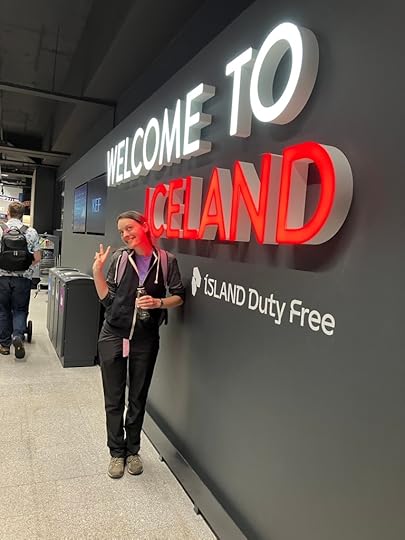
Thankfully Daniel slept, curling up in the storage space at the bottom of the stroller.
Next hurdle: getting the camper van.
This legitimately took several hours. As far as we could tell, there was no shuttle or anything from the airport to the rental place. So Stephen left his luggage with us and took a taxi. He quickly learned that the manual transmission of the van was much more difficult than the zippy little slingshot he’d practiced on.
Anyway. I don’t quite know what all took him hours, bless his heart. Meanwhile, we waited. “By the way, happy Mother’s Day,” I said to Annie.
When Stephen finally showed up, we hauled out luggage into the camper van and encountered the next hurdle: car seats.
I was so out of it by then, and I curled up on the back bed and fell into an almost-sleep as Annie and Stephen sorted out car seats. Long story short, the rental company provided car seats but didn’t give instructions on how to anchor them properly. Much discussion and frustration ensued.

Nevertheless, it got sorted out eventually. And with my almost-nap in the back for the duration of it, I was semi-functional again, and I took my place in the front passenger seat as Stephen drove and Annie sat in the back with the babies.
“Can I call you Chewie?” Stephen asked.
“What?”
“I feel like Han Solo, so you should be Chewie.”
“Okay!”
“We’re gonna make the jump to hyperspace, Chewie!” Stephen called, shifting jerkily into third gear. (We decided that Annie was Princess Leia, Daniel was C-3PO, and Hannah was R2-D2 since she only makes funny little noises.)
It’s funny…I don’t exactly see myself as someone who knows how to drive a manual transmission. But I discovered that I know a lot more than I gave myself credit for as I backseat drove that camper van.
“You need to push in the clutch when you break so you don’t stall.”
“Don’t shift back down to first until you come to a complete stop.”
“Shift into third! Can’t you hear the engine?”
I didn’t yell, but I did adopt “big sister voice” which may have been annoying. Nevertheless, though hungry and tired, we were all determined to have grace for each other and laugh instead of cry as much as possible.
The only thing I couldn’t help with was shifting into reverse. The camper van legitimately didn’t seem capable of going into reverse.
Next hurdle: getting groceries.
We were all committed to cooking our own food instead of going out to eat, so I directed Stephen around the copious roundabouts to Bónus, a grocery store that’s kind-of like the Icelandic Aldi as far as I can tell. We found a parking space we could pull through so we wouldn’t have to reverse, and we spent rather a long time there, as we all had to use the bathroom (our camper had a toilet, there was no water in it yet so we couldn’t use it), change clothes, and freshen up a bit.
Also, there were babies to tend to.
At one point I looked at my watch and realized it was 2 pm already, and I still hadn’t had any tea. Yes, I went through all of this WITH NO TEA. I kept thinking I was going to take a nap soon, and if I drink tea before I nap, I get sleep paralysis. But there was a coffee shop right next to Bónus, so I popped in and got a tea.
Followers on Instagram had warned me about egregious food prices in Iceland. But honestly, considering the fact that they have to import almost everything, I didn’t think the grocery prices were bad at all. And the tea from the coffee shop was about what it would be in the USA. We went around grabbing snacks, supplies for PB&J’s and hotdogs, and a few random things like cans of soup, prioritizing anything that looked “weird and Icelandic.” (And by “weird” I just mean unfamiliar…no shade to Iceland I promise haha.)
Fun Fact: my co-worker had told me that hotdogs were a big thing in Iceland. Sure enough, the grocery store had a large selection of random flavors with no English translation. Hotdog roulette! Fun!

Next hurdle: At the grocery store, we discovered we couldn’t get the camper van door to lock.
Then: when we got to our campsite, Annie didn’t think it looked safe enough to stay with unlocked doors. This caused a great deal of conversation and pro-con lists, until we discovered that you had to press the lock on the key fob before the normal lock on the door would work.
Did it make sense to me? No.
Was I just happy to have a place to stay? Yes.
Now, you may be wondering, “how can you possibly pull into and out of a campsite with no reverse?”
That, my friends, is a very good question. The answer is, you park very wonky, you almost hit a concrete planter box, someone in your party says “look, those people have the exact camper van that we do, maybe they can show us how to use reverse,” and someone else says “yeah but they look like they don’t want to be disturbed.”
It was nearing 5 pm by this point, and we were all tired and cranky and HUNGRY. All we’d had to eat the whole day so far was snacks. Time for real Islandic hot dogs.
The campground also had a hostel onsite, and while there were no fire pits, there was a bbq station and a kitchen area. We dismissed the bbq station as taking too long, and then spent ages waiting for the burners in the kitchen area to heat our food, before realizing that for some reason our particular stove was dysfunctional and I needed to switch to another.
So that whole process burned another…hour? I don’t know. But finally, finally, our fancy Icelandic hotdogs were cook and we adorned them with Icelandic condiments (hey! this one is sweet!) and chowed them down with a side of blueberries and carrots.
And that’s when things finally began looking up.
One interesting thing is that Reykjavik is the main city in Iceland, so while some, like us, were just beginning their Icelandic journey, others were ending it and offloading food and supplies to fellow passengers. One Canadian couple came up with a whole bag of groceries to give us. Then, as we spoke to them more, we learned a key fact: they were the couple from the camper van that was just like ours.
And, yes, they knew how to get it into reverse!
Turns out, there was a ring at the base of the gear shift you had to life up to shift into reverse. They showed Stephen, he practiced a bit, and that giant problem was now solved.
Hooray!
“Wait, but you’re still parked wonky,” I said when I saw the camper van again.
“Yeah, because it’s iconic,” said Stephen.
Honestly that was basically the end of the night for me. I was suddenly nonfunctional tired. But we still had to drive to a place where we could get water. “If I shower while you go get water, do you mind if I just crawl into bed while you do everything else you need to do?” I asked. (There were showers at the campground…we were using the camper van shower for storage.)
“Of course!”
So by 8:45 pm we’d lowered my bunk from the ceiling and I crawled into the sleeping bag I’d managed to bring in my carryon. “I’m about to start my introvert time. Is there anything else any of you need from me?”
“Nope!”
So I put my headphones in and pulled my sleep mask over my eyes. I wasn’t even trying to fall asleep yet, just introverting while the others rattled around the remaining available camper space, but I was out like a light.
Frankly, despite babies crying, adults snoring, and the sun barely setting, I slept amazingly. Earplugs and an eye mask work wonders, I learned back on my train riding days that I never managed to post about on here (although I’m slowly working through the tale on Patreon).
So the first day was a problem-solving day more than an adventuring day, as it turned out. But problem-solving is it’s own sort of adventure, is it not?
Until next time!
May 10, 2025
A Last-Minute Trip to Iceland
Life is a funny thing sometimes.
If you read my book, The Highway and Me and My Earl Grey Tea, perhaps you remember a time when I drove to Nashville, met up with my cousin Jason, and we stayed in a mansion with the Sells, a couple I didn’t know. When I asked Jason how he managed to snag such a swanky place for us to stay, he said, “My roommate’s friend has rich parents.”
Unbeknownst to me at the time, that was the closest I came to the place I’d end up living.
Jason’s “roommate’s friend who has rich parents” turned out to be a guy named Stephen Sells who, along with his wife Annie, toddler Daniel, and newborn baby Hannah, became my friends too once I moved here.
One evening I was hanging out at their house when Stephen out of the blue said, “we have all this time off work, and we’re thinking of renting a camper and taking a road trip out west. What do you think? You’ve done a lot of traveling.”
“I mean, it sounds like a good idea to me,” I said. It took me a bit to piece together the context, but essentially, with Annie’s maternity leave, Stephen’s paternity leave, and baby Hannah’s remarkable propensity to remain calm in most circumstances and sleep through the night, they’d started daydreaming travel plans.
“The other thing is…is there any chance you’d want to come with us?” Stephen asked.
“I’ll have to think about it,” I said. I genuinely wasn’t sure how serious he was.
As the topic was never brought up again, I assumed the plans were scrapped. That is until Wednesday morning, when I received the following text from Stephen:

This time, I felt like I immediately knew my answer: if I could afford it, then yes.
I don’t know…it’s Iceland! How can you say no to Iceland?
So I drove over to the Stephen and Annie’s place that afternoon, and the three of us sat in front of a computer screen and planned out logistics. Tickets! Lodging! Food! Can I afford this?
We started looking at camper van rentals. All three of us were really into the idea of tootling around Iceland in a camper van, cooking our own meals and saving money on lodging. But there were limited options on such short notice, and eventually we were stuck between:
Option A – a simpler van that sat five, but three of the five seats were up front, meaning no adult could be in the back with the kids
Option B – a slightly more expensive van with more amenities, but that had a manual transmission
Stephen likes driving and would prefer to do it, but is very dubious about his skills driving a manual transmission. I, on the other hand, should know how to drive a manual because I learned when I was sixteen, and every summer I end up having to drive a manual pickup on the farm, but even with all that I still have an embarrassing propensity to stall on that initial release-the-clutch-push-in-the-accelerator transition, and I always struggle to get the vehicle in third gear without accidentally going into fifth gear.
And besides, I don’t like driving, despite my inclination to drive nine hours to Ohio to visit my cousins and such.
But we eventually settled on the manual. “I’ll figure it out by the third day at least,” Stephen insisted.
I had to leave around 5 pm, but by the time I left we’d agreed to go for it. Stephen and Annie bought tickets that night. We were scheduled to fly out on Saturday…in a mere three days!
Thursday, I went on an expedition to buy Trip Pants. I almost never wear pants, as I’ve worn skirts all my life and think they’re much more comfortable, easier to fit, and suit my style more. But as I contemplated living for ten days in a camper van in Iceland, packing everything (including bedding) into a carry-on, the obvious solution was to wear the same basic thing every day, changing out undergarments and such. And the obvious item of clothing I needed was a pair of basic pants that would keep my legs warm and dry in the wet winds of Iceland.
So I went to a thrift store and tried on:
A pair that was comfortable but uglyTwo pairs that were too smallA pair that was perfect except the legs were four inches too short, and I can’t stand the feeling of thatA pair with pant legs so long they dragged on the groundTwo pairs that were tight on the lower leg, a feeling I can’t standFinally I found a pair that was decent in all respects except it was too loose around the waistband. So I spent an extra dollar for a pink-and-white striped belt. But seriously…how do normal worldly people ever find pants that fit, are comfortable, and look cute? Baffles me.
Meanwhile, Stephen Sells texted all his friends to see if any of them had a car with a manual transmission he could practice on. He ended up with this thing.

Friday I did a last-minute run to Walmart to buy melatonin, a sleep mask, fleece-lined leggings, and a bunch of random food items. Then I crammed everything into my carryon.


Today, Saturday, has been a scattered day so far, full of a bunch of little one-to-two-hour time segments before our long flight to Iceland.
Step one: meet up and Stephen and Annie’s to pack everything up.
Step two: drive to Nashville

Step three: Spend a few hours with Stephen’s parents at a new mansion in Nashville (they recently moved from the mansion I wrote of in my book).
Step four: Get Stephen’s parents to drive us to the Nashville airport
Step five: Fly to Atlanta

Stephen and Daniel (the toddler) sat on one side of the aisle, with me, Annie, and Hannah, on the other. One poor stranger had to sit in the middle of us, as you can see in the photos below.

Step six: layover in Atlanta
Step seven: fly to JFK
Step eight: layover in JFK
And then finally, the flight to Iceland!
Currently, we are on step six, slightly delayed and hoping we don’t miss our connecting flight. So far we’ve survived:
Somebody accidentally leaving their phone behind when they boarded the airplaneSomebody throwing a temper tantrumNevertheless, we are undaunted, we found solutions, and onward we go!
May 5, 2025
Never Such Devoted Sisters
Nothing makes you feel settled in a new place like having someone come visit you.
I see everyone in my family at least once a year, but we’re rarely all together at once, and Amy and Jenny are the hardest to get in the same room. Amy teaches in Thailand and Jenny teaches in Virginia, and their school schedules are so different that they never get the same days off (except weekends).
But somehow, we managed to snatch most of two days together at the end of March. Amy, on her annual pilgrimage to the USA on her school break, went to a wedding in Kansas and then hopped over to Chattanooga. Jenny made the five-and-a-half hour drive from Blacksburg on a Saturday morning and returned on Monday.
And oh, how fun to be the hostess! I started remembering. The last time I’d hosted my two sisters was in 2009, when I was living in Colorado. We watched Wives and Daughters and Jenny fell in love with Roger Hamley, never to recover. Then she got chicken pox. She did recover from that, thankfully, though she’s still a bit lovesick for Roger Hamley to this day.
***
Amy flew into the tiny Chattanooga airport around 10:30 am on the last Saturday of March. I picked her up and we drove to the Asian food store while she told me about the Amish wedding she’d just attended. Then we roamed the narrow aisles, picking up packets of mint, galangal, and hoisin sauce for all the wonderful meals she planned to make before the trip was over.
The cashier was from Laos. “Did you hear about the earthquake?” she asked Amy when she heard Amy was from Thailand. They swapped stories about various people they knew and how they’d been affected.
We’d just had a streak of glorious weather, so I was disappointed by the rain, gray skies, and thunderstorms predicted for the days my sisters were to be here. But the wisteria was out in full force. I never knew that wisteria grows wild, smothering trees in glorious dripping blossoms of pale purple, but we gasped and pointed at the magnificent displays as we drove home.
Amy attempted to nap while I fried some chicken, and then we commenced to make spring rolls—chopping veggies, cooking rice noodles, tossing the chicken with cilantro, mint, and peanut sauce—and then encasing it all in rice paper wrappers to dip into even more peanut sauce. Jenny rolled in at 1 pm, and we sat down to eat our bounty, sharing with David and Rebecca, the couple I live with.
While we ate, I glanced out the window at the gray sky. “If we want to take a walk before it rains, we should probably do it now,” I said.
David and Rebecca volunteered to clean up since we’d made the food, and my sisters and I grabbed our shoes and jackets and went out the door, laughing and swapping stories, catching each other up on the various dramas of our lives.
The walk wound around the golf course, and on the far side, I showed my sisters one of my favorite vistas: down the mountain to the various north Georgia towns that flow together into the general suburbs of Chattanooga. Jenny pulled out her camera and started taking snaps.


And then the first drops splashed on our foreheads and shoulders, and we dashed back, sweating profusely in the humidity despite the impending rain.
My typical Saturday consists of spending the afternoon at a coffee shop with our cousin Jason, where we both work on our writing, and then going to the Saturday service at church at 5 pm, after which I eat dinner at church and often head to Jason’s after for a game night with friends. So I dragged my sisters along for this ritual. And by the time church was over and the meal began, lo and behold, the sun actually came out, and we ate our dinner in the church courtyard.
It’s a curious thing, showing up to all your usual haunts with two sisters in tow after making your mark as An Individual for six months. I like giving context for who I am. I like being part of The Smucker Sisters instead of Just Me.
***
Someone told me to go see some waterfalls, as late winter/early spring is their peak. One of the closest waterfalls was at Lula Lake Land Trust, just down the road from my house. Lula Lake only allows tourists in one weekend a month, and the weekend my sisters were here was one of them. So I made a reservation with no idea if the weather would permit such an excursion.
Sunday morning, my sisters sat at home sipping coffee while I ran back to church for an hour to go to Sunday School, and as I drove home, it poured buckets. I sighed, thinking of the umbrella I left in Houston and my raincoat back in Oregon. No hike to a waterfall for us, I guess.
I came home to my favorite Thai meal of all: galengal soup. At least the rainstorm is good for something, I thought. It makes eating soup feel cozy.
But my sisters were undaunted. We are Oregon girls after all, and Jenny, warned ahead of time about the possible rain, had come prepared. I’d borrowed an umbrella from Mariah, and when Jason came over with his supplies, we found that between the four of us, we had two rain coats and three umbrellas.
It was enough. We piled into my car and drove to Lula Lake Land Trust.
And yes, the rain and dampness did cause our map to disintegrate and stick together to the point that we had to get another. But we persisted, marked out the hike we wanted to do, and then went on our way.
Before long, the rain cleared away, leaving only a gray sky and dense humidity. And then we came around the corner, and there was the lake and the waterfall.


That was the extent of the day’s adventures. We spent the rest of the afternoon sitting on the pink couch in the living room and talking. Moving outside to the deck when the sun unexpectedly burst forth, and then back inside when dusk settled. Catching up on each other’s lives.
The rain poured all night, and when we rose at 6:15 am to see Jenny off, lightning flashed across the sky. “Stay safe!” we implored her, pouring her coffee. “Prioritize your safety on the road over making your meeting!”
She laughed and promised us, then dashed through the rain to her car and was off.
But Amy was staying for another few days. I had to work that Monday, as it was the end of the month and I had some things I needed to finish up, but when the rain slowed to a drizzle she walked with me to Starbucks, and in the evening we went to watch a movie with friends. Tuesday, though, the weather was nice and I took off work and we made a day of it.
I took her to the North Shore first, an area here in Chattanooga full of walks along the river and touristy shops. It was while we were driving there that Amy looked at her phone and said, “Oh no.”
“What?”
“Mom just sent a message to the family group chat. It says, Putting this out there with Paul’s permission. And wanting your thoughts. He is on one of his Freight Train Great Ideas campaigns about this free dog on Craigslist.”
“Oh no,” I interrupted.
Amy gave me an I know, right? look and continued. “It would motivate us to take walks and I wouldn’t be as nervous at night when he travels etc etc. Which are good reasons I admit. BUT I think it would end up being his enthusiasm and my responsibility. He disagrees. Maybe he’s right but I’m pessimistic.”
I groaned. “This is a terrible idea. The last thing Mom needs is to feel responsible to take care of some dog. And Dad travels all the time.”
“Should I record you saying that and send it back?” Amy asked.
“I think you should just say that we both think it’s a bad idea.”
We pulled into the parking lot of a thrift store, but they weren’t open yet, so we drove on down the street. My phone buzzed and buzzed. I parked and then checked my phone to see that Amy had expressed our dubiousness, and various family members agreed with us.
Most of the shops were closed. It seems that people who visit the North Shore aren’t particularly early risers. We walked through the park and down to the river, shivering in the morning chill. Phoebe sent information to the family group chat about German Shepherds, and how much activity and stimulation they need to keep from growing bored and destroying your stuff.
The coffee shop was open. Amy and I wandered inside, ordered drinks, and sat in the upstairs room, flanked by exposed brick and large picture windows overlooking the river. She opened her phone and gave a startled exclamation.
“What?” I asked.
“Check your phone!”
I looked. Mom had sent an update. “Oh, I should add one more detail: APRIL FOOLS”
Oh man. She got all of us so good. None of us were remotely suspicious, and it was the best kind of prank in that we all felt relief upon discovery rather than disappointment or stupidity.
***
The shops finally opened, and we spent a glorious morning browsing them and visiting local thrift stores, until my growling stomach propelled us home, across the river and back up the mountain, to eat leftovers for lunch.
Then, the morning chill evaporated by the afternoon sun, we explored the various hiking trails on Lookout Mountain.


Finally, we reached Point Park, at the very tip, and gazed down over the city and the river.
“Look!” I said, pointing to the north shore of the river, “There’s where we were this morning!”


(This is a picture of me, intending to gaze over the city, but instead being momentarily distracted by drama in the group chat.)
We didn’t stay long, as we needed to hurry home, make dinner, and then attend a church event that evening. But I couldn’t believe I’d lived on this mountain for almost six months and never taken the the time to explore these trails.
***
The bad news: Amy left Wednesday morning
The other bad news: she had to leave insanely early in the morning.
The good news: she flew out of the tiny Chattanooga airport, so after I dropped her off I bipped back home in half an hour and went back to bed.
The other good news: I have sisters, and they are vivacious, interesting, kind, hilarious people. And we love each other and like each other. And we always find a way to be together, even in the midst of impossible schedules.