Sarah Sarai's Blog
September 8, 2025
HOW TO BUY MY POETRY BOOKS
So. Most of my collections - The Future Is Happy (BlazeVOXBooks) - Geographies of Soul and Taffeta (Indolent Books) - That Strapless Bra in Heaven (Kelsay Books) - and Bright-Eyed (Poets Wear Prada) are available on Amazon. Click here.
Bookshop is currently carrying two of my books - Geographies of Soul and Taffeta (Indolent Books) and Bright-Eyed (Poets Wear Prada). The advantage there is that a bit of the monies go to a bookstore of your choice.
Today is September 8, 2025. Things are changing all the time. Leave a comment if you have trouble finding the websites. And remember. WHEN IN DESPAIR
 , Google: Sarah Sarai + Amazon + Bright-Eyed


November 3, 2024
Bright-Eyed (Poets Wear Prada) 2024: Reviews keep happening
 Rain Taxi
. REVIEW by Jim Feast: links to an Instagram post
The Writing Disorder
. REVIEW by Ed Go
Rain Taxi
. REVIEW by Jim Feast: links to an Instagram post
The Writing Disorder
. REVIEW by Ed GoMER/Mom Egg Review . REVIEW by Jordan E. Franklin.
Compulsive Reader. REVIEW by Charles Rammelkamp
Tears in the Fence. REVIEW by John Brantingham
Necromancy Never Pays. REVIEW by Jeanne Griggs
Thanks always and ever to Roxanne Hoffman and Jack Cooper, publishers, Poets Wear Prada (Hoboken, New Jersey and Paris, France).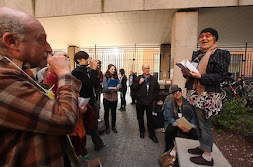 Sarah Sarai, 2010, or so.
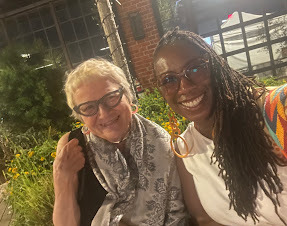 Sarah Sarai, 2023, with Stacy's Daughter, in L.A.
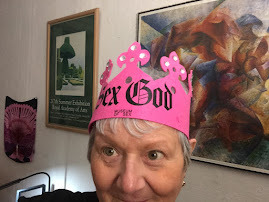 Sarah Sarai, Needing No Explanation, 2022
 Conjunction Sam, the Patron Saint of Editors
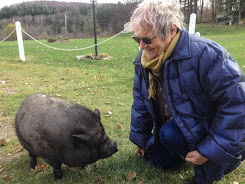 Sarah and Alice. Vermont.
PurCHasE! Go to seller of your choice, including:
Amazon
Bookshop
Abe Books
April 25, 2024
BRIGHT-EYED: The new poetry collection from Sarah Sarai & Poets Wear Prada
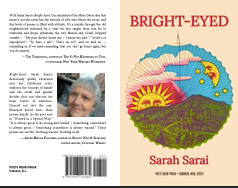 BRIGHT-EYED
is now available on Amazon.
BRIGHT-EYED
is now available on Amazon. from the back cover:
Bright-Eyed, Sarah Sarai’s deliciously quirky excursion into her California roots, explores the concept of family and the racial and gender divides that can obscure the basic truths of existence. Danced out into the sun-bleached So Cal heat, these poems dazzle. As the poet says in “Wasted in a Special Way,” It is always good to be young and loaded./Something, somewhere is always good./Something somewhere is always wasted. These poems are terrific. Nothing wasted. Nothing at all.
—Alexis Rhone Fancher, author of EROTIC: New & Selected
With Sarah Sarai’s Bright-Eyed, I’m reminded of the Miles Davis idea that music’s not the notes but the attitude of s/he who blows the notes, and Bright Eyes is filled with attitude. It’s a joy-ride through the old neighborhood informed by a vital wit that ranges from Sun Ra to Nietzsche and drops aphorisms the way Hansel and Gretel dropped crumbs – the past doesn’t haunt you/you haunt the past; youth is a superpower; To have a self:/That’s an art; and on and on – reminding us, if we need reminding, that you can’t go home again, but you do anyway.
—Tim Tomlinson, author of This Is Not Happening to You; co-founder, New York Writers’ Workshop
Order here: https://amzn.to/3PM90bH
BRIGHT-EYED is published by Poets Wear Prada, a press founded in Hoboken and specializing in beautiful paperback books. Roxanne Hoffman is founder and editor-in-chief. Jack Cooper is editor.
About BRIGHT-EYED: These poems reflect this native New Yorker’s family's move to California; growing up on the West Coast—the San Fernando Valley, the Crenshaw District, Echo Park, in the 1960s and 19670s as a preteen, teen, and soon an adult; and her responses to her new surroundings and the times. Several poems explore interracial tension and coexistence from the viewpoint of a young person whose older sister created an interracial family. The poet explores her relationships with her nephew, niece, their children, and her brother-in-law from the perspectives of both family and race. Her insight and wit are reminiscent of the California poet Diane Wakowski and James Broughton.

October 24, 2023
draft
all by Sarah Sarai 2022 Oct 24
Please Include a Short Bio Statement
My bed is a living soul.
I change the sheets weekly.
When trying to quit
I would smoke a few,
drench the pack,
tweak out,
dry cigs in the oven,
light up.
The fire that time.
No one showing for my funeral,
especially the twittering phobic,
doesn’t faze me.
Everyone knowing the twittering
phobic don’t show for my funeral
equally fazes me not.
Can I swing retirement in Belize?
Oman’s not working out
as I’d hoped.
Speaking abstractly,
penises can be beautiful.
Breasts are the world.
FAMILY SECTION
Be Holding Dr. J -
Be Aunting
I sent my great-nephew
a collection of poems on perfection,
mastery, the work, this whole
being alive thing, being Black
(which I’m not but my nephew is
is and my great-nephew is).
He is in 12th grade. Status schools
have been scouting him for his
brain, big, analytic, mathematical.
The collection is Be Holding.
It is an ode to Dr. J.
The poet is Ross Gay.
If you are reading this, Ross Gay,
who I have not met, thank you
for your gift to the all of us.
I hope my great-nephew’s life
is floral and expert and California-
worthy. I want it beautiful
and open, glorious, sure, I’ll take
glorious, in this untrustworthy world.
“split at the root” Adrienne Rich on being half Jewish
Half Christian
Big Little Lambs
My nephew and niece,
half-White all-Black,
don’t care about my divided self,
my split-at-the-rootness,
Christian blah blah Jewish blah blah.
White + white is two whites
spooning in a pudding of white.
With all respect to my folks.
Hey, I know Black is not
for sure saintly as most saints
are not for sure saintly.
But for their time on the rack.
Let’s rest this poem on an oven
rack as if it were lamb led
to dinner, a lamb dripping with
blood, connection, and shame.
This poem is heliocentric as
the ego basking in itself.
Nephew and niece, they grow,
like we’re said to in California,
sprouting leaf after shiny leaf
happy as neon or sundrops.
Erin thanked me for the fifty!
Come on. Sing Happy Birthday.
No One’s in High School These Days
We graduate with contrastive badges,
weirdo girl, prom girl, high i.q.-girl,
neutral girl in the bleachers one row
behind puffy coat-wearing skinny
page-girl girl next to goofy boy
jabbing her car-coat’s loft, pow,
pow, right index finger, pow pow,
left index finger, lipping You look
fat in this coat, pow, and neutral girl
thinking Shut up and skinny page-
girl girl thinking she’ll skip the coat
next week, nerdy girl, abused girl,
abused girl, abused girl, pot-dealing
girl, acid-dropping girl, girl who in
seventy years will be not-so-bitter
girl, immovable past girl, future girl.
Shock-White
i.
After my mother died from Jesus I left my hair color alone. If it’s just fucking you want, or all you can handle, a decent cut will do.
ii.
We laughed, me and her, when she stopped. It was the same faded blond she’d been covering.
iii.
Once I quit, my hair prospered gray and white and where you rubbed my nape, auburn, like my locks when California sun baked them red. When I was waiting to be something or someone. And still didn’t realize the woman who was my mother read only that bit of her job description on good shoes and teaching four daughters how to assemble do-it-yourself installations of shame.
iv.
In the year of covid-fear all the hairs on my head turned shock-white, all white, only white.
v.
Back when Mom was killing herself in the name of Jesus my next oldest sister jumped shock-white. She did that over and over pleading thing, too. Stop, stop, stop. No changing Mom, is what I knew.
vi.
Though one time I floated my theory on the limitations of Jesus, who I like outside of church. Mom kept dying.
vii.
Volition and a misreading of human possibility. Are the careless and evil winning?
How Brilliant Beethoven
If my father believed he needed to arm himself against the insanely damaged carrying rapid-fire to end everyday schoolkids with still-squishy bodies perfecting daffy walks, or teens with their dreams of endless horizons after high school, some part of them knowing life doesn’t give up on its challenge but that youth is a superpower. Well, if my father owned a gun he’d have fumbled opening the safe, shouted at my mom and sisters to be careful as he lifted a lockbox from the safe, trembled working the lockbox and shaken on realizing nothing left to open but a box of bullets and opening that would call the question. He’d have howled there was no locked box in the lockbox in the safe, not that we ever owned a safe or lockbox to lock in it, insisted we were moving back to New York. My mother, who was Christian, would have taken gun and bullets from his twitching hand to load the pistol. She gave birth four times and also could drown mice in the toilet or a pail of water. She would not have shot anyone, would have denied the weapon existed then read Bible and attendant texts while my father, calmed by a shot of whisky, demanded to know if I had read Robert Louis Stevenson yet and if me and my three sisters, each far older than I will ever be, had a clue how brilliant Beethoven was.
great Weather for Media:
The “Was That Your Sister’s Vagina?” Monologue
I’m not judging,
but there’s a vagina on
your sister’s profile.
Likely not your sister’s
vagina but it is a vagina,
winking at whoever
drifts by, signaling
rest in a storm or
no rest for the stormy.
Maybe statement art
mixed message-y
yet a necessary reminder:
A vagina is not an
insta-salve for loneliness.
Estranged are the many
from their heartbeat.
Please tell your sister
about the vagina on
her profile. Remind her
to check her settings,
and also that Auntie
would love to hear
from her. She didn’t
answer my last email.
This Way and That
It was a fairy funeral. [William Blake]
On the garden bed of
Blake’s fairy procession
roll this and that, these ways
of midnight pleasure
in enchantment and
commonplace wisdom
like don’t touch the fairies,
they’re sensitive.
Act within a soul
populated by
sightings and wistful affection,
see the filmstrip is at
high-enough speed
life’s fluidity’s felt,
as at the funeral Blake saw,
a bodylet laid out on a leaf.
Authentication enough for me
[that fairies exist] I e-mailed you
who reminded me
Blake saw God when he was
four. God got down on Her
omni-aching knees
now and then to spy on
William Blake
and could hardly contain Her
infinite self, waiting for
the artist to become Heaven and
those paintings to be flashed to
the good and bad alike as proof of
the great mystery of vision
even She can’t figure out.
August 5, 2023
Pine Hills Review LOW-LIFE MALIBU (a #poem)

Adventurous lit journal Pine Hills Review is published at The College of St Rose in Albany, New York.
Pine Hills Review, "Low Life, Malibu" by Sarah Sarai.
Dig it. And also, the perfect image.“Lunch Break” by Nicole Monroe. That's what life felt like when I was young and shiftless.
Check out the PHR submission policies for art and poetry and prose.
The end. (Sorry to be so brief.)
Shout out for Pine Hills Review #poem #phr #pinehillsreview
Adventurous lit journal Pine Hills Review is published at The College of St Rose in Albany, New York. It's all good, which is not meant in that appeasing way "all good" can be misused. "You didn't mean to knock my eye of of it's socket? Don't worry. It's all good."
The binding element of online journals is the visuals. I like to read. I like to read. I like to read what people write. So all of that plus great artwork, culled from the reaches of the web. Or however art is culled these days.
Take a look via the following options:
Google "Pine Hills Review" and see what pops up! Most likely it'll be Pine Hills Review, linking to the Pine Hills Review. Or it could be the Pine Hills Review page on Facebook or the assisted-living facility in North Dakota. There are selections galore.
I mention all this because I was going to celebrate my recent Pine Hills Review publication of "Low Life, Malibu" (a poem). Consider it mentioned. In fact I was going to post the poem, but why, when you can simply click. Please do so:
To repeat: Pine Hills Review, "Low Life, Malibu" by Sarah Sarai.The perfect match of an image, “Lunch Break,” by Nicole Monroe, pulls it together. (Things are out of control, here.)
When you are sated check out the PHR submission policies for art and poetry and prose.
July 31, 2023
Their Every Yellow Leaf #poem #NewOhioReview
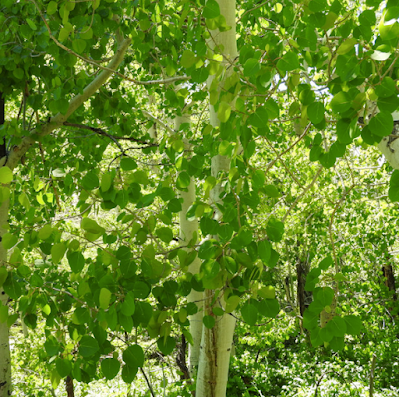 Aspen leaves still green but ever fluttery.https://budburst.org/plants/38
Their Every Yellow Leaf
Jacinth looks at the pig and
asks what she did in another lifetime
to be so beautiful.
Maybe not everyone would see it
but she’s perfect.
I am not everyone. I agree.
Alice is perfect,
a hippopotamus made compact.
I stroke her dark hide and feed her
fruit cup from breakfast.
Cauliflower and a toasted bagel.
Plum jam.
With the pig, Jacinth
and I break bread.
Jacob, who is new to this poem,
buries his cigarette in a late Fall lawn
to take a call from Quebec.
In bright sunlight Alice considers
eternally recycling life. Is my guess.
Jacinth has no interest in me or Jacob
and praises only the pig, who is complete.
Is her guess. The heart gets lonely
some days. Is Jacob’s guess.
Feeding Alice renders longing and irritation
irrelevant, without obliterating either.
Aspens snap their every yellow leaf.
The trees expected we’d be gone by now.
Their every yellow leaves don’t guess.
Thank you to the editors of New Ohio Review, 2023 for selecting this poem.
Leaves, Leaves, the Trees Have Leaves #poem #NewOhioReview
Aspen leaves still green but ever fluttery.https://budburst.org/plants/38Leaves, Leaves, the Trees Have Leaves
by Sarah Sarai
Jacinth looks at the pig and
asks what she did in another lifetime
to be so beautiful.
Maybe not everyone would see it
but she’s perfect.
I am not everyone. I agree.
Alice is perfect,
a hippopotamus made compact.
I stroke her dark hide and feed her
fruit cup from breakfast.
Cauliflower and a toasted bagel.
Plum jam.
With the pig, Jacinth and
I break bread.
Jacob, who is new to this poem,
buries his cigarette in a late-fall lawn
to take a call from Quebec.
In bright sunlight Alice considers
eternally recycling life. Is my guess.
Jacinth has no interest in me or Jacob
and praises only the pig, who is complete.
Is her guess. The heart gets lonely
some days. Is Jacob’s guess.
Feeding Alice renders longing and irritation
irrelevant, without obliterating either.
Aspens snap their every yellow leaf.
The trees expected we’d be gone by now.
Their every yellow leaves don’t guess.
Thank you to the editors of New Ohio Review, 2023 for selecting this poem.
May 7, 2023
Renegade Sonnets Once Removed
 "September" by Gerhard Richter
Museum of Modern Art, N.Y.C.
Renegade Sonnets Rendered via EkphrasisA few notes on Rob Stanton’s Once Removed (Nono Press/2022) by Sarah Sarai
insignificant
Blow back.
blow back
February 14, 2023
Blackbird v Blackbird: Stevens v Sarai: Two Poems
 "The End of November: The Birds That Didn't Learn How to Fly" by Thornton Dial, 2007. The Metropolitan Museum of Art, N.Y.I am close to embarrassed, but what would be the point. I already know that I am not Wallace Stevens, and he is not Sarah Sarai. That being established may I say I had Stevens’ poem in mind as I wrote “Another Way of Looking.” I was responding to Stevens. Saying, Click a prism and you will see different perspectives with each time. But now that I see my poem adjacent to the great Wallace Stevens’ poem, “Thirteen Ways...” Well. Yikes and all that. Sigh. I plow on. First my poem. Then his. Thanks to the editor of
Prelude
, Stu Watson.
"The End of November: The Birds That Didn't Learn How to Fly" by Thornton Dial, 2007. The Metropolitan Museum of Art, N.Y.I am close to embarrassed, but what would be the point. I already know that I am not Wallace Stevens, and he is not Sarah Sarai. That being established may I say I had Stevens’ poem in mind as I wrote “Another Way of Looking.” I was responding to Stevens. Saying, Click a prism and you will see different perspectives with each time. But now that I see my poem adjacent to the great Wallace Stevens’ poem, “Thirteen Ways...” Well. Yikes and all that. Sigh. I plow on. First my poem. Then his. Thanks to the editor of
Prelude
, Stu Watson.
Another Way of Looking
by Sarah Sarai
The poem on the page
remains on the page
the page with the poem is
the page with the poem it
may lift it self (up)
or snack and nap
but there it is on the page
in all its theory
in all its wisdom which
is not all wisdom
hey, a blackbird knows wisdom
just one blackbird
no need to cast shade over
the whole of them
from Prelude Journal, Stu Watson, ed.
Thirteen Ways of Looking at a Blackbird
by Wallace Stevens
I
Among twenty snowy mountains,
The only moving thing
Was the eye of the blackbird.
II
I was of three minds,
Like a tree
In which there are three blackbirds.
III
The blackbird whirled in the autumn winds.
It was a small part of the pantomime.
IV
A man and a woman
Are one.
A man and a woman and a blackbird
Are one.
V
I do not know which to prefer,
The beauty of inflections
Or the beauty of innuendoes,
The blackbird whistling
Or just after.
VI
Icicles filled the long window
With barbaric glass.
The shadow of the blackbird
Crossed it, to and fro.
The mood
Traced in the shadow
An indecipherable cause.
VII
O thin men of Haddam,
Why do you imagine golden birds?
Do you not see how the blackbird
Walks around the feet
Of the women about you?
VIII
I know noble accents
And lucid, inescapable rhythms;
But I know, too,
That the blackbird is involved
In what I know.
IX
When the blackbird flew out of sight,
It marked the edge
Of one of many circles.
X
At the sight of blackbirds
Flying in a green light,
Even the bawds of euphony
Would cry out sharply.
XI
He rode over Connecticut
In a glass coach.
Once, a fear pierced him,
In that he mistook
The shadow of his equipage
For blackbirds.
XII
The river is moving.
The blackbird must be flying.
XIII
It was evening all afternoon.
It was snowing
And it was going to snow.
The blackbird sat
In the cedar-limbs.
from the Poetry Foundation website.