Jason Louv's Blog
April 17, 2018
Was Barbara Bush Really Aleister Crowley's Daughter?
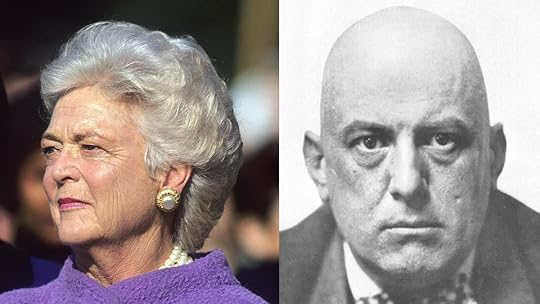
Barbara Bush died today at the age of 92, of undisclosed causes, after an alleged battle with pumonary heart disease and congestive heart failure. Wherever one falls on the political spectrum, this is a sad moment for the Bush family, and a moment in which America loses part of its living history.
Over the next few days, I suspect that an old meme is about to show up back in the media spin cycle: That Barbara Bush was the daughter of the infamous British occultist Aleister Crowley (and that therefore George Bush, Jr. was Crowley's grandson).
Let's take a look at this one clearly, before people start recycling this old rumor all over social media. The truth actually turns out to be a lot stranger than most people suspect, by the way.
Aleister Crowley was a mountain climber, author, occultist, intelligence agent, sexual libertine, drug addict and sometimes cult leader who spent a good deal of time terrorizing respectable British society in the first half of the twentieth century. Born into wealth, he burnt through his inheritance by self-publishing a tremendous number of books, ranging from pornographic poetry to manuals on consciousness raising through drugs, sex, and occult rituals. He started the religion of Thelema, which took sexuality as its central sacrament and urged its adherents to strive to discover their True Wills, their reason for being, by delving into black magic. It's all a bit like Ayn Rand for goths.
Crowley was not a particularly nice man. Despite being a genius, he was also kind of a sociopath, and treated the people in his life quite poorly in-between bouts of obsessive sex and cocaine, heroin and ether abuse. He was always broke, and constantly sponging off his students for heroin money. He once tried to get one of his followers to have sex with a goat. He wasn't, you know, the kind of guy that would be a promising candidate in a job interview.
One thing he was great at, however, was manipulating the tabloid press of his day, who declared him the "Wickedest Man in the World" and loved to play him up as the Devil Incarnate. Crowley decided this was great fun, and realized that playing in to this image would probably be a great way to get people to pay attention to him and maybe sell some books. Which is exactly what he did, and as a consequence, you've probably heard of him and his antics, and the fact that he is somehow associated with the Dark One himself (that's Satan, not Jimmy Page). Meanwhile, how many other early 20th century poets can you name, at least ones that were as bad at poetry as Crowley? Probably none.
Ever since Crowley's PR trickery in the 1920s, he's become associated with the Devil in people's minds. That means that people have been hanging all kinds of conspiracy theories on him ever since. One of these—the most famous one, actually—is that he was Barbara Bush's father. (Because George Bush, Jr. is therefore eeeevil, get it?)
This rumor comes from an April Fool's Day post on a Blogspot blog called "Cannonfire." (Here's the post.) The post is built up around the (true) information that Crowley was at least acquainted with Pauline Pierce, Barbara Bush's wealthy socialite mother, during the 1920s, when he was spending a lot of time practicing sex magick with anybody who was game to assist. ("Sex magick" means using orgasm as a way to focus your mind on achieving your goals in life, which is a lot more, you know, sexy than meditation.) According to this (again, April Fool's Day) post, Pauline Pierce ended up participating in one of these rituals with Crowley—specifically, an exercise in "eroto comatose lucidity," which is Crowley-speak for having a foursome until you stimulate and then exhaust yourself so completely that you start having visions. This was meant to be undertaken so that Crowley could attain to the highest states of magical consciousness.
While this ritual certainly did take place, there is no existing record whatsoever that Pauline Pierce participated—all we know for sure is that she was in Crowley's social circle at this time. To make the logical leap that she participated in a sex ritual with Crowley, and that she then conceived as a result, and that the child was Barbara Bush—which, yes, is what the blog post claims—is a bit of a leap. Like, a huge one.
So no, Barbara Bush was in all likelihood not Aleister Crowley's daughter. Which hasn't stopped people from circulating this rumor as if it were indisputable fact for the last twelve years.
However, just like with most urban legends that take off, there is a deeper mythological resonance to this story—one that nobody has picked up on before.
As I discuss extensively in my new book John Dee and the Empire of Angels, which is about the (hidden) influence of the occult on the last 500 years of Western history, Aleister Crowley was raised in an English extremist religious group called the Exclusive Brethren, lead by a preacher named John Nelson Darby. Darby is the person that invented the concept of the "Rapture," the idea that people will be literally teleported into heaven during the Second Coming. He made a huge mark on history by claiming that the book of Revelation was literally real, and definitely not, you know, just a metaphor—and even that human beings had to help God's plan by bringing about the end of the world so that Jesus would come back sooner.
The British, not being particularly impressed by anything this sincere, let alone religious literalism, didn't take to Darby's ideas. Aleister Crowley sure did, however, because he spent the rest of his life rebelling against his early cult brainwashing by trying to create his own, "Satanic" version of Darby's teachings. While Darby declared that a new "aion" was coming, meaning the Second Coming of Christ, the adult Crowley declared himself the prophet of his own "New Aeon," one that was to be focused on enacting the reign of the Antichrist (meaning Crowley himself, of course), rather than Christ. Somewhere in the back of Crowley's mind, he probably believed that he was just helping Jesus' plan along by playing the bad guy in the story.
Another group that took Darby's ideas quite seriously was, well, American evangelicals. The idea that the Apocalypse is not only literal, and just around the corner, but that Christians actually have to help it happen—what I call Turbo-Christianity—circulated throughout the American religious right during the early part of the century, until it became the dominant religious form in America. You can tell because the Left Behind books—the most read books in America—are directly based on Darby's ideas; and because 1 in 3 Americans now believe that we live in the Apocalypse and that Jesus is coming back in our lifetime (according to a 2006 Pew Forum study). You can also tell because Ronald Reagan took this idea so seriously that he regularly told his aides that he was shepherding the world through the end times, and that his role was to overcome Russia (which he likened to "Gog and Magog" from the apocalyptic Book of Daniel) in preparation for the Second Coming.
George Bush, Jr.—Barbara's son, of course—believed this too, infamously telling the French President Jacques Chirac that he saw "Gog and Magog at work" in the Middle East when trying to enlist his support for the War on Terror, which (as you can imagine, Jacques being French and all), didn't go over particularly well. You can also see this dispensationalist theology clearly guiding the hand of Mike Pence, and now John Bolton, who also played a starring role in the invasion of Iraq, and is now working to level Syria (which is also a fulfillment of pre-apocalyptic Biblical prophecy, by the way, from Isaiah 17:1). This is all because evangelical Christians believe that Islam has to be removed from the Holy Land in preparation for Jesus coming back, more or less—and the fact that the evangelical Republicans have been quite regularly trying to force that to happen at the tip of a nuclear warhead should be a lot scarier to you than whatever weird heroin fetish rituals Crowley got up to in his basement.
But the kicker, of course, is that both of these things come from the same place—Crowley's satanic occultism, and the Republican right's thermonuclear Middle East interventionism.
So in that case, even if Barbara Bush wasn't literally Crowley's daughter, they were both drawing their inspiration from the same place—Darby's dispensational Christianity. Which at the very least makes them ideological relatives.
Where there's smoke, they say, there's fire—whether it's from an occult ritual or a drone strike.
For more on the connection of the American right to occultism, check out my new book John Dee and the Empire of Angels—I've spent the last three years exhaustively researching the connections between the occult and British and American politics. I'm an author and journalist that has regularly covered trade policy, energy, surveillance and religion for VICE News, Boing Boing, Motherboard and lots more. (More about me here.) If you're a journalist working on a related story, you are welcome to contact me on Twitter @jasonlouv for a quote for your piece.


March 5, 2018
John Dee & the Empire of Angels, My New Book, is Out April 17
Friends, I'm very proud to announce that my new book, John Dee and the Empire of Angels, will be released on April 17, 2018 by Inner Traditions. It will be available through Amazon, Barnes & Noble (in store and online), through Indiebound and also directly through the publisher. You can find out more about the book at the John Dee and the Empire of Angels minisite.

This book is, at least at this point in my life, my masterpiece. It's 560 pages, hardback, and full of illustrations, diagrams, and color plates, including high-res images of the Enochian Watchtowers that I painstakingly re-assembled myself.
The book is a biography of John Dee, the alchemist who advised Queen Elizabeth I, created the plans for the British Empire, and even claimed that he spent almost a decade regularly communicating with angels, who gave him the secrets of the universe, and the original language that mankind spoke before the fall. But it's even more than that: It's the story of the Western magical tradition, the Enochian magick that John Dee transmitted, and the way these secret, underground currents have shaped history, from the birth of the Rosicrucians and Scottish Rite Freemasonry, to the genesis of modern science, to the founding of America, and even all the way to the creation of the United States space program. Beyond just John Dee, I do deep dives on Aleister Crowley, Victor Neuburg, Jack Parsons and Marjorie Cameron, in the process surfacing the details of exactly what "magick" is, and how it just might have built the modern world.
I'll be doing a lot of promotion for the book in the coming months, which you'll be hearing about soon. In the meantime, you can pre-order the book—it's already been #1 new release in the Magic Studies, Occultism and Philosopher Biographies sections on Amazon. And by the way, hardcover occult books sell out FAST these days, and quickly shoot up in value—I wish I could say it's because so many people want to read them, but it's because there is a thriving collector's and second-hand marketplace for hardcover occult books. So definitely snag one before they're gone and start commanding big resell prices (the first hardcover printing of Thee Psychick Bible was actually going for $1000 on Amazon at one point)!
More soon!
April 3, 2017
A Video Update From Jason Louv

Here's a video update from me on what's been going on for the last year, especially with Ultraculture and Magick.Me.
I'm hosting a live Webinar on Saturday, April 8 to decamp with readers and students, check in with you and see what you want next.
You can join the Webinar (at the right time) right here!
April 1, 2017
How to Live Awesomely, According to the Buddha
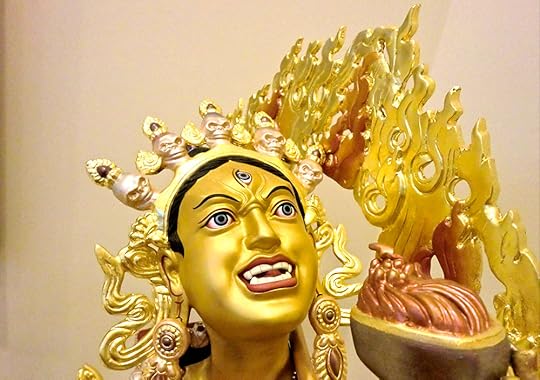
This article originally appeared on Ultraculture.
Learn more about how to achieve deep meditation states, access inner bliss—and begin to radically shift your life—at Magick.Me, my online school for spirituality.
As an exercise, I've been working on following the Buddhist Eightfold Path. It's tough.
I'm not a Buddhist—actually, I don't follow any religious path. What I am interested in is looking at strategies and techniques that work for living better. Some of those strategies and techniques can be found in religions, and I personally don't see any problem with applying them to my own life to see what they do.
OK, that's nice. Now, what is the Buddhist path?
The Eightfold Path was announced at the enlightenment of the Buddha as the way to end suffering. It was preceded by the 4 Noble Truths, recounted below.
1. The Truth of Dukkha: Existence is suffering, because it is in a state of constant change.
Everything in life is impermanent, therefore unattainable in any real sense, and this causes suffering or dukkha. In short: You think the virtual reality show called life is real, so you cling to the objects you see, and experience suffering when they turn out to just be illusions.
There are many types of dukkha or suffering: The wheel of samsara or constant reincarnation is dukkha; birth, aging, illness and death are dukkha; sorrow, lamentation, pain, grief and despair are dukkha; not getting what you want is dukkha. The understanding of impermanence is dukkha. Even enjoying pleasures in life is dukkha, because you know they will eventually fade or go away.
2. The Truth of the Origin of Dukkha: Attachment to pleasure and aversion to pain trap you within existence.
As long as you stay in the up-down, left-right, this-that dance of existence, you're stuck. You lunge with craving fingers towards the things you want. You recoil in horror from the things that you do not want. You are fidgeting and flailing in your existence. And existence is quicksand, and sucks you in deeper the more you struggle. You are not still, and so you cannot see the truth.
This teaching comes from the Indian roots of Buddhism: In certain Hindu schools, these tendencies of the mind are called the kleshas. Roughly translated, they are Attachment, Aversion, Ignorance, Ego and Clinging to Life.
3. The Truth of Cessation of Dukkha: By ceasing the attachment/aversion cycle, you can experience liberation from existence.
Attachment and Aversion are the fundamental movements of the mind. Cease the craving that drives them, and you will cease the motion of the mind. Renounce the sense pleasures of the world, and Just. Deeply. Let. Go, and existence no longer has a hold on you.
4. The Truth of the Path to the Cessation of Dukkha: The 8-Fold Path is the way to end suffering.
The 4 Noble Truths were the Buddha's basic diagnosis of humanity's ailment: We're in a kind of virtual reality game produced by our own attachments and aversions, and are unhappy because we have forgotten that it's just a game, and are experiencing our in-game losses and misery as real losses and misery. How to deal with this situation? The Buddha prescribes Eight Steps.
These constitute the Noble Eightfold Path, as follows:
1. Right View
Right View means understanding that life is just a magic show. It is transitory. It is virtual reality. And it causes suffering as long as you think it is real, and take it too seriously.
2. Right Intention
Right Intention means being resolved to renunciation. It doesn't necessarily mean that you give up everything and go become a monk, unless you're that much of a drama queen. It means working to steadily improve yourself, to rid yourself of the defilements of the world. It means intending good will and harmlessness towards all beings (including yourself) instead of ill will and harmfulness. Ultimately, it means intending to get out.
3. Right Speech
Right Speech means not lying, not speaking divisively or abusively, and not engaging in idle chatter and gossip (hello social media!). Words are magic. They create the reality you live in. Be mindful of how you use them. Do not waste them.
4. Right Action
Right Action means being morally upright in your actions, and not acting in corrupt or harmful ways. Specifically, it means: Not killing, not stealing (not taking what is not given), and not engaging in sexual misconduct.
MaxNormal.tv, who later became Die Antwoord, explain Right Action.
5. Right Livelihood
Right Livelihood is not making your living in a way that creates suffering for other beings. There are five specific types of business that should not be undertaken:
Business in Weapons. (Arms dealing.)
Business in Humans. (Slavery, prostitution, human trafficking, prisons-for-profit.)
Business in Meat. (Selling meat or raising animals for slaughter.)
Business in Intoxicants. (Dealing, selling or advertising drugs, alcohol or tobacco.)
Business in Poison. (Dealing, selling or advertising any chemical designed to cause harm.)
That disqualifies a good deal of the modern world, doesn't it?
Ideally, your business should be something you can put your heart into, and that benefits other sentient beings.
6. Right Effort
Right Effort means working to uphold all that is wholesome within yourself and the world, and also working to abandon all that is harmful. It means being one of the good guys.
7. Right Mindfulness
Right Mindfulness means staying present and aware of yourself, reality and your place in reality. It means paying attention and not zoning out—primarily because when you zone out and live life on "autopilot," you can easily take harmful actions without really thinking about it. For instance: While working on following the basics of the path recently, I resolved not to kill. Just a few minutes later, I was zoned out again, and when a fruit fly landed on my left hand I immediately lashed out to kill it. Why? Instinct. Years of trained behaviors and the inertia behind them. Autopilot. Non-mindfulness.
(Note: This is not to be confused with the corporate "mindfulness" scam, in which workers are sent to "mindfulness" seminars that are really about making them focus on their work.)
8. Right Concentration
Right Concentration means meditation. Once free from sense-desires, and leading a tranquil life, the practitioner begins to meditate, usually through mindfulness of breathing, object concentration or repetition of mantras. The meditator may begin to pass through the four classic Jhanas or meditative absorption, being:
The rapture and joy of withdrawal into meditation;
The rapture and joy of unified awareness, free from directed thought;
Equanimity, mindfulness, and alertness (as rapture fades away);
Perfection of equanimity and mindfulness, free from both pleasure and pain. Pure, bright awareness.
Below, an experienced meditator explains the four jhanas.
All of these should, with effort, be applicable in anybody's life. You don't have to retreat to a mountain or a cave to live awesomely. You just have to stay present.
Bodhi Svaha, oh what an awakening!
(Image via).
March 29, 2017
Why You Should Have a Big Ego
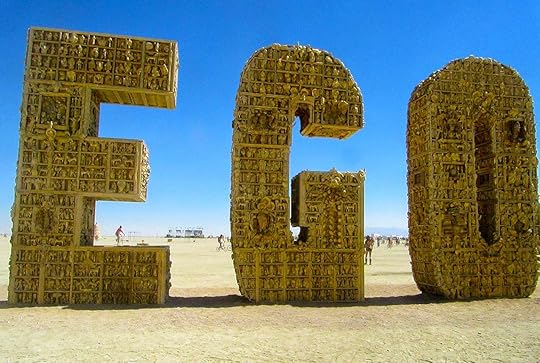
Originally published on Ultraculture.
Since I got into spirituality, people have been laying this "kill your ego" trip on me.
The Ego is a concept created by Sigmund Freud to denote "the organized part of the personality structure that includes defensive, perceptual, intellectual-cognitive, and executive functions." (From the Wiki.) It was part of Freud's unique internal cosmology and has no direct analogue in Vedanta or Buddhism, which have much more complex terminology for the self.
The Buddha, of course, came to a realization that there is no actual individual self—the idea that you have a unique, core, true "self" is—according to the Buddha—actually a kind of cognitive illusion created by the interconnection of phenomena.
Now... both of these concepts got mashed up by 1960s psychonauts who started taking really really fucking potent LSD, and entering states in which they momentarily perceived their selves as, well, cognitive illusions. Afterwards, they tried to explain their experience first in Freudian terms ("I realized the ego is a lie"), and then with a bit of Eastern mysticism ("The Buddha said the self isn't real and that's what I saw on LSD"). These then got mashed together as the general idea that you have an "ego" which is "bad" and that if you "delete" it, you get closer to "god."
(Because psychoanalysis and Buddhism aside, Western people are Christians deep down, and what we're really looking for is a communion wafer and some penance and lashings to make us more "good." Hence acid and "killing our egos.")
To get in touch with who you truly are, and unlock your true potential as a human being, check out my online course on Unlocking Your True Will.
These days, we now just have people running around saying "you have a big ego" and "you need to turn your ego off" and the like. This is:
a) Not actually based on any sound theology or psychology;
b) Has nothing to do with aiding others to gain insight into the illusory nature of the I-making faculty. It does, however, have everything to do with critiquing other people's outward personalities and therefore control.
"You have a big ego" is a covert game by which spiritual, New Agey and occult people police each other's actions.
It actually means "you're not doing what I think you should," "your actions do not jibe with my ego," or even "immediately cease thinking for yourself or questioning, and think and behave only as I or the group leader wish you to." It means "you are not following my/the group's script."
"Delete your ego" is, of course, a primary game played in cults, and a primary way in which compliance among cult members is achieved and enforced. Corporate America studied this in detail and has applied similar techniques to organizational psychology and human resources in order to control employee behavior.
So let me say this again:
"You have a big ego" means "you are not on script." "Delete your ego" means "get in line."
Now, is overcoming the "false self" a critical part of spirituality? Yes, it is.
But in terms of group dynamics:
Yes, I have a "Big Ego." Yes, I have every fucking right to have a "Big Ego." My ancestors crawled out of the protoplasm, evaded sharks, flopped about in tidepools, climbed into the trees, learned to use tools, endured millenia of brutal warfare, disease, invasion, rape, degradation, abuse, misery, starvation and migration and somehow survived it all because they believed that they mattered and they would overcome the shit their environment threw at them no matter what, so that I could sit here today with the privilege of coming to self-awareness, let alone the hard-won freedom to express those thoughts to others on the Internet in a relatively danger-free existence. All of that freedom and luxury is won not by the lotus blossom but by the sword.
I've had decades of strife, people controlling me, people telling me to shut up, to not open my mouth, to stay small and afraid, to go along to get along, that my ideas are "juvenile" and "ego-driven," etc etc, and a good deal of that was in the name of "not having an ego." And I've also spent years of my life in "egoless" states, so blasted on meditation, magick and psychedelics that I simply remained in "transpersonal awareness" without any sense of having a self separate from the universe.
But you know what? You're goddamn right I have an "ego." I have a right to have likes and dislikes, to be angry or "negative" when I want, to have lust, greed, pride, envy, sloth and the rest. These are part of what make me human. And to simply amputate my basic humanity doesn't serve me at all: It only makes me compliant, docile, easy to manipulate by others.
And look, I'm a white, middle-class, American male—near the very top of the global race/class control pyramid. How do you think women and people of color feel when you say "stop having such an ego" when they raise their voices, express outrage, anger—or anything at all?
In this context, "You have a big ego" starts to sound like "You don't have a right to speak."
During a seminar on Ishmael Reed, my college literature professor Louis Chude-Sokei told me something I've never forgotten: That under slavery, the general "scientific" belief was that black people did not actually possess souls, and that this narrative was constantly repeated and driven home as a control mechanism. This was one of the major reasons that soul music became so critically important. It was also a major reason why black people were generally deeply underwhelmed with the 1960s idea that people should "kill their ego." (A point of study is what happened when members of the Black Panther Party were invited to acid group therapy and hot tubs at Esalen... and the white, upper-middle-class hippies discovered that acid wasn't actually a magic cure-all for millenia of oppression, racism and rage, and that no communication breakthrough across group lines actually happened.)
So this is a key point:
I have an ego. I have a right to my ego. I can turn off my ego if I like, or leave it on if I like, but what I do with my ego is fundamentally nobody's business but my own. Spirituality need not and should not hang an "open season" sign on your sense of individuality and self-worth.
Cherish your ego. Follow your own script. Do What Thou Wilt Shall Be the Whole of the Law.
March 17, 2017
The 10 Secrets of Adulting Like Your Life Depended On It
This article was originally published on Ultraculture.
Adulting is a rough process. If we're lucky, we get good role models in parents and teachers, but many don't. One way or another, regardless of our external resources, we have to do it, because while society often rewards those who get their act together, it isn't particularly forgiving of those who don't. That makes adulting our responsibility, and ours alone—no matter what story you might have been telling yourself about how you got a raw deal.
Here's a few of the most crucial life skills and attitudes I've picked up along the way that have helped me a) not die, b) not be a dick and c) get out of the occasionally hellish attitude problems of one's teens and twenties. Hopefully these are of use to you—I'm not saying I'm the master of them, either. It's all a process, and I've learned all these by doing their complete opposite. But on my best days, I keep these ten things closely in mind. In no particular order, they are:
1. See society as a game
I once saw society as an oppressive, dominating monster, a Saturnian Archon that eats its own young—the 1% dominating the 99%, a rigged con, and a delusion. I don't see it this way at all anymore—in fact, I now recognize my earlier fear of the world as just that—fear, stemming from inexperience, which is impossible to circumvent in your twenties (even if, like me, you had been in the workforce consistently since before it was actually legal for you to work, pausing for college). After you get out of your twenties, though, you've likely had the shit kicked out of you so many times that you hopefully start to get a good sense of what behaviors work to get positive results and which don't. Hopefully, you start encouraging the behaviors in yourself that work, and discouraging the ones that don't.
If you're smart, that's when you start seeing society as a game—instead of trying to break the rules, you start trying to understand the rules, and work with them.
If you're smart, that's when you start seeing society as a game—instead of trying to break the rules, you start trying to understand the rules, and work with them. They're not perfect, and often need structural change (because they remain rife with bad programs of class and caste system, glass ceilings and racial discrimination—this is where I will readily acknowledge my white male privilege), but they've been built up over thousands of years as a scaffolding that more or less works. Consider that despite our many problems, we are not currently all engaged in trench warfare or dying of the black plague, generally have much higher life expectancies and qualities than our ancestors, and have history's entire accumulated knowledge at our fingertips. Society can be refined but should not be destroyed—and when you stop trying to destroy society, you can start to see how it is refining you.
Mark Pauline of Survival Research Labs once put it best: "Society wants to play—it just wants to play really hard." You've likely seen plants which are tied to stakes as they grow. That's society—an imposed structure that helps you grow taller. A magical system, as you will, that works to your advantage ONCE you learn the rules.
2. No failure, only feedback
You will fail. You will fail a lot. Failure is fine—giving up is not. Pick yourself up every time and keep going. Do not dwell, do not ruminate and do not take failure as a sign that you are a bad person. It's a sign that you performed an action or behavior, or series of actions and behaviors, incorrectly—and it's now valuable information you can use to adjust accordingly, thereby bringing you closer to getting it right and success.
3. Invest your time, instead of wasting it
There is no free lunch, no quick fix, no shortcut, etc.—we've heard it all, and yet we constantly seek for instant gratification for our desires, wrecking ourselves in the process. Adulthood, in many ways, recapitulates an evolutionary shift from hunting and gathering to farming. Instead of going out every night to look for a temporary mate, getting wasted to get temporary enjoyment, hopping from temporary job to temporary job, and generally running here and there like an insane monkey looking for resources in the big bad urban jungle, you sit your ass still and start farming. You regularly invest in stabilizing a career, a relationship, core friends and financial savings, starting small at first, so that you can harvest your work sustainably far into the future without burning yourself out trying to acquire things that don't truly belong to you, because you didn't put the time in.
4. Shift to understanding life as contextual instead of essential
If your boss is a dick, it's not because she's an awful person—it's because you're in a situation and context with her that produces that behavior. If you fuck up, it's not because you're a failure at heart—it's because you were in a contextual situation that produced that outcome.
This may be the most crucial item on this list: Stop thinking things have essences. They don't—at least not in the way you think. Behaviors and events are contextual, and as soon as you understand that, the oppression and depression will start to lift. If your boss is a dick, it's not because she's an awful person—it's because you're in a situation and context with her that produces that behavior. If you fuck up, it's not because you're a failure at heart—it's because you were in a contextual situation that produced that outcome. This is a primary reason, by the way, to cultivate friends who regularly experience happiness and success—it puts you in a happy and successful context.
5. Do not bear grudges—let the past go
Seriously. All bearing a grudge will do is eventually turn you into the person you hold the grudge against, because you've been meditating on them for so long.
Likewise, you need to consistently—like every day—make a habit of consciously letting the past go. Anything less means you're not responding to your environment, you're responding to delusions in your mind, ideas about the world you held when you were less experienced, faulty self-images—and that's dangerous. Let it go and see what's right in front of you.
6. You need others—life is a team sport
Nobody does it alone. The more that people conglomerate into groups—families, companies, clubs, societies, religions, multinational corporations—the more generally secure they are. Of course, the downside is the possibility for institutionalization and groupthink, but judicious associations with others are critical. Research suggests that exile from groups is actually MORE damaging to the body and immune system than serious disease or critical injury (I can't find the article right now, but I definitely read it). We're social animals—down to our very physiology. Stop competing and start co-operating.
7. Look sharp and show up on time
It's the small things. Groom yourself, dress nice, and show up on time. You have no idea how much these simple actions mean to employers and significant others. When you don't do that, you don't look like a cool devil-may-care creative maverick, you look like a fuck-up. (How many times I have learned this the hard way.) Take this advice from Anthony Bourdain (via Men's Journal ):
It's the small things. Groom yourself, dress nice, and show up on time.
Show up on time. I learned this from the mentor who I call Bigfoot in Kitchen Confidential. If you didn’t show up 15 minutes exactly before your shift — if you were 13 minutes early — you lost the shift, you were sent home. The second time you were fired. It is the basis of everything. I make all my major decisions on other people based on that. Give the people you work with or deal with or have relationships with the respect to show up at the time you said you were going to. And by that I mean, every day, always and forever. Always be on time. It is a simple demonstration of discipline, good work habits, and most importantly respect for other people. As an employee, it was a hugely important expression of respect, and as an employer, I quickly came to understand that there are two types of people in this world: There are the type of people who are going to live up to what they said they were going to do yesterday, and then there are people who are full of shit. And that’s all you really need to know. If you can’t be bothered to show up, why should anybody show up? It’s just the end of the fucking world.
Oh yeah—start getting up early and going to bed early, too. That shit will change your life.
8. Give people a break—they're doing the best they can
I'll never forget a cartoon (I have no recollection of who it was by) I saw some time in my college years, featuring a ranting cynic in a shopping mall (possibly based on Bill Hicks or Henry Rollins) shouting that people are complacent, conformist, mindless sheep. The next panels zoom in to a nondescript mall shopper with a face full of tension and fear, clearly terrorized by the screamer, with a thought bubble over his head that reads "Hope I don't die of colon cancer soon." That made an impression. You can't win friends or influence people by attacking them, and you certainly can't change them. Give people a break. They're doing their best with the resources they have.
9. Nobody will do it for you
Your parents will not do it for you, your significant other will not do it for you, your friends will not, your company will not, your boss will not and society will not. You're on your own, buddy—everybody else is too busy treading water with all their might. And the more you rely on others, the weaker you get.
Your parents will not do it for you, your significant other will not do it for you, your friends will not, your company will not, your boss will not and society will not. You're on your own, buddy—everybody else is too busy treading water with all their might. And the more you rely on others, the weaker you get, because you not only need to get strong enough to tread water on your own, you need to get strong enough to swim. Society loves when people get strong enough to swim. It really loves when teams of people get strong enough to swim somewhere together. It does not love when somebody tries to latch on to somebody else treading water and drowns them both. That's not the game. Stop crying, get healthy, get fit, get smart, keep re-training yourself, keep showing up and keep accumulating skills and expertise.
10. It's what you give, not what you get
Another truism and cliché—yep. Truisms and clichés stick around because they're important. And this is one of the most important. If you want to make more money, provide more value for people—your boss or the people you are selling to. If you want to be loved more, love more. And on and on and on. The more you give, the more you get—and don't worry if they don't balance. Give more than you get, always, instead of clinging to every cent like a miser or trying to rob your environment like a vampire. Open up, let go, and see what you can give the universe.
Bonus: 11. 'Refine thy rapture'
As an adult, you should really not be unsustainably getting wasted, getting high, eating unhealthily, being an unproductively promiscuous maniac or otherwise acting like you're still in college.
But that doesn't mean you have to stop. It just means you plan that stuff out so you can enjoy your debauchery in productive, intelligent and meaningful ways that don't threaten to wreck your life or the lives of people around you. Sip your champagne, buddy, don't chug it. It's so much better that way.
For the "adulting fast track," check out my course Unlock Your True Will, which will help you hone down and discover your true purpose in life. Nothing helps you grow up like having a positive, inspiring, incredible goal to grow towards.
How to Meditate
Below, check out a handy guide on how to meditate—real meditation, not the guided visualization exercises that so often get passed off for meditation in the marketplace. It'll get you up to speed on everything you need to know to start a solid meditation practice.
Included are:
• The reasons to meditate. These are gaining a sense of focus, learning to let go, and a growing, ever-deepening process of maturation.
• The fundamentals of Raja Yoga: basic asana (motionless sitting), pranayama (deep breathing) and dharana (one-pointed consciousness).
These basic skills should be the foundation of any spiritual practice; as I wrote in this article about the 7 Master Keys of Spiritual Growth, meditation is the skill that can unlock all areas of life, from your focus on your work to your emotional health to your ability to your sense of spiritual connection and well-being. There's a reason so many Silicon Valley companies are recommending mindfulness meditation to their employees and executives: It works. It makes you a better human being.
But this isn't just mindfulness meditation—this is something much better, and older. Check it out—once you learn how to meditate the right way, you'll be light years ahead in the human experience.
This free video is more than enough to get you started on a lifetime of fruitful and deep meditation practice. For those who are interested in accelerating their understanding and progress, this video is a great primer for my in-depth course Hardcore Meditation: The 8 Limbs of Raja Yoga.
In this five-hour class, we'll cover not only deeper material on how to meditate but also the ancient and sacred eight limbs of Raja Yoga (the true, Vedic system of meditation) step by step. The course material is divided into simple sections that you can watch at your own pace, in whatever way works best for you. We'll cover:
Yama: How to structure your life so thay you can meditate daily
Niyama: How to keep drama out of your life so that your meditation isn't disturbed
Asana: Physical postures for meditation
Pranayama: Breathing techniques for stilling the mind and body and producing neurosomatic rapture
Pratyahara: Withdrawing the senses from the external world
Dharana: Concentrating the power of the mind into focused awareness
Dhyana: Achieving single-pointed concentration
Samadhi: Union, the Ultimate Goal of Yoga.
You'll get a solid grounding in the true theory and practice of meditation, far beyond what you can learn from a book. Check out the course here and learn how to meditate like the masters!
6 Wearables for Altering Your Consciousness

Wearable technology has rocketed into public awareness in the last few years, particularly with the Apple Watch; along with the "Internet of Things," devices and their connected apps are beginning to saturate nearly every aspect of our lives.
The use of modern technology for altering consciousness and getting into peak states has been a long-standing interest of mine. William S. Burroughs, one of my heroes and also of the 20th Century's greatest psychonauts, was particularly keen on exploring fringe technology like orgone generators and Dream Machines, and using them as aids in his own personal development and creative process. But along with these old standbys, I've become particularly interested in a totally new wave of commercially available neurofeedback devices that are capable of directly monitoring and giving you information on your brain state, as well as other wearables for directly altering consciousness. While some of this technology is new, however, related devices (like the Proteus and Thoughtstream, which still look incredibly retro) date back to the 1980s, and have long been in use in the "psychonaut" underground. Perhaps it's only now, with wearables coming more into the public eye, that this type of technology will gain more traction and interest.
Here's some of the best consciousness-altering wearables on the market. You can click the headline for each to get more information at Amazon.
1. Muse Headset

The Muse, one of the pre-eminent commercial devices for neurofeedback, straps to your head and gives you immediate feedback on your brain states. Whereas neurofeedback devices once cost tens of thousands of dollars, this small device brings the power of neurofeedback into your home—and can be used for deepening and monitoring your meditations.
2. Thync

Similar to the Muse, Thync attaches to your head—in this case, a single location on your temple—and is able to induce deep altered states similar to drug highs. Sounds incredibly useful for fast sigil casting, even in public. If I were to only get one of the, this would be the one. The promise of drug-free highs is never one I pass up.
3. NeuroSync

The NeuroSync connects your brain to your computer and can be used with over 100 apps. The makers of the product literally claim it will let you "harnass the power of your mind to become a powerful wizard." Sounds good to me!
4. MindPlace Thoughtstream

If you don't want to go full into neurofeedback, the Mindplace offers an easy and portable biofeedback system—it measures information from your skin instead of your brain. Incredibly useful for stress relief and meditation, if you want a no-frills approach.
5. MindPlace Proteus

A classic and famous device in the psychonaut underground, the Proteus is a set of glasses used for inducing drug-like altered states of consciousness. You'll definitely feel like you're in a 1980s cyberpunk book, but you'll have a lot of fun, too.
6. Apple Watch

Of course, I couldn't leave out the Apple Watch, which is in a way the most useful device on this list, primarily because you can wear it all the time, particularly in polite company. You can load the Apple Watch up with apps which monitor your vitals, your sleep, your diet and even (with apps like Headspace) train you in meditation, making it an incredibly potent tool for long-term, sustainable consciousness alteration, providing you with tons of data (deellliiccciousss data) for honing your mind and body. If I were actually to stick with one device from this list, it would probably be the Watch.
Check out these devices on Amazon, and let me know in the comments if I've left any good ones out!
(All images used for review purposes only.)
March 15, 2017
7 Master Keys of Spiritual Growth
Spiritual growth and personal growth happen slowly... unless you take charge.
The universe is a machine designed to grow souls by exposing them to an incredibly wide spectrum of experiences, both positive and negative. It is constantly in the process of evolving you as a human being.
So why do some people seem to grow and mature quickly, and others not so much?
The secret is conscious engagement in the universal process—showing up, doing your part, and being grateful for the chance to be alive against nigh-impossible odds.
These seven tips will help you to fully work with the current of evolution and accelerate your own spiritual growth. They're certainly not the only ways to grow spiritually, but they're among the best.
1. Turn Off Your Mind.
Meditation is the core of any spiritual practice—most everything else is window dressing. Just like you need to do cardio and lift weights to get physically fit, you need to meditate to get spiritually fit.
More than that, you need to meditate correctly. There are lots of meditation techniques available on the open market, most of which are essentially guided visualizations or fluffed-up feel-good techniques. Forget this stuff. The core of meditation is learning how to turn off your mind. Consistent practice in single-pointed awareness—for instance, by focusing your attention on the point between your eyebrows, or a visualized shape—for at least 30 minutes a day is what will build you mentally and physically. Perhaps no pursuit on Earth holds as much net positive benefit in strengthening the mind, maturing the emotions and hastening your spiritual growth.
To get the fast track on learning how to meditate correctly, and save yourself years of trial-and-error of trying ineffective techniques from the broader spiritual marketplace, check out my class on Raja Yoga—the original, true, ancient technique of Vedic meditation.
Do this, and you can throw out 99.9% of the watered-down techniques you'll find marketed in New Age, personal growth and religious books and seminars.
2. It's Not About You.
Wei Wu Wei, one of the greatest writers on Buddhism in history, wrote this profound truth about the nature of suffering: “Why are you unhappy? Because 99.9 percent of everything you think, and of everything you do, is for yourself—and there isn’t one.”
Wei Wu Wei, one of the greatest writers on Buddhism in history, wrote this profound truth about the nature of suffering: “Why are you unhappy? Because 99.9 percent of everything you think, and of everything you do, is for yourself—and there isn’t one.”
Most suffering comes from our internal narrative about our own life: Our rumination about the past, our feeling of inadequacy about the present, our anxiety about the future. Staying in these mental states uses up a LOT of mental processing power.
There is an easy fix for these mental agonies: Realizing that it's not about you, and focusing on other people, instead of yourself. The more you can show up for other people, facilitate their experiences, and work for their happiness, the more of that positive energy will come back to you—and in the mean time, you won't be stuck in your own head and in your own entrapping story about your life.
Note: This does not mean sacrifice yourself or ignore your own self-care! Boundaries are important in all things, and finding a good balance of helping others and helping yourself is crucial.
3. Gratitude.
It's been said by many of the great spiritual teachers: Staying in a state of gratitude will fully open you to the incredible blessings that are all around you. By opening to what's right in front of your eyes, you get out of the feeling of lack or inadequacy that haunts so many people. You realize that we truly do live in a world full of incredible blessings that we so often overlook in our quest for the next big thing. It gets you out of the mental loop of focusing on what you feel is wrong with your life, or with the world, or what latest catastrophe was in the news that day. Cultivating gratitude isn't masochism: It's revealing the truth, which is that we have an incredible chance to live, to be conscious, to draw another breath, and to savor the life we have already lived in this brief moment of time we have to be alive in this strange corner of the universe. This, right here, is one of the most profound keys to spiritual growth we have.
4. Let Go.
Life comes at you fast. So fast that it is often literally impossible to control, and the more time we spend tying ourselves in knots trying to control it, the less we actually have control.
Life is a bewildering, exhilarating, often terrifying psychedelic trip. The secret is to let go. That doesn't mean give up—it means to relax and understand that, at the end of the day, you have no control. Enjoy the ride.
5. Active Dreaming.
Most people sleep eight hours a day, and if they have dreams, they probably forget them within a few minutes of waking.
That's 1/3 of the day—every day—that's lost. Over time, it's 1/3 of an entire lifetime.
What if you could get 1/3 more lifetime?
You can, if you open up your sleeping life to active dreaming, which means better dream recall, and even lucid dreaming or controlling your own dreams. You can have access to a virtual reality better than anything that will ever be on the market, in which you can come to an incredible sense of radical self-understanding and self-awareness by exploring your own unconscious mind. With 1/3 more life, you get 1/3 more life experience, and 1/3 quicker maturity.
The first key to active dreaming, and using your dreams for your own spiritual growth, is simple: Write your dreams down in a dream journal every morning upon awakening. Even if you don't currently remember your dreams, this simple practice will change that. The more you write down your dreams, the more you will become aware of them—and in them.
To master the art of lucid dreaming, check out my Introduction to Lucid Dreaming class now!
6. Become Who You Truly Are.
You will never be happy becoming somebody else's idea of who you should be.
Ever.
Instead, you've got to take the hard road: Becoming laser-clear about who you truly are, and what you truly want for yourself, and then committing to fully becoming that, even if there's no safety net, even if it will bring the judgment of the people around you, even if it will take years or decades.
Instead, you've got to take the hard road: Becoming laser-clear about who you truly are, and what you truly want for yourself, and then committing to fully becoming that, even if there's no safety net, even if it will bring the judgment of the people around you, even if it will take years or decades.
That's the way to true satisfaction, true self-confidence, and true happiness.
The first step on this journey is getting perfectly clear about who you are and what your goals in life are. This often isn't easy, but I've made it a lot easier for you: Check out my Unlock Your True Will course to tap in to powerful techniques for unveiling the core of who you really are!
7. Balance.
Life is about balance. The I Ching and the Tao Te Ching, two of the oldest books in human history, are master courses in understanding balance, and how all dualities equalize over time. What goes up must come down, what goes down must come up—and to all things there is a season. Understanding life's natural rhythm is the key to everything from emotional health to managing work/life balance to making money on the stock market. Understand balance, and you will understand life.
With these simple but effective tools and philosophies, you can build an incredible foundation for real and lasting spiritual growth!
To leverage all these techniques and much more, and put rocket fuel into your spiritual development, check out my online school for spirituality, Magick.Me, where you can learn about everything from meditation to lucid dreaming to flowing with the Tao and lots, lots more.
March 14, 2017
Not Dead, But Dreaming

I hear I've been missing for a few years.
Allow me to reintroduce myself.
Over the last two years, I've largely been absent from the Internet (outside of instant-gratification Facebook ranting to blow off steam) while I've been wrapping up a new, substantial book. It's bold new territory for me, and beyond that I will say no more... stay tuned.
That's largely meant I've been absent from writing for the Web, either for Ultraculture (including podcasts), Boing Boing, Vice or the various other outlets I've written for in the past. But rest assured, between the book and some other clandestine projects, I've been working harder in the last few years than I may ever have in my life... just not on ephemeral Web content.
As is inevitable with such a long period of heavy intellectual work (as well as the passage of time), my outlook on life has altered quite a bit. Of course, reality itself has changed significantly, too—when I began working on the new book, we were still in the tail end of the Obama years. Now we live in a fresh hellscape crafted by Donald Trump, Steve Bannon, Vladimir Putin, Aleksandr Dugin, 4chan and 8chan's /pol/ boards and, it seems, the ghost of Julius Evola, whose long talons have stretched from the grave to drag the 21st century into his perverse and warped version of Hermeticism, Hinduism and mostly imaginal "traditionalism." Great Caesar's Ghost! Well, the books of Revelation and Daniel do identify the force of the Antichrist with an attempt to restore the Roman Empire, after all, and if you're going to have an apocalypse you have to do it by the book...
It's a strange new world we live in, where 18-year-olds read Ride the Tiger and sling "meme magic" into the greater Internet, and a new feminist witchcraft movement grows daily to challenge this information infection. Jeez, kids, I know I said I wanted an occult revolution in Generation Hex, but I didn't expect it to, you know, escalate that quickly...! Occult revolution, occult counter-revolution... get ready for years of entrenched and bloody metapolitical warfare over reality itself as traditional media continues to crumble in the face of new media, and the conglomerates face their total inability to control the narrative. It seems that all the prophets of this new world that I was reading in the late 90s—Doug Rushkoff, Tim Leary, Grant Morrison—were, if anything, far understated in their future predictions. I think only William Burroughs, the commissioner of sewers, got close to touching on not only the corruption of the "Ugly American Deathsucker" that would one day manifest as Trump, but the magical war that was to come, that had to come, as electronic media further mutated human consciousness!
Well! What to do?? In many ways, Ultraculture—which I ran out of a backpack and off of Monster energy drinks with every waking second from 2012 to 2016, and which I will forever be grateful for as it liberated me from a stint in corporate America—was wholly a product of the Obama era. My calling with that blog was to bash against the sociopathic undercurrent of the Democrats' vision of a globalized sweatshop world, railing against how the media had essentially become the human resources department of the corporate-controlled executive branch, and point out the horrors of drone warfare, police militarization, private prisons, the NSA surveillance state, Keystone XL, the TPP and all the other hits.
How quickly things changed. Like everyone else, I watched with increasing disgust as both the virulent new Alt-Right movement and the unhinged "accelerationist" far left decided to back Trump (overtly or covertly) as a Molotov unwisely thrown at the progress of globalization. Of course, Trump will only make things far, far worse. But the pyromaniac style of politics is impossible to argue with, as it is driven by fear, desperation, ignorance or even willful evil. Seeing my own anarchist impulses reflected in the madness of the mob gave me pause. It made me rethink everything—suddenly conspiracy theories and even anti-establishmentarianism were looking kind of awkward, embarrassing, and maybe flat-out irresponsible. The new populist climate in America made me long, more than anything, for a sane center, a basic common sense and decency that Americans can be very good at maintaining... when times are good, I suppose. I don't know what I think of America and Americans now, when so many of them chose to do the wrong thing, even if they faced a tough double-bind.
Understanding the role of magic in the coming years will be tricky. Pushing back against the expansion of the European hard right into America—that shitty Neoreactionary, wanking-to-Death-in-June occult current (which has always been there, albeit dormant)—will be of obvious importance. Creating positive communities, and restoring a sense of commonality, trust and purpose in the face of the Thresher will be, as well. Magic has long been the province of people with their back against the wall, a wartime pursuit, which manifests in times of crisis. (Back in the 90s, we even used to poke fun at "crisis magicians" who always had to have their lives in a state of catastrophe in order to do magic... I lived that way myself for many years.)
And here's a crisis all right.
I've been reorienting to this new reality for a while. I'm mostly there. Expect some very different approaches from me going forward—because we evolve with the times, or we die in the dust because we're still working off the data points of the past. It's 2017 now, not 2015... and the Hills Have Eyes.
Stay tuned here as I continue to update with new content. In the meantime, here's two recent podcast interviews with me: One with Zach Leary, the day after the election, in which I break down and analyze the Alt-Right, and one with Duncan Trussell, where we discuss John Dee, magic and the nature of reality.
Stay strong, and burn bright... well, reasonably bright enough to stay burning for a long time yet.
It's All Happening With Zach Leary #66 with Jason Louv