Jessica Brodie's Blog
December 1, 2025
When Christmas Hurts: Celebrating Through Loss and Change

By Jessica Brodie
Turn on the radio or flip on the television, and it doesn’t take long to be reminded this is the happiest time of the year. Except … what if it’s not?
What if, in many ways, this is the hardest time of year for you?
I’ve always looked forward to Christmastime. As a kid, I remember being absolutely giddy with excitement, and it often had nothing to do with what was waiting under the Christmas tree. What caught me up was that glorious buzz of joyful energy from the loved ones all around me—all the laughing grown-ups excited to see each other, everyone dressed up in something festive, all the whispered secrets about gifts and hopes, spinning together to create what felt like a magical time.
Later, when I grew up and had my own kids, it was exciting just to watch them experience that Christmas joy for themselves—going to church, singing the hymns and lighting the candles, picking out gifts for each other.
As the years have passed, though, my circle is slowly growing smaller.
My grandparents have all passed away, as have my dad, my stepmom, and my favorite aunt. Beloved in-laws, too. My sister lives hours away, my uncle is clear across the country, and I can’t remember the last time I saw the cousin who used to be my best childhood friend.
Loved ones I used to see every holiday are now people I haven’t seen in ages.
Two of our four kids are now off to college, and though they’ll be home for Christmas break, it’s different now that the kids are older. Everything feels different, smaller, slightly off-kilter. More subdued.
I’m still joyful, still blessed. Yet the difference feels palpable somehow.
Maybe that’s you—maybe you normally love Christmastime, yet the pang of loss cuts deep right now. Maybe you’ve lost a spouse, children, siblings, or a close friend this year, and there’s little laughter this season. Every gleam of joy brings along with it a sharp and painful reminder of the one you’ve lost.
Or perhaps you’re struggling with difficult health diagnosis, a broken relationship, financial catastrophe, or mental illness.
Whatever it is, the holidays are hard for you, and you struggle to gain even a glimmer of cheer.
The truth is that despite the messages around us trying to tell us what Christmas is “supposed” to be and how we’re “supposed” to feel, the reality is that Christmas is none of those things. The expectations we’ve created around this time of year pale in comparison to the perfect truth about why we celebrate it in the first place.
We celebrate Christmas because we celebrate the birth of our savior, God in human form, word become flesh who lived, suffered, and then died as a sacrifice for our sins… only to rise again and lead us to eternal life.
And so—even as my heart sometimes aches for those I’ve lost this time of year, while all the songs on the radio tell me how things should be—what helps is remembering the real reason for the season.
What helps is loving the ones who are around me now, even as I miss the ones who are no longer with me.
Loving the people in my world today is not only a way that I can claim joy in the season, but it’s also a way that I can honor the gift of Jesus Christ and the birth of my savior. After all, Jesus told his disciples the world will know who they are—his!—by their love for one another (John 13:35).
Love really is the greatest truth of all and the most important thing to remember
So wherever you are this holiday season—grieving and heartbroken, happy and content, or a little bit gloomy and cynical—remember this: Love is the one thing that carries on from Christmas to Christmas. The love of Jesus Christ for all of us, and the love we have for each other in his name.
Amen.
If you’re struggling this year, can I pray for you? Comment below, or reach out to me privately.
“By this everyone will know that you are my disciples, if you love one another.”—John 13:35 NIV
A prayer: Lord, help me to remember the true reason we celebrate Christmas. It’s not the lights or the gifts or the celebrations but the fact that You came into this world, Emmanuel—God with us. You chose to live as a human, then suffer and die as a sacrifice so that we could join You in eternity. What a true gift that is. No matter my feelings right now, please help me remember this. Amen.
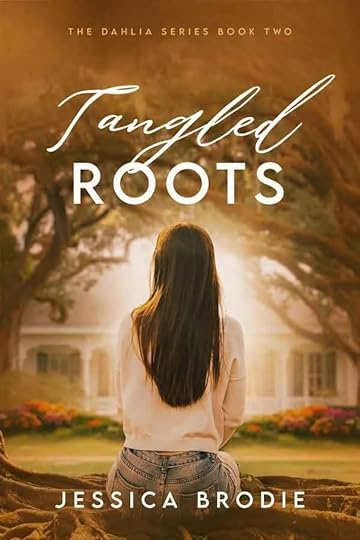
Have you read my newest novel, Tangled Roots? I hope you’ll head over to Amazon today. It’s available as an ebook, paperback, and audiobook. While it’s book two in the Dahlia series, you don’t need to have read book one, The Memory Garden, for it to make sense; it stands on its own. (But I’d love if you’d read both!)
If you know someone who would benefit from reading this blog, please share this with them:
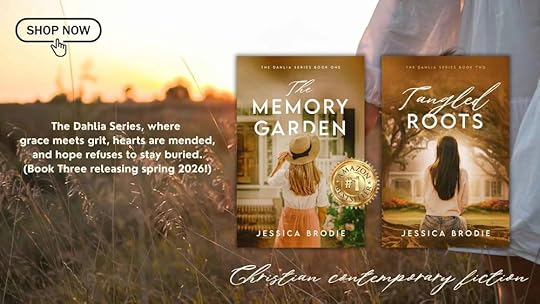
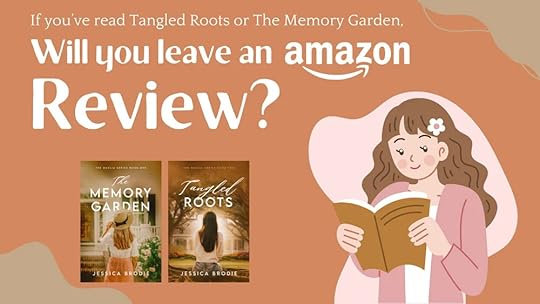
I’m trying to reach more than 200 Amazon reviews for The Memory Garden and 100 Amazon reviews for Tangled Roots! The more reviews they have, the more likely the algorithm will help reach other readers/book buyers. If you’ve read either, would you help me? I’d be truly grateful. You can review The Memory Garden here and Tangled Roots here.

Thanks to my Patreon sponsors: Brian Black, Matt Brodie, Emily Dodd, Jane, Marcia Hatcher, Frances Nwobi, Kathleen Patella, Billy Robinson, Yancy Rose, and Lanny Turner.
 Get your free copy of Jessica’s eBook, A God-Centered Life, by signing up for her weekly blog Want weekly inspirational and uplifting emails from Jessica?* indicates re-quired Email Address * First Name Last Name
 SHARE TODAY’S BLOG ON SOCIAL MEDIA: CLICK HERE OR THE SOCIAL LINKS BELOW.


November 24, 2025
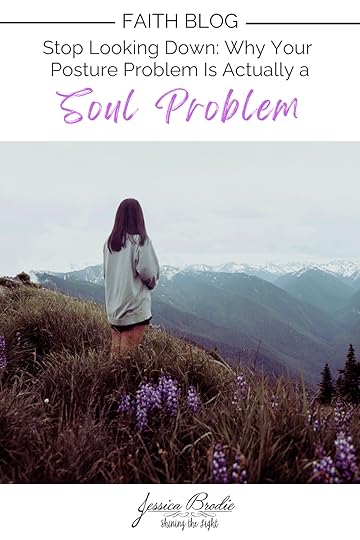
Stop Looking Down: Why Your Posture Problem Is Actually a Soul Problem

By Jessica Brodie
Have you ever discovered something going on with you physically that has a spiritual connection, too?
Recently, tension headaches prompted me to see a chiropractor. She took some X-rays, and it looks like I have a curve in my neck that slopes a bit downward instead of upward and back as it should. As a writer who spends a lot of my day hunched over a computer, I’m not terribly surprised about this. It makes sense that if I’m looking down at a screen all day and constantly hunching over a laptop that my neck would show some wear and tear after decades in this industry.
The solution is a combination of both chiropractic care and training my body ergonomically—positioning myself at the laptop in a way that keeps my head and neck straighter, so I don’t make the problem worse.
Of course, there’s a spiritual metaphor in this, too—for indeed, always looking inward and down, instead of upward and out, isn’t good for the soul, either.
God created us human beings to be in perfect communion with him—to look to him for answers, for comfort, for guidance. But what do we do instead? We turn in toward ourselves, focusing our perspective on our own wisdom and insight and on the concerns of our own little worlds instead of on the Lord.
Even if our concerns in this world seem like they’re godly—our family, our ministry, our relationships—think about it. If we’re really truthful with ourselves, we pay a lot more attention to the self and to this world than to the spiritual world.
Physically, emotionally, and spiritually, we’re looking down. We’re hunching over, instead of straightening to look up and out.
That’s not good for us or the world around us—and it’s certainly not what the Lord intended.
Self-care is important, and of course we’re going to feel naturally inclined to care for the people in our inner circle—the children, spouse, or other loved ones around us daily.
But we’re meant to do more.
Consider the good Samaritan in Luke 10:25-37, how he put his own world and his own people on hold to see the stranger in need and rescue him. He spent his own time and resources to get the wounded stranger proper care, and then he came back later to check on him. He didn’t rush home to his own wife and kids. He sacrificed for someone he didn’t even know.
And Jesus said after telling this story, “Go and do likewise.”
Consider also the disciples. After his resurrection, just before he ascended to heaven after spending forty days with his followers, Jesus didn’t say, “Now go home and make sure your family and friends are cared for, and teach them the gospel.”
He said, “Therefore go and make disciples of all nations, baptizing them in the name of the Father and of the Son and of the Holy Spirit, and teaching them to obey everything I have commanded you. And surely I am with you always, to the very end of the age” (Matthew 28:19-20 NIV).
Some of us spend far more time focusing on the needs of ourselves and our inner circle instead of caring for the stranger. And while it’s not right to neglect the self or our family and friends, neither is it right to neglect the needs of the wider world.
This season, as I’m training my head and neck to pull upward and out, I’m also considering: What are some new ways I can do the same in my soul? How can I train myself to see the needs of others—people I don’t even know? What are some ways I can heed the nudge of the Holy Spirit, to be the hands and feet of Jesus Christ, to the world around me?
I hope you’ll join me.
All this Good News isn’t meant to be for us alone.
Comment below on what you are doing or have done to be more focused on the Lord and on shining his light in the world around you. I’d love to learn more.
Have you read my newest novel, Tangled Roots? I hope you’ll head over to Amazon today. It’s available as an ebook, paperback, and audiobook. While it’s book two in the Dahlia series, you don’t need to have read book one, The Memory Garden, for it to make sense; it stands on its own. (But I’d love if you’d read both!)
If you know someone who would benefit from reading this blog, please share this with them:
I’m trying to reach more than 200 Amazon reviews for The Memory Garden and 100 Amazon reviews for Tangled Roots! The more reviews they have, the more likely the algorithm will help reach other readers/book buyers. If you’ve read either, would you help me? I’d be truly grateful. You can review The Memory Garden here and Tangled Roots here.
Thanks to my Patreon sponsors: Brian Black, Matt Brodie, Emily Dodd, Jane, Marcia Hatcher, Frances Nwobi, Kathleen Patella, Billy Robinson, Yancy Rose, and Lanny Turner.
Get your free copy of Jessica’s eBook, A God-Centered Life, by signing up for her weekly blog Want weekly inspirational and uplifting emails from Jessica?* indicates re-quired Email Address * First Name Last Name SHARE TODAY’S BLOG ON SOCIAL MEDIA: CLICK HERE OR THE SOCIAL LINKS BELOW.
November 17, 2025
A Hope Stronger than the Shifting Sand

By Jessica Brodie
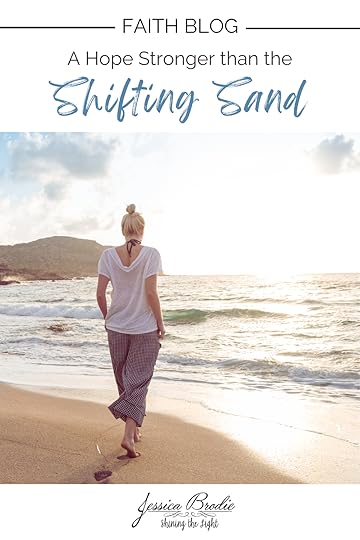
Have you ever walked on soggy sand at the beach? You set your foot down, expecting to stand upright, but the sand sinks ever-deeper with your weight, sagging into a little hole as the water rushes around your ankles. You fight to keep your balance, but the sand feels unstable. You’re not exactly sure where to walk.
At the beach, that’s usually not a problem. You can either jump in and get wet, continue walking unsteadily, or head to drier, firmer sand, where you can walk with confidence.
But in life, sometimes we find ourselves walking on sinking sand we can’t seem to escape. It becomes like quicksand—dragging you down, not wanting to let go.
Sometimes this transition to “sinking sand” happens quite suddenly. You’re walking along in life, thinking everything is just fine. Then, bam! A loved one dies unexpectedly. You receive a frightening health diagnosis. Maybe you lose your job or find yourself in a financial or legal crisis. Maybe your spouse leaves, or a child becomes a prodigal, getting involved with drugs or lifestyle choices that are nowhere near what you had hoped for them.
It’s scary. All of a sudden that firm foundation—that regular, normal, everyday life you were counting on—is nothing like what you expected. You find yourself wondering what else in life can change on a dime. You start to realize that, in fact, everything in life is tenuous and shaky, that you’re actually not in control of anything. Perhaps you can barely find your footing.
So what do you do? Do you tuck in and hide until things feel more stable again? Do you do your best to become a control freak, micromanaging what is in your power? Or do you just walk the best you can, realizing perhaps solid footing is just an illusion?
I have learned over the years that God is the only one who makes my path straight and my foundation secure. When I’m not walking with him, I veer off track, or I sink. Or perhaps even worse, I think all the gains and strides I’m making are my own doing.
But when I walk with the Lord, I can trust my footsteps are planned and ordained. I can trust that when I’m walking in his will and his purpose, I don’t have to worry about whether things are going to go wrong. I know that if they do wrong—and yes, they do, even for those of us who belong to the Lord!—I’m still safe and protected. If I sink or I stumble, God is right there with me, and I’m not lost. I’m only having a setback in this world, and I’m not going through it alone.
God‘s plan for my eternity is bigger than what I’m going through right now. Even if what I am experiencing is horrible, and even if it looks like I won’t survive it, I have a hope that is bigger than today. It’s bigger than the shifting sand beneath my feet.
We go through difficult things in this life. Sometimes they catch us off guard, and maybe we think we don’t deserve them, or that they shouldn’t happen to us because we are good people or kind or Christian. God doesn’t cause those bad things. But he does work them out for his good and glory, and we can trust that he walks with us in in the bad and the scary circumstances.
So the next time you’re at the beach and you stumble in the soft sand, remember that God is right there with you. And even if the sand seems like it’ll carry you away, you’re safe in the Father’s arms. No matter what.
Have you read my newest novel, Tangled Roots? I hope you’ll head over to Amazon today. It’s available as an ebook, paperback, and audiobook. While it’s book two in the Dahlia series, you don’t need to have read book one, The Memory Garden, for it to make sense; it stands on its own. (But I’d love if you’d read both!)
If you know someone who would benefit from reading this blog, please share this with them:
I’m trying to reach more than 200 Amazon reviews for The Memory Garden and 100 Amazon reviews for Tangled Roots! The more reviews they have, the more likely the algorithm will help reach other readers/book buyers. If you’ve read either, would you help me? I’d be truly grateful. You can review The Memory Garden here and Tangled Roots here.
Thanks to my Patreon sponsors: Matt Brodie, Emily Dodd, Jane, Marcia Hatcher, Frances Nwobi, Kathleen Patella, Billy Robinson, Yancy Rose, and Lanny Turner.
Get your free copy of Jessica’s eBook, A God-Centered Life, by signing up for her weekly blog Want weekly inspirational and uplifting emails from Jessica?* indicates re-quired Email Address * First Name Last Name SHARE TODAY’S BLOG ON SOCIAL MEDIA: CLICK HERE OR THE SOCIAL LINKS BELOW.
November 10, 2025
A Divine Whisper: Trusting God’s Timing and Plan

Dear readers,
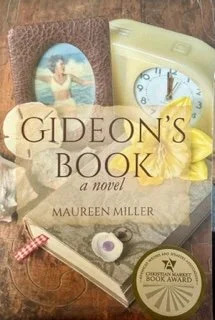
Today I’m excited to introduce you to Maureen Miller, a dear friend who is a guest blogger this week. Maureen released her debut novel Gideon’s Book earlier this year. Here, she reflects on how learning to trust God’s perfect timing helped her craft the best version of her book. Gideon’s Book is a time-split novel that weaves the stories of three souls searching for purpose and healing, exploring the transformative power of faith and self-discovery. You can find the book here on Amazon .
—Jessica Brodie
Guest post by Maureen Miller
“The Bible by the bed.” That’s what I heard one morning in 2007.
And I knew—God wanted me to write. Not a work of nonfiction, which I was most comfortable with. Not a children’s picture book, which I hoped to write one day. Nope. A full-length novel.
“What?” I argued. “You realize you’ve wired me to write nonfiction … right?”
His silence told me. He was serious.
Several months later, I attended Write to Publish in Wheaton, Illinois, where Cecil Murphey offered the keynote. He repeated three words over and over: “Hone your craft.” It was a reminder—it’s not perfection but commitment to the call that matters most.
Write often. Write much. Write variety.
“And when you don’t feel like writing or battle writer’s block—write anyway. Yes, write through—whether letters, a favorite passage of scripture, or simply the phone book. Write. Write. Write.”
That’s what we were told.
Butterflies danced as I anticipated all the writing I would do once home—God’s whisper, “The Bible by the bed,” echoing in my heart and mind.
Before the conference ended, I gathered my courage to meet one-on-one with a representative from Tyndale. I had zero words of my story written and only a simple, several-sentence description scribbled down. Still, I took a deep breath, then shared my idea.
“I love it,” the woman exclaimed before concluding, “Send me the first chapter of your finished manuscript marked ‘WTP 2007’ and I’ll take a look.”
My heart soared with this invitation—a bonus often afforded for those who attend a writers’ conference, meeting editors and publishers face to face.
“All I have to do now is write the book,” I proclaimed to my mom, who’d attended the conference with me. She just nodded, wearing a proud smile.
Trouble was, I came home and… didn’t write the book.
Instead, I did face a major health crisis with my husband who underwent several surgeries and procedures. I did mourn the loss of a daughter after a failed adoption. I did fall into a pit of despair, battling anger and depression for a season—all while homeschooling our two elementary-age sons.
Yes, and I did inquire of God, sometimes with clenched fists—“What are you doing? Why? Why? Why?”
His Perfect Time
Truth was, I wasn’t trusting God’s timing; rather, I struggled under the weight of my self-imposed expectations.
It wasn’t until I released this to the Lord and walked, day after day, by faith—claiming God’s promise to achieve the purpose for which his word was sent (Isaiah 55:11). Only then did I experience what is also promised—to “go out with joy and be led forth in peace” (v. 12).
My husband recovered, and his disease went into remission. Our once-dreamed-of daughter didn’t return, but another little girl joined our family in 2012. The cloud of sadness lifted, and joy returned. Our boys grew into young men and became more independent.
And I continued to “hone my craft” in a variety of ways, though the season for my novel had not yet arrived.
Through it all, God affirmed—I was to write a work of fiction about a Bible by the bed, and he would help me, fully equip me … when the time came. My job was to continue writing and remain patient. Out of my obedience, the book he was birthing in my heart would be born in his perfect way, in his perfect time.
The Birth of a Book
In early 2019, I began writing The Bible by the Bed. Then, that summer, I attended Write to Publish again.
After prayerful consideration, with a more professional one-page in hand and several thousand words toward my work in progress, I met with the founder of Redemption Press, Athena Dean Holtz. In the time we spent together, I shared my story’s major themes as well as my passion for these topics—issues like adoption, the sanctity of life, and racial reconciliation.
When I returned home, I signed a contract with RP, then got to work to finish my first draft. In June 2020, I hit “send” on my manuscript, then waited for edits to return. But we all know what happened in 2020. During our Age of Isolation, it seemed anyone who ever wanted to write a book wrote a book.
Once again, I grew frustrated in the waiting—often asking God, “When?” But he reminded me once more of Cecil Murphey’s words—hone your craft. It’s then I threw myself into collaborative writing—penning stories, devotions, essays, and articles for dozens of anthologies, covering a plethora of topics. And during this season I heard God whisper something else:
“You need to start over. You need to rewrite your book.”
What? Was he kidding? After all, my words were precious. My story was perfect. What could he mean, start over?
But God was serious, and as I sat with this truth, I knew—I’d not written quality fiction. I had much to learn. And yes, I needed to rewrite The Bible by the Bed.
And that’s what I did. But not before investing time to learn my craft—by reading quality fiction, reading about quality fiction, and asking God to direct me in the writing of what I knew he desired—quality fiction.
In 2023, I began again—hitting send on my second draft in the spring of 2024. And this time, I believed I’d done the best I could, had stewarded my time and talent well, and, in retrospect, could smile, rather than cry, as I pondered the journey.
Despite the tears, the fears, and all frustrations, there’d been joy as I walked—as I wrote—with Jesus.
Writing as Worship
Even with all the ups and downs, twists and turns, since that initial 2007 whisper, I am thankful.
As I reflect on what will soon be two decades, I wouldn’t change a thing—not because the road was easy. Not because there weren’t seasons of deep heartache, even loss. But through it all, I see God’s redemptive hand—his redemptive plan—at work. Guiding and directing. Binding up and healing. Exhorting and encouraging.
Truly, this has been a Romans 8:28 experience: “And we know that in all things God works for the good of those who love him, who have been called according to his purpose.”
Over the years, writing became worship. As I showed up day after day, year after year, to write, I made it a habit to pray the prayer of Moses: “May the favor of the Lord our God rest upon us; establish the work of our hands for us—yes, establish the work of our hands” (Psalm 90:17 NIV). In doing so, I experienced his presence. His peace. His joy.
Words To Change the World
What later became Gideon’s Book—based on God’s whisper about the Bible by the bed—was born in June 2025, and I can testify with all humility: God is faithful. He is patient. He has a plan. Our words possess great and lasting power and timeless truths when they originate from the Word.
Indeed, God’s messages birthed in Christian writers to be offered to the world will do that which God intends. His words will not return void, whether we’re the ones courageous enough to write them or not.
As Esther 4:14 reminds us (paraphrase)—“And who knows but that you, writer, have come to your publication position for such a time as this?”
May it be so.
A Word of Gratitude
I am so grateful Jessica invited me to share the goodness of my writing journey. I pray it points to Jesus’s divine purpose and the power of our words. My hope is that I’ll continue writing for him, for his glory, and that—when he calls me home—though I may have many incomplete manuscripts, I’ll leave no unfinished business.
Soli Deo Gloria!

Maureen Miller is an award-winning author with stories in more than 20 collaboratives. She contributes to Guideposts’ All God’s Creatures, her local newspaper and several online devotion sites, including the award-winning Arise Daily and Inspire A Fire. Married for 36 years to her childhood sweetheart Bill, she enjoys life with their three born-in-their-hearts children and three grand-girls, not to mention a variety of furry beasts. They live on Selah Farm, a hobby homestead nestled in the mountains of Western North Carolina. Connect with Maureen at “Windows and Wallflowers” (https://www.maureenmillerauthor.com), on Facebook, or via email at maureen.miller913@gmail.com. Gideon’s Book is available wherever fine books are sold. Find it on Amazon here.
Have you read my newest novel, Tangled Roots? I hope you’ll head over to Amazon today. It’s available as an ebook, paperback, and audiobook. While it’s book two in the Dahlia series, you don’t need to have read book one, The Memory Garden, for it to make sense; it stands on its own. (But I’d love if you’d read both!)
If you know someone who would benefit from reading this blog, please share this with them:

I’m trying to reach 200 Amazon reviews for The Memory Garden and 100 Amazon reviews for Tangled Roots! The more reviews they have, the more likely the algorithm will help reach other readers/book buyers. If you’ve read either, would you help me? I’d be truly grateful. You can review The Memory Garden here and Tangled Roots here.
Thanks to my Patreon sponsors: Matt Brodie, Emily Dodd, Jane, Marcia Hatcher, Frances Nwobi, Kathleen Patella, Billy Robinson, Yancy Rose, and Lanny Turner.
Get your free copy of Jessica’s eBook, A God-Centered Life, by signing up for her weekly blog Want weekly inspirational and uplifting emails from Jessica?* indicates re-quired Email Address * First Name Last Name SHARE TODAY’S BLOG ON SOCIAL MEDIA: CLICK HERE OR THE SOCIAL LINKS BELOW.
November 3, 2025
Is Self-Care Selfish?

By Jessica Brodie
Have you ever given a gift to someone and felt unreasonably protective about taking care of that gift before you gave it to them?
If I go to the store and buy something for myself, it can roll around in the back of my trunk until I get home, and I’m not terribly worried about it. But if I’ve bought a birthday gift for someone, I make sure it’s nestled carefully in my trunk so it won’t get trampled by the other things back there. Then when I get home, I keep it somewhere safe—preferably where the cats can’t massacre it—until I have the time to wrap it, topping it all off with a nice bow before I present it to them with love. I take care of that gift, making sure it’s in as good a shape as possible before it winds up in the hands of my loved one. After all, it’s a gift. It’s something precious, a tangible representation of my love and care.
But do we take care of ourselves, our bodies, with that same measure of care? Truthfully, not always.
Perhaps we forget sometimes that our bodies are also a gift. Not only are they a gift that God gave to us—human houses for our souls, as well as the Holy Spirit who lives inside all believers—but also a gift that’s meant to be given away. We’re meant to lay down our lives for those we love (1 John 3:16), as well as to offer our bodies as a living sacrifice to the Lord (Romans 12:1). We’re meant to die to the old so that we can embrace the new (Romans 6:5-6, Ephesians 4:22-24, 2 Corinthians 5:17, John 3:3).
That’s not because our bodies are worthless garbage. It’s because they’re a genuine gift.
Our bodies are one thing we can fully offer to the Lord, whether that’s in service or in sacrifice, whether that’s offering our life by defending the weak and the “least of these,” or in living sacrifice as we respond in the aftermath of disasters, or by visiting prisoners, tending the ill, praising the Lord through music or dance, or feeding and caring for those without homes or food. Our bodies are precious, meant to be used in love, service, and care.
However, many of us see self-care as selfish.
Perhaps we think if we’re truly being sacrificial, we are supposed to push ourselves until there’s nothing left. We work our lives away as though our bodies mean nothing. We put junk food in our bellies, we don’t get adequate sleep, we don’t take time to move and stretch and build our muscles, and then to feel better—or numb our pain, or maybe because we think it’s fun—we expose our bodies to toxic chemicals like drugs, too much alcohol, or other substances. We allow our bodies and our minds to get consumed by stress instead of stopping to tend the houses of our souls, the physical homes of the Holy Spirit on earth.
And perhaps we think there’s nothing wrong with that.
But just like plants need to be cared for in order to produce crops or flowers, just like churches need tending and financial support to be able to truly be the body of Christ in the world, our bodies also have needs. They need for us to take care of them properly in the world for the Lord.
If you think about it, our bodies are a gift from God. They’re meant to be used by us, yes. But they’re also meant to be given away by us to the Lord, whatever that looks like. And if we’re truly intending for our bodies to be a gift, we shouldn’t be treating them like trash.
I wouldn’t let my mom’s birthday gift roll around in my trunk, getting crushed and mangled, only to present it to her with a sheepish grin, “Here you go! Sorry it’s a catastrophe!”
Our bodies are the same. We don’t want to present them to the Lord in poor shape.
So no, self-care is not selfish. It’s stewardship.
It’s an act of love, care, and respect for a gift that God gave us in his perfect love.
If you’re struggling to see your body in this way, stop and consider how God might view how you’re treating yourself. If that’s difficult to wrap your mind around, then consider how you might react to a small child hurting herself, driving herself to the point of pain and debilitation. Wouldn’t you encourage her to take a nap, have a good meal, or slow down and rest? That’s how God feels about you and about every one of his children on this earth.
As Jesus told us in Luke 12:7, “Why, even the hairs of your head are all numbered. Fear not; you are of more value than many sparrows” (ESV).
Our bodies are precious to the Lord. Every aspect of who you are is precious to the Lord.
Remember this.
A prayer: Lord God, sometimes I treat myself like an afterthought But I’m no afterthought to you. I was created in perfect love, handcrafted by You. Help me honor Your love in the way I treat myself and care for my body, mind, and soul. Help me care for the gift You gave with proper stewardship that honors You. Amen.
Authors note: This reflection was inspired by a lesson taught by the Reverend Cathy Jamieson.
Have you read my newest novel, Tangled Roots? I hope you’ll head over to Amazon today. It’s available as an ebook, paperback, and audiobook. While it’s book two in the Dahlia series, you don’t need to have read book one, The Memory Garden, for it to make sense; it stands on its own. (But I’d love if you’d read both!)
And if I can pray for you, or you want to talk further about your struggles, I hope you’ll reach out and let me know. God bless you.
If you know someone who would benefit from reading this blog, please share this with them:
Thanks to my Patreon sponsors: Matt Brodie, Emily Dodd, Jane, Marcia Hatcher, Frances Nwobi, Kathleen Patella, Billy Robinson, Yancy Rose, and Lanny Turner.
Get your free copy of Jessica’s eBook, A God-Centered Life, by signing up for her weekly blog Want weekly inspirational and uplifting emails from Jessica?* indicates re-quired Email Address * First Name Last Name SHARE TODAY’S BLOG ON SOCIAL MEDIA: CLICK HERE OR THE SOCIAL LINKS BELOW.
October 27, 2025
How Do I Know God Loves Me Personally?

By Jessica Brodie
Have you ever been startled and simultaneously touched when someone used your first name? The other morning, I asked my Alexa device to set a timer for me. She responded with, “Good morning, Jessica! I’m setting your timer now!” It probably sounds dumb, but her use of my name immediately brought a smile to my face.
I feel the same way when someone I don’t know well greets me by name in public, or when I’ve been feeling a little anxious in a crowded situation and a friend calls my name, saying, “Jessica, come sit over here with me.”
It’s a sweet and personal touch when someone calls you by your given name. It’s like they’re extending a little hug or a friendly gesture of encouragement, like they’re saying, “I know you, and I am with you in this.”
What’s especially beautiful is knowing that it’s not just people (or our Alexa devices!) that know our names. God knows our names. He truly does.
Many times we feel like God, the father of all creation, creator of the universe and all things, is a distant God. Perhaps we think he’s off somewhere, looming above the heavens, looking down on us Impersonally.
But that’s not true at all. Countless scriptures tell us that our God is a personal God, someone who takes care of and pride in us.
In Isaiah 43:1, God says, “Do not fear, for I have redeemed you; I have summoned you by name; you are mine” (NIV).
In John 10:3, we’re told that our gatekeeper, Jesus, “calls his own sheep by name and leads them out.”
As Psalm 139:1-5 explains so poetically;
“You have searched me, Lord, and you know me. You know when I sit and when I rise; you perceive my thoughts from afar. You discern my going out and my lying down; you are familiar with all my ways. Before a word is on my tongue you, Lord, know it completely. You hem me in behind and before, and you lay your hand upon me.”
And further in that same psalm, it says:
“For you created my inmost being; you knit me together in my mother’s womb. I praise you because I am fearfully and wonderfully made; your works are wonderful, I know that full well” (Psalm 139:13-14).
Even sending his son, Jesus Christ, to die for us wasn’t an impersonal sacrifice that occurred for humanity in the most general sense. Jesus’s was personal. We are meant to understand in the depths of our being that Jesus Christ died from me personally, and for you personally, as well as for all humanity generally. What a gift!
It’s hard for me as a human to comprehend that, because I’m not God. It’s hard for me to understand how someone can love me so personally yet have that same deep love for everyone else.
But he does.
God’s love knows no bounds. His love is bigger than we can imagine or even begin to comprehend.
So yes, hearing a friend or acquaintance—or even my Alexa device—say my name is nice and feels good. But I can only imagine how good it will feel one day to stand before my Lord and hear him say, “Welcome home, Jessica, my daughter.”
How do you feel about this? Have you had an experience when someone called you by name and it was such a comfort? Do you struggle to understand that God loves you with a deeply personal and intimate love? I’d love for you to share in the comments below.
Have you read my newest novel, Tangled Roots? I hope you’ll head over to Amazon today. It’s available as an ebook, paperback, and audiobook. While it’s book two in the Dahlia series, you don’t need to have read book one, The Memory Garden, for it to make sense; it stands on its own. (But I’d love if you’d read both!)
And if I can pray for you, or you want to talk further about your struggles, I hope you’ll reach out and let me know. God bless you.
If you know someone who would benefit from reading this blog, please share this with them:

Thanks to my Patreon sponsors: Matt Brodie, Emily Dodd, Jane, Marcia Hatcher, Frances Nwobi, Kathleen Patella, Billy Robinson, Yancy Rose, and Lanny Turner.
Get your free copy of Jessica’s eBook, A God-Centered Life, by signing up for her weekly blog Want weekly inspirational and uplifting emails from Jessica?* indicates re-quired Email Address * First Name Last Name SHARE TODAY’S BLOG ON SOCIAL MEDIA: CLICK HERE OR THE SOCIAL LINKS BELOW.
October 20, 2025
Living Split: The Cost of Hiding Our Wounded Half

By Jessica Brodie
Have you ever seen a tree split in two, yet still standing tall? It’s a beautiful and amazing thing to behold.
Recently my husband and I went camping in the Monongahela National Forest in West Virginia. I didn’t notice the tree the evening before, when we set up camp. But at dawn, I wandered a bit and discovered the tall beauty. Slender but sturdy, she rose high above our campsite. Right down the center, it looked like a perfect slice had been made from top to bottom. Yet still she stood, growing and thriving, providing shelter for countless forest creatures.
Gazing at the two halves, I began to think about how that’s sometimes the way it is with people. Many of us seem to have two halves—one that’s our private self and one that’s the version we show the world. Both halves are there, making up one whole and functioning as one for all the world to see. Yet when you pause to look closely, you notice there’s a split. Maybe one half isn’t identical to the other. Perhaps it has scars, defects, and wounds, things that weaken its structure or weigh it down. The other side might look healthier, as if thriving. Regardless, it’s connected to that other half. Both are part of the same unit. They are one, tied together in life.
For many years I was like that—I had what felt like two widely separate “halves.” I had my public self, which pretended everything was just perfect, as if I had no problems at all. Perhaps I looked confident, invincible, like I had it all together. Yet walking alongside me in every moment was that other half—vulnerable, wounded, hurting, and overly sensitive. That other half had a harder time trusting, a harder time confiding. It built up an armor of protection from what it assumed was a big, bad world—so much armor, in fact, that few could penetrate it. So much armor that I spent far too much energy on protecting myself from harm instead of what God really wanted me to focus on.
It was a lonely place, and I’m grateful those years are over.
That notion of a hidden self—a hidden “half”—is something I address in my latest Christian contemporary novel, Tangled Roots. In the book, Tiff has carefully constructed a façade so ironclad that no one knows she was once raised in an abusive, dysfunctional family, one of those “no good Steadmans.” She ran so far from her past both physically and emotionally that it doesn’t even cross her mind anymore, except in the occasional nightmare. Yet when her brother is released from prison and his parole officer wants him to join Tiff in her new, wholesome hometown of Dahlia, South Carolina, her carefully concealed past now comes back to haunt her. She has to confront her past—her hidden wounds, her hidden self, not to mention her anger toward her brother and her family—in order to move into a healthy, godly future.
Do you know someone who goes through this in real life, or is that something you have been struggling with? It takes a lot of emotional and spiritual effort to maintain those two halves—so much so that the work sometimes interferes with God’s purpose for our lives. Sometimes it prevents us from forgiving those who once hurt us, or even forgiving ourselves for past sins. Sometimes it prevents us from becoming the best, healthiest version of ourselves—the person God truly wants us to be, brimming with the fruit of the Spirit.
There are times when it’s best to leave the past in the past. But sometimes, we need to deal with the pain of the past in order to let it go.
God can help with this. Church can help with this.
But once we’re free of the shackles of the past, the liberation is truly, abundantly awesome.
“So you also are complete through your union with Christ, who is the head over every ruler and authority.”—Colossians 2:10 (NLT)
If you’d like to check out Tangled Roots, I hope you’ll head over to Amazon today. It’s available as an ebook, paperback, and audiobook. While it’s book two in the Dahlia series, you don’t need to have read book one, The Memory Garden, for it to make sense; it stands on its own. (But I’d love if you’d read both!)
And if I can pray for you, or you want to talk further about your struggles, I hope you’ll reach out and let me know. God bless you.
If you know someone who would benefit from reading this blog, please share this with them:

Thanks to my Patreon sponsors: Matt Brodie, Emily Dodd, Jane, Marcia Hatcher, Frances Nwobi, Kathleen Patella, Billy Robinson, Yancy Rose, and Lanny Turner.
Get your free copy of Jessica’s eBook, A God-Centered Life, by signing up for her weekly blog Want weekly inspirational and uplifting emails from Jessica?* indicates re-quired Email Address * First Name Last Name SHARE TODAY’S BLOG ON SOCIAL MEDIA: CLICK HERE OR THE SOCIAL LINKS BELOW.
October 13, 2025
What Does It Really Mean to Be a New Creation?

By Jessica Brodie
Have you ever done something awful—I mean, really awful … so awful it still haunts you?
Of course, everyone’s version of “awful” looks a bit different. One person’s awful might look like a time of wandering away from God and dabbling in immoral activities, while another person’s awful might involve murder, adultery, or other illegal activities. Maybe you regret a lie you told, or the betrayal of a friend. Maybe you spent years engaging in sinful situations and woke up one day, just like the prodigal son, and returned to God’s fold repentant and determined to live in a righteous and holy way.
Anything we do or say that’s not in line with God’s way is considered a sin. And the Bible tells us the wages of sin—no matter the sin, whether lying or murder—is death (Romans 6:23). Thanks to the mercy and sacrifice of Jesus Christ our savior, we who repent and believe are forgiven. When we become followers of Christ, believing in him and repenting of our wrongs, God tells us we are washed clean (1 Corinthians 6:11). There’s nothing we can do to earn that. It’s a gift from God, an extraordinarily gracious and extravagant gift, and it gives us all great hope and assurance that we will get to join him in eternity.
Still, knowing this in our head and our heart can be two different things. Knowing this and fully trusting it can be a challenge, too.
I know many people who led sinful lives in their youth, doing terrible things. They’ve turned their lives around, yet still find themselves haunted by the past, deep down doubting that God’s grace actually applies to them.
“I know I’m forgiven, but I can’t seem to forgive myself,” one friend shared once, tears glimmering in her eyes. “And I’m worried that maybe there’s a loophole—like, what I did was just too bad or too wrong to be forgivable.”
Rest assured—there is nothing that can separate us from God’s love. As we’re told in 1 John 1:9, “If we confess our sins, he is faithful and just to forgive us our sins and to cleanse us from all unrighteousness” (ESV).
One of my favorite Bible verses is 2 Corinthians 5:17, which tells us, “Therefore, if anyone is in Christ, he is a new creation.”
Consider that wonder for a moment: We are a new creation in Christ. A new creation! We truly get the chance for a fresh start, a do-over. We get to lay aside the old, sinful self and be a brand-new, upgraded version.
I like to explore these sorts of faith questions in my fiction-writing. In the novel I just released, Tangled Roots, one of the protagonists is a man, James, who has just been released from prison. Incarcerated after committing a hate crime in his youth, James has become a Christian in the seven years he spent behind bars. Yet now that he’s been released, he’s consumed with shame for his past sins, berating himself for all the things he did wrong. His pastor in prison taught him about being a new creation in Christ, and since then, he’s repeated 2 Corinthians 5:17 every day, trying to sear the meaning about being a “new creation in Christ” into his bones.
Still, he just can’t seem to believe the scripture applies to someone like him—a dirt bag, he thinks. A mess-up. The worst kind of person in the world.
Some of us are a lot like James, aren’t we? Maybe we forgive others for their sins, but when it comes to our own, we beat ourselves up relentlessly, thinking terrible things about ourselves.
It’s hard sometimes to believe the promises of scripture. We think maybe that kind of grace is just for some people, or we think maybe it’s just not true. But walking in the Lord requires us to have faith, even if we can’t fully understand why God would do such a generous thing. We are to have faith in spite of those doubts.
As the man said to Jesus in Mark 9:24, “I believe; help my unbelief!”
If you find yourself doubting, take heart. God forgives us all when we repent and believe—no matter what. That includes you and me, no matter how far gone we once were. We truly are new creations in Christ.
Let’s own that truth and let God’s grace set us free from the shackles of our past.
How about you—are you struggling with forgiving yourself or believing God’s grace truly applies to you? Have you ever felt this way? Or do you know someone walking through this? I’d love to hear your thoughts. Please comment below!
If you’re interested in checking out Tangled Roots, I hope you’ll do so here, or click the book image. Tangled Roots is Book Two in the Dahlia Series, where grace meets grit, hearts are mended, and hope finds a way to flourish. (You don’t have to read Book One in the series, the #1 Amazon bestseller The Memory Garden, but you can find that one here if you’re interested.)
If you know someone who would benefit from reading this blog, please share this with them:
Thanks to my Patreon sponsors: Matt Brodie, Emily Dodd, Jane, Marcia Hatcher, Frances Nwobi, Kathleen Patella, Billy Robinson, Yancy Rose, and Lanny Turner.
Get your free copy of Jessica’s eBook, A God-Centered Life, by signing up for her weekly blog Want weekly inspirational and uplifting emails from Jessica?* indicates re-quired Email Address * First Name Last Name SHARE TODAY’S BLOG ON SOCIAL MEDIA: CLICK HERE OR THE SOCIAL LINKS BELOW.
October 6, 2025
Finding Hope in Broken Relationships
By Jessica Brodie
Have you ever loved someone who ended up disappointing you? Maybe they hurt you emotionally, or betrayed you, or perhaps they did something to another person that was so awful you had to cut ties with them?
Broken relationships are one of the hardest things we humans navigate during our lifetimes. The pain we experience, and the decisions we have to make, can be difficult and even traumatic.
In my life I’ve rarely had to completely break ties with someone I’ve loved, but I’ve had to put firm boundaries in place. Even that can be tremendously challenging.
Perhaps because it’s so hard, it’s one of the topics I find myself coming back to over and over again, not only in my faith blogs and other nonfiction but in my fiction. I’m particularly drawn to difficult family relationships—mostly because you often feel “stuck” with your family, so you’re forced to find creative ways to deal with tension and brokenness. And sometimes those methods are decidedly imperfect. For instance, the sibling relationship is one of the most complicated and extraordinarily beautiful that we’ll ever experience. But sometimes, horribly painful circumstances can erect walls between siblings—walls so high they cause permanent damage.
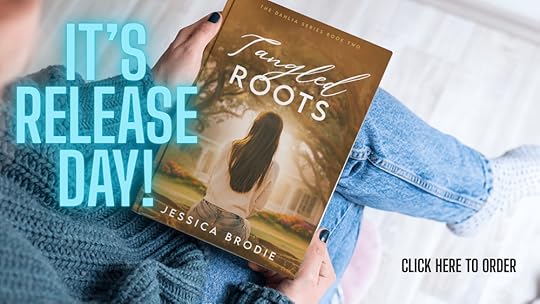
That’s the crux of my latest novel, which releases today. Tangled Roots explores the broken relationship between Tiff and James, a brother and sister who were once so close they relied on each other for survival—but now they can barely speak to each other.
Tiff and James grew up in a dilapidated former mill town, two children of abusive, alcoholic parents. James was Tiff’s protector throughout her childhood—her hero—but their lives took two very different paths. He joined a gang and wound up locked up in prison for a hate crime, while she got a college scholarship and moved far away, burying herself in her faith and her future. Now, in peaceful Dahlia, South Carolina, she’s finally built the respectable life she’s always craved. With a proposal from her upstanding boyfriend Bobby, everything seems perfect.
Then she gets word that her brother has been released from prison—and his parole officer wants him to join Tiff in Dahlia.
But Tiff hasn’t told anyone, including her fiancé, about her past—or about her brother. Nor has she forgiven her brother for the wrongs he’s done, or for abandoning her to survive the chaos of their family alone. And she can’t believe her brother really has become a born-again Christian and wants to turn his life around, despite his letters and his pleas.
She’s also not convinced that she herself won’t repeat the cycle her family started.
I won’t tell you anything else, because I hope you’ll read the book and see how Jesus triumphs over this seemingly irredeemable situation. But here’s the not-so-secret real-life secret: Jesus does fix our broken, seemingly irredeemable, seemingly unfixable messes.
I’m fascinated with Christian redemption stories, the way that deeply flawed people undergo a profound, miraculous transformation as they see the proverbial light and begin to walk God’s path for their lives. Perhaps it’s because I myself am a redemption story, and I’ve seen the powerful and beautiful ways God works in our lives.
At its core, that’s where this book originates—in the notion that no matter how far away someone seems from Christ, no matter how many wrongs they’ve done or how bad a sin they might have committed, no one is exempt from the saving grace of Jesus Christ. No one, no matter what. There is room for everyone at God’s table.
God’s love is that powerful.
One of my favorite Bible verses is 2 Corinthians 5:17: “Therefore, if anyone is in Christ, the new creation has come: The old has gone, the new is here!” (NIV).
That’s how big God’s love for us is—we who genuinely believe have the opportunity for a do-over, a rewrite, a truly fresh start, no matter what.
In our relationships, sometimes that’s not possible or healthy.
But with God, it’s different. God wipes our slate clean.
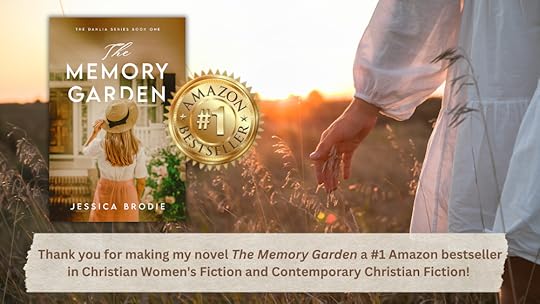
If you’re interested in checking out Tangled Roots, I hope you’ll do so here, or click the book image. Tangled Roots is Book Two in the Dahlia Series, where grace meets grit, hearts are mended, and hope finds a way to flourish. (You don’t have to read Book One in the series, the #1 Amazon bestseller The Memory Garden, but you can find that one here if you’re interested.)
And if you’re someone who, like me, has had to navigate your share of broken real-life relationships, take heart. On this side of heaven, things don’t always get resolved. But sometimes they do. Yet no matter what, you can be certain Jesus is walking right beside you. He knows your pain and your heartache, your baggage and your guilt, your anger and your anguish.
And he can help.
A prayer: Lord, thank you for your willingness to shine your pure and holy light into the darkest of circumstances and the darkest of relationships. Thank you for meeting me in my pain and understanding the whole situation. I surrender all to you and your healing mercy. Amen.
If you know someone who would benefit from reading this blog, please share this with them:
Thanks to my Patreon sponsors: Matt Brodie, Emily Dodd, Jane, Marcia Hatcher, Frances Nwobi, Kathleen Patella, Billy Robinson, Yancy Rose, and Lanny Turner.
Get your free copy of Jessica’s eBook, A God-Centered Life, by signing up for her weekly blog Want weekly inspirational and uplifting emails from Jessica?* indicates re-quired Email Address * First Name Last Name SHARE TODAY’S BLOG ON SOCIAL MEDIA: CLICK HERE OR THE SOCIAL LINKS BELOW.
September 29, 2025
Trusting God When Life feels Hopeless or Hard

Dear readers,
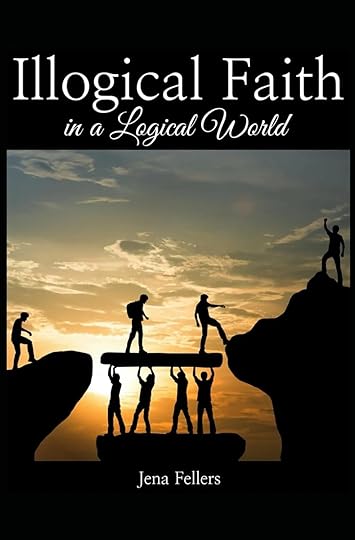
Today I’m excited to introduce you to Jena Fellers, who is a guest blogger this week. Jena recently released her helpful newest book, Illogical Faith in a Logical World . Here, she reflects on how her story of learning to trust God and how we can do the same.
—Jessica Brodie
By Jena Fellers
For retirement, we desired to live simpler and healthier lives than when pastoring for 25 years. Homesteading, here we come—almost!
Once our adult children knew we were serious, they wouldn’t let us move without them.
Okay, finding affordable, larger property to meet everyone’s individual needs is an obstacle, but is doable … with effort. Bingo! Done! Wait—what?
After signing our contract and turning financial papers in, we learned the seller forgot to disclose detrimental information. A windmill lease existed on the property stating nothing could be built—even growing a tree required their permission.
Devastated, and not knowing what to do, it was a “pull your hair out while you pray” day—maybe even a week or two! Nothing like watching your future go down the drain.
I might have been upset longer, but this wasn’t my first time feeling hopeless from hitting a brick wall.
You see, in college, I was diagnosed with retinitis pigmentosa, a rare, incurable, and progressive eye disease, resulting in tunnel vision and night blindness.
They informed me I was legally blind, even though my acuity was 20/50 in one eye and 20/80 in the other.
Puzzled, they quickly explained, “It’s due to your peripheral vision. Anything less than twenty degrees out of ninety is legally blind. Yours is fifteen.”
The doctors had no idea how long I’d be able to read or when I’d be totally blind.
Afraid, I questioned, “Would I be able to graduate? Teach? Live alone? Would a man marry me?”
My only options were to give up or give it to God.
Giving up wasn’t in my personality. When praying, I felt an inner peace to move forward. I trusted him to guide me in my unknown future—somehow, some way.
He did! One day at a time.
While I lost vision throughout college, God guided me, encouraged, and strengthened me. I not only graduated, but landed a job, found a house, and taught elementary special ed for three years.
I learned when truly trusting him in the unknown, he would equip me for whatever lie ahead, like working in social work with teenage male juvenile offenders before going on disability.
Trusting God again with the unknown, God led me to my knight in shining armor, who had custody of his teen children. Seven weeks later, we married. We had one child together that I homeschooled.
Then, God called us to pastor a small church. Having low vision, I resisted at first before surrendering. God showed me if I was a willing vessel, he would equip me to work through.
God enabled me to play the flute on our worship team, teach children of all ages weekly and Bible studies occasionally, preach, and pretty much fill-in anywhere needed. What a journey!
To prevent empty nest syndrome, I learned to write after 15 years of being unable to use a computer. Thanks to an affordable screen reader my husband discovered, I began blogging in 2015, not knowing if anyone would ever read my words or not.
The biggest step of faith I ever took was when my husband and I co-founded a feeding ministry where we relied totally on God for food resources, funds, and volunteers that served 1 million meals over a ten-year span.
It wasn’t our plan. God laid it on our hearts and confirmed it with a miracle. We had to obey.
He then expanded the ministry to glorify him—not us.
Maybe that’s why my sweet friends refer to me as someone who walks by faith, both physically and spiritually. Such an honor.
Now, I have been in several “Red Sea” moments and have been able to trust God and see miracles as a result. He has built my faith step by step. I want others to grow their faith to experience God in a new way during their hardship. To thrive; not survive.
That is why I wrote my newest release, Illogical Faith in a Logical World. In it, I guide readers through seven necessary steps for walking by faith and trusting God more than ever before. I break down an often-quoted but rarely lived to its fullest verse: Proverbs 3:5,6.
But first, I demonstrate the amount of trust and faith a blind person needs to walk using a cane or sighted guide.
With this book, and practice, anyone can walk by faith as easily as a blind person walks without sight. You can experience supernatural peace, joy, and strength while walking through your hard unknown.
Buying our property seemed impossible, but here we are three years later, camping in our “Promised Land” while building a homestead with our family. True freedom and peace!
The bank president said in his 35 years at that bank, he had never seen anyone get a lease rewritten.
Grateful, we testified, “God is big, and we’re thankful he chose to show favor upon us.”
That didn’t mean everything has been smooth since. It means we continue to trust a mighty God regardless of what we see. He has a plan for us.
He has a plan for you—a plan to trust. The benefits are out-of-this-world!
Jena Fellers walks by faith, not by sight—both physically and spiritually. Diagnosed in college with a rare, progressive eye disease, she managed to graduate and teach elementary special education. After losing enough vision to go on disability, she married Steve Fellers. They have three children and four grandchildren. In Baxter Springs, Kansas, Steve and Jena pastored Trinity Worship Center for 25 years before retiring and moving to Oklahoma. For ten of those years, they also cofounded Word in Action Ministries, an outreach ministry to the poor that included free nightly hot meals, a food pantry, and a thrift store. As an author, inspirational speaker, pastor, and resilience coach, Jena loves to help others, teach, and share personal stories, especially about the miraculous ways she has witnessed God working in her life. Her passion is to educate, empower, and encourage others to follow Christ a little closer. She blogs at https://www.changingfocus.life. Her ebooks are housed in the blog’s shop, and her print books are on Amazon, including her newest, Illogical Faith in a Logical World.
If you know someone who would benefit from reading this blog, please share this with them:
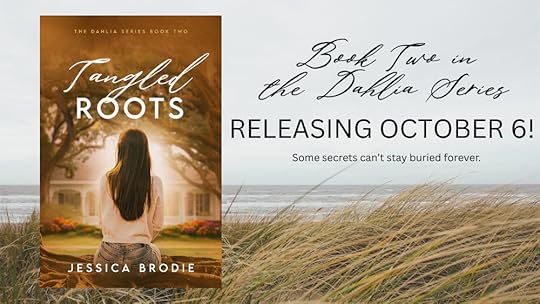
My novel Tangled Roots releases Oct. 6. If you’d like to help me launch it, email me and let me know!
Thanks to my Patreon sponsors: Matt Brodie, Emily Dodd, Jane, Marcia Hatcher, Frances Nwobi, Kathleen Patella, Billy Robinson, Yancy Rose, and Lanny Turner.
Get your free copy of Jessica’s eBook, A God-Centered Life, by signing up for her weekly blog Want weekly inspirational and uplifting emails from Jessica?* indicates re-quired Email Address * First Name Last Name SHARE TODAY’S BLOG ON SOCIAL MEDIA: CLICK HERE OR THE SOCIAL LINKS BELOW.