
Jack Whyte's Blog
June 1, 2020
Measuring Up…

 Don’t Let Them Get You Down! UK Version of “Forest Laird.”
You might have noticed, after the past couple of months of isolation, that you can go a bit stir-crazy once you’ve exhausted all your avenues of self-distraction… Your reserves of resilience start dwindling and your capacity for patience starts drying up. I reached that point a few days ago, having managed to keep myself active prior to then by writing madly and putting together a collection of short stories. Once that activity died down, though, and faced with the prospect of increasing boredom and ennui, I went looking for something uplifting that would divert my mind, and the minds of my friends, if for no more than a few smiling moments, from the wintry, humorless cynicism that surrounds us nowadays.
Lots of time ahead, I thought, to contemplate the “post-COVID” future: the resumption of loud, vulgar, uneducated and corrupt morality; fake news, false promises, phony values, festering discontent and foolish, empty rhetoric. For the time being, ignoring “the New Reality”, I felt I needed something to exalt me, to lift me up above the bleakness in the hope I might find something or someone to look up to.
Then I remembered Peter Finch in the movie, “Network”, standing up on national television and shouting to the world that he was fed up and wasn’t going to take it any more, and I perked up immediately, remembering that people, historically, have always managed to come up with ways of uprooting threats, lifting up their spirits, and upgrading their prospects, even when they feel most powerless and ineffectual.
I remembered brightening up at the mental vision of Don Quixote tilting at windmills, and I thought about bearing up under the strain; about not giving up the ship; and about upping the ante by speaking up about my opinions and beliefs…
And then I thought about the word “up” itself, and a memory popped up about something that had cropped up about that a few years ago, and had amused me; something to do with “up” being idiomatically uplifting and astonishing in its range of meanings. So I went digging up old files while the thought of it was still uppermost in my mind, and I came up with what follows here. I wish I could say I wrote it, but I did not. To the best of my knowledge, it was written up anonymously. I’m merely bringing it up now for your enjoyment.
“Up” has more meanings than any other single word in the English language. It is listed in the dictionary as an adverb, a preposition, an adjective, a noun and a verb.
Its meaning is straightforward when it means toward the sky or at the top of the list, but after that, “up” defies classification, other than being described as idiomatic. But you put up with it because you can’t get away from it: when we awaken in the morning, why do we wake up? At a meeting, why does a topic come up? Why do we speak up, and pipe up, and why are qualified candidates said to be up for election? Why does a tie call for a toss up, and a lie, too often, for a cover up? Why is it up to the secretary to write up a report? We call up our friends, brighten up a room, polish up the silver, warm up the leftovers and clean up the kitchen. We lock up the house and fix up the old car. People stir up trouble, line up for tickets, work up an appetite, and think up excuses. And while it is one thing to be dressed, to be dressed up is special.
When it threatens to rain, it’s clouding up; when the sun comes out, it’s clearing up. When it rains, the earth soaks up the water. When it doesn’t rain, things dry up. A drain has to be opened up if it’s blocked up, but why do we open up a store in the morning and close it up at night? We seem to be pretty mixed up about up!
To bone up on the proper uses of up, look up the word “up” in the dictionary. In a desk-sized dictionary, its listed meanings take up almost a quarter of the page and can entail up to about thirty definitions, but if you are up to it, you might try to draw up a list of the many ways up is used. It will take up a lot of your time, but if you don’t give up, you may wind up ending up with upwards of a hundred.
I could go on, but I’ll wrap it up for now because, to sum things up, my number’s up and it’s time to shut up. What’s up with that?
The post Measuring Up… appeared first on Jack Whyte.


May 5, 2020
Scrivener, the Ink-Stained Wretch
I bought the original version, Scrivener 1.1, and I’ve been using it ever since, but in the meantime the the program itself has grown and expanded exponentially, and I’m now using Version 3.15. It’s a wonderful platform, designed specifically for writers of all stripes and chock-a-block with everything any writer might need in versatile, endlessly flexible ways of cataloguing, assembling and organizing stray thoughts, ideas, summaries, version comparisons, and bits-and-pieces, as well as web sites and research resources and all kind of writing possibilities… All in all, Scrivener is far richer in its intuitive potential than Microsoft Word, the Goliath of word processing world. But the difference between the Scrivener 1.1 I first fell in love with, and the current Scrivener is huge, nowadays, and frankly, I’ve sometimes found it difficult to keep on top of all the changes. The mechanics of learning to use the various elements of the program have become quite complex, even intimidating. In the minutiae of its bewildering capabilities, Scrivener has unfortunately become quite difficult to master.
That was massively frustrating because, even after using the program for years, I knew I wasn’t taking full advantage of its power. There are things in there that I knew I should be able to do quickly and easily, but I didn’t know how and there didn’t appear to be any means of learning individual techniques and tricks quickly, with quickly being the operative word. I’ve used the program in writing my last five novels, and I love it in so many ways that it made me sick even to contemplate abandoning it to return to using Microsoft Word. But until very recently I was seriously contemplating doing precisely that, because in Word, I simply write, and that is, that has to be, my overriding priority. I know how the Word program works and I don’t need to fret over formatting or manipulating text or even about retrieving revised and edited text that should never have been lost in the first place.
So there I was, not long ago, actively contemplating uninstalling my beloved but frustrating Scrivener, when by sheer serendipity resulting from a carelessly hit button I should never have gone close to, I found myself gazing at a the Home Page of a website called “Learn Scrivener Fast.”
To this moment, I don’t know what I did to get there or how I arrived there, for I hadn’t gone looking for it–I had never even conceived of such a site, but there I was. And so I started reading, and I ended up buying the proffered course–which is a LOT more expensive than Scrivener ever was. That did not bother me. This is a full-bore, interactive, digital course of instruction built around a series of two- to four-minute how-to videos. It is divided into five sections and capable of being consumed linearly, from start to finish, soup-to-nuts at your own pace, or of being cherry-picked at leisure for specific instruction on precisely the kind of things I’ve been gnashing my teeth over. Or you can go both ways. The most exciting thing of all, though, as far as I was concerned, was that this course lets you take your time and pick and choose between segments, returning to any of them as often as you want to or need to. And the individual “lesson” segments are short and punchy, simple to understand and easy to put into practice and into the context of the real, working world. The average length of each element is about a minute and a half. Some are shorter, some are longer, but so far I haven’t seen any that are three minutes long . . . They’re all connected, too, and they flow in sequence, but they break down into instantly comprehensible, easily digestible chunks. The whole thing is “look and learn”. You watch a bit of one video, then do it on your own documents until you understand how it works, go back to the video and watch another bit, then return to your own writing and implement that, too. There are bona fide video samples on the site, too, taken right from the program. I recommend the package, but if you want to experience a really superb web-site-cum-pitch, check it out at www.learnscrivenerfast.com. The sit back and have fun writing.
The post Scrivener, the Ink-Stained Wretch appeared first on Jack Whyte.
May 2, 2020
Behemoths
America, and by extension, Canada, is a nation of car lovers. To see the proof of that, all you have to do is sit by your TV and count the number of automotive commercials on television. Irrespective of where you might be on any given night in North America, you will be stunned, once you become aware of it, by the amount of money being spent, every day, on advertising vehicle sales in every area of both Canada and the USA.
in recent years, truck sales have grown even more quickly than car sales. That, from my viewpoint at least, is astonishing. When I first came to Canada, a very long time ago now, car sales were the automotive industry. Station wagons were popular for families, and there was no such thing as a minivan or an SUV. City and town dwellers everywhere drove American sedans or the occasional coupe—there was no foreign competition, except perhaps for Volkswagen Beetles and buses—and Detroit, Michigan, which had just started to churn out sophisticated muscle cars, was the automotive capital of the world. The Japanese Invasion hadn’t really begun yet, Nissan was still called Datsun, and the Honda Civic, an alien-looking, boxy little thing, was perceived as some kind of Mickey-Mouse joke.
The rural marketplace, on the other hand, was the domain of the half-ton truck. Every rural worker in the country drove a half-ton. It was the workhorse of the entire country, apart from “big” rigs and multi-axle haulers. No matter what your personal preference in brand names might be, the half-ton was everywhere.
Now it’s a surprise to see one anywhere. They have practically vanished, made obsolete by what I think of as the Juggernauts—those gigantic, almost identical behemoths produced in such astounding numbers by truck manufacturers everywhere.
The COVID-19 pandemic has decimated the automotive market, just as it has every other industry, and sales have dropped in consequence, but the Juggernauts are still out there, and one of these days they’re going to start asserting themselves again. But a couple of months ago, before the arrival of this latest Coronavirus, I used to dread coming out of a store and returning to my parked car to discover that it has been hemmed in on either side by a huge pair of high-wheeled leviathans that simply defy you to back safely out of a parking space between them that was too narrow in the first place. Good luck with that. No one knows your vehicle is hidden in there, no one can see it or you, and no one expects a ludicrously small-looking (but yet normal) car to back out from between the two giant cliffs formed by the square ends of the vehicles masking it from sight.
The most astonishing thing I’m aware of in vehicle sales today, though, is the seemingly inexhaustible reserves of uncomplaining gullibility that people show in deference to Automotive Marketers, swallowing the bait those people offer so cynically.
For years now, sales spiels have centred upon cash-back bonuses. Huge numbers of people willingly subscribe to the marketing idea that we can be conned into spending money through the prospect of getting cash back afterwards. That supposedly “free” benefit of receiving a “return” on your purchases, is utter nonsense. Everyone knows, or ought to, by now, that there is no such thing as a free lunch. And yet all the automotive companies use it and it obviously works. If it didn’t, they wouldn’t be doing it, and they certainly would not have been doing it for as long as they have.
If they really wanted to be as solicitous and generous as they profess to be, they would simply lower the price of each vehicle, right on the showroom floor, and let the numbers speak for themselves. For some reason, though, that style of sales technique won’t fly, and one has to wonder why. Might it be because the industry can’t make as much profit by being truthful about what they are offering? That is the truth, but most people can’t, or won’t see it. If they did, they would stop responding to ads that promise them a rebate on what they haven’t spent yet. And if that happened, the industry would quickly ditch the whole idea of “cash back” bonuses.
The truth, of course, is that the automotive companies finance the entire ticket price of the vehicles they sell, and while they might “give you back” up to $8,000 or more on “selected purchases,” they then go ahead and charge you hefty interest rates on that “cash-back” amount, no matter how much it is, for the entire duration of your financing contract. So a $10,000 “rebate” on a 60-month contract means you’ll be paying monthly interest on that cash-back $10,000, on top of your “normal” payment, for the next five years.
Silver lining: according to Internet analysts, (and dreamers,) and despite the current debilitating effects of the viral pandemic, all of that is going to change soon and we are witnessing the last death-throes of a dying industry. Thus say the Pundits. The far-too-volatile fluctuations of the petroleum industry, combined with the advent of computer-driven, electric and electronic cars, will eventually abolish the need for gasoline. The increasing sensitivity of driverless cars will reduce the accident rate to the point where auto insurance, as we know it, will become unnecessary, preventing long lawsuits; and the proliferation of companies like Uber will mean that the next generation of consumers won’t even think about learning to drive. They’ll pay for use as they go, just as they do already with cell phone data. And thus, abandoned parking lots will turn green again, dedicated to other uses. And the band plays on…
The times, they are a-changing, too rapidly for most people my age, but then, I find the idea of a world without personally-owned and operated vehicles to be unimaginable, despite the fact that it would be a good thing on every level.
The post Behemoths appeared first on Jack Whyte.
January 29, 2016
More about The Skystone
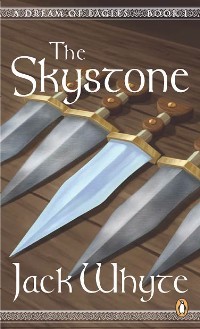 The current Canadian version of the paperback edition
I wrote a post some time ago about what had happened to “The Skystone” because several readers had written to me saying they couldn’t find copies to buy, and some people had even heard that the book was out of print.
That last part galvanized me, I admit, because if the book had gone out of print, then it had done so without anyone at Penguin Books having thought to contact me in order to inform me that after twenty-odd printings and twenty-plus years of constant availability, it had eventually been deemed to be irrelevant and defunct. I seriously doubted that such a thing might have happened, and I was right. My editor at that time assured me that the book was simply “between print runs” and would become available again in the near future, and at that time I wrote a Blog entry entitled “It’s about The Skystone”.
Since then, though, my beloved editor, Adrienne Kerr, abandoned me, leaving the Penguin organization to get married to the guy she’d spent a lifetime looking for, and to hang out her own shingle as a freelance professional editor. And after her departure there came a long silence that lasted until I phoned the PenguinRandomHouse headquarters in Ontario and spoke with the Associate Publisher, who promised to get back to me the following day. In the event it was Brad Martin himself, the President and CEO of Penguin Random House, who phoned me back from the very apex of the mountain, and the last of my concerns evaporated as he laid out, chapter and verse, what would be happening henceforth not only with The Skystone, but with all future editions of my other novels. Henceforth, he told me, my books will be reprinted only in Trade Paperback editions as they become due for renewal. The only information I lack now is the exact, specific date when The Skystone will again become available in Canada, but he assured me that it will be very soon, and readers may rest assured that I’ll publish the information here as soon as I have it.
The post More about The Skystone appeared first on Jack Whyte.
December 13, 2015
“If They Asked Me, I could Write A Book….” That’s a Song.
Now that, I believe, was sage advice, and I have tried to abide by it ever since. But that need to have me offer gratuitous advice to less established writers (all of whom are younger, alas!) seems to be endemic among interviewers, and so I’ve been thinking about the little advice I do offer struggling writers. It’s encapsulated in two points, predicated upon some of the pragmatic realities I have experienced along the way to becoming an author whose work is accepted by both publishers and readers. Here it is:
Don’t dream of being published. Work to get published. That’s what I tell wannabee writers who attend my workshops. I invite them to think of all the people they’ve heard say, “Some day I’m going to write a book…” knowing that they never will. Because there’s only one way to write a book—you have to sit down and write it, spending long months and sometimes years in solitary confinement, struggling with words and your own ability to manipulate them and make them attractive and appealing. Most people think writing is easy; that there’s nothing to it; that anyone can write a book if they care to sit down and do it. They believe, too, that as soon as they’ve taken the time to write one, somebody out there will be eager to publish it and make them rich. ’T ain’t so, I’m afraid.
As an aside, I heard a lovely story about a retiring brain surgeon who, when asked what he would do next, said, “Oh, I think I’ll write a book.” One of his dinner companions, a female author in her fifties, laughed and said. “I hope you will. I can’t wait to read it. When I retire I intend to try my hand at brain surgery.”
So how hard can it be to write a book? I’ve lost track of the number of times I’ve told classes and students that it’s not really that hard, if you’re prepared to give up a year or two of your life to write one. Writing’s easy, I tell people. A year, perhaps two years of donkey work and you’ll have written a first draft of some description. After that, you start rewriting it for Draft Two, and it’s it’s the re-writing that will kill you. The constant repetition and redrafting, reconstructing and refurbishing and rebuilding and reformatting and re-envisioning and revising in what often seems like a never ending fight to get your story absolutely right and ensure that it’s the best, most utterly authentic manuscript you are capable of generating at this stage of your life and career. And I’m sometimes asked, “Is that necessary? Does it absolutely have to be that difficult?” The answer to that question, though, is simple: “No, it doesn’t, if you don’t care about getting published.”
If you do care about publication, though, there’s a different, self-evident answer. Twenty years ago, before the Internet and the self-publishing craze, the statistical, industry odds against any manuscript ever being published were 30,000 to one. In other words, for every manuscript that actually made it into publication, 29,999 were deemed unpublishable. For commercial publishers, that has not changed. The odds against publication by a legitimate publishing house have, in fact, increased now that everyone in the world thinks they’re capable of writing a book. In truth the Big Question in the publishing world, asked by agents and publishers alike upon first eyeing a new manuscript, is not, “Have I found the next Shakespeare or Victor Hugo?” It is, “Can I make money off this?” And that brings me to my second piece of advice to the wannabee author:
Above all, learn your craft. When you decide to become a Writer, the English language becomes your stock-in-trade, so that means you have to learn to use it properly before you start to abuse it. There are no ifs, ands or buts associated with that statement. It’s an absolute. You owe it to yourself, if you really want to succeed, to learn the rules of usage—all of them—so that you know them inside out and upside down; so that you can shuffle them like cards, cutting them and manipulating them endlessly in constantly varying patterns, without a hitch or a fumble.
Once you do know all the basics—the rules of spelling, punctuation and grammar—you can go ahead and break them any way you choose to. But you have to know them and understand them first, so that when you break them you can do it with authority and your readers will know beyond a doubt that you’re doing it deliberately and for effect . . . not out of ignorance, smug self-righteousness or an embarrassing lack of understanding, knowledge or erudition.
You have to accept that people out there—publishers, editors, critics and a huge percentage of readers—know, understand and are governed by the established rules of grammar and punctuation and spelling, and they won’t be fooled or impressed if they see, or even suspect, that you do not subscribe to those fundamental standards. So learn to use the language. It’s like serving your apprenticeship, or learning your craft, or paying your dues… They’re all honourable, long-accepted and legitimate rites of passage.
You should be working every day, too, to increase your vocabulary. And if your eyebrows went up, even mentally, after reading that sentence, it would be a good idea right now to consider some other means of pursuing fame and fortune, because the odds at this stage of your being a successful author are less than encouraging . . . and I’m being nice about it.
The world needs good writers, because there are too many writers out there today who are just plain bad. On the bright side, though, I know lots of brilliant, upcoming young writers, to whom I love to say, “Keep going, keep writing. Believe in yourself and believe in your work and be proud of the countless hours you spend perfecting your craft.”
The post “If They Asked Me, I could Write A Book….” That’s a Song. appeared first on Jack Whyte.
December 9, 2015
Looking through a different window onto Life…
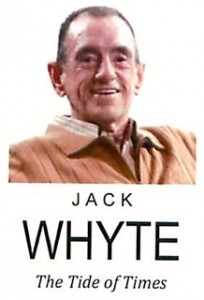
I received a very nice tribute a few days ago from a fellow called Conor Cobban, who wrote to me via hotmail.com to tell me he’s a registered site member and that he recently stumbled, almost by accident, upon the subsection of this site that features the weekly columns I now write for my local newspaper here in the Interior of British Columbia. He had been digging around within the site, as members are supposed and encouraged to do, and had come across the columns almost by accident. Having discovered them, though, he then inhaled them all in one enormous, all-but-indigestible gulp and decided he wanted to write to me and thank me for including them. I was, of course, highly gratified with his praise, as writers always are when they hear from people who enjoy their work, but I couldn’t get that niggling, “almost by accident” phrase out of my mind, and it stayed with me to the point at which I decided I would have to sit down and write a special Blog post, inviting visitors and regulars alike to visit those particular pages and sample another, very different aspect of my writings…
It’s not difficult to find the pages I’m talking about, because they’re not hidden in any way, but neither are they listed front and centre in the main menu on the Home Page, and that is purely because of space constraints. If we were to add the extra box required to highlight the feature on the main menu there next to “Jack’s Blog”, we’d have to shuffle everything else over to fit and we’d end up having to cut off my chin in the main background shot, and I refuse to go chinless… And so we added the feature as a subdivision of the “Jack’s Blog” box. Clicking on that generates a drop-down menu with two items: the blog itself (which you’re reading now,) and another section called “The Tide of Times”. That’s the section that contains the weekly columns, and that’s the Masthead for the columns that you see above here, on the upper left.
I was more than a little leery at first, when the Managing Editor of the newspaper invited me to submit a weekly column. Frankly, that was because I didn’t think I’d be able to do it with any kind of consistency. I have spent decades now writing “big” books, anywhere from 200,000 to 250,000 words long, and here was this newspaper editor asking me to write solid, complete and concise columns of 800 words, once a week. So I said, “Thanks, but no thanks.” Fortunately, though, he persisted and I was intrigued, and eventually I went to meet with him at his office and launched into a whole new way of thinking and of looking at things going on around me.
The best part of all of this, though, is that I’m not bound by any editorial expectations—other, of course, than those governing common decency, civility, good manners and common sense, like not shouting “Fire!” in a crowded theatre. Apart from that, the world’s my oyster and I can sound off about anything that captures my attention. And I’m loving it. It contains a whole new set of disciplines and deadlines that I’ve had to learn to deal with in a very short time, but my fears that I would soon run out of things to talk about have so far proved unfounded. That has a lot to do, though, with the feedback I’ve been getting from readers. I’m very aware that these particular readers are not my regular, book-buying patrons. Most of them had never heard of me and never read my work at all until I started showing up in their newspaper every Saturday morning, occupying the big spread in the middle of the Opinion page. There’s a very high probability, in fact, that relatively few of them are book lovers, and few of those who are would probably choose to read the kind of books I write. They’re just reg’lar folks, as my wife’s father used to say, but a lot of them are emailing me regularly now, to tell me they’ve enjoyed this or that article, and boy, that’s a new kind of rush!
So what will you find in these columns if you go looking? The answer is simple. You’ll find me holding forth or sounding off on pretty much anything that’s been on my mind for a week or two, ranging from my favourite books all the way through politics (though not much of that,) to the kind of things that really tick me off, like having telemarketers phone me just when I’m sitting down to dinner, or suffering through the incredible, incessant and intelligence-insulting ocean of condescending crap thrown at us on TV every night by the American pharmaceutical companies. Anything, in fact, that I can chew up and express in 800 words within a couple of hours. I’ve written more than forty of these little pieces now, since I started doing this in April, 2015, and there are currently more than 20 of those published here on the site, bringing the publication schedule up to November 21st as I write this, with new ones being added regularly. Eventually, though, we will catch up, and if I’m still writing the column when we do, then the entries will dwindle to one a week.
I’m hoping some of you will nose around in the “Tides of Time” section, and if you recognize the reference (it’s from Shakespeare’s Julius Caesar, where Mark Antony calls Caesar’s corpse, “…the ruins of the noblest man that ever lived in the tide of times,”) I hope you won’t think I’m comparing myself to Caesar. ‘T ain’t so. It’s simply that that particular comment, that specific line, struck me more forcibly than any other single line from Shakespeare when I studied the play in school in Grade Nine. The image of the tide of times, with all the movement and underlying currents the phrase entailed, stuck in my mind, and after all these years I’m now using it effectively, I hope. I hope, too, that if you read and enjoy a particular piece, you’ll leave a comment on it and let me know what you think. Thanks for your time, and your enjoyment of my work.
The post Looking through a different window onto Life… appeared first on Jack Whyte.
December 6, 2015
The Times They Are A-Changin’ . . .
A London Cockney comedian called Bernard Cribbens wrote a song called “Fings ain’t wot they used to be” in England in the late 1960s, complaining, in a very comical way, about how everything around him in the world at that time was going rapidly downhill. I rediscovered the song (and the sentiment) recently, after not having thought about it in decades, because I realized that the process hasn’t stopped.
Every now and again, something triggers that old association, and it usually happens when I’m feeling nostalgic about something and I take the time to stop and think back to what it was about it that made it so enjoyable.
Too often now, though, it’s difficult to remember or recapture what that special something was, because in far too many instances it has disappeared completely and there’s nothing left to recognize or identify in what remains, proving that things really aren’t what they used to be… Everything is still going downhill, it seems.
There’s even a word for the process. It’s called entropy, and it’s a form of slow decay; a gradual decline into disorder.
It’s one of those things that’s an inescapable part of life, and though most people might live their entire life without ever hearing or noticing the word, every one of us is more than familiar with how entropy affects us.
This frame of mind I’m in has been growing for some time now—more than a year, at least, and probably for two or three—but it crystallized a month or so ago when my wife and I decided, on the spur of a passing whim when we were in town one evening and temporarily at loose ends, to have a hamburger at a well-known family restaurant where we used to eat regularly when we visited BC from Alberta.
It was a huge disappointment, nothing at all like the memories we had of eating there in past times, and it made me think again of other, similarly disappointing experiences we’ve had in recent years.
I’m not saying there was anything wrong with that particular restaurant itself, or with the service we received that evening. On the contrary, the premises were bright and attractive, the atmosphere was friendly, welcoming and pleasantly busy, and the staff were attentive, helpful and efficient. It was the food that had changed; the individual components of the meal. The flavours, textures and even the composition of the meal had changed radically over twenty years of entropy: the buns were hugely different—fluffy, too dry and floury and altogether commonplace compared to the smaller, more dense and chewably delicious buns that had characterized the legendary institution in the 1980s. The fries were different, too, which was a shame.
Of course it doesn’t need someone with a marketing degree to attribute causes to the differences we noticed. The restaurant chain in question is no longer owned by its founders. It’s now part of a much larger and more complex organization that is operated nowadays, like every other successful multi-divisional corporation, with an eye on the bottom line and overall corporate cash flow and profit. That means it’s effectively governed by accountants whose job it is to cut down costs by shaving off a fraction of a cent here, there and everywhere by exercising economies of scale and buying wherever they can get the best deal.
Over a period of years, though, those economies and parings add up to a loss of identity and ultimately to a loss of character, sacrificing the elements that made the chain and its food unique and earned its reputation for excellence in the first place. There’s no malice involved anywhere in the development. No one ever set out to undermine or devalue what was there. It simply occurred, incrementally, over long periods of “economic improvements” and the end result, for those who remember why they used to go there, is disappointment and regret because spicy country gravy has given way to bland brown guck, chewy buns have been replaced by starchy, indigestible tastelessness, and the tangy, delicious piquancy that used to make eating there a pleasure has been filtered and finessed out of existence.
That’s entropy at work, and it happens all the time. DQ is no longer called Dairy Queen, because DQ serves no dairy products at all nowadays—they were phased out—and KFC would really like you to forget that the Colonel’s chicken was ever “Fried”. It isn’t now. But then, it’s no longer the Colonel’s, no matter what the marketers say about the original recipe. It’s been entropied.
The post The Times They Are A-Changin’ . . . appeared first on Jack Whyte.
November 29, 2015
It’s not the words you use, it’s the way you hold your mouth…
And that, in a nutshell as they say, is why I don’t use archaic language: because no one today understands how it works. Most people think that if you simply add “eth” to the end of every verb in a sentence, you’ll be speaking the way reg’lar folks used to talk back in the Middle Ages. But it doesn’t work that way at all.
That has always been one of the major obstacles, if not the greatest single difficulty, facing inexperienced writers who want to convey immediacy, intimacy and authenticity in their descriptions of times, places and people in ancient times. They try too hard, not knowing that genuine authenticity is the kiss of death to writers, because language changes too quickly.
The unsuspected pitfall in trying to use era-authentic language is the fatal misstep of confusing your readers, because once you’ve done that, pushed them beyond their comfort zone and made them feel silly or inadequate or even ignorant, you’ve lost them, irretrievably. There’s too many other, better books to read out there that won’t make them feel dumb.
The truth is that the seemingly generic, “universal” English we speak in North America today is really very new, and it has been scattered and fostered — literally broadcast in the past hundred years — by the spread of radio and audiovisual media. Before we were all able to hear how other people spoke in other countries, we only knew how people spoke in our own local areas. That’s how regional accents developed—because for untold generations local folk spoke only to other local folk and they very seldom heard different, competing ways of saying things. Even today, according to census statistics, the vast majority of people, everywhere, grow up and die with 25 to 50 miles of their birthplace and when they speak, they hold their mouths and pronounce their words the way their neighbours do.
And yet words change all the time, and usage of certain words sometimes flashes across entire societies. When I was young, for example, “stereophonic” was the biggest thing in music. When did you last hear that word used?
The accepted vehicle for written communications in English is called “standard English” and it is simply a set of rules and regulations governing English grammar, syntax, punctuation, spelling and usage. But until as recently as the time of Queen Victoria, those rules had not been assembled into any conventional, generally recognized format, and there were no hard and fast rules for things like spelling. That’s why you often see the letter “s” written as an “f” in old manuscripts. The Victorian standardization of English changed all that, and cleared the path for uniformity throughout the English-speaking world.
But even in those 19th Century times, people from Highland Scotland couldn’t understand what people from northern England were saying when they spoke; Londoners couldn’t understand people from Devon or Cornwall or Yorkshire; and they all thought the Irish, Welsh and Scots were gibbering savages . . . and all because the sounds they made and the words they used to describe some things were vastly different.
The good news for writers, though, is that no matter what language like-minded people were conversing in two thousand years ago, or even two hundred years ago, they all understood one another perfectly and without difficulty at the time, within the conventions and the capabilities of that language. Latin speakers from Italy could converse with Latin speakers from North Africa, once they had grown used to hearing the local pronunciation of words and vowels from each others’ home region.
And wherever people of different cultures, languages and traditions assembled at the world’s crossroads to trade, throughout history, they have very quickly invented new languages, melding common ideas and needs into comprehensible sound bytes (and there’s another new one!) to help their trading. In Victorian Africa that language was Swahili, and in Asia it was Pidgin. In my books, set in more ancient times, I refer to that language as the Coastal Tongue, because it was always found in marginal, trading regions, most of which involved coastal areas.
Really, though, thinking back on it now, I suppose that the most practical demonstration I could have given my friend to pinpoint the essential futility of his question, would have been to quote Robbie Burns to him. He’s a Scot, and proud of it, but like more than 95% of the Scots alive today, he barely understands more than a few verses of the Bard’s most popular and famous poems, because the language in which Burns wrote and spoke, the old Scots Doric, isn’t spoken today, 200 years later, except in some small, isolated Scots communities where it has always been the common tongue. Outside of there, though, it’s gone, like thee and thou and est and eth.
The post It’s not the words you use, it’s the way you hold your mouth… appeared first on Jack Whyte.
November 21, 2015
Show me the money, and where it goes.
It happens every year, and it’s part of the festive season, no matter what your specific name for the Holiday Season might be, and it’s something we take for granted, accepting the need to reach out and help others who aren’t as privileged or prosperous as we are.
I’ve always done that.
You probably have, too.
It’s part and parcel of the way we were brought up—to have a conscience and a sense of responsibility for ourselves and for our duty to other less fortunate but no less deserving members of our society. And so each year we, as a family, decide how we can best allocate the resources available to us for charitable donations and endeavours. My wife and I each have our favourite charities and between us we manage to cover those we consider to be most important. Mine include the CNIB, the Canadian Diabetes Association and the Cancer Foundation, among others, and my wife’s first choices cover the Heart and Stroke arena, Breast Cancer, the Hospital Foundation and the United Way, which she strongly believes in. We budget for our donations, and we have a small reserve for special instances of need that are unexpected or unanticipated.
But the flood of solicitations never abates, and some of the vehicles being used today to widen the wellspring of fundraising strike me, frankly, as verging on the cynical and abusive.
I first became aware of this four years ago, when on a visit to the mail kiosk.
There’s a garbage can there, and I noticed it was completely filled with white, boxed packages identical to one I had just collected from my own mailbox, and the ground around the can was littered with the overflow. Intrigued, I took my package home. The shipping box contained a beautifully made little note pad, with my name and address printed at the head of each page. It also held a decently made pen, several sheets of decorative, stick-on Christmas labels, several more sheets of personalized, adhesive return address stickers with my home address, and a beautifully written letter, on expensive paper, telling me why I should be duly grateful for the loving care and attention given to preparing this wonderfully thoughtful little gift, and should demonstrate my thanks by mailing a cheque to the enclosed address.
To say that gave me pause would be understating the situation by an order of magnitude.
I spent years in the advertising business at one stage of my life and I know how much it costs to prepare a package like that. Every element of that elaborate preparation has to be paid for, because no one can afford to provide all that time and labour voluntarily, to prepare such a huge, nation-wide campaign at no cost. From initial concept and original design, to step-by-step nurturing and creative development at every stage through intensive, minutely-detailed personalized production, packaging and eventual national distribution, each individual component of that perfectly packaged end product has to be paid for before anything else can happen.
That’s business.
And in my little postal kiosk, accommodating perhaps 120 to 150 households, dozens of those white boxes covered the ground where they had fallen when the garbage can overflowed.
It begged the question: who’s going to pay for all those discarded items? Which posed another question: if I were to send in a cheque now, how much of it would go to the charity? How much of it would go to paying for the wasteful campaign and the cumulative wages of all the people who worked to create such a huge fiasco? It left me with a bad taste in my mouth.
And now there’s another one out there: “Here, Mr. Whyte, we’re sending you a free nickel. Now you can choose to keep it and be a thieving cheapskate, or you can send us a cheque. Your choice.”
I’m not carping about the validity of the need for the funds raised here, but I have a very real concern about the tactics being used to raise many of those funds, either through the mail or over the phones. Too much of what I see and hear in these areas nowadays strikes me as being argumentative and sometimes even confrontational, and I believe there is something fundamentally immoral, or at the very least amoral, about soliciting charitable donations by inspiring feelings of guilt or discomfort in the people to whom you are addressing your concerns. Especially when you make me wonder just how much of your pay check my contribution to your cause might cover.
The post Show me the money, and where it goes. appeared first on Jack Whyte.
November 14, 2015
My Three Muses…
“How indeed?” I thought, and wondered idly how many old maids had suffered that fate of a lonely and neglected death in previous centuries.
From there, though, once started, my thoughts drifted on to other meanings and nuances and shades of meaning, and more recent times.
The term, “old maid” has always had cruel overtones. The “old” infers an inability to produce children, and the “maid” part, in more strait-laced times, referred to the woman’s unmarried status, rather than her unspoilt chastity. The appellation says it all, and more. There is no need to name the contributing elements that led to the woman’s rejection; all the shame and bitterness, the condemnation and recriminations are there, in the name itself.
When I was a boy, though, fresh complexities had brought changes to such descriptions. “Old maid” had been replaced, in many but not all instances, by “maiden lady.” That’s a name that might make young people choke with disbelief today, but that reaction is a very new phenomenon.
When I was young, maiden ladies were a commonplace, and few of them would ever have seen a garrett. Times had changed. I had a maiden aunt, on my mother’s side of the family, and I seldom, if ever, thought about it.
No one in those post-WWII days would ever have thought to ask what a maiden aunt was, because they were, quite simply, a fact of life. Most people had at least one of them either living at home or nearby, and maiden ladies were a commonplace and unremarkable element of the society in which we lived, the enormous majority of them drawn from that generation of women whose lives were irreparably blighted by the cataclysmic loss of eligible men in the First World War.
When I was a boy, though, I was blessed by a trio of such ladies, all of them probably in their late 40s and early 50s, though to me they seemed ancient.
Some kids are natural mathematicians. Others are natural athletes and still others are born with an affinity for the sciences or for music. I seem to have been born with an intrinsic love of language, and I was immensely fortunate, from the age of eight until I was eleven, to have a series of devoted and inspiring teachers.
They were all “Misses”: Miss Callaghan, Miss Gibson and Miss Hughes, though with the unthinking and unintentional cruelty of children we called them Big Mary, Wee Betty and Big Aggie, respectively, but I am eternally grateful that they all delighted in the way I sucked up everything they taught me.
For three consecutive years, those women nurtured me deliberately and with great care and attention, evidently seeing things in me that no one in my family, including myself, would ever have thought to look for. I see it now, but for many years I had no inkling of the truth, which was that they passed me along from one to the other, in the order I defined above, as I completed their grades, and in the course of my time with each of them they went far out of their individual ways, and far beyond the requirements of the curriculum, to stimulate, foster and reward my curiosity.
They taught me to revere the wonder and the logical majesty of linguistic syntax and analysis, and of scansion and prosody, words seldom heard by elementary school students nowadays. They taught me to admire and appreciate, and eventually to love, the intricate ways in which language works; the manner in which all the various elements and pieces of the whole come together to create the magic of great stories and enthralling, visceral poetry.
It was a love I was never to lose, a gift that I continue to value more highly with every day that passes and with each great book I read.
I call them my three Muses nowadays. My love of language was deep-rooted before I was eleven, thanks to them. And syntax was my overriding passion. For the sheer fun of it, I would open a book at random—any book—and parse a paragraph or an entire page, identifying and defining the various structural properties and parts of speech in every phrase and sentence, and the various and variegated clauses of a compound-complex sentence would leap up off the page to demand my attention. They changed me from a callow, know-nothing boy into a writer.
Everyone should know old maids like my three Muses.
The post My Three Muses… appeared first on Jack Whyte.
Jack Whyte's Blog

- Jack Whyte's profile
- 772 followers

