
Caroline Lawrence's Blog
July 16, 2023
City Wall - a new mini-museum in London
As I stood at the top of the black marble stairs going down, I felt a prickle at the back of my neck... ‘At almost every ancient site in the world,’ said Solomon Daisy over his shoulder, ‘when you go down, you go back in time.’ (The Time Travel Diaries, p 15)
I was inspired to write those words (and an entire book) by stairs at the London Mithraeum, a relatively new museum that brilliantly showcases Roman London using archaeology and artefacts in a creative way. Black marble stairs lead you from street level down to a mysterious temple, recording the ground level with every few steps. As you descend you go back in time: past the Blitz of 1941, the Great Fire of 1666, the coronation of William the Conqueror in 1066 and the Roman exodus from Britannia in AD 410.
 Caroline on the stairs of the London Mithraeum
That’s when it first occurred to me that if you were to put a portable time portal on the modern street level, set the dial for Roman London and step through, you would fall at least 5 metres and probably break both legs. It’s not that London is sinking, but rather that the street level rises with each successive generation, so that the older parts of London are gradually being swallowed. That’s why you must go underground to find not only the Mithraeum, but London’s amphitheatre, various bathhouses and other random ruins. This includes the twenty-odd surviving fragments of London’s city wall; all are at a lower level than the surrounding ground, one section is even located in a fume-filled underground car park.
Much nicer than a fume-filled underground carpark is one of London’s newest museums, City Wall at Vine Street. As at the Mithraeum, the stairs you descend become a kind of time machine taking you from the 21st century to Roman level.
 Stairs at City Wall at Vine Street
Whereas the black marble stairs at London’s Mithraeum (top photo) plunge you down into a suitably murky underground temple that Romans called a ‘cave’, the installation here is the opposite. It is light, bright and spacious. I first went in May of 2023, and again in July. After the seething summer crowds at the Tower of London and the British Museum it was a joy to have this airy, echoing space all to myself.
 View of the wall and display case at City Wall
London was founded by the Romans circa 47 AD at the crossroads of land route and the river Thames. Used as a military and supply base it immediately attracted entrepreneurs from across the channel. Therefore, most of Londinium’s early population were ambitious immigrants, just like today. When Boudicca led some of the local British tribes to burn Londinium to the ground, it rose from the ashes within a year. There was another less well-documented disaster around 120 AD but it wasn’t until the year 200 that a massive stone and brick wall was built to replace an earlier wooden palisade. The wall has a fascinating history of nearly two millennia. Now a slice of that history is revealed in this bite-sized museum.
The beautifully preserved chunk of Roman wall is teamed with a couple of glass-fronted cases of choice artefacts. The developers, Urbanest, hired the talented design firm Metaphor to work with archaeologists from MOLA (Museum of London Archaeology) who had excavated the site. Metaphor call themselves ‘storytellers’. One of their early proposals shows a mural listing some of the people who would have lived in the shadow of this wall: Legionary, Centurion, Gravedigger, Beggar, Gunmaker, Tea Merchant, Hawker, Silk Weaver, Tanner, Ankle Beater, Match Girl, Nipper, Gold Beater, Glassblower, Lamplighter. I love this idea because history is all about people and their stories.
As you reach the bottom of the stairs you are confronted by a massive chunk of wall, brightly lit to show off its original structure as well as later additions.
 The west-facing inner part of the Roman wall
This is the inner, western-facing wall. It’s an excellent example of Roman building: several courses of squared Kentish ragstone sandwiched by narrow layers of red ceramic tiles to level the wall and make it stronger. (Whenever you see those narrow courses of red brick like the burgers in a Big Mac, you can be sure your wall is Roman, not medieval.) Originally set on a base of orange sandstone, there are later additions beneath the wall, all designed to keep it standing: black-painted brick columns built in 1905, concrete blocks added in the late 1970s, red jacks and horizontal steel props inserted during the construction of the current building around 2021. This part of the wall is itself a kind of Time Machine. I can imagine the sweaty soldiers and slaves grunting as they bring rubble to fill the core; the legionary pacing up and down atop the finished wall, keeping watch; the centurion in his horizontal crested helmet and twisty olive-wood staff, barking orders.
 A cross section of London's Roman wall with bastion
The glass case shows us bits of amphorae, heating flues and food preparation bowls. I imagine burly sailors bringing the amphorae full of olive oil and wine from ship to city gate; a fish-sauce merchant from North Africa pressing his bare hands to the plaster wall warmed by a hypocaust on a winter day; the Germanic wife of a retired soldier grinding spelt for bread.
Somewhere between 350-375 AD bastions were added to the Roman wall in an attempt to keep out Saxon raiders. Go around the outside of the wall to see the only surviving remnant of one of these bastions. These towers didn’t discourage Saxons who settled west of the wall in what was first called Lundenwic and would later be known as Westminster.
For the only time since London was founded, the space within the wall was abandoned. For nearly four hundred years the only things living here were snails, birds, small wild mammals, a few shepherds, and a smattering of monks who used the seclusion to pray (and to build the first St Paul’s Cathedral around 604 AD). Amusingly, the case displays snails on a wall for this period. I imagine a hooded monk from St Paul’s watching a snail in the ruins of a Roman courtyard and praising God for all creatures great and small.
In the 800s Viking raids became a constant threat, so in 886 AD King Alfred repaired the crumbling Roman wall and moved Londoners back inside. The trench outside the walls was widened. This was for protection, but people still used it to dump rubbish, beloved of archaeologists. Hundreds of churches were built within the walls and the Poor Clare nuns built an Abbey over the Roman graveyard outside the city wall. New mass graves were needed after the Black Death in 1348. I can see a gravedigger in a grubby tunic with calloused hands and a well-worn spade.
 Display cases at City Wall at Vine Street
In the 1500s the ditch outside the wall was filled in to become gardens and pasturage for animals. With the dissolution of the monasteries under Henry VIII the Abbey and its land was sold. From the mid-1500s people began to build workshops and houses here. Luckily the Great Fire of 1666 does not quite reach this part of London. Meanwhile the wall was being gradually swallowed by the rising ground level.
Thanks to objects in the cases from the 17th and 18th century, I imagine sweaty workers casting copper alloy bells in pits lined with horncore, the inside part of animal horns. I visualise a glassblower in a leather apron, dropping dark-green toffee-like strings and blobs of glass on the floor. I see a goldsmith skimming dross from the top of a crucible; he is squinting because the window panes don’t let in much light.
Two Georgian residents are singled out in their own double display. Francis Joyce and James Reynolds both lived in Georgian townhouses near this section of the wall. Both houses had back gardens with cesspits that yielded fascinating clues to their lives. Although cesspits were intended for the contents of chamberpots, (which ‘night soil men’ would regularly collect), both pits contained broken porcelain, glass bottles and the bones of animals that had been butchered. Thanks to other documentation we know that Joyce was a boxmaker (an undertaker) who lived with his wife, their children, his mother-in-law and possibly a bird in a cage. They may have kept a pet bunny as the bones of a complete angora rabbit (with no butchering marks) were found in their pit. Reynolds was a gunmaker. He left less rubbish, but enough to conjure an image of him smoking a white clay pipe, while his wife used a fine boxwood comb to untangle her long hair. Or maybe she was the smoker and he was the owner of the comb.
 Bones of a complete rabbit found in a 18th century cesspit
With the coming of the railways and building of Fenchurch Street Station this part of London begins receiving even more imported goods from the docks. In 1863, the massive Metropolitan Bonded Warehouse opens on this site. Here wine and spirits arrived by train to be recorded, taxed, bottled and sent out to merchants and shopkeepers. Tea and cork were shipped here, too. The remaining stub of the Roman wall above ground was used as part of the structure but plastered over, so nobody knew they were walking past an ancient landmark. I can see a Victorian Clerk dipping a quill pen into a stoneware inkpot and sipping tea. Messenger boys play marbles between running errands. A Matchgirl on the street outside examines her reflection in a precious fragment of mirror she has just found.
I imagine a Christmas party in the Interwar period with men and women dressed like characters from P.G. Wodehouse’s Jeeves and Wooster. They are drinking wine, sipping cocktails and later quaffing cure-alls from smaller bottles to ease their hangovers.
 cocktail shakers from the 1920s
Now it is 1944. I hear the rattling drone of a V-1 ‘Doodlebug’ missile suddenly going quiet, just before the massive explosion that rocked the warehouse and destroyed most of it. But it was rebuilt, again incorporating the surviving part of the ancient wall.
In the late 1970s I visited London as a student. I still remember seeing smart city businessmen in bowler hats walking on the same pavement as girls in mini-skirts and hippies. I imagine them now, stopping to watch the demolition of the old Metropolitan Bonded Warehouse just around the time of my visit. (A tiny blue bead in one of the final cases might have been dropped by a hippie.) By now the wall had been completely swallowed by the rising street level so those 1970s businessmen and hippies had nothing to see. However builders found this bit of wall in the basement of the warehouse, and in 1979 they stopped construction long enough to let archaeologists excavate.
Because the wall was now under preservation order, the two buildings that rose on the site kept it in their basements and adopted suitable names: Roman Wall House and Emperor House. Between 1980 and 2010 the wall could only be viewed upon request. Then, for a few years between 2011 to 2018, it appeared behind glass as a feature of a nightclub with the suitably Roman name of Club II AD. This ancient wall vibrated to the sound of House music and the sight of clubbers dancing under strobe lights. From Roman soldier to Raver in 1800 years!
 Club II AD on Google Street View from June 2012
Roman Wall House, Emperor House and Club II AD were all demolished in 2018 to make way for a new 11-storey building for Urbanest, a company which offers luxury student accommodation at more than half a dozen London sites. I don’t have to use my imagination to see wealthy and ambitious students from the UK and abroad; they’re coming and going in the lobby next door.
The designers have thought of many other clever aspects for this mini-museum. A compass in the floor shows the direction of the river, the fort and the cemetery. A short, animated filmstrip on a loop tells you what went on here over the years and documents the succession of warehouses that incorporated the wall. (Watch it HERE) Charming graphics illustrate how to use a commode (a chair with a chamberpot in it) and a Georgian townhouse cesspit. A two-storey tall mural by artist Olivia Whitworth presents stylized versions of famous treasures of London history, with – appropriately – the oldest at the bottom and most recent on top.
 A compass in the floor and artwork on the wall
Unlike the hero of my Time Travel Diaries book, I didn’t have to be decontaminated and debriefed after my visit to the past. When I came up the stairs through the exit, I found a delightful little coffee shop called Senzo. Tables on a mezzanine allow you to sip a fairtrade cappuccino and gaze down on the Roman wall and its artefacts, pondering what you have just seen.
As I was finishing my coffee and making notes on my second visit, Senzo’s affable co-founder came down to chat. Born in Denmark to Asian parents, A.J. is typical of today’s Londoners who have come from all over the world – like me – to achieve their ambitions. He clearly loves his job. He is friends with lots of the students who live upstairs, and he actively encourages tourists to stop and sit and take in the world. ‘For me, it’s not about the coffee,’ A.J. told me. ‘It’s about the people.’
I couldn’t have put it better myself.
 Senzo coffee overlooking City Wall at Vine St
P.S. When you leave the building look out for Stop 4 on the London Wall Walk. It is one of a dozen remaining tile plaques that will take you on a pleasant treasure hunt around the City to see the other surviving remnants of London’s Roman wall.
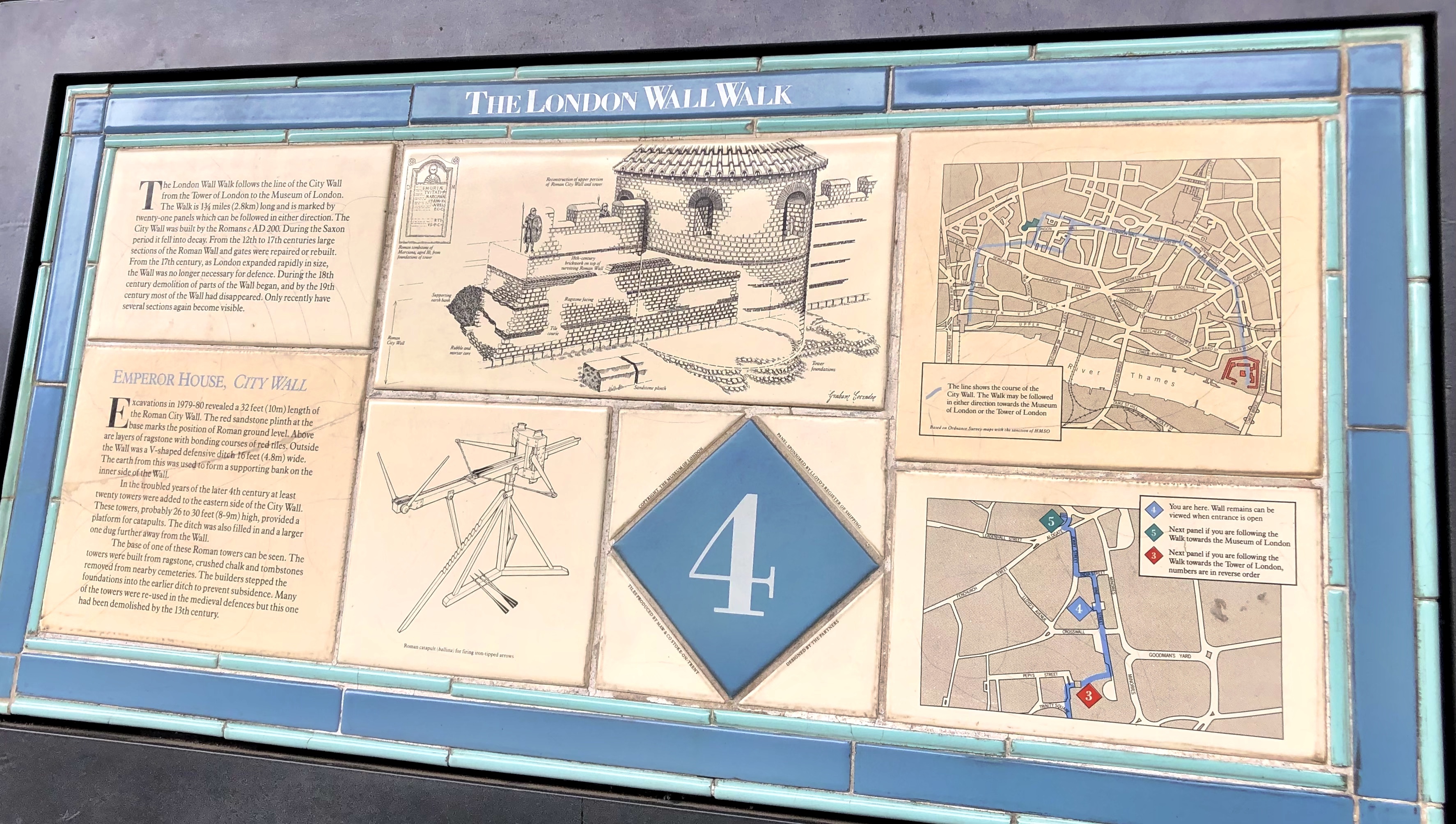 Stop 4 on the London Wall Walk
City Wall at Vine Street is closed on Bank Holidays but open every other day from 9am to 6pm. Entry is free but they ask you to book a time slot. Find City Wall just a few minutes’ walk from Fenchurch Street rail station, Tower Hill or Aldgate tubes. Thanks to MainlyMuseums.com who commissioned this article and published it first.


October 20, 2021
How We Wrote Amarantus by Caroline Lawrence
 In July of 2018 I was invited to join a team putting together an online ancient history module for students in Key Stage 3.
 Headed by Caroline Bristow of the Cambridge Schools Classics Project, this online course would be based around the ancient Roman inhabitants of the so-called House and Bar of Amarantus in Pompeii. Archaeologists Andrew Wallace-Hadrill and Sophie Hay would provide the physical evidence; Greek Myth Comix artist and Classics teacher Laura Jenkinson would illustrate it; historians like Olivia Elder would advise and I would write a narrative incorporating some of what we know about the residents.
The story would be fictional, showing daily life of a middle-class Pompeian family, but based on the archaeology, especially the house plan, artefacts, graffiti and plant remains. Caroline Bristow wanted six modules each based around a specific topic, such as Roman Beliefs and Ancient Food.

The Amarantus Team. Back row from left to right: Stephany Ungless, Charlie Andrew, Mair Lloyd, Caroline Bristow, Dr Olivia Elder, Dr Sophie Hay, Dr Ian Colvin, James Watson. Front row: Prof Andrew Wallace-Hadrill, Caroline Lawrence, Laura Jenkinson-Brown
 signet ring with mule, photo by Chris Warde-Jones
Instead of making up my own plot, as I usually do, I had to stick to the six specific topics. I was also given a wish-list of scenes and ideas to incorporate, especially by Dr Sophie Hay, who helped excavate the site for several years and discovered the remains of a mule and dog in one of the front rooms! I felt like writer on a TV show working with a room full of collaborators. We had to decide the age and status of our hero Amarantus, when to set the story, the time span of the narrative and other elements of the plot, (like the names of the mule and dog).
Most books or stories about Pompeii conclude with a bang: the town’s destruction by the eruption of Vesuvius in 79 CE. However, archaeologist Sophie Hay was keen to set our story seventeen years before the eruption when a sizeable earthquake rocked Pompeii. I suggested we begin the book with a bang: the earthquake. But Dr Sophie (as we call her) was adamant that the earthquake occur halfway through. After a few days of sulking, I realised she was right. There is often a dramatic event at the halfway point of a story and this could be it. It could also show that what seems to be a disaster for many can be a blessing for a few. The earthquake becomes crucial for Amarantus’s personal journey from slave to successful freedman.
 Brainstorming ideas at my London flat in August 2018
The earliest age that a slave can be manumitted is thirty. So we decided to make Amarantus thirty. Graffiti shows him with spiky hair and a bulbous nose. So we incorporated those elements into our story. And what about the dead mule and dog? I couldn’t bear to write a story with unhappy animals so decided to give them to Amarantus and also to make him soft-hearted, which I’m pretty sure was not the case for most ancient Romans.
Once we agreed these basic elements, I was given free rein. My main motivation as a writer of historical fiction has always been to transport readers back in time, using soundscape, smellscape, touch and taste as well as visual descriptions. That is what I wanted to do here. I also set myself the challenge of making each chapter unique and compelling. Finally, I wanted to show how like us the ancients were, but with a surprise or even sting at the end of each tale, reminding people how unlike us they were.
I wrote the first draft in a few months, finishing it by Christmas of 2018.
 View of the crossroads fountain, seen from the bar of Amarantus
But I wasn’t done yet. Oh no.
Esteemed professor Andrew Wallace-Hadrill whom I have nicknamed the ‘Myth Buster’ challenged many of my decisions. Did they really have ‘wheels of cheese’ in Roman times? Is there actual evidence of betrothal rings? We had to find evidence! I too am obsessed with accuracy and I long to know what it was really like in the past, so I didn’t mind at all.
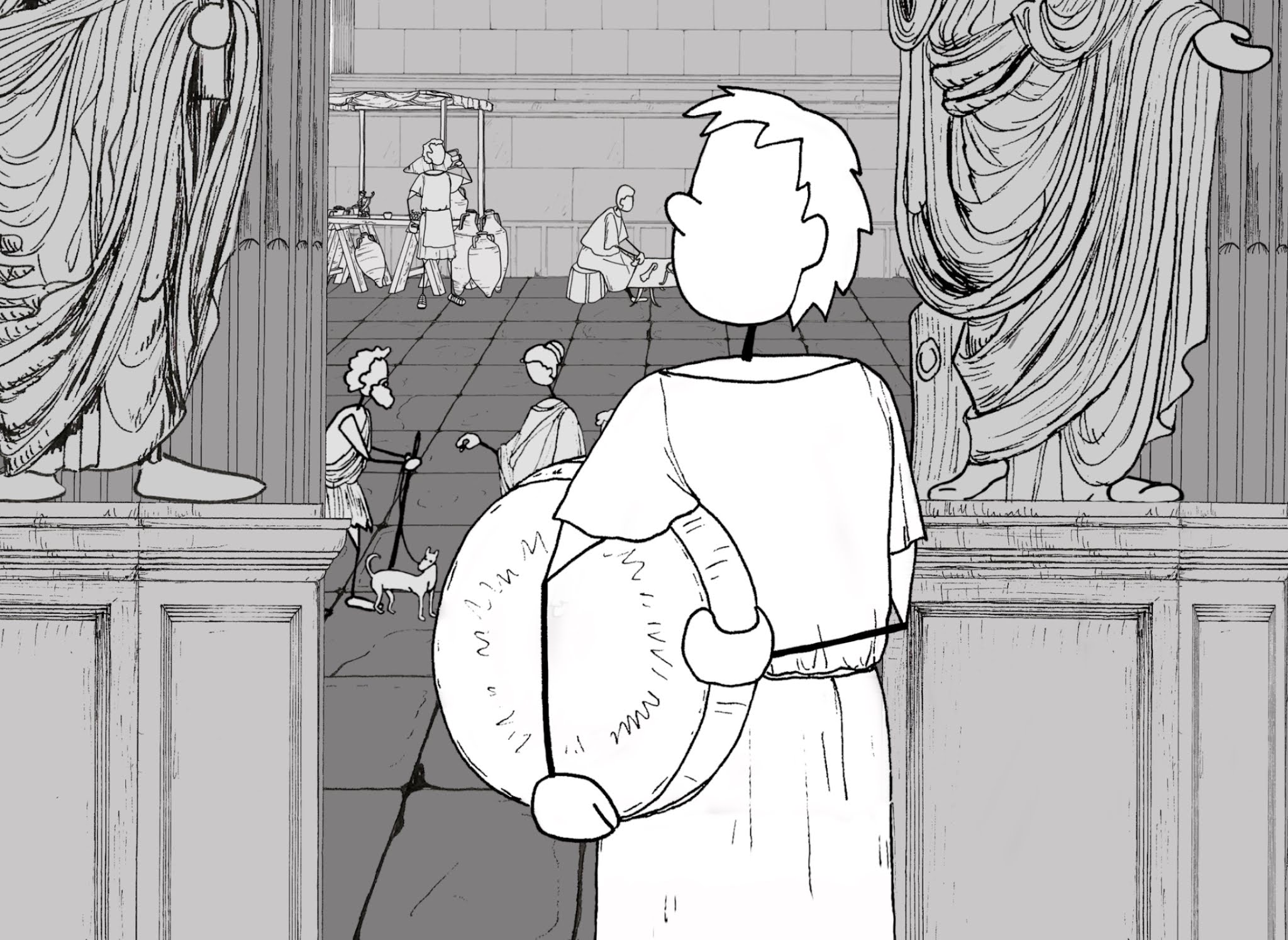 Amarantus with a 'wheel of cheese' by Laura Jenkinson-Brown
Because this story is set in the ‘universe’ of Caecilius, Metella, Quintus et al from the original Cambridge Latin Course book, we decided to put in a few ‘Easter Eggs’. I believe James Watson suggested a cameo by baby Quintus.
Olivia Elder, our graffiti expert, requested graffiti only found in Pompeii and the environs. This included a few quotes from Virgil. Again, I was happy to comply.
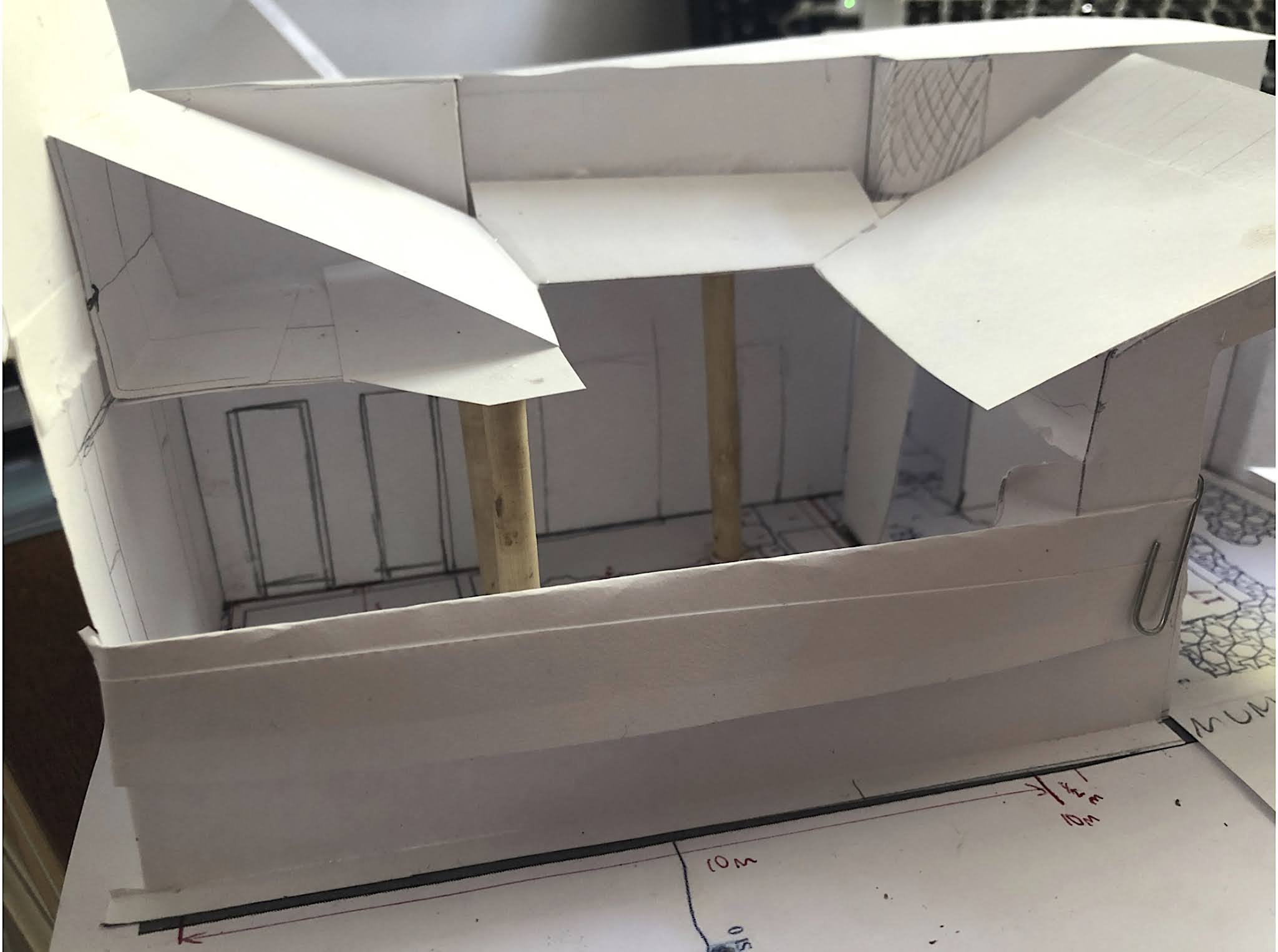 Model of Vatia's garden by Laura Jenkinson-Brown
Then in came Laura Jenkinson-Brown, our amazing Classics teacher by day and illustrator by night. As she began to draw the scenes, this raised a myriad of new questions. How BIG was a wheel of cheese? What does a wineskin actually look like? Where would the shadows fall in a west-facing dining room? Laura went as far as constructing 3D cardboard models to better depict some of the scenes and even persuaded her delightful husband Sy to pose with soft toys while she sketched the characters.
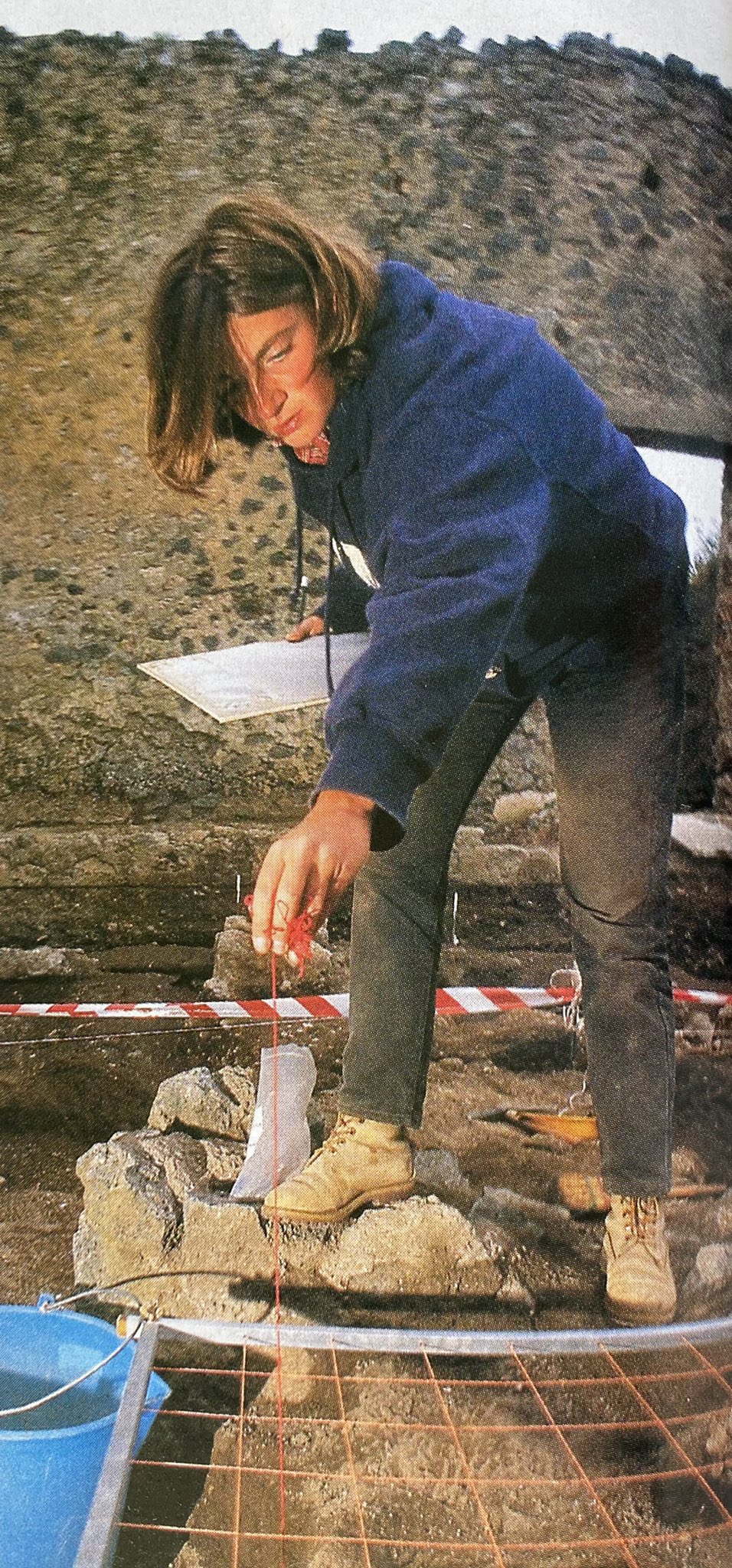 Dr Sophie digging in Pompeii!At this stage we all contributed, especially Dr Sophie, who knows the house and bar of Amarantus like the palm of her hand. Sometimes Sophie, Laura and I were sending comments on the illustrations back and forth into the wee hours. Did we grumble? No! We loved every minute of diving down these many rabbit holes.
 The Amarantus Project turned out to be one of the most enjoyable projects I have ever worked on. I would like to thank the CSCP team and all the other brilliant and meticulous scholars who helped me write this story. This truly is a labour of love. I’m sure my collaborators would all agree when I say that we hope this book will grip middle grade readers and get them as excited about Pompeii and the past as we are.
P.S. You can now buy the book Amarantus and his Neighbourhood from Amazon. If you want to dive down more rabbit holes with us, go to the interactive site, www.cambridgeamarantus.com, where there is evidence for almost every line in this book.
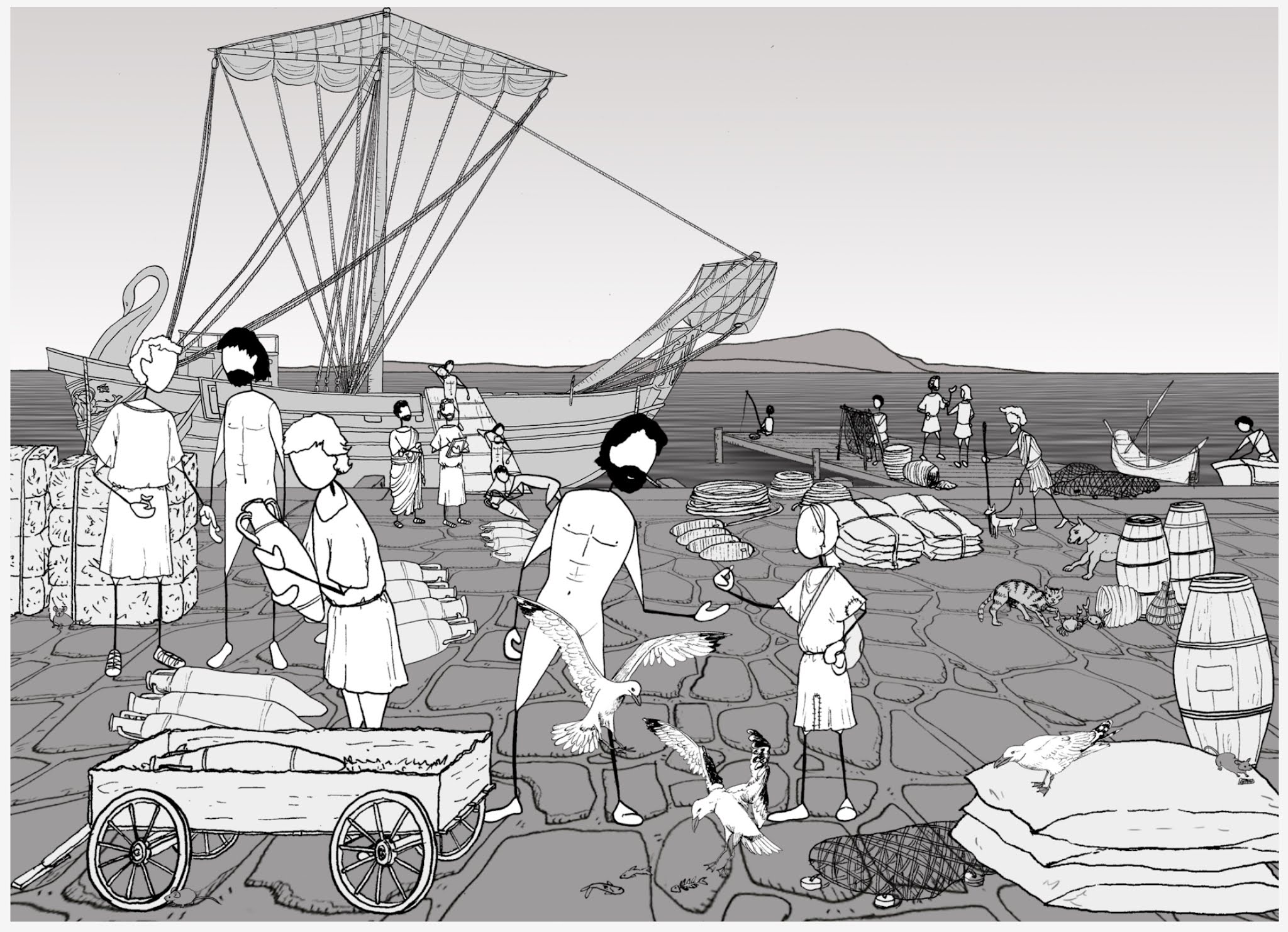 Sophe at Pompeii's port, my fave illustration by Laura Jenkinson-Brown
P.P.S. Observant readers will spot that street urchin Sophe resembles Dr. Sophie Hay in certain respects. This was a clever visual tribute by Laura Jenkinson-Brown, who also represents herself as one of the characters. Can you guess which one?
October 9, 2021
How to Get Published by Caroline Lawrence
1. DON'T SUBMIT YOUR FIRST BOOKMake sure your book is the best it can be. I read somewhere that it is usually a writer's fourth book that gets published. You are still learning to write during the first three. I personally have several failed attempts in a drawer. I might go back to them later, but no way am I submitting them without a major rewrite first. Of course there are always exceptions to this rule!
2. READ THE BASIC BOOKSI am amazed by the number of people who tell me they want to be a writer, but have not read any basic books on writing. Here are five essential books I would recommend. Do not even think about sending your stuff to an agent until you have read these (or something similar.) 1. Becoming a Writer by Dorothea Brande2. The Artists Way by Julia Cameron3. On Writing by Sol Stein4. Word Painting by Rebecca McClanahan5. On Writing by Steven King
3. LEARN THE CRAFTFor me, the structure used by Hollywood screenwriters is most helpful. My breakthrough was hearing an audio course on Story Structure by Hollywood script guru John Truby. I realised that I needed a road map to keep my story fast moving, compelling and on course. Some people object that popular movies are 'formulaic'. You be they are! That's why they are popular. Writing is a craft like carpentry. You need to learn the skills involved. I have written a book with all the tips and tricks I learned from scriptwriters and movies which I hope will help prospective writers aged 8 to 80. It is called How To Write a Great Story. Read it. Apply the principles. Have fun!
4. GET SOME DISTANCEOnce you have written a book you think is good enough to be published, put it aside while you work on your next project. Then come back to the original book. You will be amazed at how much you will want to change about it.
5. GET AN AGENTVery few publishers will look at stories sent to them by a person they don't know. They will only consider manuscripts submitted by an agent. To find an agent you have to search through a book called The Artists & Writers Yearbook (or its US equivalent) and send the first three chapters and synopsis of your book to likely agents. Even getting an agent is difficult these days, but hopefully one of them will like your story and start sending it out to publishers. Most agents take 10% of every payment you receive. It is worth it. Even after they have found you a publisher they do all the tricky stuff like asking for more money. This keeps your energy free for creative writing.
6. DON'T GIVE UPOne thing that separates successful authors from unsuccessful ones is persistence. Keep at it and don't give up. Don't listen to anybody who says you can't do it. Believe in yourself and in your desires. You have to be single-minded. Sometimes you have to sacrifice other things in your life. (For ten years I used to get up an hour early to write. I was a single mum with a long working day as a teacher.) Go on courses. Read books about the craft. Get together with other writers to encourage one another. Listen to podcasts like Prepublished and Writers Routine. There are many YouTube clips about writing, too.
7. WRITE TO ENRICH NOT GET RICHJ.K. Rowling is a once-in-a-century phenomenon and therefore NOT a helpful role model! If you are one of the lucky ones you will make a living by writing. But don't make that your main motive. Instead, write the sorts of thing you would like to read. Write about issues and questions that really interest you. Then, even if your book never gets published, the hours you put in will not be lost. They will have enriched your life. That is the best advice I ever heard, and I got it from my mentor, the wonderful John Truby.
Happy writing and good luck!
Caroline
P.S. I’m sorry but I don’t read other people’s stories unless they are about to be published and need a quote or last minute notes. If you would like a professional to read your novel then I suggest you contact the excellent Jericho Writers. Of course you will have to pay them, but if you want to be a writer then it is worth it.
[This is an article I wrote over ten years ago in 2011 but I have given it a light update!]
August 5, 2021
Aesop's World by Caroline Lawrence
 When I was invited to do a new translation of Aesop’s Fables, I was thrilled. It was like opening a window into daily life in ancient Greece. Talking animals and walking gods aside, the stories are full of detail about ancient family life, agriculture, religion, education and travel. They also cast a light on the ancient mindset, something much more elusive. But some of the people and objects from those long-ago times need illustrating, so we can visualise them. Here are a few images to help us ‘see’ that ancient world.
1. Earliest Depiction of Aesop?
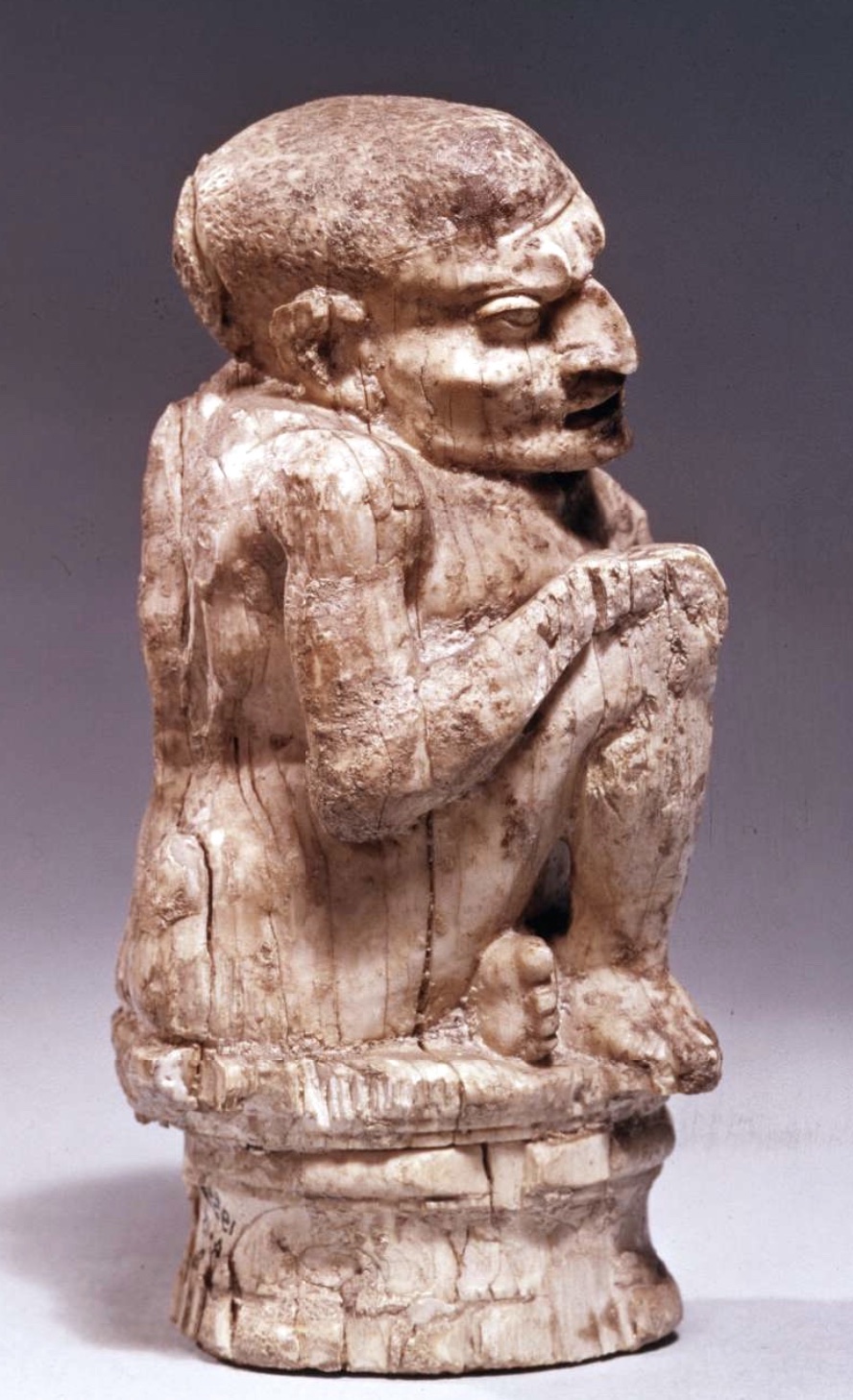
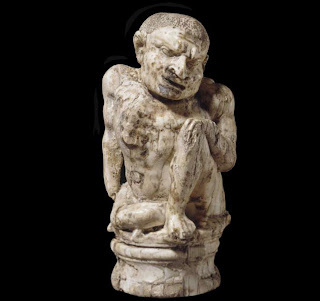
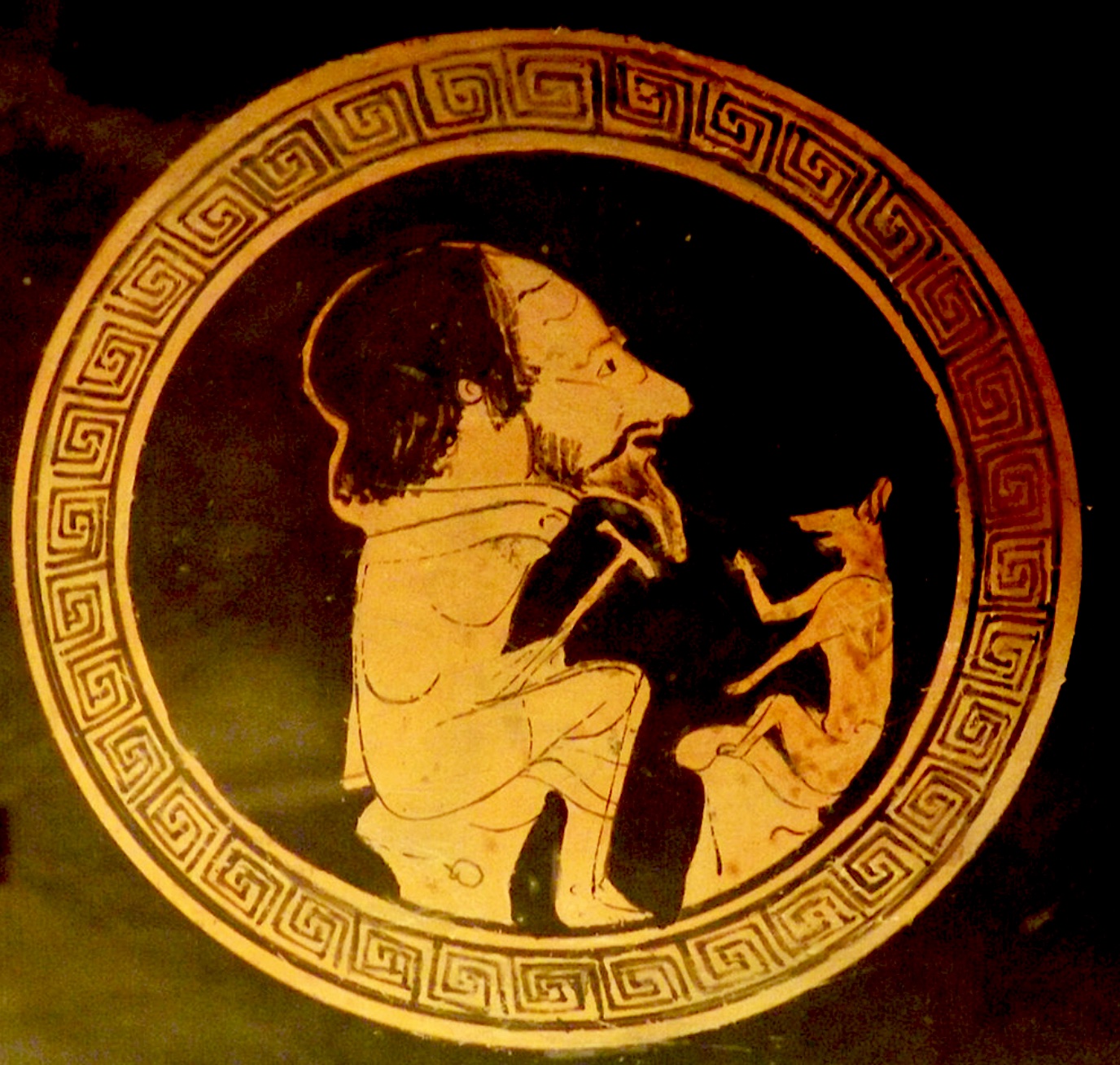 Aesop lived so long ago that some even question his existence. Others say he was born around 620 BCE and died perhaps sixty years later. This is the inside of an ancient Greek kylix (wine cup) now in the Vatican Museum. It shows a bearded man in a cloak apparently conversing with a fox. Because the subject matter is so unusual many have assumed it must show Aesop who told fables about talking animals, especially clever foxes. The first thing we notice about the man – apart from the fact that he is listening to a fox – is his abnormally large head. Most men on Greek vases are usually shown with idealised beauty; this man has wrinkles on his brow, a big nose and a scruffy beard. An ancient biography of Aesop tells that he was hideously ugly and possibly a hunchback like the image at the top of this blog, a small ivory figurine in the British Museum. Maybe that is why on this cup his body is so small in relation to his big head. That may also be why his staff looks like a crutch. This kylix is usually dated to about 460 BC, so if it does show Aesop then it is our earliest representation of him in any form. The first written mention of him is by the historian Herodotus around 425 BCE, at least a generation later.
2. The Cloak and Staff
 I have a crazy theory that this ancient Greek kylix now in New York shows Aesop with a hedgehog. I may be wrong. It may not be Aesop. It may not be a hedgehog. Scholars have suggested that the mystery animal could be a dog, a pig or even a porcupine. But notice how the man is dressed. He is wearing a himation, a cloak like a tablecloth or blanket. Judging from many Greek pots and sculptures, some men wore only this cloak and nothing else. The cloak and walking stick became a kind of uniform of rich, upper class men in Ancient Greece. Many philosophers are shown with a cloak and staff. Some philosophers, like Socrates and Diogenes, famously went barefoot like the man on this cup. The ancient biography of Aesop tells us that he was born a slave, but eventually won his freedom and became famous. Like many philosophers and sophists (the ancient version of motivational speakers) he went on tour, sharing his wisdom with others.
 3. Different types of Tunics
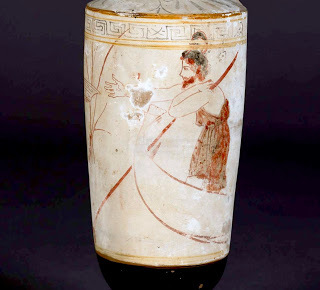 Younger men and those who had to work for a living often wore a tunic instead of a cloak. The tunic, called a chiton, was like a long T-shirt of linen or wool. One type, called the ‘exomis’ left one arm and shoulder uncovered and was favoured by workmen like blacksmiths and potters. Or you could roll down the upper half of your tunic and make it into a kind of kilt. This lekythos (funeral oil-jar) now in the British Museum shows Charon, the ferryman of the dead, in a red exomis and strange crested cap.
4. No clothes at all!
 In ancient Greece many men wore no clothes at all, even in public. Working men like fishermen and potters may have gone completely naked. Rich men who had time to exercise often did so naked at a place called the Gymnasium, which comes from the Greek word ‘gymnos’ or ‘naked.’ In sacred games like the Olympics the athletes competed in the nude. Because women mainly stayed in the home, men could run around naked more easily. Imagine the hot Athenian marketplace full of naked men, some of whom wore the T-shirt like tunic or the tablecloth-like cloak. One of my favourite Greek vases, a black-figure amphora (two-handled storage jar) in the British Museum, shows men and boys harvesting olives by beating the tree and shaking the branches. The men wear their purple tunics with the tops rolled down and the boys are naked!
5. Women in Ancient Greece
 Greeks had dozens of different types of ceramic pots, each for a different purpose. This black-figure vase in the British Museum is a hydria, a jar for holding water. Suitably, it shows women and girls fetching water from the public fountain. It also shows what women wore: a long tunic with an outer tunic and/or a shawl or mantle, the female equivalent of a cloak. You can see some of the girls have pads on their head to cushion the weight of the heavy hydria full of water that they balanced on their heads. Although there are lots of female animals in Aesop’s Fables, women and girls hardly appear at all. The realm of women was the household, where they would cook food, weave cloth, raise children, tend domestic animals, command their slaves and avert evil spirits.
6. The Evil Eye
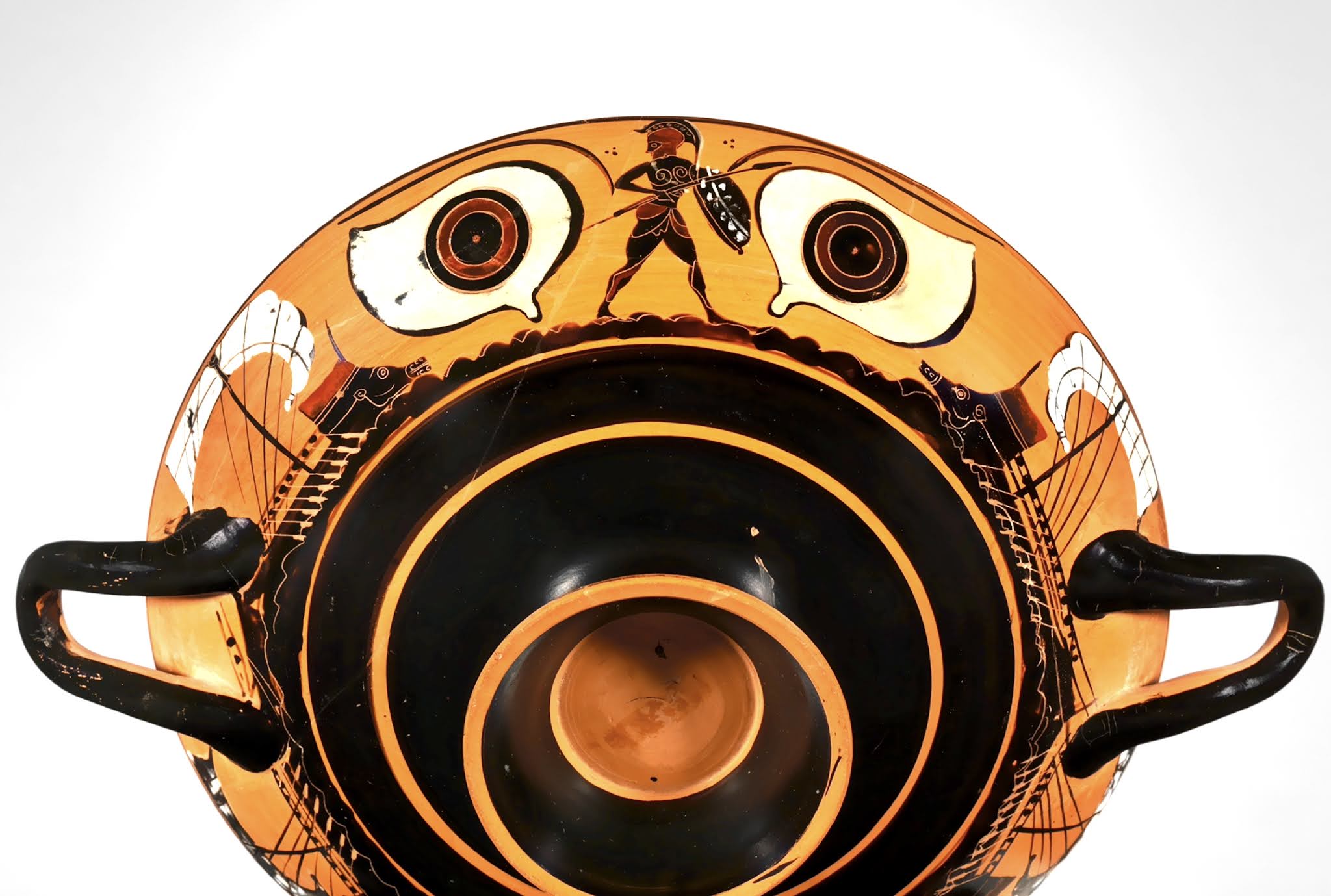 In ancient times, many people believed that when you looked at something, tiny beams made of fiery particles flew out of your eyes. That was how you could see. That’s why Jesus says ‘The lamp of the body is the eye.’ Matt 6:22. If you looked at someone the beams from your eye touched them. If you looked at someone with envy, malice or anger it could hurt them, possibly because your look allowed in evil spirits. That is why people used amulets confusingly called ‘evil eyes’ to reflect back this ‘evil eye’. Such images and amulets are ‘apotropaic’ which means they ‘turn away’ evil. An Evil Eye amulet might have a pictures of eyes or a scary face. The face of Medusa is called the gorgoneion. A scary mask is called a mormolukeion. This kylix in New York is doubly apotropaic. It has medusa on the inside and eyes on the outside so when a drinker raised it to drink the eyes would seem to gaze back, averting any evil spirits or reproachful looks from other diners.
7. Demons and Evil Spirits
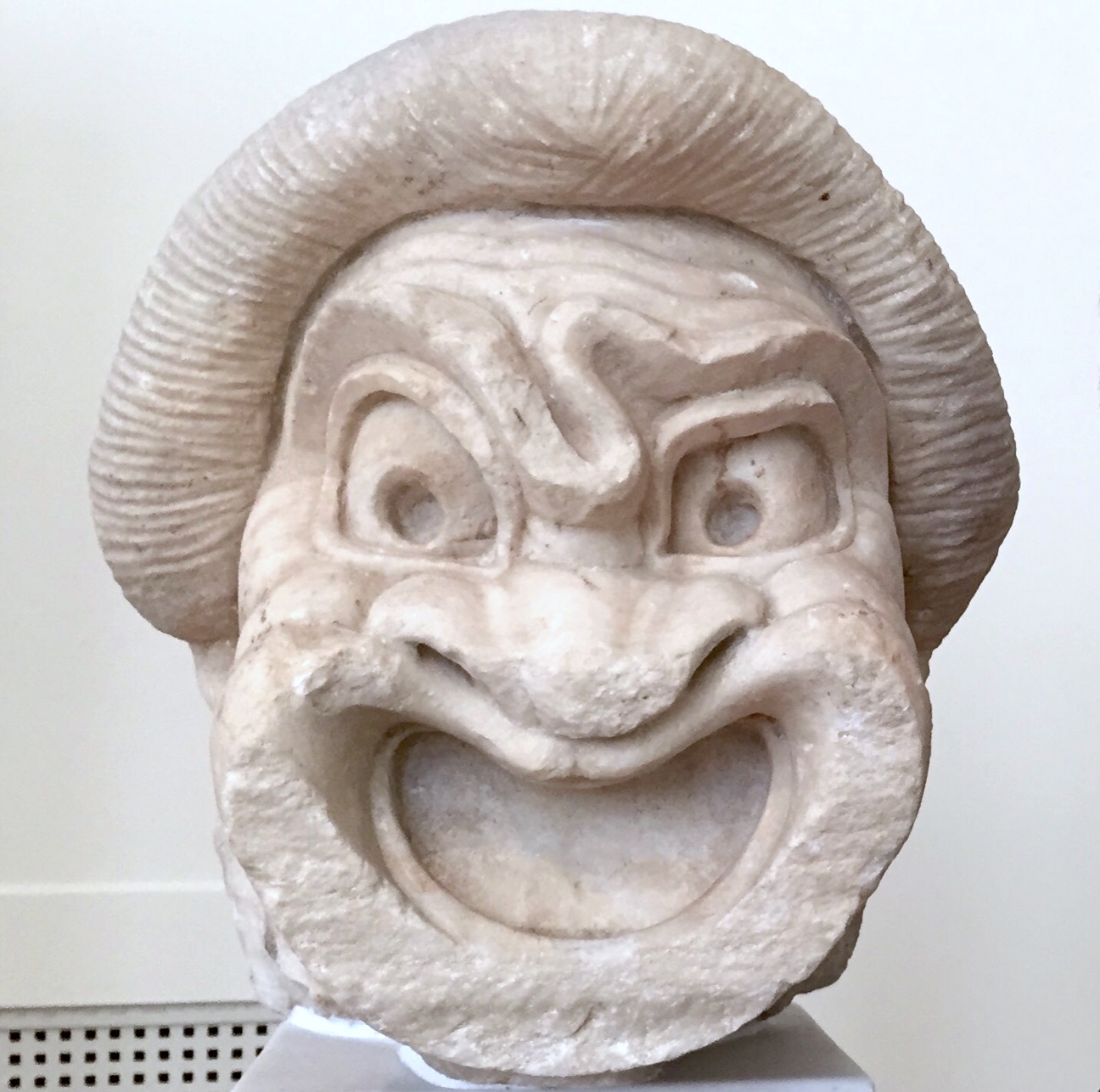 Most ancient Greeks and Romans believed in a world full of gods, demi-gods and spirits. Some were good and some were bad, but they were everywhere. You could distract the malicious spirits with complicated borders on clothes, the sound of bells or nasty smells. You could frighten them away with scary faces or animals. Stone masks like this one from Athens were obviously not worn by actors, nor were the scary masks shown in frescoes and mosaics. They were meant to scare away evil spirits. Amusingly, they were also used to threaten children, like a bogeyman. Ugly Aesop tells a slave dealer that he could be a ‘mormolukeion’ to frighten children into behaving. And later he says he can be a walking talking evil eye.
8. Greek gods, especially Hermes!
 The Greek gods frequently appear in Aesop’s Fables, especially Zeus and Hermes. Zeus is portrayed as a mainly benevolent creator god, like the father of a household. Hermes is his messenger and errand-runner, a bit like a son who is old enough to drive. The name Hermes is naturally linked to the word ‘herma’ which was a square pillar of stone used to mark boundaries and crossroads and protect them against evil. Sometimes the carved stone head of a deified hero like Heracles or the god Hermes was placed on top of these herms to make them even more protective. This pelike (jug) now in Berlin shows a young man bringing a pig to a herm. An image of your favourite god or hero might also protect your house from evil. In Aesop we see people buying statuettes of gods to put in their homes. They would lay an offering such as a candle, cake or flower in front of the statue. They might also pour a libation, a little bit of wine or oil, at its feet or at the base of the altar or niche in which it stood.
9. Strange Jobs
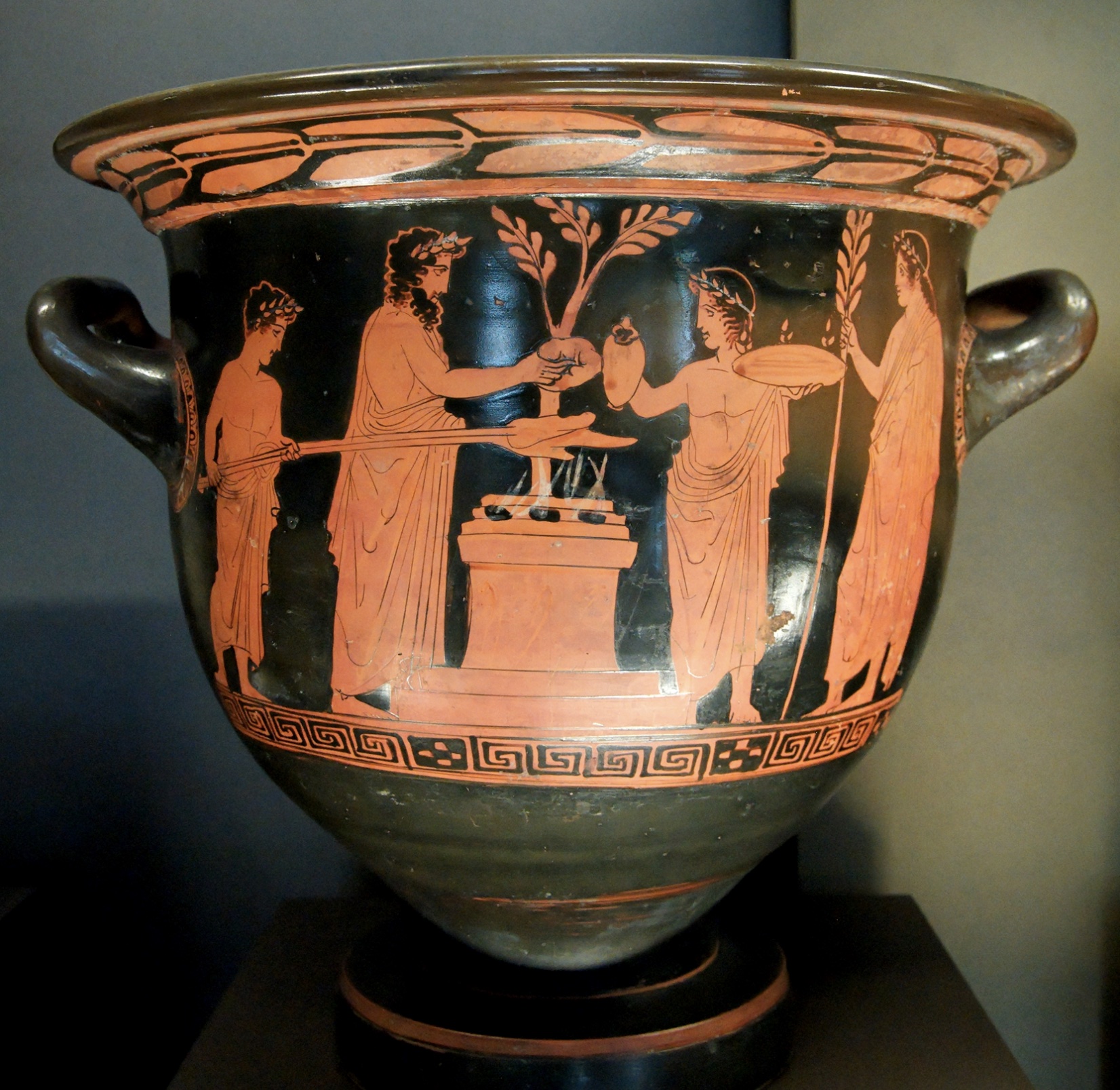 People had jobs then that we do not have today. A charcoal burner made charcoal from wood. A fuller cleaned clothes using urine and sulphur smoke. A fowler caught birds using sticky birdlime smeared on twigs, then sold them to people to eat. Professional mourners were women who helped families grieve their dead by wailing and beating their breasts. An orator was a public speaker, usually an upper class rich man who defended people in law courts for free as part of his career in politics. A sophist was a combination philosopher and orator, like a motivational speaker. A temple priest knew how to sacrifice a live animal and put certain bits on the altars to various gods. A soothsayer would look at the internal organs of a sacrificed animal and tell whether the gods were for or against a certain course of action. This red-figure krater (wine mixing bowl) now in the Louvre shows a priest and his attendants at an altar. The priest seems to be holding an internal organ while one of his helpers pours a libation (drink offering). Another helper is roasting meat over the flames on the altar. Apart from the garlands on their heads, the priest and his attendants wear only cloaks.
10. Other professions
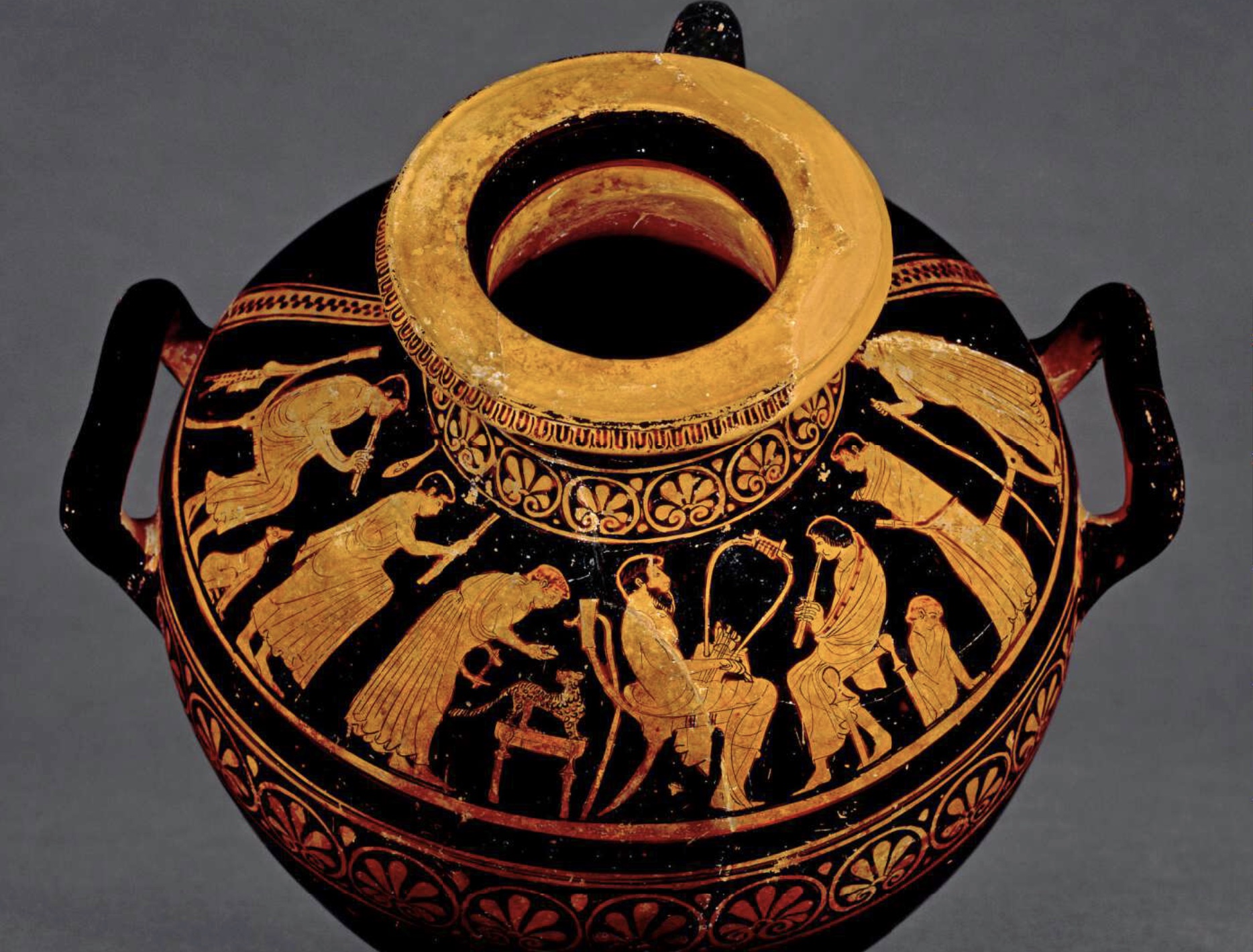 Men and women from all walks of life are mentioned in Aesop’s fables. In addition to the less-well-known professions mentioned above we read of actors, artisans, astrologers, athletes, beekeepers, beggars, blacksmiths, builders, butchers, carpenters, cooks, cowherds, craftsmen, doctors, donkey drivers, executioners, farmers, ferrymen, fortune-tellers, gardeners, goatherds, grooms, hunters, innkeepers, judges, landowners, litter bearers, locust catchers, merchants, millers, musicians, ox drivers, pedlars, ploughmen, potters, robbers, sailors, sculptors, shepherds, shipbuilders, ship-owners, shoemakers, shopkeepers, slave dealers, soldiers, sorceresses, storytellers, tanners, tax-collectors, teachers, tutors, vintners, wall painters and woodcutters. At the lowest level we find many slaves and at the highest are a couple of kings and tyrants. This red-figure hydria (water jar) shows a music teacher giving lessons to young people. Note the pets: a dog and small leopard (not a house cat) listening. Presumably the music entrances them.
11. Unfamiliar Animals
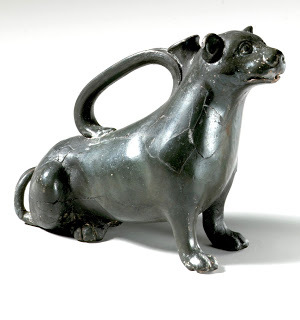 Speaking of cats and dogs... Although dogs were extremely popular, some scholars think cats were rare in ancient Greece and that people often kept stoats or weasels instead to keep down the mice. Aesop seems to confirm this for he has several fables about stoats. The fable about the mice ‘Belling the Cat’ was added much later, in medieval times, so in my retelling I call it ‘Belling the Stoat’. This black-glazed askos (jar with handle) from about 400 BCE shows a charming stoat (or weasel). Another unfamiliar animal was the onager, also known as a wild donkey. Onagers could not be tamed. They were so fierce that people caught them and forced them fight other wild beasts in the arena. A cicada is a small insect like a cricket that features in several of Aesop’s fables. They are the tiny creatures who make the rhythmic creaking noise you hear in Mediterranean countries on a hot afternoon.
12. Appearance not everything
 In this post I’ve tried to give you a quick glimpse of what Aesop’s world looked like. But while I was translating the fables the message that came through to me over and over is this: It is not the outward appearance but the inner nature that is important. Hideously ugly Aesop became a success because of his wit, bravery and sense of humour. One of his fables sums this up beautifully. It is the story of the Leopard and the Fox. A fox and a leopard were disputing about which of them was more beautiful. ‘Look how beautifully I am adorned!’ said Leopard. ‘See how varied and delightful is each one of my spots!’ Said Fox, ‘Too bad you cannot see how varied and delightful is each one of my thoughts! Your beauty is only of the body, my beauty is of the mind.’
We hope the retelling of Aesop's Fables will be out in Autumn 2022, illustrated by the wonderful Robert Ingpen. In the meantime you might enjoy my book Adventure in Athens about a couple of kids who travel back to ancient Greece during the time of philosophers, sophists and policemen in striped pyjamas.
July 22, 2021
Caroline Lawrence Membercast Objects
 In July 2021 I was interviewed by fellow children's author Iszi Lawrence (no relation) for the British Museum Membercast. We talked about artefacts in the British Museum that have inspired my writing. For anyone who wants to know more, here are some of the objects we discussed. Click the photos for links to the objects. 1. Rock crystal die. Find it in the Greek and Roman Life room (room 69) display case 9. This beautiful little object was a vital clue to the identity of a dog-killer in my first book, The Thieves of Ostia.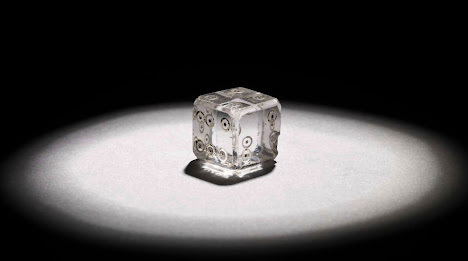
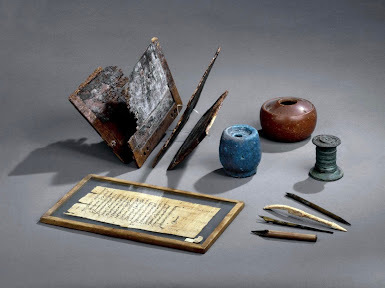
2. Wax-tablet and writing things. Greek and Roman Life room (room 69). I try to make some artefacts a matter of life and death, like a wax-tablet to Lupus, a character from my Roman Mysteries series of books. Lupus is mute and illiterate but as he learns to read and write his wax tablet becomes a vital means of communication. My replica wax tablet smells like honey because of the beeswax on it.
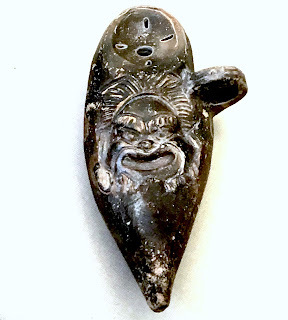
3. Why would you put a scary actor’s mask on a baby feeder? I believe the answer is that it is apotropaic (turns away evil). A face like this, possibly called a mormolukeion, keeps malicious spirits from turning the milk sour. This becomes an object of life or death importance in my book Escape from Rome. Find it in the room next to the Greek and Roman life room, in room 70 and display case 14.
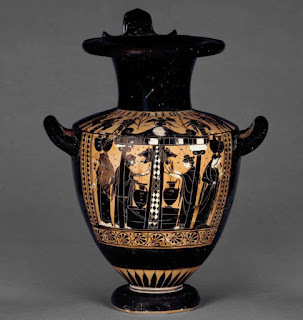
4. Hydria. This beautiful Greek jar for carrying water is one of literally thousands of Greek, Roman and Etruscan vases in the British Museum. Women and slave-girls would take a pot like this to the fountain and bring it back on their heads, full of water. Other Greek vases range from tiny perfume bottles to big mixing bowls for wine. The decoration on them gives us glimpses into daily life, customs and beliefs. For a scene where kids hide in a fountain, check out my book Adventure in Athens.
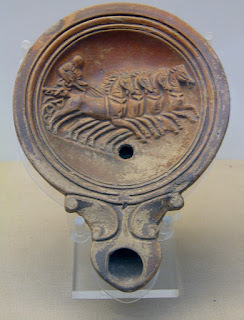
5. Oil-lamps are like snapshots of the ancient world… Many of them also have apotropaic images on them, and the oil-lamps themselves – lights in the darkness – keep away evil. One of my favourite oil-lamps is in the Greek and Roman Life room (room 69) and shows what racing chariots really looked like. I incorporated that knowledge into Roman Mystery 12, The Charioteer from Delphi.
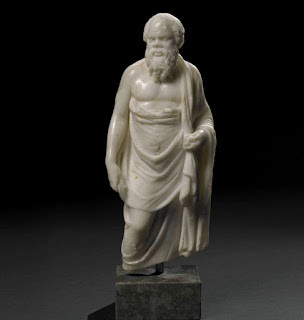
6. This superb statuette of the ancient Greek philosopher Socrates informed my most recent historical thriller, The Time Travel Diaries, Adventure in Athens. Note that he is only wearing a cloak, probably light linen for those hot Athenian summers. Find him downstairs in Room 22 and display case 6.
7. Another figurine, a little ivory hunchback from Alexandria, is inspiring my current work in progress, a retelling of Aesop’s Fables (proposed publication date Sept 2022). Note that he is wearing nothing at all. You can find him near the Socrates figurine just mentioned in display case 6 in room 22.
Thanks to Iszi Lawrence for letting me gush about some of my favourite objects and thanks to the British Museum for inspiring my writing. Find out more about my books at carolinelawrence.com. Find out more about Iszi's books at iszi.com.
P.S. All the photos on this post are copyright of the British Museum.
March 15, 2021
Up Yours, Brutus!
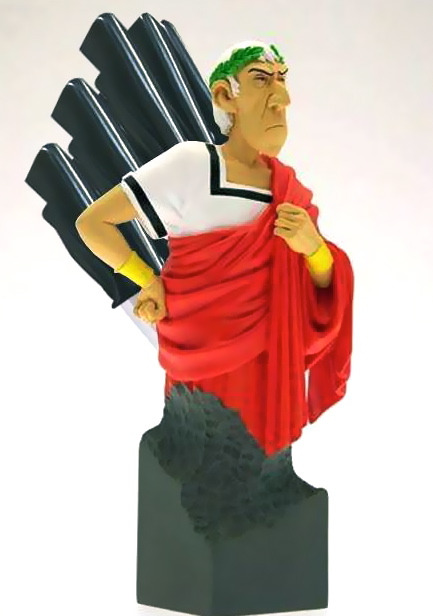 by Caroline Lawrence (author of the Roman Mysteries)
One of the first things that greeted visitors to the Life and Death in Pompeii and Herculaneum exhibition at the British Museum in the summer of 2013 was a jolly fresco of a phoenix above two peacocks (below). On the audio guide, curator Paul Roberts called this fresco a pub sign. It was found on a wall of a popina or fast food joint in Pompeii. The slogan reads Phoenix felix et tu: The Phoenix is happy (or lucky), and you!
What caught my attention was the phrase et tu which immediately called to mind Julius Caesar's last words according to Shakespeare: et tu, Brute. Of course, as any Classicist knows, Caesar didn't really say et tu. He spoke in Greek: Kai su, teknon, which means 'and you, my child'. This is often interpreted as the poignant words of a noble, betrayed Roman to the young assassin who might have been his illegitimate child: 'Even you, my son?'

But the phoenix pub sign hints that Caesar might not have gone down quite that submissively on the Ides of March in 44 BCE.
One thing the Pompeii exhibition brought home to me was how obsessed the ancient Romans were with keeping away evil. A little research showed me that the phrase 'and you' – whether in Greek or Latin – is apotropaic.
Apotropaic is Greek for something that 'turns away'. It usually refers to anything that averts evil or bad luck. Apotropaic images include the raised palm of the left hand, erect phalluses, the unflinching gaze of a full frontal face and the eye amulets that are still so popular in the Mediterranean. Also apotropaic is the peacock, which has a tail full of 'eyes'. All these things 'turn away evil'.
The phrase et tu ('and you') has a similar meaning. It reflects back. Our modern equivalent might be 'the same to you!'. In Roman times, if a person approached you with good intentions, saying 'et tu' would be a blessing. But if they came at you with evil intent, the phrase becomes a curse. So whether Julius Caesar said et tu or kai su to the young man stabbing him, it meant the same thing: 'Back at you, punk!' or better yet: 'Up yours, Brutus!'
Check out my 30 plus history-mystery books for kids at www.carolinelawrence.com!
February 1, 2021
Pliny's Laurentine Villa?
A Visit to Laurentum and the possible villa of Pliny the Younger
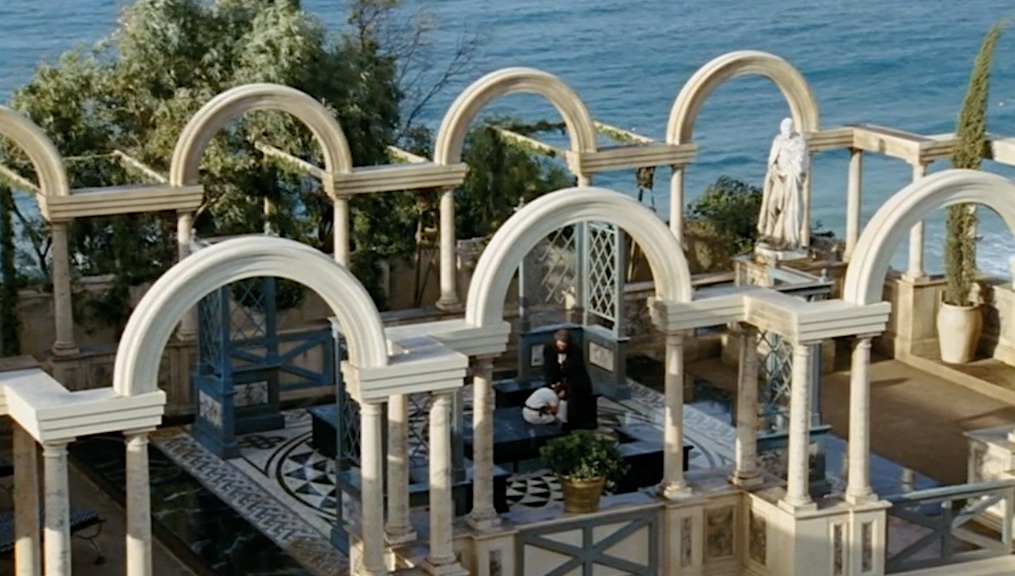 Set of Pliny's Laurentum villa by Jason Carlin
My name is Caroline Lawrence and I am a teacher turned historical author. My best-known series of books are The Roman Mysteries. In the second book of that series, The Secrets of Vesuvius, a Roman girl named Flavia Gemina and her three friends are playing on the beach of their home town Ostia when they spot a man in trouble out at sea. They combine efforts to rescue him from drowning. When they get him safely to shore, clever Flavia deduces that he is the famous author and naturalist, Pliny the Elder. She is correct and the polymath gratefully promises to reward them over lunch the following day at his seaside villa a few miles south. Here's a passage from the book:
It was only a few miles from Ostia to Laurentum, a pleasant drive along the coastal road. The carriage crunched up the gravel drive of Pliny's seaside villa less than half an hour after they had left Ostia. A door-slave in a red tunic met them on the steps of the butter-coloured villa and led them through cool rooms and sunny courtyards to a breezy dining room.
Flavia and her friends gazed around in amazement.
The room they stood in was surrounded on three sides by water. Only a low wall and spiral columns separated them from the blue Mediterranean. Jonathan and Lupus immediately went to the marble parapet and leaned over.
'Careful!' wheezed Admiral Pliny, shuffling into the room. 'We're right above the sea.'
(from The Secrets of Vesuvius page 17)
In book five of the Roman Mysteries, The Dolphins of Laurentum, Flavia and her friends return to this villa following the eruption of Vesuvius. This time they meet Pliny the Younger, who is only seventeen years old at the time. I assume he has inherited the villa from his uncle, who sadly died in the eruption of Vesuvius. The children's adventures include diving for sunken treasure and encounters with dolphins.
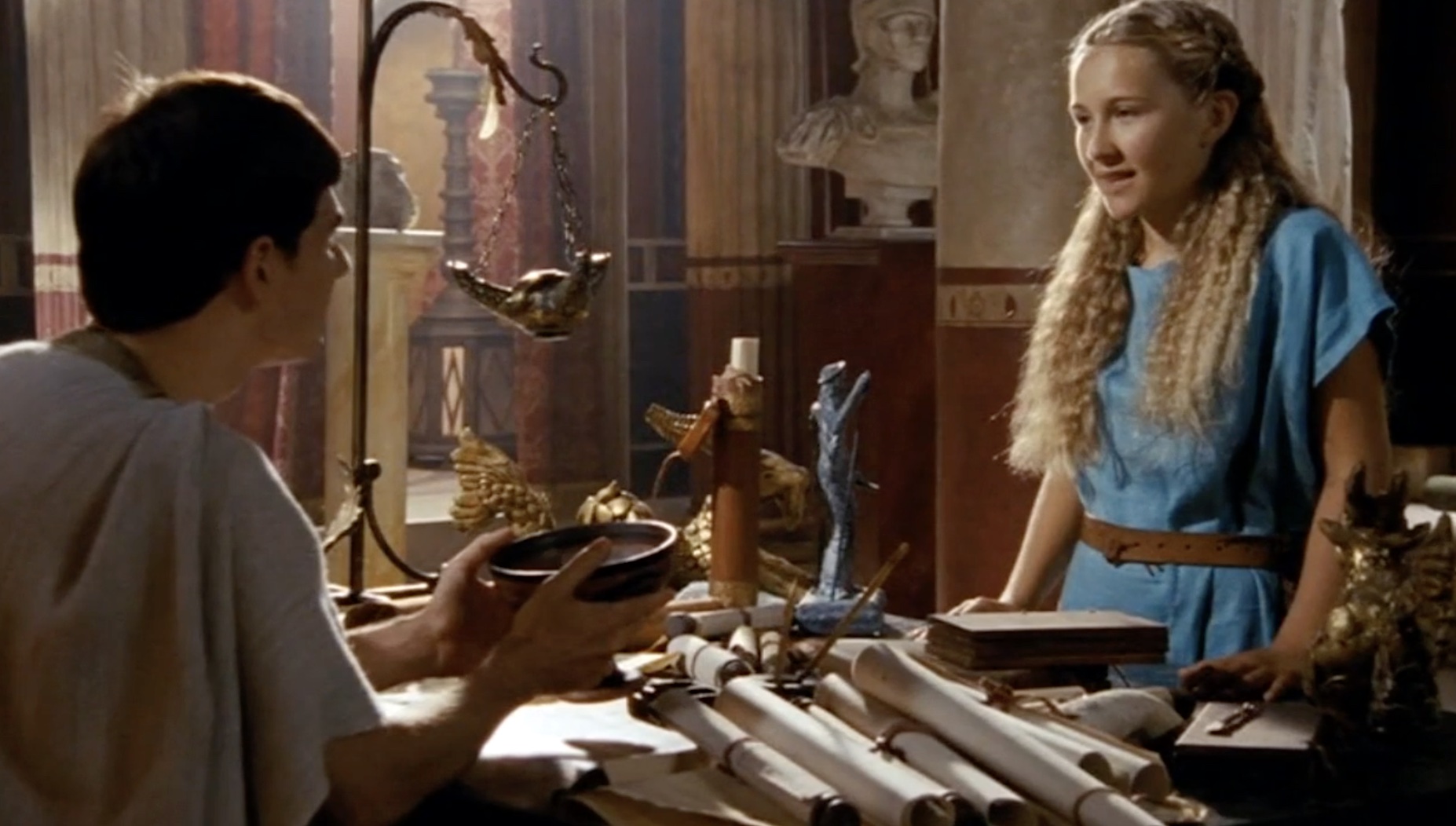 Pliny the Younger & Flavia Gemina from the TV series
Pliny the Elder and Pliny the Younger were both real people. We know that the younger Pliny had a lovely seaside villa in Laurentum which he called his 'Laurentine'. He writes about it in loving detail to his friend Gallus. (Epistulae 2.17) The letter is so detailed that many architects and historians have tried to come up with a plan of his mansion. Below is the plan my husband and I put together based on a close reading of Pliny's letter... and our imaginations.
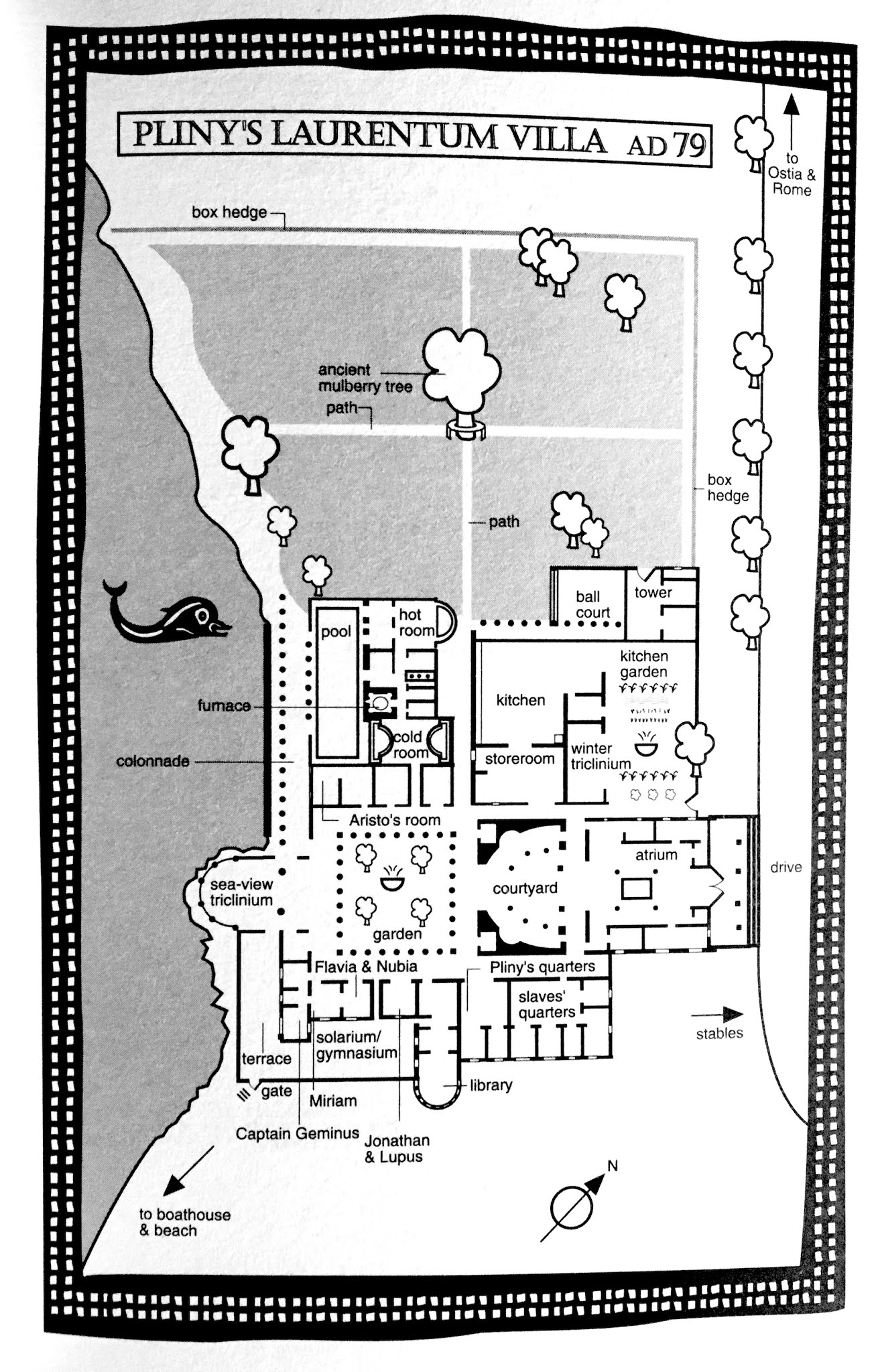
While I was still planning book five, the one set at Laurentum, I was invited to the Bologna Book Fair. It was the perfect opportunity to take few extra days to travel to Ostia to do some research. Pliny's Laurentine villa is only a few miles away. I didn't want to hire a car, but I could take public transport. But in those pre-smartphone days it was tricky to find. Here is my original account:
It is a mild spring day in mid-April of 2002. Although rain had been forecast all week, so far I have been blessed with beautiful spring weather. I catch the 3pm train from Ostia Antica and arrive at Cristoforo Colombo just ten minutes later.
 Stazione Cristoforo Colombo via Google maps
A friend has given me a map and directions. Once out of Cristoforo Colombo station, I turn right, walk along Lungomare Amerigo Vespucci a few hundred metres to the petrol station, then turned right again along Via Cristoforo Colombo. It is very dangerous walking along Via Cristoforo Colombo because there is no pavement. The traffic roars past me, only inches away. After about ten minutes I glimpse a road through some woods to my right, blocked off for traffic but open to pedestrians.
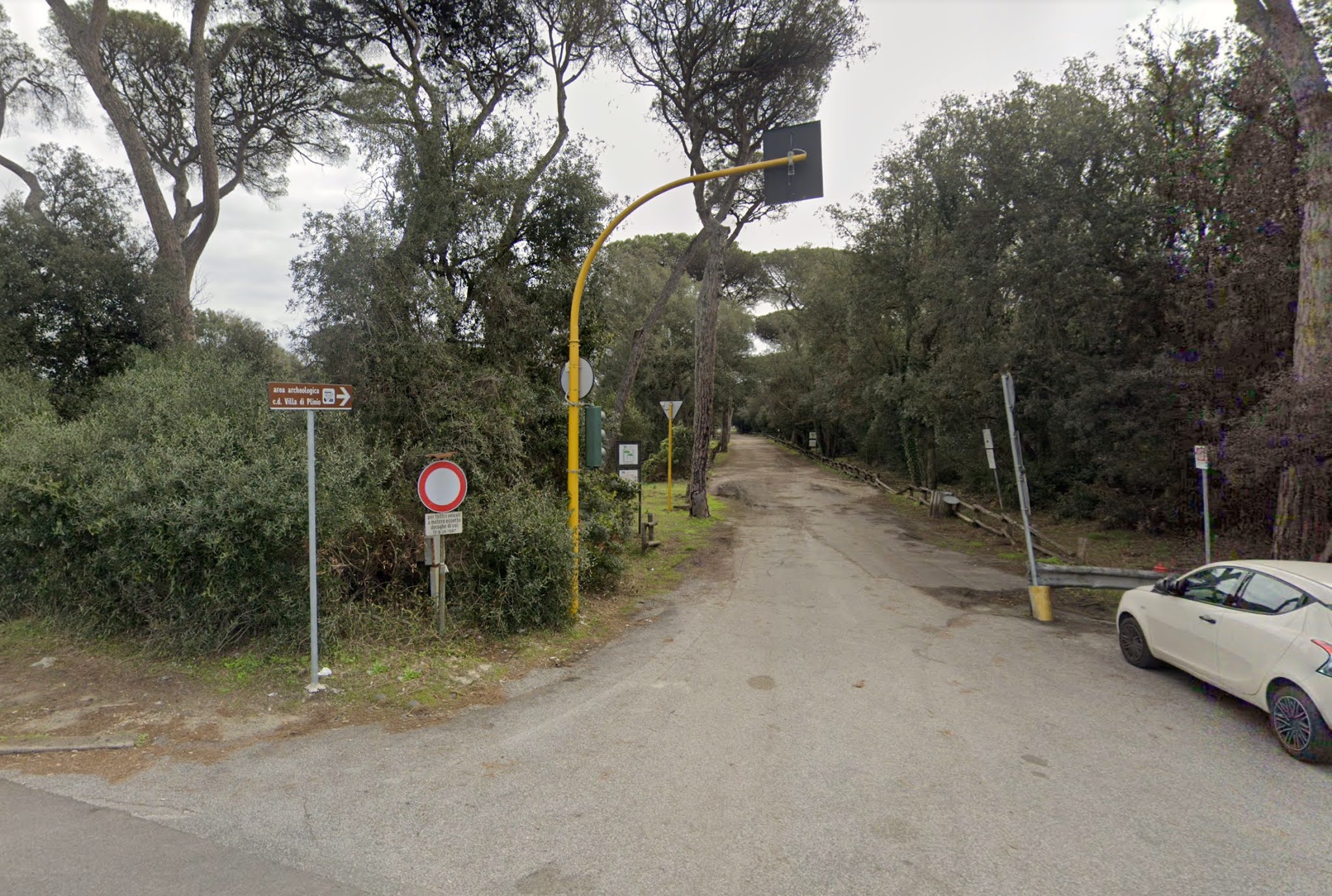 (There's now an entrance closer to Cristoforo Colombo station)
Gratefully, I leave Via Cristoforo Colombo and go past the barrier into a peaceful nature reserve. A sign informs me that I am in the Pineta Castel Fusano (Pine Woods of Castle Fusano). I am surrounded by whispering umbrella pines and oak trees. Although it is a Saturday afternoon, the place is almost deserted. Only a few elderly couples stroll, some kids on micro-scooters, one or two young people on bikes. This road is now called the Viale della Villa di Plinio (Villa of Pliny Road). It runs along the course of the ancient Via Severiana. Although Septimius Severus - the Emperor who built the Via Severiana - lived about a century after Flavia, an earlier version of this road almost certainly existed in the time of my books.
The reserve is pancake flat, perfect for walking. There are picnic tables in the shade of the umbrella pines and even a drinking fountain. I stroll between pine trees, hawthorns, myrtle, oaks and poplars.
In a clearing near a crossroads, I spot some ruins marked by a modern brick arch. These are certainly the remains of a large house, but did it belong to Pliny? I can see traces of a large colonnaded central garden and rooms on the side. The baths are where you would expect them to be. But there is no sign of the famous sea-view triclinium. or Pliny's later additions like the annex to which he retreated during the mid-winter Saturnalia festival while the slaves had parties in the main house. No ball court, and certainly no heated swimming pool... The bath complex does have wonderful black and white mosaics like those you can still see in Ostia, but these are more commonly from a slightly later period. I spot tritons (half man, half fish), seahorses, dolphins and a wonderful crayfish.
 Arch & mosaic of the so-called Villa di Plinio by Ugo Becattini
(A few years later, while watching the TV episode based on my book, I wonder if set designer Jason Carlin saw photos of the modern arch and used it for his design.)
Back in 2002, I pretend to be Flavia and take a few steps towards the place where the sea-view triclinium would have been. The coast is now about half a mile away and I find only a forest glade. Is that a fence beyond? Yes. Pushing through a hole in it I find myself on a traffic-free road called the Via dei Transatlantici.
As I take notes, the afternoon sky grows dark. There is an ominous rumble of thunder and some rain spatters down onto my notebook. The drops are blood red. Later, my friend Barbara Cooper tells me that this red rain is due to dust from the Sahara desert which has been blown over Italy. But ancient Romans would certainly have taken this as a bad omen.
The rain soon stops and I walk towards the sea. At the place where the Via dei Transatlantici meets the Via Litoriana I come upon a sign telling me I am leaving the nature reserve. There is a list of some of the animals still found in this parkland: cinghiale (boar), tasso (badger), donnola (weasel), puzzola (polecat), martora (marten), volpe (wolf), istrice (porcupine), scoiattolo (squirrel), and lepre (hare).
Presently I reach the Lungomare Amerigo Vespucci, the present coastal road. Now I know where I am. I can easily find my way back to Cristoforo Colombo train station. But before returning I decide to have a restorative snack at one of the beachfront cafeterias.
A few minutes later as I sip Coke, munch peanuts and gaze at the sea, I decide it is unlikely that the villa I just visited belonged to a Pliny. But my jaunt helped me learn about the flora and fauna of the area, and gave me the good idea of using ominous red rain!
Later, I discovered that other archaeologists came to the same conclusion that I did. Excavated in the 1930's, this villa has five different levels of rebuilding and occupation with the earliest during Flavia's time. Although it is like Pliny's villa it almost certainly not his. Some now call it the Villa della Palombara after the wood pigeons (Columba palumbus) that used to roost in a large oak tree nearby.
If you decide to visit on foot, I suggest the blue-dotted route below. The first few photos show landmarks on the route from the station to the entrance of the park. However your up-to-date device may tell you otherwise.
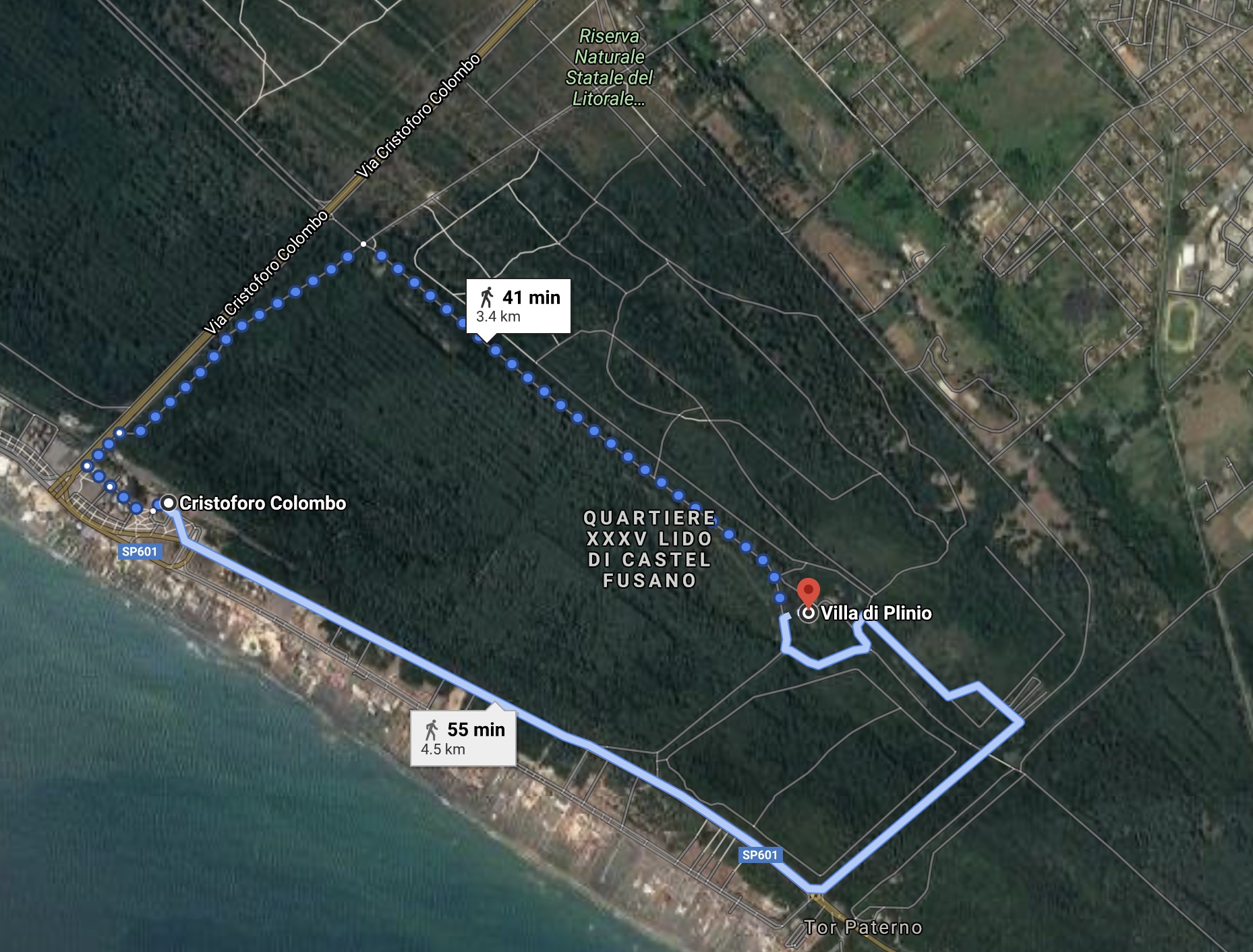 Right out of Cristoforo Colombo station then right again...
 Go north over the train tracks via Via Cristoforo Colombo
 Carefully along busy Via Cristoforo Colombo...
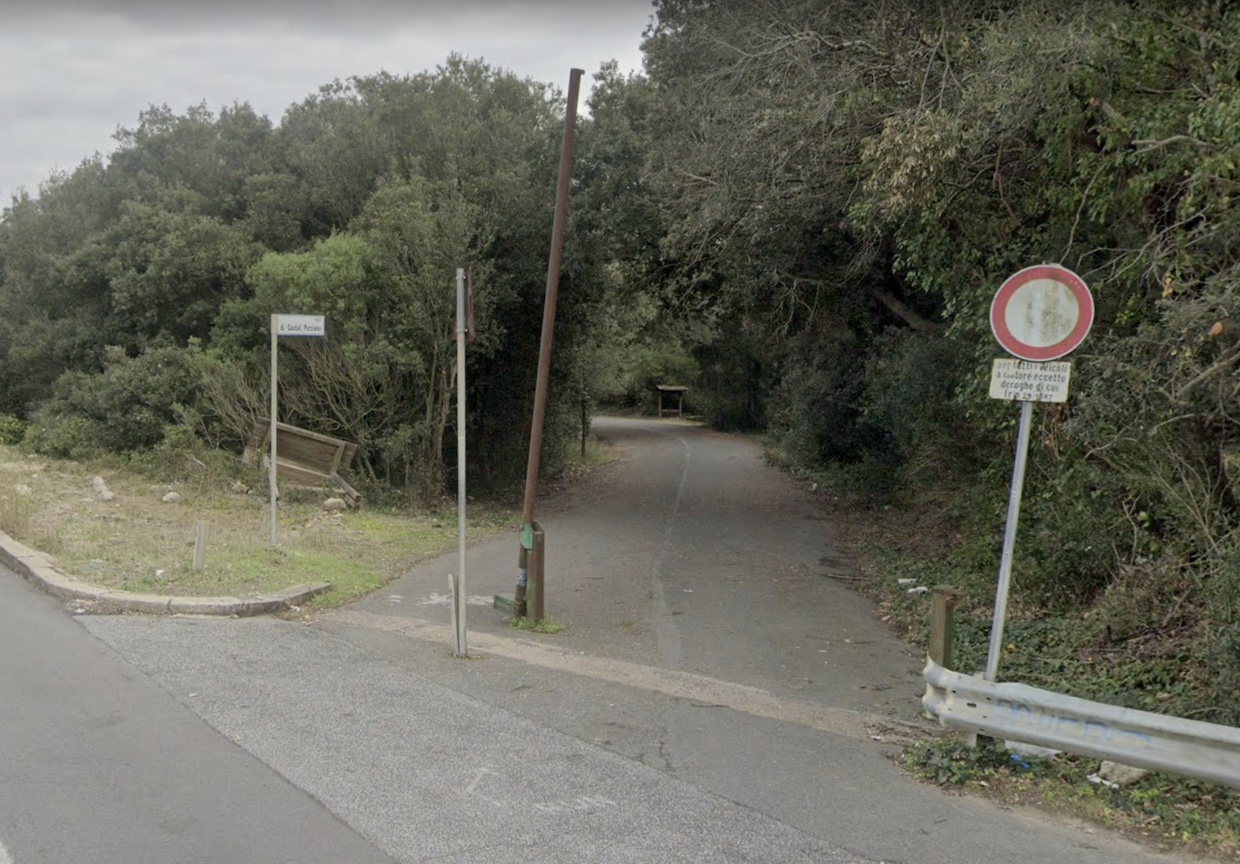 And into the park via this entrance!
You can read the entire archaeological report HERE. It's in Italian but has a good introductory paragraph in English and some great diagrams and photos.
You can read my book The Dolphins of Laurentum in hardback, paperback or ebook formats. And you can buy the complete Roman Mysteries TV series on DVD HERE.
NB: At the time of writing this, February 2021, the Official Site says that the villa is closed to the public (presumably fenced off) unless you reserve a place to go with a group of 30 or more. If this is not possible, you should still be able to catch a glimpse of the villa. And at the very least you will get a feel for the trees, animals and atmosphere of the region where Pliny the Younger enjoyed his Laurentine Villa. Buon viaggio!
January 9, 2021
How Audiobooks Helped Me Find a Voice
by Caroline Lawrence...
When I was a teacher, I discovered that students prefer one of three learning modes. They are either predominantly visual (and learn best by seeing things), auditory (they like hearing things) or kinaesthetic (they get it by doing things). Of course this is a generalisation. Most students are a combination of the three. But good teachers will use all three modes to reach their students.
The same goes for storytellers.
In the world of storytelling I think movies appeal to the visual mode, plays to the auditory and platform games to kinesthetic learners.
A writer of novels depends on visual and auditory modes. We all know authors who are superb at capturing dialogue but not so good at painting the world. And vice versa. An author will strive to be good at both.
My main mode is visual. I want to be able to see my world and I want my readers to see it, too.
For me, dialogue has always been a challenge. Following a conversation I can rarely remember exactly what was said, only the gist. This was a disadvantage when my son still lived at home. He favours the auditory mode and could always tell me exactly what I did or didn’t say.
When I was writing books set in ancient Rome, I didn’t try to make the dialogue sound Latin. I just wrote in plain English with a smattering of Latin words and tried to avoid modern idioms and ideas. (A reader once took me to task for using the word ‘weekend’ which is not an ancient concept.)
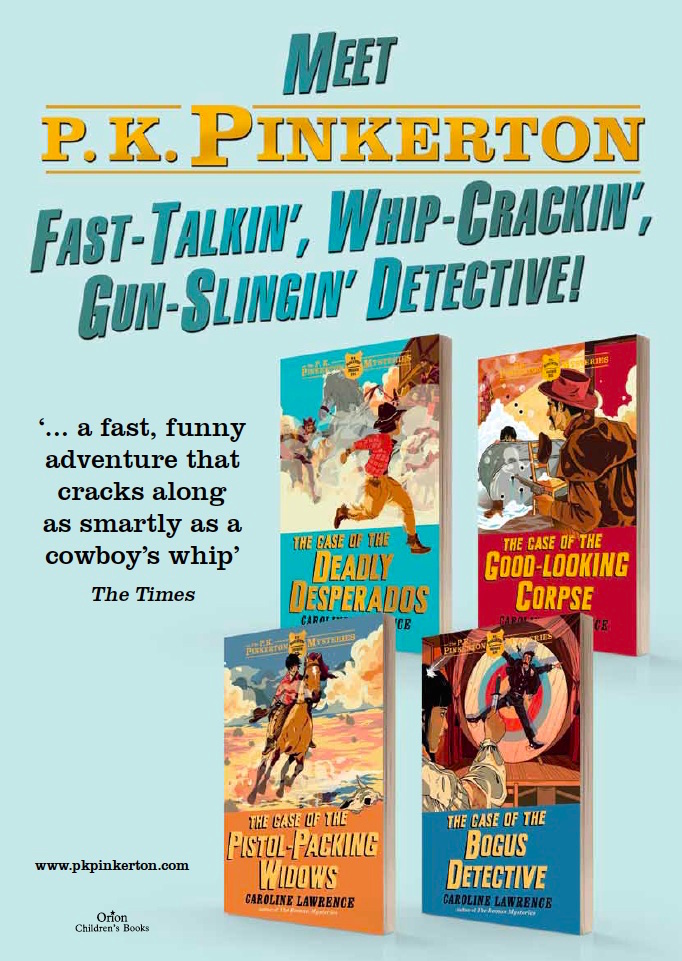
But everything changed when I wrote a series of four books set in Nevada during the early 1860s. In researching my P.K. Pinkerton Mysteries, I discovered a vast wealth of primary sources. As well as books and short stories, there were diaries, letters, newspaper accounts and even reports of the proceedings of the Territorial Legislature.
The literature of Nevada and California around the time of the American Civil War is often dubbed ‘Sagebrush Literature’ after the scrubby little plant that dots the Nevada deserts and perfumes the air. ‘When crushed,’ wrote Mark Twain, ‘sage-brush emits an odor which ain’t exactly magnolia, and ain’t exactly polecat, but a sort of compromise between the two.’
The most famous of these ‘sagebrush writers’ was Sam Clemens, who would become Mark Twain. But there were a passel of others who were just as drily witty. Like Clemens, Dan De Quille, Andrew Jackson Marsh and Alf Doten were all journalists at one point. By dipping into their articles, essays, journals, stories and poems, you taste the primordial literary soup from which Mark Twain emerged.
Here are some examples of slang that has passed out of use:
Hell did pop - Alf Doten
He kicked up thunder - Doten
Flew like a streak of chalk - Doten
The new mines are a bilk - Dan De Quille
In ‘borrasca’ – out of luck - De Quille
He did it in a hurry-skurry fashion - A.J. Marsh
The whole capoodle - Marsh
The council met at high 12 - Marsh
I got the dead-wood on him - Mark Twain
I don’t care a snap - Twain
1860s slang that is still around:
Stuck up - Twain
Don’t get huffy - Twain
They entered the saloon to take a nip - Marsh
Keep your shirt on - Twain
That girl is one in a million - Twain
Ruffle your feathers - Twain
Phrases to make you chuckle:
First it blew, then it snew, then it thew, then it friz. - Doten
I like myself first rate and think I am some punkins - Doten
Expectation stood on tiptoe - Marsh
You are a liar from your midriff up - Marsh
Cast soft glances upon his manly form - De Quille
He was a love of a dog, and much addicted to fleas - Twain
The cat let fly a frenzy of cat-profanity - Twain
Would have made a Comanche blush - Twain
Some phrases require further research:
A basket of champagne - Marsh
Three cheers and a tiger - Alf Doten
Living on alkali water and whang leather - Rollin Daggett
I wanted my characters to employ these same delicious words and expressions. I wanted to have these phrases in the top drawer of my brain so whenever I reached for an idiom or word it is right there.
But I am a visual learner. Auditory stuff doesn’t stick.
So how did I get it in my brain? Audiobooks!
I listened whenever I can. Not just during my daily walk or while travelling on public transport, but when I was making my breakfast, doing the dishes, putting laundry in the machine. Even little five or ten minute chunks could be useful. I’d often hear a phrase and pause the audiobook to make a note. (The audiobooks are all on my iPhone now so I can stick it in my pocket put in headphones and have it wherever I go). For a while I tried putting on Huckleberry Finn or Walt Whitman during one of my afternoon powernaps. Unfortunately, it’s a myth that you can learn while asleep. You definitely have to be awake.
Here are the three modes of audio I employ to get the sound of period narrative in my head.
Primary Sources - I love listening to books written during my time period, the mid-19th century. Mark Twain’s Roughing It, The Innocents Abroad, Tom Sawyer & Huckleberry Finn. Bret Harte’s The Luck of Roaring Camp has stories about the California Gold Rush, while it was going on. Ambrose Bierce, the cynical Civil War writer, also helps me get into the mindset of the period. Poetry from Emily Dickinson and Walt Whitman set a mood. George Alfred Townsend’s contemporary account of Lincoln’s assassination, The Life, Crime and Capture of John Wilkes Booth, has more concrete descriptive detail than any other writer I’ve found; but is also richly peppered with period expressions. I even have Dombey and Son by Charles Dickens on my iPhone audiobook library, because that’s the book Twain and his pals were reading in 1861.
Historical Fiction - True Grit by Charles Portis is famous for its quirky narrative and dialogue, all historically accurate. My favourite audiobook of all time is Donna Tartt’s reading of True Grit. It is pure genius. A couple of other great Western novels I listen to over and over are Boone’s Lick by Larry McMurtry (read by Will Patton) and Appaloosa by Robert B. Parker (read by Titus Welliver)
Homemade Recordings - Some of the letters and legal proceedings I really want embedded in my brain are not available on audiobook, so I read them into my iPhone and then listen to myself reading them. This is doubly good because reading out loud involves the kinesthetic (doing) as well as the auditory (hearing) and the two together are a powerful tool.
If you listen to something over and over, it becomes part of you, and even if you’re a visual thinker and writer like me, you can begin to achieve the special voice that tells your reader they are in another place and time. The spoken word on tape, CD or digital download is a fabulous resource for many writers and one that has not been available until relatively recently. Long live the audiobook!
* *
 My sagebrush-scented P.K. Pinkerton novels are set in the mile-high mining town of Virginia City in 1862, when a 12-year-old misfit detective hero named P.K. Pinkerton rubs shoulders with Mark Twain, Dan De Quille, Joe Goodman and other sagebrush journalists as they witness shootouts, fires, poker games and furniture auctions.
 The audio book of the first P.K. Pinkerton mystery, The Case of the Deadly Desperados, is read by Pat Rogriguez (above) with just the right amount of sagebrush-dry, deadpan humour. You can listen to a sample HERE.
(An earlier version of this article was first posted on the Booktrust site in 2012.)
July 13, 2020
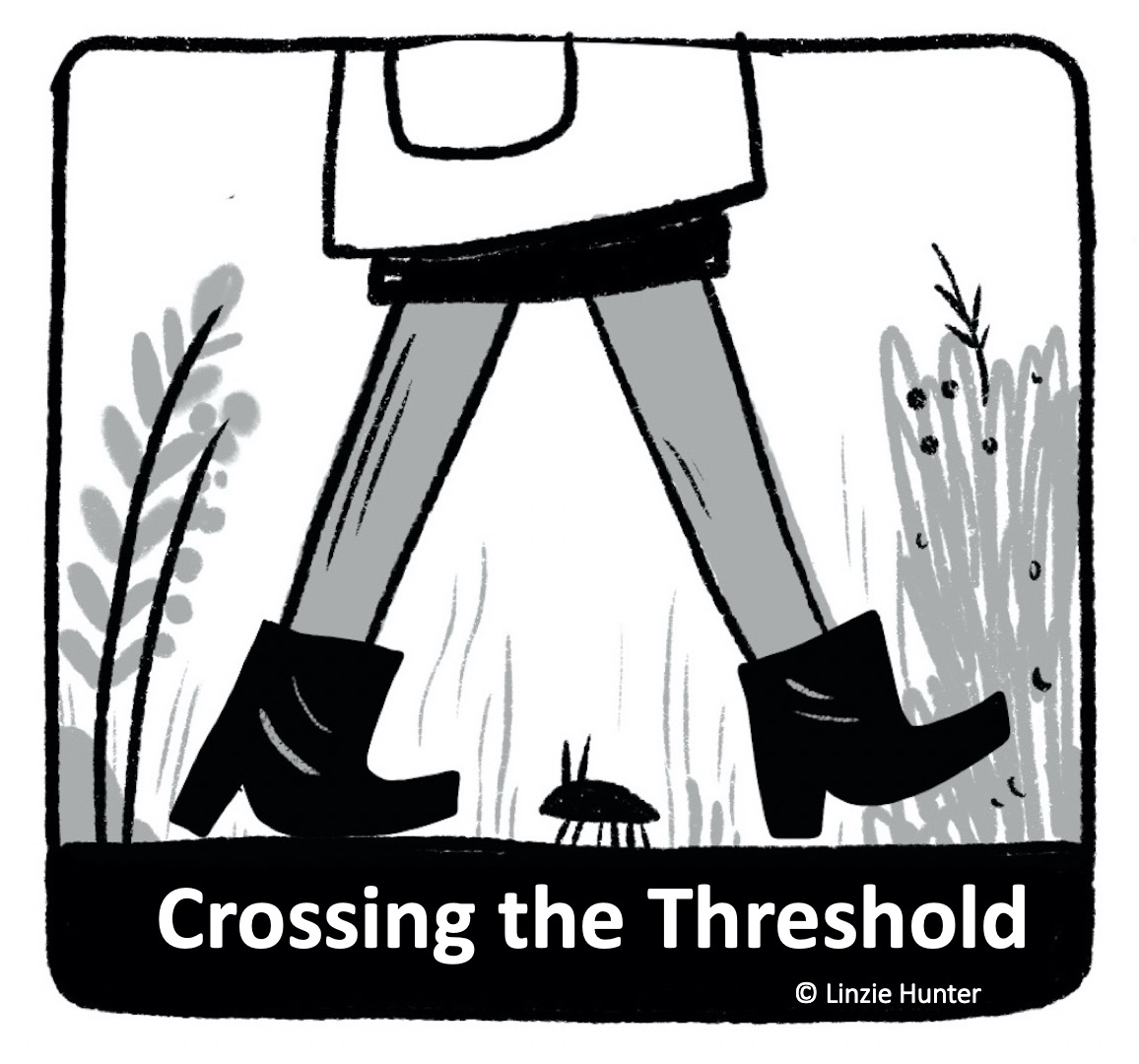
Crossing the Threshold
 by Caroline Lawrence
When I first started writing, I didn’t know how to write plot. Then I discovered story structure principles used by Hollywood script gurus like John Truby, Christopher Vogler and Blake Snyder of Save the Cat! fame.
It was a major breakthrough for me.
At first I just used story structure as a guide to keep me on track.
Later I used story structure to help generate ideas.
But over the past few years I’ve come to realise that story structure is not just a tool of good storytelling; it’s the KEY to good storytelling.
At its most basic level, storytelling consists of two beats: The Desire and The Battle.
At slightly more advanced levels there are additional beats like The Problem, The Opponent, The Plan, The Revelation and The New Level.
 At its best, storytelling includes fun beats like The Rubber Ducky, The Mentor, The Talisman, The Dance, The Miniature and Crossing the Threshold.
One of the elements I am currently obsessed with is that last beat, the one called Crossing the Threshold.
In many movies there is often a moment when the protagonist must leave their ordinary world and enter a world of adventure, usually on a journey or a quest for knowledge or a reward (i.e. The Desire). Think of The Wizard of Oz. A terrifying tornado lifts farm girl Dorothy out of black and white Kansas and deposits her in technicolour Munchkinland. In the first Harry Potter movie, Harry has to push a trolly through a brick wall at Platform 9 and ¾ to get on the Hogwarts Express. In The Matrix, Neo takes the red pill and melts into a mirror. This is borrowed from Jean Cocteau’s film Orphée, based on the Greek myth of Orpheus.
In the Pixar's Up, Mr Karl Frederickson flies away from his ordinary world in a house attached to a thousand coloured helium balloons. Remember how WALL-E, in pursuit of Eva (his Desire) grabs onto a rocket and passes through a crust of junky satellites before fizzing through Saturn’s rings? Epic!
Sometimes Crossing the Threshold involves crossing an actual threshold. In the first Hunger Games film, the camera lingers on the train door. The train door! That’s because that single step up will take Katniss out of her ordinary world and into the world of adventure. The moment she steps on the train she has left drab District 12 and enters a world of colour and abundance, in short she is in the Capital. This transfer is reinforced by a long shot of the train snaking through wooded mountains to the big city. There are many crossings of thresholds in the first Hunger Games movie. I counted at least half a dozen. In Paddington, my favourite film of 2014, the bear from darkest Peru crosses no fewer than a dozen mini-thresholds, including the actual threshold of the Brown’s house. The writer director knows the power of crossing the threshold which is why the camera lingers on Paddington’s paws stepping over it.
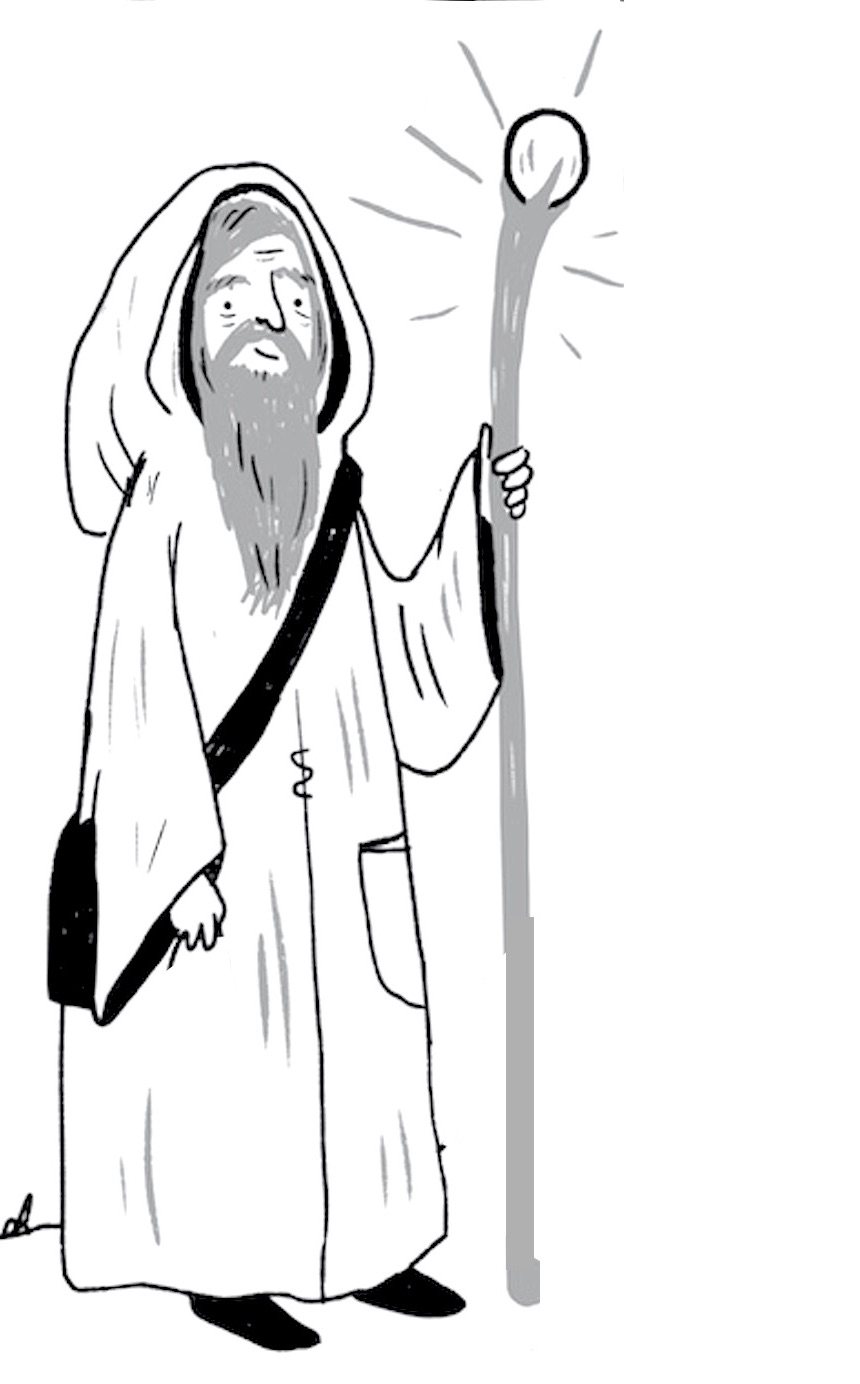 Sometimes there are Threshold Guardians, another fun trope. Threshold Guardians are people or creatures stationed at the portal between one world and another to make sure the hero really deserves to pass through. I always think of the old man by the bridge in Monty Python and the Holy Grail: ‘Stop! Who would cross the Bridge of Death must answer me these questions three, ere the other side he see.’
 Sometimes the threshold is to keep bad things out. This is the premise of many horror stories including Alien and Jaws.
Sometimes Crossing the Threshold marks the end of Act One. Or The Point of No Return. Or the beginning of the Battle. Sometimes the best Crossing of a Threshold comes right at the end: The Shawshank Redemption, Thelma and Louise, Blade Runner…
Why do we like this beat so much? I believe it is because everyone who ever lived can identify with it. We cross thresholds a dozen times a day, whenever we leave a room, a house or even a town or country. We also cross major Thresholds in our lives. When I visit schools, I ask the kids to tell me the Seven Major Thresholds they have crossed (or will cross) in their lives. ‘What’s the first threshold you ever cross?’ I ask. ‘The first time you leave a place you feel safe and go into a strange and unknown world?’
They all get it: When we are born! And the last threshold we ever cross? Presumably when we die. As Peter Pan says, ‘… an awfully big adventure.’
Our lives are a succession of journeys, some big and some little. Strung all together, they make up our life’s journey.
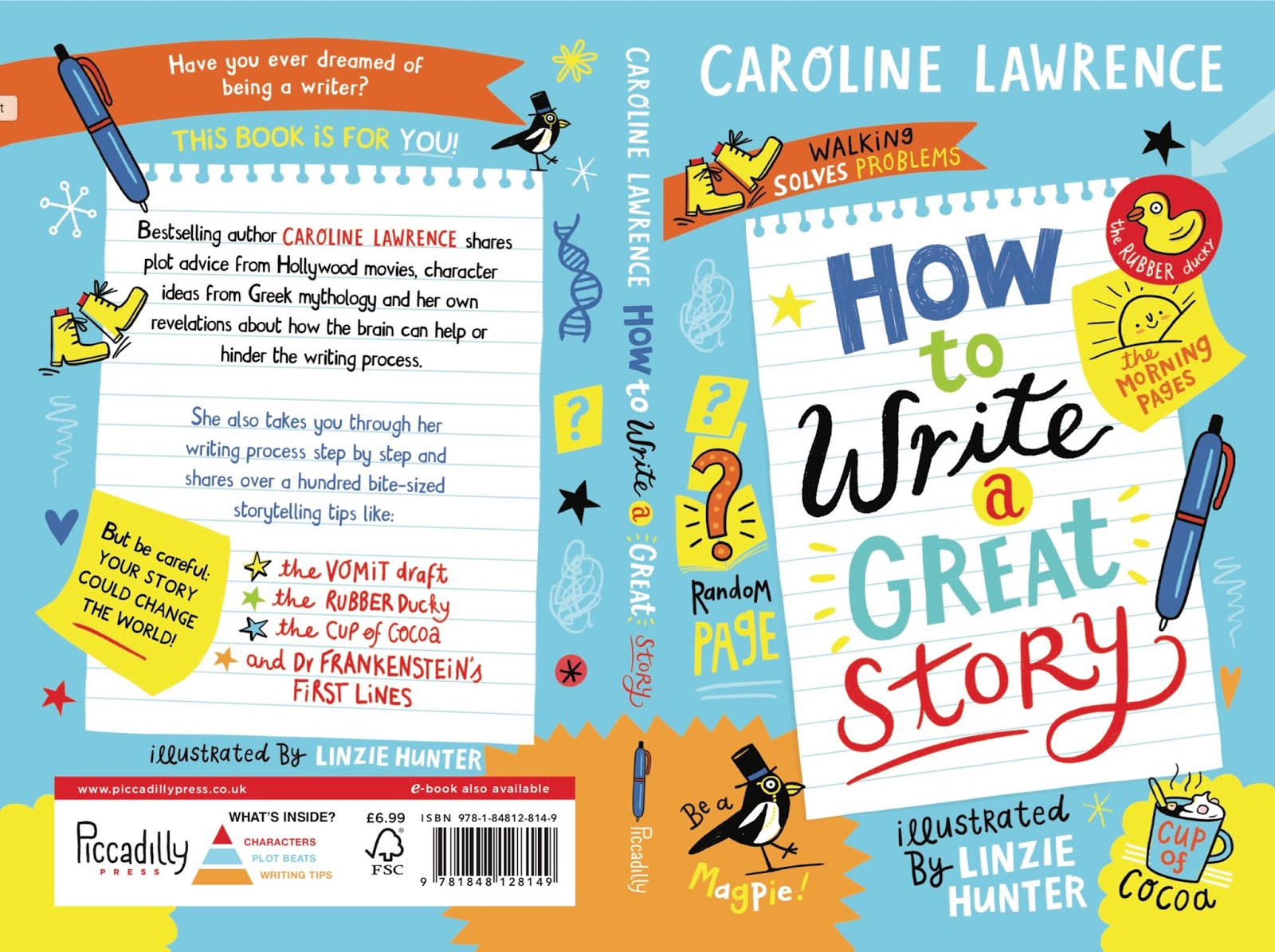
To discover more about this trope and others mentioned in this blog post, dip into my book How To Write a Great Story , delightfully illustrated by Linzie Hunter, who did all the illustrations on this page. Or drop in on my FREE writing webinar Creative Writing Tips, Tricks and Tropes next Tuesday 21 July 2020 at 6.30pm GMT. Sign up for free HERE.
May 27, 2020
Ancient History Quiz (hard)
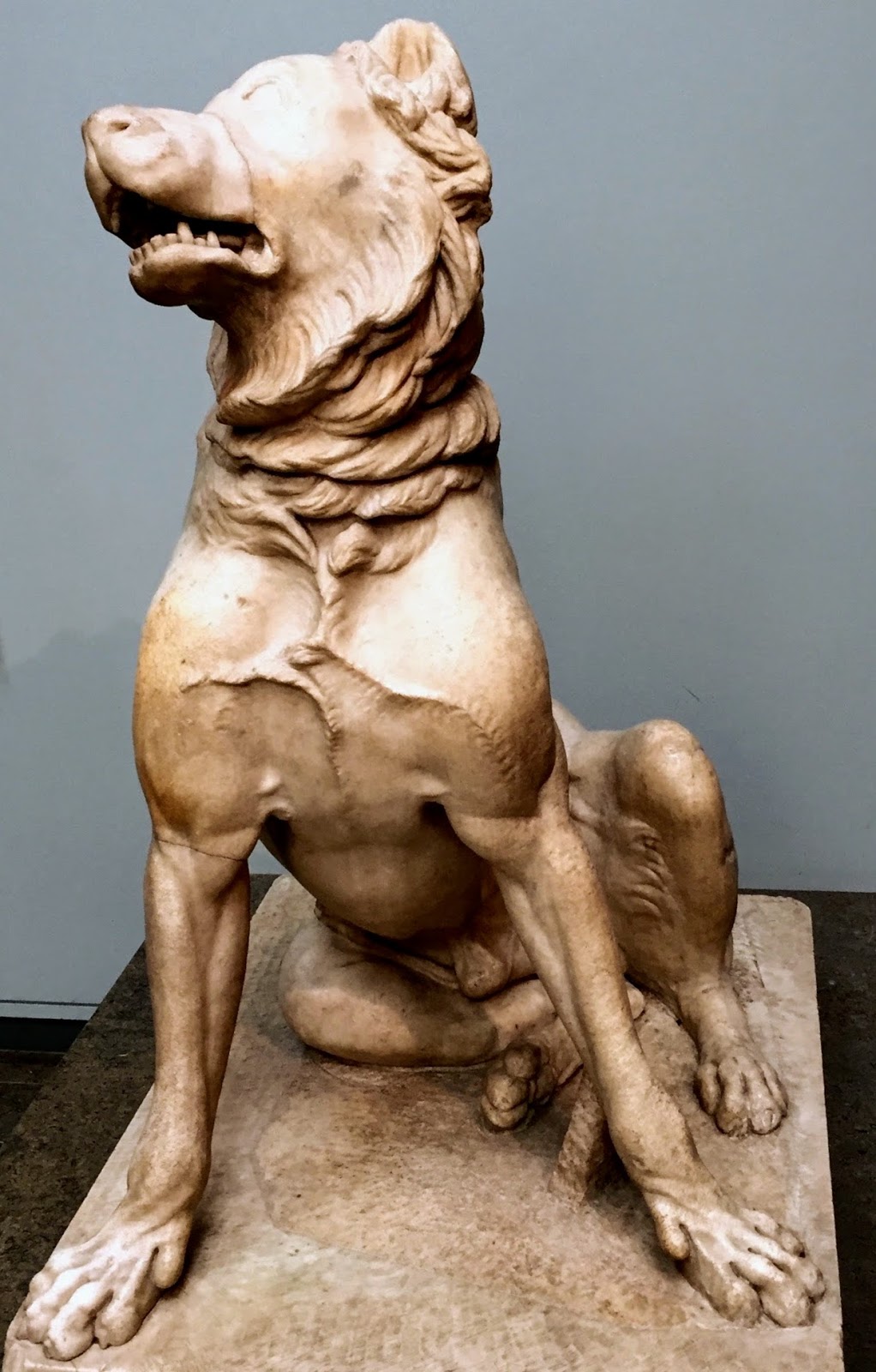 Molossian Hound, British MuseumRecently I was asked to write a quiz for a kids’ book site based on my first two Time Travel Diaries books. I sent them a quiz which they thought was TOO DIFFICULT. So I am posting it here.
 How well will YOU do?
This quiz is based on some of the strangest facts I have come across while writing my first two Time Travel Diaries, the first set in Roman London and the second in Ancient Athens. If you don’t know, have an educated guess! Answers at the bottom.
1. The enamel in a skeleton’s tooth can sometimes tell you
a) where the person grew up
b) what colour their eyes were
c) what part of the world their mother came from
d) all of the above
2. Athens was famous for producing some of the world’s most famous playwrights. Which of the following died after being attacked by dogs?
a) Aristophanes (author of The Birds, etc)
b) Euripides (author of Medea, etc)
c) Aeschylus (author of the Oresteia etc)
d) Sophocles (author of Oedipus Rex, etc)
3. What did the philosopher Socrates use to slice a hardboiled egg?
a) A spear
b) A hair
c) A fork
d) A stylus
4. The word gymnasium comes from the Greek word for
a) naked
b) athletic
c) muscular
d) exercise
5. Londinium (modern London) was founded by
a) The Celts
b) The Greeks
c) The Romans
d) The Saxons
6. Certain animals frightened away evil spirits and were therefore used to decorate jewellery, clothing, walls and other objects used by Romans. Which animals were NOT used this way by the Romans?
a) snakes
b) sharks
c) leopards
d) dogs
7. Which of the following fascinating objects was NOT found in Roman London?
a) An ancient version of a Swiss army knife
b) two pairs of leather bikini bottoms
c) an ivory knife
d) an amber amulet in the shape of a gladiator’s helmet
8) The Roman god Mithras was popular from the first to third centuries AD. Which of the following groups people were his most faithful followers?
a) high-ranking soldiers
b) retired soldiers
c) men
d) all of the above
9. The god Mithras wore strange clothes. Which of the following was NOT in his wardrobe?
a) a Greek helmet
b) a flapping cloak
c) leggings
d) a floppy hat like a Smurf
10. Today you can still visit the foundations of London’s Mithraeum, where the god Mithras was worshipped. Which American company restored it to its original position deep below their London branch and offers free access every day but Monday?
a) Microsoft Corporation
b) Bloomberg LP
c) Google LLC
d) Walt Disney Corporation
Want to know more? Read or listen to Caroline Lawrence’s first two Time Travel Diaries. And check out her other 30+ historical novels for kids on her website: www.carolinelawrence.com.
_____
Answers: 1 = d (using DNA and isotopes); 2 = b (When he was an old man, Euripides was savaged to death by Molossian hounds); 3 = b (Plato has Socrates tell of using a hair to slice an egg); 4 = a (because Greek men exercised without clothing); 5 = c (London started life as a Roman trading post around AD 50); 6 = b (No shark has ever been found on Roman jewellery); 7 = a (something like a Swiss army knife WAS found, but not in London); 8 = d (In fact we think only men were allowed into his temples); 9 = a (Mithras is never shown with a Greek helmet); 10 = b (You can find London’s Mithraeum in the European headquarters of Bloomberg LP by Bank tube station)


