Martin Bodenham's Blog
March 12, 2024
What Makes a Great Crime Thriller?
Crime thrillers have long captivated readers with their intricate plots, suspenseful twists, and compelling characters. From the classic whodunits to gritty noir tales, the genre has evolved over the years, but certain elements remain essential to crafting a truly gripping narrative. So, what exactly makes a great crime thriller?
First and foremost, a great crime thriller must have a compelling protagonist. Whether it’s a brilliant detective, a flawed anti-hero, or an ordinary person thrust into extraordinary circumstances, the main character should be someone readers can root for – or at least find fascinating. Their motivations, flaws, and inner conflicts add depth to the story, keeping readers engaged from beginning to end.
Next, a great crime thriller needs a riveting plot that keeps readers guessing until the very last page. Twists and turns are essential, but they must be believable and well-executed. The best crime thrillers are like intricate puzzles, with clues carefully sprinkled throughout the narrative, leading readers down unexpected paths and culminating in a satisfying resolution.
Atmosphere also plays a crucial role in setting the tone of a crime thriller. Whether it’s the gritty streets of a bustling metropolis or the eerie quiet of a small town, the setting should be vividly depicted, immersing readers in the story’s world and adding to the sense of unease and suspense.
Of course, no crime thriller would be complete without a formidable antagonist. Whether it’s a cunning serial killer, a corrupt politician, or a shadowy criminal organization, the villain should be as compelling as the hero – if not more so. Their motivations should be complex, their actions unpredictable, and their presence should loom large over the story, driving the protagonist to their limits.
Dialogue is another key element of a great crime thriller. Sharp, snappy dialogue can reveal character traits, advance the plot, and ratchet up the tension, adding layers of complexity to the narrative. Whether it’s a terse exchange between adversaries or a heart-to-heart between allies, well-written dialogue can elevate a crime thriller from good to great.
Finally, a great crime thriller should leave readers thinking long after they’ve turned the final page. Whether it’s a shocking plot twist, a thought-provoking moral dilemma, or a lingering sense of unease, the best crime thrillers stick with readers, sparking discussion and debate long after the book is finished.
In conclusion, what makes a great crime thriller? It’s a combination of compelling characters, a riveting plot, a vivid atmosphere, a formidable antagonist, sharp dialogue, and a lasting impact. When these elements come together seamlessly, the result is a novel that keeps readers on the edge of their seats from start to finish – and leaves them hungry for more. So, the next time you’re looking for a thrilling read, keep these elements in mind and dive into the world of crime fiction. You won’t be disappointed.
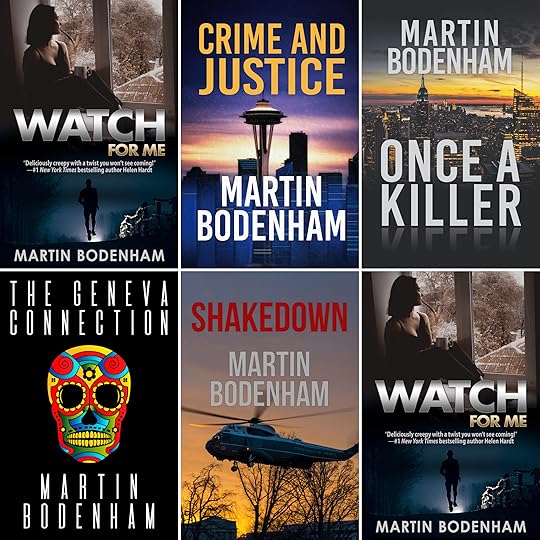 The post What Makes a Great Crime Thriller? first appeared on Martin Bodenham - Crime Thriller Novels.


August 15, 2021
Watch For Me – Publication Day
It’s publication day for my psychological suspense novel, Watch For me.
Happily married, Tom Harper cannot understand why a woman not much older than his teenage daughter is suddenly obsessed with him. Watch For Me tells the story of one man’s struggle in the face of overwhelming psychological and physical torment by a female stalker. Set on Vancouver Island, the book is published by US publisher Down & Out Books and is my fifth crime novel.
A man being stalked by a woman is far less common than the other way round, but it happens, and more frequently than you might think. In the US alone, the National Center for Victims of Crime estimates there are around 370,000 men stalked annually. And when it does occur, men find it far harder to obtain the psychological and legal support they need. I wrote the novel to draw attention to this most intrusive and threatening behaviour which affects both sexes.
Already, the book has won some excellent advance reviews:
“Deliciously creepy with a twist you won’t see coming!” – Helen Hardt, #1 New York Times bestselling author
“I read spellbound as Tom Harper’s life is demolished brick by brick. Assured, remorseless writing, that grabs the reader and doesn’t let go. Highly recommended.” – Michael Ridpath, author of The Diplomat’s Wife
“I absolutely loved this book. One of the best I’ve read in ages – gripping, thrilling and pretty scary!” – Alex Pine, author of The Christmas Killer
Here’s the synopsis from the back cover:
“Tom Harper, a Vancouver Island realtor, has the client from hell, Ali Page, a beautiful and intelligent young lawyer returning from the mainland to take up a job with an island law firm. Trouble is there’s always something wrong with the properties Tom shows her, always a reason not to commit. Finally, after they find a condo she likes, he receives a text thanking him for his help. Ali signs off: I’m sad we won’t get to spend more time together. Often cold and withdrawn throughout their weeks of searching, Ali’s words seem strangely out of character.
The texts keep coming, increasingly incoherent and disturbing. What does Ali mean by: we have a special connection, and why on earth would she say: I’ll be here for you when you leave your wife? Happily married, Tom cannot understand why a woman not much older than his teenage daughter is suddenly obsessed with him. When he rejects Ali’s unsolicited advances, Tom soon discovers the sinister depths to which a delusional mind will sink to obtain what it wants. Isolated and seemingly abandoned by the police and legal system, this is the story of one man’s struggle to rescue his marriage, his family, and his sanity in the face of overwhelming psychological and physical torment.”
 The post Watch For Me – Publication Day first appeared on Martin Bodenham - Crime Writer.
May 27, 2021
Watch For Me – Book Cover
My latest crime novel, Watch for Me, is a psychological suspense thriller. I have just received the book cover from my publisher, Down & Out Books. I hope you like it.
Chris Rhatigan, publisher of All Due Respect Books, a crime fiction imprint, had this to say after he read the advance review copy:
“This is an outstanding novel that got its hooks in me from the first page. I love the laser-focused storytelling—the terror of Ali Page is evident in every line. It’s like a clinic on how to write a thriller, every beat of the plot is perfectly placed.”
The novel comes out in paperback and e-book formats in August.
 The post Watch For Me – Book Cover first appeared on Martin Bodenham - Crime Writer.
August 17, 2020
Publication Day – Crime And Justice
My latest crime thriller novel, Crime And Justice, is published today. It’s available from most book retailers in both digital and paperback formats. Set in Seattle, the story is about a policewoman detective’s search for truth and justice in the face of corruption and corrupted evidence.
I hope you enjoy reading it.
[image error]
“Martin Bodenham’s new Seattle-based thriller hits the ground running and doesn’t let up for a minute. Crime and Justice has gripping page-turner in every bit of its DNA. A compelling tale of one policewoman’s determination to seek the truth in the face of corruption and corrupted evidence.” -Andy Griffee, author of the Johnson and Wilde crime mystery series
“In Crime and Justice, Martin Bodenham has crafted a finely tuned, intelligent thriller with an engaging cast of characters. Full of corruption, back-stabbing, and plot twists, this is a novel you won’t want to miss.” -Chris Rhatigan, publisher of All Due Respect Books
“Grips you from the very first page and doesn’t let you go! Sinister and compelling, with a conclusion you won’t see coming.” -Derek Thompson, author of Long Shadows and The Complete Thomas Bladen Thrillers
June 4, 2020
Crime And Justice
My new crime thriller is published in August. In the meantime, here’s a sneak preview of the book cover. I hope you like it.
[image error]
June 2, 2020
Seattle skyline
Seattle has a beautiful skyline, which is one reason it’s the setting for my new thriller novel, Crime and Justice, published by Down & Out Books this August.
[image error]
December 29, 2019
Feels like 1999
During the run-up to the new millennium, I was a corporate
finance partner in Ernst & Young’s London office. One of my
responsibilities was taking over as the head of the firm’s technology incubator
business in late 1999. Before that time, I’d been working in the private equity
market, mainly focused on management buyouts of mature businesses where paying
a double-digit earnings multiple for any company was pushing the boat out. So,
you can imagine my surprise at the crazy valuations mooted for dot-com
companies when I took control of the incubator. It felt as though I’d landed on
another planet.
Late 1999 was the era of the dot-com bubble when companies only
a few weeks old were being valued on multiples of prospective revenues or the
number of page visits on their nascent websites. Those of us who were brave
enough to ask about earnings were stared at as if we were speaking another
language. “You just don’t get it,” people would say to me. “There’s a new
paradigm; earnings don’t matter.” A few weeks after I took over, the market
peaked. By March 2000, the Nasdaq index had risen 400% in five years; it rose
almost 90% in 1999 alone, when companies such as Qualcomm rocketed in value by
almost 3,000 percent.
Irrational exuberance took over. I met experienced cab drivers
who’d tell me they were thinking of giving up driving as they had made so much
money investing in the market that year. Some of the new graduates I met
shortly after they joined the firm spoke in awe of their friends who’d turned
down offers from blue chip firms in order to become full-time day traders or to
launch their own dot-com venture. The world went crazy.
The bubble burst in March/April of 2000, right after the
Nasdaq Index hit a peak of 5,049. In early April, Bloomberg published a widely
read article that stated: “It’s time, at last, to pay attention to the
numbers”. Then Alan Greenspan, Chair of the Federal Reserve, started
raising interest rates, and the markets fell off a cliff. By the time it troughed
in 2002, the Nasdaq index had lost almost 80% of its value. So much value was
wiped out, it took around fifteen years for the index to recover its 2000 peak.
I feel the same nervousness today. This year, the Nasdaq has risen by more than a third. Even the broader S&P 500 index is up almost 30%. And yet total 2019 net income for companies within that latter index is expected to fall between one and two percent. It’s as if the numbers don’t matter again. While I don’t work in London any longer, so I no longer get to meet cabbies or new graduates, everywhere else I look, complacency about asset prices abounds. Irrational exuberance has taken hold.
I can’t help but feel it’s 1999 all over again.
[image error]
May 5, 2019
Are private equity managers cutting their own throats?
At yesterday’s Berkshire Hathaway annual shareholders’
meeting, Warren Buffett took another swipe at private equity fund managers. “If I were running a pension fund,” he said,
“I would be very careful about what was being offered to me.”
Buffett has taken shots at the private equity sector for
many years, targeting the industry’s aggressive use of leverage, opaque
reporting and questionable returns. As a
former private equity fund manager, I don’t agree with everything Mr. Buffett says,
but there have been times when his criticisms have been well-founded,
particularly when the practices of some of the larger funds have been driven
more by self-interest than maximising returns for their investors. Right now, I believe we are witnessing
another such moment. In my view, the
recent drift towards “super carry” is a step too far.
For decades, the industry ran on a “two and twenty” pricing
model. Fund managers charged an annual management
fee of 2% of committed capital plus 20% of profits made for investors (known as
carried interest). However, over the
last year or so, a handful of mega-fund managers have raised their carried
interest to 30%, and there is talk of more to come.
It’s not difficult to see why. The last few years have seen record inflows
of capital into the sector, with a disproportionate amount going into the
coffers of the mega-funds. Pension funds
and other institutional investors continue to see private equity as a route to
out-performing the quoted markets and have voted with their feet, ploughing
some $750 billion into the sector in 2017 alone. Faced with such massive demand for their
product, who can blame some managers for raising prices? That’s capitalism at work, right?
The problem is the record returns reported over the last
couple of years are not necessarily indicative of future results. You see, private equity is one of the most
cyclical games in town. Recent realised
profits reflect investments made in the early part of this decade, when
acquisition multiples were low following the financial crisis. Right now, in my view, private company price
multiples are at their peak. According
to McKinsey, 2017 saw the global private equity average deal size rise by 25%
and most of this was as a result of multiple increases. In other words, in order to deploy record
amounts of dry powder, fund managers are having to pay handsomely for their
targets. When recent investments are
divested in five or six-years’ time, my worry is that we will be facing a completely
different stage of the cycle.
If I’m right about prices having peaked, then future profits
for investors will be considerably lower when current funds reach maturity. Worse still, investors in those mega-funds
with 30% super carry will feel particularly aggrieved. Not only will their profits be lower, but
they will also have paid their private equity managers much more for the
privilege.
If more managers follow suit and introduce super carry into
their funds, I believe institutional investors will look to do what some of
their more forward-looking peers have done already. They will build their own in-house deal teams
and start cutting out the expensive middle-men.
The rise of super carry means private equity managers run the risk of cutting their own throats.
[image error]
January 16, 2019
Private Equity – Why I believe 3i Group has much further to fall
International investment house 3i Group (LSE:III) has seen its share price tumble almost 20% from the record high achieved in May 2018. Recent analysts’ recommendations are either buy or outperform, so investors might be thinking now is a good time to pick up some of this FTSE 100 company on the cheap. With a current dividend yield of almost 4%, what’s not to like about this debt-free private equity leviathan, for which I used to work?
Quite a lot, as it happens, but you need to look below the surface to spot it. You see, private equity is one of the most cyclical games in town. The best returns for a PE firm come from adding to its investment portfolio during the low points in the cycle — that’s why the industry harps on so much about “vintage years” — and then selling assets at the top. Sure, good portfolio management of the underlying investee companies can move the needle, but it won’t make up for getting the cyclical timing wrong.
[image error]
Let’s take a closer look at 3i’s recent portfolio activity.
In the two years to 31 March 2018, the company realised cash from investments
to the tune of £2.6bn, a level some 80% higher than the average of the
previous five years. So far so good. It makes sense to offload investee
companies when valuations are at their highest and corporate acquirers are out
with their chequebooks. And it appears 3i has sold well, achieving a 2.4x money
multiple on assets sold last year. My concern, however, is the potential realisation
values of those businesses remaining in the portfolio. For it is those that
will drive future profits.
I mentioned earlier this is a cyclical business. According
to BDO’s latest quarterly private equity price index (PEPI), the average enterprise
value to EBITDA multiple on acquisitions made by private equity firms came in
at 12x (just a little lower than the FTSE All-Share’s 12.8x). This represents a
50% increase in the average multiple paid since 2013. Competition from other PE
houses, flush with cash from record fundraising, and trade buyers, fuelled by
cheap debt, has pushed up the value of private companies.
3i doesn’t disclose what it pays for individual portfolio companies, but it is reasonable to assume it has not been immune to escalating prices. While the firm has done well selling into this frothy market, my concern is that it has also stepped up its new investment activity near the top of the cycle. In 2018, it invested £587m of its capital in new deals, compared to only £100m in 2013. Given 3i’s stated target holding period of four to five years and the high multiples it is likely to have paid for recent investee companies, I struggle to see much scope for capital growth or realised profits from the portfolio in the medium term.
If we are at or near this cycle’s peak, and multiples paid for private companies drift lower from here, I expect to see 3i’s share price take a hammering. At that point, I’ll consider owning the stock again, but I’m in no rush to do so.
November 17, 2018
Corporate Debt Bubble
US corporate debt is 40% higher than its 2008 peak, funding share buy-backs, acquisitions, etc. As a percentage of GDP, its level is worryingly consistent with pre-crash peaks of the past.
The era of cheap money is over. We’re in another corporate debt bubble.
[image error]