Cecily Anne Paterson's Blog
May 3, 2015
How to love really difficult family members

Okay. First up, in case there are any of MY family members reading this, THIS IS NOT ABOUT YOU. Be reassured, Mum, Dad, brothers, everyone else vaguely or distantly sharing blood. Sit down. Breathe deeply. It's alright. I love you. I'll phone you. Mwah mwah mwah.
Now that's sorted out, we can get on with the post.
I get asked tricky questions every so often, and the most recent was this: "How am I supposed to love my difficult in law family member? I don't even like him/her and I just feel really angry at him/her every time we're together."
Ahhhh, family. The best and worst of inventions. We love so deeply when it's good, and hate so intensely when it's not. Add in-laws to the mix and it's a wonder any of us are functional human beings at all.
But the question is real, and it brings a lot of grief to a lot of people, so I'll do my utmost to answer in the best way I know how.
1. Define what you mean by 'love'.
We often have very specific, very deep, and often unspoken expectations in our minds when it comes to family members. We glean all sorts of ideas from all sorts of places about what a relationship ought to look like - books, movies, TV, our friends' families and our own imaginations, and then we sit back and wait for things to follow our plans.
What this usually means is that we want certain feelings to come about as a result of our interactions with our family. We expect they will listen to us in this particular way and respond to us in that particular way. And then we expect that we will feel bonded / warm / understood / cherished - whatever. Take your pick.
When we feel those expected feelings as a result of interacting with the person, we often call it 'love'. For example: my Pop always compliments my appearance and says how beautiful I look, no matter what I wear. As a result, I feel warm and happy and a teensy little bit more beautiful, even though I know he's 94 and needs his glasses to be able to open the fridge. It's easy then to say, "I love my Pop."
That's not to say that getting good feelings from someone isn't love. But it's important to realise that it's only one part of love. A lot of love is deciding to commit to a person, to being there for the relationship, to doing good even when it's hard. In the old, old words, love is patient, love is kind. It forgives, it perseveres, it protects and it does a whole lot of other very active, mindful and disciplined things that most people don't do naturally.
My simplified definition of love is this: wishing and acting for the good of another.
So to love a difficult family member, we need to be able to wish them well, and act for their benefit.
But that's all terribly difficult when they annoy the heck out of us and we can't even look at their face without feeling like we want to explode. So what do we do with the highly charged feelings that come our way?
2. Grieve the relationship you expected
Grief isn't just restricted to death or divorce, or the big events of life where we lose something we had. You can grieve something you never had, but you really, really wanted. Sometimes those griefs can be even bigger, because in grieving them, you have to say, "There is never any chance that this dream of mine will be fulfilled."
Grief hurts. And it takes time. There are stages of grief that are easy to get stuck in and sometimes it feels like you're never going to get out. Or if you do, you're going to be angry all your life. Elizabeth Kubler Ross's five stages of grief are: denial, anger, bargaining, depression and acceptance. Unfortunately a time line of grief doesn't come with the stages. It can take longer than you think.
Grieving well is an art and a discipline. Some people benefit from journalling, others set aside specific time to think their thoughts and feel their feelings. In my own experience, I have found that sitting with the feelings and actually bearing the pain they bring helps them dissolve more quickly. Fear of feeling sad is often stronger than the sad feelings themselves - not always, but often.
3. Look elsewhere for what you needed from the relationship
Perhaps you expect a warm listening ear from a particular relationship, or a certain amount of time spent with family, or simply a phone call or a polite 'hello'. The things we expect and want from relationships are related to certain needs we have. Maybe the needs are significance, affirmation, friendship, or simply some time off from your kids.
Identify them and write them down as specifically as you possibly can. Then go looking for other ways to get them fulfilled.
I find that looking for my significance and sense of purpose from God takes a lot of pressure off relationships. I can be free to let other people give me what they give me, without having to worry that I'm not getting all the things I need from them. If it's a more practical need, like babysitting or help around the house, ask around and see who else can provide - perhaps on a swap-type basis.
4. Understand the person, and the family system relationship you're both in
My Nanna was a lovely lady but sometimes she was a bit, um, 'feisty'. It helped a lot to realise that she was brought up as the youngest child in a very poor family of 9 siblings in the depression. She learned to speak up and out to get what she needed from a very young age. And those early habits don't disappear easily.
Dig a little into your family member's past, but look also at the broader family they found themselves in. "Family systems theory" says that we learn how to get on with others from the family system we are born into. If it's a highly anxious system, you might find that one family member controls everyone else through panic or misplaced 'concern'. Look at the type of family system your family member comes from, and (if it's different) the type of family system you've come from. What's your role in that system? Does it transfer across, or are there lots of differences?
At this point it's important to look at ways you may be inflaming things, perhaps by the way you react, or with an annoying habit you may have. (Of course, you might not have any, but it's important to be just as vigorous in self-examination as it is to be vigorous in understand the other person too.)
Doing the work of research and analysis of what actually is going on might not make you like the person more, but hopefully it will make them more human and more understandable. At the very least, you'll have more knowledge up your sleeve, and more understanding of what is actually going on - especially if the relationship is really, really toxic and you need to protect yourself.
And, actually, this point is important. Some relationships are toxic, and you do need to keep yourself safe in them. Some people are abusers, in which case you should avoid them entirely, even to the point of breaking off the relationship if it is hurting you badly. (But this is an extreme step, and not one to take lightly.) Other people are just difficult and tricky, but still manipulative and out for what they can get. Understanding their strategies and the patterns is really key to knowing how to proceed.
5. Have a plan
With all this work under your belt, it's time to make a plan for how to proceed in your difficult relationship. Some things to look at might be: putting boundaries around the time you spend together, deciding not to pursue certain conversation topics, if you know they are likely to end up exacerbating things, or refusing to get drawn into old family battles or gossip sessions.
What are the things that make you most uncomfortable or upset in this relationship? Work out three things you can do to reduce the stress. Write them down.
6. Take baby steps
It's pretty unlikely that all your relationship difficulties are going to be solved all in one miraculous hug-fest one sunny afternoon after Christmas lunch. More realistically, you're going to be in for a long haul with ups and downs. Some years wiil be better than others. Sometimes you're going to be so angry you'll feel you could burst.
If you can do one small thing from your plan in every interaction, you will be on your way to loving that difficult family member more and more.
If you fail, don't beat yourself up and give in to middle of the night miseries. Have a bit of a thinking session, work out what happened, and figure out ways to make it better next time. Go back through these steps. Grieve again, work out what you're needing and get it.
You can't change them. You really can't. All you can do is to actively, and with God's help, work on yourself and your own reactions, understanding why they happen, and what's going on in your own soul. Yes, that's a slow process, but it does work, and it does make lots and lots of things in life a whole lot better.
What helps you to love difficult family members?


April 25, 2015
Why I'm still not reading my box of letters from boarding school

Nearly two years ago my mum gave me a wonderful present for my 40th birthday. Tied up, in a blue box, were all the letters I wrote in the five years I was at boarding school, from age 11 to age 16. I nearly cried, I was so touched.
I talked about it and blogged about it for a couple of days. And then I put the box away at the top of my cupboard, unopened, without even a tiny peek inside.
The thought of opening that box fills me with dread and terror. I just don't want to do it. At least, I tell myself that I don't want to do it in some haphazard way in the middle of normal life. I'd have to go away. Get prepared. Give it time.
But even if I took myself away for a few days, to a safe, beautiful place, I still don't know if I would want to open them.
The most obvious reason for not wanting to read them is because they'll bring back old pains and hurts and tears. I try to avoid my scars. Some things took a long time to heal. Others didn't heal well, but I've found ways not to limp too obviously.
But that's only one reason.
The bigger reason, which has only just become clear to me, is because, for some reason, I am embarrassed. Embarrassed and ashamed of the person I am/was at the ages of 11, 12, 13, 14, 15.
I can hardly even explain this. It's not as if I was awful or did terrible things or have some dark secret to hide. It's shame about my childish innocence and naivete, as if for some reason I should have had the wisdom and smarts I have now, at the age of 40.
Most people only have photographs to bring back their junior high school days. It's pretty rare for anyone to have more than one or two old diaries. Because of that, I'm guessing that it's reasonably easy to 'remake' your embarrassing self in your own mind, if, indeed, you ever bother to think about those days at all.
I'm going to have to deal with this. If I'm so embarrassed and ashamed about my young self that I can't read old letters, surely that's got to have some kind of play into how I think/am/operate now. And I've decided: next year will be the time to sort it out; go away, read the letters and write about it all.
In the meantime, I'll just try to avoid looking at the blue box in my cupboard.
April 20, 2015
Persistence and its complicated relationship to school holidays in my life.

A few years ago I spent months thinking about patience - what it is, how to get it, how it works. In my twenties I was obsessed by the concept of joy. I've written a whole book about what I learned about love and what it really is.
Turns out I have 'themes' in my life. The new theme, the idea that has bounced around the inside of my head for weeks now, is this: perseverance and persistence. I figure they're just two words that mean pretty much the same thing. Sticking at something. For a long, long, long time.
Of course, when I realised what was going on in my brain, I lay awake for three hours buzzing and planning a new book. Persistence, perseverance, what it is, what it gives you, how to do it. How long do you persist for? What's the difference between persevering and just dumbly putting up with rubbish instead of cutting and running? Is perseverance always a good thing? When can you say 'I quit?'
I was inspired and brave and bold and ready to launch into the beauties and soaring heights of persistence and perseverance for about a day.
And then school holidays happened.
Let me just say that there is really nothing like a good dose of school holidays to bring perseverance into sharp focus.
I had plans to build a billy cart. No, actually, I had plans to build two billy carts. But they were harder than I thought. And the wheels were bodgier than I expected. And the tip/recycling centre wasn't quite as full of treasures just waiting to be repurposed into swift child-friendly, retro go-carts as I imagined. And then one of the kids pinched my drill key and I couldn't find it, and the screwdriver really hurt my hand and the wheels ended up being too slow and I screwed a bit of wood on totally the wrong way. Plus my back hurt because I don't have a dedicated building bench in my garage. And then, one afternoon, when I forced all the children into the car and drove 40 minutes to the really good tip, to get some really good wheels, I arrived there to find I'd left my wallet behind and the recycling centre people wouldn't accept a cheque. Sigh.
Also, the kids argued with each other. A lot. So I had to use all my smarts to figure out ways to get them to stop, which involved a lot of drawing of diagrams and individual chats with each person (we can't manage 'family conferences' at all) and sticking up slogans and notices all over the kitchen as reminders. And then I had to be available, around, and engaged. Playing UNO. Building lego. Listening to long stories about princesses and ponies. Doing good, pro-active parently type things. Which I'm sure the kids enjoyed, but which to do them, I really had to dig into all the perseverance I had in long-ago stored up, bottled reserves, right at the back of my psyche.
I still practiced my cello, which is a 'persistent-y' thing I like to do, but during the lesson before the holidays, my teacher gave me a tricky little piece which involves lots of quick notes - 'DAH-da-da-da, DAH-da-da-da'. It hurts my fingers and sounds like I am murdering a small animal.
And then there was the Blood Test Saga in which I realised very clearly that I should never schedule my autistic son to have a blood test on the way to a trip to Sydney, and, even less, should never make him try to go to a new blood test venue. I ended up having to ring to apologise to the pathology lady - not for his behaviour, but for mine. We persisted for a full week with helping our son face his fears until today he was finally successful in 'risking having a sharp object poked in his arm'. (His words.)
Oh yes. And did I mention I decided to sort out the lego box? And persistently track and clearn up the source of a terrible smell in the lounge room. (Dogs + wet weather + carpet = you draw your own conclusions.) And cook. Every night. (I know, right?)
As a result of all of this persistence overdrive, I decided to take a little break from my running routine, 'just to have a rest', or so I told myself. But then I felt guilty for not persevering with that. (The sleep-ins kind of made up for it, but only just.)
Perseverance. It's a challenge. Will you feel like crying? Often. Will it seem that you just have to muddle through on many, many days? For sure. Will the results be outstanding? Not always. Is it worth it? I'm pretty sure it is.
What do you think? What do you have to persist at? And is it worth it?
March 25, 2015
How to succeed, and the incredible, freeing, transforming power of perseverance that I am learning about at the age of 40-something.

In my middle age, I am learning something.
It's nothing I didn't *know* before, if 'knowing' something in theoretical terms can actually be called 'knowing'. I mean, I've grown up and been taught it my whole life. But it's only just now, at the esteemed age of whatever I am/early forties/blah blah, that I am seeing the wondrous simplicity and beauty of it.
Here's what I'm learning.
There are no magic bullets. Success only comes by making good decisions, consistently, over a long period of time, no matter how you feel.
You. Just. Have. To. Do. The. Work.
It doesn't matter what you're talking about. You might be looking for successful relationships, a good career, a way to get fitter (or thinner). Whatever it is, you can pretty much guarantee some level of success if you do two things.
First, take a long view. Nothing happens quickly except things that are 'flash in the pan', which often don't last anyway.
Second, take the small steps, even when they are hard, and even when they are boring, and even when you don't feel like it too much. Sometimes you'll be able to run the small steps and go a bit quicker, but sometimes you'll be back to trudging. Either way, it's okay. Just take them.
What I'm talking about is called perseverance. It's something I hated as a kid. I was always looking for the quick option, or the thing I could do that didn't take so much effort or time. I wanted results immediately. Persevering was boring. And I didn't really do boring.
Of course, despising perseverance also meant I wasn't ever very good at anything. I was as good as someone could be who had a little bit of talent, but I never really got past that first level.
Now I see perseverance in a whole new light. Instead of seeing it as a trudge and a dreary burden, I see it as freedom and promise. I can try to play the cello today, but I know I'm not that good. I want to be good. I really do. And I know that if I do the work, commit to the practice and prioritise playing mindfully every single day, I am going to be as good as I want to be eventually.
I want to be fitter. When I started running, I could only keep going for about three minutes. Now I'm running for 20 minutes at a time, just because I kept going, and I added a little extra every single day. I want to be faster. I'm not fast yet, but I know I will be eventually if I push a little bit more every single day.
I want to write books. But they don't write themselves. And there's not a lot for it but to do the work. Write words every day and every week. The words add up, and eventually, the book will be finished. I just have to keep going, and keep choosing to learn more and put the effort in.
Perseverance is a gift. It's a treasure. It's a tunnel out of darkness towards the light. There's not much that's out of reach, as long as we are prepared to get on the right track, take the long view, make the good decisions, and keep making them, day in and day out.
It helps to be middle aged too. I can look back on the blink-of-an-eye that has been my adult life and know that time goes quicker than you think. A year is nothing. Five years is not much more. It's something you can't understand that when you're young, of course. Achieving success over a long period looks way, way more possible when you can look back on time as well as look forward.
Perseverance costs effort and, often, pain. But the repayment that comes is larger and sturdier and more lasting than you can imagine. I'm excited about my efforts in perseverance at the moment. And I'd say I 'can't wait' for the results, but I'm going to. It's the only way they're going to come about.
March 15, 2015
Why I would rather be a singer than almost anything else.

My teenager and I were standing in the checkout line on Saturday morning, waiting for the three people in front of us to have their vegetables weighed and their milk scanned. Over the speakers was playing 'Gloria', a song by Olivia Newton John*, one of my favourite childhood singers. I LOVE that song and I started to imagine myself onstage singing it, as I do with most big '70s power vocals. ('Specially anything by Aretha Franklin. I adore Aretha Franklin.)
And then I got all sad that I can't sing like Olivia or Aretha or Diana Ross or Karen Carpenter or any of the other ladies who can seriously belt out a tune, and we were still really behind in the queue, so I asked my daughter: "What talent would you rather have? To be able to sing, to write, or to paint, but really, really well."
She thought for a moment and chose painting. "Because you can really express yourself that way."
I was disappointed. Doesn't everyone want to be a singer? She looked at me. "You'd choose being a singer, right?"
"Totally, I said.
"Okay," she said.She thought for a few seconds. "What would you rather? Be really, really smart, or be a great singer?"
"Singer."
She thought harder. "What about this: be really, really good looking or be a great singer?"
"Singer."
She sighed. "Okay. I have it. Would you rather be a great singer, or would you rather be able to fly?"
I had to consider it for a second. And then I left my singing dreams behind. "I'd rather fly." She smiled in satisfaction.
It's true, though. With the sole exception of being able to take off and land and glide on the wind currents, my greatest desire (and it goes waaay beyond writing) is to have a voice that transports people, that makes them shiver and tremble and soar. I'd love to stand next to a grand piano and sing smoky jazz. I'd love to belt out big numbers and prance around a stage in heels. R-E-S-P-E-C-T. You get it.
Tragically, my dreams of being a singer died about the same time that I realised that I would never, ever be a ballerina. For, oh, so many reasons. (Embarrassingly, I must admit that this realisation came much later than anyone else would have expected.) However, my love of music and being part of performance has never gone away. Now, my dream is not to sing with my own voice. It's to sing, using an instrument.
My absolute favourite time of day is Tuesday morning, when I get to take my cello lesson. It challenges me every single week. I feel like a numbskull and a newbie and a dunderhead every time, but somehow, at the same time, simply by practising and adjusting and practising again, I am learning to play.
My second favourite time of the week is Sunday morning, when I get to join in with whichever musician at church is on that day, and play along with the four or five songs we sing together. At the end of last year I was part of a strings ensemble my cello teacher put together. My part stretched me, and I was probably the least accomplished person in the group but we made some incredible music for three whole minutes. It was the biggest buzz of my year. Just tonight, I played three songs for a smaller group. I could have played eight, I was enjoying it so much.
As a child at boarding school I learned piano, practising every afternoon in the designated practice room at the allotted time. One evening, feeling a bit downcast, I headed to the basement where 'my' piano was waiting for me. It was far enough away from the dormitories to make me feel sure that no one else would be listening, so I played and sang along to my own accompaniment. Then, this happened:
I heard angels singing. Voices, not my own, joining in the hymns that were bashed out under my incompetent fingers, singing high and low, in harmony and rhythm and all in perfect tune. And they were beautiful.
I love music. But mostly, even though I'm not that great at it, I like making music.And if I can't sing, I'll play. Because I want the angels to join in.
*(As a by the by, you may or may not be interested to know that my younger brother grew up thinkiing Olivia Newton John was a band, not a singer. In the same vein as 'Peter Paul and Mary', he assumed that the band name was 'Olivia, Newt and John'. Not interested? 'K. I'll remember that for future reference.)
March 11, 2015
Why I am not blogging much. (And why I feel the need to explain myself.)
This blog. Sometimes it's a source of total joy and excitement. Sometimes it's a rock hanging from a frayed rope, just above my head, ready to fall at any time and kill me. Sometimes it's a blank room with no view. Nothing to see here. Move along, folks.
'I should blog,' says my brain.
'What about?' I say back to it.
'Whatever you're thinking about,' it replies. A little tartly. (My brain can be quite strict with me. It's like that.)
'You know I can't write about the things I'm thinking about,' I groan.
'Why not?' It clips its mouth shut and raises an eyebrow.
'Well, the political things are only half-formed, plus I don't write politics because no matter what I write someone's going to get mad at me, and you know I can't handle that.' I say. 'I can't write about decluttering because my house is a *mess*, which ironically started to happen again once I decided to stop writing about decluttering. I'm not allowed to write about the parenting awesomeness I've been doing, the reasons for which have totally consumed my life for the last 15 months, because the child I want to write about is old enough to know (a) I have a blog and (b) I might be writing about her and (c) I could be being embarrassing. So any mention of a teenage child is pretty much totally off limits. Everyone's heard about the four year old who talks too much, and anyway, what can I possibly add to the world of parenting bloggers who are all way more amusing and poignant than I am? I'd write about spiritual things but that feels too personal right now, and I'd write about chronic pain stuff but that sounds too wacky, even though its working and I've been pretty much pain free since January.'
I take a deep breath. 'That only leaves three topics: (1) feeding children vegetables, but it hasn't progressed enough beyond yelling 'eat your cucumber' to give any kind of update. (2) My writing. But really. I'm not sure my readers want to be involved in my crashes of insecurity, the daily word counts and the apparent trauma of feeling like being an unsupported indie author. The only other option is (3) my cello and here's how that would go. 'Hey, I'm playing the cello. I really like it. I'm still playing it. I still really like it.'
My brain sighs. A long, painful, drawn-out sigh. 'Haven't you read any books lately? Seen any films? Good grief, woman. Are you living under a rock, that you really have nothing to talk about?'
I look at my feet and squirm. 'Um, not really. I get lots of books out of the library but I don't read all of them. No time. As I said, I'm writing and doing some freelance editing. And, also as I said, that's unbloggable because it's boring.'
'Films? Come on. I know you've watched films. All that slobbing around on the sofa at night. With your knitting needles out.'
'I'm liking the TV series Smash at the moment,' I venture. 'It's a musical about a musical, which always ticks my boxes. The only problem is the heavy-handed, unneeded affair between the writer and the co-star. And yeah, I knitted. But very slowly. Just squares for someone else.' I perk up a little bit. 'Oh, I know. The new series of Survivor is awesome. Blue collar folks vs white collar folks vs 'no collar' free spirits. I LOVE it. I'm secretly going for the white collars to win. Hmm. What does that say about me?'
My brain rolls its virtual eyes. 'Survivor? Again? I mean, I know it's a fun show, but I'm not so sure your readers are going to be staying with you if you go there again.'
'I could just kind of give a general update,' I try. I'm feeling uncertain now. Nothing's obviously going to be quite right, or well-written or profound enough to meet the standards someone clearly set for this blog, once upon a time. 'General updates are okay, as long as there aren't too many of them, right?'
There's a sniff. And a snort. My brain is giving me a look that says okay. I'll let you off this time. Just don't do it again. 'Alright. A general update then. But whatever you do, don't you dare disobey the first rule of blogging and apologise for not having written anything.'
February 28, 2015
Movie Review: Whiplash
We like a Friday night DVD, the husband and I. But we have one rule. We give our movie ten minutes to prove itself. If it hasn't grabbed us by 9 minutes and 55 seconds, we turn it off, no regrets.
The ten minute rule has been in operation for several years now - probably since we signed up for our DVD rental subscription with Quickflix, which is great, I have to say. We get the movie they send us, we give it 10 minutes to try it out and if we don't like it, we send it back the following day and get the next one on the list.
While it's true to say that we don't always enjoy the same genre of movie (him: superheroes, me: chickflicks) we both really, really like an edge-of-your-seat thriller, even if I have to leave the room during the last fight scene because I can't watch the violent bits. (I figure I know how it's going to turn out. Liam Neeson will win, the baddies will be vanquished and they'll land the plane or the boat or the submarine or the spaceship or whatever. Oh, and the love interest will get a kiss, and no one will suffer from post traumatic stress disorder. Ever.)
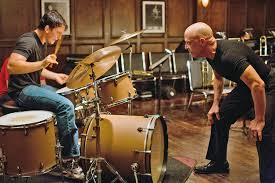
So then Whiplash arrived. It's a recent film about a kid who wants to be a jazz drummer. The best jazz drummer in the world, actually. And he wants it really, really badly. So badly, in fact, that he's prepared to be unpopular and have no friends or girlfriend because 'they get in the way'. But we like him, because he's got a cute face and he's kind of vulnerable, and because he's so, so passionate about his dream.
We put the DVD in the machine and settled back. I was mostly expecting to enjoy the music. The husband wanted to see whether the Best Actor nomination for JK Simmons was warranted. What we didn't count on was being literally on the edge of our seats most of the entire movie. The ten minute mark went by without us even asking the question, "So, what do you think?" Seriously, it was as tense as Taken, as mysterious as Man on a Ledge, as suspenseful as anything Jason Bourne ever did. (Sorry, couldn't think of an action thriller starting with S off the top of my head.)
The story basically goes like this: Andrew, the wanna-be worlds-greatest-drummer can't fulfill his dreams of being picked for big gigs unless he can play with his music school's 'Studio Band', which is run by a musician/teacher (played by JK Simmons) who is both a genius and a tyrant. He runs band practice like boot camp and fires musicians for the smallest things. He's an exacting perfectionist who wants only the best, and he'll throw a chair at a musician to make it happen. Basically, he's a bully.
Running through the film is a story about jazz musician Charlie Parker, who 'only became great' because Joe Jones threw a cymbal at him in a rehearsal. Parker was so humiliated that he practiced crazy madly for an entire year, came back in 12 months and blew the world away with his solo.
The question is: will JK Simmons' tactics bear fruit? Will his attitude towards Andrew actually help him be a better drummer and fulfil his potential, just like Charlie Parker did? Or, alternatively, is he just a bully who will squash whatever talent he sees around him? And can Andrew fight his way through and fulfil his dream?
There were times that my husband couldn't watch this film because the tension was so great. We were both covering our eyes, not wanting to look. And we both said to each other, at least twice, "Man, we didn't see that coming."
The ending was a cliffhanger, right up until the last two minutes. (It was a little bit like what I imagine some 20 overs cricket matches might be like, if the games were close, and if I bothered to watch them. But it was better, of course, because, jazz.)
And seriously, the music in this film was tight. Oh, I love big band music SO much I could burst. I'll admit that I'm not that big on drum solos (and there were quite a few drum solos, as you would expect) but I treated them just like the car chases in a Liam Neeson flick and did a few extra rows of my knitting while they happened. All the other music, though, especially the double bass lick in the last set piece, was astounding and incredible and smooth.
Personally, I think JK Simmons' character was a bully. (And he deserved the Oscar, FYI.) But, at the same time, the character of Andrew probably ended up being a better drummer because of the hardships he had to overcome. Although I'm thinking that in 10 years, he might just have developed a little bit of PTSD, not to mention have a string of very failed and flawed relationships. But that's a subject for another movie entirely.
Also, interestingly, the movie was written and directed by a guy who used to be a jazz drummer. When asked, in the Q&A session in the Special Features, why he went from being a jazz drummer to being a film producer, he said, "Um, because of what happened in the movie." So I guess it was based on a true story.
Whiplash: 4 1/2 stars from me. I loved it.
February 19, 2015
What I have learned from arguing on the internet

I had a bit of an argument on Facebook a couple of weeks ago.
First, I read something someone posted a certain way. Next, I got really upset about it. I fumed and fussed internally for a few hours and then thought, "Right, well, I should say what I really think because, something might happen if I don't."
So then I said what I really thought, and then she said what she thought, and it wasn't the same as me, and my heart got all fluttery and my anxiety levels went through the roof and I GOT ALL UPSET. And argued.
It wasn't even a particularly 'arguey' argument. She was genuinely incredibly gracious to me and gave me plenty of room to express myself and in the end agreed to disagree.
But I didn't really stop at that point.
I went on to write a blog post about my VERY IMPORTANT FEELINGS which was, yes, I have to admit, a touch mean in one place. The gracious lady called me on it privately, and when I got a little bit tough and arguey all over again, she wisely and generously stopped the conversation. (FYI, later I went and edited out the mean bit.)
All of this contributed to me being in an angry and very emotional state for at least 14 hours. You see, I do not do conflict well at all. Come up against me or my opinion or my article and I'll either fold and see your point of view immediately, or I'll start to cry and be totally unable to express myself coherently. It doesn't really matter who the conflict is with either. I'm a total emotional wreck before, during and after.
It's a bit of a stupid way to be as a blogger and writer though. Especially because I publish stuff and put it out there. For actual people to read. The internet is full of people arguing with each other. Even things I'd think are completely self-evident and obvious get push back - and in all sorts of ways, and my skin is pretty darn thin.
What have I learned from arguing on the internet?
This: I'm not very good at it. At all. I'm not very gracious, I'm not terribly articulate, I'm a little bit mean. And I don't recover well.
The question is: should I do something about it? What would I gain if I got 'better' at arguing? What would anyone gain if I got better at it? But what would I lose if I didn't at least try to figure out why I have an unstoppable need to cry the second anyone says anything strong in opposition to me?
How come some people are able to hold their own and push against the pushback while others crumble with opposition? Where does it come from? I'd love to hear your thoughts. (But be nice to me, okay? I might cry.)
February 8, 2015
I can run.

© 2007 Dafydd359, Flickr | CC-BY-ND | via Wylio
There's been a bit of a revolution in my life over the last six weeks. It comes down to this: I am running.
Look, it's a long story. But my motivation is fueled by the thought that I don't want to limit myself, which is something I'm very good at and very practiced at, and have done over lots of years. Old habits are being changed, largely as a result of re-reading Dr Sarno on chronic pain. It's exciting.
But there's another motivation in the fact that I have a really fit 15 year old who keeps inviting me out to run with her. I take that as a compliment. Wouldn't you? (It's that or admit that she just wants to 'fix' me. I choose the compliment.)
The difference between us comes down to this: 20-something years and 20-something kilos. And it's extremely obvious when, after our third time around the oval, I'm puffing like an asthmatic and sweating like a, well, let's be honest, a pig. She, on the other hand, uses our two minute break to practice two-footed jumps up the steps, in training for the Iron Woman competition at our local Small Town Show.
Why haven't I run before? Lots of reasons, but the biggest one is this: Pain. I just don't like the muscle ache and the groaning from the heart and lungs and the misery of thinking, "Gah, if I can only get to the end."
To combat the pain I now have a few techniques. First, I focus on the parts of my body that aren't hurting. At this point, there are essentially only two: my ears and my elbows. So I think about them the whole way around the oval. Ears and elbows, ears and elbows, ears and elbows.
The second technique is to try to imagine how I want to look when I run. Obviously, I don't want someone to look at me and think 'hmm, grunting, shuffling bag of heavy'. I'd prefer to be a lithe, loping gazelle. So I imagine myself all gazelle-like and, what do you know? I run just a little lighter.
The third technique is to tell myself that my brain is taking a run. My body is just coming along for the ride. Basically, brain runs the show. Body can put up or shut up. My brain wants my body to be strong and powerful, and its in charge. (My lungs don't like it, but everyone's happy on day two when that lovely tired muscle ache kicks in.)
"Maybe my aim will be to try to be as fit as you," I said to my daughter tonight, as we walked back from our workout, me red and dripping, her hardly breaking a sweat. I didn't mention that, at this point, it would appear that achieving that goal is about as likely to happen as me swimming to New Zealand.
She raised her eyebrows. "Good idea."
I got cheeky. "What would happen if I ever caught up to you?" I said.
"You wouldn't," she said.
"I might," I said, a little miffed. New Zealand isn't that far away.
"No, I mean, if you did, I would run faster," she said. "I would run myself to the point of death than let you win."
Clearly, she inherited her competitiveness from her father. She also obviously has something to prove.
"Don't worry, " I said. "It's unbelievably unlikely that your death is imminent."
The fact is, I'm still celebrating the fact that I've got sports shoes. Not only that, I'm actually putting them on my feet and using them. I can run.
January 26, 2015
A free gift for my readers
Because you read along here and because I just know everyone is like me and sometimes worries about friendships and getting along with people, here's a gift for you from me.
It's a free PDF copy of my little book about Friendship.
Imaginatively titled 'Friendship', this book is the sum of my knowledge and experiences in the fraught area of getting on with people. How to understand them, how to understand yourself with them and how to avoid some of the common pitfalls when it comes to relationships with friends. Also, how God and the Christian faith plays into how you relate to people.
If you like it, you can share it with your teenage daughters or friends (because heaven knows the poor little pets need all the help they can get.) Or you can invite me to come speak at your group or school or whatever about the topic.
Happy reading. And even happier friendships!