Alexander Jablokov's Blog
November 24, 2025
On The Inappropriate Disposal of Coffee
I was recently struck by a story in The Guardian, about a woman in west London, Burcu Yesilyurt, who was initially fined £150 for pouring out what was left in her takeout coffee cup before getting on the bus, presumably to get to work.
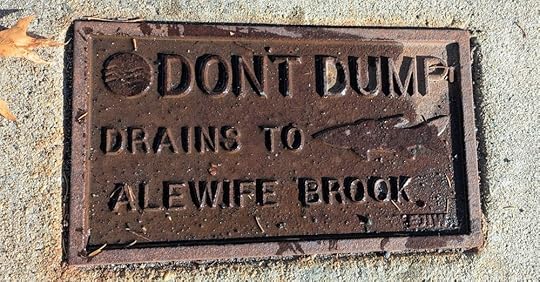
Doing so violates section 33 of the Environmental Protection Act 1990, which is mostly about disposal on land, but does have the covering statement “a person shall not…treat, treat, keep or dispose of controlled waste (or extractive waste) in a manner likely to cause pollution of the environment or harm to human health.” The bolded phrase is what was cited as justification for the fine.
They told her she should have poured the coffee into a disposal bin. I generally dislike doing this because it leaves a giant, sloshy mess, and in places where actual humans have to pull out the bags and haul them somewhere, it makes their job even less pleasant than it already is.
How absurd is a fine for pouring out coffee, anyway?So, I initially thought the whole thing was ridiculous. But a bit of looking around (with the help of ChatGPT 5.1) indicates that coffee, and particularly its caffeine, is an actual hazardous substance, particularly when poured into storm drains that pour unprocessed into rivers, lakes, or the sea. Even if it is poured down the sink, most waste processing doesn’t get rid of caffeine.
The volumetrics of unused coffee disposal is a shockingly understudied topic, but clearly, everyone drinks a lot of coffee, and buys even more than they drink, so there is always a lot of coffee going down the drain. Though I suspect much of that volume is from places that brew coffee and have to get rid of old coffee, because if they tried to sell it, they’d quickly have no business.
Fresh hot coffee at any time is one of the wonders of modern civilization. But, like most of the rest of our luxuries-turned-necessities, it comes with environmental externalities.
The environmental impact of staying awake in SwedenRosa Hellman, of the Swedish University of Agricultural Sciences, wrote a Master’s thesis (PDF) on liquid coffee waste in food-service settings. She estimated that Swedish restaurants and cafés discard something like 17,000 to 25,000 tonnes (that’s metric tons, 10 percent bigger than US tons) a year.
Hellman also cites a food diary study by the Swedish Environmental Protection Agency, which found that in 2020, households disposed of 190,000 tonnes of food and beverages through sewage, and 45 percent of that was coffee or tea. That works out to around 8 liters per person per year of coffee and tea, not separated in the study.
The restaurant and the food diary numbers are about two quite different things, so they can’t be combined to give a good estimate of how much coffee is getting into the water.
What’s the appropriate fine for inappropriate coffee disposal?Ms. Yesilyurt felt that £150 was a bit steep, and I’d have to agree. The fines in the now-notorious section 33 seem aimed at businesses and other larger operations, not individuals getting rid of whatever is left in their takeout (well, this is London, so “takeaway”) cups. £150 is the minimum amount stated.
Interestingly, the Guardian article didn’t bother to tell us how often anyone in the UK gets fined for inappropriately disposing of coffee. I can’t find any source of information. Was Ms. Yesilyurt the first person in the UK ever hit with this fine? After she made an issue of it, they rescinded the fine, which seems to be the way these things always work.
The article does add a bit of back and forth over whether the cops were too aggressive, but that seems mostly because anyone confronted by three police officers and given a significant fine after doing what Ms. Yesilyurt did would be startled and nervous. Though this does stimulate the usual harrumphish but not inappropriate question: “Isn’t there some actual crime you people should be preventing or solving?”
What made them decide to do this? Ms. Yesilyurt seems a demure sort, not dangerous or likely to be aggressive, so maybe she was just an easy target at that time of day.
Who should bear the cost of preventing environmental damage?Every action has an environmental consequence, but when is it worth tying that consequence to the small daily actions of individuals? A fine commensurate with the actual impact would be too small to be worth levying. And if cafés then have to bear the burden of undrunk coffee somehow, that makes it marginally less appealing to run such a business, and we like to have our cafés on every corner. Who is the lowest cost avoider here?
How well would you, bleary-eyed and about to get on a bus to get to work, have reacted in this situation?


July 21, 2024
A sphexish jabroni with sanpaku eyes: your vocabulary words for the day
I've been reading most of my life, and like to think that I have a decent vocabulary, but always get kind of a charge when I come across an unfamiliar word, particularly an odd or useful one. Recently I've come across three that were new to me, all of them, as it happens, in comments to blogs and Substacks that I read.
SanpakuThis universally comes in the form "sanpaku eyes", which is how I saw it, in a comment to a photograph on Shorpy, a site that restores and enhances old photographs of the United States, a daily visit for me. In this case, the photograph was Dandy Duffers: 1900, and the comment referred to someone sitting on a fence rail as having sanpaku eyes.
This is the character in question:

Labeled with a term he could never have known
Sanpaku is a Japanese term and means "three whites", where the white of the eye, or sclera, is more visible than average, either above or below the iris. In medicalese that's called "scleral show". The pop culture figure easiest to see it in is Billie Eilish:

The celebrity most often used to illustrate sanpaku eyes
This is just a cosmetic feature, but there is no random feature that someone doesn't turn into a way to rank and judge people. Japanese face reading has all sorts of ways of telling you your fate from sanpaku eyes, though, like most such superstitions, it's inconsistent, so you can pick the fate you want.
I'm unlikely to use this term, even to describe a character's appearance, because I'd have to explain it, and that takes all the fun out of it. Unless they are then sclera-shamed by some other character, in which case it becomes yet another skirmish in the battle against ridiculous and sometimes harmful folk beliefs.
SphexishI found this is a comment to the Astral Codex Ten post Highlights From The Comments On Mentally Ill Homeless People, which is itself a follow-on to the post Details That You Should Include In Your Article On How We Should Do Something About Mentally Ill Homeless People.
Both, incidentally, are well worth reading, particularly if you are interested in urban issues. They are about demanding specific policy proposals for specific problems, in this case homelessness, specifically in San Francisco. What are you actually going to do? He is particularly amusing on what, exactly, getting "tough" actually means. And many of Alexander's commenters respond to his demands with actual specifics, not that common in a world where vibes are only product politically active people seem to either want to generate or consume.
Commenter CSW, a former public defender, about commitment hearings for mentally ill homeless people, discussed the amount of time it takes to deal with someone in that condition:
It was not uncommon to have hours worth of conversations with clients who had fixed delusionary beliefs, sphexishly returning to non sequiturs, and/or severe problems with logic and memory.
"Sphexish", what a delightful word. It refers to the repetitive actions of digger wasps (genus Sphex), and apparently came into usage via cognitive scientists Daniel Dennnett and Douglas Hofstadter. Though apparently the initial story underrates actual digger wasp behavior (there is no satisfying illustrative anecdote that is absolutely true as stated), the word has come to be used for repetitive behavior that shows a lack of self-reflection, and thus a certain lack of consciousness.
JabroniThis is more slang than a word that delineates a previously vague concept. It seems to have been associated with Dwayne Johnson, The Rock, and just an insult to refer to a dumb person you feel contemptuous of. Probably more detail than you need. Though it comes from pro wrestling, and refers to some kind of apprentice wrestler whose job it was to lose to the talent, it doesn't seem to have much specificity to its meaning. It just has a nice jerky lilt to it.
I found it in a comment to this thoughtful analysis of the disaster of NYC congestion pricing: The Death of NYC Congestion Pricing, by Joey Politano, on his blog Apricitas Economics, which is generally interesting, though I read it mostly for housing and transportation issues.
The comment, by Edward Williams, was about problems facing the LA Metro, which Williams feels is actually pretty good. One of the problems he sees is:
public safety on trains and buses - every time a bus driver or passenger is assaulted, the LA times trots out the same nonprofit jabronis that say that the solution is free fares or jobs or whatever.
Politano liked the comment, and I do too. Safety on public transportation is key to wider use by a wider range of people, many poor and needing to get to work, childcare, and the grocery store, and those who oppose the effective enforcement of public safety laws are the common enemies of all transportation users, their motivations more about their own egos than about anything that actually benefits anyone. And free fares, in an attempt to solve an almost nonexistent problem without actually doing anything, cause a range of other real problems.
But "jabroni", pleasing though it is, will never been in my own insult dialect. I'll always worry I'm using it with a slight but distinct accent, as in "You are a sphexish jabroni with sanpaku eyes".
January 17, 2024
San Francisco and Boston: a tale of two trolleybuses
A couple of weeks ago, Miss E had a business trip to San Francisco, so I came along the weekend before. Her Airbnb was in the western part of town, an area called The Richmond (note: not Richmond, which is somewhere completely different). It’s a nice area, pretty quiet, mostly two and three-story residential, most with a garage taking up the first floor.
Pi.1415926535, CC BY-SA 3.0 , via Wikimedia Commons
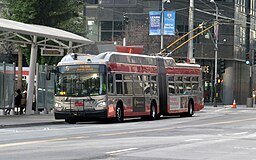
The old part of town is way east, so we took a bus to tour around down there. Actually it was a trolleybus, an electric bus powered by dual overhead wires. I gather that trolleybuses are favored in San Francisco over diesel because of their better ability to climb hills.
The trolleybus was comfortable, but stopped pretty much every block. Short distances between stops seems to be a common problem with municipal bus systems. I presume it’s because locals all demand that the stops be close to their house, and claim hardship if they are farther way. But that’s just a guess. All I know is that the quiet, quickly accelerating bus could never get up to speed because it was stopping again almost immediately. This made the trip way longer than it need to be.
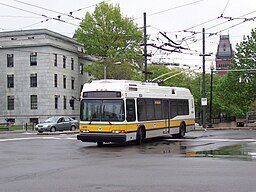
The ride did make me miss trolleybuses, or trackless trolleys, as they were once known in the Boston area. Even when I moved here in the 80s, most people just called them electric buses. A year ago, all the ones in my area (Cambridge, Watertown, Belmont ) were eliminated.
Adam E. Moreira, CC BY-SA 3.0 , via Wikimedia Commons
The MBTA gave a lot of reasons why they had to go, and the reasons were familiar: the system was old and hard to maintain, and very few cities use them anymore. Some road work meant it would be expensive to replace the overhead wires, so why not just take them down since new battery-powered buses would be here soon? Using diesel buses would be a stopgap just until the new buses show up in 2024. Well, given the MBTA’s record of project rollout, we’ll have to see how long this stopgap is.
I got the impression the electric buses just seemed a bit dowdy. And I get the San Francisco keeps its system because of its hills. They are even converting diesel lines to trolleybuses.
I think battery-powered buses will have their problems, including the complex charging infrastructure, unanticipated maintenance problems (these are always unanticipated), and the disposal issues. People need to take a harder look at a working system before they decide it should be replaced by something sexier.
Like everyone else with an interest in public transportation, improving urban life, and mitigating climate change, I want the MBTA to make good decisions. I’m just not sure this was one of them.
August 11, 2023
Trying to understand Your Own Internal Server Errors
Don't you love informative, helpful error messages? We all do, of course, but given the number of things that can go wrong, we don't always get them.

That was the message I was getting from the Zoho CRM I use for my actual business, marketing writing for healthcare and technology companies. I had to authenticate my email, otherwise they would send my email using their domain, rather my natty sturdywords.com domain. Bad for branding! I'd made all the necessary additions to my DNS record, but no dice, nothing was happening.
Eventually I sent a note to the helpdesk, and someone got back to me within a couple of hours. It turned out someone had blocked something on my account (that's as much as I cared to puzzle out). Now, to be clear, I don't pay for Zoho CRM, except a small fee to occasionally back up all my contacts. I'm a solo practitioner, and they seem to have some sort of soft spot for people like me. So consider this a recommendation of their customer support, which quickly solved my problem even though I must be a net loss to them.
But while I was annoyed at the uselessness of the message, I had to acknowledge that my own messages to myself are not any better. Why am I in a bad mood? Am I hungry? Tired? Anxious? Is this chair uncomfortable? Did I sleep poorly? If I did sleep poorly, why?
There's no dashboard I can look at that shows me blood sugar, organ status, electrolytes...anything, really.
When I was younger I had great faith the power of introspection. I was sure I had privileged access to my internal workings. Who, after all, could have a better one?
But now I know that only a few rooms in the house of my mind are actually accessible to me. Some, maybe, I could get into if I really tried, but fear what I may find there—or worse, that the room is really completely empty.
Other people, people who know me, have access to parts of my personality that can't make myself conscious of, any more than I can see the back of my own head without using a mirror. People who know you can see where you have gone mentally off track. Of course, these people have their own issues, their own interests, and their own flawed perception. And they don't necessarily have your best interests at heart. Sometimes the people who oppose us are those who understand something about us that no one else really does. Some people have a gift for detecting and exploiting weakness. Their self-motivated words and actions might well reveal weaknesses you never knew about.
It takes a village to see yourself. It will a lot of work to correctly interpret the error messages you're getting, but if you integrate your internal blinking lights with external messages, you might have a chance of understanding something about yourself.
March 15, 2023
Problems of Central Asian geography
My college library (Doheny Library, at USC) had old dark stacks that clearly dated from the era when you had to request a book and have it provided by a librarian. Actually, the same was true of my graduate school main library and here in Cambridge until they rebuilt what is somewhat oxymoronically called the Main Branch.
It was full of what can only be called tomes, and I remember seeing several evocative and challenging titles. One was Prosopography of the Later Roman Empire. Another was The Empire of the Steppes: A History of Central Asia, by René Grousset, with a severe black cover.
I did not essay either of these books at the time. I’ve been meaning to dive more deeply into geographies and eras of world history that I had little knowledge of. Earlier this year Razib Khan, a big reader of history as well as science, presented several reading lists, and I decided to start reading my way through the first one, on history.

The Eurasian steppe belt is in teal, with mostly forest to the north, deserts and mountains to the south
These are damned, thick, square books, and each takes a few weeks to read. So now I have read The Empire of the Steppes! It’s an old book (first published in French in 1939, translated into English in 1970), and extremely dense, covering steppe empires from the Scythians to the last remnants of the Mongols in the 18th century.
There are many tribes, many rulers, many betrayals, many overthrows. But it is also rewarding, because it really gives you a sense of the sweep of both geography and time. It is a vast overview of events between the southern Ukrainian steppe and Manchuria.
I can’t keep Central Asian geography in my head. Grousset provides useful schematic endpaper maps showing the different steppe regions as well as forested and mountainous areas, and a number of line maps for various empires and historic events. The dust jacket is taped down over the endpapers. Fortunately, front and back have the same map (perhaps anticipating this), so I could put the whole thing together by flipping back and forth.
The specific more-detailed line maps were extremely helpful for the events being covered in that section, but I still had a lot of trouble relating the schematic to the topography and landscape. I’ll keep working on it, though. It’s clear that the history we know well, essentially that of peripheral sedentary states, was strongly influenced by and often dependent on events in the center of the continent.
Oh, and I have still never read Prosopography of the Later Roman Empire. Roman prosopography studies social networks and groups to get at an understanding of social life where individual biographies are scarce or nonexistent. I see that the volume I would see has been joined by several more over the past few decades, so I am falling farther and farther behind.
February 26, 2023
Getting to transit
I live in a small city (Cambridge, MA) right next to a medium-sized one (Boston). Cities that are fun to live in and cities that are easy to drive in are pretty much mutually exclusive categories. Since Cambridge is fun, it is a nightmare to drive through. So I don’t. I don’t even own a car.
I would like it if fewer people drove here, and more people lived here. It would be a healthier, quieter, and safer place, with even more things to do, and more people to run into while doing them.
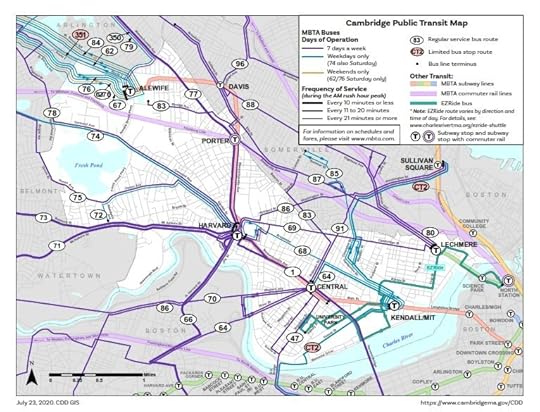
I live up near the circled T called Alewife, in the upper left of this map
One thing essential to moving in that direction is a fast, safe, and convenient public transportation system. That, unfortunately, is not something Boston’s public transportation system, the Massachusetts Bay Transportation Authority (MBTA), seems able, or, it seems, even willing, to provide. So most people really have to drive to get where they want to go, even if that is expensive, inconvenient, and frustrating.
While the MBTA seems to have been getting steadily worse over the past decade or so, this has stimulated a lot of attention. Trains are delayed, buses skipped, and conditions often unpleasant. The Boston Globe’s reporting on public transportation issues has been great. This has partly been stimulated by organizations like Transit Matters, which has been providing a lot of data on how the system has been operating, and thus compelling the MBTA to open up its opaque system.
This is a moment for me. I have realized that I, an educated citizen of mature years, have no idea of how to figure out what the problems are, how to decide what to do about them, and how to act in a way that helps provide solutions. Local politics are really the only way any of us has a chance to influence anything.
I’ve joined Transit Matters, as well as a local housing advocacy organization, A Better Cambridge. But it is still difficult for me to make a meaningful effort in making the city I live in an even better place. I’m going to try to discuss this, and the issues I have been dealing with, because I’m sure I’m not alone in my mix of ambition and flailing.
August 28, 2020
Writing With Intent: Muriel Spark on Sex and Prose Style
I'm still on my Muriel Spark kick. And, by the way, I did reread The Girls of Slender Means again. Once you start, you really can't stop.

I’m not sure if the schoolteacherish demeanor is deliberate, or just impatient
Now I'm in the middle of Loitering With Intent. Entertaining, of course, but not as easy a read as some of the others. It's about a writer, Fleur Talbot, who finds that aspects of reality begin the mimic events in a novel she has written. And Fleur gets accused of libeling people despite the fact that she wrote her novel before she met those people, or they did the things she wrote about.
It's inspired by the same period in Spark's life as A Far Cry From Kensington, though is more distant from the actual publishing milieu. It does have more sex, which plays a role in the quotation below. Fleur is talking to a frenemy, Dottie, whose husband Leslie Fleur has slept with. Despite their contentious relationship, which involves stolen manuscripts, among other misbehavior, Dottie and Fleur seem entangled for life. But I haven't finished the book yet.
Dottie and Fleur are talking on the phone. Dottie has just said that Fleur's book, Warrender Chase is "a thoroughly sick novel" (and, thus, we are reading a sick novel). In return, Fleur attacks Leslie's own literary work:
I could hear Dottie crying. I meant to tell her more about Leslie's prose, its frightful tautology. He never reached the point until it was undetectably lost in a web of multisyllabic words and images trowelled on like cement.
She said, "You didn't say this when you were sleeping with him."
"I didn't sleep with him for his prose style."
Muriel Spark herself has an economical way of telling a story, a manner I now aspire to, since all too often I am more Leslie than Fleur.
August 18, 2020
Muriel Spark on getting a cat to aid in concentration

Cigarette, nibbled pencil, stacked books: the signifiers of authorship used to be so much easier….
I finished reading A Far Cry from Kensington, by Muriel Spark. At a point in the middle of the book, Mrs. Hawkins is invited to a fancy dinner party, and finds herself seated next to "a red-face retired Brigadier General" (rather a stock character, which Sparks is totally aware of):
...I said something to the effect that he must have had an interesting life.
"I could write a book," he said.
"Why don't you?"
"Can't concentrate."
"For concentration," I said, "you need a cat. Do you happen to have a cat?"
"Cat? No. No cats. Two dogs. Quite enough."
(I have trouble explaining why I found that sequence of one and two-word sentences so funny, but I read it over and over out loud).
She then explains to him, at some length, how a cat aids in concentration, and at the end of it he says "Good. Right. I'll go out and get a cat."
Then she give us this coda:
(I must tell you here that three years later the Brigadier sent me a copy of his war memoirs, published by Mackintosh & Tooley [the publisher where Mrs. Hawkins works, though not for long, since her bête noire, the pisseur de copie, met in the previous post, will soon put in an appearance]. On the jacket cover was a picture of himself at his desk with a large alley-cat sitting inscrutably beside the lamp. He had inscribed it "To Mrs Hawkins, without whose friendly advice these memoirs would never have been written—and thanks for introducing me to Grumpy." The book itself was exceedingly dull. But I had advised him only that a cat helps concentration, not that the cat writes the book for you.)
An absolutely fantastic book, with a light surface and some darker undertones (typical of Spark), well structured, does not outwear its welcome.
August 12, 2020
Don't get on the bad side of a Muriel Spark character
I like to say that I like the writing of Muriel Spark, but then, if only to myself, have to admit that this is based solely on The Prime of Miss Jean Brodie, her most famous work, the movie version of which impressed me, at 13, with its sophistication...and, by extension my own, and on The Girls of Slender Means, which I love, and have read a couple times.

Muriel Spark in Rome, c1969
So, feeling somewhat at loose fictional ends, I got from the library one of those Book of the Month Club omnibus volumes where several separate books, complete with their own margins, fonts, and pagination, are squished together between hard covers, as through some mysterious geologic process. This one has, in addition to TGSM, which I plan to read for a third time, Memento Mori and the book I checked the volume out for, A Far Cry From Kensington.
It is told in a slippery time structure similar to the other two I have read, with the narrator (in this case, Nancy Hawkins, describing her life in 1954, when she worked at a dying publishing house) free to hint at what is to come, contrasting how she felt about something when it happened to how she feels about it as she is writing, and unexpectedly telling you a character's fate, or alternately, revealing something about her own past.
She has just met a character who will clearly be significant in her life (although I, the naive reader, have no idea why yet):
At this point the man whom I came to call the pisseur de copie enters my story. I forget which of the French symbolist writers of the late nineteenth century denounced a hack writer as a urinator of journalistic copy in the phrase 'pisseur de copie', but the description remained in my mind, and I attached it to a great many of the writers who hung around or wanted to meet Martin York [her boss, failing and now seemingly committing serious fraud]; and finally I attached it for life to one man alone, Hector Bartlett.
Then, somewhat further on:
Pisseur de copie! Hector Bartlett, it seemed to me, vomited literary matter, he urinated and sweated, he excreted it.
'Mrs Hawkins, I take incalculable pains with my prose style.'
He did indeed. The pains showed. His writings writhed and ached with twists and turns and tergiversations, inept words, fanciful repetitions, far-fetched verbosity and long, Latin-based words.
If you are a writer, you might sometimes wonder what the employees at your publisher really think of your work. Perhaps better not to inquire.
August 4, 2020
Balancing a cabinet on the edge of disaster: France 1940

I recently read Strange Victory: Hitler's Conquest of France, by Ernest R. May, about the Fall of France in 1940. May has written a number of books about executive decision making in foreign policy and intelligence assessment. Strange Victory is very much about that. May gives you an excellent view of the constraints facing the various participants, the constraints they thought they faced and maybe didn't, and how events can seem to go with glacial slowness, only to suddenly accelerate without warning.
On September 1, 1939 France and Britain, having promised to do so without anticipating that they would really have to follow through (the point was to dissuade Hitler from going ahead, they didn't really expect to have to do it), declared war on Germany in response to its invasion of Poland.
But then they didn't really do very much. There is some reason for this, there were a number of difficulties, but they both futzed around from then until May 10, 1940, blaming each other for things, when Hitler decided put an end to their prevarication.
So it's interesting to contemplate some of the problems facing Edouard Daladier, France's prime minister, after the declaration of war:
The autumn of 1939 had been frustrating for Daladier. He had tried to form a national government, hoping that in wartime he would not have to continue formulating every act or decree like a pharmacist preparing a complicated prescription. With the goal of at least having his own Radical Socialist Party [despite the name, a centrist party] united behind him, he asked Herriot, his old mentor and rival, to replace Bonnet as foreign minister. But Herriot said he would serve only if the cabinet also included Marshal Pétain, and Pétain refused to serve with Herriot on the ground that Herriot's appointment as foreign minister would alienate Mussolini and Franco. Socialist leaders also refused to serve either with one another or without one another. Paul Faure, himself ineligible because a pacifist and unregenerately munichois [as appeasers were known after the Munich agreement of 1938], swore to oppose a cabinet that contained Léon Blum or any socialist on Blum's side. He reportedly said that, if Blume entered the government, "then all Israel with him! That would be war without end!" [no surprise, Faure ended up serving Vichy, Blum in Buchenwald]. Faure and Blum alike threatened to vote against a cabinet that included anyone from the right; Flandin and others linked to employers' groups vetoed inclusion of even a moderate trade-union leader.
Soon after, Daladier yielded the premiership to Paul Reynaud—but Reynaud had to retain almost all of Daladier's cabinet, including Daladier as both minister of defense and minister of war. That's cabinet politics in the twilight of the Third Republic.
The closer you look at history, the less clear its lessons seem to be, and the more complex and tangled the lines of causation. May sees France's (and Britain's) failure as largely down to poor acquisition and management of intelligence. I'll try to take a look at that in a bit.