Hayim Herring's Blog
July 28, 2023
Charisma, No, Passion, Yes
The post Charisma, No, Passion, Yes appeared first on Hayim Herring - Rabbi, Entrepreneur, Consultant.


October 11, 2022
In Memory of my Father, Jack Herring, Yaakov ben Meir v’Esther
My father, Jack Herring, of blessed memory, died last Wednesday, October 5, on Yom Kippur. My sisters told me that he drew his last breath during the unetaneh tokef, a dramatic prayer that imagines God reviewing each individual’s life and deeds and determining if he or she will live another year and experience rest and calm or wander and be tormented. He struggled greatly with COVID for over two weeks. At age 93, after almost 70 years of marriage to my mother, Bobbi, he had made peace with dying and did not want to suffer anymore from a state of vastly diminished health, worsened by COVID. I wrote this poem in the present tense on Friday, September 30. To honor his memory, I’m sharing the revised version, now written in the past tense. I love you, Dad, and miss you but I thank God that you are at rest.
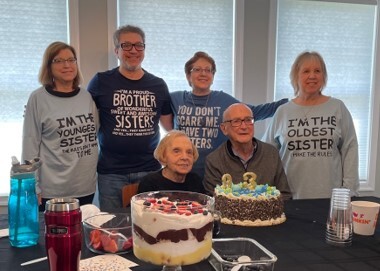
Dad and Mom at Dad’s last birthday party with children Andie, Marci, Hayim & Amy (from right to left)
Dad
I was so used to calling,
Six or seven times each week.
To hear my father’s soothing words,
His voice so gentle and sweet.
To be my age (I’m 64),
I thanked God for you each day.
You knew that life must wind down,
So you taught us to find our way.
Your laughter, patience, and quiet strength,
We felt your caring ways.
God rewarded you (and us)
with life and “length of days.”
You made us laugh, with torrential jokes,
You modeled (peace) shalom bayit.
Through your words and every deed,
you inspired us to apply it.
At sixty-five, double work complete,
we worried you had no hobbies.
Yet once again you fooled us saying,
“All that I need is Bobbi.”
Zayde, Dad, Yankel, Uncle Jack,
a gem with many names.
We love you Dad, want you to know,
Within us you’ve earned eternal fame.
© Rabbi Hayim Herring 2022
The post In Memory of my Father, Jack Herring, Yaakov ben Meir v’Esther appeared first on Hayim Herring - Rabbi, Entrepreneur, Consultant.
September 25, 2022
When the Community Separates from Us: Connecting with People Who Live with Chronic Illness
I’ve been reluctant to write so personally, but over the past five years, I have become a member of an invisible community. Most people expect this illness narrative: “he was well, he became sick, he received treatment, and he recovered.” People who live with chronic illnesses deviate from that narrative. We never recover. We just hope that we can manage our symptoms and have more better days. The “never recover” frightens people, and many colleagues and friends disappear from our lives. We become invisible to much of the community of which we were apart. We haven’t intentionally “separated from the community” (Pirkei Avot 2:4), but at times it feels like the community has parted ways with us.
I began writing poetry to give voice to my feelings and to those who live with chronic illnesses. Because you may not see us at tefilot, you can’t ask what daily living looks like for us. We feel the sting of invisibility more acutely on Shabbat and Jewish holidays. So please – take your fresh experience of isolation and invisibility from COVID, look at the empty seats that were occupied by acquaintances and friends who can’t be there because of chronic illness (or who are there but would love some more ongoing contact with you) and call them. Those calls and visits add joy to our lives, and we will also add joy to yours.
לשנה טובה תכתבו ותחתמו לאלתר לחיים
Some Varieties of Pain
Pain has darkened my reality,
And warped my personality.
It lives too well inside of me,
and is stuck in my vicinity.
It wears me down,
it twists my gut.
They say, “double your infusion
and some pain might ease up.”
Neuropathy makes my skin crawl,
So many times, I have paced the walls.
Oh, this inside-out itch from neuropathy,
why won’t it show me some apathy?
My eyes burn red from inflammation,
and a detached retina is in gestation.
My mouth so parched, unlike any dryness.
It’s hard to speak, I experience shyness.
My unsteady ankles are insecure,
I walk with a cane, feet unsure.
Bone-on-bone, the last option is fusion,
An operation gone wrong, more pain and confusion.
The post When the Community Separates from Us: Connecting with People Who Live with Chronic Illness appeared first on Hayim Herring - Rabbi, Entrepreneur, Consultant.
September 20, 2022
In Transit with Sundae Bean

The post In Transit with Sundae Bean appeared first on Hayim Herring - Rabbi, Entrepreneur, Consultant.
June 27, 2022
The January 6 Coup
I am a proud American and Jew. As I watched the attempted January 6th Coup happening on the news, I thought of the fires of hate that burned throughout Europe in the 1920s. This hatred was a harbinger for what was to come: the Fascist march on Rome, the Nazi march on Nuremberg, and the murderous veil of darkness that nearly devoured the world.
Now, the embers of hate across the United States threaten to catch fire and burn the fabric of our American democracy. White Nationalists marched on the U.S. capitol echoing voices of the Old South and carrying the flag of the Jim Crow laws and Confederacy. Voices demanding that African Americans and Jewish Americans return to segregation. Swimming pools refusing ‘Jews and Blacks’, lynching of African Americans, extra-judicial killing of American-Jews, the Tulsa Race Massacre…
Hatred is growing across these great United States, fanned by our self-declared enemies, including the Iranian dictatorship, the Russian autocracy, and the North Korea supremacy. We must renew the American spirt, “for out of the many, one,” and stand resolute for our democracy. This burning animosity is un-American and drives our fellow Americans to hate each other.
We must regain the way of these great United States of America, of what the American flag truly means – democracy, dignity, and freedom. We must reject the evil that threatens to take our democracy, to turn Americans against each other and leave us as impoverished citizens. All faith traditions command us to unite in God’s love and make our democracy thrive for all again.
The post The January 6 Coup appeared first on Hayim Herring - Rabbi, Entrepreneur, Consultant.
February 3, 2021
A Groundhog’s Lament
I don’t know the time,
or recall the day.
When the music stopped,
And the notes flew away.
When the clouds gathered,
and the storm drew near.
When distant warnings,
Were suddenly here.
Life was large,
but then grew small.
We shut the doors,
We climbed the walls.
Existence was dull,
Groundhogs grew bored.
COVID killed,
What we adored.
The post A Groundhog’s Lament appeared first on Hayim Herring - Rabbi, Entrepreneur, Consultant.
October 22, 2020
Faith in the Future: Leaning in on Avraham Aveinu
Leave – leave everything behind that you’ve been familiar with your entire life: your family, neighbors, language, and land.
וַיֹּ֤אמֶר יְהוָה֙ אֶל־אַבְרָ֔ם לֶךְ־לְךָ֛ מֵאַרְצְךָ֥ וּמִמּֽוֹלַדְתְּךָ֖ וּמִבֵּ֣ית אָבִ֑יךָ אֶל־הָאָ֖רֶץ אֲשֶׁ֥ר אַרְאֶֽךָּ׃
With God’s command to Avraham, lekh lekha, the Jewish people’s story and its connection to a specific land begins. The text gives no introduction about why God commands this person to begin that journey. What is it about Avraham that qualifies him to be the vehicle to revolutionize the world with his belief in one God?
We can reconstruct why God chose Moshe to lead the Jewish people out of Egypt. A younger Moshe frequently exhibits a willingness to act on his keen moral outrage. He takes justice into his own hands when he sees an Egyptian beating an Israelite slave. For this act of insurrection against Pharaoh, Moshe must flee to Midian. When he arrived, he rescued some young women (one of them is future wife, Tzipporah) from lawless shepherds who were likely trying to steal their water. His compassion for Yitro’s flocks foreshadows the compassion that he will have for the flock of people that he will lead from Egypt to the promised land. Over time, we watch as Moshe’s small acts of justice morph into righteous audacity.
The evidence for Avraham is murkier. His willingness to undertake a risky journey with only two other family members, Sarah, his wife, and Lot, his nephew, is admirable. But when he obeys God’s command to sacrifice his son, Isaac, do we acclaim or assail his action? He wages war to redeem his nephew, Lot, from captivity but pleads with Sarah to pose as his sister when encountering local leaders. Her consent makes Avraham less vulnerable to attack but leaves her unprotected. In contrast to Moshe, it takes more detective work to infer why Avraham’s biography was well suited to the task. But – we’re given one enticing clue in our parasha.
In lekh lekha, Avraham laments to God that he has no biological heir and that his lead servant will be the heir by default. But God reassures him and says, “That one shall not be your heir…Look toward heaven and count the stars if you can count them.” And God added, “So shall your offspring be.” And now for the clue: “And Avraham believed in God, and God accounted it to him as righteousness (Genesis 15:6).”
וְהֶאֱמִ֖ן בַּֽיהוָ֑ה וַיַּחְשְׁבֶ֥הָ לּ֖וֹ צְדָקָֽה׃
The first time in the Tanakh that the root word for faith, אמן, appears is in this verse. Avraham introduced the world to the concept of having faith in a future that he would never live to see. That was his greatness, having a depth of faith that his biological line would flourish despite how precarious his line’s continuity was now.
We’re not expected to be another Avraham or Sarah – that isn’t realistic. But we can lean into that kind of faith to sustain us as we get ready for a very long winter. Leaning in means that if we find our faith gauge a little low, we can refill it by reflecting on the lives of our Avot and Emahot and other figures in Jewish history who probably wondered how they would endure their trials. Leaning in means that we’re willing to enter into the conversation with God that our ancestors started and to stay in that conversation when confronting demanding realities that we don’t understand. Leaning in means staying as connected as we can to the people who matter the most to us.
We are in an existential lekh lekha moment. We’re not going to leave everything behind when it’s safe to re-enter into a landscape that will be different. But now is the time to assess what is essential for us to take into the future and what we would do better off leaving behind when we re-enter the world. By doing so, our choices will be more intentionally significant.
The post Faith in the Future: Leaning in on Avraham Aveinu appeared first on Hayim Herring.
September 11, 2020
A Spiritual Vaccine for 5781: Act, Engage, Trust, Hope
A pandemic that has wrecked untold suffering and rapid, unprecedented loss of life, broken political systems, suspicion of the other, social isolation, and despair: that summarizes the mood of many since March. We’ve had to shut ourselves in and shut our loved ones out for fear of infection. A Zoom seder was a novelty, but the thought of Rosh ha-Shanah online makes us nostalgic for lengthy tefilot. Even if we’re able to daven at socially safe services, the sight of a Shofar covered with a KN95 mask will be unsettling. How can we maintain our faith until researchers develop a safe, effective vaccine? Here are four practices rooted in Rabbinic texts that I’ve adopted in preparation for the yamim noraim and the days that follow:
Act: Speak Little and Do Much/ אֱמֹר מְעַט וַעֲשֵׂה הַרְבֵּה (Pirkei Avot 1:15)
Very few statues have been dedicated to critics; it’s the creators, those who act and lead the way to change, who are honored. The warning, “If you see something, say something applies to public safety situations. But we’ve generalized this advice and often reflexively post our annoyance with a person or issue without thought to the aftermath. To build immunity against making gratuitous comments, I will criticize a bothersome situation only when I can work to remedy it, alone or working with others.
Engage: Don’t Separate Yourself from the Community/ הִלֵּל אוֹמֵר, אַל תִּפְרֹשׁ מִן הַצִּבּוּר
(Pirkei Avot 2:4)
I’ve used creative license to incorporate this value into my life as it’s a challenge for someone with autoimmune or certain other medical conditions, and those whose age puts them at greater risks for COVID-19 complications. My social bubble is small, but I’m engaging with the community as a Biden-Harris “call-crew” volunteer. Last year, I thought that I would be knocking on doors in my neighboring swing state, Wisconsin. Instead, the campaign’s sophisticated system is my key to voters’ homes. I’m one of a motivated multitude of callers who don’t want to be bystanders to the 2020 election results. This campaign’s outcome will be consequential for America, the American Jewish community, and the State of Israel. By engaging in some political action, I feel like I’m inoculating myself against political apathy.
Trust: Judge all people favorably/ דָן אֶת כָּל הָאָדָם לְכַף זְכוּת (Pirkei Avot 1:6)
The ancient sages who spoke these words must have been peering 2,000 years into our contemporary culture. Does it feel like people increasingly give others the “detriment of the doubt” and don’t extend the “benefit of the doubt” to them? You might believe so if you remember when disagreements were fruitful and when leaders viewed a compromise as noble. You can’t compromise with people who are anti-Semitic and racist or support hostile views on gender and sexual orientation. We should challenge statements that diminish the innate Divine worth of another person. But learning how to have a respectful disagreement on a significant issue is a skill that we need to reacquire. Divergent viewpoints help clarify our thinking. We may learn that “the other side” has some ideas that are not so crazy, and the other side may realize that we’re also not insane. We may find areas of agreement that are the basis for joint action. To build my immunity against being narrow-minded, I’m doubling down on my commitment to trust that I can learn more about others whose ideas differ from mine, provided that they do not disrespect the godliness that everyone shares equally.
Hope: Did you hope intensely for salvation/ צָפִיתָ לִישׁוּעָה (BT Shabbat 31a) (Heschel’s translation)
Hoping for a better world does not mean waiting for it to emerge. Abraham Joshua Heschel wrote, “To wait is to stay in readiness, to live a life of expectation” (Israel: An Echo of Eternity, p.96). A continuous strand that runs through Jewish history in tragic and joyful times is living life in a state of active, anticipatory hope. In practice, that means attempting to maintain spiritual and religious practices even when our hearts make carrying those routines heavy. It can also mean performing work or volunteering for causes that won’t bear fruit until decades from now and investing more in what is most important: relationships with family, friends, and community. In 5781, I’m committing to finishing a first draft of a book with my friend and colleague, Rabbi Jeffrey Schein, tentatively titled, L’Dor va-Dor in a Digital Age: Reimagining a Jewish Intergenerational Community.
Life has taught me the meaning of faith or emunah: with God’s help and the help of family and friends, we get through the worst difficulties, even when a crisis envelopes us in a thick fog confusion. Emunah doesn’t shield us from pain, but it makes it more bearable. I’ve also learned not to judge people for what they can and cannot bear. No one voluntarily chooses to live with anxiety, depression, hopelessness, and fear as constants in their lives. We’re doing the best we can in what often feels like a Hollywood apocalyptic movie, but this is life now. I hope that you’ll share your ideas on maintaining your spiritual health in the year ahead.
Cross-posted to the Times of Israel blog.
The post A Spiritual Vaccine for 5781: Act, Engage, Trust, Hope appeared first on Hayim Herring.
July 8, 2020
Urgent COVID-19 Takeaway: Replace Just-In-Time Conversations with Ahead-of-Time Conversations
In my recent book, Connecting Generations: Bridging the Boomer, Gen X, and Millennial Divide, I described the reluctance of Millennials to speak with their Boomer parents about life transitions like downsizing dwellings, illness, and death. Unsurprisingly, Millennials were as eager to talk about these issues as their Boomer parents were to listen! Millennials assumed their parents had left written plans about emergency medical situations, and Boomer parents acted as if they wouldn’t age despite mounting evidence to the contrary.
But COVID-19 makes having conversations about illness, hospitalizations, and death ahead of when they might happen more urgent. If older adults contract COVID-19, they are at higher risk for complications and hospitalizations. While many younger people will not be symptomatic or will have milder symptoms, some will still need to plan for help when they feel sick and weak for an extended time.
Well before COVID-19, parents and children tacitly agreed to avoid discussions about transitions involving work, health, and finances until some upheaval triggered a discussion. They treated these conversations like a manufacturing process that Toyota pioneered to improve productivity called “just-in-time.” “Just-in-time” meant making “only what is needed, when it is needed, and in the amount needed.”
But people aren’t auto parts and waiting to have “just-in-time” conversations about sensitive issues is a mistake. These conversations are delicate and emotional. They require practice. Ideally, they work best when family members have had conversations about their values and what matters most to them at each stage of life. Issues about change and loss flow more smoothly when family members regularly speak about what they value.
So what can you do? Replace “just-in-time” conversations with “ahead-of-time” conversations. Become literate with legal and financial tools that enable family discussions about medical and legal choices. If parents and children have strained relationships, vet a few neutral third-party experts like therapists, mediators, and attorneys who can help guide difficult discussions (suggestion: do not use other family members to facilitate these conversations). In my book, Connecting Generations: Bridging the Boomer, Gen X, and Millennial Divide, you’ll also find a guide to help navigate conversations about health care and other significant among grandparents, parents, and older adult children. It’s intimidating at first to have these conversations. But you’ll often find that family members have been thinking about them already and are grateful to share them finally.
The post Urgent COVID-19 Takeaway: Replace Just-In-Time Conversations with Ahead-of-Time Conversations appeared first on Hayim Herring.
June 4, 2020
The Maximizer, The Catastrophizer, and the Pragmatizer: Post-Pandemic Personalities of Gen Zers and Millennials*
In my last blog, I posted my initial analysis of a survey that I administered to over 200 Gen Zers and Millennials on how COVID-19 is reshaping their personal and professional priorities and their views on the future. In this post, I introduce you to three post-pandemic “personalities” of Gen Zers and Millennials: The Maximizer, The Catastrophizer, and the Pragmatizer. I developed these personalities from over 600 insights that they shared about themselves, their families, and their friends. I lightly edited their responses for clarity, but did not change their substance. The members of these generations will be our leaders in business, government, in the nonprofit sector before we know it. As you read about them, ask yourself: “How can I support their healthy impulses about personal and professional growth and ease their feelings of hopelessness?” I urge you to listen to their voices, and then to connect more deeply with at least one Millennial or Gen Zer. Find a way to show them that you are listening to them.
The Maximizer: I’ll be Better because of the Pandemic
I’m more capable of doing things than I thought I was, and I am more resilient than I give myself credit for. I’m not lazy; I was just extremely overwhelmed by work and school, which left me unable to do anything productive once I got home. Now, I have hobbies and interests and keep my room clean. I am hardworking at a job, and even without structured tasks, I can be) productive. I get things done even when they feel impossible if I make time for self-care, no matter how busy I am.
I’ve been able to stay connected with friends through this pandemic. They’re the best! We text more often, and we FaceTime each other when we have time. We are so creative in how to stay in touch with each other! Friendship is such an important thing for me. A little effort can go a long way with friends, which I plan to continue making after this pandemic. I value my friends and family so much more now. I’m incredibly grateful for my parents and brothers. My sister and I are more different than I thought, but we also get along better than I thought, and I’ve gotten closer to my brother.
I realized I don’t know if I’m as suited to live abroad and away from my family as I thought I was.
I have the tools and knowledge to survive a zombie apocalypse. I got a job at a grocery delivery app which wouldn’t have happened without the crisis. So I have a weird dichotomy of feeling more optimistic about my future even though I’m less optimistic for my generation, my family, and my friends’ futures. I’m going to do pretty well in life despite what everyone else said. I do know this: when the economy crashes, which appears inevitable, that will be the time to strike on the stock market because no matter how long it takes, America has always bounced back. I will bet on America USUS! I want to be on the frontlines of creating the world of tomorrow.
The Catastrophizer: It Won’t Ever Get Better
I used to think I would never be the type of person to get depressed, that I would always be motivated to keep myself busy and productive, but I’m not. I’m also not as resourceful as I thought, and I’m not safe either. I can self-isolate rather well, but that tends to make me indulge in vices more to pass the time. Structure is hard to maintain when no one is watching. I need to be distracted at all times, or else I’m bombarded with negative thoughts.
I can’t learn online on my own because I have a really short attention span. I spend too much time on the phone, I eat when I’m bored, and I am very lazy. I lack self-motivation and passion, and I have no real drive, life goals, or aspirations. I never realized how much I relied on the physical separation of my work and home life for my mental health. I need to fix my sleep schedule. I am afraid of what I can’t see. I have insane anxiety, I’m sad, and I’ve been depressed for ages.
I hate living in this house! My family is easier to deal with when I can hang up on them. My dad is childish, so I have to be the grownup in the relationship, my mom is crazy – she thinks that the COVID-19 pandemic is all a hoax – and my stepmom sucks. They’re extremely susceptible to fear tactics. I never want to live with my sister – ever – and I don’t want a relationship with my brother. It’s hard to be around family always when you have differing views and opinions, especially when you feel like they always belittle you. They make me feel bad, and they’re toxic and selfish. Selfishness does not change whether or not someone claims to love you. Their abuse doesn’t stop or get better; it just feels like it’s better when you’ve moved away. But how helpless we are when we need each other but can’t help!
I’m too good at social distancing. I like being out but do not like other people, yet not seeing people destroys my motivation. I depend heavily on the company of others to stay sane, but that group needs to be diversified to avoid killing my roommate. I never realized how many stupid people I interact with regularly. A lot of people I thought were generous and kind are holding a lot of secret biases. They’re not willing to converse and confront their bigotry. So I’ve lost many friends. They’re fake and needy anyway, so I barely see them. Most of them only liked me because we worked at the same place. After I got laid off, all that I heard were birds chirping. But I’m also a bad friend, and I’m boring. I am becoming reclusive. I like being alone.
I’ve had to drastically cut back on all political content because I no longer have healthy ways of dealing with the frustration, like talking to people or being social. I hate how the government functions and how the lightest brains seem to be the only ones that float to the top. I’m concerned about my species. We prove time and again how resilient we are, and now we’re proving how absolutely arrogant and stupid we are. What happened to us??? I never realized how unprepared I am to lose even a single paycheck, and young Americans won’t achieve anything without a full-blown revolution. I probably have anger issues. I am around more high-risk people for illness than I thought. I don’t care that old people are dying and I’m lowkey highkey ready to die.
The Pragmatizer: It Could Have Been Worse and it Might Get Better
I haven’t been as affected by this crisis as I thought I would be, though my stress levels have definitely been up. I had an enormous burst of creative energy and interaction with friends and family for the first month or so of the crisis, but that’s started to die out in the last couple of weeks.
I have anxiety but resiliency, and it’s fine to rely on medication for my mental health. I also need to find more hobbies and focus on relationships to feel good.
My worst days happen when I have unrealistically high expectations but having structure in my day helps. I struggle with time management when I am unable to change my location, and I need a routine to be successful rather than playing each day by ear. I like in-person classes much better than online classes. Self-discipline to do schoolwork is much more difficult than I imagined while living at home.
I can be an introvert and enjoy solitude, but I am much more socially dependent than I thought. Not being around people and being cooped up in the house has affected me. I need daily social interaction with my coworkers more than I thought I did, and I’ve learned how important face-to-face connections are with my friends instead of strictly having a friendship over a cellphone. Family is nice in small doses. They may be annoying as f***, but I have to appreciate them for who they are. I see (interactions with family) as character development. I know that I should spend more time with my family when this is all over.
I am not financially secure as I thought, but I could not do much more about it than I already wasn’t doing. I don’t need to go out, eat out, drink as much as I did to have a fun-filled life. If working from home will become a more popular option in the future, I will need to be more disciplined.
Some significant insights that I’ve learned during the pandemic are:
Loneliness is a mindset.
Feeling like you “do nothing” is very different from not being able to do anything.
We need each other so much.
It’s impossible to prepare for everything.
I don’t need to be busy all of the time.
It’s impossible to prepare for everything. Whether I like it or not, pandemics and events will happen, but I know I can wait one out. It’s important to breathe, “just be,” and trust the outcome.
My life will still go at its own pace.
* I administered this survey before the wave of national protests for racial justice triggered by the killing of George Floyd.
The post The Maximizer, The Catastrophizer, and the Pragmatizer: Post-Pandemic Personalities of Gen Zers and Millennials* appeared first on Hayim Herring.