K. Vann O'Brien's Blog
January 7, 2020
Their Eyes Were Watching God
Today is Zora Neale Hurston's birthday, and she's trending on Twitter.Hurston was a paid writer of the Harlem Renaissance, making her living on folk tales. When she published Their Eyes Were Watching God near the end of the 1930’s, she was heavily criticized by black male literary figures of the day for painting a too-pretty picture of African-American life in the south. In their eyes, Hurston had skirted her duty by not focusing on the plight of her people. As a result, she was ousted from the black writing community and spent the last decade of her life working as a maid. When she died, she was buried in an unmarked grave.All because her writing was too positive.I feel like those who ostracized her didn't actually read this book. Nearly every woman in the story is raped or beaten at some point, the trials and pain of segregation were heartrending, and the main character (Janie) searches her entire life - nearly in vain - for peace.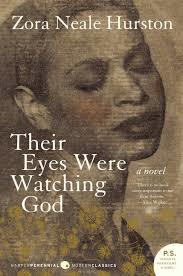 Perhaps what these critics disliked was Janie’s reaction to her situation. She is a strong character who decides early in life that, despite what she was born into, she deserves to be happy. Forces work against her and there are times when lesser souls would have given in, resigned to their fate. Instead, she looks at the life she is offered and does not accept it. She demands better for herself, and she eventually gets it. It's a great message, and one clearly missed by her peers. But not one missed, evidently, by Twitter. In the 1970s, Alice Walker, a professor at Wellesley College, introduced one of the first African-American women’s literature courses. She taught this book in that course, and when she discovered the tragic tale of Hurston’s final years, she set out to find her unmarked grave. After some searching, Walker discovered Hurston’s grave, and marked it with a headstone that dubbed the writer “A Genius of the South.” Happy birthday, Zora.
Perhaps what these critics disliked was Janie’s reaction to her situation. She is a strong character who decides early in life that, despite what she was born into, she deserves to be happy. Forces work against her and there are times when lesser souls would have given in, resigned to their fate. Instead, she looks at the life she is offered and does not accept it. She demands better for herself, and she eventually gets it. It's a great message, and one clearly missed by her peers. But not one missed, evidently, by Twitter. In the 1970s, Alice Walker, a professor at Wellesley College, introduced one of the first African-American women’s literature courses. She taught this book in that course, and when she discovered the tragic tale of Hurston’s final years, she set out to find her unmarked grave. After some searching, Walker discovered Hurston’s grave, and marked it with a headstone that dubbed the writer “A Genius of the South.” Happy birthday, Zora.


January 17, 2019
Wildfire in a box
The Bookworm Box took a pretty pretty picture of Wildfire, surrounded by warmth and pine cones.It's up for sale on their website and all proceeds go to charity.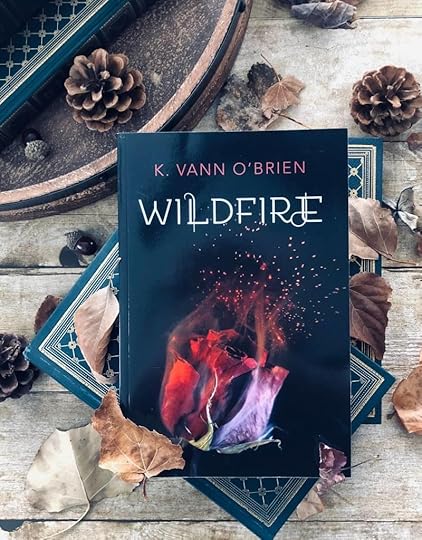
July 16, 2018
My Complicated Relationship with Hemingway
The idea of Earnest Hemingway is romantic. A sweeping, brash man holding a sweating mojito, braced against the wavering Havana heat. But the romanticized version of anyone is often treacherous, and commonly incorrect.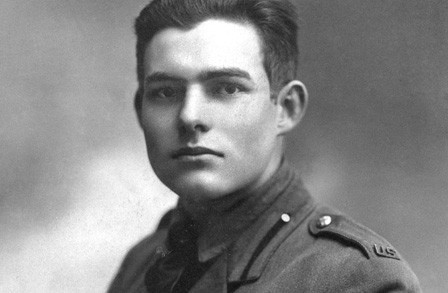 I read A Farewell to Arms in high school. My English class had just finished Emily Bronte's Wuthering Heights, and it ruined me. The greatest love story of all time, my teacher called it. Bleh. Catherine was spoiled and Heathcliff was narcissistic and (spoiler alert!) I was done with it by the time the selfish twit died. (I didn't read Jane Eyre until much later, but I think Charlotte Bronte got the short end of the high school English department stick. She clearly knew the sacrifice of love better than her sister. But I digress.) After the exhausting journey of Wuthering Heights, I was looking for something more solid, something to restore my faith in the love story. Along came Hemingway and his soldier and nurse. And they were strong, smart characters. He told her every thought in his head and she resisted his charms and the anguish of love began. But the writing is what caught me. It was hard and honest and unapologetic.
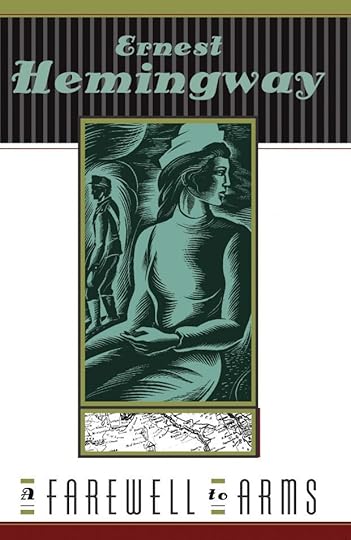 And I was a little swept up in it. So much so that, before I had finished the story, I looked into the author. I had to know who this man was - what he thought and how he operated. And then I discovered his tendency for womanizing, his demanding nature, his crass egoism. It disappointed me that someone whose writing I had grown to admire had been such an ass. (I was young, I looked at love and life in very black and white terms ... and I judged him.) The more I read about Hemingway, the less I liked him, and the character of Frederic in the novel suddenly warped into a tainted version of what he once had been to me. His forthrightness, his eagerness to have the nurse, his desire, morphed into something selfish and hungry, less romantic, more ass-like. By the end, I was bitter. Hell hath no fury and all that. I now have a strict policy - The Hemingway Rule. I don't read about the life of an author until I've finished a book. I don't want reality to taint the fiction.But life happens in layers, doesn't it? And the next layer, when laid over the first like a filter, changes the light in which I view Hemingway. A few years ago, I was sifting through the shelves of an old bookstore along Pirate Alley in New Orleans and came across The Paris Wife, by Paula McLain. Housed in the former home of William Faulkner, Faulkner House Books was the perfect spot to find a book about Hemingway. Though the two writers couldn't have been more different in style, both were American contemporaries influenced by Sherwood Anderson. In fact, Anderson encouraged his publishers to read the works of both Hemingway and Faulkner, which directly tied to their fate. Again, I digress.
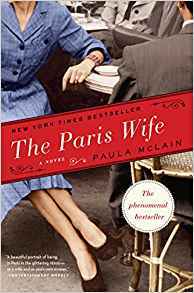 I didn't buy the book. I was looking for a work by Faulkner, of which - infuriatingly - they had very little inventory. (It's called Faulkner House Books, people, house some Faulkner inventory!) Regardless, one cannot go into Faulkner's house and purchase a work about Hemingway. Seems sacrilegious. Years later, the book came to me again, from the bottom of a dusty pile at a garage sale. And I fell in love. With Hadley Richardson, Hemingway's first wife. And with the world in which they lived. And I discovered something else about the man I'd loved and hated, in turn, in the past: he's a lot like me. The way he enters into his work and needs to be pulled out of it at the end of the day, his moodiness, his judgement of others *ahem*, the way he observes people and draws from their madness. The way he would reach the end of a story and become reluctant to finish it, holding onto something he was afraid to let go of. It's infuriating to realize someone you once hated is just another version of you. And it makes sense. After all, don't we often judge people based on the pieces of ourselves we see in them?The Paris Wife is fantastic. The prose is poetic and lovely and simple. And Hadley is a calm, insightful, patient human being - the only kind that could put up with a writer. I highly recommend it, even if you are in a tragic love-hate relationship with Hemingway.Paula McLain wrote an article recently (inspiring these thoughts today), outlining the life of another Hemingway wife - his third - war corespondent and novelist Martha Gellhorn. My base reaction to the article was surprising. McLain seems to marginalize Hemingway, as the stance she takes is one of support of the wife who left him for her career. And I found myself bracing against that opinion, as if I were loyal to a man I'd never actually met. Strange, because, clearly, I agree with the stance against which I reacted. One cannot read about a man asking a woman to choose his bed over her career and not be peeved about it.I'm telling you, it's complicated.The article is to promote the release of the book Love and Ruin, outlining the life of another piece of Hemingway history. And I'm afraid this strange relationship is going to have to continue, as now, I find I need to read this one too.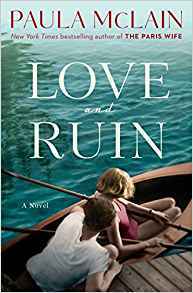
I read A Farewell to Arms in high school. My English class had just finished Emily Bronte's Wuthering Heights, and it ruined me. The greatest love story of all time, my teacher called it. Bleh. Catherine was spoiled and Heathcliff was narcissistic and (spoiler alert!) I was done with it by the time the selfish twit died. (I didn't read Jane Eyre until much later, but I think Charlotte Bronte got the short end of the high school English department stick. She clearly knew the sacrifice of love better than her sister. But I digress.) After the exhausting journey of Wuthering Heights, I was looking for something more solid, something to restore my faith in the love story. Along came Hemingway and his soldier and nurse. And they were strong, smart characters. He told her every thought in his head and she resisted his charms and the anguish of love began. But the writing is what caught me. It was hard and honest and unapologetic. And I was a little swept up in it. So much so that, before I had finished the story, I looked into the author. I had to know who this man was - what he thought and how he operated. And then I discovered his tendency for womanizing, his demanding nature, his crass egoism. It disappointed me that someone whose writing I had grown to admire had been such an ass. (I was young, I looked at love and life in very black and white terms ... and I judged him.) The more I read about Hemingway, the less I liked him, and the character of Frederic in the novel suddenly warped into a tainted version of what he once had been to me. His forthrightness, his eagerness to have the nurse, his desire, morphed into something selfish and hungry, less romantic, more ass-like. By the end, I was bitter. Hell hath no fury and all that. I now have a strict policy - The Hemingway Rule. I don't read about the life of an author until I've finished a book. I don't want reality to taint the fiction.But life happens in layers, doesn't it? And the next layer, when laid over the first like a filter, changes the light in which I view Hemingway. A few years ago, I was sifting through the shelves of an old bookstore along Pirate Alley in New Orleans and came across The Paris Wife, by Paula McLain. Housed in the former home of William Faulkner, Faulkner House Books was the perfect spot to find a book about Hemingway. Though the two writers couldn't have been more different in style, both were American contemporaries influenced by Sherwood Anderson. In fact, Anderson encouraged his publishers to read the works of both Hemingway and Faulkner, which directly tied to their fate. Again, I digress.I didn't buy the book. I was looking for a work by Faulkner, of which - infuriatingly - they had very little inventory. (It's called Faulkner House Books, people, house some Faulkner inventory!) Regardless, one cannot go into Faulkner's house and purchase a work about Hemingway. Seems sacrilegious. Years later, the book came to me again, from the bottom of a dusty pile at a garage sale. And I fell in love. With Hadley Richardson, Hemingway's first wife. And with the world in which they lived. And I discovered something else about the man I'd loved and hated, in turn, in the past: he's a lot like me. The way he enters into his work and needs to be pulled out of it at the end of the day, his moodiness, his judgement of others *ahem*, the way he observes people and draws from their madness. The way he would reach the end of a story and become reluctant to finish it, holding onto something he was afraid to let go of. It's infuriating to realize someone you once hated is just another version of you. And it makes sense. After all, don't we often judge people based on the pieces of ourselves we see in them?The Paris Wife is fantastic. The prose is poetic and lovely and simple. And Hadley is a calm, insightful, patient human being - the only kind that could put up with a writer. I highly recommend it, even if you are in a tragic love-hate relationship with Hemingway.Paula McLain wrote an article recently (inspiring these thoughts today), outlining the life of another Hemingway wife - his third - war corespondent and novelist Martha Gellhorn. My base reaction to the article was surprising. McLain seems to marginalize Hemingway, as the stance she takes is one of support of the wife who left him for her career. And I found myself bracing against that opinion, as if I were loyal to a man I'd never actually met. Strange, because, clearly, I agree with the stance against which I reacted. One cannot read about a man asking a woman to choose his bed over her career and not be peeved about it.I'm telling you, it's complicated.The article is to promote the release of the book Love and Ruin, outlining the life of another piece of Hemingway history. And I'm afraid this strange relationship is going to have to continue, as now, I find I need to read this one too.
April 9, 2018
New friends
New to the website?Considering signing up for the mailing list but just not sure yet?You should do it.Really.Go to the contact page now and sign up for updates before you chicken out.Or just email me directly at kvannobrien@gmail.com.New friends are always a good thing.
October 22, 2017
The beauty of #metoo
For the past week, I've seen the #metoo hashtag pop up on social media, on the pages of women I love and admire. And the intent - to make everyone aware of how rampant sexual assault is - was achieved. There's been backlash, of course. Small people will always try to make others feel small, which has never been more clear since the invention of the internet. But that's what assault is all about, isn't it?It's about power.And sexual assault does have power over you, for a lot longer than just in the moment it happens. Years later, you imagine it happening all over again, you feel the fear and the anger, you remember the pain. A few years ago, I was trying to write the rape scene in Avalanche. And I was struggling with it. I wrote it the first time in a completely emotionless state, which became obvious during editing. I was forced to go back and actually feel the emotion I had been protecting myself from, to put myself in the scene, to feel the pain. Because I wanted the scene to be real. I wanted to honor it with honesty. Because, in addition to writing it for me, I was also writing it for the other girl, the one who doesn't know how to process what she's been through, and turns to literature to get her through.It's important to talk about it.Sometimes, it feels like talking about it allows it to have power over you again. It's easier to hide it away than to bring it up, to reveal it to the world. And the internet trolls certainly don't make it easier. But it's important to do it anyway. Revealing your truth makes you vulnerable. And vulnerability makes you strong, too.I grew up in a sheltered life. My parents were protective, the small town I lived in had it's frightening parts, but I rarely witnessed them. In high school and college, I was surrounded by strong female friends, and we protected each other from potentially damaging situations. The rules were clear: you come with me, you leave with me. You don't put your drink down. You don't accept drinks from strangers. If you can't fend off a drunk on the dance floor, I will do it for you. Safety in numbers.But still. Even with a net of protection around me, it happened to me. It happens a lot. But we don't talk about it. Until those hashtags start to pop up and women - and some men (9% of assault victims are male) - proclaim it happened to them too. And you see people you know and respect reveal their pain to the world.It's courageous to do so. It's not about victimization. It's not about a witch hunt. It's about calling out to others struggling with the memory of it and telling them it's okay to talk about it. It's not your fault. You did not wear something too revealing. You were not too friendly with that person. You did not ask for it.Sexual assault, which happens to someone roughly every minute and a half in the US, does not happen because you are wearing a short skirt. It happens because the perpetrator wants to feel power over you and disregards your right to consent.It's okay to move on after that. It's okay to process the emotion and scream in outrage. Or not. It's okay to refrain from putting the #metoo hashtag on social media. It's okay to keep it to yourself. But when you're ready, it's okay to come out and say it happened. And to forgive yourself. Because, if there's something this hashtag has taught us, it's that it happens more often then we all know. And that's the beauty of using the internet for good instead of evil.
A few years ago, I was trying to write the rape scene in Avalanche. And I was struggling with it. I wrote it the first time in a completely emotionless state, which became obvious during editing. I was forced to go back and actually feel the emotion I had been protecting myself from, to put myself in the scene, to feel the pain. Because I wanted the scene to be real. I wanted to honor it with honesty. Because, in addition to writing it for me, I was also writing it for the other girl, the one who doesn't know how to process what she's been through, and turns to literature to get her through.It's important to talk about it.Sometimes, it feels like talking about it allows it to have power over you again. It's easier to hide it away than to bring it up, to reveal it to the world. And the internet trolls certainly don't make it easier. But it's important to do it anyway. Revealing your truth makes you vulnerable. And vulnerability makes you strong, too.I grew up in a sheltered life. My parents were protective, the small town I lived in had it's frightening parts, but I rarely witnessed them. In high school and college, I was surrounded by strong female friends, and we protected each other from potentially damaging situations. The rules were clear: you come with me, you leave with me. You don't put your drink down. You don't accept drinks from strangers. If you can't fend off a drunk on the dance floor, I will do it for you. Safety in numbers.But still. Even with a net of protection around me, it happened to me. It happens a lot. But we don't talk about it. Until those hashtags start to pop up and women - and some men (9% of assault victims are male) - proclaim it happened to them too. And you see people you know and respect reveal their pain to the world.It's courageous to do so. It's not about victimization. It's not about a witch hunt. It's about calling out to others struggling with the memory of it and telling them it's okay to talk about it. It's not your fault. You did not wear something too revealing. You were not too friendly with that person. You did not ask for it.Sexual assault, which happens to someone roughly every minute and a half in the US, does not happen because you are wearing a short skirt. It happens because the perpetrator wants to feel power over you and disregards your right to consent.It's okay to move on after that. It's okay to process the emotion and scream in outrage. Or not. It's okay to refrain from putting the #metoo hashtag on social media. It's okay to keep it to yourself. But when you're ready, it's okay to come out and say it happened. And to forgive yourself. Because, if there's something this hashtag has taught us, it's that it happens more often then we all know. And that's the beauty of using the internet for good instead of evil.
July 2, 2017
North & South: Afternoon tea and moral ambiguity.
The 2004 TV miniseries based on Elizabeth Gaskell's novel, North & South, has been on Netflix for a while. And I can’t tell you how many times I’ve watched it.When I’m stressed, I lean toward 19th Century English period pieces. I think it's because I find them calming. Reading the novels of Jane Austen in my teen years kicked off this obsession, followed by Jane Eyre. Then, film adaptations of these works led me to Downton Abbey and North & South. And my fixation was solidified.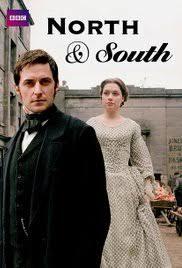 I think I enjoy the simplicity of the era. Walking over country lanes and rolling green hills as a form of exercise and transportation. Serving afternoon tea and calling on neighbors for entertainment and conversation. Writing and receiving hand-written letters from family and friends. The elegance and the slow, intentional lifestyle appeal to me.It's much different from the frazzled everyday life of a busy working mom trying to write books in her "spare" time. Hahahaha. Spare time. In addition to the calming nature of the time, North and South is a literary package of love and devastation, moral quandaries and revolution.Richard Armitage is smoldering as industrial mill master John Thornton, who is in love with Margaret Hale, an educated but kind woman whose class is clearly above his own. (Interestingly, according to IMDB, Richard Armitage’s parents are also named John and Margaret.)If you’re a fan of the Lord of the Rings franchise (Hobbits also have a way of slowing things down and focusing on what is important - like cheese), you’ll recognize Armitage from his role as Thorin Oakenshield, leader of the dwarves. He lent the same intensity to that role, but in a more overt, crazy dwarf-like way. In his role as John Thornton, his ferocity was more complicated. He has a hard life, trying to provide for his mother and unmarried sister, run a mill, provide for his employees, all the while trying to maintain a threshold of emotion between himself and everyone who counts on him.
 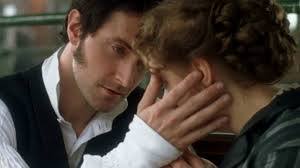 When Margaret arrives, she softens John's edges. She's from another town - seemingly another world - made up of green countryside and fragrant flowers. She's not familiar with the workings of a town forever covered in a layer of grey smoke, both literally and figuratively in the hearts of those who live there.When they meet, John is beating a man in his mill. Margaret is angry and exasperated at the sight of such violence unit John reveals the reason for it: the man was smoking. In a highly-flammable cotton mill, this is the most dangerous thing anyone can do. He put himself and the other men, women and children working in the mill at risk. John recounts a time when he saw a mill go up in flames, consuming every life within in mere seconds. Margaret soon realizes she judged John too harshly.The characters continue to misjudge and misunderstand each other. Customs and social behaviors are very different between the North and the South. Margaret has to adjust her views of both. Then the strike begins, and Margaret has to help her friends on both sides of the argument.Any moral righteousness the reader holds at this point - in support of either the mill masters or the workers - gets shaded in a smokey grey as children starve and masters prepare for bankruptcy.Margaret and John continue to misunderstand each other. They disagree on politics. They fumble over varying customs. But they always hold each other high in regard and respect. Until, eventually, their circumstances bring them together in the end. (I would have prefaced that with a spoiler alert, but there's no general surprises in 19th Century English literature. The characters, no matter their position, always come together in the end. Except, maybe, for the selfishness of Wuthering Heights.)I don't know how much longer North & South will be on Netflix. But I hope to continue to watch it long into my stressful nights, when I can see Margaret and John dance in their ethic battles, holding in the love they have for each other in dignified restraint. And, of course, serve afternoon tea.
I think I enjoy the simplicity of the era. Walking over country lanes and rolling green hills as a form of exercise and transportation. Serving afternoon tea and calling on neighbors for entertainment and conversation. Writing and receiving hand-written letters from family and friends. The elegance and the slow, intentional lifestyle appeal to me.It's much different from the frazzled everyday life of a busy working mom trying to write books in her "spare" time. Hahahaha. Spare time. In addition to the calming nature of the time, North and South is a literary package of love and devastation, moral quandaries and revolution.Richard Armitage is smoldering as industrial mill master John Thornton, who is in love with Margaret Hale, an educated but kind woman whose class is clearly above his own. (Interestingly, according to IMDB, Richard Armitage’s parents are also named John and Margaret.)If you’re a fan of the Lord of the Rings franchise (Hobbits also have a way of slowing things down and focusing on what is important - like cheese), you’ll recognize Armitage from his role as Thorin Oakenshield, leader of the dwarves. He lent the same intensity to that role, but in a more overt, crazy dwarf-like way. In his role as John Thornton, his ferocity was more complicated. He has a hard life, trying to provide for his mother and unmarried sister, run a mill, provide for his employees, all the while trying to maintain a threshold of emotion between himself and everyone who counts on him. When Margaret arrives, she softens John's edges. She's from another town - seemingly another world - made up of green countryside and fragrant flowers. She's not familiar with the workings of a town forever covered in a layer of grey smoke, both literally and figuratively in the hearts of those who live there.When they meet, John is beating a man in his mill. Margaret is angry and exasperated at the sight of such violence unit John reveals the reason for it: the man was smoking. In a highly-flammable cotton mill, this is the most dangerous thing anyone can do. He put himself and the other men, women and children working in the mill at risk. John recounts a time when he saw a mill go up in flames, consuming every life within in mere seconds. Margaret soon realizes she judged John too harshly.The characters continue to misjudge and misunderstand each other. Customs and social behaviors are very different between the North and the South. Margaret has to adjust her views of both. Then the strike begins, and Margaret has to help her friends on both sides of the argument.Any moral righteousness the reader holds at this point - in support of either the mill masters or the workers - gets shaded in a smokey grey as children starve and masters prepare for bankruptcy.Margaret and John continue to misunderstand each other. They disagree on politics. They fumble over varying customs. But they always hold each other high in regard and respect. Until, eventually, their circumstances bring them together in the end. (I would have prefaced that with a spoiler alert, but there's no general surprises in 19th Century English literature. The characters, no matter their position, always come together in the end. Except, maybe, for the selfishness of Wuthering Heights.)I don't know how much longer North & South will be on Netflix. But I hope to continue to watch it long into my stressful nights, when I can see Margaret and John dance in their ethic battles, holding in the love they have for each other in dignified restraint. And, of course, serve afternoon tea.
June 7, 2017
Research and wine
For my 40th birthday in March, I traveled with a friend to Italy and spent a week roaming churches, perusing art and eating cheese. Oh yeah. And drinking wine.So much wine. And of course, I had an ulterior motive: research. My WIP takes place primarily in this beautiful, ancient, storied country and I wanted to experience the feel and look and smell of things before I wrote about it. (Write what you know, right?)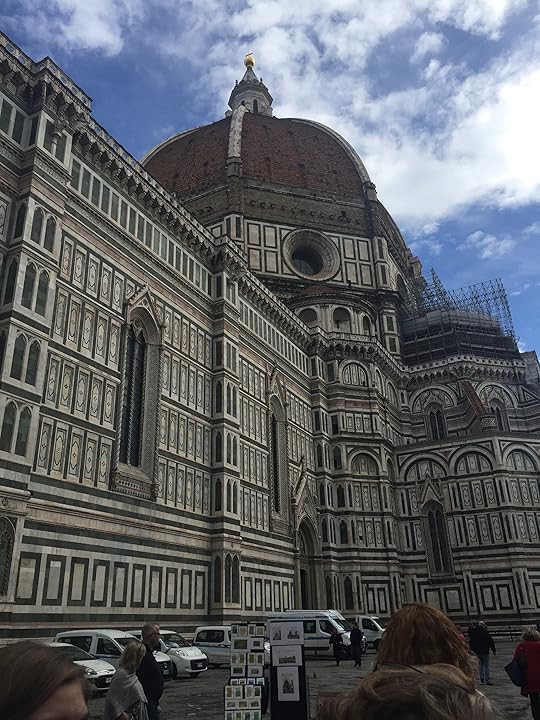 I'm currently writing Chapter 16, which draws the characters to the Cattedrale di Santa Maria del Fiore, or the Duomo, in Florence.
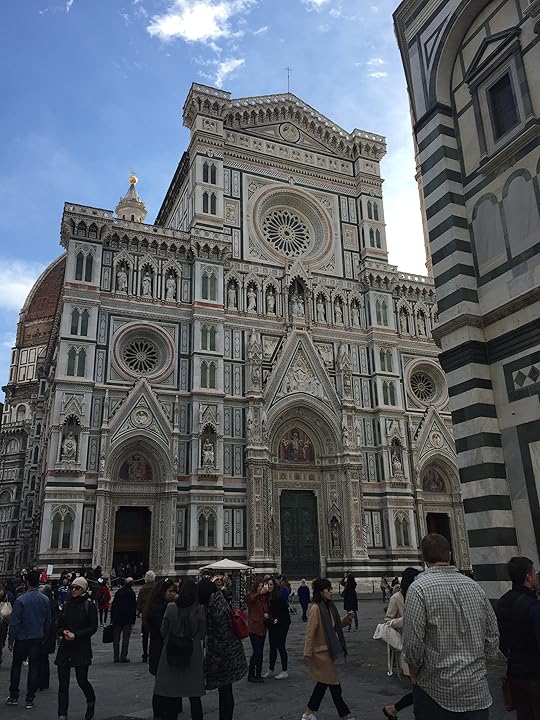 What I loved about this church was the very idea of it. The Medici family held all the wealth and power in Florence at the time, and most the buildings were funded by them and therefore provided them more control. They put their family symbol everywhere, like a cat who sprays its scent, in order to remind the people who was in charge.But this church was built by the people of Florence, for the people of Florence. Though they tried, the Medici were not allowed to put any money toward it, and therefore wielded no control. Later on, when the people's defenses were down, they snuck their way in, holding a Medici wedding in the church and adding one stamp to the floor with their symbol on it, which is annoying. But the simple fact that the people pulled this off in the face of such wealth in the first place is amazing.The Duomo is medieval and ornate on the outside (the facade was built much later than the church itself), but on the inside, it is plain and simple. Because the goal was to welcome anyone - rich or poor - to worship here. They wanted to ensure everyone felt comfortable, no matter who they were. And that is a truly beautiful thing.
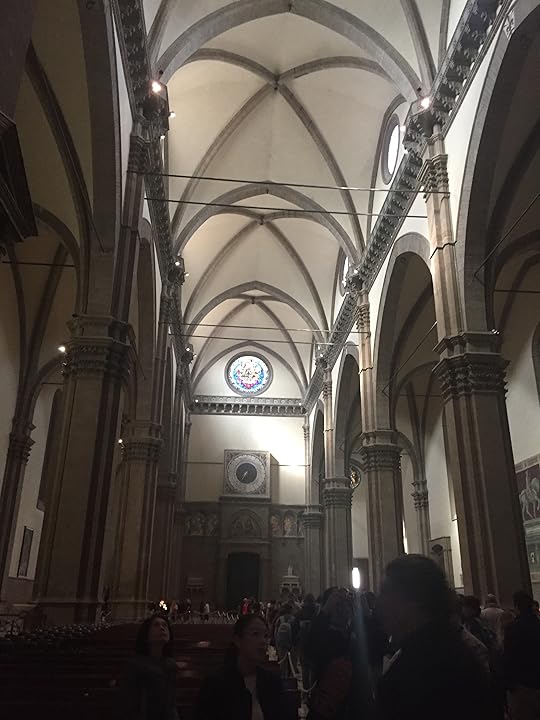 Inside is more my speed. It's beautiful, but it's the bones - the careful craftsmanship and elegant architecture - that make it that way, not the showy facade. Which is a metaphor for life, is it not?By the way, that clock above the door still works. It runs counter-clockwise and there's 24 hours on it, instead of 12, like we're used to. Here's a closer look at that if you're interested.
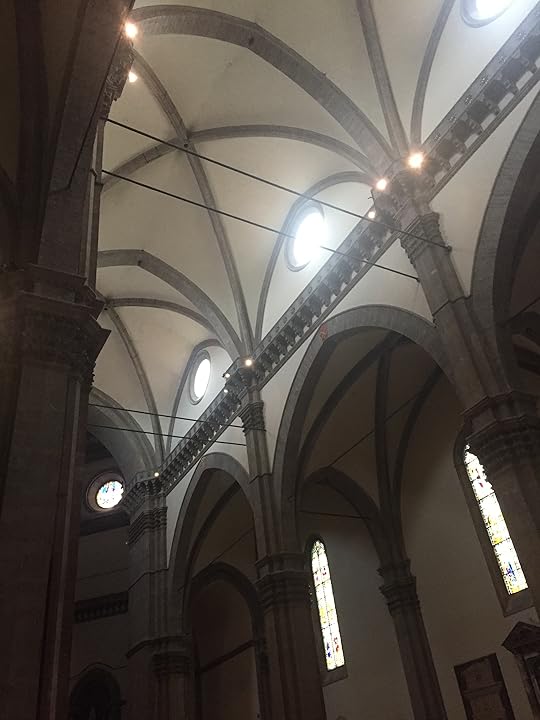 The light shineth ...
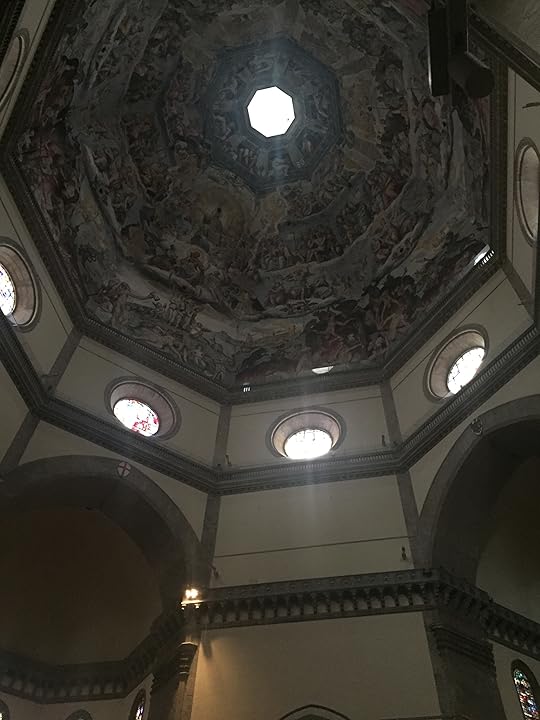 I didn't get a great photo of the lovely mosaic floor, because I was too busy looking up. The primary grandeur inside is the dome - the feat of architecture from which the Duomo gets its name. But wait. There's domes in churches all over the place, you may be saying. Why does the world refer to this one as THE DOME? It's because the dome is masonry and it's 150-feet wide. Today, it remains the largest masonry dome on the planet. Because no one knows quite how they pulled it off. The dome was built using experimental methods that architects still ponder over six centuries later. Our tour guide told us Michelangelo came to study the structure when he was designing the dome for the Basilica in Rome.
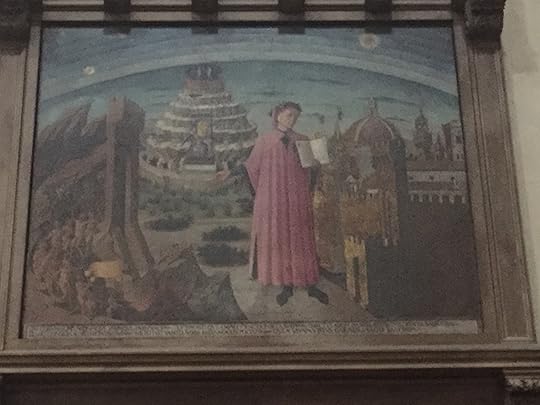 One thing that struck me about Italy is the way art and religion and science all seemed to blend together. As an example of this, hanging in the Duomo is a painting of Dante and his Inferno. A church is displaying art depicting literature that questions religious doctrine. The openness of this makes me happy.Part of the romance of this country is that things aren't always black and white here. The Medici, though powerful and overbearing, were also regarded whimsically as contributors to art and science. It was the Medici who secured cadavers and a forum to allow Michelangelo and Da Vinci to study human anatomy, which contributed significantly to their art. And some of the greatest art and science in this era was funded by the church. It all blends in a way that leads to the possibility of discovery and education and intelligence. The heart of the Renaissance.In the Duomo is a basement. It is in this basement that the characters in my WIP are heading now. In real life, we didn't tour the basement. But I recall walking by the entrace and thinking, hmmmmm ... So my imagination is going to be fueling this one. Let's see if I can figure it out ...
I'm currently writing Chapter 16, which draws the characters to the Cattedrale di Santa Maria del Fiore, or the Duomo, in Florence.What I loved about this church was the very idea of it. The Medici family held all the wealth and power in Florence at the time, and most the buildings were funded by them and therefore provided them more control. They put their family symbol everywhere, like a cat who sprays its scent, in order to remind the people who was in charge.But this church was built by the people of Florence, for the people of Florence. Though they tried, the Medici were not allowed to put any money toward it, and therefore wielded no control. Later on, when the people's defenses were down, they snuck their way in, holding a Medici wedding in the church and adding one stamp to the floor with their symbol on it, which is annoying. But the simple fact that the people pulled this off in the face of such wealth in the first place is amazing.The Duomo is medieval and ornate on the outside (the facade was built much later than the church itself), but on the inside, it is plain and simple. Because the goal was to welcome anyone - rich or poor - to worship here. They wanted to ensure everyone felt comfortable, no matter who they were. And that is a truly beautiful thing.Inside is more my speed. It's beautiful, but it's the bones - the careful craftsmanship and elegant architecture - that make it that way, not the showy facade. Which is a metaphor for life, is it not?By the way, that clock above the door still works. It runs counter-clockwise and there's 24 hours on it, instead of 12, like we're used to. Here's a closer look at that if you're interested. The light shineth ...I didn't get a great photo of the lovely mosaic floor, because I was too busy looking up. The primary grandeur inside is the dome - the feat of architecture from which the Duomo gets its name. But wait. There's domes in churches all over the place, you may be saying. Why does the world refer to this one as THE DOME? It's because the dome is masonry and it's 150-feet wide. Today, it remains the largest masonry dome on the planet. Because no one knows quite how they pulled it off. The dome was built using experimental methods that architects still ponder over six centuries later. Our tour guide told us Michelangelo came to study the structure when he was designing the dome for the Basilica in Rome.One thing that struck me about Italy is the way art and religion and science all seemed to blend together. As an example of this, hanging in the Duomo is a painting of Dante and his Inferno. A church is displaying art depicting literature that questions religious doctrine. The openness of this makes me happy.Part of the romance of this country is that things aren't always black and white here. The Medici, though powerful and overbearing, were also regarded whimsically as contributors to art and science. It was the Medici who secured cadavers and a forum to allow Michelangelo and Da Vinci to study human anatomy, which contributed significantly to their art. And some of the greatest art and science in this era was funded by the church. It all blends in a way that leads to the possibility of discovery and education and intelligence. The heart of the Renaissance.In the Duomo is a basement. It is in this basement that the characters in my WIP are heading now. In real life, we didn't tour the basement. But I recall walking by the entrace and thinking, hmmmmm ... So my imagination is going to be fueling this one. Let's see if I can figure it out ...
March 20, 2017
Derek Walcott
Nobel laureate Derek Walcott died on St. Patrick's Day. While he's most known for writing the EPIC poem Omeros, he also wrote one of my favorite (short) poems that I wanted to share with you: Love after LoveDerek WalcottThe time will comewhen, with elationyou will greet yourself arrivingat your own door, in your own mirrorand each will smile at the other's welcome,and say, sit here. Eat.You will love again the stranger who was your self.Give wine. Give bread. Give back your heartto itself, to the stranger who has loved youall your life, whom you ignoredfor another, who knows you by heart.Take down the love letters from the bookshelf,the photographs, the desperate notes,peel your own image from the mirror.Sit. Feast on your life.Great, right?I first read this poem at a trying time in my life, when I was feeling lost. It inspired a conversation with myself about who I was and what I was doing with my life. I took some if it literally, opening up a box of memories and actually feasting on my life, trying to remember who I was. I think it's important to do that every once in a while, to take stock of who you are and where you've been, and really get back to the center of you.Years later, I read the poem again, and saw it in a different light. I was now a mom and the "other" I was ignoring myself for was not a lover but the smaller, louder, more insistent males in my life.And now it's even more important to remember who I am and come back to center when I'm feeling lost. Thank you, Mr. Walcott, for helping me do that.You can read more about the poet and playwright inthe Guardian article announcing his death.
Love after LoveDerek WalcottThe time will comewhen, with elationyou will greet yourself arrivingat your own door, in your own mirrorand each will smile at the other's welcome,and say, sit here. Eat.You will love again the stranger who was your self.Give wine. Give bread. Give back your heartto itself, to the stranger who has loved youall your life, whom you ignoredfor another, who knows you by heart.Take down the love letters from the bookshelf,the photographs, the desperate notes,peel your own image from the mirror.Sit. Feast on your life.Great, right?I first read this poem at a trying time in my life, when I was feeling lost. It inspired a conversation with myself about who I was and what I was doing with my life. I took some if it literally, opening up a box of memories and actually feasting on my life, trying to remember who I was. I think it's important to do that every once in a while, to take stock of who you are and where you've been, and really get back to the center of you.Years later, I read the poem again, and saw it in a different light. I was now a mom and the "other" I was ignoring myself for was not a lover but the smaller, louder, more insistent males in my life.And now it's even more important to remember who I am and come back to center when I'm feeling lost. Thank you, Mr. Walcott, for helping me do that.You can read more about the poet and playwright inthe Guardian article announcing his death.
February 15, 2017
A week in pictures: the sun shines. Briefly.
I'm not going to say it was a long winter. I live in Austin, by God, I have no right to complain about the cold. But it was cold. And long. And it's still happening. Today I'm back to bundling up. But for a brief few days, the sun came out and we rode bikes and bought plants and enjoyed the warmth.Shopping (we bought strawberries, jasmine and a peach tree):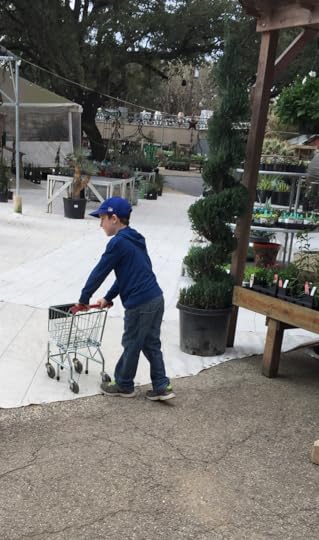 We did not buy the big toes:
 I love moss. It's so GREEN!
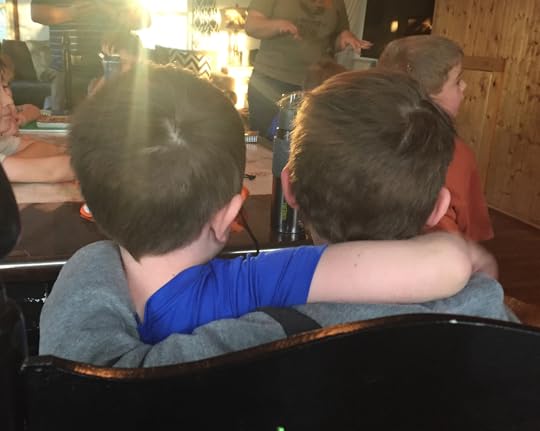
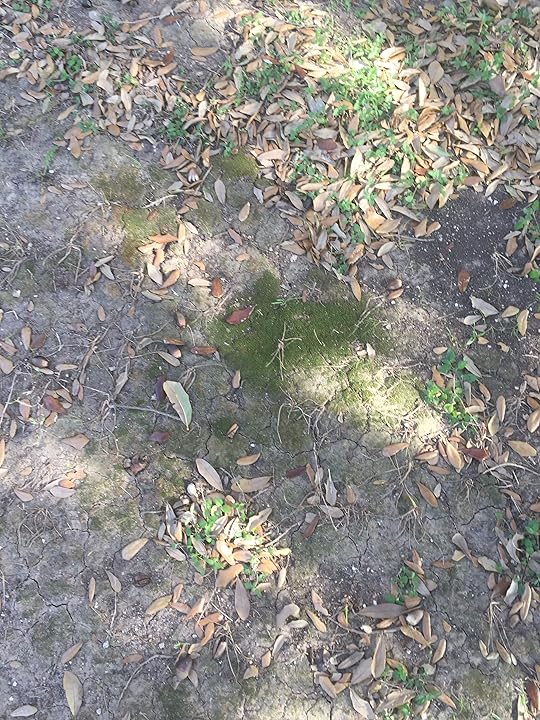 The sun shining on a cub scouts meeting. Five seconds before headlocks commenced.
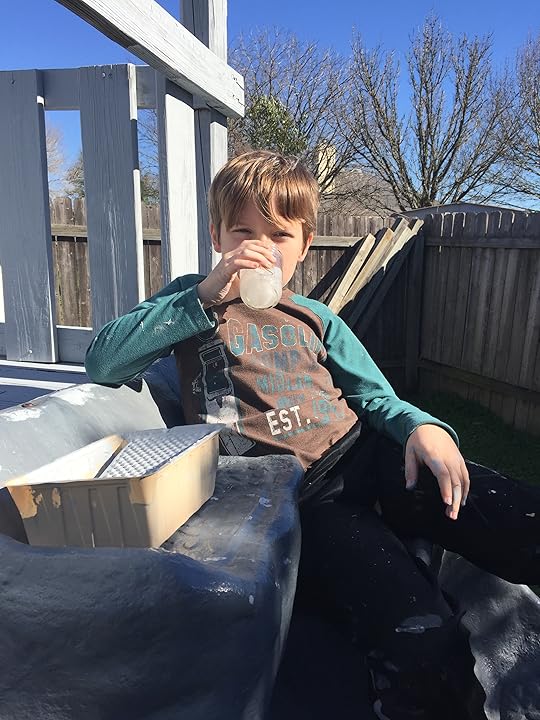
 Project: playhouse renovations. He's not drinking the paint, I promise.
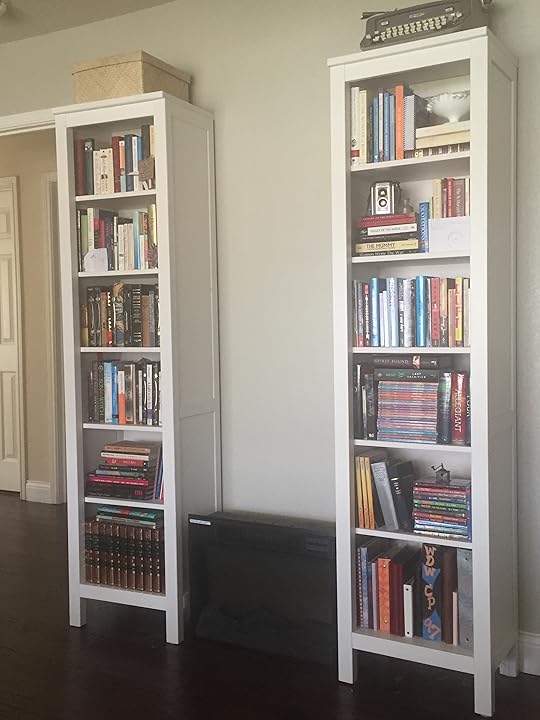
 Project: more books! And a(n electric) fireplace! I'm excited about this renovation in my office. I'll share more as it happens.
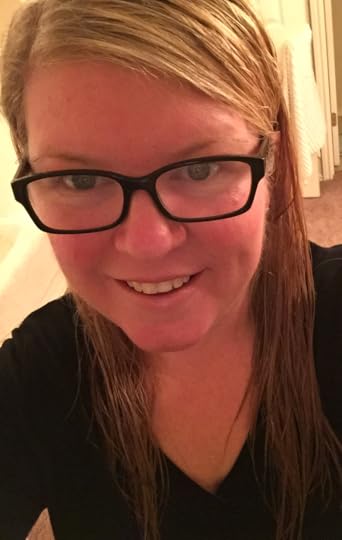
 Project: love thyself.I don't like pictures.I avoid them.As does my husband. My social media feeds are just a bunch of pictures of the kids. And books. Because that's the material I have to work with. But lately I've been thinking that I'm going to be old soon. And I might like to have some photos of myself around.I avoid photos because I'm overly critical of them. My hair is too thin, my face too red, my teeth not white enough, my chin too double-y. Similar to the way I write a sentence over and over until it feels right, I want to edit the photos until I find nothing wrong with them. But, you see, it's not really about the pictures, is it? It's about that critical biotch inside of me. (Everyone does this, though, right? Except, I see selfies on other feeds. And I always think, "how brave.")So this week I took a photo of myself right out of the shower, hair wet, no makeup, pajamas and glasses on. This is me at 9 pm, after the boys are asleep and I'm about to curl up and read in my own bed. I'm currently in the bathroom. You can see my towel hanging from the doorknob behind me, and the carpet on the floor. Yes, my house was built in the 90s and there's CARPET on the bathroom floor.And YES, I'm still being critical.Dammit.Ok. So there's me. Tutto naturale. Flaws and all. For posterity.
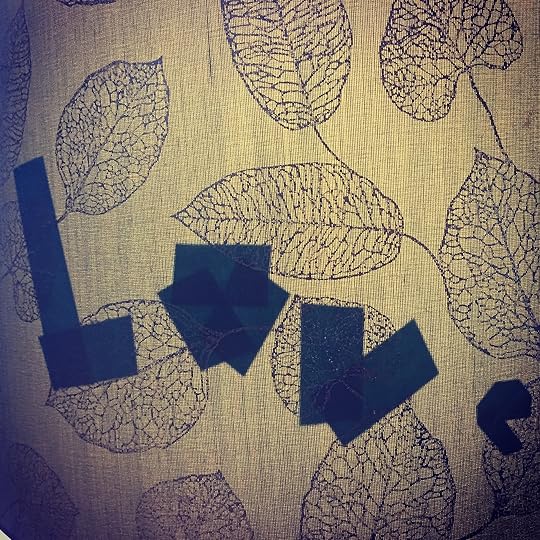
 And of course, I turn on my reading lamp, and I'm reminded of how much that crap doesn't matter. My son taped LOVE in washi tape on the inside of my reading lamp! So I am reminded every night when I turn it on that he is awesome and I am loved.(I should note his first instinct was to create the image of a large spider, as a prank. But he went with this approach instead. Perspective.)
 My husband bought me flowers this week. (Not on Valentines Day; we don't actually celebrate that holiday. But earlier in the week; he was feeling thankful.)
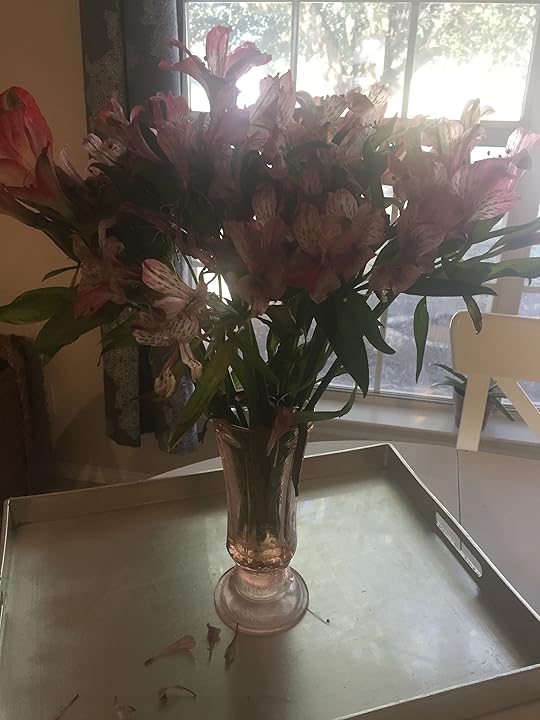 ANDI had a lunch date on Valentine's Day and she brought me flowers! (And I'm an ass, because I didn't even CONSIDER bringing her something. Again, not a V-Day chick. And actually, when I hear V-Day, I think ofthis. Which is romantic, right? Sort of.)Now these guys live on my desk and make me happy throughout the day.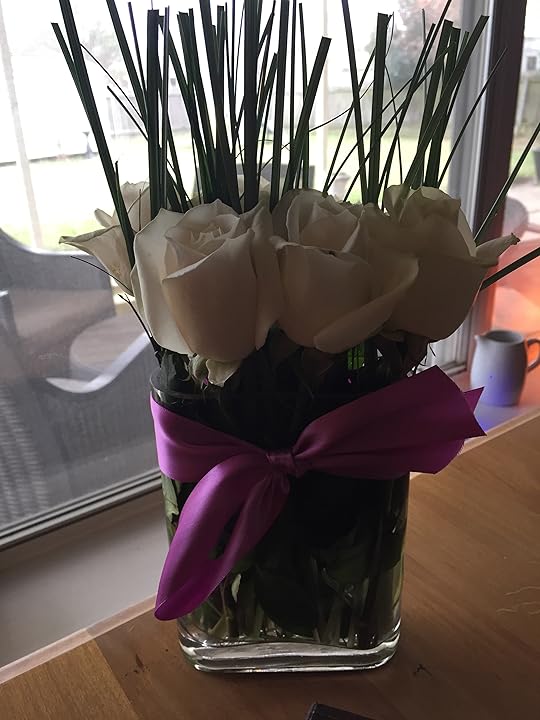
We did not buy the big toes:I love moss. It's so GREEN!The sun shining on a cub scouts meeting. Five seconds before headlocks commenced.Project: playhouse renovations. He's not drinking the paint, I promise.Project: more books! And a(n electric) fireplace! I'm excited about this renovation in my office. I'll share more as it happens.Project: love thyself.I don't like pictures.I avoid them.As does my husband. My social media feeds are just a bunch of pictures of the kids. And books. Because that's the material I have to work with. But lately I've been thinking that I'm going to be old soon. And I might like to have some photos of myself around.I avoid photos because I'm overly critical of them. My hair is too thin, my face too red, my teeth not white enough, my chin too double-y. Similar to the way I write a sentence over and over until it feels right, I want to edit the photos until I find nothing wrong with them. But, you see, it's not really about the pictures, is it? It's about that critical biotch inside of me. (Everyone does this, though, right? Except, I see selfies on other feeds. And I always think, "how brave.")So this week I took a photo of myself right out of the shower, hair wet, no makeup, pajamas and glasses on. This is me at 9 pm, after the boys are asleep and I'm about to curl up and read in my own bed. I'm currently in the bathroom. You can see my towel hanging from the doorknob behind me, and the carpet on the floor. Yes, my house was built in the 90s and there's CARPET on the bathroom floor.And YES, I'm still being critical.Dammit.Ok. So there's me. Tutto naturale. Flaws and all. For posterity.And of course, I turn on my reading lamp, and I'm reminded of how much that crap doesn't matter. My son taped LOVE in washi tape on the inside of my reading lamp! So I am reminded every night when I turn it on that he is awesome and I am loved.(I should note his first instinct was to create the image of a large spider, as a prank. But he went with this approach instead. Perspective.)My husband bought me flowers this week. (Not on Valentines Day; we don't actually celebrate that holiday. But earlier in the week; he was feeling thankful.)ANDI had a lunch date on Valentine's Day and she brought me flowers! (And I'm an ass, because I didn't even CONSIDER bringing her something. Again, not a V-Day chick. And actually, when I hear V-Day, I think ofthis. Which is romantic, right? Sort of.)Now these guys live on my desk and make me happy throughout the day.
October 9, 2016
Happy Creepy Reading Month!
I picked up a book from my TO READ shelf the other day and was only two pages in when I put it down, not because it wasn’t good, but because it was set at Christmastime. And just now, as the long streaks of fall sun light up my office window and the spice in the air tells me Halloween is coming, I can’t possibly read something Christmas-y.This is my favorite time of year. It’s quiet and slow. The heat of summer blows away and the promise of costumes and ghost stories abound. Now is the time for witches and goblins, potions and spells and for the line between imagination and reality to blur. This is our time, we lover of tales and tellers of story.It’s time to read something wicked and fun.My love of paranormal literature first sparked when my sixth grade English teacher let us pick books from a cart to read and review. It pains me that I cannot remember this woman’s name, but the projects she engages us in were unique and memorable. A few I prominently recall were reading Dante’s Inferno and creating our own circles of hell, and researching lines from “We Didn’t Start the Fire” by Billy Joel and presenting our findings to the class. Great lesson plans. But the project that triggered a lifetime love in me was simple: pick a book from the cart, read, review.By the time I got to the cart (my last name being Vann), it was picked over. Only a few books remained. But there, waiting for me, like a soul mate, wasDouble Trouble. The main characters of this book are twins. Their parents have died and the siblings have been separated, the boy entering into the foster system. But they can still be together because they have perfected the powers of ESP and astral projection.
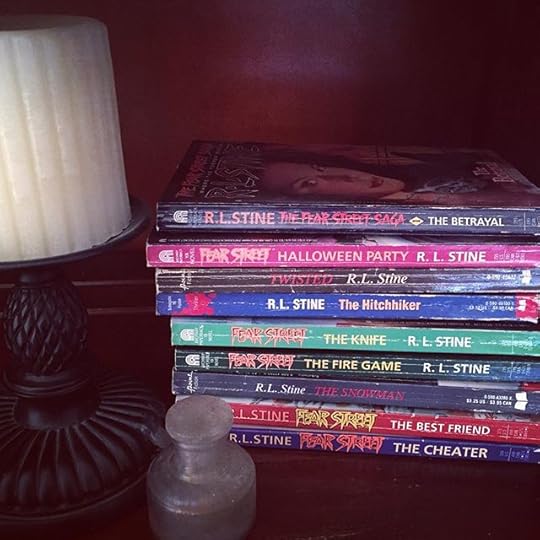
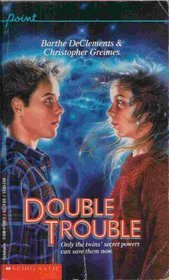 What I found memorable about this book wasthey learnedhow to do these things. If they could learn how to ease their souls out of their bodies and fly around, so could I. Right? For a month after I read this book, I lay in bed at night, willing my soul into astral projection. Didn’t work. But still. The book was cool. And it was much different from my usual: Sweet Valley Twins and The Babysitters Club.Then, at a sleepover, I was introduced to theFear Streetseries by R.L Stine. On my friend's bookshelf were these interesting-looking books with creative, frightening covers. I couldn’t help but wonder about them. She let me borrow one and I was immediately hooked. After that, my trips to the Waldenbooks at the mall, where I always went straight to the section in the back to smell the new arrivals, changed. Fear Street was sold in a different section (away from the bubble-gum covers of the SVT). I felt very sophisticated.
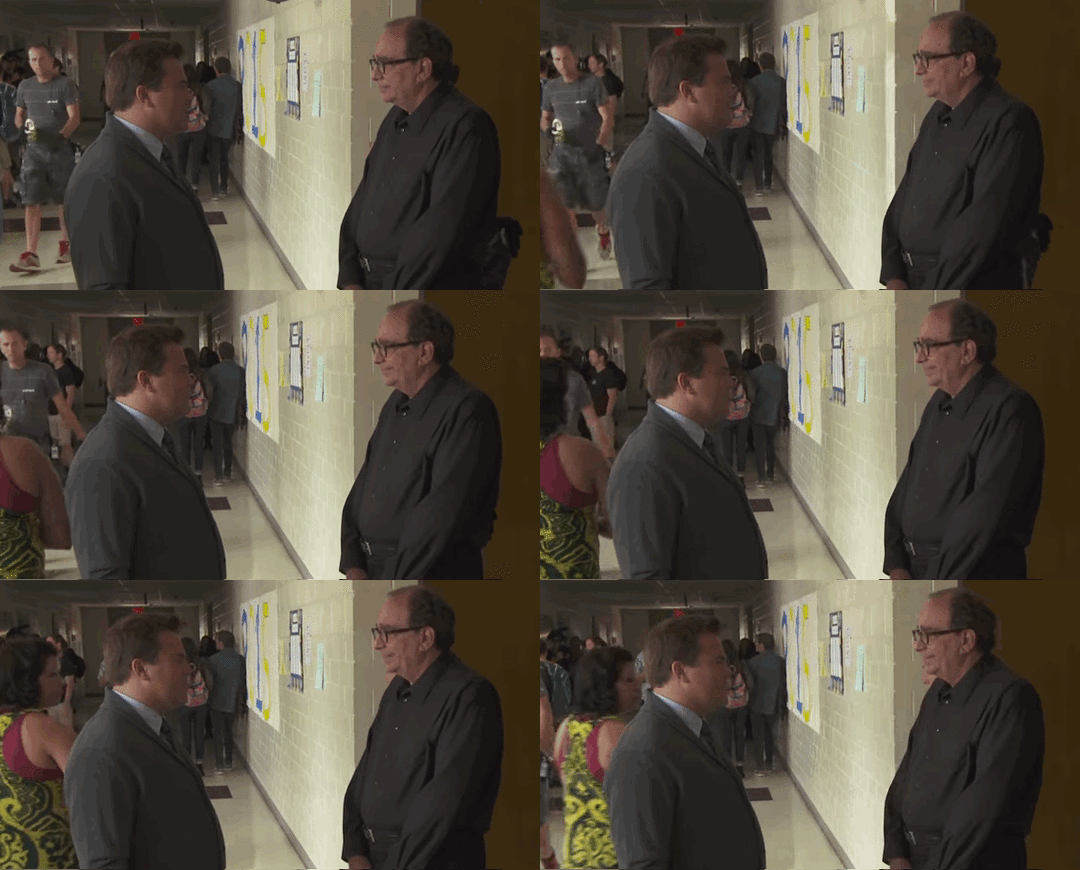
 R.L. Stine is better known for the series he wrote later on –Goosebumps. I was excited when that movie came out because it introduced my kids to one of my favorite authors. Even though I never read the Goosebumps series, it was a great reprise of Stine's stories. I completely geeked out toward the end when R.L. Stine passes the characters in the hallway at school. Jack Black says “Mr. Black,” to R.L. Stine and R.L. Stine says “Mr. Stine” to Jack Black. Simple, elegant, beautiful cameo that only a lover of Stine’s work would notice.
 After Fear Street I readThe Secret Circle, a series by L.J. Smith about a coven of witches trying to navigate high school. If Double Trouble introduced me to this genre, and Fear Street pulled me in, it was The Secret Circle that solidified my existence in it. I dreamed of finding a coven of witches to join; powerful, snarky girls who would accept me as one of their own. At that time, there were only three of these books. But in 2012 and 2013, three more were released. I may have to go read those. Just to complete the circle. (See what I did there?)
 The Secret Circle was turned into a television series in 2011 (perhaps by someone who read these books when they were younger?). Britt Robertson played the main character Cassie Blake. This adorable actress has been in a lot lately, but I mostly remember her as Steve Carell’s emotional daughter in Dan in Real Life. The real gem of IMDB crossover information, however, is in Thomas Dekker. He resurrected my nostalgia as the tormented Adam in The Secret Circle, but really shined a few years later in the Backstrom series, as Gregory Valentine. Also tormented, but more realistically (and hilariously) so, less of a “poor-me-I-can’t-decide-whom-to-love” teenage angst kind of way.L.J. Smith also wrote The Vampire Diaries, which – as we all know – was also turned into a television series. I never read these books and though I did binge watch the series for a while, I didn’t make it to the end. There’s SO many episodes. And I think it became quite a struggle after a while to hold that love triangle together. Who’s a vampire this week and who’s not? Who’s worthy of Elena’s love this week and who’s not? Who has time for that?After The Secret Circle, I readTrick or Treatby Richie Tankersley Cusick,The Witch of Blackbird Pondby Elizabeth George Speare, andWait Till Helen Comesby Mary Downing Hahn.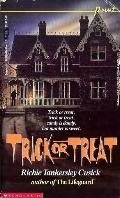
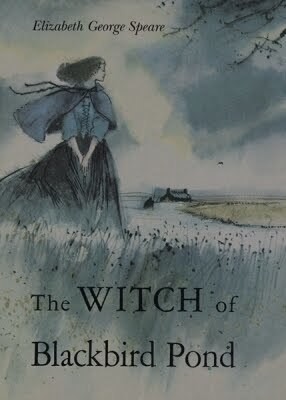
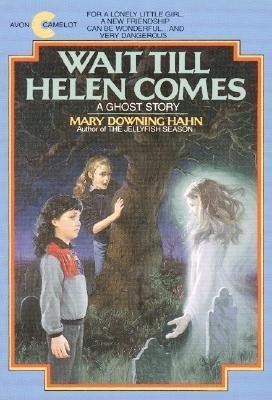 Though the cover of Wait Till Helen Comes looks tween-friendly, it was a creepy read. The main character moves with her family into an old church, which has been converted into a house. This concept struck me as very cool. But also nuts, since the backyard of the old church was a graveyard haunted by a ghost. The ghost seems to have good intentions at first but then she doesn’t.More recently, this book attained a new cover that better conveys its true level of creepy.
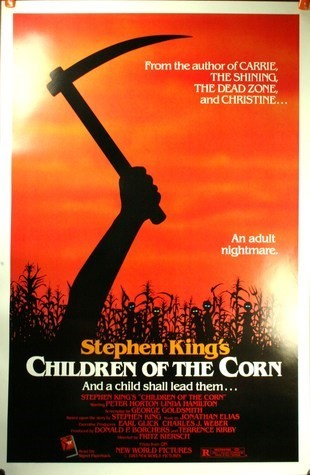
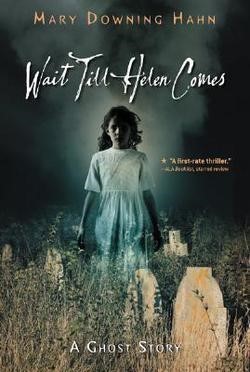 Pretty big difference, eh?After reading this book, I felt I’d graduated to another level of paranormal.At a garage sale, I bought some Stephen King novels:CarrieandChildren of the Corn. And this is when my mother really started to worry. When I tried to name my cat Malachai, after a character in Children of the Corn, my mother rolled her eyes and said, “I am not calling that cat Malachai.”She called the cat Puddin’ and eventually I did too.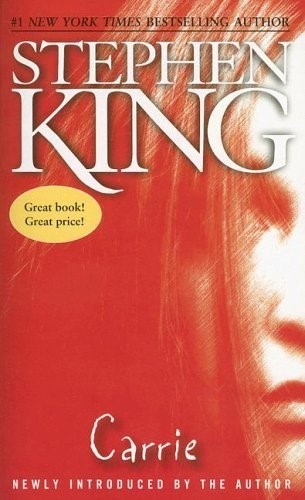
 In my freshmen year of high school, I was asked to write a sensory engagement essay. I wrote about being buried alive and the sensations of suffocating and trying to dig my way out.My English teacher was also worried.I should note, however, that my interest in the occult did not cross over into my actual life. I had no delusions of actuallybeinga magical creature, despite my fascination with reading about them. So, while my English teacher mentioned to me she was worried, she never contacted my parents. She wasn't terribly concerned that I’d crossed over onto a dark, unreasonable path. My mother did mention I was wearing too much black a few times but I assured her I was just in it for the slimming effects, not the “I’m a witch,” facet.Interestingly, the Harry Potter generation doesn’t feel the need to explain this for themselves. But I came from a different era and the adults in my life were leery.But – this is important –they never asked me to stop reading.So I didn't.
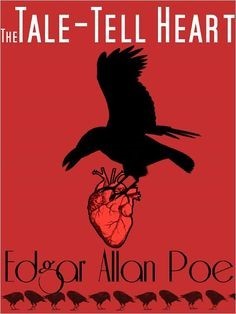 After readingThe Tale-Tell Heart, Poe became a deep favorite of mine. It was a one-sided love affair in which I imagined the possibility of anyone ever loving me as he lovedAnnabel Lee. I also readFrankensteinandDracula. (All assigned to me through excellent high school Lit classes).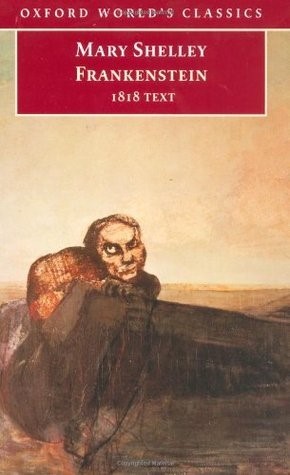
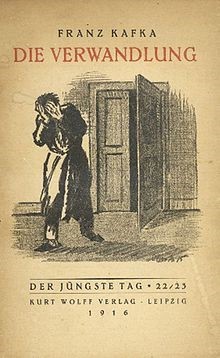
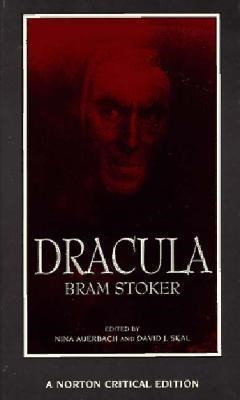 And then, somewhere around my senior year, I discovered Jane Austen. And my reading life shifted to the magical world of 19th Century English literature. (That’s a list for another day.)College was an exciting time for reading and discovery, but I generally didn't attend to the paranormal during those years. One notable exception to that was Kafka’sMetamorphosis, Which is a phenomenal Halloween read.In fact,if you haven’t read it, start with that one. It’s just a novella, so it won’t take too much of your time. I found this work so outrageous and disturbing, I read parts of it aloud to my boyfriend (now husband) on a cross-country road trip. I can still taste the thrill on my lips as he drove us along and Kafka’s words dripped from my mouth like a horror story and we both marveled over the brilliance.
 After college I got serious about writing my own books and curved my reading life toward research of the young adult genre. And this base, to my delight, has recently taken a turn back to the occult of my younger years. (Thanks again, I believe, to Harry Potter.) So I’ve read Twilight (some of them, anyway), theVampire Academyseries (much stronger characters, though not as much of a following), and a few of Gregory Maguire’s brilliant retellings of fairy tales from the villain’s point of view. SUCH a great concept, and one that really took off withWicked.
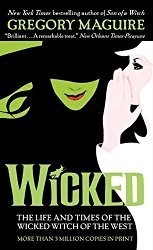 I’m sure you’ve heard of Wicked, the Broadway show. But it actually started out as Wicked, the fantastic novel about a misunderstood girl who somehow ended up as the villain, to no fault of her own. I loved this book so much I met some friends in NYC in March of 2003 just to see the show. We were fortunate enough to see it with the original Broadway cast and I will never forget that experience. After the show we went for coffee and discussed the differences between the book and the show. We talked about the powerful chill bump-inducing voice of Idina Menzel (who would later use that power to grab the hearts of girls everywhere with “Let it Go”) and the hilarity that ensued when a set piece didn’t move the way it was supposed to and Kristin Chenoweth made a joke, tapping her wand as if it were broken, then lost her place and sent Menzel into fits of laughter.There is nothing like live theatre, folks. Nothing.What was the purpose of this blog post again?Oh, yeah. What to read NOW as I wait for the mysterious fog of Halloween to roll in?I’m currently reading the fourthHarry Potterbook to the kids. We’re taking it slower than normal. I don’t want to dive into the darkness of these last four novels too quickly.
 But outside of that, I want to curl up with a book on my own, warm drink in hand, snuggled into my reading chair, dreaming of witches and goblins and ghosts and ghouls. And decorate my house with black candles and pumpkins.Here’s some I’ve read recently that I highly recommend:
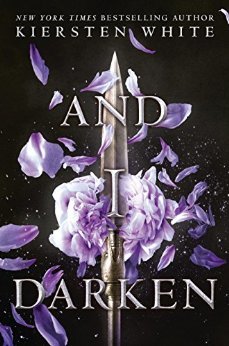 And I Darken:Brilliant retelling of Vlad the Impaler in female form. Brutal, angry and twisted. Could not put it down.
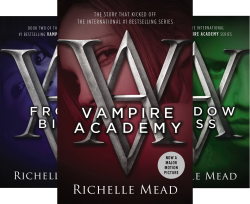 Vampire Academy:I know, I KNOW, vampires have gotten a bad rap recently, thanks to the arrival of the sparkly ones. But this series isn't like that. The main character has a vague Katniss-ness about her that redeems the genre.
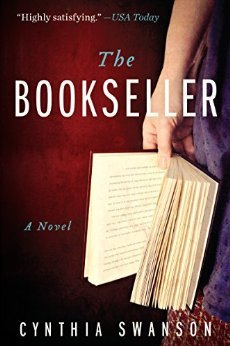 The Bookseller:Fantastic concept. The anticipation of discovering what was true and what wasn't kept me reading until I absolutely had to attend to my own life. Great read.
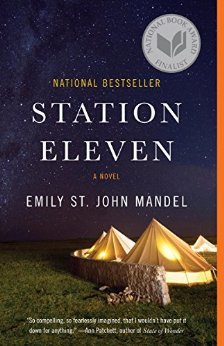 Station Eleven:I can't explain the beauty of this book. The simple act of survival, the looming threat of something we all fear, the connection points of all the characters. It's well put together and poetic in its misery.And here’s what I’m reading now:
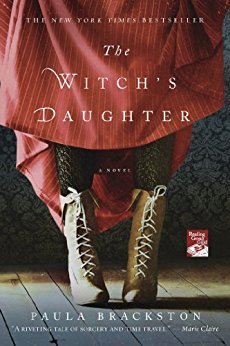 The Witch’s Daughter:It's good so far. Sufficiently creepy.And finally, what’s on my To Read shelf:Miss Peregrine’s Home for Peculiar Children:My kids are dying to see this movie NOW. But I want to read the book first. We'll see who wins. ;)The Witch of Portobello:by the incomparable Paulo Coelho. I may just let the kids see the movie and skip to this one.The Night Circus(I actually started reading this one on my Kindle a few years ago. But then my son dropped my Kindle and broke it and I’ve been meaning to get back to it since.)The New York Regional Mormon Singles Halloween Dance:just because it sounds awesome.Happy Halloween Reading!
Now is the time for witches and goblins, potions and spells and for the line between imagination and reality to blur. This is our time, we lover of tales and tellers of story.It’s time to read something wicked and fun.My love of paranormal literature first sparked when my sixth grade English teacher let us pick books from a cart to read and review. It pains me that I cannot remember this woman’s name, but the projects she engages us in were unique and memorable. A few I prominently recall were reading Dante’s Inferno and creating our own circles of hell, and researching lines from “We Didn’t Start the Fire” by Billy Joel and presenting our findings to the class. Great lesson plans. But the project that triggered a lifetime love in me was simple: pick a book from the cart, read, review.By the time I got to the cart (my last name being Vann), it was picked over. Only a few books remained. But there, waiting for me, like a soul mate, wasDouble Trouble. The main characters of this book are twins. Their parents have died and the siblings have been separated, the boy entering into the foster system. But they can still be together because they have perfected the powers of ESP and astral projection.What I found memorable about this book wasthey learnedhow to do these things. If they could learn how to ease their souls out of their bodies and fly around, so could I. Right? For a month after I read this book, I lay in bed at night, willing my soul into astral projection. Didn’t work. But still. The book was cool. And it was much different from my usual: Sweet Valley Twins and The Babysitters Club.Then, at a sleepover, I was introduced to theFear Streetseries by R.L Stine. On my friend's bookshelf were these interesting-looking books with creative, frightening covers. I couldn’t help but wonder about them. She let me borrow one and I was immediately hooked. After that, my trips to the Waldenbooks at the mall, where I always went straight to the section in the back to smell the new arrivals, changed. Fear Street was sold in a different section (away from the bubble-gum covers of the SVT). I felt very sophisticated.R.L. Stine is better known for the series he wrote later on –Goosebumps. I was excited when that movie came out because it introduced my kids to one of my favorite authors. Even though I never read the Goosebumps series, it was a great reprise of Stine's stories. I completely geeked out toward the end when R.L. Stine passes the characters in the hallway at school. Jack Black says “Mr. Black,” to R.L. Stine and R.L. Stine says “Mr. Stine” to Jack Black. Simple, elegant, beautiful cameo that only a lover of Stine’s work would notice.After Fear Street I readThe Secret Circle, a series by L.J. Smith about a coven of witches trying to navigate high school. If Double Trouble introduced me to this genre, and Fear Street pulled me in, it was The Secret Circle that solidified my existence in it. I dreamed of finding a coven of witches to join; powerful, snarky girls who would accept me as one of their own. At that time, there were only three of these books. But in 2012 and 2013, three more were released. I may have to go read those. Just to complete the circle. (See what I did there?)The Secret Circle was turned into a television series in 2011 (perhaps by someone who read these books when they were younger?). Britt Robertson played the main character Cassie Blake. This adorable actress has been in a lot lately, but I mostly remember her as Steve Carell’s emotional daughter in Dan in Real Life. The real gem of IMDB crossover information, however, is in Thomas Dekker. He resurrected my nostalgia as the tormented Adam in The Secret Circle, but really shined a few years later in the Backstrom series, as Gregory Valentine. Also tormented, but more realistically (and hilariously) so, less of a “poor-me-I-can’t-decide-whom-to-love” teenage angst kind of way.L.J. Smith also wrote The Vampire Diaries, which – as we all know – was also turned into a television series. I never read these books and though I did binge watch the series for a while, I didn’t make it to the end. There’s SO many episodes. And I think it became quite a struggle after a while to hold that love triangle together. Who’s a vampire this week and who’s not? Who’s worthy of Elena’s love this week and who’s not? Who has time for that?After The Secret Circle, I readTrick or Treatby Richie Tankersley Cusick,The Witch of Blackbird Pondby Elizabeth George Speare, andWait Till Helen Comesby Mary Downing Hahn.Though the cover of Wait Till Helen Comes looks tween-friendly, it was a creepy read. The main character moves with her family into an old church, which has been converted into a house. This concept struck me as very cool. But also nuts, since the backyard of the old church was a graveyard haunted by a ghost. The ghost seems to have good intentions at first but then she doesn’t.More recently, this book attained a new cover that better conveys its true level of creepy.Pretty big difference, eh?After reading this book, I felt I’d graduated to another level of paranormal.At a garage sale, I bought some Stephen King novels:CarrieandChildren of the Corn. And this is when my mother really started to worry. When I tried to name my cat Malachai, after a character in Children of the Corn, my mother rolled her eyes and said, “I am not calling that cat Malachai.”She called the cat Puddin’ and eventually I did too.In my freshmen year of high school, I was asked to write a sensory engagement essay. I wrote about being buried alive and the sensations of suffocating and trying to dig my way out.My English teacher was also worried.I should note, however, that my interest in the occult did not cross over into my actual life. I had no delusions of actuallybeinga magical creature, despite my fascination with reading about them. So, while my English teacher mentioned to me she was worried, she never contacted my parents. She wasn't terribly concerned that I’d crossed over onto a dark, unreasonable path. My mother did mention I was wearing too much black a few times but I assured her I was just in it for the slimming effects, not the “I’m a witch,” facet.Interestingly, the Harry Potter generation doesn’t feel the need to explain this for themselves. But I came from a different era and the adults in my life were leery.But – this is important –they never asked me to stop reading.So I didn't.After readingThe Tale-Tell Heart, Poe became a deep favorite of mine. It was a one-sided love affair in which I imagined the possibility of anyone ever loving me as he lovedAnnabel Lee. I also readFrankensteinandDracula. (All assigned to me through excellent high school Lit classes).And then, somewhere around my senior year, I discovered Jane Austen. And my reading life shifted to the magical world of 19th Century English literature. (That’s a list for another day.)College was an exciting time for reading and discovery, but I generally didn't attend to the paranormal during those years. One notable exception to that was Kafka’sMetamorphosis, Which is a phenomenal Halloween read.In fact,if you haven’t read it, start with that one. It’s just a novella, so it won’t take too much of your time. I found this work so outrageous and disturbing, I read parts of it aloud to my boyfriend (now husband) on a cross-country road trip. I can still taste the thrill on my lips as he drove us along and Kafka’s words dripped from my mouth like a horror story and we both marveled over the brilliance.After college I got serious about writing my own books and curved my reading life toward research of the young adult genre. And this base, to my delight, has recently taken a turn back to the occult of my younger years. (Thanks again, I believe, to Harry Potter.) So I’ve read Twilight (some of them, anyway), theVampire Academyseries (much stronger characters, though not as much of a following), and a few of Gregory Maguire’s brilliant retellings of fairy tales from the villain’s point of view. SUCH a great concept, and one that really took off withWicked.I’m sure you’ve heard of Wicked, the Broadway show. But it actually started out as Wicked, the fantastic novel about a misunderstood girl who somehow ended up as the villain, to no fault of her own. I loved this book so much I met some friends in NYC in March of 2003 just to see the show. We were fortunate enough to see it with the original Broadway cast and I will never forget that experience. After the show we went for coffee and discussed the differences between the book and the show. We talked about the powerful chill bump-inducing voice of Idina Menzel (who would later use that power to grab the hearts of girls everywhere with “Let it Go”) and the hilarity that ensued when a set piece didn’t move the way it was supposed to and Kristin Chenoweth made a joke, tapping her wand as if it were broken, then lost her place and sent Menzel into fits of laughter.There is nothing like live theatre, folks. Nothing.What was the purpose of this blog post again?Oh, yeah. What to read NOW as I wait for the mysterious fog of Halloween to roll in?I’m currently reading the fourthHarry Potterbook to the kids. We’re taking it slower than normal. I don’t want to dive into the darkness of these last four novels too quickly.But outside of that, I want to curl up with a book on my own, warm drink in hand, snuggled into my reading chair, dreaming of witches and goblins and ghosts and ghouls. And decorate my house with black candles and pumpkins.Here’s some I’ve read recently that I highly recommend:And I Darken:Brilliant retelling of Vlad the Impaler in female form. Brutal, angry and twisted. Could not put it down.Vampire Academy:I know, I KNOW, vampires have gotten a bad rap recently, thanks to the arrival of the sparkly ones. But this series isn't like that. The main character has a vague Katniss-ness about her that redeems the genre.The Bookseller:Fantastic concept. The anticipation of discovering what was true and what wasn't kept me reading until I absolutely had to attend to my own life. Great read.Station Eleven:I can't explain the beauty of this book. The simple act of survival, the looming threat of something we all fear, the connection points of all the characters. It's well put together and poetic in its misery.And here’s what I’m reading now:The Witch’s Daughter:It's good so far. Sufficiently creepy.And finally, what’s on my To Read shelf:Miss Peregrine’s Home for Peculiar Children:My kids are dying to see this movie NOW. But I want to read the book first. We'll see who wins. ;)The Witch of Portobello:by the incomparable Paulo Coelho. I may just let the kids see the movie and skip to this one.The Night Circus(I actually started reading this one on my Kindle a few years ago. But then my son dropped my Kindle and broke it and I’ve been meaning to get back to it since.)The New York Regional Mormon Singles Halloween Dance:just because it sounds awesome.Happy Halloween Reading!