L.J. Breedlove's Blog
October 2, 2022
A visit to the garden
One of my favorite places in Portland is the Lan Su Chinese garden in Chinatown — Old Town, the city marketers are trying to call the area now, but Old Town is south of Burnside, Chinatown is north to an old Portlander like me. When you pass through the red Chinese gates, you know you’re there.
It was always kind of a seedy place. A lot of dive bars, dance places, small curious shops that never seemed open. It never seemed like the streets themselves were as clean as the rest of Portland. There were more street people, some drinking from bottles in paper bags.
Then there were the Shanghai tunnels….
I loved it.
At its heart, for decades now, is the Lan Su garden. It covers a city block, and was built in collaboration with a sister city in China. It is a scholar’s garden.
When China invented bureaucracy, it created a class of city administrators who passed very stringent tests. Those at the top were expected to be proficient not only in administration, but in the arts: poetry, painting, literature. And gardening. A scholar’s garden incorporates all of that.
I do wonder how our society might be different if our leaders aspired to be scholars, artists and gardeners.
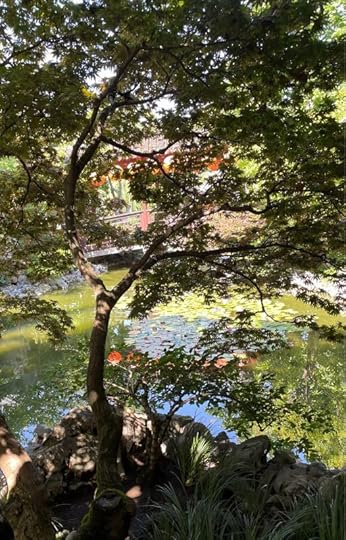 The koi pond through a pine tree. The orange paper lanterns reflected in the pond below.
That form of administrative governance no longer exists in China of course, but the garden tradition does. And Portland is fortunate to have one, designed with the city and the neighborhood in mind.
The tough times have been hard on Portland, and Portland’s leadership has failed in providing basic services. (Haven’t talked to a Portlander yet who didn’t describe the mayor as having his head up his ass. Or sometimes, if they’re polite, he’s in over his head. My mind tried to combine the two images, of course. Don’t do it.) And that’s apparent in Chinatown. The streets are dirty, the garbage is overflowing.
And the Garden is struggling because people have been put off by media portrayals and the Cassandras of the police department, and the mayor who has his head up his ass.
Shortly before I visited Portland in August, Steve Duin, a long-time columnist at the Oregonian had this to say:
Elizabeth Nye always imagined Lan Su Chinese Garden as an Old Town oasis.
A monument to the endurance and grace of Asian immigrants. A tea-house window into Chinese culture in an age of rising anti-China rhetoric. The inspirational ground-zero for the revitalization of Old Town.
A showcase.
And that’s precisely what the garden block is this summer, only in ways Nye never envisioned
Lan Su is hostage to the twin plagues of rats and methamphetamines in downtown Portland. It’s testimony to the cavalier abandonment of community policing by a demoralized, understaffed police bureau. And the Chinese Garden finds no relief in the defensive, uncoordinated “leadership” at Multnomah County and the city of Portland.
I could spend a column just picking apart Duin’s opening paragraphs (demoralized and understaffed police bureau, my ass). Instead, I made a point of visiting the garden. It had been a while since I was there — like most people, I hadn’t traveled much during the pandemic. A trip to Portland the summer of 2021, and again this summer is about it. I miss traveling.
Back to Lan Su. I drove around the neighborhood, parked in front of the garden, which told me a lot about the lack of garden visitors. I usually had to hunt for parking. I got there in time for a tour, led by an excellent older man who looked like he ought to be on the docks in Winchester Bay telling sea stories. (And my dad would have been right there, matching him story for story.)
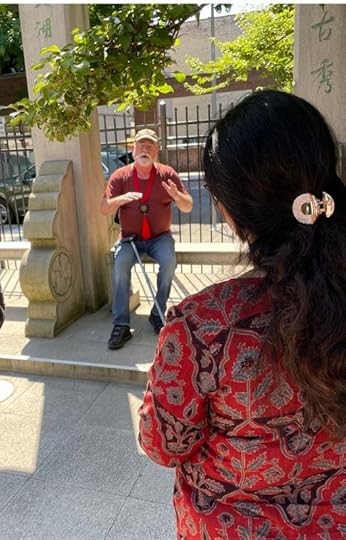 The tour guide at Lan Su garden in August.
I pried a bit into his background, but he was more interested in talking about the garden. Informed, witty, gentle, he was a man with a passion for the garden. It was a wonderful way to spend the afternoon. After the tour, I talked to some clerks in the gift shop. And like most true Portlanders, they shrugged at the increasing number of street people, and fumed about the government’s inability to provide basic services. Not the people’s fault, the young woman said. Her older coworker nodded.
The mayor has his head up his ass, she said. He’s so overwhelmed, he doesn’t know what to do. And hiring Sam Adams isn’t going to help. We gossiped about city politics and Portland’s colorful and often contentious politics.
They too loved the garden. And they thought the tour guide was wonderful: He’d lived in the neighborhood for years. Raised show dogs for a while. He said he learned Chinese culture, because he’d married young into a traditional Chinese family in Portland. Damn, I want more of his story. I think the two women had a mild crush on the man — fair enough, so did I.
Leaving, I drove through the maze of one-way streets. Dirty streets. Overflowing garbage cans. Those are things the city of Portland could do something about. The fact that they don’t — and then blame the problems on homeless people — is disturbing.
So, I came home, and knew I where the next Newsroom PDX story had to be located — Chinatown. Ellison Lee, one of the TV anchors, takes center stage in Who Can I Tell?, book 18 in the series. He’s living a double life, well triple, if you count the one he tells his parents. His alter-ego, E. Lee, dances at the Stag, a gay bar in Chinatown. Miguel Garcia is back, still covering the homeless community. And their lives converge because someone is throwing lit hibachis at homeless camps. (Truth, it was a thing in Portland a while back.) Rumor has it, it’s a frat initiation stunt.
If you get the chance, visit the Lan Su garden. Take a tour. If you’re lucky, John will be your guide. Have tea. Celebrate the heart of Chinatown.
And you can pre-order Who Can I Tell? wherever you buy your e-books. Always best to read a series from the beginning, but you can drop by the EWN Newsroom in Portland at any point. They won’t hold it against you. Might put you to work.
I left the garden, had Thai food at Peacock Thai (wonderful) not far from Powell’s, and then went up to the art museum for its show of photos from Black and Indigenous photographers during the 2020 George Floyd protests. Also wonderful. I encourage you to visit there too.
Portland is a great city, and doomsayers miss its resiliency. I hope I capture that in Newsroom PDX. Enjoy.

The post A visit to the garden appeared first on Telling Stories.


August 2, 2022
Book Review
The Murder Gene, by Karen Spears Zacharias.
This true crime story is written by one of my oldest friends, so I’m not exactly objective. Fortunately I don’t have to be, it’s an interesting story, well told. In 2012, a man murdered a young woman in Pendleton, Oregon, a victim selected at random. A year later, he attempted the murder of a second woman, and was caught on video, tried and convicted.
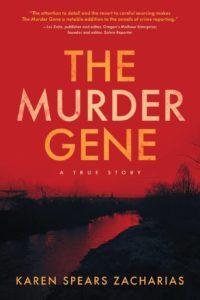
But Karen weaves a more complex story than that — the story of a son of missionaries who loses his way and a story of the eerie link to his grandfather’s similar murder spree 40 years before. Is there a case to be made for a murder gene? Can genetics give us an insight into why men kill?
So Karen talked to me about the story as she researched. It made me uncomfortable, actually, because humans have frequently sought to label certain groups of people as more likely to be criminals — eugenics. Right-wing racists. Self-righteous missionaries. The list is long, unfortunately. But the science that Karen explores in this book isn’t about groups of people, it’s about a genetic defect that some individuals carry, that makes them prone to violence — just as a person might have inherited a defect that makes them more prone to diabetes or hemophilia. And apparently scientific studies show that many of those convicted of violence have such a genetic defect.
Karen is a phenomenal storyteller. She weaves the two narratives of grandfather and grandson with the cutting edge science. She’s a former journalist and it shows. She has never been afraid to ask people questions. (Trust me, we go back to age 20, and she’s not shy about asking a question. Any question.) She tracked down the people who knew the murderer and his family, as well as those who knew the victims, knew the police involved in both men’s sprees. And she asked questions. Not everyone answered, but more did than you might think.
She and I might disagree about the role religion played in the grandson’s life. She describes the events that followed as happening in spite of his Christian upbringing. I might argue it was because of the extreme narrowness of his upbringing. But she makes a compelling argument for the genetic component of violence. Highly recommend. Available at Amazon.
The post Book Review appeared first on Telling Stories.
July 24, 2022
PDX 2020
This came up in my Facebook feed recently. You know, that feature, you have memories to look back on? It seemed particularly relevant to today’s headlines about the Jan. 6 attempted coup.
Because before Jan. 6, there was Portland.

Isabelle Allende has famously said, “write the stories that must not be forgotten.” And as horror upon horror is revealed on our nightly news, it is easy to forget that what happened on Jan. 6, 2021 did not happen in a vacuum or came out of nowhere. It had been playing out in Portland for years.
I’ve told stories so that they wouldn’t be forgotten — as a journalist, as an academic and now as a novelist. And all those methods contribute to our understanding of the world around us. But of all the stories I’ve told, I think the suspense novels of Newsroom PDX might be the ones I prize the most.
You can start the story with Choose, book 1, for $.99 or jump in with the first omnibus that includes the first three books.
And it’s a story that’s not finished. Before Jan. 6 was Portland, a recent Oregon Public Broadcast headline read. But Portland still is targeted, still struggles. And so the story continues.
Newsroom PDX: “Dystopian fiction from today’s headlines.”

The post PDX 2020 appeared first on Telling Stories.
July 17, 2022
NOBODY’S FOOL
Even Heroes Make Mistakes
Lanky Purdue is an Alaskan icon. He’s been there forever — the dashing Air Force pilot, the man who flew medicines into villages in dark winters, the man who has rescued more stranded climbers than anyone can count. If you need help, Lanky Purdue is the man you go to.
So when Belle Robards shows up at Purdue Flight Service in the dead of winter looking for help, it’s no great surprise to Dace Marshall, his office manager. So yes, she’s wearing a skirt, high heeled boots and a fur jacket — in Talkeetna at 10 below — and she won’t tell Dace what the problem is. But Lanky wouldn’t fall for a pretty face and a bogus sob story.
Would he?
Book 4 in the Talkeetna series featuring Candace Marshall and Police Lt. Paul Kitka. Out Sept. 6. Pre-order here.
The post NOBODY’S FOOL appeared first on Telling Stories.
June 29, 2022
Reading about Internment Camps
The internment of Japanese Americans is part of the historical backdrop for the Wolf Harbor series. Here are three books that I picked up to supplement academic knowledge I already had. I’m finding that graphic novels and accounts — especially those aimed at teens — fill in the emotional gaps that research papers and scholarly books aren’t designed to address. Reading widely is important! These books helped me create what I hope was a respectful backstory of what the Japanese Americans faced in the internment camps of WWII. (Remember please that Wolf Harbor is fiction. Good fiction, I hope. But fiction — which means I made stuff up — nevertheless.)


Impounded, Photos by Dorothea Lange. Edited by Linda Gordon & Gary Okihiro. (2006) Dorothea Lange is best known for her pictures of the migrant families of the Dustbowl. But she also photographed the impoundment of Japanese-Americans — only to find her work impounded as well. Most of the photographs weren’t allowed to the public until much later. The essays from the two editors are also illuminating, using Lange as a lens to examine the censorship that surrounded the incarceration of Japanese-Americans, based solely on their race.
I’ve always admired Lange’s work. She’s amazing. And these photographs are worth studying — for both content and style. The content will break your heart. They chronicle a story of a people who, in spite of everything, valued their dignity, created homes from nothing, and faced endured the hardships and mistreatment of the camps.
They Called Us Enemy, George Takei. (2020). I was a Star Trek fan from the very beginning, and so of course George Takei is an early hero. And as I’ve aged, and as he’s aged, I’ve found new reasons to admire him for his advocacy on so many fronts. This is a graphic novel that tells the story of his own family as they were forced into an incarceration camp when he was a child.
I’ve become interested in the form of a graphic novel lately — and find them an interesting way to fill in the gaps of my knowledge on a subject in my own writing. Usually aimed at middle school and high school students, they’re worth checking out for us adults too.
I’m ABD (all but dissertation) in multicultural education, so I’ve read scholarly research and historical accounts of the Japanese-American incarceration camps. But a story like this one makes the reader feel the events in a way that facts and historical accounts don’t necessarily do. I think of my research for the books I write as filling in the gaps. And often those gaps are emotional not factual. (You should see the reading list for Newsroom PDX and the diverse students in that book! LOL.)
Displacement, Kiku Hughes. (2020) This one is fiction, a time-travel novel also aimed at teenagers. A Japanese-American girl from the present is transported back to the camps where her mother spent her youth. Some of the reviews of the book criticized it for the science fiction aspects, saying they would have preferred a straight non-fiction narrative. Which is silly, quite frankly. We can tell stories in a variety of ways, and this is one that would work especially well for teens who might not pick up a non-fiction narrative. There is room for both — for a plurality of voices telling stories in a plurality of ways.
I recommend it.
The post Reading about Internment Camps appeared first on Telling Stories.
June 22, 2022
Before Jan. 6, there was Portland….
Here’s the headline from yesterday’s @OPB First Look newsletter. And oddly echoing the headline for the suspense series Newsroom PDX. https://ljbreedlove.com/newsroom-pdx/
Sometimes we need good fiction as well as good journalism to help us understand…/1
@ljbreedlove2, 6/22/2022Before Jan. 6, there was Portland….
— LJBreedlove (@LJBreedlove2) June 22, 2022
Here's the headline from yesterday's @OPB First Look newsletter. And oddly echoing the headline for the suspense series Newsroom PDX.https://t.co/IMiPb5Krr3
Sometimes we need good fiction as well as good journalism to help us understand…/1 https://t.co/RIzQ98eSlN
So we’re reversing things today. This links to a Twitter series of posts about the OPB article and Newsroom PDX. So follow the link, to finish the essay, and comment there, if you would. (And give me a follow, while you’re there? This is my secondary account that focuses primarily on Portland, that I use for research. It could use some love, however.)
I’ve been thinking a lot lately about the need for both good journalism and good fiction to help us understand the the reality of events of this magnitude. I’ve written both (at least I hope both my journalism and my fiction were good). Journalism offers us the facts, the events of the day, a variety of perspectives, and a whole host of other things to inform us. But it can’t take us inside the heads of people in the way fiction can. (Although talented writers such as Tom Hallman of the Oregonian come close. He’s practically invented a whole new form of storytelling, and has a Pulitzer to prove it.)
Fiction, however, allows us to become people who aren’t like us, for the duration of a book at least, and we walk away changed by the experience. We can all name books that did that for us. And it doesn’t have to be a monumental work of fiction. Walter Farley’s Black Stallion made me crave adventure at age 8, a taste I’ve never lost. Ditto with Robert Heinlein’s Have Spacesuit Will Travel. My friends laugh at me, because I would still go into space, if given the chance, even if it meant close confines with Elon Musk. I never lost that sense of wonder and adventure either.
That doesn’t mean I base my understanding of the Middle East or space, either one, on those books. A lot of good journalism and non-fiction books have educated me on both topics since I first read those books. But that sense of wonder? Of adventure? Yes, that was fiction’s contribution to who I am.
So read the journalism. Read the fiction. What happened these last two years cannot go unforgotten.
OPB Jun 21As U.S. House committee hearings continue on the Jan. 6, 2021 attack on the Capitol, it is clear the violent day was the culmination of years of political violence. Oregon and other states served as training and ideology testing grounds. By @_jlevinson: https://opb.org/article/2022/06/21/ho...
— Oregon Public Broadcasting, June 21, 2022
The post Before Jan. 6, there was Portland…. appeared first on Telling Stories.
June 10, 2022
And then this happened
Here’s the two stories from the Oregonian. (I hope you can access them.)
Story breaks: Former controversial sheriff to speak at school resource officer training.Follow up story: Protests ensue, he’s cancelled.Controversial ex-sheriff from Wisconsin. I saved the first story without reading it, because it’s the kind of thing I might use for one of the Newsroom PDX books. If you’re not familiar with that series, it is about a college newsroom in downtown Portland dealing with the issues of last two years: protests, pandemic, policing, white supremacy and now homelessness, amidst all the personal issues of being 20-something in Portland. I highly recommend the series, LOL, so check it out! (Links at the bottom, so you will read first, then click….)
And a few days later, the organization — the Oregon School Resource Officers Association — canceled the speaker saying they didn’t want a speaker who would be offensive even some of the participants.
If any presenter, in the eyes of some, is going to damage our credibility and/or ability to fulfill that mission, then we will make the necessary changes,” wrote Mike Jackson, association president, and Rick Puente, association vice president. Days earlier, both had defended the choice of Clarke as a guest speaker, saying they weren’t interested in his politics.
— Oregon Live, June 10, 2022
And I thought who are they talking about? Surely they didn’t invite David Clarke to talk about school safety? But there’s the photo.
 From the Oregonian’s website, oregonlive.com
And I’m like OMG, an organization that helps police departments who provide officers to schools thought David Clarke was an appropriate speaker? WTH?
And the Oregonian referred to him as a controversial former sheriff from Wisconsin? Are you kidding me?
I suppose they’ll invite the controversial former sheriff Joe Arpaio as his replacement.
So who is David Clarke? He’s a crazy dude who hates Black Lives Matter, and resigned after it was revealed that:
Four people, including a baby, have died in Clarke’s jails since April 2016. One man died of dehydration after being locked in solitary confinement and denied water. According to a lawsuit filed in March, at least 40 women in Clarke’s jails have been shackled while giving birth. One newborn died after a woman was forced to give birth in her cell without medical treatment.
Vanity Fair, September, 2017
He was considered for a post in Homeland Security by the Trump administration, but couldn’t pass the security questions in the Senate confirmation process (which in the Trump administration is truly astounding.) A frequent Fox commentator, he was known for his disparaging, and often racist, comments about Black Lives Matter, protestors, and his support for Donald Trump.
Now he’s on the speaker circuit. Here’s how he’s portrayed there.

Here’s how the Milwaukee Journal Sentinel describes him as a man who Fox won’t even have on its shows because he has been promoting violence.
“Stay disciplined in your anger,” he wrote in a (Parler) post accompanied by a photo of a growling lion. “The left needs to be shown that there WILL be an accounting for what they did to Trump and us for 4 straight years. They will regret this day. Trust God.”
Milwaukee Sentinel, January, 2021.
So what should the Oregonian headline have been?
Police Association invites far-right, former sheriff David Clarke to speak at a conference for school officers.Clarke resigned his post after deaths and brutality were revealed in his jail. He was noted for his promotion of violence toward liberals and Black Lives Matter protesters, and defended the actions of those on Jan. 6.
It boggles my mind that any police association would think he was an appropriate speaker for training purposes. But for school police? Really? A man famous for his promotion of violence against protesters and for the brutality in his jails is going to teach your officers stationed in our schools how to better serve the public? I’m not sure which I find more appalling, the original invitation, or the statement about canceling him, about not wanting to offend even a portion of our audience. Either the association leadership are supporters of far-right racist ideology or they are so ignorant they shouldn’t be allowed to train janitors much less school police.
Kudos to the person who spotted what was happening and brought it to the Oregonian’s attention, and to all who protested, and made them back down. Now either demand the resignation of the people who invited him, or boycott the organization. Hate shouldn’t be a part of the curriculum.
It’s not the only case like this where former police officers go on the speakers’ circuit and offer training to our law enforcement. Here’s a similar story from J.J. MacNab, who studies and writes about extremism:
Yikes. This is everything that’s wrong in law enforcement all wrapped up in one tidy tweet.
Quote Tweet
Sheriff Dave Marshak
May 27
If you are open to learning why kids kill, how to train LE to be warriors, and the consequences then start your journey here. Preparing police for battle requires work, which is why we are proud to host Lt. Colonel Dave Grossman @GrossmanAcademy and founder of #killology
@jjmacnab
Or this story out of Spokane:
Spokane cops read children’s book authored by controversial ‘Killology’ trainer to preschoolers
What we say we want from law enforcement isn’t what they’re being trained to do. If we train them to be warriors that’s what they become. If you teach them hate and racism, that’s what they know. To combat that, we have to work at the local levels, to take a serious look at how our police are trained.
And David Clarke, former sheriff and right-wing extremist, isn’t what we need.
Oh yes. Check out Newsroom PDX — one reviewer called the books ‘dystopian fiction from today’s headlines.’ And you can bet David Clarke as trainer for school police officers will be making his appearance one of these days.
Here’s where you can buy the omnibus version.The post And then this happened appeared first on Telling Stories.
May 30, 2022
Book Review: Gender Queer by Maia Kobabe
I write diverse characters, always have. But gender identity has gotten more complex in the last decade, and for Newsroom PDX I needed to upgrade. Newsroom PDX is about a college newsroom in downtown Portland during the protests and pandemic. Based on the newsrooms I’ve advised over years, including the one at Portland State University, Eyewitness News had to reflect gender diversity as well as racial and ethnic diversity. (Available wherever you buy your e-books.)
I asked around, and found two books that seemed like they would be helpful. And an extra benefit, they were both graphic novel style books. I’d been meaning to explore that, because I associate graphic novels with comic books, and it sounded like I needed an upgrade there too.
So, the first book was How to They/Them: A Visual Guide to Nonbinary Pronouns and the World of Gender Fluidity by Stuart Getty. Very helpful. I’d created two minor characters who used they/them, only they became major characters….
This happens as a writer. A character keeps tugging at you, so you include them in another book, and then another. And finally one day you think what’s going on with Character X, anyway? So you write a book centering that character.
And it became a real challenge to get the pronouns right every time, and to make sure the writing would be clear to the reader. They/them is easy in spoken words — you tend to know who the ‘they’ refers. But on the page, the inflections aren’t there. So do I mean ‘they’/Carroll? Or ‘they’/several people? And there are ways to deal with that. Getty’s book helped.
The second book is a memoir written by Maia Kobabe, called Gender Queer. It’s poignant, laugh-out-loud funny, informative, and kind. I loved it. And I truly believe it should be given to every girl when she starts her period. All of us can relate. So I’ve been recommending it to mothers of daughters as well as my own friends who are wondering what gender identity is all about.
And then Florida passed the Don’t Say Gay laws, and Texas decided it was illegal to provide health care to transgender youth, and Virginia and Tennessee were banning books in school libraries. I kept seeing the list of books, and many of them were familiar. Some I bought in solidarity. Ban a book? Watch it’s sales soar. It sends a message to the book banners: there’s more of us than there are of you.
(Actually, does someone want to start a petition to ban Newsroom PDX somewhere? I could use the sales.)
And one book, even liberal people agreed, probably shouldn’t be in middle school libraries, and maybe ought to be for only mature readers in high school. But ban it? No.
And I kept thinking, is that the book I’ve recommending?
And then Tennessee decided to label it obscene.
From the Virginian Mercury:
A Republican lawyer who serves in the Virginia House of Delegates is pursing restraining orders that would make two books unavailable to minors after a retired judge acting on behalf of the Virginia Beach Circuit Court found the books could be considered obscene due to explicit sexual content.
In an interview Thursday, Del. Tim Anderson, R-Virginia Beach, said he and his client in the case, Republican congressional candidate Tommy Altman, are now seeking temporary restraining orders that would prevent distribution of the books to minors by libraries and bookstores.
The books in question are “A Court of Mist and Fury,” a fantasy novel that contains sex scenes, and “Gender Queer,” a memoir about LGBTQ identity written in a graphic or comic book style format. It has come under fire from some parents over an illustration depicting oral sex. (Continue reading here.)
So I dug through my pile of HBR,NBR (have been read, needs book review) and sure enough, it was the book I’d recommending for all 13-year-old girls — Gender Queer. The other book labeled obscene is a best-seller science fiction book. It’s on my wish list, but everyone else who reads science fiction has read it and loved it, and told Amazon so. Its author dominates the best sellers list.
And Tennessee is trying to get it banned not just from school libraries but from bookstores like Barnes and Noble.
Gender Queer is the story of a child who doesn’t really identify as either male or female. As the child grows up, they experiment and explore their sexuality and their identity. (The reason I think all girls should read it as they begin their periods is Maia is horrified and decides for that reason alone they want to be a boy. I howled with laughter. All women everywhere can relate, I think.)
Is it graphic? Well, it’s a graphic novel and so there are these wonderful sketches that accompany the narrative. Is it more graphic in terms of sex? All the sexual exploration is consensual which puts it above a fair number of books that are required reading for students. (Here’s the Goodreads compilation of required reading for high schoolers, in case you’re interested. Doesn’t look like it’s changed much since I was in school.) I just did a database search, and Tess of the d’Urbervilles by Thomas Hardy is on the recommended list — in California, no less. But no Gender Queer.
Did I go ewww a couple of times? Yes, but I’m old. Would a kid? Maybe, but they’d like the book because of it, not be repulsed.
Book banners are extremely naive about what teens already know about sexuality. Trust me, there’s no sex act in this book that my friends in the seventh grade weren’t already talking about when I was in school, and that’s…. let me see, subtract that from that, recheck the math, is that really true?…. let’s just say it was decades ago, OK? Today’s kids? (insert lots of laughing emojis here. And an eyeroll or two.)
I keep wondering who the book-banners are visualizing when they say a book like this one is inappropriate for kids. To be honest, I think they have this fantasy of a protected innocent girl who is completely clueless about sex until her older, more experienced husband can initiate her to sex the way he wants it. Which combined with the Tennessee legislature also recently making it OK for someone to marry a 14-year-old, makes me wonder about them. Creeps me out a bit, really, because you’re protecting child molesters, and banning books about sex for the same age group? Hummm. Can we say Lolita Complex is alive and well in Tennessee?
So buy the book. Read it and decide for yourself if your child can handle it, and then give it to your kids to read. Most important, though, is to talk about the book and about sex with your kids after they’ve read it.
Because in Tennessee? Molesting 14-year-olds is OK if you ‘marry’ them, but reading about sex isn’t. Fight back with literacy and knowledge about sex and their bodies.
And vote the bastards out.
The post Book Review: Gender Queer by Maia Kobabe appeared first on Telling Stories.
May 20, 2022
Mount St. Helens
It’s been 42 years since Mount St. Helens erupted. There were warnings, people left — or didn’t leave and died — and people told stories about where they were and what they were doing when the volcano spewed ash over the Northwest. This is my story.
I was a young reporter, just at the beginning of my career in Ontario, Oregon, on the Oregon-Idaho border — a 7-hour drive from the volcano. (If you want to get from Portland to Boise, you will go through Ontario.) It’s a small town struggling to stay alive these days. But back then it was a thriving town, the economic hub for the area’s farmers. Although I hear there’s been somewhat of a renaissance of late — providing services to Idahoans that Idaho prohibits: marijuana, COVID care, women’s health care….
 From the Department of Interior files
The Argus Observer was a daily newspaper. I covered county government and the courts. And Vale city, because after all it was the county seat, and I was already there anyway. And since I was there, I ended up with the Bureau of Land Management, and for some reason, agriculture. And the sheriff’s office. Why? Because I was already there….
Small towns and their newspapers. They were still healthy then. Now there are whole regions without a newspaper at all — news deserts, they’re called. The fact that we have a name for it disturbs me. A place loses a part of its identity without its newspaper.
But this isn’t about any of that. It’s about being in a newsroom when the volcano blew. And answering the phones. Because it was wild.
One man called to tell us his theory: The eruption was caused by Ore-Ida. (It’s a potato processing company. Well, it’s a lot more than that, but in Ontario, it processed potatoes.) They’d sunk a very deep well recently looking for geothermal water — hot water. And as I recall they found it. It was a controversial well, for reasons I don’t recall. But my caller was convinced that there were all these waterways deep in the earth that were connected. Ore-Ida had tapped into it, and unbalanced the pressure causing the volcano to blow. I think that’s what he said. I thanked him for calling. (This theory actually took off. There were a lot of people who became convinced that Ore-Ida’s well caused Mount St. Helens to erupt. And no matter what experts said, they still believed it.)
Several called to ask anxiously if Malheur Butte was going to blow next. No, I told them, the butte (which looks like a… thumb… sticking up from the flat agricultural lands around it) is the core that’s left after the volcanic mountain erodes away. It can’t blow. Well, couldn’t lava from those connected runs deep in the earth blow up through it and push it out of the way? Well, no…. I was unimpressed with my callers scientific knowledge, and they were unimpressed with my lack of imagination.
And one guy called to tell me that a black stealth helicopter, full of government spec ops soldiers, all dressed in black, had landed in his backyard and forced him to give samples of bodily fluids (and he apologized for talking about them with a young lady). And he didn’t know why except he’d recently been abducted by aliens, and perhaps the aliens had something to do with Mount St. Helen’s blowing? I told him I didn’t know why they would either…. I actually considered calling for a mental health check on him. But the calls kept coming, and he began to seem relatively harmless.
And I learned some things that week that I’ve been thinking about this week, 42 years later, as we struggle to stay a democracy among people who believe Qanon conspiracy theories, deny scientific facts about COVID vaccines, and distrust the government.
One, we’ve always been a suspicious, ignorant, distrustful people. And proud of it, unfortunately. I talked myself hoarse answering calls that week and convinced no one who called in. Of course, the balanced didn’t call in. They read the news and went on with their lives. I hope.
And two? A looming catastrophic event pushed people who might have been only marginally balanced over the edge. There was a fair amount of panic and fear about the volcano. Would it blow again? Would the wind shift, and we would get a layer of ash on our farm lands and crops? What did this mean? Was it the end times? (Sigh.) Those who’s grip on reality wasn’t strong to begin with lost it.
The parallels to today, writ large by social media, make me think. Do those whose grip on reality isn’t all that strong sense a pending doom again? (Right or wrong?) And is the rise of the ignorant, distrustful, anti-science conspiracy theorists due to sensing we are living on the cusp of an environmental disaster? That climate change is real and the earth as we know it is changing? And that feral, survival-driven part of the hindbrain is reacting. We know something is coming. Something bad. And the unstable among us are scrambling for answers. (I didn’t realize there were this many of them, truthfully, but a lot of what I hear and read in social media remind me daily of the fearful and unbalanced who called about Mount St. Helens.)
Or maybe I’m now the marginally balanced one scrambling for an explanation of the disaster I see before us. Maybe. (No alien abduction, however. Or soldiers wanting body fluids. Too bad. Because that would be a hallucination worth having! Hey, I write suspense fiction, all right?)
Anyway, 42 years ago a volcano erupted. And that’s my story about where I was and what I was doing on that day.
The post Mount St. Helens appeared first on Telling Stories.
May 7, 2022
A Mother’s Day story
(This was a part of last week’s Telling Stories newsletter. The newsletter goes out every two weeks. On opposite weeks the Hat Island News has begun publishing. If you’d like to receive either newsletter, you can sign up by clicking the links above. There’s a free signing bonus with either one — a short story. I’d love to have you join us.)
I was listening to Think on NPR recently — Krys Boyd was interviewing a woman about memoir writing. A woman called in; she’d been assigned to write an essay about someone who had had an adventuresome life. She decided to do it about herself. Her friends and partner demurred; she should write it about her father, her partner said. He had lots of interesting stories.
So the caller goes on to talk about all the things she’d done in her life, and it was truly amazing and fascinating. And the memoir writer says, yes, this was exactly her point. Women aren’t allowed to be the center of stories, not even their own.
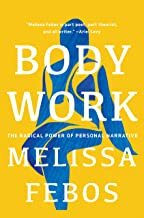
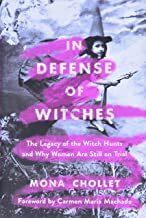
It hit me hard, and so I bought the book, Body Work by Melissa Febos, and it is now my breakfast reading — pushing aside a History of Witches by Mona Chollet which dovetails into Febos’ thesis in some ironic and painful waves. (Febos, it turns out, is a professor at University of Iowa who not only writes memoir but teaches it. And her first published memoir is about herself as a dominatrix. Yes, I’ve ordered it, too. Of course, I did.)
But this isn’t about Febos’ book, or Chollet’s, fascinating as they both are. And it’s not going to be some revelation about my own life, although Febos’ book challenges some of my own prejudices about memoirs. So maybe someday.
No, this is a long lead-in to a Mother’s Day story. Because listening to the caller talk about her life of adventure, and having it dismissed, made me remember my mother.
Mom died twenty years ago. She’d married at 32, late for her generation, and so, when she died at 77, I was 45. It was sudden, and none of us were prepared for it. She had two requests: She wanted to be buried in the cemetery in Union, Oregon, the town I grew up in, not where they were living now. Not that difficult, although no family member had lived in Union in 20 years.
And she wanted a Nazarene minister to perform the ceremony.
A bit more difficult. None of us attended church at that point, and Union had lost its Nazarene church when it grew too small to sustain a pastor. Word had it that the young minister in Baker City was a good man. So the call was made, and he agreed. And we all went back to Union to bury my mother.
The pastor asked to meet with us to talk about my mother, because he hadn’t known her, and he wanted to be able to personalize the message he would deliver. And so we did — in a motel room on a hot, dry-heat day, where the air-conditioner unit in the window couldn’t keep up. A minister, my father, two brothers, and me, perched on the beds and chairs, talking about Mom. Awkward. Claustrophobic. Miserable.
My father talked about how Mom was a good wife and mother, and told a rambling story that was more about him than her, but he was in his mid-80s, and us kids had heard the story before. We didn’t interfere; the minister had a brief frown, but he listened patiently.
My brother talked about her as a mother, about how she took their teasing good-naturedly. (She hated it, actually, but she never told them.)
And my other brother interjected that she was also a great teacher, and that a lot of people would remember her as a teacher, both at church and at school.
Pat Breedlove, wife, mother, teacher. They agreed — it’s on her tombstone even.
And the pastor looked at me and said, “you’ve been silent.” No one let me get a word in, to be honest.
I told him about my mother.
Dorothy Davis grew up poor in the Depression on a isolated homestead in the foothills of the Cascades. No running water, her father was disabled, and her mother took in laundry — and washed it in the creek — to keep the family afloat. She’d been born a premature twin, and even by the first grade she was thought to be developmentally slow — to the point where her teacher decided she wouldn’t be able to spell her real name, Dorothy, and made her use Pat — for her middle name of Patricia.
Surprising them all, she graduated from high school — just as WWII broke out.
Pat Davis went to work for the Navy in Seattle, down on the piers, a brave thing for a young woman on her own. Living in Seattle, working on the Navy Pier, adventures.
She became a Christian, and, after the war was over, she went to Northwest Nazarene College in Idaho. She wanted to become a missionary, and got a degree in education. She became an ordained preacher and ‘rode circuit’ throughout central Idaho in the early 1950s.
“Your mother was one of those preachers!” the minister exclaimed. “She was quite the pioneer then. She and women like her built this church.”
I nodded, because it was true. The Nazarene Church was an offshoot of the Methodists in 1908, and although a ‘plain’ church, allowed the ordination of women. And during the Great Depression and two World Wars, it was women who kept the denomination alive. My mother walked in their footsteps.
Mom also went to Chicago to teach literacy in the slums there, one summer. And when she came back, she went to the University of Washington and got a master’s degree in education.
“So not so dumb after all,” the minister said, appreciatively. “UW is not easy to get into.”
He and I had tuned out my father and brothers, who were making small noises that threatened to interrupt — this wasn’t the woman they remembered — nor wanted remembered.
Mom met my Dad, who had just retired from the Navy, when she was teaching back in her hometown. He had recently divorced and now had custody of his stepdaughter who happened to be in Mom’s English classes. Hallmark Channel cute. It was a whirlwind romance, and they married in 1955. I was born 9 months and 3 days later. (Those 3 days were important to my mother when she told this story.)
Mom taught most of their married life, first in the Seattle area where Dad worked as a guard for Boeing, and then when we bought the ranch outside Union, she taught in eastern Oregon as well. It was her income that kept the family — and the ranch — afloat. A common, and under-acknowledged, story among family farms.
She truly was a fantastic teacher, baby brother was right about that. (I bumped into one of her students when he became a colleague of mine at the university. Mom made him memorize Poe’s The Raven for fighting after school rather than turning him in for suspension. It changed his life, he said, now a professor with a PhD.) At her funeral, people came to speak of her who hadn’t seen her in 20 or more years but whose lives were changed because of her as a teacher, mentor, counselor — friend.
And me? I remember the woman who let me read whatever I wanted to. Although she was a devout Nazarene her whole life, she never banned a book. She loved literature — she taught high school English — and she passed that on to her kids and to her students.
(All right, once she ‘banned’ a book: I was 8, maybe, and found a book of hers, called the Valley of the Dolls, and was struggling through it (adult book) waiting for the dolls to show up. The book disappeared. LOL. The book is about the wild life and drugs of the rich and famous. She told me about it later. Much later.)
She was an amazing woman in her own right, although she would have described herself in the same way that my father and brothers did. She probably never realized how her independence and life inspired others as much as her ability to teach and to nurture a student’s intellectual growth.
I’ve lived an independent, and adventure-filled, life. And family often refer to my father as the source of my sense of adventure — his Navy years, buying the ranch, then a fishing boat and going to Alaska. (He couldn’t have bought the ranch without Mom as his partner, by the way. Just pointing that out. And Mom had her Navy years too — she once confided that she’d held a higher security clearance than Dad did. Which still makes me grin.)
But it was my mother, really, that I inherited it from. Her life showed me that a woman could do things, important things. She taught me to love books, and encouraged me to follow my interests no matter how contrary to the status quo (often my Dad) they might be. She believed in the power of the written word, and that service to others was the highest calling.
So Happy Mother’s Day, Dorothy Patricia (Davis) Breedlove. I miss you.
The post A Mother’s Day story appeared first on Telling Stories.