Leo E. Walsh's Blog: Leo's Realm
April 1, 2019
Tao Te Ching, Chapter 1
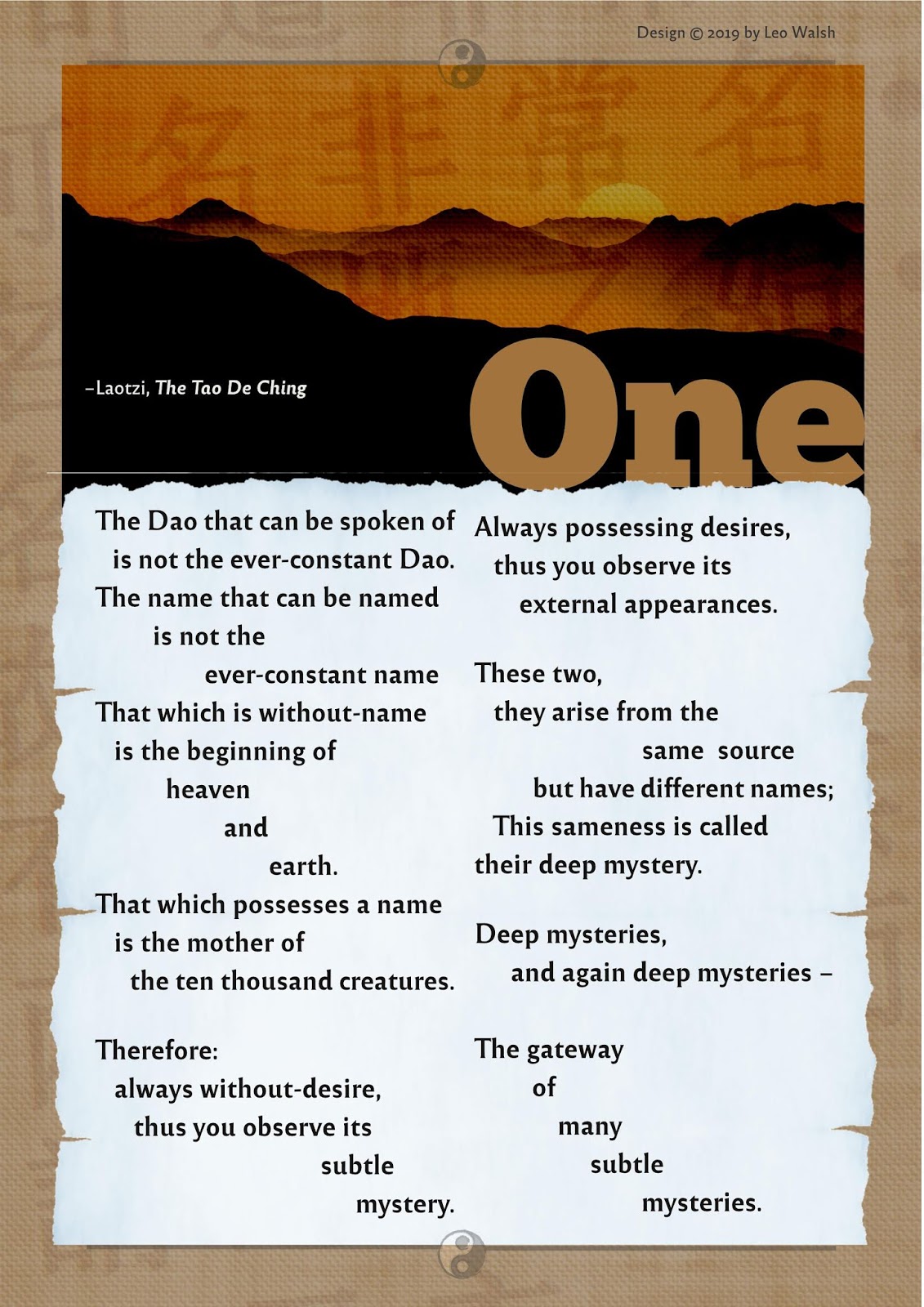 I've been creating an "Illuminated" version of Project Gutenberg's
Dao De Jing A Minimalist Translation
by Laotzi (translated by Bruce R. Linnell). It's a commission from Oberlin Editions Press via my friends at Deleon Designs. According to the contract, I'll maintain rights for all but the printed book.
I've been creating an "Illuminated" version of Project Gutenberg's
Dao De Jing A Minimalist Translation
by Laotzi (translated by Bruce R. Linnell). It's a commission from Oberlin Editions Press via my friends at Deleon Designs. According to the contract, I'll maintain rights for all but the printed book.At first blush, creating yet another version of the classic seemed pointless. I've seen dozens of illuminations online, albeit most look amateurish and/ or too "New Agey." Not that there'...


February 15, 2018
Eliot Ness and the Origin of Ideas
 Successful authors advise novice writers to read EVERYTHING. They maintain that good ideas may percolate from our subconscious and consuming diverse inputs creates more interesting percolations by increasing. Sort of how a better coffee bean creates a more robust, complex cup of coffee. This week, I experienced the wisdom of this sage advice.
Since National Novel Writing Month in November, I've been working on a novella set in Cleveland. I copped the working title, Build Break, Rebuild, from t...
January 7, 2018
Free College-Level Creative Writing Course Offered on Cousera
 I’m both writer and die-hard exerciser. However, cardio bores me. Sure, I love running outdoors. I dig the scenery (trees, clouds, animals, etc) breathing in the big-sky and soaking up rays. These satiate my sensual-mind. However, these pleasures do little to keep my thinking-mind from chattering, like a wild monkey, telling me “You’re wasting time.”
 To chill my skeptical monkey-mind, I ‘read’ several dozen non-fiction books per year while running. What can I say? I'm easy to dupe. I’ve...
December 14, 2017
'Build, Break, Rebuild' — a free novella on WattPad.
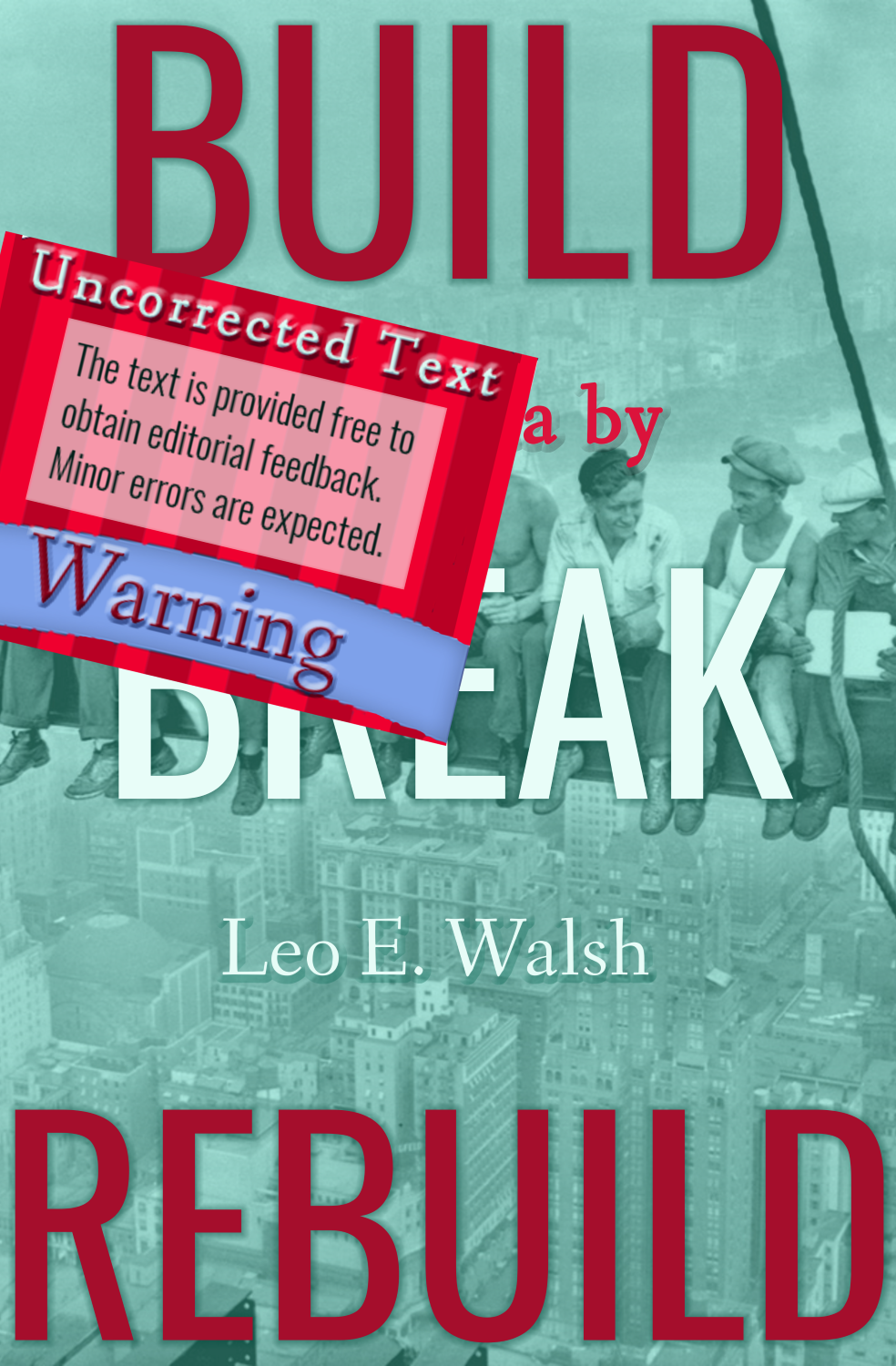 During National Novel Writing Month, I completed over 30,000 words. The result is an anti-racist. anti-fascist novella (not Antifa, who advocate anonymous violence) novella titled Build Break Rebuild. Which started out as a chapter for the novel I've been hammering away at, called Livewire Voodoo, but soon took on a life of its own.
I'm nearing the final edits and will print galley proofs for family and local writers group members in January. If you're interested, I am post...
BUILD BREAK REBUILD: a free novella on WattPad.
During National Novel Writing Month, I completed over 30,000 words. The result is an anti-racist. anti-fascist novella (not Antifa, who advocate anonymous violence) novella titled Build Break Rebuild. Which started out as a chapter for the novel I've been hammering away at, called Livewire Voodoo, but soon took on a life of its own.I'm nearing the final edits and will print galley proofs for family and local writers group members in January. If you're interested, I am post...
December 13, 2017
I'm Smart... But Kind of Dumb
 I’m smart. Not Stephen Hawking smart, but I received a good education and have a solid grasp on basic knowledge. In fact, my brain teems with trivia, leading my family to suggest I try out for Jeopardy. So I’m used to being right about facts. But a recent public error left me red-faced after I spent a few moments arguing an incorrect “fact” — which cannot be a fact if it’s false by definition.
Anyways, here’s the story. During a writer’s group meeting, I read from a burial scene set in Novembe...
May 5, 2017
Health Humbug vs, Science

Near Easter, a doctor diagnosed my mother, a 70-something retired school teacher, with Atrial fibrillation (AKA AFib). Since heart disease has a genetic component, and I’m getting no younger, I decided to clean-up my diet, which was better than most. I love veggies, fruits and fish, seldom eat processed food, etc. But after reading up on the Dash Diet, I added yogurt to my diet for probiotics.
And then I read I Contain Multitudes by Edward Yong. Yong sites research that revealed stomach acid kills most if not all of yogurt’s active bacterial cultures.So I fell for yogurt advertising BS. Hook, line and sinker.
Why is “eating well,” which should be easy, so difficult? Still, I like yogurt, probiotics or not.
Image Source: http://maxpixel.freegreatpicture.com/...
January 9, 2017
Fake News and Post-Truth: Does truth matter… or even exist?

“Does truth exist?” When I stumbled on this question on GoodReads, I rolled my eyes. Sophomoric, dorm room rap-session stuff. But the more I thought, the more I realized the inquiry relevant in contemporary “post-truth” society, rife with “fake news.”
My take is that facts matter, since they get us closer to reality. So by ignoring facts, fake news is dangerous. You cannot even run a household without facts. Like your checking account balance and electric bill amount.
Imagine ignoring those facts. You don’t like your utility, so you skip paying your electric bill. And you “pretend” your balance is higher than listed, so you write checks over your real balance.
The result? Checks bounce, and they cut-off your electricity.
Rationalizations and emotional fantasies DO NOT alter reality. In fact, they often lead to reality sneaking up on and smacking us. So basing political opinions on fake news can be dangerous.
Problem I see is that fake news exploits emotion. Consider that Facebook’s most shared “news story” over October was fake, containing conversations and emails that never happened. It’s untrue title is bombastic -- " Wikileaks CONFIRMS Hillary Sold Weapons to ISIS… Then Drops Another BOMBSHELL!" Worse, this is only one of many fake news stories that floated around Facebook in the election’s final weeks.
It’s one thing to dislike Secretary Clinton for her record or personality. It’s another to dislike her due to lies.
Put metaphorically, “Don’t write a check on a fake report. It’ll bounce.”
#
That said, we need emotions. People with damaged limbic systems, the brain’s emotional center, struggle to make even the simplest decision. At best, decisions are based on facts and reasoned, with emotions coloring our interpretation.
Example. It is a fact that Donald Trump lost the popular vote by 2% and yet won the Electoral College by 14%. But imagine how both a Wyoming Republican and a California Democrat would feel about that fact.
#Though most discussion participants supported my position, others argued that there is no truth, only society-sanctioned opinion.
One smart participant in GoodReads discussion presented the classic Buddhist Fable of the Elephant to illustrate this.
If you are unfamiliar, the parable runs like this.
A raja orders several blind people to describe an elephant, The first grabs a tusk, and says “An elephant is like a plow.” The next hugs a leg, and he says “An elephant is like a column.” Another touches an ear, and he says “An elephant is like a winnowing basket.” And then, the men argued, convinced they were right, and others wrong.
For sure, this parable argues for relativism: we can only know part of the truth. But the parable does not show, as that commentator posed, no truth exists.
Instead, the elephant -- reality -- exists. It is the truth the blind men are fighting over. The raja, symbolizing divine elevation, understands this. So the parable does not argue relativity. It cautions us against being cock-sure of anything. Certitude impedes our grasp of the truth. Instead, we must heed other’s truths and enlarge our worldview to include their “facts.”
This does not imply blind trust of others. Instead, as Reagan said, “trust, but verify.” So the tusk-holder would guide the ear-holder to the tusk, and then confirm the ear. Together, their description or reality would be more true.
And since fake news exploits our emotions, it drives people apartby confirming their pre-held assumptions. Which isn’t good. As Ben Franklin put it, referring to Britain putting American rebels to the gallows, “We hang together, or we’ll hang separately.”
SourcesStory:https://www.buzzfeed.com/craigsilverman/viral-fake-election-news-outperformed-real-news-on-facebook?utm_term=.rgMJD5Pg1o#.xeM4Eyzjvq
http://www.npr.org/sections/alltechconsidered/2016/11/23/503146770/npr-finds-the-head-of-a-covert-fake-news-operation-in-the-suburbs
https://www.cs.princeton.edu/~rywang/berkeley/258/parable.html
Photo:https://cdn.pixabay.com/photo/2013/07/25/11/52/truth-166853_960_720.jpg
November 9, 2016
Stronger Together, But So Far Apart*
 I was wrong.
 I’m a white Catholic with a college degree, just short of a masters. I test as moderate on political tests (like this Vox questionnaire). And near 50, I’m no longer a starry-eyed idealist.
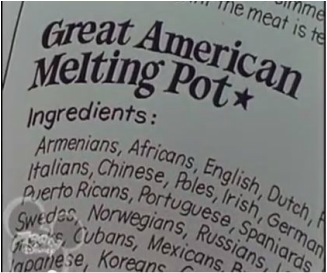
But I grew up believing in the Schoolhouse Rock song “The Great American Melting Pot” reflected America. I thought our openness made America American.
I was wrong.
Perhaps it’s because I’ve lived most of my life in multicultural blue-areas: Cleveland, Columbus (OH) and Los Angeles. But I love, and have always loved, meeting people from different cultures. They’ve enriched my life.
Heck, I got straight A’s in university Spanish by conversing with Mexican cooks and dishwashers in the restaurant I worked in. I ate tasty goat and lamb kabobs at a Persian colleague’s wedding. And had an Indian friend whose parents were members of Gandhi’s non-violent “army.”
Etc.
Each interaction enlarged my America. Exposure made me less about me, more about them, and enlarged my sense of “us.”
Back in January, I reckoned 75% plus white people dug Schoolhouse Rock , and would reject Trump. Sure, I understood that racists exist. I’ve got a brash and vocal racist uncle. But in my worldview, racists were the butt of Mel Brooks jokes in Blazing Saddles. “You've got to remember that these are just simple farmers. These are people of the land. The common clay of the new West. You know... morons.”
I was wrong.
Further, our forebears faced xenophobia. “Irish need not apply.” Labeling Italians, many of whom were here illegally, as WOP’s (Wop is short for WithOut Papers). The hunting of Catholics and Mormons. Etc. I figured their descendants would remember.
I was wrong.
It turned out that I’m an outlier among white males, who based on exit-polling voted 70% for Trump. And their number one issue was immigration.
Not that I’ll ever change my mind. I will still be open to people, regardless of race, color, creed or sexual orientation. But I now see that racism and anti-”them” xenophobia lie at the heart of many white Americans’ worldviews. Worse, I’ve seen a populist Trump ride that wave to victory.
I still say, “God bless America.” But my view of America has changed. Even in jaded middle age, reality can still shred your remaining ideals.
Who knew?
Sourceshttp://www.vox.com/2015/12/7/9828120/partisan-test
http://www.nytimes.com/interactive/2016/11/08/us/politics/election-exit-polls.html
* Title stolen from this blog post. http://terribleminds.com/ramble/2016/11/09/stronger-together-but-so-far-apart/
Imageshttp://www.thesociologicalcinema.com/uploads/4/8/3/9/4839762/4352647.jpg?1438169466
October 19, 2016
Using the 7 “Primitive” Defense Mechanisms to Juice-Up Your Characters
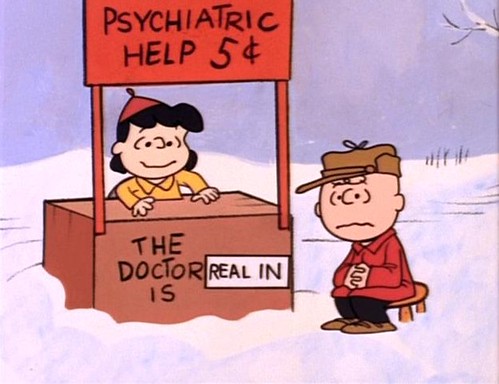 Defense mechanisms.
We all use them to protect ourselves when reality gets "real". Problem is, they're easy to locate in others -- just read the personal sniping in the comments section of any political article. But they're hard to see in ourselves. Since seeing oneself objectively takes hard work.
Perhaps that explains why writers seldom employ defense mechanisms in their characters. Since when behind a point-of-view character's mind, we identify with them. And thus, find fessing-up to having blind-spots makes us uncomfortable? Who knows.
Regardless, when characters use the same defense mechanisms we all do, they become believable. Not despite, but because of their contradictions. And once learned, defense mechanisms are easy to deploy in your work. And once deployed, they add depth with scant effort.
Fiction Writer's Guide to the 7 "Primitive" Defense Mechanisms1) Denial We deny reality to avoid the pain of having our preconceived notions shattered. We may be so afraid of something harmful, and thus ignore it.
To illustrate, consider this line uttered in the emergency room by a patient suffering from cirrhosis of the liver. “Do I drink? You mean alcohol, like an drunk? Hell, no. I only drink beer.”
2) Regression At age 36, actor Sean Penn found a paparazzi photographer hiding in his hotel room. A healthy adult in their mid-30’s would call security to remove the man, and perhaps press charges. Penn, however, acted like an adolescent, dangling the man from his 9th story balcony.
That’s regression. When facing a stressful event, we “regress” to an earlier stage of development.
Other examples: After a devastating loss, a character spends few days in bed, unwilling and unable to face family and friends -- as if waiting for their mother to “kiss their boo-boo.” Or instead smashes something in anger -- like a child throwing a tantrum.
3) Acting Out Mad at work? Or have a fight with your spouse? But instead of stating what’s wrong, you punch a wall. Or spend an hour at the gym, burning off your anger.
That’s what psychologists call “acting out.”
Other examples include a child, ignored by his working parents, who causes disruption in school. Which has the principal to send a note home. Which leads to parental attention for the child.
4 & 5) Compartmentalization/ Dissociation We all dissociate from reality along a scale from compartmentalization to dissociation. Both allow people to hold views contrary to their actions.
4.0. Example Setup A middle manager with a deep sense of responsibility to their employees has to lay people off in the midst of the 2009 downturn. As a manager, based on pure production, they rank their employees.
Problem is, he or she must lay off two employees with large families. Both of whom they count as solid, honest, hard-working friends. While several top performers, who will remain employed, are mean-spirited and devious folks whom the manager dislikes.
4.1. Compartmentalization Example The manager ignores his feelings, calls the good people with poor performance into their office, and fires them. He offers them support, trying to cushion the blow. While telling himself or herself “It’s only business.”
4.2. Dissociation Example An extreme, and rare, case where denial of reality is less transparent. Psychology refer to this as dissociation.
After ranking the employees, the manager grows angered at the low performers. Despite the support given them, they presented a drag on his bottom line, putting his or her own job in jeopardy. He sees them as weaklings, unable to deliver.
So instead of just firing the people, the mangaer kicks them to the curb with a vengeance. And aligns himself with the morally suspect “winners.” Who make them look good Note, the stress causes the manager to become a different person.
FYI: “Multiple Personality Disorder” -- near non-existent in reality, but so common in fiction it’s cliched -- takes dissociation to the extreme. In this disorder, the manager’s need to avoid the pain of firing good people, the manager “becomes” a cold shark during the firing. Only to come-to later, with no memory of the dirty deed.
6) Projection As that old claptrap goes, we fear in others what we fear most in ourselves. A saying that illustrates “projection” better than a formal definition, IMHO.
For instance, consider fundamentalist preacher who rails against homosexuality, calling gays evil. And yet, after espousing these views, he’s found in a hotel room with a gay lover.
Any doubts that the ‘evil’ the preacher ‘fought’ was his own repressed homosexuality?
7) Reaction FormationImagine a mother gushing over her super-talented, super-smart teenage son. Who is the neighborhood bully with average grades and an IQ of 98 who threatens his mother when pushed?
That’s a reaction-formation, where a character refuses to face impulses or emotions they find destructive. Instead, they substitute more acceptable opposite. And often go overboard. In the example above, the mother knows her child’s average. And violent. And maybe even dangerous. And yet, she cloys, all fake sweetness and light.
Conclusion I hope that explains the primitive defense mechanisms. And gives you some ideas on how to use them to create better characters, whose foibles can drive better plots.
However, I want to conclude with a caveat. Defense mechanism are universal because they’re useful. They help people cope. In mature individuals, who understand themselves and their own reactions to negative stress, defense mechanisms can work wonders. What’s more, psychologists acknowledge “higher-level” defense mechanisms deemed not only healthy, but transformative.
For instance, psychologists consider “sublimation” a higher-level defense mechanism. Wherein a person acknowledges an “unacceptable” impulse. But instead of acting on or denying the impulse, they channel the urge’s power to create positive change.
For instance, consider the preacher in the example above. Were he healthy, instead of denying his homosexual tendencies, urges at odds with his faith, he could have channeled the impulse. For instance, by creating a ministry helping homosexual AIDS patients. That would be sublimation.
Same urge. Same moral judgement. And same refusal to act on the impulse. But, healthier outcomes. For both the preacher and the world.
Sources 15 Common Defense Mechanisms, John M. Grohol, Psy.D (http://psychcentral.com/lib/15-common-defense-mechanisms/?all=1)
Sean Penn anecdote. (http://www.complex.com/style/2012/10/when-celebrities-attack-20-infamous-paparazzi-assaults/sean-penn)
Using Defense Mechanisms for Characters, Laura Diamond (http://roniloren.com/fictiongroupiearchives/2010/12/22/guest-post-using-defense-mechanisms-for-characters-by-laura.html)
Image Credit: https://c1.staticflickr.com/3/2501/4012904148_a362e234eb.jpg
Leo's Realm

I am a writer. I am a human. I like to muse about different things. This is the place I do it.
- Leo E. Walsh's profile
- 127 followers