Ken Brack's Blog
September 22, 2022
Keeping the fires lit
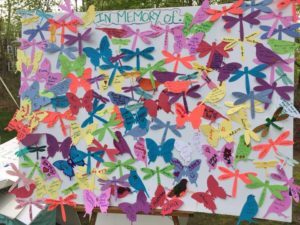
My adrenaline is pumping again. A surge courses through when Denise and I feel uplifted by many helping hands and strong hearts.
There’s a renewal of energy as this fall begins. Part of which infuses the community event our nonprofit will hold on Saturday October 1, the Hope Floats Memory Walk.
A gathering of several hundred people, the walk is a day of remembrance to honor our loved ones. It is poignant and halting, while also generating smiles and many hugs. We set aside a morning to hold those we miss close. And we do it alongside others on a quiet walk to Kingston’s picturesque waterfront and back for lunch on the lawn.
That moment we realize we’re not walking alone can be empowering.
There’s a camaraderie that none of us would have ever wished for.
An aching dichotomy is part of that energy surge. There is longing for our son, for his presence and wondering where his life would have led, his aspirations, all that he’s missed amongst our family and his friends.
There are regrets, some dark—and then there is light. We believe in what is possible, how their lives touched others and still matter. Perhaps we can also believe again in the best of ourselves.
There is isolation—because the world spins by us, and a sudden trigger, a date, a certain song, a holiday approaching, bring us again to our knees.
And then there is accompaniment. That moment we realize we’re not walking alone can be empowering. Perhaps this parallels an awareness that reclaiming hope is a tangible thing. You might actually feel and hold it, if fortunate enough to be moving forward in your grief.
They do not forget. It brings chills.
There are too many pithy quotes about hope. I don’t believe this from author Barbara Kingsolver is among them:
”Hope is a renewable option: If you run out of it at the end of the day, you get to start over in the morning.”
Renewable and visceral. We felt this again just the other night. A group of Michael’s buds, along with others in their circle, now in their late 30s and several raising families, were at our house. They are starting to organize a golf tournament next year (June 26!) to benefit Hope Floats, to help us sustain outreach that supports grieving families. It will also be a gala celebration— mixed with laments and laughter, and, I imagine, some of their stories.
His friends will drive this. Think about that. Twenty years later, following a tragic car crash that killed two friends, while building careers and for some, finding soul mates and becoming dads, they do not forget. It brings chills.
For Mike and PJ. For whom we must keep the fires lit.
And for so many families facing the worse trials of their lives. For whom we pledge to keep the fires lit.
Our tears this week may be closer to relief or even finding peace.
There’s probably no such thing as tears of sheer joy. Ours are sometimes mixed with lingering anguish or with the pain that gets ripped open from time to time like an old scab. Yet our tears this week may be closer to relief or even finding peace. Since there is joy in knowing how Mike is remembered and still a part of his friends’ lives, and joy we receive from their untainted giving.
Sort of a timeless reciprocation. Which in moments just blows me away.
Another example of this, a mini-surge on its own, came earlier this week. Our friend Tony LaGreca found Hope Floats seeking help after his son died of an overdose in 2014. While at first skeptical whether a support group would help, Tony found it meaningful and often comforting to be with other parents.
He has done many things since then advocating for families stricken by the opioid crisis. He also hosts a podcast on WMEX 1510 AM opening up the phone lines, and his heart, to others who have lost loved ones to this scourge.
The program is called “Courage to Hope with Uncle Tony.” It is part of his mission to make sure his son’s death was not in vain. I joined him the other day on the program to talk about the Memory Walk and ways that adults and families find support during their worst trials.
Tony is a warrior, keeping his own fires lit.
He is among a great circle of people, fluid, incandescent, and stretching, who keep us grounded. While also lifting us up.
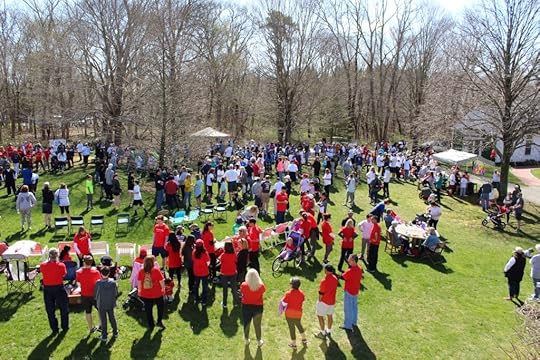 On the lawn during the Hope Floats Memory Walk in 2018.
 Keep me in your heart for a while
Hold me in your thoughts
Take me to your dreams
Touch me as I fall into view
When the winter comes
Keep the fires lit
And I will be right next to you
“Keep Me in Your Heart” by Warren Zevon


May 4, 2022
Slivers of reception
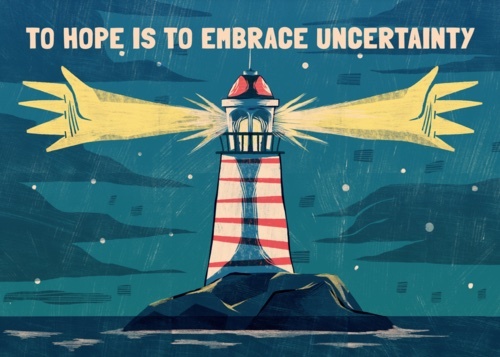
“Do not fear to hope.”
It sounds so straightforward. As if we don’t need a reminder of this intuitive wisdom.
Yet we do from time to time. Layers of fears can hold us back—from reconciling with friends or relatives, from shifting a career, to deconstructing why one’s purpose in life feels washed out. The barriers we put up to seeking forgiveness.
And for some of us, perhaps most poignantly, the fear of not staying connected with a loved one.
Facing that fear requires a gut check of sorts. Some of us shoulder a burden of not wanting to admit this even as we feel our relationship slipping away with someone who is physically gone.
Still, there are palpable ways not only to hold on, but to even expand that relationship. Dave Kane and the legacy of his youngest son, Nicholas O’Neill, reminded me of this the other day. Speaking to a group at Hope Floats, Dave urged us to be open and remain aware of the ways that our son, daughter, or partners, parents and others stay connected with us.
“I’m glad you’re all together … I will always love you.”
Nicky was the youngest victim of the The Station nightclub fire in West Warwick, Rhode Island in February, 2003. A raconteur, musician, and playwright, Nicky was actually in a band scheduled to warm up for the headliner the next evening. While Dave recalled reeling from that horrific night, as he probably has done more than a hundred times over the years, his core message continues to be: they are still with us.
“They are heart and soul,” he told me years ago. “They are love and joy.” All in the present tense—as much as we can continue holding them now, in this very moment.
Depending on how open we are to this—when slowing down to appreciate the little things, which many write off as mere coincidences—our loved ones continue to send us many signs. Which often say, as Dave offers, “I’m okay.” Or “Please play … take care of Mom … I’m glad you’re all together.” Or, “I will always love you.” More on those signs in a moment.
Is it about being more receptive?
Dave and his family believe that Nicky continues to do a job that began when he passed. He helps bring people together while assuring them that those bonds can continue. Sometimes Nicky works through his father, who is the author of 41 Signs of Hope, and a radio broadcaster in Rhode Island, to spread this message. Other times he works behind the scenes to lift the awareness of people facing despair—and helping strangers support one another.
Nicky and our son Michael were behind the scenes (or perhaps right in the open unbeknownst to us) connecting my family with Dave’s, and to some survivors of The Station fire. But that’s another story already told in my own book.
This can be freaky stuff. The hard-bitten cynics among us demand proof. While Dave’s book, for one, gives innumerable accounts where Nicky’s family experienced his favorite number “41” or received other signs, and felt viscerally connected to him, that may not work for everyone.
“What if I don’t see any signs?” one woman asked him the other day.
Perhaps one answer to that is how receptive we are to retaining a connection. How we meet or reconcile our worst fears around this.
A few days ago, a two-inch-long splinter of wood from an old shovel handle lodged in my palm while I was landscaping. It didn’t really hurt going in, but got well under the skin. I worried what it would feel like coming out.
Facing that relatively mild fear or instance to pull out the splinter is sort of a mini-parable for this. Perhaps we need to meet that fear of not staying connected head on, release the anguish, the expectation of it, or vent this somehow. And consider what to change if we want to carry that relationship forward. To carry the spirit of our loved one forward, what shift can we make? What practice, daily or otherwise, will help hold her close?
“They are love and joy.”
Dave Kane
It is about being more receptive? To the presence of certain animals, for another example, who somehow carry or convey our loved one’s spirits. Several friends of mine pause and even smile at the appearance of a hawk circling overhead, or a deer on the lawn. My family can marvel at how two seals approached close enough to shore to approve of his sister’s wedding last summer, a sign of my late mother’s presence as well.
Nicky reminds us to try opening ourselves. About a year before the fire, he wrote a one-act play about three guardian angels who are recently deceased and running around New York. The play ends with the lines, “Do not fear to hope.”
It’s now in production for a movie called “Sliver of Bliss.” Dave says the title refers to the brief thrill you get when everything comes together in that moment.
And yes, that thrill is real.
March 3, 2022
The luminaries among us
 Photo credit: Yun Xu on Unsplash
What a rollercoaster these past two years have been.
Flung around sharp bends and suddenly pitched downwards, it feels like we’ve been on a collision course on so many levels. We’ve tried to endure the toll of Covid 19 variants, the strain of loneliness, the negative impacts on children and elders particularly, and antagonism over restrictions and vaccine rollouts. It’s been an unsettling ride.
If that weren’t enough, the pandemic has also aggravated the grief some of us were already trying to process, and added agonizing new losses.
Too many people were unable to accompany a loved one during her last days. Too many visits were postponed with a grandchild or parents. Weddings and even memorial services got pushed back or canceled. We have unfinished stories that may never be told.
The sense that our lives will never be complete again—following the loss of a child, sibling, parent, or partner—has been brought to the fore with crippling force. A gray landscape not unlike the twists and turns of the weather entering March.
We may feel robbed. And this can be debilitating, with so much spinning out of control.
We’re done. Beyond fatigued. Understandably wanting—or demanding—a return to normal.
Yet surely light is returning to clear away the relative darkness. It’s not just the season, although each day of a slightly-higher arcing sun surely helps. For me, an inspiration, or guiding force, if you will, during these past two years has been a greater appreciation of being with supportive people. Being part of a community that lifts each other up—those who get what you are going through—is what I consider to be an unspeakable gift. (A gift freely given, one that we never would have chosen to need.)
Hopefully each of us know people who bring light into the world. That may sound trite to some, but I don’t mean it casually. For those of us connected to Hope Floats or invested in another service community, staying grounded to help others cope with crises that no one deserves, that light means everything.
And there are luminaries among us.
They inspire you. Perhaps they’re the ones who keep showing up, despite the relative distance or hardship getting somewhere. Perhaps they’ve stayed on the front lines in hospitals or clinics or nursing homes, as contractors and teachers and first responders, or working at Stop N’ Shop.
A luminary reminds us that when times are tough, this is exactly when we must rise to the occasion.
What I admire most about a luminary, as a notable person who gives without taking, is that he reminds us that when times are tough, this is exactly when we must rise to the occasion. We can step outside of our narrow lanes and routines. Even in a world threatening to consume us in darkness (see Ukraine, the rising autocrats here and abroad, or fill in your blank) we have an endless capacity to regenerate community right where we live.
Of course, a luminary most likely is no saint. But his or her selflessness or ability to transcend painful experiences in kind of an outward flow reaching others is no less admirable—and so needed today.
A luminary may be a good listener, who you feel present and not scanning a screen when you connect.
A luminary may be the one accompanying you on a forsaken road while others have walked on.
A luminary may be the glue of your family—in my case, my later mother, who quietly urged reconciliation when it was needed, or reminded us to become our better selves.
A luminary may be the voice telling you want you do not want to hear, but in a way that doesn’t cut you down.
We need those who help light the way forward.
A luminary may also be someone you know who makes a profound difference in others’ lives, prolific in whatever field or profession they are in. My family is fortunate to be connected to at least one—a caring oncologist and researcher at the Dana-Farber Cancer Institute who helps direct a team finding new treatments for ovarian cancer.
Though perhaps most luminaries we know go at it more under the radar. I count our support group facilitators at Hope Floats, our dedicated counselors, and other volunteers among them.
We all can use more light, and returning warmth. We know it will eventually come in the physical sense. With other events poised to jolt us on yet another white-knuckle ride, we may need the bonds of community even more.
And those who light the way forward.
Finally, some lines from George Harrison’s “Here Comes the Sun” have been playing in my ears recently. Somehow speaking again to this time, emblematic in their full figurative sense:
Little darling, I feel that ice is slowly melting
Little darling, it seems like years since it’s been clear…
July 20, 2021
Summer revels and restoration
How do we make this an amazing day?
Lately I’ve tried to begin each morning doing one simple, positive thing. It may be thinking of a family member in distress. Perhaps writing down a clarifying thought. Pausing to be more grounded before I start with the lists, or reading news that often spirals into a dark morass.
Midsummer can be restorative, even magical. We take in the extended daylight, perhaps an earlier morning walk, and evenings outside under the stars. We recall summers of childhood, breaking boundaries as teens, and revel in sparkling days spent with our children. If we are fortunate enough this season, another chapter may be added to those memories of family vacations as we recharge the batteries of our soul.
On the other hand, to be complete and untainted by romantic naivete, midsummer can also be a drag. It torments us—with so much going askew, so many red flags aflame.
The humidity and rain-stuck pattern that persists in many places feels depressing. Work grinds on and traffic is horrendous. My tomato plants are stringy and the squash seems paralyzed in fading blooms. Some of us already yearn for a fall cool-down and return to routines.
Turning our gaze to the West, we shudder as family members relate the dangers of intense drought and wildfires, and the unprecedented recent heat dome. The face of climate catastrophe stretching from Klamath County, Oregon, to the Rhine, to the Maldives Islands and back rattles us.
Regardless of those extremes—co-existing with them, actually—we must embrace the best possibilities. Somehow, each day, or as often as possible, by exuding our highest energies we can counter what others describe as the amplification of fear and anxieties, which seems to be the most ominous common denominator these days.
A season for reflection and gratitude
As my mother would undoubtedly remind my family if she were here, this is a season for reflection and gratitude. If one can slow down even a bit, a time for listening to whatever has been buzzing inside but somehow been kept out of range.
“Your job in your life is to determine what people are trying to teach you,” Joan wrote in a meditative journal that I recently reopened. More on her journal in a moment.
If we cannot seize the day now, when will we?
Among the things I am grateful for, here are a few snippets that you might add to your own:
Bustling preparations for my daughter’s upcoming wedding in Maine. The rising tide will be perfect, peaking an hour after the ceremony begins. She and Andy have waited, endured, and loved—what a day to come!
I await the calm of walking those August fields a day or two beforehand, expectant and still. Knowing that her brother and grandmother will be beside her, and all of us.
Recently Denise and I stopped for an ice cream along a rural stretch of the coast. A roadside stand attached to a home had been open only three and a half weeks. The proprietor, a woman named Cindy, was gracious and intentional—a sprig of dried lettuce hung over her doorway, with a note explaining that the Chinese consider that as good fortune for a new enterprise.
As we enjoyed ours on a picnic table, we intuited the vibrancy and slices of hope this entrepreneur was casting out to the world. Beside us, a dark-haired adolescent boy marveled at the choices of flavors his caretaker offered him. He was minimally verbal, perhaps autistic, and so radiant.
“Schedule time for your inner work,” my mother continued to write. “Keep asking yourself what’s really important.”
We attended a fundraiser the other night for a charitable foundation started by a family we feel completely aligned with. They honor their daughter’s very fiber by supporting others’ outreach and dreams, along with breast cancer research. An aspiring physical therapist, Haley Cremer’s spirit lives on through them—a true ripple effect.
The Haley Cremer Foundation’s core values are demonstrating compassion for others; Instilling perseverance in the face of hardship; fostering insight and recovery; and championing renewal of spirit. I chatted with their emcee, a gregarious man who had articulated this well to a room full of sweaty golfers. “People are good,” he told me.
Which rings so true: what we put out there comes back to us. If we wake with an embrace, perhaps being kind to ourself, and kinder to one another, the day unfolds so much better.
“Shower the people you love with love,” she might have written, from a James Taylor song. (I’m not sure she did this but will briefly sprint with poetic license here.) “Show them the way you feel.” That used to sound so cliché to me, so pop-happy and trite. But no longer.
Co-existing with extreme anxieties, we must embrace the best possibilities
I retrieved that journal my mother had started maybe thirty years ago and never finished. She recorded tidbits of wisdom striving to be mindful, and noting the dutiful practice required to achieve this.
The book is nested among photo albums and other emotional heirlooms in a nook of the summer house my parents loved. Those treasured items span four generations. Yet I, for one, rarely make time to ponder them. Washed out photographs appear on the verge of disappearing, frayed like too many vital relationships.
Her journal is just one of several notebooks chock-full of Joan’s attempts to find peace and balance. We believe she largely accomplished that. Perhaps we need to believe that, even approaching twenty-two years, and increasingly so this summer.
This amazing and contorted summer—when she calls on us to celebrate. And we will.
Re-learning to breathe before we speak
Looking ahead, I have a goal to assemble a meditative daybook—an offering of quotes, lyrics, and thoughts. It may be a collective inspirational thing with many contributors. I may borrow some of her excerpts.
Hopefully it will be a partial anecdote to the divisions and disassociation, a growing pandemic of the unvaccinated, even the looming prospect of another “Reichstag moment.” But forget all that, in this moment. Let it wash off you with the rain.
“Breathe before you speak,” Joan quoted Rabbi Harold Kushner. “Make peace with the way things are. Get comfortable not knowing.”
April 26, 2021
No return to normal

As I sat down to get my first vaccination, gut-churning guitar chords and Ozzy Osbourne’s nasal rant blasted a crowded former showroom floor.
Black Sabbath’s “Iron Man.” Classic. Spine-crushing. And somehow so apropos.
“Has he lost his mind?
Can he see or is he blind?”
Gone are the days when we don’t see each other’s pain.
Among the twists of this pandemic, rising among the many fallacies, there is this: I can’t wait for a return to normal.
A return to what? Where, exactly?
I’m afraid there is no “normal” to return to. At first glance, it is understandable that this may be what we all desire. Returning to what we’ve known, or thought we could control, our familiar ways and even beliefs. In the past, many of us at least had some kind of roadmap for our lives. Even when expectations were dashed, some of us at least retained the capacity for agency, to act independently and make our own choices.
Looking more deeply at others’ experiences the past fourteen months, along with my own reflections, I see that much of this has been uprooted—or blown up. We cannot simply go back. Too much has shifted, and far too much is now at stake. Fill in the blanks with your own concern or reality: As with the adaptation among many professions to largely work remotely, a reverse thrust seems unlikely.
After a year when so many gross inequities have been exposed and calls for racial justice continue to grow, how regressive and painful would it be to go back in time? Those seismic eruptions are not finished.
If you haven’t lived or felt what amounts to a sea change, perhaps you’re holed up on a ranch the size of Rhode Island in say, Montana. (Or hanging with Ozzy in a bunker on Planet Gonzo? Or still waiting for your cuts of prime rib in a certain buffet line? Sorry, no more squirming- maggot allusions: Ba-da-boom!)
Some of this disconnect – you might call it traumatic distortion– shows itself in the emerging conversation about what is dubbed pandemic grief. Not that everyone has heard this phrase, or if they do, they might downplay it. There is fallout from a national trauma that is only beginning to unfold while the evidence (yes, data) comes in.
Already, a divide seems to be widening between those who avoid or won’t acknowledge what has taken place, and the millions of families and friends in substantial circles who have been impacted by a loved one’s loss.
The impact of a Covid-19 death, research suggests, is often pre-occupying and dysfunctional—more so than after so-called normal deaths. We may struggle in additional ways, such as with intense isolation, distress over being unable to accompany a dying loved one, and trying to meet other family members’ needs.
There’s also a new multiplier. For every person who has died from Covid-19, an estimated nine people are bereaved. Many of those are at risk for dealing with prolonged or complicated grief. “It’s a sticky, heavy grief that doesn’t yield to the passage of time,” said psychologist Robert Neimeyer, who recently surveyed more than 800 American adults who had lost a loved one to Covid.
If not responding to suffering is “normal,” please set me adrift from your island.
So many people have been living in a pressure cooker. Whether grinding it out every day as a once-heralded essential worker (note how that has changed), hurt by a closed business, or just sick of it all, it’s been a tough ride for most. I keep hearing from friends and relatives of lives transformed in toxic directions, of increasing anger over a dislodged career, or finding new people and forces to blame.
There’s also a growing awareness of the “years of life lost,” or the loss of opportunity that impacts not only families but communities with each Covid death. For any parent who has lost a child, under any scenario, making such a calculation is like spitting out a crushed tooth. In a collective sense, public health experts say it is far more vital to track the time we’ve lost to the pandemic, rather than lives in a statistical sense.
Suck it up: it is what it is.
Of course, some people refuse to hear any of this. What new mental health needs? they ask. We’ve always dealt with loss; just move on. Suck it up: it is what it is.
A recent provocative column called “The Grief Crisis is Coming” by author Allison Gilbert considered the toll of our national bereavement and ways society can address and perhaps better protect survivors. Could this be a “new normal?” I wondered. Yet scrolling through readers’ comments to suggestions such as creating a White House office of bereavement care, it wasn’t long before the naysayers emerged.
I’m kind of done with these divisions. Parting ways while attempting to stay grounded. I wish those on the other side the best and will continue moving forward.
Yet I must wonder whether a reckoning will come.
Late last year, the Washington Post took a close, visceral look at how people were grieving during the pandemic.
The writer interviewed a woman who had lost her father and was planting a flag amidst a public display of thousands, with “Love U Forever” written on it. A day before, she had been to part of a neighboring state – which, unlike her community, had not been disproportionately impacted—and she felt as if nothing had happened there. No mask wearing; little social distancing.
“I said to myself, ‘Until you feel this pain, until you see this pain, you don’t know. Or you don’t care,’” she told the newspaper.
Gone are the days when we don’t see each other’s pain. If not responding is “normal,” please set me adrift from your island.
Limited are those days when others’ carelessness around this stuff ratchets up our anxieties. It is abnormal to be constantly immersed in a negative energy.
Dwindling are the days of distortion and lies. Sure, people will cling to their alt-realities and conspiracy channels. But I have to believe sunshine and truth will prevail.
Perhaps I’m just addled with Covid brain. Processing is slow and weeks fracture easily. But when not riding the “crazy train,” I can see change coming.
December 11, 2020
Alone without beliefs

The fragmentation of 2020 is stunning.
On so many levels, the divides between us have never felt so wide, and so freshening. Some say rifts have been lying in waiting, disparities re-exposed by the pandemic and much more.
It seems to go even deeper than that as we hunker down for a dark winter with our partners, our tightening circles, our tribes. I wonder if you are experiencing anything like what I am.
There are steep drop-offs within families and splits among friends. Feuds between those following protocols to reduce risk from the novel coronavirus versus those mask-wearing and gathering-spreader deniers. Between reds and blues, anti-vaxxers, and segregated bubbles of information and trash.
Consider where you were a year ago: does life feel more fragile? Are you more grateful? Feeling more helpless?
True, on one hand, a very bright spot on the horizon is the expected rollouts of the vaccines that are showing strong initial results. Whether enough people will get over their mistrust to take them is another thing. And whether they will be distributed proportionately to those communities and populations hardest hit remains to be worked out.
How do we close the gap?
Amidst all this, I keep searching for unity, for inspiring common ground—and come up short. As much as I try to be a glass-is-half-full person, what I see most often is carelessness unraveling into decline.
I keep looking for hope from the outside—and realize it may only reside in my own beliefs, and by caring for the ones I love most.
I yearn for a bridge over gaping inequities, and growing fears. This has never felt so insurmountable.
Perhaps, just as empires must fall (and people far more astute than myself submit that is exactly what is occurring here), we need to break apart and fall away from one another in order to reform. To be made whole again.
I get some of that—having lived it. Our smashed pieces welded together into a new mosaic, or re-fired as pottery, can become stronger.
I believe in the reality of redemption.
Must we break apart to be made whole again?
Yet on the most personal, direct level, the disconnects and losses of this season and year cut extra deep. We have close friends striving to be responsible around Covid, staying isolated and taking other precautions so as not to infect a stranger, a neighbor, or an elderly loved one.
They have tried to do what was right—for themselves, and completely for others. Only to have that relative become infected, likely due to someone else’s lapse. Perhaps due to someone’s selfishness or denial.
I believe there will be a reckoning, when people must own up to their choices, creating other divides.
Careening into the holidays, you might expect we could cross some gaps as we wish others joy. At least be somewhat on the same page during a week when a third of all Americans lived within reach of hospitals running out of intensive care beds.
At the least, our leaders could do their jobs to protect citizens during a day when as many Americans died from Covid as those perished in the 9/11 attacks.
At the least, we could finally train our attention on solving massive needs—one of eight Americans going hungry—and the ongoing calamity of people out of work, or being evicted.
I believe time is running short to repair these things.
Instead, the fault lines have become more evident. While so many people’s lives are turned upside down.
Laid bare again are the divides of class and race. Between those who drive or take a bus or train each day to work showing up in person each day, versus those like me who are fortunate (and have the privilege) to largely work virtually, and sequestered.
I likely do not appreciate the experience of a nurse traveling into the city, the Stop ‘N Shop cashier, the plumber loading the van. We may thank the “essential workers,” those on the front lines, in posts and hearts taped on our homes. But how do we close the gap?
I have to believe it is possible to do so. If not, if we exist on islands of our extended or nontraditional families, on our phones and in social media vacuums, we are lost.
Also laid bare again are what Dr. Paul Farmer calls the “social pathologies of our nation come to fore” in a pandemic. Some of what Farmer means is how we have failed to invest in public health and making a care delivery system a priority. Our collective failure to make it accessible and equitable for all.
A recommendation: please take the five minutes to read or listen to Farmer’s recent interview on Democracy Now. If you don’t know, he is the world-renowned infectious disease doctor who started the nonprofit Partners in Health 33 years ago to deliver healthcare to people in Haiti. He’s worth a listen.
Also laid bare are staggering ironies—you might also call them hypocrisies—of this age.
For just one, anytime I hear people whining about their liberties being taken away, I want to ask (in an attempt to find common ground): did any of your grandparents or other relatives serve in World War II, or otherwise support the American effort to defeat fascism?
If so, what do you know about their sacrifice?
As this retrospective column details, that generation (not really so long ago, but many of us have not learned from them) made great sacrifices. Gathering scrap metal and rubber to recycle. Buying war bonds. Rationing, planting Victory gardens and turning off lights. Going without many things for three or so years. And of course, going to war.
I believe we can once again rally to a call like, “All hands on deck.”
So what is the resolution to these divides?
Perhaps it begins with taking ownership—surely, most of us have a part. Many times I use too broad a brush, a so-called progressive’s point of view. I don’t consider it as hubris, but I can be more open to others’ experiences as well as being self-critical in an ongoing dialectical exchange.
Maybe it’s time to cast those markers that separate us into the pit. Before we break apart some more.
And so you see, I have come to doubt
All that I once held as true
I stand alone without beliefs
The only truth I know is you
And as I watch the drops of rain
Weave their weary paths and die
I know that I am like the rain
There but for the grace of you go I.
— Simon and Garfunkel, “Kathy’s Song”
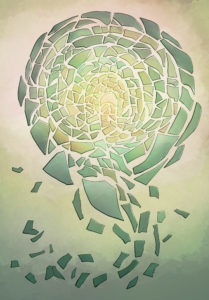 “Shards” illustration by Amanda Brack
September 24, 2020
Six weeks of hell
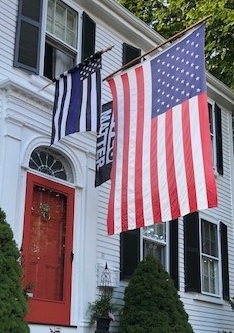 The unity suggested by these three flags combined feels like an idyllic past.
Rattled, I dread the run-up to November.
Every day there is more division, whenever we turn around or check our news feed. Anxieties and dysfunction are stoked.
Last night it was dismay over the one indictment returned for the shooting of Breonna Taylor—#SayHerName—coupled with a president egging on potential armed confrontation, refusing to commit to a peaceful transfer of power. That was just one night—plus the continuing epic wildfires in the West, floods, and Justice Ruth Bader Ginsburg lying in repose. Might we expect locusts and asps next?
We are a mess. I am a mess. A multiplier effect of imbalance rages: consider the signals Mother Earth is ending us, for one.
These deviant times portend even worse ones ahead. Enough so that it is becoming harder to stay anchored by hope.
It’s not just that we’ve strayed “off course.” I fear that that our collective moral compass itself is broken—in terms of showing empathy, and finding common ground.
For sure, this begins internally and emanates out. I feel my own contradictions. Struggling to stay mindful of ways to handle this anxiety and not get sucked in.
One tip I’ve read is to pay close attention to positive, non-threatening things you encounter. A boy playing hide and seek on a swing set with his Dad, a wanderlust-loving cat curled beside you on the couch.
I am far more vigilant in the opposite direction. Driving through town, I cringe at three heavy-duty pickup trucks in a line flying oversized American and Trump flags. It feels irrational; there is absolutely nothing wrong with them doing this.
We are also urged to not interpret ambiguous situations as threatening. When anxious, our focused attention is more biased—perhaps reinforced during a season such as now when life has been reshuffled so capriciously.
At the local transfer station, a barefaced man near a busy recycling bin appears to roll his eyes at my facemask and me. Maybe that verges on my own paranoia, since perhaps he’s just duly fed up.
Another tip is to avoid overestimating the chances of bad things happening. And going further, not to call something a catastrophe when you actually have resources—like resilience, and experience—to deal with it.
For me, I am chilled not only by images and accounts, but also by an oversized expectation, of violent conflicts among protestors and counter-protestors. Ever since Charlottesville, and stretching back further, the prospect has sickened my stomach. In moments this feels out of whack—though in another lurch, I fear the president is setting the stage not to concede if needed and for what may happen then.
My father lives in Concord, Mass., iconic launch pad of American history and perhaps an entitled enclave of Transcendentalist-imbued liberalism. The Unitarian Universalist church he attends there braced for a weekend counter-protest, as for many months, the parish had the audacity to drape a “Black Lives Matter” banner across its large columns. I am urging him not to go.
How do we restore balance, and repair that moral compass?
Last spring, despite the relative hardships of a lockdown there were bright spots. Now as we spiral into a season of darkness, they seem like distant memories.
We felt more attuned to wildlife. A mama fox raised her three kits for a while under a nearby shed while other animals extended themselves into spaces people normally occupy. In late May, I experienced a large “swarming pine cone” of honey bees, perhaps two feet tall in a Norway Spruce. The next day they were gone.
We felt more grateful—for each other’s company and staying in contact with family. For essential workers on the front lines, even for the prospects of a unified approach to the pandemic in all of its complexity.
Currently—I don’t know about you—I am waking earlier, if not stirred by restless thoughts much of the night. I haven’t played the guitar in more than a month, being inattentive to a means of pure release and joy. I keep putting off calling old friends, a few of whom I know are on the other side of the political divide. Jog a bit less. Energy seems to flow in the wrong direction.
How do we restore balance, and repair that moral compass?
Seasoned mariners know the difference between magnetic variation and deviation. Variation, the angle between true north and magnetic north (or more precisely, the horizontal trace of the magnetic field), requires a simple plotting adjustment to keep your vessel safe on its heading.
The deviation or error in a compass itself a bit more dicey. Deviation is caused by the magnetic influence of some nearby object, requiring some technical knowhow to adjust for.
Correcting for this deviation requires “internal” work. It’s akin to what feels lacking within and around us right now.
It’s becoming harder to stay anchored by hope.
Finally, with each of these accumulating layers of distress, I wonder about their compounding effect, or how that adds to our own deviation. So many norms have been scrambled. Truth has been turned upside down into alternative facts. It seems impossible to process all the angles of attack, retreat and rollbacks, coming at us.
But people can only be oppressed for so long. Others can only take a drumbeat of negativity and isolation for so long—until they must tune out, or burn out. Others are poisoned into thinking they are the victims, that their liberties are under attack, until they erupt.
“What happens to a dream deferred?” Langston Hughes asked. At the end of that resonant poem, he posed:
Maybe it just sags
like a heavy load.
Or does it explode?
Where are we headed?
April 24, 2020
A six-week pressure cooker
Rain is beating down again; it feels like a deluge every third day now. Six weeks of temporary ups and steep downturns, exacerbated in so many ways.
Where are you in this storm? How are you navigating the isolation—unable to be with loved ones, or face to face with people you care about? You may be grinding it out on the front lines, or perhaps sheltering in place.
Do you experience a battle between trying to stay connected, even lending a hand during the pandemic, with trying to stay balanced and hopeful?
If you’re anything like me, some mornings are a struggle. I rise hours before first light, torn and anticipating the latest news of suffering and dysfunction. It feels like prolonged strife just setting in, far heavier than short-term strains that can be lifted by some magical reopening.
We’re in a pressure cooker, for sure.
It’s tough to fend off despair and even depression—which seem to vacillate with glimpses of gratitude like the rotation of raw and more promising days this spring. And while no one can claim to know when this will abate, what seems sure is that life as we used to know it has become much more fragile.
A pulverizing aspect of this rapid change feels so challenging.
You may be brutally aware, more than myself, of how so much has happened in such compacted time. That pulverizing aspect of change feels so challenging. We’re drained before we know it, our energies and work routines and social connections thrown off. So many developments and setbacks occur each week, if not daily—beyond the almost numbing statistics—packing far more volatility than we could have imagined before.
If you’re spent by Friday morning, you’re not alone.
We each likely have friends and families on the edge of financial calamity, if not already there.
We worry and pray for family members and others treating the sick or accompanying the dying. A friends’ daughter, a physician, endured the spike in Manhattan; a girlfriend of our close friends’ son was apparently untouched by the virus, lone among an infected nursing home staff here at home.
More broadly, many fault lines in our society have been re-exposed. Vulnerable people and whole communities at spiked risk as this catastrophe again bares our pernicious failures and bitter ironies.
A gust brings more driving rain.
How this contagion impacts people trying to cope with a previous loss is another emerging truth. Part of the work my wife and I do is providing peer-led bereavement outreach to children, adults, and families. We are trying to figure out the depths and layering of those grief triggers during the pandemic, and how to support others riding the inevitable surges to come.
As a community, for example, we don’t just “send thoughts…” to someone who now is unable say goodbye or visit her aging or virus-compromised mother in a hospital. We cry for them both. We find other ways to connect, new resources to suggest—even while feeling momentarily paralyzed by the nightmare of not saying goodbye.
Far less straining, but still biting, is how people who are grieving juggle the added, competing uncertainties of this time. Their neighbors may complain that routines have been disrupted—shopping, the gym—and they must handle this disconnect of relative hardship.
Tomorrow, I may feel refreshed. But the rain continues to fall hard.
Of course, this contagion ushers in many other losses: high school seniors without a graduation; teachers and students cut off from one another; family gatherings and celebrations still on the calendar but unlikely to come. And helping people traumatized during this uncertain time, whether children stuck at home or practitioners making critical care decisions, will be an ongoing challenge.
I recently met a woman who lost a sibling last December due to a chronic illness after a steady, year-plus decline. Her sister was only in her early 60s, and family members at least were able to play cards and visit her, and say goodbye. The same woman then lost one of her children unexpectedly early this year. Six weeks later, Covid-19 infections were spreading across the country.
She is not raging (though no one would fault her). She needs time to breath. Space to unpack some of what has fallen like bricks on her family. She already knows that many facets of their child’s loss will continue to cycle through in the months and years ahead—undeserved feelings of guilt, the circumstances of the death itself, and wanting to ensure that their child will not be forgotten.
When the rain pounds on my roof, it could be shaking hers with gale force winds.
Emerging challenges will steepen.
In another scenario, a frontline practitioner at a major Boston hospital reached out to my wife about two weeks ago as her team prepared for a surge of Covid-19 patients. We’re going to need help, she said. So Denise and her colleagues are assembling support groups where medical health care workers can vent and cope better with their load.
Other challenges will steepen. Earlier this week, a contact at a homeless shelter serving our region told me a bit about how her dozen families are handling things there.
Her staff is trying to get the kids to follow protocols more consistently: wearing masks, and hand washing. Many of the children see themselves as being at home and resist social distancing. Schools sent extra tablets but not all the kids use them. The staff is looking ahead, concerned about a lack of summer camps and enough scheduled activities.
“What they are going to learn from this time is what they are witnessing,” she told me. “We have to do everything we can to make sure their spirit flourishes and grows.”
I found a parallel to this spirit of compassion in an insightful column in today’s Boston Globe. In her piece, Renée Loth built upon her maternal grandmother’s experience surviving the Spanish flu, and then the Depression. Loth probed whether we “can hold on to the lesson of communal responsibility that the coronavirus pandemic is teaching.”
Can the imprint of this disaster help us build more compassionate policies as we recover? We can stitch together the safety net more tightly and recreate an economy where fewer people need to use it — but only if we can hold on to the lesson of communal responsibility that this pandemic is teaching.
— Renée Loth
Tomorrow I may wake later and be refreshed about this. I may reclaim gratitude, which feels authentic. Our family remains safe, and many good people around us continue reaching out to others in varied ways.
But for now, the rain continues to fall hard.
*****
“Rain Has Fallen All The Day” by James Joyce
Rain has fallen all the day.
O come among the laden trees:
The leaves lie thick upon the way
Of memories.
Staying a little by the way
Of memories shall we depart.
Come, my beloved, where I may
Speak to your heart
March 24, 2020
A compassion multiplier
That hug from your partner or child never felt better—if you are fortunate enough to have either close by. A friend reaches you on the phone, her laughter breaking your isolation. Colleagues check in, a community scrambles for new ways to support the most vulnerable among us.
Our responses to this unprecedented time are vital and myriad. And also so fragile.
We’re moving at warp speed. Grinding through each day, absorbing fast-changing data and COVID-19 dissonance. Fearful for our elders, and for family members or friends on the front lines, whether doctors, nurses, and other practitioners scrambling for equipment and likely soon, ICU beds, or for those working at nursing homes and grocery stores.
We seek glimmers of hope—tempered by a new reality, if not sliced apart raw.
Will our response be enough, and where will it lead?
The vitality of our interconnectedness has never been more magnified.
Two things seem clear to me. The first is a resurgence of gratitude amidst the uncertainty. Being able to look into my wife’s eyes each morning to express we will navigate this together. Knowing our children and their partners appear to be safe—each making good decisions, well informed, rather than wasted in denial or distractions. And having gratitude for the decent people connected with our nonprofit who are already finding creative ways to reach families feeling additional stress.
Can this gratitude grow exponentially? I don’t mean that naively, as if it’s a salve, and we should downplay the modeling of this virus by epidemiologists, the economic devastation just beginning to ripple out, or ignore the distancing directives.
Nor ignore a shudder and tear when it hits us how long it may before we can be with a loved one again.
We are truly in unchartered waters. So let’s try to man the oars with grace—reaching out to others wherever we can. Thankfully, so many people in our circles are already doing this—more on that in a moment.
Which leads to the second thing I see emerging: a reassertion of our interdependence. Humanity showing its best face.
There is an emerging dynamic: as we turn inward following the guidance of social distancing, self-isolating, or even sheltering-in-place, the primacy of our interconnectedness has never been more magnified. Forced inward, we are stripped to the core. The greatest self-fulfillment and lasting meaning comes when we step outside of ourselves.
All this is occurring despite the rifts of tribalism, our repellent, nativist impulses, and a narcissist-in-chief for the times.
The root questions going forward may be: how do we stay connected? How will we support loved ones who are not physically with us, and those people and communities we care about?
Almost everyone I talk to seems assured we will get through this. Eventually, yes. But what will that look like?
Those fears are real and ratcheting. Yet let’s also consider how small acts of kindness ripple out—someone tipping a waitress now out of work or doing take-out, or pre-paying a yoga instructor whose classes are closed. Combine these small actions with our ingenuity, an entrepreneur’s drive to create new tools for outreach and education, for example. Perhaps a sort of compassion multiplier is already emerging.
Think of how someone stuck alone is brought to a smile as you connect by phone, a thoughtful card, on Skype or some other means. Even without your hands clasped. Without seeing the strain and lament and thankfulness in her eyes up close. Yes, there are limits to this. I think of a dear friend of my father’s (and our entire family) who lives alone, now quarantined in an assisted living facility. Her daughter can only visit through the window, and fortunately her mother is on the first floor. My heart goes out to each of them.
Surely, our neighbors and friends will create new ways to connect, some built on timeworn practices. On a grand scale, meeting the challenge of this age is perhaps akin to the commitment and sacrifice the greatest generation made during World War II.
Author and columnist David Brooks makes a compelling case for this social solidarity, as he calls it.
Whereas “social connection means feeling empathetic toward others and being kind,” solidarity “is more tenacious,” he writes. “It’s an active commitment to the common good—the kind of thing needed in times like now.”
I want to believe we can do this. A tenacious solidarity.
Another response, another angle, comes from a men’s group I help facilitate. Seven or eight fathers like myself who have lost a child gather every two weeks upstairs at Hope Floats Healing & Wellness Center, a bereavement center my wife and I started in 2008. The last time we met in person, a night before a national emergency was declared over the coronavirus, we talked about what was coming.
Some of the men downplayed it—not ignoring the pandemic, but knowing the relativity of how we experience it. We have a different perspective, having already been through perhaps the worse thing life can serve up: losing a child, for most of us catastrophically. “If I can make it through that, I can survive anything” was the shared mantra.
Entering this new reality, I found myself wanting to break from the news cycle and heightened risks during the weekend. I decided to got out and row.
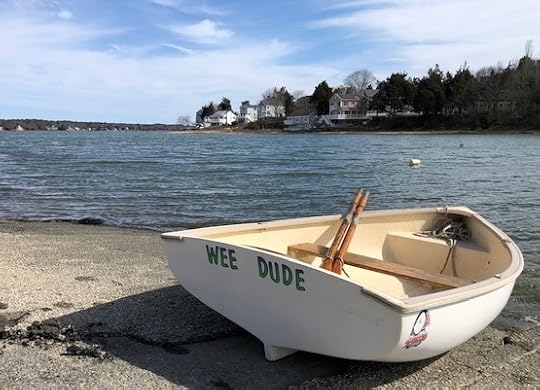
We have an eight-foot dinghy, a sturdy Puffin built in Maine. She’s well balanced and handles charging into minor swells. I took off from a small harbor where we live.
I rowed hard to the wind into the bay. Went easy for stretches returning along salt marsh in the lee. Taking deep breaths, inhaling the salt air. Trying to become one with the water even for a few minutes Met a small great blue heron in a side channel, and watched its flight.
We’re yearning for solidarity and connection. We have to keep trying.
How do we stay connected?
October 31, 2019
The Four P’s

Source: Wikimedia Commons Author: cogdogblog
Pain. Passion. Purpose.
How do we move from experiencing pain, to rediscovering passion, to finding purpose?
And going further: Finding peace?
How is this possible? What might resolution or even redemption look like?
These questions came up earlier this week as I gave a book talk in a neighboring town. My audience was tiny, perhaps in part because of the dreary rainy night and a culminating World Series game on tap. Likely more so because of my difficult topic: helping people cope with grief during the worst trials imaginable.
There is no closure, yet neither am I mired in the past.
Striving to move forward rather than being stuck. Which for some of us involves forging or discovering a new purpose when life as we knew it has been shattered by the death of a loved one.
My wife and I live this. We continue to wrestle with those fierce emotions while attempting to stay on course. Not always sustaining this, but trying again, even when grief sets us back.
The focus of my talk was in part sharing a narrative of how we created a nonprofit bereavement center, Hope Floats Healing and Wellness Center, in 2008, six years after losing our oldest son, Michael.
Hope Floats offers free support groups for grieving families and children in our region south of Boston. It grew from Denise’s vision to help other families in a safe, confidential setting where they are accompanied by those walking a similar road.
Our charity has grown from her setting up a makeshift office, hanging fliers and sending mailings—starting a first support group with about ten women—to more than fifteen free groups. Adults, children, teens, and families gather together to vent, ask questions, and support another for a range of losses: the death of a child or adult caregiver, a partner, a loved one to suicide, overdose, and supporting families who have a loved one undergoing treatment for cancer or a life-limiting disease.
Building from the very ruins. Can this bring solace?
I framed my talk on something I had found reading about Congressman Elijah Cummings of Baltimore, who died a few weeks ago.
In 2016, Cummings was asked about the response of a handful of moms—the mothers of Trayvon Martin, Michael Brown, Eric Garner and other African Americans killed by police—who each became activists and advocates.
“Those women were very bold,” Cummings said. “What they did was they took their pain, turned it into a passion to do their purpose…And so, I admire them, because they have taken their pain, and now they’re trying to help other mothers not have to go through what they went through.”
Building from the very ruins. Facing the very forces they believe were responsible for their child’s death. Trying to make meaning from their suffering.
But does this bring solace?
A man in the audience asked if that had worked out for Denise or myself. We lost Michael in 2002. We’re on the cusp of seventeen years as I write, with flashbacks and shards of memories of a mid-November night.
I told him I was at least partway there finding peace. During the first ten or fifteen years I first had to reconcile many things. Learn more about, and open my heart, to forgiveness. Understand the cost of holding on to anger and wrath. Forgive my own faults as a father, and reconcile both some of my guilt and a disabling fear that his unfulfilled life had no meaning.
Fortunately, I‘ve been able to resolve much of this. I’m not sure if full redemption per se will ever be possible, or if that even applies to me. The waves of pain—as other parents expressed to me in my book, Especially for You—have lessened over time. Yet storm surges do occasionally return; they do not relent completely. There is no closure, yet neither am I mired in the past.
For others, finding a new purpose is elusive. The very idea seems laughable.
A man I know, who I will call John, faces many triggers that swirl inside and around him. Sometimes he does not deal with them so well. He often chooses isolation. He has compounding regrets and bitterness after the staggering loss of an only adult child.
John would like eternity to begin any time now, thank you. Still, he’ll do anything for a friend, drop off gifts unexpectedly, even when reeking and unsteady. He is empathetic beyond measure when on. Volatile as a Molotov cocktail when he’s off.
His grief seems to be more complicated, in the fullest delineated or perhaps clinical sense. The intense yearning and preoccupation with thoughts and memories of his daughter seem to dominate life. The future often seems bleak; rage lingers just below the surface. Dysfunction threatens to become the norm.
I wonder for him, and so many others: is peace possible?
Pain? Without a doubt. Passion? Intermittent. Purpose? Struggling to find it.
What’s next?
They have taken their pain, and now they’re trying to help other mothers not have to go through what they went through. — Congressman Elijah Cummings in 2016