
Claudette Melanson's Blog - Posts Tagged "social-media"
Not Nice… Tone & Social Media

Hey, I think I’m a nice person. I try to be as much as I can. Whenever other authors ask me for prize donations for an event, I never turn them down. I retweet and share as much as I possibly can across multiple platforms. I know I don’t get everyone, but I try with all the energy and time I’m allowed. I love animals and am a huge advocate for their rights, donate to the causes that ask for help with their vet bills. I know my schedule makes me cranky at times, but I really, honestly try to be nice to everyone.
Imagine my shock at getting a DM on Twitter from another writer, telling me in no uncertain terms I was, and I quote, “not nice.” She didn’t know me. We’d never interacted. I certainly hadn’t called her a bad name or thrown rotting produce at her…
So what had she taken issue with that drove her to message a complete stranger, someone she knew very little about, and tell said stranger they were a not-so-nice person?
Ultimately, it was the unintended tone of my Twitter bio. I am a writer. I need adequate space and character count to communicate my thoughts with any real authenticity. Twitter only allows a user 160 characters to tell the world who you are—barely more than a tweet! Desperately trying to convey all the information I wanted to get across, I tried to make a few points.
Twitter is a very reciprocal social media site. If someone retweets you, you want to retweet them back. Let me first say that I know I miss retweeting some people, simply from the sheer volume, and I retweet plenty of people who never connect with me at all. I try to help other authors and present the best in book and book blog news…along with a few other interesting tidbits. So, one of my short points I tried to get across in the confines of the limited space was “RT 4 RT.” Hey, you retweet me, why shouldn’t I reciprocate (unless it’s porn or hate speech)? It’s only polite to return a favor. That was my meaning.
I also included, “Will unfollow if no follow back.” I had no idea anyone would take issue with that. Why should I follow anyone who doesn’t return the favor? There are very few celebrities I follow and that’s because I don’t think anyone else on Twitter is ‘better’ than me or vice versa. If someone can’t take the time to follow me back, there is no good reason for me to continue to follow. It implies they have no interest in me or my tweets, so, naturally, there is no incentive to follow back. I mean it in no other way than this. This is my standard procedure on Twitter, so I was merely being upfront about it.
Due to my forced brevity, I supposed my message may have come across as snotty or callous, but I certainly didn’t mean it that way. I was shocked to find a message in my inbox saying said person might have followed me if I hadn’t said I unfollow (and I always give a week’s time to be fair) for not following in return. Then, she flat-out called me, “Not nice.” I have to admit I became quite enraged. As I said previously, she didn’t know me and knew nothing of my interactions with others, so I proceeded to tell her this. She still came back, arguing that what I’d said made me undesirable to her as a social media pal. I tried further to explain that Twitter is a very reciprocal community, and I was merely behaving within the unspoken rules that seem to drive the Twitter machine.
She still thought I was being a pompous ass (my words, not hers…but that was her general assessment). I promptly blocked her...I remove negativity from my life. I have enough stressful things to deal with, and refuse to invite anything further. Afterward, though, being a progressive thinker, I revisited my bio. I didn’t want anyone else to take me the wrong way, so I did make a change. It now reads: “RT in return, followback <3 same courtesy .” Despite being attacked in a way I considered most unjust, I didn’t want anyone to be put off by my words, so I did make the change and promised myself I would be more careful with my social tone. We’re already at a disadvantage what with no vocal inflection.
By the way, this little incident did have a happy ending. Although I’d blocked my attacker to avoid any further conflict, she did have one of her friends message me so that she could apologize via the friend. I told her friend to tell her I bore no hard feelings and even ended up helping her friend with a few questions she had about social media. Even though I would have preferred not to go through it in the first place, I’m happy it ended well and gave me some insight into considering the words I put together on social media profiles and posts.
Do any of you have a similar story to tell? I’d love to hear your stories about how social media might have earned you a verbal ‘ruler to the hand.’ Please share them with us below!


Stick a Pin in It! Two Crucial Strategies to Build Your Twitter Platform

Whether you’re an author, a blogger, an Etsy seller or maybe a reader who loves to shout your favorite authors’ praises from the four corners, Twitter is an excellent place to get the word out. I have grown my Twitter following from 250 followers, when I first published in February 2014, to over 43,000 by studying Twitter etiquette—what works and what doesn’t—and though I still have so much to learn, there are two key tips I want to share with you on this blog today. If you employ these two simple strategies, they will help to give you a definite boost with your Twitter engagement, as it has with mine.
Rule #1 – Pin that Tweet!!! – Have you ever visited a Twitter page and seen a tweet crowning the all others in an individual’s feed on their profile? Perhaps you’ve seen the words, “Pinned Tweet,” at the top of the box? There is a very good reason for this. A pinned tweet is one you can glue to the top of your Twitter profile. Typically, a pinned tweet is one that contains a message you urgently want to share with followers or visitors to your profile. For the authoring world, most of our tweets will be our pretty book promos, or perhaps we are featuring a giveaway about which we’d like to spread the word. Authors – PIN YOUR BOOK PROMOS. When I go to the page of someone who has retweeted one of my promos, this is the first thing I look for. What do you most want me to share with my followers? Don’t know how to pin a tweet? Check out the picture below. Follow the red-encircled instructions for any tweet:

Rule #2 – OMG do NOT just Tweet Your own Stuff! – Twitter thrives on retweets. That is really what it’s all about. Now, you tell me, which would you rather: go to a page that has a mix of really interesting stuff from ALL OVER Twitter or go to one where a Twitter user tweets only their own stuff repeatedly. Humans thrive on diversity and variety, and your Twitter profile is no different in this respect. I can tell you that when I go to another author’s page and see nothing but his/her own tweets, I can’t help but immediately think, “Hmmm, not much chance of a reciprocal relationship here.” If I know he/she will probably never retweet me, they don’t have much chance of ending up on my list for reciprocal tweeting. Think about it. If you retweet the promo of twenty other authors, they are highly likely to retweet you in return, so you not only get the eyes of your followers but those of all the other twenty other authors, as well. Go look at my Twitter profile: https://twitter.com/Bella623 You will see my PINNED tweet and under that a whole lot of “Claudette Melanson retweeted.” I LOVE helping other authors and other types of Twitter users. I get back so much more in return. My retweeters and supporters are INVALUABLE to me. I love them. I would shout their praises from the highest rooftops (and I’m deathly afraid of heights!). Look at the picture below, and then look at your own Twitter profile. You need to be seeing this, not a whole whack of your own tweets…trust me!

Give a Hoot! Hootsuite—It’s Not Just for Posting!

Being an indie author is work. Hard work. It takes more time, effort and dedication than I would have ever imagined before I got started. But I love it. Not more than my little furbaby bunnies, but I love it a lot.

Forget the mere hours spent writing…and add to that the massive effort required to keep up with social media. For me, that is equally important too. Social media is where my readers ‘live,’ and if you are one of them, you know just how very significant you are to me and my writing.

I try harder than you might imagine to see every post, respond to the avalanche of messages and emails—and fail miserably most of the time.

So, let me tell you just how much I love discovering a tool which allows me to interact faster and with greater visibility. One of my greatest challenges has always been responding to mentions on Twitter. The “Notifications” page falls down on the job when it comes to notifying the user about both retweets and mentions. Believe me; I understand. There is a lot going on with that website, especially when it has to keep up with more than sixty-six thousand followers! I realize there is only so much it can show me. But the scattered and limited format with its mishmash of retweets, follows and mentions—which it cuts off at a certain number for retweets—does not help me keep up with the massive flow of my Twitter communication. There were always several mentions, some with important personal messages, I missed.
Surprisingly, it was a tool heralded for its ease of social media posting which aided me in more effective Twitter communication with my followers—Hootsuite. I’ve used Hootsuite since nearly the beginning of my indie author career. I love the features allowing for the scheduling of future posts, and for sending said posts out to more than one social media site. One day, though, I happened to take a closer look around and discovered a couple of other tools which offered me the ability to pin down communiqué control over my growing-by-leaps-and-bounds Twitter account. Check this out:
Mentions-

See that graphic? That is what I see in the My First Tab section found above the streams on the Hootsuite dashboard. Essentially, Hootsuite sucked my Twitter account into its brain, transforming it into a one-stop shop. All of my mentions are collected here in one convenient spot. I can easily scroll down through the stream and thank people, retweet posts or reply to any questions or comments. I do this using the little menu at the top of each mention, which I have pointed out in the graphic with an arrow. If I do this once every twenty-four hours—and I do try—I can easily respond to my very important Twitter mentions for each day. As you can see, one of my big-hearted followers has tweeted about a school contest I have going. It is very important to me to thank her and follow her if I didn’t already. Another of my author friends has created a graphic to tweet which mentions my book. He definitely deserves gratitude, and, once I find a spare moment, I will make a special tweet to feature his book and return the favor.
Retweets-

One thing that always bugged me about Twitter was that it only showed you a certain number of the people who’d retweeted one of your tweets. I wanted to see them all so I could add my supporters to my retweet lists. Hootsuite allows you to see them all and in one convenient place. If you click on the number of retweets in the window, which I’ve drawn the arrow to, you can click on the account from the window pop-up and ensure you have your retweeters on your list or retweet them from their page immediately. I try very hard to keep up with this, so if you retweeted me and I didn’t do so in kind, please let me know. If you do it in a mention, I’ll be sure to see it! ;)
So, as you see, apps can be a strong source of aid to keep you connected to the readers or clients you hold so dear. And, as shown here, sometimes they offer help in areas for which you didn’t even realize they were designed.
Very Pinteresting! Using a Pinterest Visual Board To Support Your Writing & Readers

Ever get writer’s block? I used to, but don’t have as much trouble with it now as I did in the past. This is due much in part to my use of a visual board on Pinterest, which can be found here: http://bit.ly/1pTacsv . There, I can pin photos of all my characters, locales, homes and even the clothing worn in one space where they are all laid out for me to see. Much of my writing time used to be spent at working to picture every detail of the scene I was describing. Even worse, when writing about said subject at a later time and, perhaps, being far removed from the memory I’d conjured up earlier, I worry about failing to recall every original detail. With a visual board, I have a fixed image from which I can draw my particulars. For me, it makes for more consistent writing and less time putting the book’s world together behind my eyes. This is what my board looks like, and from this example, you can see I put everything on there from characters to cars, so I have access to specifics I may not have even considered including:

Housing – One of the most challenging descriptions for me to write has been the ones of dwellings and all the many pieces inside. In The Maura DeLuca trilogy, in books two and three, there arose a need to accurately capture the details of far more opulent housing. When one writes about covens made up of several members who all live together, who are all talented and have money to spare, given each one’s extraordinariness and the sheer amount of time they’ve spent living, it would follow that their houses would be larger and more luxurious than the usual. Since I’ve never experienced such luxury firsthand, real estate web sites come in very handy, because they not only post pictures of the grounds outside, but, many times, the extravagantly furnished rooms within. When I find ‘the’ house, it doesn’t matter if every room is pictured; the whole world inside that house begins to come together and adding on additional rooms within the confines of my imagination becomes much easier. This is an example of some of my locale pins for the dwellings in my trilogy:

Characters – Sometimes, I have had a character in mind without seeing the complete depiction of what they look like. For instance, with my character Aoife, an Ireland-born vampire from the sixteenth century, I knew I wanted her to be a redhead, but was having trouble filling in her other physical features. I did a Google image search for “female red hair” and perused the pictures generated by the search. I knew her when I saw her, and the picture made it much easier for me to describe her features to my reader. Pinning pictures to represent your characters on your Pinterest board can be a great resource for your readers, assisting them with the materialization of your character inside their heads. Just as with movie casting for adaptations made from books, your reader may not love your visual, but at least you’ll be presenting the most accurate depiction possible from ideas inside the author’s head. These are some of the characters found on my board:

Extras – There are lots of little extras your board can assist you with for your writing. I’ve used mine to help me describe food, jewelry and even Christmas ornaments. Sometimes you’ll search for one item and end up seeing another visual you didn’t even know you wanted to include in your story. I’ve also had my board help me choose giveaway prizes. When I found the exact picture of Maura’s vampire-bat ornament for her tree, I thought about how cool it would be as a reader to win a prize which is an exact replica of an item included in the book. Since I found that picture on eBay, I was able to provide Maura’s ornament as one of my holiday prizes. Here’s a shot of my board containing some of those little extras:
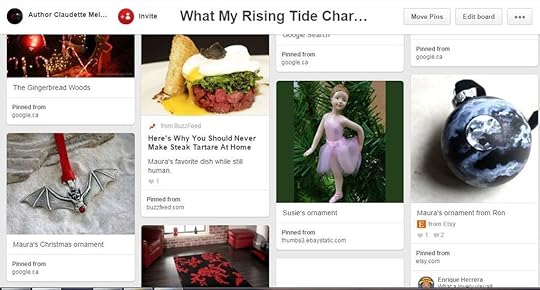
I hope this has given you some ideas so that you can create a visual board to help with your own writing. So, sign up for an account if you don’t already have one and get to pinning! Create a stunning visual to complement your words, aid the flow of your writing and assist your readers in bringing your characters and every other element of your fictional world to life.
Reader Rally Cry! 4 Things You Can Do to Help the Authors You Love

Many of us love to read. I know I do! But what keeps that writer glued to their keyboard, oftentimes missing out on social outings or even getting to see the outside of the house—this is my life at most times—so that they keep producing the stories we most enjoy reading? Money? That isn’t what does it for me. Between my giveaways and the few trips I take to events, I make about six times less than I earn from my books. I believe most of us do it simply because we love the craft. I can’t imagine going for a terribly long span without creating my fictional worlds for my readers. I took a year off to try and build my editing business, but with the loss of my greatest passion, I found myself depressed and feeling much like a failure. That isn’t to say I don’t love helping my fellow authors to put their works out into the world; I’m just saying I was throwing myself waaaay out of balance. I’ve taken the last five months of my life and written in every spare moment available to me so that I could publish Riptide, the third book in my Maura DeLuca YA vampire trilogy. It did so much for my mental well-being, and I love writing for myself…but I still need the help of my readers, much in the same way I need to breathe or eat!
So, what can you do to help ensure your favorite authors keep writing? Here are just a few things:

1. Buy Their Books!
An article on The Guardian’s website states that the median income for any author is $5,000. Wow. How is anyone supposed to survive on that? I know mine is much less than that number, hence my need to keep my day job. You can help by supporting the author and buying their book. Don’t download from pirating websites…you’re taking food out of an author’s mouth, essentially. It’s really no different than walking into a bookstore and putting a book under your coat before walking out without paying for it. Think $4.99 or even $5.99 is too much for an Ebook? Consider that five months I put into Riptide, and the span was nine months for Undertow. What would you expect to be paid for working eight to ten hours four days out of seven for five months? Additionally, many would gladly hand over $5 to Starbucks—sometimes even daily—for a latte that takes three minutes to make. (I know I have!) That Ebook, which costs roughly the same, will provide you with enjoyment multiplied by several more of the minutes you spent downing that coffee! And the author put so much more time and money for things like a cover and editing into creating the book.

2. Leave a Review
For God’s sake, leave a review! Okay, I’ll stop being so heavy-handed, but a review is the best way to thank an author. It doesn’t have to be long-winded, either. A couple of sentences about what you enjoyed about the book, or even what you didn’t enjoy, will definitely suffice. I never realized myself how important reviews were to an author, but now that I do, I try to leave a review for every book I read. Most authors know about the magic number. In an article on The Huffington Post, point number three discusses the importance of fifty reviews on Amazon. Once a book hits fifty reviews, Amazon takes notice and will start making the book more visible on their site. Believe me when I say they are our lifeblood!
And just a note about book blogger reviews. Book bloggers, please, please, please stop excluding Indie Authors from your reviews, if you are one of the bloggers who do so. You are missing out on an avalanche of great books when you employ this rule. If you want the book to have a certain number of reviews on Amazon, so be it. But to refuse Indies entirely is blatantly unfair.

3. Buy Print Books on Createspace instead of Amazon
Createspace is basically Amazon. They provide the print copies of Indie Authors’ books to both the authors and to Amazon for distribution. If you buy the book on Amazon, the author makes about half the royalties they would had you bought the book from the Createspace store. Either way, you’re getting the same book at the same price, but you’re helping the author make more money. Click here: https://www.createspace.com/pub/simpl... to visit the store where you can search for the title or author you’re looking for. See the snapshot below. That is a comparison of what I make in royalties on Createspace vs. Amazon:

4. Help Authors Spread the Word and Engage
You may have seen authors posting about their books on Facebook and Twitter. You can help them out by engaging with them on social media too. Facebook will make posts more visible according to the likes, comments and shares a particular post gets. So, take that second as you’re scrolling down to like their picture, or even better, share it on your wall. Believe me, we appreciate it. Retweet their tweets on Twitter. Share posts on LinkedIn and plus one them on Google Plus. Like their Facebook pages and follow them on Twitter. Sign up for their newsletters so that you can help support them when they put out a new release or need a contest vote. So many of my readers have done this and I appreciate it so much!! Follow their Amazon Author Page. You can do this by clicking on their name at the top of any book’s page on Amazon. There is a rumor that Amazon offers you more visibility once you hit a certain number of follows, but I’m unsure as to whether that is true. And do you know about Goodreads? It is a site made for authors and readers. And one last mention—Facebook events. Make sure you attend the authors’ launches, cover reveals and parties. It’s all online, so can come in your jammies. They always give away awesome prizes, and I can promise you, the games are so much fun!

Thank you for reading and for supporting your favorite authors!

Website Resources:
https://www.theguardian.com/books/201...
http://www.huffingtonpost.com/brooke-...
Escaping the Depths of Tell: Showing VS Telling for More Effective Writing

“Show me; don’t tell me,” my English professor quipped as she handed back my latest creative work, a flourish of bright red ink gracing the top of the page with a grade I found much less than desirable.
Learning to differentiate between showing and telling in my writing was a hard lesson to grasp during my early years as a writer. Luckily, I kept reading my weight in books over and over again as I practiced my craft. If Stephen King doesn’t provide a fine example of this technique over and over again, I don’t know who does. And I was lucky enough to find myself inside the classrooms of diligent and knowledgeable instructors, who were quite adept at teaching me the ins-and-outs of crafting a darned fine story. As an author today, I try my hardest to hold those lessons close, always endeavoring to hone and perfect my craft—and I will never stop trying to improve. As an editor, I strive to share anything I learn with my fellow authors. I’ve found that many struggle with the subject of this blog post and so hoped it might be useful to write up a post providing a couple of examples put into practice.
Showing in scenes of past action
I’ve read many scenes in which the author attempts to sum up actions occurring in the past, instead of flashing back to that point in time, giving the reader the opportunity to look through a magic window and watch the scene play out. It all comes down to adding adequate detail and expanding on one’s writing expertise so that the event is easily pictured in the reader’s mind. I’ll show you an example. The first scene will employ telling vs the second, which shows.
Telling-
When I was a little girl, Timmy bullied me horribly. He pulled pranks on me even his own friends found to be harsh and unnecessary. He tortured me with words as well as deeds, cutting me to the bone with his taunts. I couldn’t get him to stop, no matter how much I cried or pleaded. One day he did something horrible, and I found myself forced to stand up to him. I defended myself against his cruelty by fighting back, which actually brought the bullying to an end.
Showing-
During second grade, I attended school with a little boy, Timmy, who’d become my worst nightmare. He’d stood nearly one and a half times my size and doubled me in girth as well. His beady little green eyes had always found me the moment I’d stepped onto the playground at recess every day. With the shock of greasy black hair falling over one of his evil orbs, one might’ve wondered how his aim was so accurate when he landed punches against my jaw and square in the middle of my solar plexus. The hard-earned love of my teachers had become a handicap when Timmy had used it as a weapon against me. He’d taken great joy in dubbing me, “Lil Ass Kisser,” replacing my name with the term every time he’d caught sight of me. This had lead him to come up with taunts like, “Hey, Lil Ass Kisser, what’s that on your nose?” after which I’d found my appendage being shoved into the sticky mud. He’d forbidden me from washing the dirt away before we’d all returned to the classroom, causing my teachers to roll their eyes in exasperation and disbelief as they’d banished me to the boys’ washroom to make myself presentable…again. My mother had advised me to tell him how hurtful his actions were, but when I’d told Timmy his words and actions, “…really hurt my feelings,” he and his cronies had broken into fevered laughter before he’d told me, “I’ll show you what real hurt is, you slug.” That had been the day he’d dislocated my shoulder as he’d shoved my face into the earth. My tears hadn’t moved him to mercy in the least, as he’d left me wailing on the ground, so racked with pain I couldn’t move until the teacher had found me under the jungle gym outside, my face streaked by muddy tears and snot.
One day, I’d caught a caterpillar who’d been making his way along the rough bark of the massive oak tree at the edge of the playground. As he’d innocently inched along my finger, Timmy had snuck up behind me, slapping his hand down over mine and smashing my new friend into goo in the process. When I saw the green splatter of wasted innocent life dripping from my hand, something in me had snapped. I’d whirled in fury, crashing into Timmy so hard, he’d fallen instantly to the dirt. My eyes red with rage, I’d straddled him, beating his face with my tiny but effective fists until it had been transformed into a mess of bright blood sullied by caterpillar guts. Every time Timmy had focused those dull eyes on me in the future…he’d run in the opposite direction.
Which retelling would you whether read? Adding a few dry facts about a flashback is no match for providing vivid details which take the readers to the place where they can picture the events unfold inside their imagination.
Showing with dialogue
As a reader, and an editor, there’s nothing worse than when I see something like this when reading a text I’m deeply engrossed in:
Telling-
We told each other stories about all the Christmases we’d enjoyed the most. I told him about all my favorite presents and he described his most treasured to me. We told each other which carols we’d sung and about our most beloved foods at Christmas dinner. He described to me his most beloved memory of Christmas: the tree with all its ornaments passed down through the years, coupled with the enchanting colors of the strung lights, the same treasured memory as my own.
While endearing…this can be much improved upon.
Showing-
“What was your favorite Christmas?” I asked him, staring up into the light that was his eyes.
“The year I was six,” he answered, his eyes growing misty at the memory. “I’d asked Santa for a train set. One that would run upon its tracks when I pushed a button.”
“And you got one that year?”
“Yes,” he answered. “All I had to do was pop in a new set of batteries to see it race over the track whenever I desired.” He paused before gazing down at me with curiosity in his eyes. “How about you? What present did you love the most? What brought you the most excitement of any Christmas morning you can remember?”
“I was four.”
“Can you really remember back so far?” he asked, laughing.
“I can,” I assured him. “That was the year I found my first drum kit under the tree. I really can still remember the way my parents stuffed foam earplugs into their ears, still smiling to make me believe they loved the noise I made.”
“Now, those are good parents,” he told me, after his laugher had died away.
“Oh, they were,” I assented. “We used to sing “Jingle Bells,” the three of us, when they tucked me in on Christmas Eve.”
“It was always “We Wish You a Merry Christmas” in my family,” he said, a saddened smile playing across his face.
I wanted to erase the parts that weren’t happy in that expression of his. “Did you eat turkey and mincemeat pies?” I asked him.
“My family always ate ham. But my mother made the best pecan pies. Did yours?”
“The best sugar cookies,” I told him. I could feel the differences creeping in to separate us further. “I did love our tree,” I said, failing to see how anyone could refuse to cherish their own Christmas tree.
“That was always my favorite part of the holiday,” he revealed. “I used to lie beneath it and let the twinkle of all the colors carry me into sleep.”
“We have that in common,” I whispered. “I always did the same.”
See the difference again? Showing is always better than telling. Any writer can state facts… Can you make the details come alive with a flair that makes the reader forget their surroundings? Practice your own art of showing and work to perfect your skills as a writer.


