
Matt Rees's Blog - Posts Tagged "thailand"
The Writing Life: Christopher G. Moore
Readers love to discover an author whose work suggests they’re a kindred spirit. Novelists, engaged in the often lonely work of writing, enjoy it even more. That’s how I feel about Christopher G. Moore, whose path is in many ways similar to mine (as you’ll see in this interview). Based in Bangkok, he’s the creator of one of the most striking sleuths in crime fiction: Vincent Calvino seems a distillation of all the most intriguing expats you’ll ever meet traveling the world and at the same time utterly unique. Moore's “Spirit House” is one of the most riveting crime novels I’ve read, and I’m delighted that he’s the first fiction writer to participate in “The Writing Life” interview series.
How long did it take you to get published?
My publishing history is a checkered one. My first professional sale was a radio drama to the CBC in 1979, and my first novel (His Lordship’s Arsenal) was published in New York in 1985. After what will soon be 21 novels (The Corruptionist will come out in 2010), I look back and think that I was lucky to start out when I did. It is much tougher now.
Would you recommend any books on writing?
There is a small library full of books on various aspects of writing. Ranging from the mechanics, to the business and legal issues, to self-help. A good web site which includes a page titled Writers Resources which has a lot of useful information about the creative process. Novelist Timothy Hallinan is the brains behind the website. It is hard to disagree with Stephen King’s "On Writing". He says that all writers must be readers. The best education is to read and re-read a diverse range of very good books. I read between 50 to 150 pages a day.
What’s a typical writing day?
The smell of fresh coffee and a long plume of black smoke rising from a burning bus across town. Seriously, there is no “typical” day as any book is a long series of marginally connected events: on the street for research, note making, organizing material, gathering profile information on characters, assembling the cast, selecting an incident that sets off a chain of events much like breaking the rack of ball in pool, fiddling with the outline, working on plot points and structure. Then there is going back to the desk to write the first draft. . .
Plug your latest book. What’s it about? Why’s it so great?
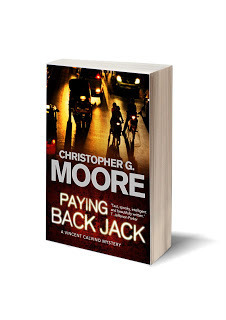
Grove Press will release the hardback edition of Paying Back Jack in October 2009 and Atlantic Books will release it in December 2009. This is the 10th novel in the Vincent Calvino crime fiction series.
In Paying Back Jack, Calvino agrees to follow the “minor wife” of a Thai politician and report on her movements. His client is Rick Casey, a shady American whose life has been darkened by the unsolved murder of his idealistic son. But what seems to be a simple surveillance job pulls Calvino into a quest for revenge, as well as a perilous web of political allegiance. Calvino narrowly escapes an attempt on his life and then avoids being framed for a murder only through the calculated lever-pulling of his best friend, Thai police colonel, Pratt. But unknown to our man in Bangkok, in an anonymous apartment tower in the center of the city, a two-man sniper team awaits its shot, a shot that will change everything.
I’ll let a review place Paying Back Jack in the context of contemporary Thai culture. “It's easy to see why Moore's books are popular: While seasoned with a spicy mixture of humor and realism, they stand out as model studies in East-West encounters, as satisfying for their cultural insights as they are for their hard-boiled action.”—Mark Schreiber, The Japan Times
How much of what you do is:
a) formula dictated by the genre within which you write?
I am told there are quite a few rules. But I never bothered to learn what they are. The private eye novel is mainly thought of as the creation of American authors; notably Raymond Chandler and Dashiell Hammett. It is an American invention based on crime in American cities and the social and class structure within which the private eye, police, victims and villains live and die. If there is an American location formula, I broke it in 1992 by setting Spirit House, the first of the Vincent Calvino novels set in a foreign location.
b) formula you developed yourself and stuck with?
To bring the reader into a different culture, different rules, expectations, language, and make it meaningful without overwhelming him/her with obscure references or incidents.
The goal is to make Asia accessible without losing the vitality and history of the place.
c) as close to complete originality as it’s possible to get each time?
I am fortunate to live in a place (Bangkok) and at a time (political chaos) that provides me with more than enough original material. A third of my fan mail is: Are you safe from the gunfire? Originality can’t be separated from the circumstances in which a writer finds himself/herself. Originality starts at home. If you lead an original life, then by the process of living the material unfolds. I suspect living in Jerusalem that you understand that authors who are living on the edge of where history is moving like tectonic plates, you understand the importance of location, and the challenges to authority, oppression, and inequality. Originality is giving a face to these concepts in real life drama played out where the stakes are high.
What’s your favorite sentence in all literature, and why?
“Is execution done on Cawdor?” Duncan, MacBeth, Act 1, Scene 4.
Treason, repentance, pardon and ability to die well all wrapped up nicely. So much of who we are is contained in the exchange between Duncan and Malcolm.
What’s the best descriptive image in all literature?
That’s a tall order to fill. Even within crime fiction there are so many compelling images. The opening of the Quiet American by Graham Greene is a wonderful description of French Colonial police and opium smoking in Saigon. But is it the best descriptive image in all literature? Doubtful. If put against the wall, the firing squad awaiting an order for me to answer or die, I’d opt for the opening of MacBeth. It is hard to beat three witches brewing up a storm when facing rifles.
How much research is involved in each of your books?
Research is the heart of any writing project. Research is part of the job. You push yourself into new situations. Meet new people. Take a different order of risk. You assess as you go along, taking notes, talking to people, strangers, friends, colleagues, locals, foreigners, to get a sense of what people are thinking, suffering, wanting, and scheming to get. Research is also the fun part of the process; you are out from behind a computer and mixing with real people. I am big fan of The Collaborator of Bethlehem: An Omar Yussef Mystery and figure you must have spent a lot of time in the back streets to get the atmosphere right. Novelists should have a journalistic instinct in the field, a poet’s instinct distilling the experience, and a surgeon’s instinct in crafting the words.
Where’d you get the idea for your main character?
Vincent Calvino emerged from my four years of living in New York
City. I spent time as a civilian observer with NYPD. Calvino is half Italian and half Jewish and narrative often draws upon this ethnic background. The Thai characters arose from various people that I’ve known in Thailand and elsewhere in Asia over the last 25 years.
What’s your experience with being translated?
It’s a bit like a heart transplant. You are unconscious when it happens and when you wake up (assuming that you do), you really only have a vague idea what was done. The main thing is someone else’s heart is pumping your blood. That said, I’ve become friends with my German, Japanese, and Italian translators. And from what I can see, they’ve successfully performed the transplant. I have a Hebrew edition coming out this summer. I understand the translator is an excellent surgeon.
Do you live entirely off your writing? How many books did you write before could make a living at it?
I am fortunate to make a living from my writing. It was about a dozen books into the game that I was able to have sufficient revenue to pay the rent and food bills. Remember, though, where I live (at least in the early years) the cost of living was very little. That is an important factor for any writer. You need to find a place that you can exist with little money. That means places like New York, London, and Paris which once provided such opportunities for artists with meager incomes, now require a law partner’s income to pay the rent.
How many books did you write before you were published?
Three. Lost, gone but not mourned.
What’s the strangest thing that happened to you on a book tour?
A Russian Mafia thug showed up at a book reading in Pattaya and asked if he could rent one of my books. Guess he didn’t want to lay out the cash investment for a outright sale. It was a public place. I figured he wouldn’t shoot me if I said no.
What’s your weirdest idea for a book you’ll never get to publish?
A katoey dressed in a Santa Claus outfit on Christmas Eve his small boat washed ashore at Muslim fishing village in Java.

How long did it take you to get published?
My publishing history is a checkered one. My first professional sale was a radio drama to the CBC in 1979, and my first novel (His Lordship’s Arsenal) was published in New York in 1985. After what will soon be 21 novels (The Corruptionist will come out in 2010), I look back and think that I was lucky to start out when I did. It is much tougher now.
Would you recommend any books on writing?
There is a small library full of books on various aspects of writing. Ranging from the mechanics, to the business and legal issues, to self-help. A good web site which includes a page titled Writers Resources which has a lot of useful information about the creative process. Novelist Timothy Hallinan is the brains behind the website. It is hard to disagree with Stephen King’s "On Writing". He says that all writers must be readers. The best education is to read and re-read a diverse range of very good books. I read between 50 to 150 pages a day.
What’s a typical writing day?
The smell of fresh coffee and a long plume of black smoke rising from a burning bus across town. Seriously, there is no “typical” day as any book is a long series of marginally connected events: on the street for research, note making, organizing material, gathering profile information on characters, assembling the cast, selecting an incident that sets off a chain of events much like breaking the rack of ball in pool, fiddling with the outline, working on plot points and structure. Then there is going back to the desk to write the first draft. . .

Plug your latest book. What’s it about? Why’s it so great?
Grove Press will release the hardback edition of Paying Back Jack in October 2009 and Atlantic Books will release it in December 2009. This is the 10th novel in the Vincent Calvino crime fiction series.
In Paying Back Jack, Calvino agrees to follow the “minor wife” of a Thai politician and report on her movements. His client is Rick Casey, a shady American whose life has been darkened by the unsolved murder of his idealistic son. But what seems to be a simple surveillance job pulls Calvino into a quest for revenge, as well as a perilous web of political allegiance. Calvino narrowly escapes an attempt on his life and then avoids being framed for a murder only through the calculated lever-pulling of his best friend, Thai police colonel, Pratt. But unknown to our man in Bangkok, in an anonymous apartment tower in the center of the city, a two-man sniper team awaits its shot, a shot that will change everything.
I’ll let a review place Paying Back Jack in the context of contemporary Thai culture. “It's easy to see why Moore's books are popular: While seasoned with a spicy mixture of humor and realism, they stand out as model studies in East-West encounters, as satisfying for their cultural insights as they are for their hard-boiled action.”—Mark Schreiber, The Japan Times
How much of what you do is:
a) formula dictated by the genre within which you write?
I am told there are quite a few rules. But I never bothered to learn what they are. The private eye novel is mainly thought of as the creation of American authors; notably Raymond Chandler and Dashiell Hammett. It is an American invention based on crime in American cities and the social and class structure within which the private eye, police, victims and villains live and die. If there is an American location formula, I broke it in 1992 by setting Spirit House, the first of the Vincent Calvino novels set in a foreign location.
b) formula you developed yourself and stuck with?
To bring the reader into a different culture, different rules, expectations, language, and make it meaningful without overwhelming him/her with obscure references or incidents.
The goal is to make Asia accessible without losing the vitality and history of the place.
c) as close to complete originality as it’s possible to get each time?
I am fortunate to live in a place (Bangkok) and at a time (political chaos) that provides me with more than enough original material. A third of my fan mail is: Are you safe from the gunfire? Originality can’t be separated from the circumstances in which a writer finds himself/herself. Originality starts at home. If you lead an original life, then by the process of living the material unfolds. I suspect living in Jerusalem that you understand that authors who are living on the edge of where history is moving like tectonic plates, you understand the importance of location, and the challenges to authority, oppression, and inequality. Originality is giving a face to these concepts in real life drama played out where the stakes are high.
What’s your favorite sentence in all literature, and why?
“Is execution done on Cawdor?” Duncan, MacBeth, Act 1, Scene 4.
Treason, repentance, pardon and ability to die well all wrapped up nicely. So much of who we are is contained in the exchange between Duncan and Malcolm.
What’s the best descriptive image in all literature?
That’s a tall order to fill. Even within crime fiction there are so many compelling images. The opening of the Quiet American by Graham Greene is a wonderful description of French Colonial police and opium smoking in Saigon. But is it the best descriptive image in all literature? Doubtful. If put against the wall, the firing squad awaiting an order for me to answer or die, I’d opt for the opening of MacBeth. It is hard to beat three witches brewing up a storm when facing rifles.
How much research is involved in each of your books?
Research is the heart of any writing project. Research is part of the job. You push yourself into new situations. Meet new people. Take a different order of risk. You assess as you go along, taking notes, talking to people, strangers, friends, colleagues, locals, foreigners, to get a sense of what people are thinking, suffering, wanting, and scheming to get. Research is also the fun part of the process; you are out from behind a computer and mixing with real people. I am big fan of The Collaborator of Bethlehem: An Omar Yussef Mystery and figure you must have spent a lot of time in the back streets to get the atmosphere right. Novelists should have a journalistic instinct in the field, a poet’s instinct distilling the experience, and a surgeon’s instinct in crafting the words.

Where’d you get the idea for your main character?
Vincent Calvino emerged from my four years of living in New York
City. I spent time as a civilian observer with NYPD. Calvino is half Italian and half Jewish and narrative often draws upon this ethnic background. The Thai characters arose from various people that I’ve known in Thailand and elsewhere in Asia over the last 25 years.
What’s your experience with being translated?
It’s a bit like a heart transplant. You are unconscious when it happens and when you wake up (assuming that you do), you really only have a vague idea what was done. The main thing is someone else’s heart is pumping your blood. That said, I’ve become friends with my German, Japanese, and Italian translators. And from what I can see, they’ve successfully performed the transplant. I have a Hebrew edition coming out this summer. I understand the translator is an excellent surgeon.
Do you live entirely off your writing? How many books did you write before could make a living at it?
I am fortunate to make a living from my writing. It was about a dozen books into the game that I was able to have sufficient revenue to pay the rent and food bills. Remember, though, where I live (at least in the early years) the cost of living was very little. That is an important factor for any writer. You need to find a place that you can exist with little money. That means places like New York, London, and Paris which once provided such opportunities for artists with meager incomes, now require a law partner’s income to pay the rent.
How many books did you write before you were published?
Three. Lost, gone but not mourned.
What’s the strangest thing that happened to you on a book tour?
A Russian Mafia thug showed up at a book reading in Pattaya and asked if he could rent one of my books. Guess he didn’t want to lay out the cash investment for a outright sale. It was a public place. I figured he wouldn’t shoot me if I said no.
What’s your weirdest idea for a book you’ll never get to publish?
A katoey dressed in a Santa Claus outfit on Christmas Eve his small boat washed ashore at Muslim fishing village in Java.


Elmore Leonard in Bangkok

Christopher G. Moore was good enough to send me an advance copy of his 10th Vincent Calvino novel "Paying Back Jack" which will be out in October (December in the UK). I love the Calvino series for the way it leads the reader into the underbelly of Bangkok in the company of its Italian-Jewish New Yorker private eye. PBJ gives us that and much more. Moore creates a cast of vibrant characters worthy of the best Elmore Leonard caper for this hard-edged, stylish mystery. With the story of snarling Special Ops hitmen and smiling Thai hookers, Moore skewers the simplistic logic of the "war on terror," lays bare its worldwide destructive power, and shows the price it makes people pay. His Vincent Calvino is at once in the finest tradition of the lone private detective and a complete original. Until PBJ hits bookshops, try "Spirit House," my favorite of the earlier Calvino novels. You can also read my interview with Moore from a little over a month ago.
Can't wait for The Corruptionist

I heard from my chum Christopher G. Moore that he just finished writing the 11th in his series of Vincent Calvino crime novels set in Bangkok. That's good news, because I already read his brilliant and forthcoming Paying Back Jack. (See my review "Elmore Leonard in Bangkok"). Knowing Chris's work, I already love The Corruptionist -- I'm enjoying guessing how he'll use that terrific title and his vibrant cast of characters to take us on another superbly original dive into the underworld of Bangkok.
On his blog, Chris recently wrote about my latest Palestinian crime novel, The Samaritan's Secret. I'm delighted he enjoyed it -- not only because I'm such an admirer of his writing, but also because we share a birthday/a UK publisher/a style of examining the foreign culture in which we live through gritty crime fiction which exposes something you'd never expect about the place. Here's what he wrote:
"Matt Beynon Rees is another author who knows the territory, the people, and the nature of the personal conflicts that separate them. Matt’s turf is Palestine, and his novels are brim with people caught in the vice of poverty, tribal and clan conflict, and facing the constant possibility of violence. He brings Palestine to life. And that is no easy thing.
"One of Matt’s Omar Yussef mysteries does more to take a person into the day-to-day reality of the lives of people in Gaza than a library of newspaper and magazine analysis of Middle East politics. Ultimately understanding countries like the Palestine and North Korea are tied to their history, language, enemies, and traditions. The reality of such a country becomes understandable through emotional lens of the people who live there. Matt channels the sensibility of Graham Greene in this series, building a picture of a time and place that stays with you long after you finish the book."
So while you're waiting for The Corruptionist, get stuck into the first 10 Calvino novels. You won't be disappointed.
Moore's new Thailand noir
Christopher G. Moore has book 10 in his terrific Vincent Calvino crime series out this week. "Paying Back Jack", which will be out in December in the UK. I love the Calvino series for the way it leads the reader into the underbelly of Bangkok in the company of its Italian-Jewish New Yorker private eye. PBJ gives us that and much more. Moore creates a cast of vibrant characters worthy of the best Elmore Leonard caper for this hard-edged, stylish mystery. With the story of snarling Special Ops hitmen and smiling Thai hookers, Moore skewers the simplistic logic of the "war on terror," lays bare its worldwide destructive power, and shows the price it makes people pay. His Vincent Calvino is at once in the finest tradition of the lone private detective and a complete original. You can also read my interview with Moore from earlier this year.
'Exotic' crime fiction makes unpalatable places bearable
 “Exotic” crime fiction has taken off in the last decade. People want to read about detectives in far-off places, even if they don’t want to wade through learned histories of those distant lands.
Many of the biggest selling novels of the last decade have been “exotic crime.” You’ll find a detective novel set almost everywhere in the world, from the “Number One Ladies Detective Agency” in Botswana through Camilleri’s Sicily to dour old Henning Mankell in the gloomy south of Sweden.
The success of my co-bloggers at International Crime Authors – with their detectives plying their trade in Thailand, Laos, and Turkey, alongside my Palestinian sleuth Omar Yussef – is also proof that this taste for international crime is more than just a publishing fad. The novels aren’t just Los Angeles gumshoe stuff transported to colder or poorer climes.
Here’s what I think is behind it:
Read a history book or a book of contemporary politics. Often you’ll find a list of the enormous numbers of people destroyed around the world by war and famine and neglect. You won’t get any sense that the world…makes sense. Crime fiction doesn’t purport to save the planet, but it does demonstrate that one man – the detective – can confront a mafia, an international espionage organization, a government and come out with at least a sliver of justice.
And justice is one of the few ideas which can still inspire.
Readers also prefer crime fiction about distant countries over so-called “literary” fiction about such places.
That’s because crime fiction gives you the reality of a society and also, by definition, its worst elements — the killers, the lowlifes — but it also gives you a sense that a resolution is possible. (See above.)
Literary fiction, by contrast, often simply describes the degradation of distant lands. If you read Rohinton Mistry’s “A Fine Balance,” for example, you probably thought it was a great “literary” book, but you also might’ve ended up feeling as abused as his downtrodden Indian characters without the slightest sense of uplift.
Crime fiction doesn’t leave you that way.
Now, that’s also true of the Los Angeles gumshoe. But the international element gives us something else to wonder about in these new novels. Not just because the scene is alien. Rather, it’s because we all trust to some extent that bad guys in Los Angeles will go to jail — or become Hollywood producers. We have faith in the system. So a detective has some measure of backing from the system, and consequently novelists have to push credibility to its limits in order to make him look like he’s taking a risk, to make him look brave.
International crime, when it’s set in the Developing World in particular, can’t be based on that same trust in the just workings of the system. The lack of law and order in Palestine, as I observed it as a journalist covering the Palestinian intifada, was one of the prime reasons I had for casting my novels as crime novels. It was clear the reality wasn’t a romance novel. Gangsters and crooked cops in the West Bank suggested the more vibrant days of the US crime novel back in the time of Chandler and Hammett, when it was much harder to argue that a city or mayor or police chief wouldn’t be in the pocket of the bad guys.
When a detective goes up against such odds in international crime fiction, it’s truly inspiring.
For books that start with a murder, that’s not what you’d expect, but it’s the reason for the success of this new exotic avenue of the crime genre.


