
Santigold, Consumerism, and the Power of Pop

March 22nd marked the second stop on Santigold’s whirlwind .99 tour. The tour just so happened to bring her to my neck of the woods, to perform at the House of Blues in Dallas, Texas. I’ve never seen her in concert, but I’ve adored her music since first stumbling across Master of my Make-Believe two summers ago. Many warm summer afternoons were spent lying on the floor, listening to that album. I’ve had Disparate Youth on repeat in my car ever since.
Santigold’s infectious, almost relentlessly upbeat fusion of punk, reggae, grime, and pop was realized on stage as a tribute to commercialism. Glittering, candy-colored animations of cheaply-assembled, low-end consumer goods were set in the context of familiar urban retail spaces. Dressed in a bright yellow We Buy Gold dress and lo-top kicks, Santigold was joined by her understated backup dancers, who twirled shop signs with the same logo. They invited the audience into the fabricated .99 store that was projected onto the screen behind the stage, where footage of shoppers milling around brightly-lit, well-stocked shelves looped throughout the concert. Her long, loose hairstyle and inconspicuous costuming made her performance look effortless, spontaneous, and fun.
Emphasis on fun.
Interposing this imagery of cheap consumerism were equally shiny and plastic visions of high-end appliances, vacuum cleaners, and tanning beds. The contrast is clear: the low-cost and readily available with the idealized and unattainable. Lifestyle is what we make of it, shopping in Santigold’s very own imagined .99 store and still striving for outdated, stereotypical status symbols. Everything is plastic and pre-made. We’re all feeding into an endless cycle of cheap ephemera, as we chase after the glossy veneer of the next tax bracket up from our current station.
But I don’t think it’s that simple, or that cynical.
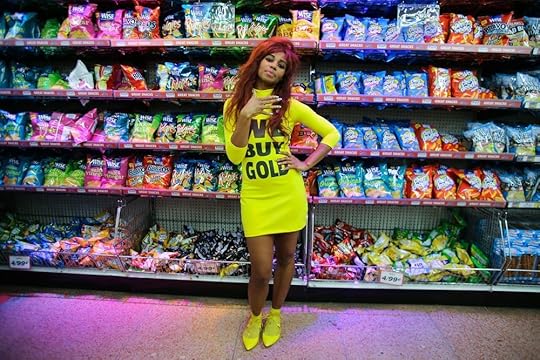
"We have no illusion that we don’t live in this world where everything is packaged. People’s lives, persona, everything, is deliberate, and mediated. It can be dark and haunting and tricky, and freak us out, but it can be also be silly and fun and we can learn to play with it".
-- From Pitchfork Magazine, January 2016
As an album, .99 is about consumption and pretense. The marketing, music videos, and stage performances are a circus of desire and excess. Santigold’s vision of consumer culture is plucked right out of the austere and overwhelming photography of Andreas Gursky. Since the 1990s, Gursky has utilized “new objectivity” to flatten the complexities of individual human experience, examining global consumerism from a cold, safe, and sometimes troubling distance. However, for Santigold, it’s a much more intimate affair.
Her interactive music video for Can’t Get Enough of Myself invites the viewer to take part in her own reflection, consumption, and negotiation of self. The you-as-consumer is allowed to see themselves in the media that they consume, as well as the products they purchase. It’s a means of dissecting the relationship between buyer-seller, consumer-producer, self-façade that we’re often quick to vilify. The track Chasing Shadows is a meditation on the anxiety that comes of measuring the self against our mediated image of other people’s successes:
“Chasing Shadows” is about with the conflicted reality of an artist's life. Caught in the web we spin around ourselves, a mixture of hubris and the guise of perfection, we fear being swallowed up by our own ambition. Never in the moment, as quickly as we reach our goals, our gaze shifts to those still looming in the distance. We judge ourselves harshly for not being further on the path and revel in the anxiety of racing the rate of consumption.
-- From Pitchfork Magazine, January 2016
As an audience, we’re encouraged to face these dichotomies, insecurities, and bombastic celebrations of consumption. We’re invited to engage with these ideas, or to simply kick back and enjoy the theater of it all, for the sake of aesthetic experience. That’s the intriguing and subtle complexity of Santigold’s packaged performance and marketing strategy. It’s so plastic, you can’t help but love it.

Andreas Gursky
diptych 99 cent store II
2001
But for me, at the end of the night, my take-away was much more personal. Standing in a faceless crowd of people, all hungry to see themselves in media, I found myself feeling at home. Santigold’s stage-turned-.99-store was the same kind of place I’ve shopped at, in many cities over many years, because that’s what I’ve had available to me. These were familiar spaces and products, held up as commonplace rather than the object of disdain. As a bubble machine spewed big, soapy bubbles over a neon-washed dance floor, we all (loudly and drunkenly) sang the entirety of Disparate Youth. Halfway through the show, Santigold invited upwards of forty people from the crowd onto the stage for a good, old-fashioned dance line. Some people on stage were so excited they cried. It was hard not to cry with them.
For a few hours on a Tuesday night in Dallas, everyone – regardless of what stores we shopped at – felt happy, and safe, and included.


