
Zero to One: Notes on Startups, or How to Build the Future by Peter Thiel
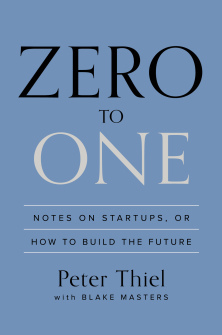 Summary: The great secret of our time is that there are still uncharted frontiers to explore and new inventions to create. In Zero to One, legendary entrepreneur and investor Peter Thiel shows how we can find singular ways to create those new things.
Thiel begins with the contrarian premise that we live in an age of technological stagnation, even if we’re too distracted by shiny mobile devices to notice. Information technology has improved rapidly, but there is no reason why progress should be limited to computers or Silicon Valley. Progress can be achieved in any industry or area of business. It comes from the most important skill that every leader must master: learning to think for yourself.
Doing what someone else already knows how to do takes the world from 1 to n, adding more of something familiar. But when you do something new, you go from 0 to 1. The next Bill Gates will not build an operating system. The next Larry Page or Sergey Brin won’t make a search engine. Tomorrow’s champions will not win by competing ruthlessly in today’s marketplace. They will escape competition altogether, because their businesses will be unique.
Zero to One presents at once an optimistic view of the future of progress in America and a new way of thinking about innovation: it starts by learning to ask the questions that lead you to find value in unexpected places.
Hardcover: 224 pages
Publisher: Crown Business; 1 edition (September 16, 2014)
Language: English
ISBN-10: 0804139296
ISBN-13: 978-0804139298
Review:
Zero to One is more philosophical rather than a step-by-step guide on navigating the complex world of start-up companies. And one would think that would be a disappointment, after all, creating a company from scratch is full of hurdles and land-mines founders aren’t always aware of. However, Zero to One‘s philosophy is spot on, and worth anyone’s time who’s serious about launching a company.
Some of the advice is tough to hear (or swallow) if you’re exploring this world. And if you’re a new, budding entrepreneur, I have no doubt that some of Thiel’s wisdom will dash your hopes. But, like anything, criticism is best if it forces you to grow and adapt, and Thiel’s advice should do just that. Whether it’s his position on competition vs. monopolies, or the fact that he believes that your product has to be a minimum of 10x better than the current competition if you are to take a significant enough foothold for your new business idea to prosper, Thiel offers his insight in a succinct, easily readable, practical way.
Thiel proposes you ask yourself seven questions as a business owner (or future business owner). These seven questions will gauge how well you’ll succeed, or fail. He believes the most successful companies answer all seven, but even five is very good.
1. Can you create breakthrough technology instead of incremental improvements?
2. Is now the right time to start your particular business?
3. Are you starting with a big share of a small market?
4. Do you have the right team?
5. Do you have a way to not just create but deliver your product?
6. Will your market position be defensible 10 and 20 years into the future?
7. Have you identified a unique opportunity that others don’t see?
Overall this book is a quick read (coming in at just shy of 200 pages) and can be tackled in a few hours. But that’s not to belittle it’s importance. I’ve read a lot of business books which focus on the “how-tos” of business, which, obviously, is of importance. Rather than focus on the micro vision of a company, Thiel takes a step back and forces entrepreneurs to look at the company as a whole.



