Can a Good God Allow Pain?

Over the next few weeks, I’ll be sharing devotions pulled from my book Living in the Shadow of Death: Learning to Thrive through Tragedy and Uncertainty. If you want to learn more about this book, scroll down or click here. If you want to read this series from the beginning, click here.
Sometimes life is just plain hard. Heart-wrenching, want-to-stay-in-bed-and-ignore-the-world difficult. What do you do when life throws these punches? Pray? Of course. Trust God? Absolutely. Cry a bit? Often appropriate. Doubt God—that He cares or is going to show up? That’s honest for. Throw a temper tantrum, yell at heaven? I’ve done that a few times in my life.
Anyone who walks with God must face a difficult question. How can God be good and allow pain and tragedy? I’ve already talked a little about this, but now it’s time to separate that into two more basic questions: Is God good? and, Is God in control? 
I believe God is managing affairs and that He doesn’t need any advice from me. ~Henry Ford, American Industrialist
Buried in James 1:17 is an idea that is paraphrased and offered in all kinds of situations: God never changes. The half-brother of Jesus was writing to Jewish Christians scattered around the Mediterranean Sea, challenging them to not let their faith merely be words, but to let their actions show it. Every good and perfect gift is from above, he writes, coming down from the Father of the heavenly lights, who does not change like shifting shadows.
When people say, “God doesn’t change,” they possess a heartfelt desire to bring comfort. But do we like a God who never changes? I know we’re supposed to, but it means that He won’t change His mind about a topic that I’m not sure I fully agree with Him on. Or that He won’t modify His stance on right and wrong based on the situation that I find myself in.
But then, do I really want Him to be different?Do I want a God who changes? One I can’t count on to be the same tomorrow as He was yesterday? The one who loved and guided Abraham, loved and guided the apostle Paul, and now loves and guides me? No, I really don’t.
This highlights a significant problem when we think about God’s goodness. We tend to simplify at least two attributes of His character, His justice, and His holiness.
God of justice.The Merriam-Webster dictionary defines the word just as “acting or being in conformity with what is morally upright or good; legally correct.” Most of the time, we like that. We want the person who wronged us to pay, even if the crime is somewhat removed from directly affecting our lives. For example, I want the person who shot a family that I don’t know to go to jail because if he can shoot them, he could shoot me or my children.
Thankfully, the Bible says God is just. Isaiah 30:18 says, The Lord is a God of justice, and Job 34:12 says, It is unthinkable that God would do wrong, that the Almighty would pervert justice. However, while we all support God’s justice for us, don’t we sometimes struggle when He also demands justice from us?
 God of holiness.
Just like justice, many verses throughout the Bible talk about God’s holiness. Merriam-Webster defines holy as “exalted or worthy of complete devotion as one perfect in goodness and righteousness.” Isaiah 6 and Revelation 4 both mention six-winged creatures crying out, Holy, holy, holy, is the Lord.”
Because God is holy, or perfect in goodness and righteousness, He is concerned with our holiness. That sounds good when we’re at church on Sunday. But on Monday night? When it’s been a tough day and big concerns plop themselves down on our living room couch?
God is so attentive to our holiness that whatever He has to do or allow to develop that righteous character in us is precisely what He will do or allow. Even though that thing may not be good in and of itself, it pushes us to seek God and allows God to act in us and through us for good.
A Good GodAs I consider the newest wave of difficulty to hit my home, I admit that us seeking God for relief and for answers is good. And when we get to that place—when we seek God and His righteousness first (Matthew 6:33)—we allow God to act in us and through us for good. Which is very good. But it all starts with circumstances that I don’t want to walk through or endure.
We should pause to consider pain itself. I tend to avoid its possibility if I can, but when I learned more about its function within the body, I was fascinated. God designed it to serve us just like he did every other part of our body. In his book Where Is God When it Hurts?, Philip Yancey writes,
Broken pain functions are not good.In a thousand ways large and small, pain serves us each day, making possible normal life on this planet. If we are healthy, pain cells alert us when to go to the bathroom, when to change shoes, when to loosen the grip on a mop handle or rake, when to blink. Without pain, we would lead lives of paranoia, defenseless against unfelt dangers.” (Yancey, 46).
Mr. Yancey spent time with doctors who study those with congenital indifferences to pain. In other words, those who live with broken pain functions. Think about raising a child whose pain receptors and signalers are not working. How do you convince them of the dangers of a hot stove or a sharp knife? Persistent headaches that would send the rest of us to the doctor would be ignored if we didn’t feel the pain to alert us to the possibility of something being wrong.
And can you consider the possibility that without pain, we’d also miss out on pleasure? Can someone who’s never pushed through the pain and discipline of learning to run understand the joy in crossing a marathon’s finish line? Can someone who didn’t submit to a physical therapist know the joy of tossing crutches aside and walking unassisted? 
FINAL THOUGHTS
In order to have great happiness you have to have great pain and unhappiness – otherwise how would you know when you’re happy? ~Leslie Caron, French-American actress
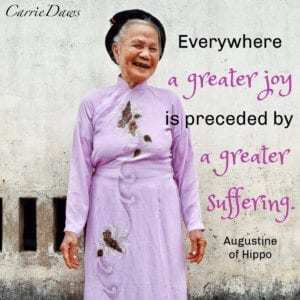
Augustine of Hippo once concluded, “Everywhere a greater joy is preceded by a greater suffering.” Perhaps our problem isn’t so much with pain as it is with our perspective of pain. Maybe we need to quit disparaging its presence and instead consider its blessing. Yes, pain alerts us when something is wrong. But pain also gives us the opportunity to do something to make it better.
READ MORE
This is an excerpt from my book Living in the Shadow of Death. I’ll be sharing more in the weeks ahead, or you can purchase the book on Amazon (other retailers coming soon!).
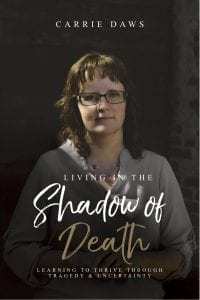 Living in the Shadow of Death
Does God have a purpose for the turmoil or tragedy you are experiencing? Does a good God allow loss and send pain? How can that lurking feeling of dread for tomorrow be part of abundant life with Christ?
Grief hits us unexpectedly. A job loss, a failed relationship, a health crisis, an unexpected move, a rebellious teen, and other difficult circumstances force themselves upon us, demanding our attention. Fear, insecurity, and loneliness intimidate us into quiet submission and attempt to dictate our choices.
But what if we could shove them out our front door?
With loving concern and unyielding devotion for those facing a loss they never imagined, Carrie opens up her heart to reveal the biblical truths she’s learned through the heart-wrenching turbulence in her own life. She answers questions many Christians struggle with but dare not admit:
Is God really good?Does the presence of pain and loss cancel out the abundant life promised to us?How can we follow God when life seems to only bring heartache?Is He even trustworthy? If these are your questions, take heart! Within these pages, Carrie shares some of her very unchristian-like doubts and how she developed an intense faith and abiding trust even while Living in the Shadow of Death.
If you want to dig deeper into this book, you can also buy the journal featuring quotes from the book (links of the Book Page). Also, on the Freebies Page you’ll find a small group study guide and a leader’s guide!