
New Photography Book!
It's been three years in the making and quite a long strange trip, but my latest book, Lopapeysa: A Knitter's Guide to Iceland with Patterns, Techniques and Travel Tips is on sale in the UK and EU. It's got LOTS of photos and it's about a really exciting and photogenic location.
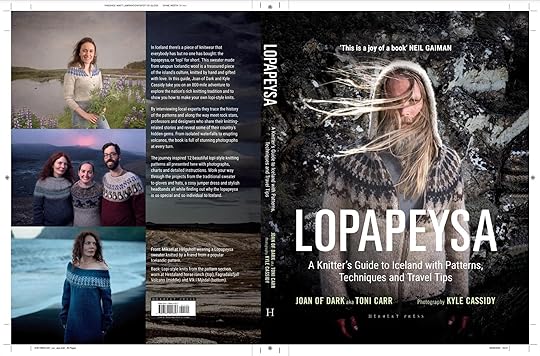 European cover of Lopapeysa
 I wanted to talk a bit about photographing this book, since I'm a gearhead, and take you a bit behind the scenes. I'll also talk about the book itself, and Iceland because, how can you not?
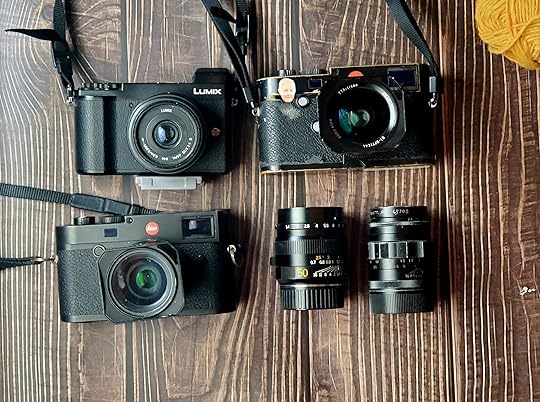 Camera gear that I took with me, a Panasonic Lumix GX9, a Leica M240 and a Leica M10 with a variety of lenses.
 Over the years, most of the innovation I've made photographically is just reducing the size of my kit. I often take a photo of the camera gear that I've packed before I go off to do something and it's pretty amazing how that pool of equipment has gotten smaller and smaller and smaller over the years. A lot of it has to do with switching from gigantic DSLR's to Leica rangefinders and mirrorless Micro Four Thirds cameras, but it comes with tradeoffs. DSLR's typically have a lot more features than a tiny little Leica, like auto focus and auto exposure and the ability to take multiple frames a second, so you definitely give up features and functionality and, if you're doing it right, you can make up for a lot of that with your own photographer skill. It's a lot easier with a DSLR, but it's also a lot more equipment you have to haul around.
So on this trip, I brought a Leica M10 as my main camera and a Leica M240 as a backup. Since Leica's don't have zoom lenses it's nice to be able to have two lenses ready to go at any time.
Leica M10 Leica M240 Leica 90mm f2.8 TTartisans 50mm f 1.4 TTartisans 35mm f 1.4 TTartisans 21mm f 1.4 Panasonic GX9 Panasonic 20mm f1.7 pancake lens Leica 45mm f2.8 macro Off camera flash Pocket Wizard radio triggers Triopo light modifier with pistol grip (I never heard of them either, I got it on eBay)For this trip I used the 21mm and the 50mm mostly so I usually had the 21mm on the M10 and the 50mm on the M240 and would switch between the two. The 21mm for wider landscapes and the 50mm for more closeup people shots.
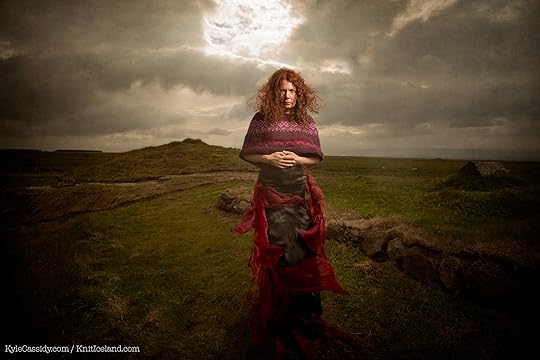 Leica M10, TTartisans 21mm f1.4 — off camera flash.
 So this (above) is one of the 21mm shots which takes in a lot of landscape because, let's be honest, Iceland has a lot of landscape.
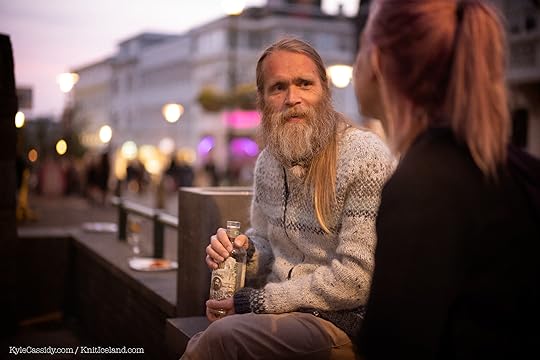 TTartisans 50mm 1.4
 And this (above) is one of the 50mm 1.4 shots (on the Leica M240) -- the 50mm has a really great ability to isolate the subject when shot wide open. I love this lens and use it a lot. I felt that there were two types of photos I was taking, one is a photo that gives a sense of mood and the other is a photo that the knitwear is the total star of and gives people looking at the photo a clear idea of what the piece is going to look like when it's done. And it's also important (I think) that these photos show the knitwear being used — what will it look like when I, my friend, my significant other, my whoever, wears this out? So the 21mm was often (but not always) my mood lens.
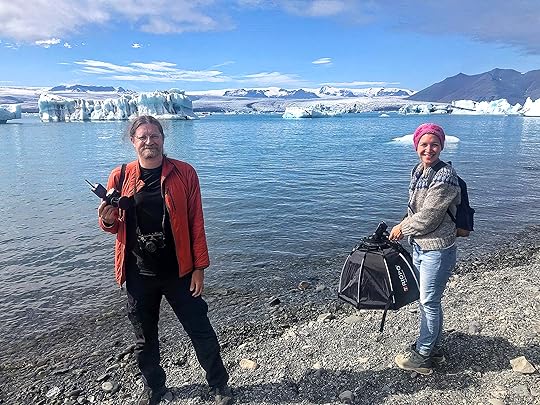 Watching a glacier turn into icebergs. That's Joan on the right. Photo by Trillian Stars.
 A lot of the photos I took had daylight balanced flash on them. I'm not entirely able to quantify why I like the look of daylight flash, but one of them is that it looks otherworldly and sophisticated to me. Because the lighting is unnatural, in that it often looks like a studio photo in the wild, it calls more attention to itself.
In order to get the flash to work in daytime I was limited by the Leica's mechanical shutter which fixed the shutter speed at 1/125th of a second and if you were at f16 an 1/125 of a second at iso 100 you're left with that Spinal Tap question "where do you go from there?" So I used a variable ND filter, which is really two circular polarizers that you can turn to adjust the amount to light they stop. The downside of this is you have to really crank up the power on the flash.
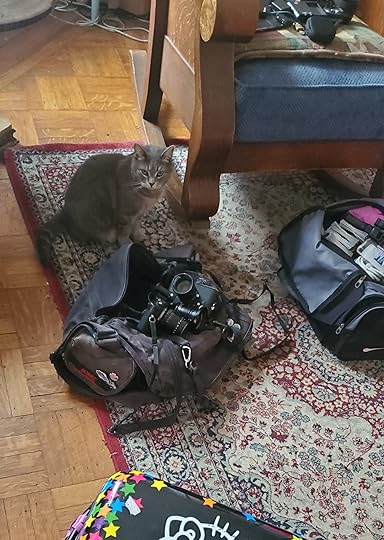 Packing to go, I had a camera bag, a duffel bag, and a hard-sided suitcase.
 I packed three bags, cameras, accessories and clothes. I checked the accessories and the clothes bag and took the camera bag with me on the plane. The camera bag had everything I needed to do my job, though not necessarily well. So I had all my cameras and equipment but only two chargers (the rest was in the accessories bag). I never prioritize things I can get where I'm going, so if your bag of clothes gets lost, you'll be fine because you can get clothes when you get there. If your AA batteries get lost, that's fine because you can get AA batteries when you get there. So plan for the worst (all your checked bags get lost) and figure out what you need to do your job — in this case, I would have been able to photograph everything, I just might have smelled bad after a couple of days. However, everything got where it needed to be.
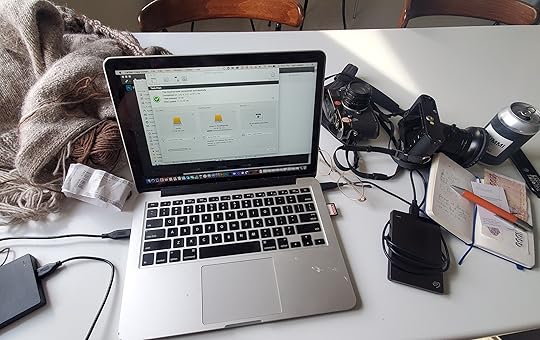 Somewhere on the road. I had two external hard drives that I synched with Carbon Copy and if I had wifi, I let it synch to the cloud. When I left Iceland, I gave Joan one of the hard drives so that if my luggage got stolen or my plane crashed they could still finish the book. Your photos are the only thing that matters.
 Your photos are always the most important thing. They're more important than your cameras, they're more important than your clothes. Because they're the only thing that can't be replaced. For this trip we were traveling in a gigantic mobile home with five people, a lot of sweaters and a modest amount of equipment. We'd bought "Internet access" and my plan was to continually sync to the could but we found out about 7 hours after we left Reykjavik that "Internet access" was limited to 1gb of data which was gone in a day. So, the rest of the time I carried out a local physical backup — one copy on the laptop HD which was synched with two external drives. Every time we paused or after each large photo shoot, I synched the photos. And if we ever ended up in a place with wifi, the cloud synch would automagically continue.
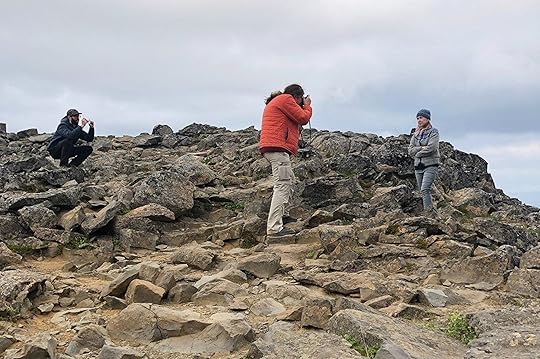 At the top of a volcanic core. I'm wearing an EMS summit jacket on top of my lopi. Before we went someone said "pack for all weathers because you will experience all of them" and that was true. it was hot, it was cold, it was dry, it was soaking. The summit jacket packs into its own pocket and you can use it as a pillow. It was a fantastic investment. Mine is stuffed with polar fleece, which is an inorganic down alternative.
 We had some specific plans as we circumnavigated the country and these were mostly based around people we were meeting up with. The rest of the time we kept free for spontaneous trips or things that people told us about. The whole idea of this book is that it's a book about having an adventure in Iceland, but it's also got 12 knitting patterns in it and, an overarching historical mystery that we were trying to solve. Having two cameras with two lenses more or less permanently mounted to them let just jump out of the RV and take photos pretty quickly.
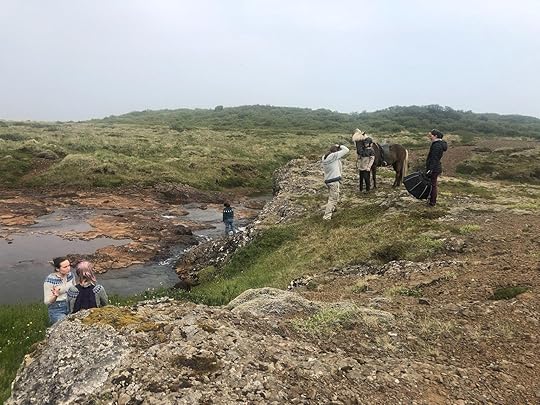 This is one of my favorite photos of the trip. Trillian Took it. It's just got everything going on at once. I'm photographing a sweater, Arwin's holding lights, Joan's talking, everybody is wearing a lopi.
 Hestaland is a horse farm that we'd always planned on visiting. It's a place you can stay for extended periods of time and have adventures organized around horseback riding. We were there for a day and did some nice photos with horses, people and the landscape. It was very cloudy out at the time which is actually a bonus for photographers.
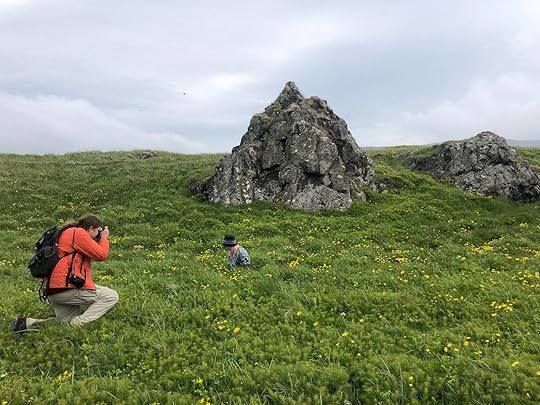 Photographing Joan journaling during a stop. Since everybody was wearing our product everywhere and the books as about traveling, anything we did became fodder for book photos.
 The ubiquitous 100% cloud cover actually served to keep all the photos looking pretty homogeneous and it helped with the external flash. We went in the summer so there were probably 22 hours of sun. It never actually set. It would hit the horizon and roll around for a bit before coming up. And by 3 am it was as bright as it was going to be at noon.
Joan had already written all the patterns, so when we got back we were pretty far along on our book. I only needed to finish the travel diary (which I was writing along the way) and pick out photos. I went through and made a big collection of lots of images distributed across two categories, "travel" and "patterns" — each pattern had at least one hero shot, one mood shot, and some closeups. The travel section just had all sorts of stuff. I wrote the travel section in Word and just pasted in images that I thought would be useful for the layout.
We had the distinct pleasure of having two publishers, Stackpole Crafts in the U.S. and Bloomsbury's imprint Herbert Books in the UK/EU, both of whom had a different vision for the final product — this was really exciting to me, to see two different editors and two different layout teams coming up with different visions for our words, images and patterns.
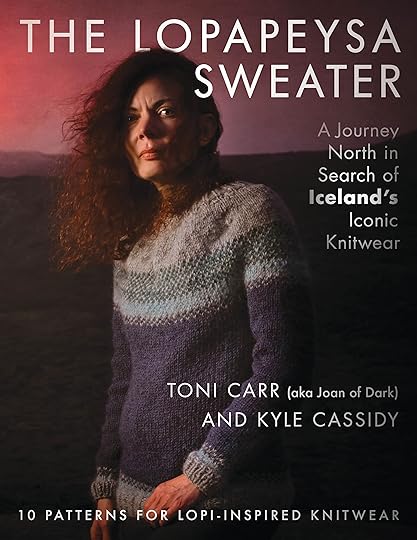 The U.S. version of the book has a different cover and slightly different content.
 The U.S. version has a photo of Trillian Stars at the volcano which was an amazing experience (you can read about it in the book).
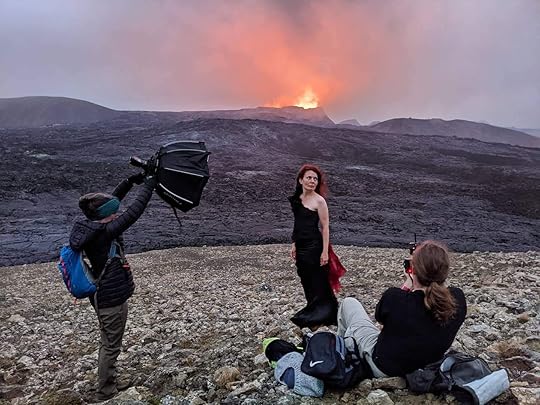 Photographing at the volcano. Lights by Arwin Thomasson, photo by Alon Abramson.
 The volcano was warm and bright at first, but then we hiked up a biiiig hill into a cloud and it got dark and very cold. The volcano itself, by the time we got there, had been disgorging lava for months and had filled up a valley and made itself pretty remote. The closest we were eventually able to get was probably half a mile. The routes changed all the time as lava filled up some places and not others. But it was a multi hour hike over some challenging terrain and when we finally got to our space the really strong winds made the lighting difficult. I'm glad that I brought a deep parabolic softbox rather than an umbrella which would have folded down smaller, but the wind would have yanked an umbrella into the lava in 30 seconds.
I organized my photos first by date and secondly by photo shoot in a folder structure. That made it easier to tag locations in lightroom when I got home and also keep a clear idea of where everything was photographed (if it was shot on day four, it must be Dalvik).
I kept all my edits in layered .psd files and then when everything was ready for the printers, I flattened them all into .tif files.
We had three levels of editing / proofing and sometimes a page would pop up with nothing on it that could hold another photo. I created a folder of additional photos that the designers could drop in anywhere and then during the proofing stages I'd occasionally ask that a photo be moved or change a caption, but as it was, the images didn't go through a lot of changes once they got sent out. A couple times I kept working on an image that I wasn't perfectly happy with and at the last minute I'd send them a newer version but it was mostly the text that needed revision. Both publishers had fact checkers as well as copy editors so we'd get a note saying "is this really the northernmost place in Iceland?" as well as one fixing the spelling.
Anyway. That's photography on the knitting book.
You can get the U.S. version here or at your favorite local bookstore.
If you're in Europe, you can get the UK edition here.
Happy to answer your photo book questions if I can be helpful. Have a great day.


