
Our Husband Has Gone Mad Again by Ola Rotimi
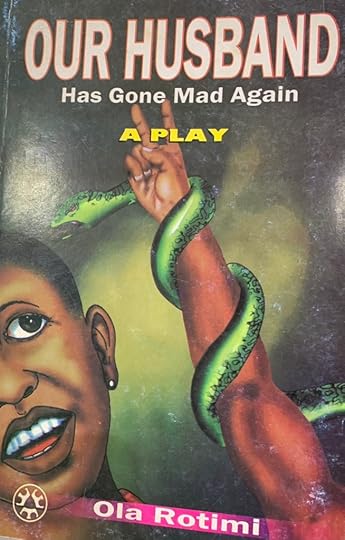
Our Husband Has Gone Mad Again by Ola Rotimi is a short play, about 85 pages. It should not take more than 2 hours to read. The book was written in 1977, just before the second republic. Nevertheless, there are quotable quotes that sounded prescient. For example, hear out the main character of the play:
Are you there? Politics is the thing in Nigeria, mate. You want to be famous? Politics. You want to chop life? – No, no you want to chop a big slice of the National cake? – Na politics.
Often people talk as if the monetisation of politics is a new thing. It is probably over four decades old. Ola Rotimi saw this in advance, even before the second republic.
He carried on:
Cakes are soft, Gentlemen. Just you wait! Once we get elected to the top, wallahi, we shall stuff ourselves with huge mouthful of the National chin-chin [munches on imaginary mouthful], something you’ll eat brother and you will know you’ve eaten something.
What about this dialogue:
Okonkwo: It sounds like war.
Lejoka-Brown: It is war! Politics is war. Oooh – I am taking no chances this time, brother mine. I took things slow and easy and what happened? Chuu! I lost a by-election to a … a small crab… a baby monkey… This time it is war.
Our Husband Has Gone Mad Again is a comedy about a soldier turned farmer turned politician.
While fighting in the Congo, Lejoka (translated chaser of snakes) Brown fell in love with a Kenyan medical student, Liza, about to head to America for a medical degree. They were married under the French law before she travelled.
However, shortly before the marriage Lejoka’s brother died and their father unilaterally married Mama Rashida, the wife of his late brown to Lejoka Brown. Lejoka Brown was informed about this but he kept this to himself and went ahead with the marriage to Lisa.
When his father died, Lejoka Brown inherited his Cocoa farm, a very prosperous business. Later he went into politics. He married Sikira, the daughter of the leader of the market women, so that he could secure her mother’s support for his political ambition.
After completing her medical degree, Liza told Lejoka Brown she was coming to Nigeria. Liza was not aware of the other women. Wanting to postpone the difficult conversation till after the election, he sent 800 pounds to Liza, encouraging her to see a bit of Europe.
A cablegram arrived informing Lejoka Brown of Liza’s arrival at 5pm. With his friend, Okonkwo, they hatched a plan for Lejoka Brown to hire a flat where he would lodge Liza and have a managed and controlled introduction of all women in his life. At one point, there was a hint of self pity as Lejoka Brown compared himself to his grandfather:
I whose grandfather had a hundred and fifteen wives, I tell you… one hundred plus ten plus five breathing wives all at once undedr his roof! But here I am, with only two little crickets, expecting one more – just one more canary, and I can’t just pick her up by the arm and say to her: “Woman, I forget to tell you: but as the whiteman says, “better late than never”, Here – meet your other ehm … sisters-in-marriage.I whose grandfather had a hundred and fifteen wives, I tell you… one hundred plus ten plus five breathing wives all at once undedr his roof! But here I am, with only two little crickets, expecting one more – just one more canary, and I can’t just pick her up by the arm and say to her: “Woman, I forget to tell you: but as the whiteman says, “better late than never”, Here – meet your other ehm … sisters-in-marriage.
This paragraph reminded me of a moan from an English chap I worked with once upon a time. He used to say that things were better in the days of his father. All a man needed to do in those days was to travel to the city to work. Once you are back home, you would not be bothered with child care. I used to remind him that in those days of his father, the wife was also a full time housewife, whereas today many women (including his own wife) held down a full time job, in addition to the remaining work he was complaining about!
Back to Lejoka Brown’s household. Unfortunately, due to bad weather, Liza arrived earlier than expected, taking a cab directly into the chaotic household of Lejoka Brown where a pet snake and chicken raised for sale dwelled with the people there.
Sikira, the youngest wife was very hostile, she was not aware of this new sophisticated rival until a couple of hours earlier. It didn’t help that Liza took her for a house help. Eventually, she worked out that the two women were her sisters in marriage. She felt betrayed and negotiated with Lejoka Brown to have some time to decide what her next steps would be as she was a complete stranger in Nigeria.
Before Liza arrived, the two women were treated like second class citizens in their matrimonial home. Lejoka Brown whose political slogan was about freedom did not allow any freedom in his own home. Neither did he allow his political associates any freedom.
In the weeks that ensued Liza transformed the household of Lejoka Brown. She taught Mama Rashida the first wife how to create demand for her egg selling business so she could increase supply. Her confidence grew to the point where she decided to move to the village where she would find land to scale the business. Lejoka Brown was welcomed to visit but he had to bring Liza with him so Mama Rashida could learn more business techniques.
Meanwhile, Liza had been busy making clothes for Sikira the third wife and indoctrinating her on equal rights for men and women. Her confidence also grew. When Lejoka Brown took exception to some of her new dresses and insisted she remove them, she refused asking that men and women need to be equal. Sikira gathered all goods and fled the house saying “Our Husband Has Gone Mad Again”. What else would you call a situation where an ex soldier wants to engage in physical combat with a woman much younger than him?
Things came to a head when a press conference that was supposed to show that Lejoka Brown’s party was united went wrong. He was expelled from the party. Lejoka Brown had been trying to use combat techniques for his campaign, having forgotten that politicians are civilians, not soldiers. Guess who his replacement was? Sikira his third wife whose mother was the influential leader of the market women.
Lejoka Brown was very shrewd with his women, especially the last two. Liza was there to enhance his image and ego as a politician, bringing her education and having been abroad to boost his political prospect. Sikira on the other hand was married purely to form an alliance with her mother, the head of the market women and secure votes that way. However, with Liza’s arrival, everything went upside down.
Finally, all he had left was Liza and she won’t be cooking for him and his political careers disappeared into thin air.
You can’t read a book like this and not reflect on how patriarchal things were 40 years ago. You would suspect the remnant of that patriarchy remains.


