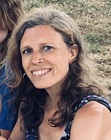
Guest Blog with Ecologist & Writer Helen Baczkowska
‘Loving this Earth and its lives is a political act right now and so writing about it cannot help but be political too.‘

A huge welcome to ecologist and writer Helen Baczkowska who I’ve known for a couple of years through Norwich Writers Rebel. Helen is one of these extraordinary characters who seems to be everywhere, all at once, casting her net wide of activism, campaigning, conflict resolution and defender of the natural world and land access. Whenever I hear of a brilliant talk or event going on in Norfolk around wildlife or environmental campaigning, it’s not an exaggeration to say that Helen is likely to be involved in it. You don’t have to be speaking to her for long to feel her fierce sense of injustice and a strength and resolve that underpins it. It’s definitely infectious.
How long have you been writing for and what kind of writing do you do?
I remember making up stories and poems in my head long before I could write, experimenting with different voices and descriptions, so I guess it is a very innate thing. I also come from a family of storytellers, not official ones, but my Welsh grandparents would tell long stories of their lives and those of their family. For my grandmother, this meant weaving family memories in with Welsh myth and Biblical stories, as if they were all people that she knew.
I have been researching and writing a book on common land in Britain today. An early draft of this and the proposal was shortlisted for the Nan Shepherd Prize. That made me cry. What is amazing is how it goes to the heart of questions over who makes decisions on land today, what the conflicts over land use are and what climate change and pollution are doing to nature. Nearly done and ready to start doing the rounds of publishers.
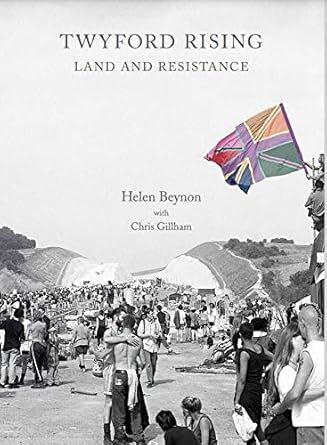
Please can you tell us a little about what drove you to protest the motorway that was being built through Twyford Down in Hampshire?
As with stories, the roots are deep. My mum used to go to Greenham Common (leaving me at home, much to my early teenage sulkiness!) and I grew up in the midst of the Miner’s Strike, with a family who had worked in mines, so there was a lot of anger, mutual aid and desire to right injustices in my upbringing. Later I became a hunt sab, then, I started a job in Hampshire and saw a poster for a rally on Twyford Down. I went along – it was a May afternoon in the sunshine and the land was alive with flowers, birds, bees, butterflies and tiny spiders in the grass. I thought I could not let harm come to this amazing place without a struggle.
Who or what inspires you and gives you hope?
Nature, always, the people who love it and defend it and the wonderful young folk that I know.
What are you most proud of in your life?
Hmm – pride is something I struggle to feel, as I am only one among many here. I’m glad we were able, collectively, to raise our voices against the Norwich Western Link road and that I was able to bring a lot of past experiences to help.
(ed: for many years, Norfolk County Council were trying to build a 4 stretch mile of road across the ecologically rich Wensum Valley. A group of ecologists, scientists, wildlife-lovers and many more came together to save the valley and after sustained pressure, the scheme has been dropped this year.)
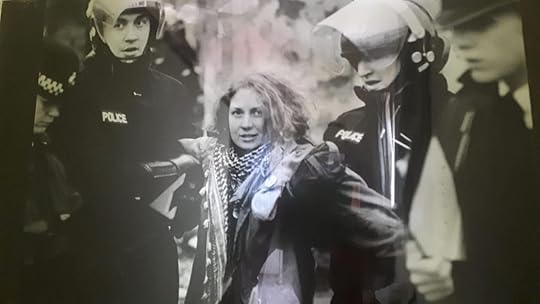
Helen protesting the eviction of houses on the M11 motorway route, 1994. Photo credit M Lambert
Where do you feel most at home?
At home, in the little back room in rural south Norfolk where I write. Or in bed….love bed!
How does your activism inform your writing or vice versa?
I think it is life that informs my writing and my activism is a part of my life. I cannot help but see most things through a political lens, whether it is social injustice or the environment. Loving this Earth and its lives is a political act right now and so writing about it cannot help but be political too.
If you were to press one or two books into the hands of everyone you know and say, you have to read this, what would it be?
Oh goodness, that is a big question! Rebecca Solnit’s Hope in the Dark feels always relevant, the poems of John Clare are always prescient too, and George Eliot’s Middlemarch might not seem like an obvious choice, but it is the most incredibly insightful and rich novel, one that changes the reader.
What work has been the most meaningful to you over the years?
For myself, the work I do on conflict resolution and wellbeing in activist spaces has become one of the most important things in my life. In the future, looking at community resilience feels necessary.
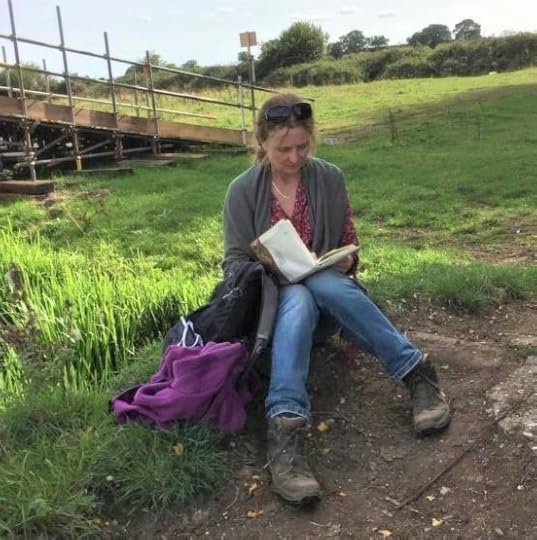
Helen writing nature notes in the Wensum Valley. Photo credit R Long
What feels like one of the most important things people can be doing right now to confront the climate and ecological emergency?
We live in such terrifying times, when protest is so hard and, despite it being at the core of my life for so long, I’m wondering at the sustainability and effectiveness of it right now. So, looking how we create community resilience and take all of learning into those spaces feels necessary – both the counter the rise of the far right and to create truly regenerative ways of living.
This is the start of one of Helen’s book chapters and also forms part of an essay called Growing Clover published in Speculative Nature Writing: an anthology — Guillemot Press
Growing Clover / The Come Alones
If this storm has a name, I’ve forgotten it. For days now, wind has thrown hail and sleet and rain at the ground and I have stayed indoors as the radio told me about famine and war, another chunk of ice sheet melting, another wild creature being wiped out by persecution or habitat loss. Now I too would like to throw something, a thing that would shatter and crash, although the noise, I know, would never be loud enough to make my species stop and reconsider its ways. Instead I huddle into my waterproof and walk down the lane to a footpath along the edge of a field. The trodden mud beside a hedge is all that remains of the Come Alones.
Only my neighbour Harry and I call this path the Come Alones now. He lives next door, in the cottage he grew up in. Once, when I was child, the family’s black gun dog had puppies and I was allowed into the shed to let them squirm, warm and smelling of milk, in my lap. I am not sure how old Harry is, his face is thin behind a white beard and arthritis has aged him. He shifts uneasily when we stand talking and winces as he moves, telling me the pain started when he worked packing frozen chickens in a local factory. As a boy he supplemented his parent’s income by raising goats along the Come Alones. Back then, he says, the path was a narrow grassy track, hedged on both sides. When he told me this, I recalled gathering blackberries with my Grampa, when my grandparents lived in the cottage I now call home. I was eight or nine and we carried the fruit back in saucepans, my fingers and probably my lips, stained with sweet purple juice. The brambles had twisted through tall parallel hedges that were divided by the narrow path of rough grass. The track I remember so clearly can only have been the Come Alones, for although I have looked, there is nowhere like that near here now.
Thank you so much Helen for coming on the blog and for sharing this moving piece of writing. Compliment this blog with reading guest interview with activist and writer Amanda Fox and an interview with solarpunk writerJimJames.
The post Guest Blog with Ecologist & Writer Helen Baczkowska appeared first on Rebecca Stonehill.