East to the Land of the Glaciers
It was late when we pulled into our campsite at Vatnajökull National Park, and I felt a distinct chill in the air as I went to the bathroom to brush my teeth and give my phone as much charge as I could. It was too dark to tell that the chill came from wind blowing down the glacier.
At this point I wasn’t thinking about the glacier so much as my power problems. All my devices were dead. Unlike the previous campsites, this one did not have a communal dining area where I could work. “Let’s get up early tomorrow and book it for Höfn,” I suggested.
“But we’re in a national park! We should see at least a few things!” Stephen countered.
The truth was, so far on this trip, “let’s see a few things” always took much longer than we expected. And the hardware store in Höfn closed precisely at 5 pm. Besides, I needed to get some work done. So we compromised: We’d go directly east to Höfn and stop at one attraction on the way. When we got to town, we’d try to find a coffee shop or something where I could work for a few hours.
The attraction we chose?
Diamond beach, where chunks of glacial ice wash up on shore.
The next morning I woke, showered, and wandered up the gravel walk through the fog. Once again, I felt that distinct icy chill. I passed people gearing up in spiked shoes and helmets. It wasn’t until later that I realized I was literally at the foot of a glacier, I just couldn’t see it due to the fog.
I found the visitor’s center, which, while it didn’t have any place to work, did have outlets next to a display of children’s art. Better than the bathroom! I plugged in my devices and then sat at a chair a few meters away and wrote in my diary.
If I’m going to be honest, when I set off on this adventure I was a little worried that, staying in a camper with four other people, I’d become grouchy and irritable due to a distinct lack of sleep and alone time. Instead, I fell into a really healthy routine. After a day of adventuring I’d be so tired I’d put in my earplugs and fall asleep no matter how noisy everyone else was. Then I’d wake early and get an hour or two of alone time before the others were up and around.
We rolled out of the campground in the late morning, and the fog lifted as we drove east. “Look, there’s a glacier! And another!”
Later I discovered that all the glaciers were connected, flowing from the same giant ice cap.
I should note that way back when I learned about glaciers in grade school, I was very confused and could never picture what one would actually look like. I’d google pictures and still be confused.
It wasn’t until I visited Alaska in 2019 that I saw a real glacier. I’d hiked a mountain and was looking out across the landscape when I saw what looked like a river of snow sliding down between two mountains. Suddenly glaciers made sense to me: the snow that collects at the top of the mountains starts to slide down, due to gravity, and it all collects in the crevices to form what looks like a river of snow and ice.
So as we drove through Iceland, every time I saw something that looked like a river of snow I was like, there’s a glacier.
But I later learned it wasn’t quite that simple. Vatnajökull is a large pile of snow and ice—Wikipedia calls it an “ice cap” while a later tour guide called the whole thing a “glacier”—and all the glaciers we saw were little tendrils flowing from the main glob.
Here’s a screenshot of Google Maps so you can see what I’m talking about.

That big white glob in the southeast is Vatnajökull. Here’s a more closeup picture from Wikipedia.

So as you can see, each time I saw one of those tendrils flowing down I was like, “there’s a glacier!” with no clue how they were all connected.
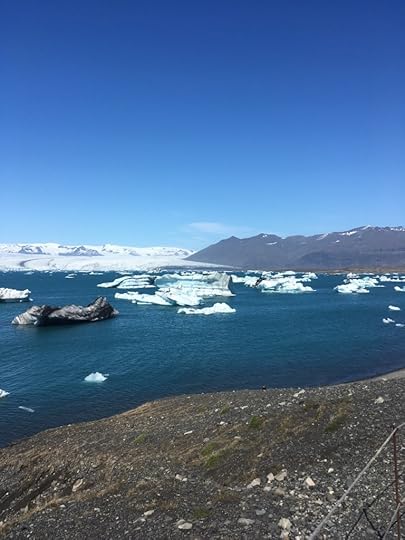
Diamond beach was a place where one of those glacial tendrils flowed into a bay and then on into the ocean. Huge chunks of glacial ice floated in the water. I quickly made tea and then walked along the bay with Stephen and Daniel while Annie stayed in the camper van to feed the baby.
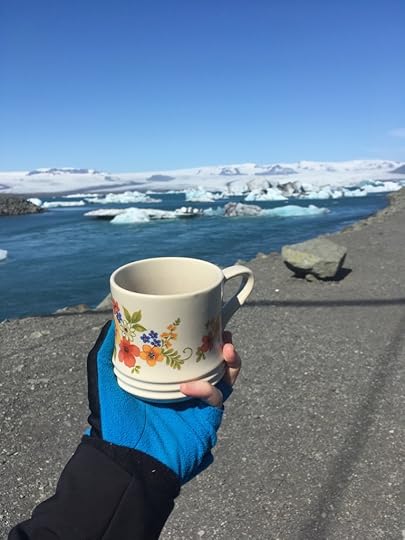
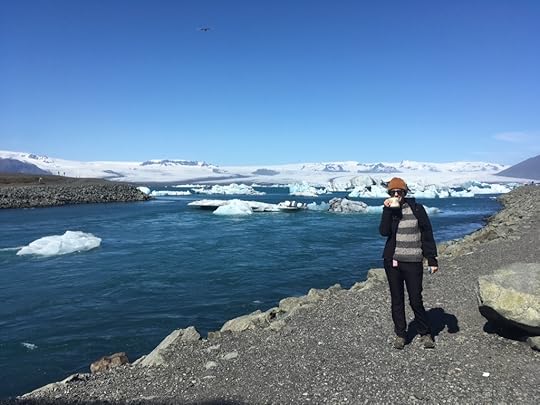
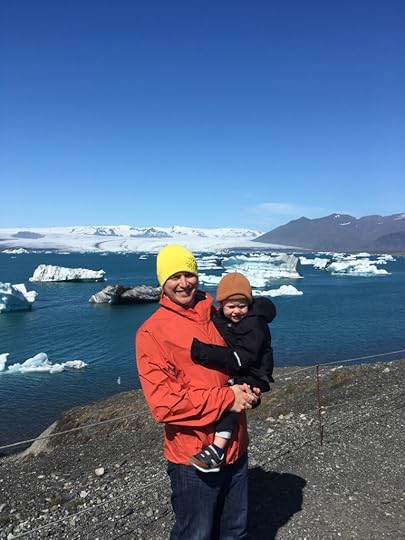
There were icebergs in the middle of the water, beanbag-chair-sized chunks floating swiftly toward the ocean, and a few teddy-bear-sized pieces washing up on shore. Stephen threw stones at one of the beanbag-chair-sized pieces, trying to break off chunks for us to look at.
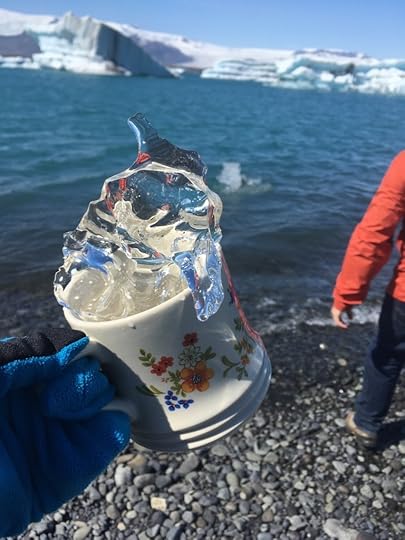
It’s hard to capture in a photo, but the glacial ice really did sparkle like diamonds in the sun. Turns out that ice that’s been compressed in a glacier for hundreds of years looks noticeably different than the ice from your home freezer.
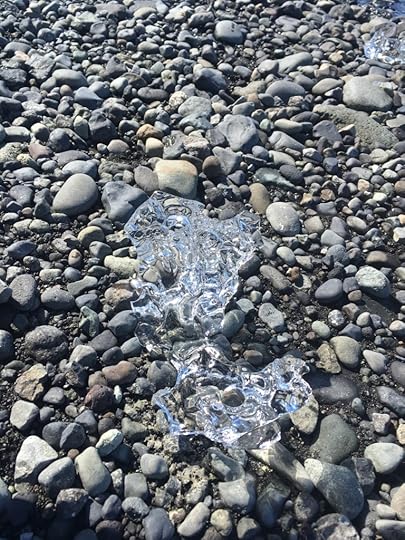
And yes, I ate pieces of it. I couldn’t resist.
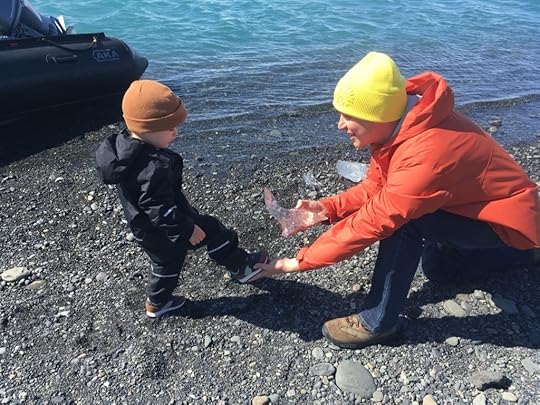
I thought this piece looked like Cinderella’s glass slipper, so Stephen and Daniel posed for a picture.
Then the bay ended at another black sand beach, where some of the larger, beanbag-sized chunks had washed ashore.
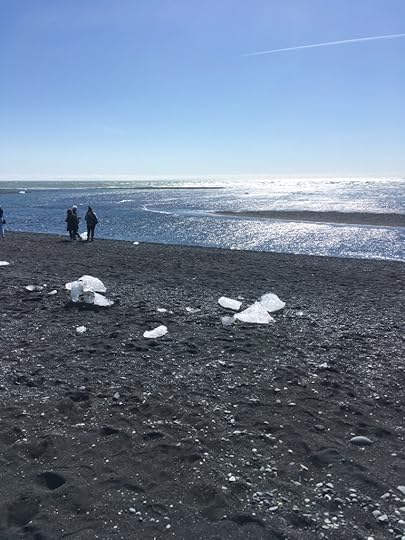
We were there for a while because it was just that gorgeous. But finally, on we went, bound and determined to find that hardware store.
Höfn was different than any place we’d been so far. For the first time since leaving Reykjavik, I got the feeling that I was in a place where real Icelandic people lived. We passed industrial-looking buildings with gravel pads outside littered with boats and old pallets.
Stephen took the broken cord into the hardware store, where they gave him the pieces he needed and then sent him to an electrician around the bay to put it together for him. Maybe that’s what made Höfn feel so real compared to Vik…there was an actual bay. Many of them, actually. The whole town was on a peninsula, with various inlets dimpling it here and there.
Also, there was no coffee shop, just a diner and a gas station. I’d assumed that if Vik, a town of 300 people, had a coffee shop, then the larger 2,000-person Höfn would surely have one. But I was starting to think Vik wasn’t a real town at all so much as a watering hole for tourists.
Annie wanted to find a playground for Daniel to burn some energy, but Google Maps showed absolutely nothing. But we did pass a swimming pool complex with a tall water slide. So the Sells dropped me off at the campground where I worked in the small communal dining area, and they went to the pool.
That evening, after plugging in the camper van (and putting a fluorescent yellow stocking cap on the gear stick as a reminder to not drive off without unplugging), eating a dinner of pasta, pesto, and questionable sausage (when I google translated the words on the package, the word “horseradish” came up), the three adults sat down to discuss the Future Of Our Trip.
The big question: should we continue around the ring road or try a different direction?
Pros of completing the ring road:
We’d gone this far, so we might as well finishPart of the fun was seeing new scenery on the drive, and if we turned back, we’d see old sceneryCons of completing the ring road:
We’d suddenly realized that most of the really cool things to see in Iceland are in the “Golden Circle,” an inland area east of the capital city of ReykjavikAlthough it looked on the map like we were almost halfway around the ring road, we were actually less than a third of the way around in drive timeDaniel, the toddler, was not doing so well on these long driving stretchesSo after much discussion, we decided the cons outweighed the pros. We’d retrace our steps the next day—Thursday—and try to make it to Selfoss, a town about an hour southeast of Reykjavik that marked the beginning of the golden circle.
Thursday morning I woke pretty early with all my devices fully charged (yay!) and went into the communal dining area to work while the Sells went back to the pool to try to get Daniel’s wiggles out before the trip. Around 9 am, Stephen texted me that they’d be ready to go soon. So I packed up, but they ended up being delayed, so I meandered along between the low-tide bay beds and the edge of town.
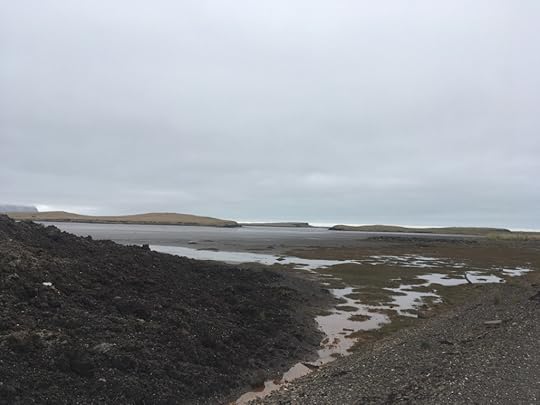
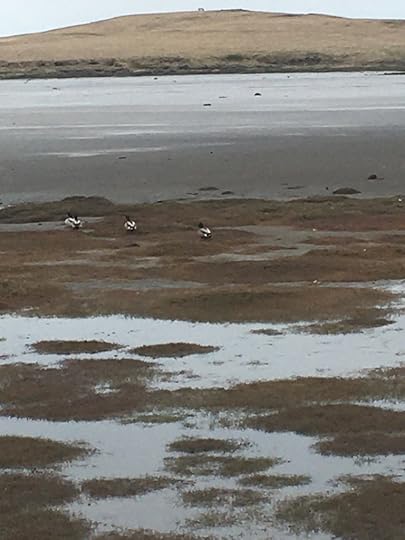
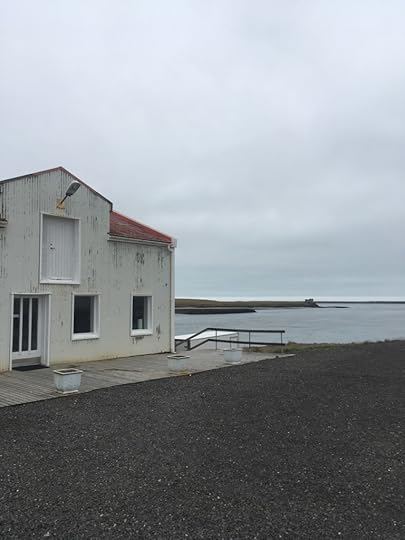
By the time they were ready to go I was back at the hardware store, so they picked me up there, and we were off, heading back west!
As we drove, Stephen told us about his experience that morning at the pool (He’d taken Daniel in while Annie waited in the camper van with the baby).
You may have wondered, before, why a town in remote Iceland with only 2,000 people and no playgrounds or coffee shops would have a large swimming pool complex with a waterslide. I mean, even a swimming pool in Iceland sounds bizarre. Who wants to go swimming in a place where it’s usually cold and snowy?
But for the Icelandic people, I discovered, swimming pools are the thing to do.
You don’t take your children to play at the playground, you take them to play at the pool.
You don’t meet your friend at a coffee shop to chat, you meet at the pool to chat.
Iceland has such a mind-boggling quantity of geothermal activity that these swimming pool complexes are everywhere, naturally heated by the earth or the abundant geothermal power of the country. They feature multiple pools with different levels of heat, from the hottest of hot tub temperatures to cooler, bigger pools for kids to play.
But even those pools are warmer than the typical American swimming pool, because they’re meant to be a warm place to play even in the bitter cold of winter.
Icelandic children get regular swimming lessons as part of their normal curriculum, so when Stephen was at the pool that morning it was full of school children. He said it was the most Icelandic experience he’d had so far.
On we drove. I didn’t mind going back through familiar scenery—in fact, it was fun to see it from the other direction. Look, the glaciers! But all was not well in the camper van. Poor Annie had barely slept all night, and she curled up in her seat to try to get some shut-eye with dubious success. Then the baby woke up hungry and began to cry.
Stephen immediately pulled off on a side road. It led to a business offering boat tours of a glacial lagoon. We quickly decided that Stephen, Daniel, and I would do the tour, giving Annie a chance to feed the baby and then get a good nap in the camper van.
Our tour guide was a young man named Matthias from the Czech Republic. He told me that most of the workers in the Iceland tourism industry aren’t from Iceland at all. He himself only spent half the year here.
“Do you speak Icelandic?” I asked.
“No,” he chuckled.
“How did you learn English so well?”
He shrugged. “American TV.”
I found it so interesting that the tourism workers were all foreigners, and I told him that this cleared up a mystery for me, as I’d wondered why the workers at the campground in Vik spoke Spanish to each other. Matthias said that half the people of Vik are actually from Poland—a fact I have no way to verify, nor do I know why Polish people might move there—but I found it interesting nonetheless.
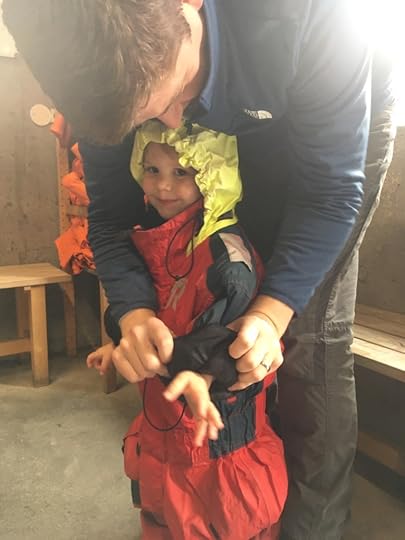
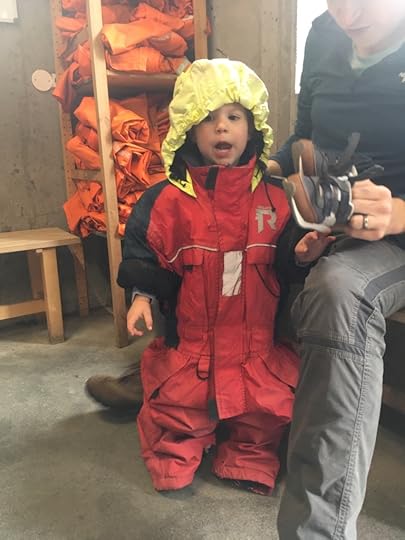
Daniel was given an outfit to wear that was adorably too big for him.
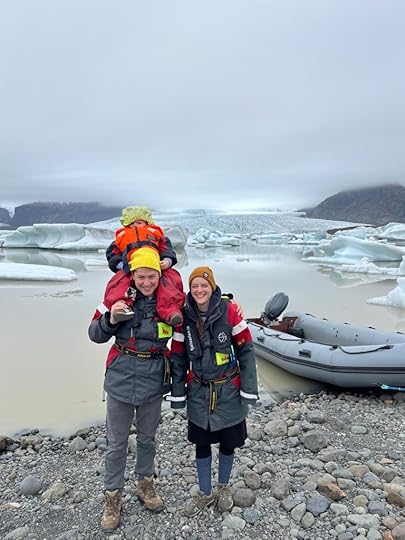
We walked over a small hill to a lagoon at the end of a glacier. There was a boat/raft there, and Matthias offered to get our picture, as he continued to do several times throughout the tour. I’m sure he thought we were a family, and I didn’t bother to correct him, but it amused me to wonder what he thought of this family where the husband did 100% of the childcare.
Oh yes, maybe I should have mentioned this before, but Daniel the 2-year-old did not like me. He was always convinced I was going to steal his toys. I blame my cousin Jason, who sometimes steals Daniel’s toys in a teasing way.
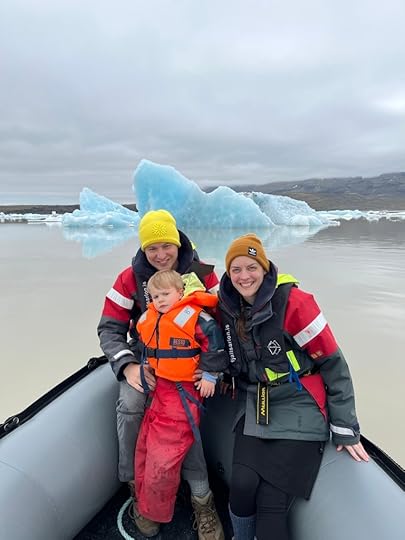
The lagoon was full of icebergs, some of which were this beautiful blue color you can see behind us in this picture here. Matthias told us that the blue ice was 500 years old, and was so compressed and compacted at the bottom of the glacier for so long that it looks blue. I felt vindicated upon hearing this, because I’d told Stephen a few days earlier that water is actually slightly tinted blue, and he didn’t believe me.
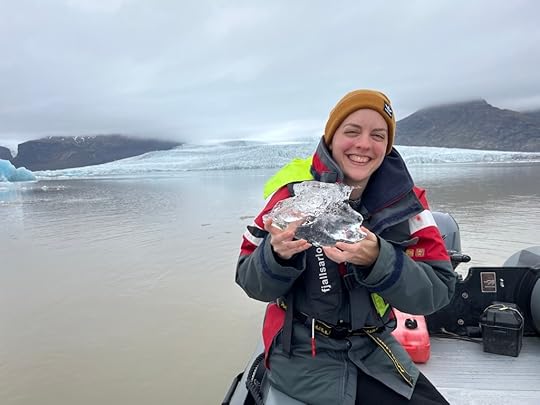
Me with a chunk of glacial ice.
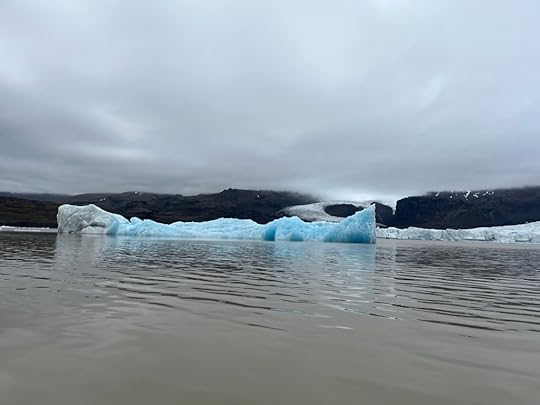
The lagoon was full of icebergs, and Matthias told us that we can’t get too close to them or stand on them because every so often they flip, and it’s dangerous.
The above picture is of an iceberg he pointed out to us that had flipped. The white part to the left was originally the floating part that showed above the water, and the blue part to the right used to be all underwater. But as some of it melted and the weight distribution shifted, it flipped 90°. It really gave me some perspective as to how much of an iceberg is really under the water!
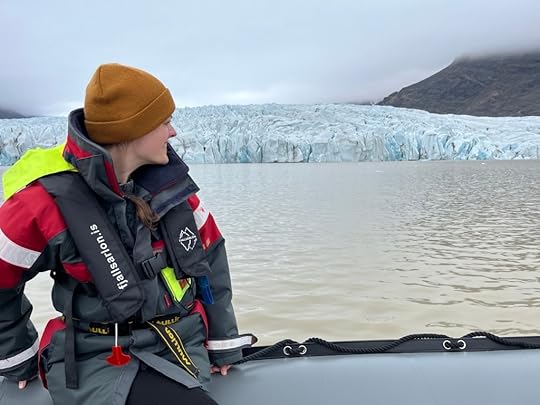
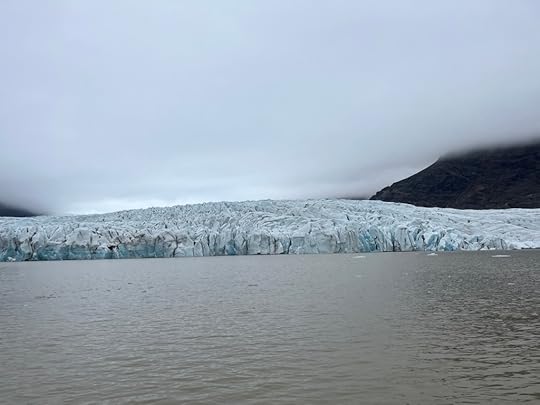
This is as close as we got to the glacier. We couldn’t get too close, because chunks break off every now and then, and it’s dangerous.
Matthias turned off the engine. “Let’s sit in silence for a minute and contemplate nature,” he said.
Poor Daniel contemplated nature so intently he fell asleep as we motored back.
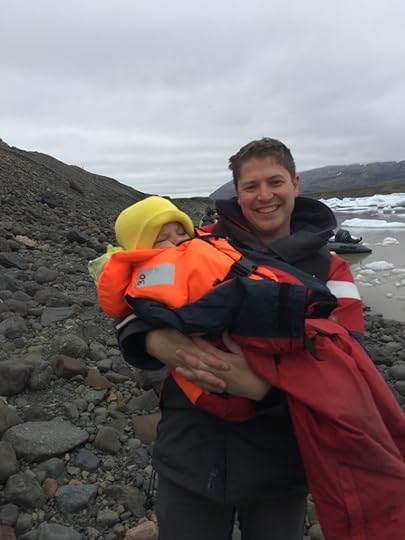
And then promptly woke up again, exceedingly grouchy, when we had to take off his suit to return it.
But Annie and the baby had nice refreshing naps while we were gone, and we made ourselves sandwiches and continued on.
Two unrelated thoughts were going through my head as we retraced our steps, driving once again through the wild volcanic barrens.
Thought 1: The weather has been remarkable
I’d been told to “prepare for every kind of weather,” warned about the drenching rain, and seen snow in the forecast in the week before we arrived. But every day so far had been nice, with no rain or snow, and only a few gray skies here and there. This day, Thursday, was gray and overcast, but Matthias had deemed it perfect because it kept the sun from reflecting off the glacier into our eyes.
Thought 2: I need to do laundry
My strategy was to do one load of laundry in the middle of the trip, and to that end I’d brought 7 t-shirts, 7 pairs of underwear, and 7 pairs of socks. I’d seen laundry machines at most of the campsites, but Höfn didn’t have any, so I hoped to do laundry that evening in Selfoss.
Since I assumed I’d be washing my pants that evening, I wore my “alternative outfit,” which was a skirt and fleece-lined leggings, and felt constantly irritated that I didn’t have a pocket for my phone.
Eventually Daniel reached such a level of crankiness that we decided to stop somewhere and let him burn energy and maybe nap. We were almost back to Vik, so we stopped at the black sands beach again.
After playing on the beach for a bit, Stephen took Daniel back to the camper van for a nap, and Annie and I decided to go get groceries. I was so excited. “I know the back way!” I said. “I saw it when we were in Vik before and I was up on the church hill!”
So we took the black sand trails from the beach, over the little bridge, and to the back parking lot of the grocery store/coffee shop/warm-clothing-supply-store complex.
Then, groceries in hand, we went back to the camper van for the long drive through the endless twilight to Selfoss.
At five hours of driving, it was our longest day yet. Five hours doesn’t seem long at all compared to the types of road trips I take with my siblings, but is quite tedious with young sleep-deprived children. But now, the long days of driving were behind us, as we prepared to spend the next few days exploring the sights of the Golden Circle.
At the campground in Selfoss, Daniel went to sleep immediately and the adults cooked and ate dinner. I went inside to see about laundry. There were machines, yes…but they each cost about $7 to run. $14 to clean my clothes, and who knows if they’ll be dry after the preset 45 minute dryer cycle?
Looks like I’ll be hand-washing underwear in the sink.