Play It As It Lays, by Joan Didion
One insightful reader of my first novel, Shadow Life, observed that the book was a battle between an autobiographer and a novelist. My reply was to confess the truth of it, although it had never been presented to me in quite that fashion.
Instead, I tended to divide plot points into three general buckets: things entirely drawn from my life. Things completely devised by my imagination. Then the (sometimes uncomfortable) anecdote that straddles both.
In The Fulcrum, the novelist seizes more control of the narrative. However, any novelist will borrow from time to time from their own lived experiences.
So, this excerpt from The Fulcrum, publishing June 10th with Girl Friday Productions of Seattle, is a true story from my university days:
“Did you know that Matt collects first edition books by twentieth century women authors?” Mary Louise asked.
“Oh, really?” Professor McConnell said. “That’s an odd choice of books for a male economist to collect.”
Matt chuckled. “Perhaps. But there’s a story behind it.”
“Do tell,” Professor O’Connell said, as she poured more Bordeaux and settled more comfortably into her chair. “I love a good story.”
“It all started at this very university,” Matt said. “Sophomore year. Back then you had to leave the Harvard Yard and move to a Harvard House. I was class of ‘74 and one of the first male graduates offered the choice of joining either Harvard or Radcliffe house. I chose North House at Radcliffe.”
“I remember that time,” Professor O’Connell said. “Wasn’t there a name for those who moved to Radcliffe?”
“Male Cliffie,” Matt said and took a sip of his wine. “Some meant it as an insult, but I didn’t regret moving to Radcliffe. I don’t remember any who did. There, the houses all turned out to be gender balanced. While the Harvard houses remained overwhelmingly male.”
“Women,” Mary Louise quipped, her finger circling her wine glass’s rim. “Nothing to do with education or feminism. You just wanted better odds on the pursuit of young women.”
He smiled. “Fair enough. But not the whole story. All in all, it was a much calmer and less testosterone-laden atmosphere than the Harvard houses. And we made lifelong friends, all of us, men and women.”
“And where do books fit into all of this?” Professor O’Connell asked.
He took in his surroundings, still amazed at the collection around him. “Well, to fit in, I thought I should take one of the courses offered at North House. Women in Twentieth Century Literature, it was called. The Radcliffe librarian was teaching it, if my memory serves, but her name escapes me. So here I was, a Harvard economics major and sophomore up to my neck in English literature majors. All of them were young, smart women. All of them were at the graduate level doing their master’s and PhDs. I was always an avid reader, but I was hopelessly naïve too. And uneducated in the ways of the study of literature.”
“Did a tragedy befall you?” Professor O’Connell asked. She pointed at him playfully. “Did you fall in love and have your heart broken?”
“Nothing so predictable,” Matthew said. “Though that would’ve been a more pleasant fate. No, I was the only male in the seminar and a male Cliffie, to boot. Economics majors were oddities.”
“But the way you put it,” Mary Louise said, “there was some indeed some tragedy of sorts?”
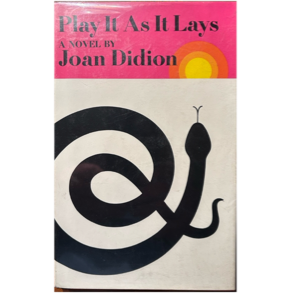
“Not a tragedy, I’d say. More an embarrassment, of an academic sort. A humiliation. At the start of term, we were given an assignment: Read and analyze one book each from a reading list. I chose Joan Didion’s novel Play It As It Lays. It had just been published, and the book and author were enjoying significant popularity.”
“Let me top up your glass of wine,” Professor Connell said, as she came around with the bottle. “I expect Matthew may need a bracing drink before he confesses his gaffe to us.”
“Gaffe doesn’t begin to describe the evening of my seminar presentation. I thought I was well prepared. I explained, to the best of my economist ability, the meaning of the book. The silence in the room when I finished made me realize that something was wrong, but I wasn’t sure what. The very first question unravelled my presentation and left me sitting there, trying to hide the redness I’m sure had rushed to my face.”
Professor O’Connell returned to her chair and sat on its edge, as if bracing for the punch line.
“The book featured the main character, a young woman driving her stick shift Corvette with great enthusiasm around California,” he said. “The first question was, did I think that perhaps some of the metaphor of the book was sexual? Not something I’d considered, and yet I immediately knew that I’d missed the whole sex thing. And it was clear that everyone else in the room knew I’d missed it, too.”
Mary Louise and Professor O’Connell both howled with laughter.
“Matt,” said Mary Louise, trying to keep her wine from sloshing and staining in the Professor’s clearly expensive décor. “How could you possibly read Play It As It Lays and not know that it was all about sex?”
“We didn’t have a lot of women driving Corvettes in Winnipeg when I was growing up. It was too cold!”
The two howled even harder then.
“From that day on, I began reading and collecting first editions of twentieth century women. Including, I might add, every book by Joan Didion. That was my way of covering my failing with a commitment to understanding the literature of women.”
“Bravo, a wonderful atonement,” Professor O’Connell said.
“Let me add, it was worth the embarrassment. I’ve enjoyed decades of reading pleasure. Nadine Gordimer, Doris Lessing, the Southern writers Carson McCullers and Flannery O’Connor. Irish writer Edna O’Brien. And more than a few Canadians, too–Margaret Lawrence, Carol Shields, Alice Munro, Margaret Atwood.”
Mary Louise smiled. “It must’ve been a dreadful moment there at the seminar, that dawning recognition.”
“Truly horrible. But an important lesson.”
“Don’t miss the sex!” Mary Louise laughed. “A very important for lesson for life as well literature.”
Like my character Matt, I too have never regretted the momentary embarrassment that ultimately brought me a lifetime of reading pleasure.
High Spots (in a collector’s terminology)In my next newsletter, I will explore the notion of the high spot or notable book for a collector.
My Joan Didion high spot – which took some years to find and acquire – was her first book, Run River, published in 1963.
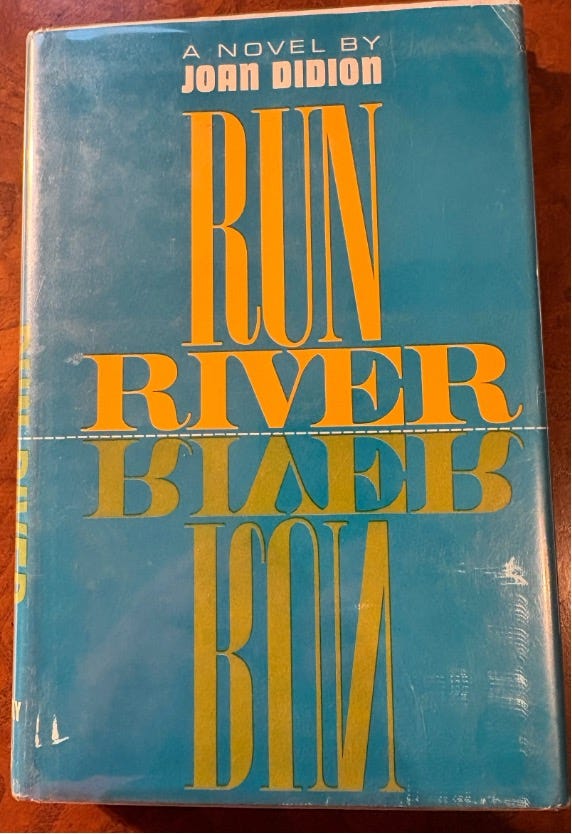
Below is the book description from Bauman Rare Books in NYC where I purchased Run River. You will see the research and care that goes into properly describing the condition of the book and the importance of its author. These notes also do double duty as catalogue entries. It is the research to prepare these notes that distinguish fine bookstores from just used bookstores.
 The Fulcrum Book Launches
June is turning out to be a busy month of book launches and talks, which I’m excited about. Hope you will join in person or digitally!
First up, Saturday June 14th, 7pm both in person in WINNIPEG at McNally Robinson Grant Park, but also on Youtube accessible wherever you live.

OTTAWA. Tuesday, June 17th, 7pm Perfect Books, 258A Elgin St, Ottawa.
TORONTO. Wednesday, June 25th, 5pm, Ben McNally Books, 108 Queen Street East, Toronto.