
What Serial Killers and Golfers may Have in Common
 Photo by mk. s on Unsplash
In measuring environmental impacts on health, we sometimes can confuse morality and science. About ten years ago, Jessica Wolpaw Reyes, an Associate Professor in the Department of Economics, Amherst College, MA, wrote an article about the effects of lead exposure on population health. Higher amounts of lead in the water supply unfolded a series of adverse behaviours—aggression, teen pregnancy and violent crime. In many places in America, levels of lead in water declined after 1980s when water pipes were replaced, and unleaded fuel became available. Tacoma, near Seattle, in America’s Washington State was particularly affected with lead “goosenecks” that connected plumbing to the mains. These were commonly used in the 1900-1940 period to connect the water main to customers’ service lines, and to this day there have been reports of Tacoma’s water supply having higher than acceptable lead levels. Outside of these lead pipes, Tacoma was also known for its industry, especially iron-ore smelters. These smelters infused heavy metals into the region’s air and water, and toxins such as lead and arsenic were known to be found in high levels in the blood of Tacoma’s children.
As someone who is interested in preventative and personalized healthcare, my mission is trying to help people achieve their best and fullest life. I am all about healthspan, rather than lifespan. My latest book, Biohacking Your Genes (Beyond Words, an imprint of Simon and Schuster, NY)—that at one stage reached No. 1 on Amazon among healthcare industry books—is all about this, as I say in the introduction: “Learning to take charge of your health requires a change of perspective. For example, if one considered our genes to be unmodifiable, then we are trapped inside our biological bodies and there is no reason to try and struggle against them. But genes are just protein makers, and half of the game is in understanding the power of your actions and educating yourself constantly about new insights. Each chapter of this book has specific rules that help us do this better”
Therefore, as a doctor and scientist, I feel if we fail to address our environment—be it external pollution or excessive UV damage, or internal diseases from processed, fast foods or contaminated water—the social and economic consequences for healthcare will be massive. I was therefore intrigued by a new theory about Tacoma proposed by Caroline Fraser in her new book, Murderland (Penguin) who writes, almost casually: “The Pacific Northwest is known for five things: lumber, aircraft, tech, coffee, and crime. Weyerhaeuser, Boeing, Microsoft and Amazon, Starbucks, and serial killers.”
Fraser’s hypothesis centres around how serial killer numbers went up dramatically and then declined equally quickly in parallel with environmental lead levels. She notes that the serial killer numbers went like this: 1940 (55), 1950 (72), 1960 (217), 1970 (605), 1980 (768), 1990s (669). Then a dramatic drop 2000s (371), 2010s (117). If you ever wondered why serial killers seem to be more common in America, Fraser narrows it down further: “It’s August of 1961. I’m seven months old. There are three males who live in what you might call the neighborhood, within a circle whose center is Tacoma. Their names are Charles Manson, Ted Bundy, and Gary Ridgway. What are the odds?”
Alongside this theory about environmental pollution being somewhat responsible for a serial killer-crime epidemic, I was recently interested to come across this article in the prestigious Journal of the American Medical Association (JAMA) about the increased incidence of Parkinson’s Disease among golfers in some parts of America and these researchers studied those people living within proximity to a golf course.
Golf has a plethora of characters from business-networkers, lunching ladies, amateurs and professionals. As a sport, it is not propulsive or fast moving such as soccer, tennis or rugby, but that’s OK. That’s how golfers like it. Golf is really where one plays against oneself, fighting nerves and anatomical limitations. Perfect golf may be devoted to a symmetry of clock-like circular movements, with repetitive movements studied, videoed and recorded into human patterns against a background of manicured greens and sand-trap bunkers.
The USA has over 40 percent of the golf courses in the world, over 16,750 according to some estimates. Japan comes in second at over 3000 golf courses. Americans love their manicured golf courses and private clubs, and reports show that pesticide use—to maintain these courses in pristine condition—is much higher in America. Because many anecdotal reports linked Parkinson’s Disease to golf courses, the authors of this JAMA study decided to explore the association between the incidence of Parkinson’s Disease and proximity to 139 golf courses within a 16,119 square mile radius in southern Minnesota and Western Wisconsin. The researchers had a theory that they would find a higher number of Parkinson’s Disease in individuals living within water service areas associated with a golf course, or on adjacent vulnerable groundwater regions. They were right; still, the findings were alarming. Individuals living within water service areas with a golf course attached had nearly twice the odds of developing Parkinson’s Disease compared with individuals in water service areas without golf courses. And further, these odds were 49% higher compared with individuals with private wells that did not use the local water supply. Of course, the study—like the Tacoma study—is not conclusive. Critics point out that in the golf course studies, no analysis was made of the drinking water pesticide levels. This lessens the validity of the claim of pesticide exposure because the studies have not been carefully controlled. But still, the findings are interesting. In New Zealand, I have not been able to find any information about pesticide use on our golf courses.
Contaminated water has affected golfers and created criminals. According to Caroline Fraser, the main culprits in the serial killer capital, Tacoma, were two of the biggest business families: the Rockefellers and the Guggenheims. The Rockefellers built the American Smelting and Refining Company (ASARCO) and in 1901 the Guggenheims assumed its ownership. ASARCO controlled almost all American lead production—a big chunk of it being at the massive Tacoma plant. Today, Silicon Valley technology companies rule the roost. And ironically the change in business leadership has brought with it a certain sameness when it comes to environmental disregard. Silicon Valley remains one of the most polluted places in America when it comes to water supply. The semiconductor industry’s historical use of toxic chemicals like TCE and benzene in chip manufacturing led to groundwater pollution in the 1980s and as a report in The Atlantic suggested, the clean-up is still not complete four decades later. Ironically, as these tech bros seek to colonize space, they still look for water as a sign of life, or to establish the feasibility of human colonies.
It is clear that we are on a precipice of a surge of environmental diseases or health issues related to water pollution. Even in supposedly clean, green, New Zealand. I just looked at the “safe swim” website and majority of beaches around my medical practice showed a red pin (high risk of illness) or black pin (do not get in because wastewater has been detected in the water) today.
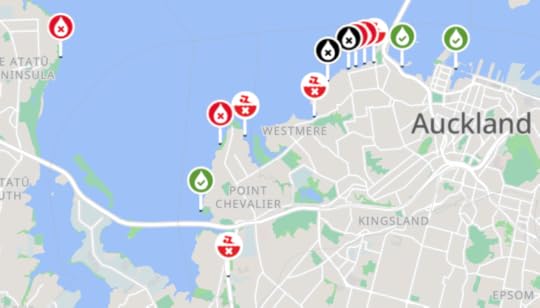 Polluted beaches in Auckland today
How bad does it have to get before we address the mismatch of global clean water needs and the supply? Water for most part, is quiet and hovers at the edge of our lives. Yet it has a cumulative power over all plant and animal life on our planet that we have to listen to this message before the science gets evaporated by media algorithms, and lives are further obliterated.
THE END
IMPORTANT: This blog is about science-communication, education, interesting new science, and medical research to do with (mostly) health and skin. It is not individual one-on-one medical advice. Please do not stop any medications without consulting your own doctor.


