A Yorkshire Ghost: The Poltergeist of Storrs Hall
Christmas 1877 at Storrs Hall was not a merry one at all. The gloomy house, which stood in the hamlet of Storrs on the moors between South Yorkshire and Derbyshire, was tormented by a restless and destructive presence. The Storrs Ghost, as it was dubbed by the press, became a sensation as hundreds came to investigate this window smashing poltergeist…
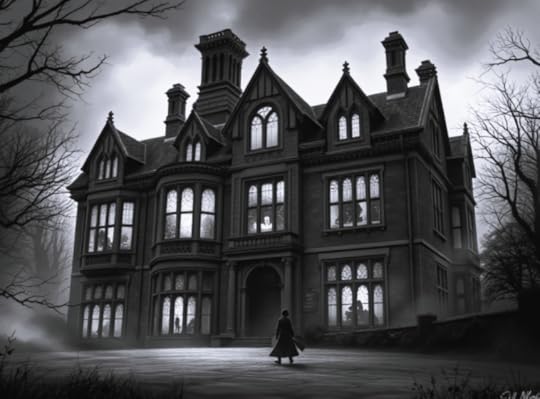 Storrs Hall, as hallucinated by our AI overlords
The Ghost of Storrs Hall
Storrs Hall was occupied by Mr and Mrs Ibbotson and their fourteen-year-old servant girl Anne Charlesworth, though a milk maid and farm labourers were also employed to work on the farm. It was around Christmas 1877 that life at the Hall took a turn for the weird.
Inexplicable rappings were heard throughout the farm. The nervous farm hands had probably heard rumours of ghostly activity in the house. On one occasion a farm hand and a milkmaid heard banging on the farm door, but when they opened it, no body was to be seen. They fled the house in terror. Later, one of the farm labourers stood in wait behind the door so that if a human culprit was responsible, he would be sure to catch them. Still the rapping happened, though the man saw nothing.
As well as the odd noises scaring the staff, the washing line would be mysteriously cut and the clothes flung out into the road.
But it seems this ghost really loved the sound of breaking glass. Windows would smash without warning in different parts of the house. When the glazier came to repair a window, it would almost immediately be broken again. Whenever any of this this happened, farm hands would grab their hayforks and go tearing around the farm hoping to catch a prankster, but they never found a sign of any human involvement.
When news of the strange events spread round the area, many locals concluded that the house was haunted. As was common in the nineteenth and early twentieth centuries, crowds went to see the house they’d heard about in local gossip or read about in the press. There they might share their own spooky experiences and theorise about the supposed ghost. It’s very likely, especially at Christmas, that they were full of the spirits of the season, and these impromptu ghost hunts could sometimes become riotous, though thankfully this did not happen at Storrs. Nevertheless, a large number of men patrolled the farm grounds with stout sticks, but the destructive presence evaded their searches and carried on its mischief.
Storrs Hall was owned by Mr Thomas Wragg, an industrialist who had made his fortune in the local firebrick industry, and after witnessing the mysterious window smashing for himself, offered a ten-shilling reward for information as to who was responsible.
Within a week of the troubles starting, Mrs Ibbotson was too afraid to sleep in the house and would only enter it with a policeman present.
Poltergeist Cluedo
Seargent Hobson of Hillsborough police station was sent to Storrs Hall to investigate, so let’s join him in a game of poltergeist Cluedo. Who was responsible for the destructive spooky pranks that were terrifying the maids and farmhands of Storrs Hall? Seargent Hobson noticed that the windows appeared to have been broken from the inside, and suspicion fell on servant girl Ann Charlesworth. She denied everything.
Then she admitted that she may have broken one of the windows but was certainly not responsible for everything else.
Finally, and sobbing bitterly, Anne confessed that she was indeed the ghost. It all started when she rapped on the barn door while a servant was milking a cow and scared him silly. She was somewhat taken aback as to how successful her little prank had been. She went on to cutting the washing line, banging on doors and throwing stones through windows. The Seargeant was astonished at the girl’s cunning and ingenuity in evading capture.
Anne Charlesworth expressed remorse at her actions and promised not to do it again, though it seems likely that she would have lost her position and returned to her parents in Deepcar.[i]
Poltergeist pranks were commonly played by servant girls in the nineteenth century and beyond. I suspect they still are. Men and boys carried out ghost hoaxes too, though they had more freedom to do so outside the home, usually by donning a white sheet or scary costume and jumping out on strangers in the dark. For more on this bizarre phenomenon, see my new book, Phantoms of Christmas Past: Festive Ghost Hoaxes, Ghost Hunts and Ghost Panics.
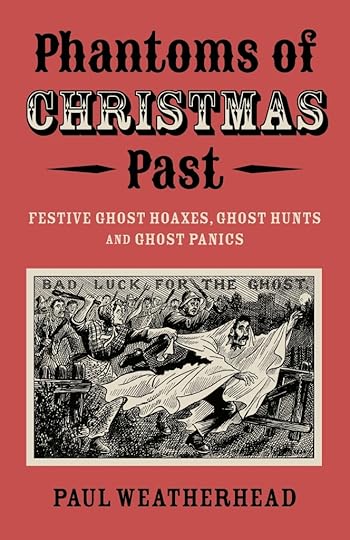 Available for pre-order wherever you get your books from!
Some scholars might see cases like Anne’s as an act of protest against a repressive patriarchal society, or something along those lines. And perhaps it was an act of rebellion on Anne’s part – she was clearly intelligent (or at least deceptive and cunning) and her talents may have been wasted in Storrs Hall, or so she might have felt.
Folklorists might say she was engaging in ostension, the acting out of legends in real life. Indeed, the Hall had a reputation for being haunted (according to one anonymous old man mentioned in a newspaper). But this doesn’t really address Anne’s motive.
Psychic investigators might say that young girls are more likely to exhibit telekinetic powers, and that’s why poltergeist cases frequently involve their presence. However, there are very many cases where maids, servants and young family members have confessed or been caught in the act of faking poltergeist activity. There is a longstanding belief in investigators of psychic phenomena that a silly young girl could never pull the wool over their eyes. They are wrong.
Some people are mischievous and enjoy scaring people then watching the drama unfold. Perhaps what starts as a joke suddenly takes on a life of its own and spirals out of control. Poltergeist scares often led to huge crowds of rowdy, drunk amateur ghost hunters swarming round the supposed haunted house
When Anne first terrified the hapless servant as he milked a cow, she made a shocking discovery that is important to understanding episodes like this. Fooling people is easy.
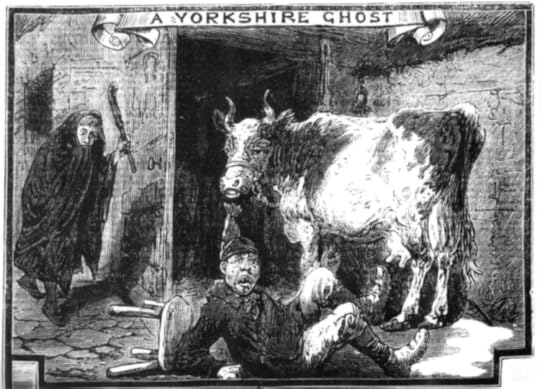 The Storrs Ghost featured in the Illustrated Police News 19 January 1838
Epilogue
An interesting little footnote to this story comes in the form of a letter from someone signing himself as J.A.G. and printed in the Sheffield Independent in early January at the height of press interest in the Storr Ghost.[ii]
His friends had for some time been complaining about the incessant ringing of their doorbell and they suspected it was a gang of young lads up to no good. Others in the household thought it was spirit activity and were greatly alarmed. Nevertheless, the author of the letter volunteered to watch outside the house, and if anyone tried to ring the doorbell, he could pounce on them.
As he waited, the bell started clanging, so he ran to the door to find nobody in sight. He searched the garden to no avail. This seemed to confirm to some of the residents that there was something supernatural afoot. The ringing continued night after night, with the young servant girl frequently having to trudge all the way from the kitchen, where the bell was, to the front door only to find no one there.
The author immediately suspected the servant girl who denied everything, and her employers scorned the accusation. However, when the intrepid author investigated the kitchen, he noticed suspicious marks on the wall near the bell. Furthermore, whitewash from the wall was on the handle of a broom standing nearby. He suspected the girl had been hitting the bell with the broom handle and confronted her with the evidence. She once more denied everything but left her employment soon after.
However, the family later discovered that the servant had indeed been the culprit but was aided by her boyfriend who sometimes rang the bell from outside before running away. This meant that the family would have heard the bell ring when the girl was in the room with them and so removed suspicion from her.
For more Poltergeist Cluedo, see below:
The Gorefield Ghost
A Lancashire Ghost Riot: The Up Holland Poltergeist
Sweary Mary ~ The Clonmel Ghost
[i] ‘A ghost at Sheffield’, North Derbyshire and North Cheshire Advertiser, 12 January 1878, p.2: ‘The latest ghost story’, Wakefield Free Press, 12 January 1878, p.5; ‘A Yorkshire Ghost’, Illustrated Police News 19 January 1878, pp.1-2
[ii] J.A.G. ‘The Ghost at Storr Hall’, Sheffield Independent, 8 January 1878, p.8