
Yorkshire Day!
Ay up, it’s Yorkshire Day! (Also Lammas or Lughnasadh; also the Feast Day for a couple of dozen saints, none of whom I feel are worth mentioning.)
This is a repost from my research blog last year which—for Reasons—seemed like a good idea to post here today.
So, what is Yorkshire? Well, it’s a large chunk of the north of England, the heartland of what in the Late Iron Age would have been Brigante territory.
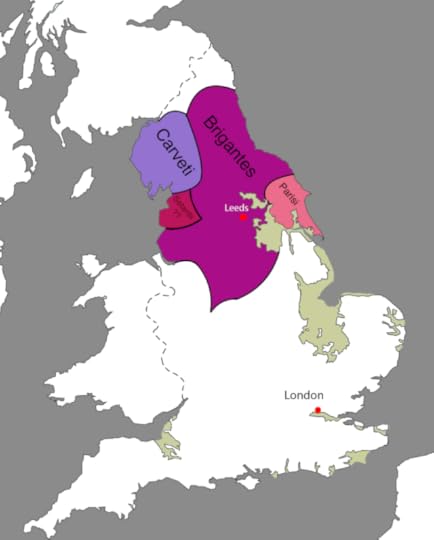 Selected late Iron Age tribal territories—the coastline looks weird because I’ve taken into account the fens and marshland that would have formed barriers and boundaries between polities and peoples
To some it’s God’s Own Country. To others simply the most beautiful land on earth. To an ignorant few, an uncouth, untutored place where the accent is incomprehensible. It’s the biggest county in the UK—by a factor of… Well, when it was the historical county of three ridings, by a factor of a lot, and even now that it’s been divided into four ceremonial counties, North Yorkshire, on its own, is still the biggest in the UK. It encompasses moors, mountains, dales, cliffs, coasts, forests, lakes… Every landscape you can think of. So Yorkshire is big, and beautiful, and, well, belligerent.
It has always had its own identity. Lots of people born and bred there—like me—would think of themselves as Yorkshire folk first, and ‘English’ or ‘British’ second. It’s the UK equivalent of Texas: it inspires fierce loyalty. It has it’s own dialect, and several distinct regional accents—a mix of Iron Age Celtic rhythms, Old English, Norse, and, from the second half of the 20th century, Caribbean and South Asian, with a sprinkling of Polish.
The Domesday Book, compiled about a thousand years ago, noted which steadings, hamlets, demesnes etc stood where, and if you tot up all the mentions, to the tax-hungry Normans Yorkshire looked something like this:
 Domesday Yorkshire
From 1889, Yorkshire had three administrative regions or Ridings: West (the largest), North, and South. Like this:
 The three Ridings of Yorkshire
There was a Sheriff of Yorkshire until 1974 when there was another reorg which frankly is best forgotten—they took part of Yorkshire away and called it something else!—and then in 1996 that miserable reorg was itself reorged, and Yorkshire was reconstituted and then split into four ceremonial counties: West Yorkshire, North Yorkshire, South Yorkshire and the East Riding of Yorkshire.1 Like this:
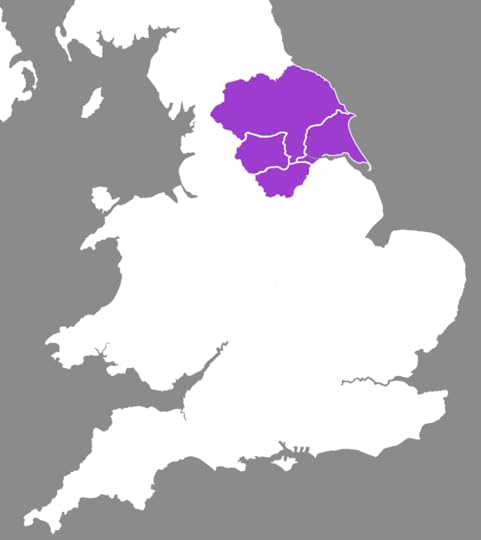 Administrative counties: South Yorkshire, West Yorkshire, North Yorkshire, and the East Riding of Yorkshire.
Why did I originally talk about all this on my research blog? Because I got tired of historians airily describing seventh-century Elmet as Basically West Yorkshire to which I’d always want to respond, Yes, but *which* Yorkshire?? That of course, will be the subject of an essay—though by ‘essay’ I suspect we might be reaching monograph territory: it will be at least 20,000 words long, with scores of maps and diagrammes—on all things Elmet. Where it was. What it was. Why it was, and when. The more I work on it the more I realise I’m really writing a summary of all I know and suspect about how The Britain of Imperial Rome became the Britain of Hild by the early seventh century. In other words, it may never be finished but it’s a deliciously knotty project.
But today is Yorkshire Day! I banish knottiness, exile it to the outer darkness of The South! Today we unproblematically celebrate all things Yorkshire: a strong brew, chip butties, and a pint or two of Tetleys. And if any you mardy buggers has owt to say to that, I’ll bray yer!
Yes, those in the east have always been a bit different; their accent’s pretty different too, probably because they were never Brigantes but Parisi—see that first map. ︎
︎


