Railroad Hauntings You Can Still Visit: A Spectral Figure in Kirkstall, West Yorkshire
This railroad haunting presents a couple of hurdles. First, the station platform from which the ghost was observed no longer exists: the Pennine Horizons Digital Archive reports that Kirkstall Station in West Yorkshire, England, “closed in 1965.” That online archive provides a nice photo of the place, though, and there’s another one here. Nonetheless, comparing this 1851 map to what we see today, we find that Kirkstall Station stood between the River Aire and what’s now called Wyther Lane, just below the B6157 bridge. The station might be gone, but we know where it was.
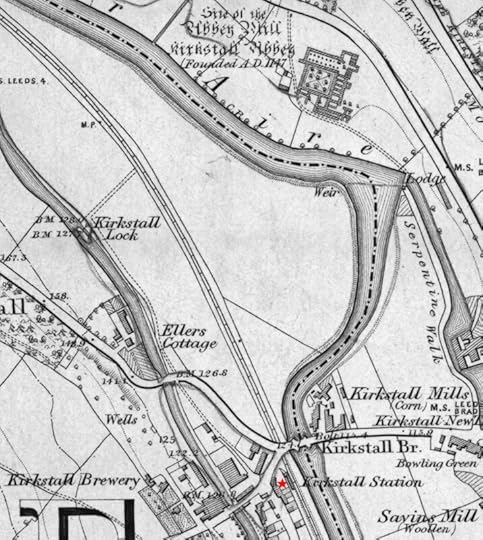 I added a red star to show Kirkstall Station on this detail from the lower right corner of the 1851 map. The Kirkstall Brewery buildings remain, but they now serve as housing. To the north are the ruins of Kirkstall Abbey, which has a few ghosts of its own.
The second hurdle is the haunting was quickly debunked. As I argue below, though, it might have been debunked far too quickly!
An Early ReportAs reported in the June 4, 1904, issue of The Stockton & Thornaby Herald,* a railway porter was on the station platform at midnight, when he spotted “a spectral figure clad, as it were, in a long grey sheet, down which streamed a long streak of red.” It was seen “gesticulating from the roof of one of wooden sheds which lie behind the station buildings.” When the porter tried to show the ghost to the signalman, neither one were able to see it. But then a passenger, a booking clerk, and that same porter observed it again in the same place some time later. Let’s keep this in mind: three witnesses and two separate appearances.
The article goes on to say that, after this double sighting,
strange lights were seen flickering around the station and the neighbourhood of the goods shed, and then the troubled spirit was again discovered haunting the purlieus of the goods shed. This time a party was formed, each member taking a different direction, and the chase once more began, but the search was fruitless.Let’s also keep in mind the strange lights, the third sighting, and the concerted yet unsuccessful effort to find a cause for it all. You see, a theory offered to explain the sighting — flimsy in and of itself — fails to account for these elements of the case.
A Flimsy DebunkingThe piece in The Herald ends with a short bit about how all three witnesses had been fooled. It says the alleged ghost was really “a mill girl, who, rising early, went out wrapped in a blanket, and mounted the shed in the goods yard in order to see the time by the station clock.” Well. Perhaps. Odd for 1904, when timepieces were fairly common, isn’t it? And why did the mill employee climb up on the shed repeatedly? And why was she “gesticulating”? Was she attacked by a swarm of moths?
In the days to follow, a somewhat more detailed version of this debunking appeared in newspapers, including the June 9, 1904, issue of The Ripon Observer:

But this all seems pretty thin unless that early article in the Herald completely misinformed readers about 1) the first two sightings being spaced some time apart, 2) the strange lights, 3) the third sighting a few nights later, and 4) the team of investigators failing to catch the mill employee, if indeed she had returned to the shed yet again.
It doesn’t add up. I’m usually pretty wary of these old railroad ghost reports. Here’s a case, though, that prompts me to squint and raise an eyebrow at the “prosaic ending” more than the initial report.
If Not the Station Grounds, Visit the Abbey!That said, I suspect I would exert minimal energy spook snooping at the grounds where the station and its shed once stood. It’s certainly worth a stop, but paranormal investigators might be far more eager to nose around the nearby ruins of Kirkstall Abbey.
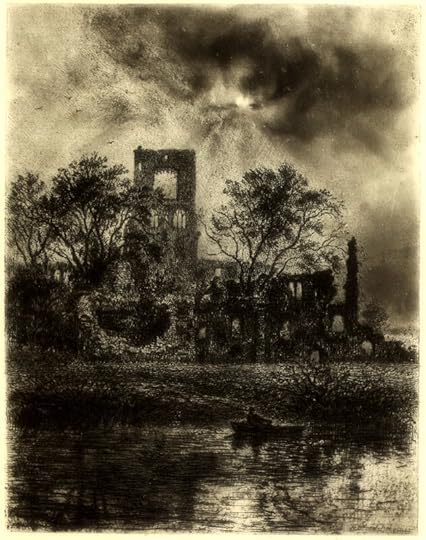 A wonderful sketch of the ruins of Kirkstall Abbey, from William Lefroy’s
The Ruined Abbeys of Yorkshire
(1883)
A wonderful sketch of the ruins of Kirkstall Abbey, from William Lefroy’s
The Ruined Abbeys of Yorkshire
(1883)After all, this location is well known for its ghosts. According to the Spooky Isles website, there’s a 12th-century monk said to linger and loiter among the ruins. There’s also a wife who turned her murdering husband over to law officials, and her feelings of betrayal were strong enough that she’s haunted and haunting still. I guess it’s not surprising that both the Herald and the Observer articles open by implying the ghost seen by the porter and others must have strolled down from the abbey, across the bridge, and to the railway station.
If you do happen to visit either of these places, please tell us about your experience in the comments below. Those tracks, by the way, are still active, so avoid them and take extreme caution in their vicinity.
*I link only free-to-see articles at the British Newspaper Archive, but sign-up/sign-in is required.
Discover more “Railroad Hauntings You Can Still Visit” at the page forAfter the End of the Line: Railroad Hauntings in Literature and Lore.