What have you done? My God, what have you done!?!
For anyone new to this Substack, welcome! I look at action figures, especially from the G.I. Joe line (because I love them so), as a touchpoint to discuss their character tropes and traits in both speculative fiction and TRPG game design.
Following our most recent look at G.I. Joe’s Dr. Mindbender, today we dive into his character trope in fiction; specifically that of “evil scientist.”
How can we start any discussion of the trope without considering the most iconic of them all—Dr. Victor Frankenstein!
“Remember, I am not recording the vision of a madman… Some miracle might have produced it, yet the stages of the discovery were distinct and probable. After days and nights of incredible labour and fatigue, I succeeded in discovering the cause of generation and life; nay, more, I became myself capable of bestowing animation upon lifeless matter.”
—Frankenstein; or, the Modern Prometheus
I’m starting with this passage to note how we’ve seen this trope traditionally labeled as “mad scientist”. Already we have Dr. Frankenstein’s claim that they are not “mad” despite the unconventional nature of their experiments, but therein raises the problematic phrasing of “madness” and mental illness; and while this particular scientist trope can certainly involve elements of obsession, delusion, or other aspects of certain mental illnesses, it just seems like phrasing best to move on from.
With Dr. Mindbender, an alternate label of “evil genius” is apt, but other scientist characters do not always fall so obviously on the alignment chart. “Eccentric genius” has been offered as an alternative, although “eccentric” does not fully convey the dangerousness associated with their work, at least not to me.
Still, let’s go with that for now…
In any case, for Dr. Frankenstein he states that every step in his experiment was perfectly measured and scientific, even if the end result is extraordinary. It is the rationalizing of their work that we’ve seen time and again with the “eccentric geniuses” of literature… and ends as horrifically as we’ve come to expect:
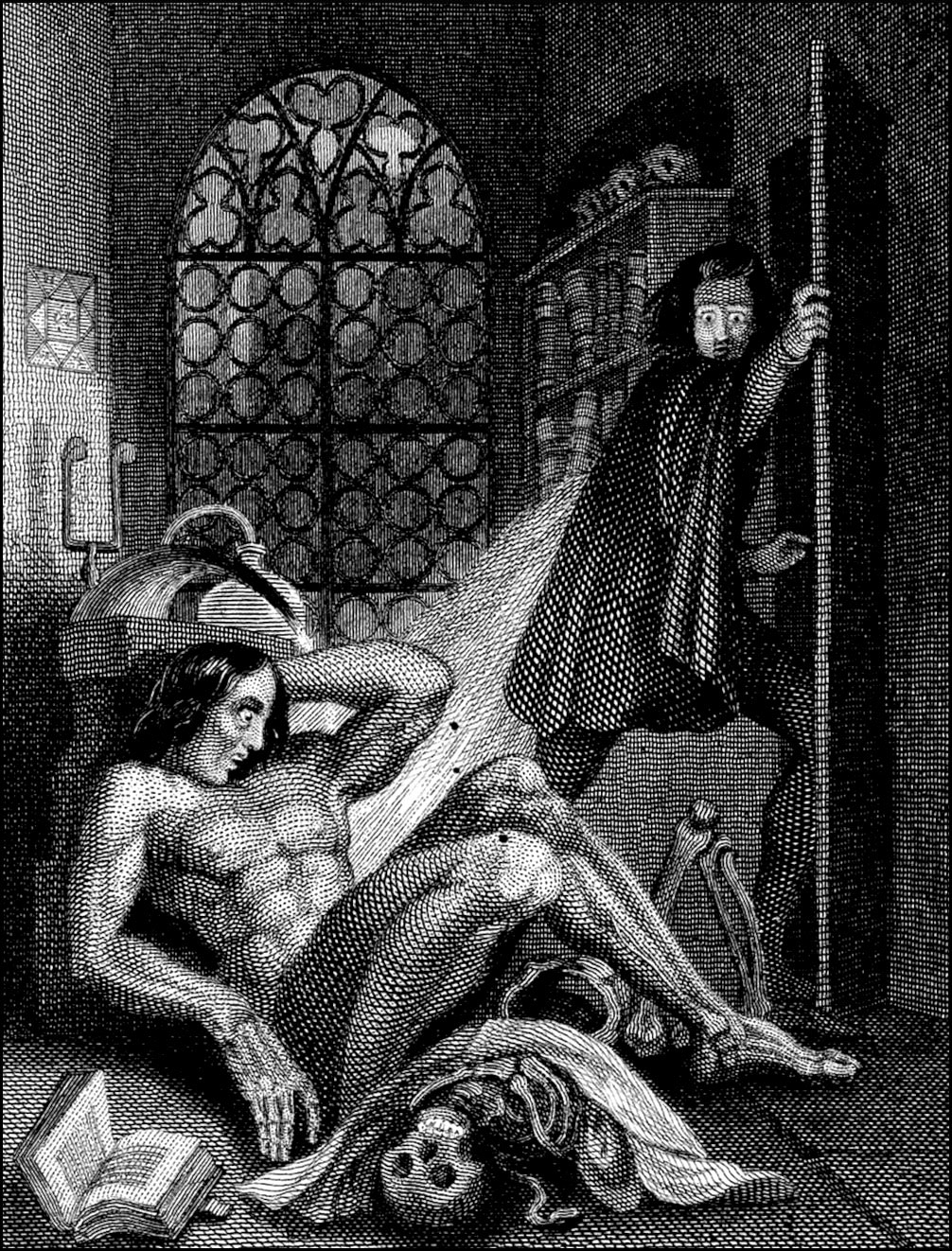
“It was on a dreary night of November that I beheld the accomplishment of my toils. With an anxiety that almost amounted to agony, I collected the instruments of life around me, that I might infuse a spark of being into the lifeless thing that lay at my feet. It was already one in the morning; the rain pattered dismally against the panes, and my candle was nearly burnt out, when, by the glimmer of the half-extinguished light, I saw the dull yellow eye of the creature open; it breathed hard, and a convulsive motion agitated its limbs.”1
This is right about where I usually add this little, blue button. Please consider becoming a regular subscriber!
Yet while Dr. Frankenstein knows he’s selected a perfect specimen of a body to reanimate, seeing its new appearance (awakening with a shriveled, yellowish complexion, pale white pupils, and black lips) has exposed his experiment for what it truly is—the reanimation of a corpse into some new, monstrous life:
“How can I describe my emotions at this catastrophe, or how delineate the wretch whom with such infinite pains and care I had endeavoured to form?… For this I had deprived myself of rest and health. I had desired it with an ardour that far exceeded moderation; but now that I had finished, the beauty of the dream vanished, and breathless horror and disgust filled my heart. Unable to endure the aspect of the being I had created, I rushed out of the room and continued a long time traversing my bed-chamber, unable to compose my mind to sleep.”2
I’m a larger fan of Science Fantasy over, say, High Magic Fantasy. That’s just my preferred flavor of ice cream (thankfully, there are many). And the concept of an eccentric scientific genius serves such a helpful purpose in the genre.
For one, scientists in general can provide the characters (and thus the readers) an explanation for how certain fantastical or even impossible elements in the worldbuilding came to be. (What is that strange creature with feet for hands? The result of science gone amok!) And, in so doing, how the science of their world works altogether. As an important note, they can do so without having to rely on explanations of “magic” or the metaphysical (such as the work of angels or demons).
And let’s not forget that as an antagonist, a scientist can creates threats that are creepier, more unsettling, and with more existential dread than might be otherwise encountered. It’s one thing to fight an opponent hand-to-hand. But to be captured and experimented on? Somehow changed or mutated? Even the bravest hero in any stand-up fight might quail at the thought of body horror inflicted upon them (and such a threat to the hero unsettles us, as an audience).
A Few of My Favorite Things…There are far too many examples of the “eccentric genius” in fiction and media, that I’ll just provide a few of my own personal favorites:
Dr. Bunsen Honeydew: What could be more terrifying than a scientist who comes at you with all smiles and soothing placations? Just ask Beaker—no matter how much you reassure us that everything will go fine… we know that it won’t.
Nikola Tesla: An inventor who goes off in their own direction; a threat to the perceived norm (as well as to the business of his rival, Eddison). The man designed an actual death ray, and was portrayed by no less than the Goblin King himself, David Bowie, in The Prestige.
Dr. Hans Zarkov: Specifically as depicted in 1980’s Flash Gordon. The only scientist that “has provided any explanation” for recent disastrous events. If only people would listen to him! And, a scientist willing to go to such great lengths to prove their theories as to kidnap unwilling test subjects—including the quarterback for the New York Jets!3
David 8: An android from the Alien movie series so fascinated with xenomorph biology as to conduct horrific experiments on human test subjects. We only see sketches and hints of whatever happened off-screen to Elizabeth Shaw between Prometheus and Covenant at David’s hands, and instills the worst fear of what will happen to Daniels later forced to take her place.
Rick: A super-genius inventor who’s greatest rival is various incarnations of himself. Who else can give him a worthy challenge? Season 3, Episode 3: Pickle Rick, tells a fantastic story of a scientist forced to save himself through his inventive powers (while Season 2, Episode 3: Auto Erotic Assimilation, has the saddest, most poignant ending for a scientist who cannot solve all of his problems through invention alone; trigger warning: suicide ideation).
(Honorable Mention) Baldanders: From perhaps my favorite novel series of all time, Gene Wolfe’s The Book of the New Sun—who at first seems a monstrous giant created by his companion Dr. Talos, until their true natures are revealed (and their true relationship reversed).
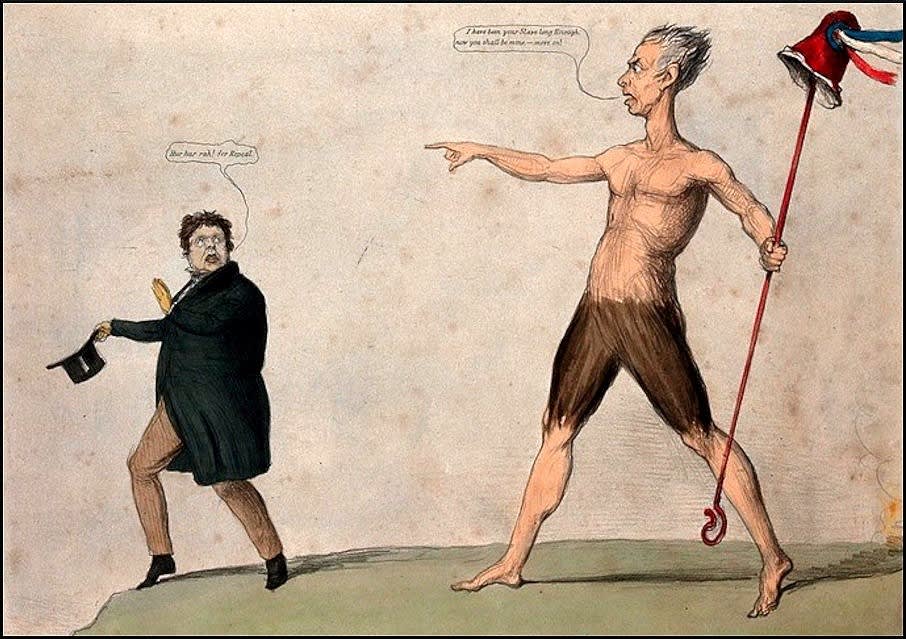 Note: Also an image of Frankenstein, but fits Dr. Talos & Baldanders just as well!
Taking a look at these figures, some of the “eccentric genius” tropes that work so well for them include:
Pursuit of science beyond its limits. The wish to expand the whole of knowledge regardless of the risks. This is Jurassic Park’s John Hammond view of science, only asking if they could, not if they should. A further shoutout to Dr. Hans Reinhardt here, willing to enter a black hole, just to see what’s in there!4
An equally driven rival. What pushes advancement if not competition? The aforementioned Tesla/Edison, the U.S./U.S.S.R. race to the moon, Apple vs. Microsoft. Oftentimes, it’s the hero up against the scientist and his creations, but a scientist vs. scientist rivalry can be far more fun to watch. In China Miéville’s Iron Council, the end battle sees golems fighting elementals, both built from two competing magical-scientific fields, and what could be better than that!
The ends justify the means. When considering the risks, it’s about the science above all else. Nothing else matters, not any moral constraints, legalities… or concerns of a work-life balance.5
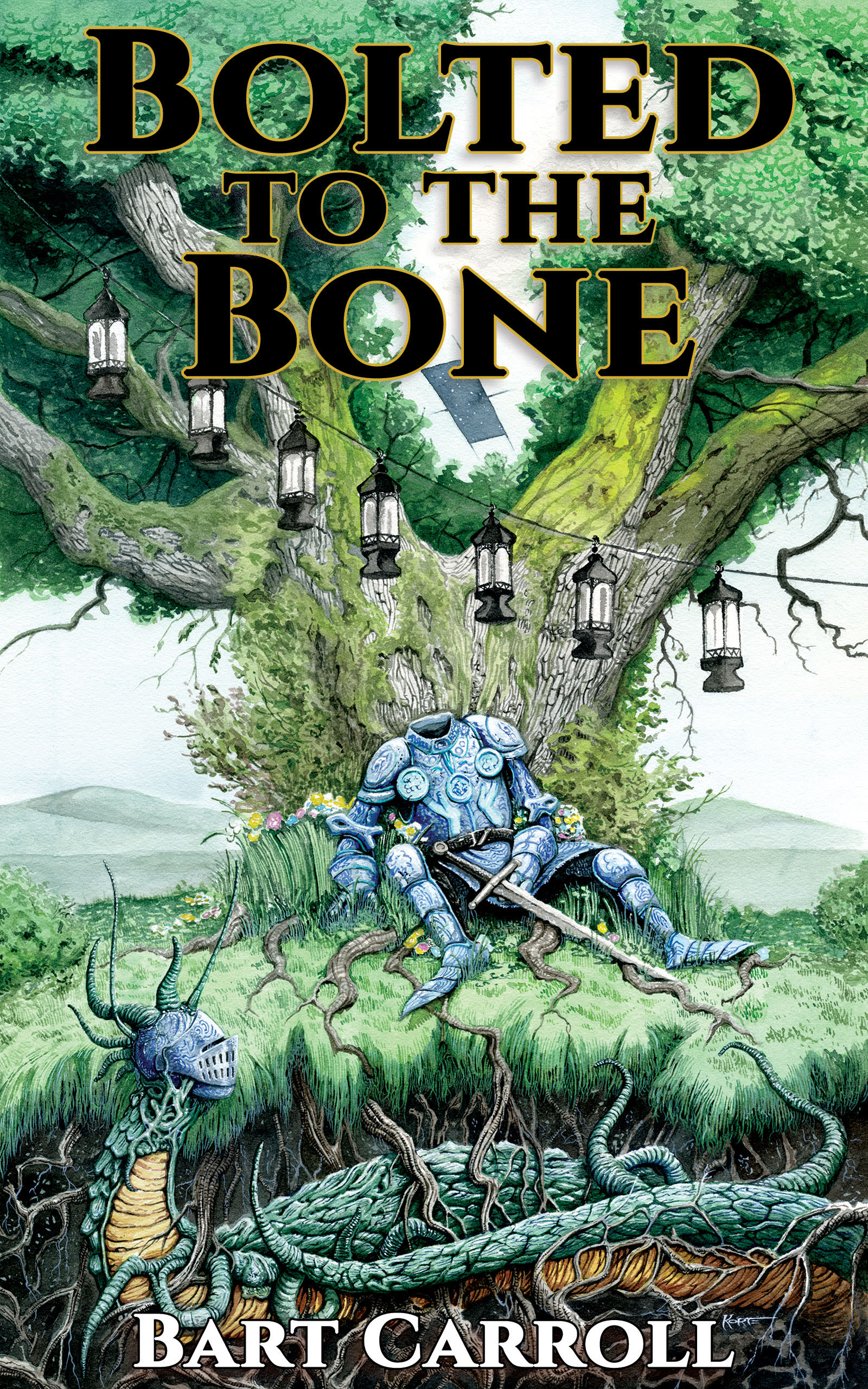
Bolted to the BoneFor my own science fantasy novel (out November 1!), the setting involves a piece of Shattered Earth; a small “garden world” rebuilt as a very intentional recreation of an older Celtic Ireland (whether by the creators’ desire to preserve the place of their own lineage or from their misguided hobbied interest). In no small part, this was so that I could explore a science fantasy version of Celtic Ireland for both of these selfsame reasons.
Several towers exist to support this garden world (called the “Emerald Remanant”), both figuratively as well as quite literally holding the artificial firmament in place. Each tower is also tasked with some scientific field needed to help manage the operations of this world—roughly classified as sky, food, water, and life.
Given that the scientists in charge are sent from the more advanced surviving populace (who, before the Earth shattered, had already started colonizing the Moon), there is a natural division between themselves and the populace of the Emerald Remanant. The scientists view the Emerald’s citizens with arrogant disdain; the citizens, despite their reliance on them, view the scientists with resentment and distrust.
As noted last time, the background incident for the book involves a panel of the firmament having fallen out and destroying a village below. The investigation naturally focuses on the Tower of the Sky.
Along the way to the tower, one of the investigators is set upon by some new, monstrous creature—a hydra, that grows a head in the likeness of whatever prey it consumes. And so how does the Tower of Life now play into things?
Well, for that you’ll need to wait until the Nov. 1 release!
Next time: Pursuing science in D&D/TRPGs.
Thanks for reading Curious Figures! This post is public so feel free to share it.
1It was a literal dark and stormy night! Snoopy would be proud.
2My own natural reaction whenever reading drafts of anything I write.
3And to think, just a year ago the thought of a NY Jets QB going into space would’ve just been his returning home!
4And gives us one of the best, most surrealist parts of the film (Disney’s 1979 The Black Hole):
5Somewhat tongue-in-cheek. Part of the trope can also involve the placement of a scientific project before family, friends, and everything else outside of the lab.