
A Theater of Presence
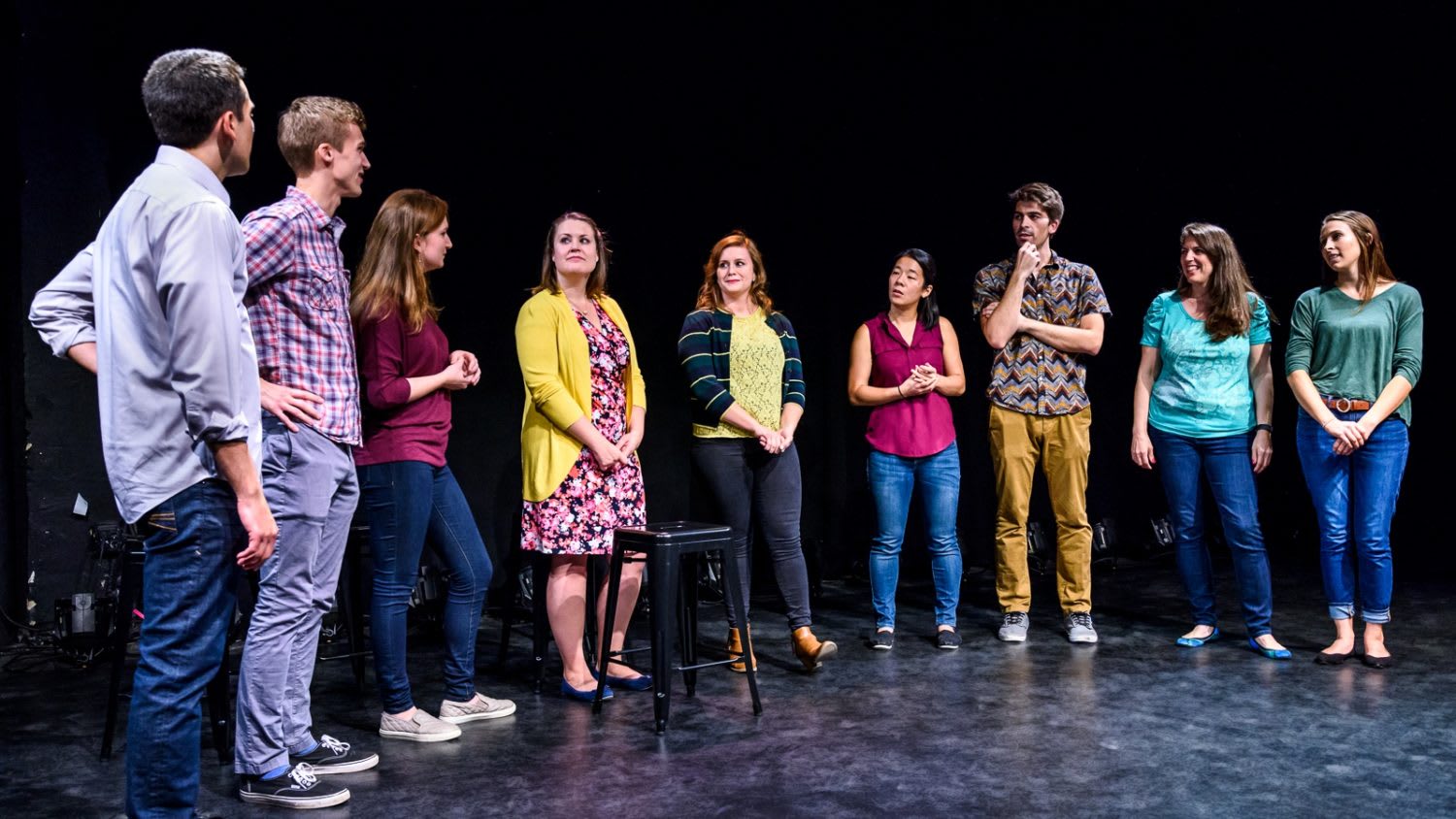
A team performs at Washington Improv Theater
In the middle of my senior year of college, while I was having fun doing theater with my friends and doing a poor job of thinking about the future, a depressing article by film critic, David Denby, was published in The Atlantic, talking about how he—a non-theater person—had attempted to see more plays and understand their power and their attraction. It hadn’t worked. He had utterly failed to understand why anyone would like theater as an art form or a storytelling medium. It left him cold.
He was raised on film, you see, and he found film a far more compelling and immersive medium, one which had the power to create realistic worlds. Not having grown up within the conventions of theatergoing, he found live performance weird and silly and a little embarrassing.
To say that the article bothered me is an understatement. I have remembered its effect on me for 40 years, without ever going to look for it again (until now). I’ve linked to it, above, but I’m not sure I want to re-read it.
It bothered me, but…I actually found his argument convincing—IF you limited it to the world of realism and naturalism. Yes, a living room set on a theater stage will never feel as convincingly real to an audience as a living room scene captured on film. Yes, everything on stage will feel symbolic and actor-y and freighted with meaning, in ways that movie acting rarely does.
AND YET. At the time, I also rejected his argument, because I already knew that theater could be much more than a second-best rendering of living-room reality. When a new medium is invented, old artists have to adjust. When photography became popular, painters had learn how to do more than try to imitate reality. Some of them didn’t bother; they continued to paint landscapes and portraits. But others experimented with light and form and color and shape to see “reality” in very non-photographic ways—and it is their work that we talk about.
Theater can definitely do that—and it has, for decades. But does it matter?
Maybe it’s about to, in a way it never has before.
Every action has an equal and opposite reaction. That’s not my opinion; that’s the law, and I’m starting to see it play out with technology among my kids’ generation. Inundated with Smartphones and streaming media and computer-generated special effects, a lot of them seem to be craving something more tangible—more “real.” Suddenly, vinyl records are back in fashion. Suddenly, typewriters are kind of cool. Substack may be growing, but so is a return to paper-based ‘zines. What’s next?
Well, if we’re about to have an AI-generated actress foisted upon us to join the kaiju and monsters and superheroes that populate our screens, maybe kids will start seeking out a storytelling medium that they can touch—something that was built to talk to them in a human way, on a human level—something that will hear them when they talk back.

“I’m not real, and neither is my coffee.”
A play can’t speak to millions of people simultaneously, and maybe that can be its strength now. Maybe what we need is to be in smaller rooms, watching and listening together, attending to something that’s actually happening in front of us.
Another author from back in the 1980s saw this coming from miles away. George W.S. Trow wrote an essay in the New Yorker magazine called, “Within the Context of No Context,” which was republished with a new forward as a book in 1997. He was looking at the effects of television and tabloids, but everything he worried about back then has only gotten worse.
In his essay, Trow talks about how the middle-ground of public life has decayed, leaving only things meant for everybody and things meant just for you. What has been lost is a sense of community—of smaller-scaled things built by and intended for a more intimate “us,” that is more than just “me.”
Two grids remained. The grid of two hundred million and the grid of intimacy. Everything else fell into disuse. There was a national life—a shimmer of national life—and intimate life. The distance between these two grids was very great. The distance was very frightening. People did not want to measure it. People began to lose a sense of what distance was and of what the usefulness of distance might be.
Trow nails it, long before the advent of streaming and doomscrolling. In Hollywood, they talk about trying to produce “four quadrant” movies that can appeal to every single demographic and suck up every single dollar possible. That is the grid of the two hundred million. And even though “television” is no longer as monolithic as it was when I was a child, or when Trow was writing about it, it still aims at millions.
Who tells stories meant only for thousands—or hundreds—or a single auditorium?
When I was living in Atlanta and working at a regional theater, I belonged to a group called Alternate Roots, which brought together a wide variety of performing artists who all felt a sense of community-based mission in their work. To join the organization, you had to stand in front of the membership and talk about your work—what community it grew out of and what community it was meant to serve. It could be a physical community, like your town or your region; it could be a religious or spiritual community; it could be an ethnic or sexual or gender community—it didn’t matter. But you had to have a sense of rooted-ness; you had to know who was feeding you and who you were trying to feed.
I loved the people in that group, and I enjoyed their enormous annual get-togethers that combined business meetings with workshops and performances and communal cooking and a fair amount of late night drum-circling. I loved the people, but I never really felt like I fit in or knew my place. I was trying to understand myself as a playwright, but I never knew how to answer their Big Question: who was my community?
I didn’t have one. I was just trying to write whatever interested me.
“Community theater” gets a bad rap sometimes. It’s not “professional.” It can be amateurish, or inept, or raw, or cringey. But it can also be warm, and loving, and wonderful—because we know everyone up on stage, and we know what part they played in the last show, and we know what they’re going to do next, because they told us when we saw them this morning at Starbucks.
But it also gets a bad rap because community theater often mounts plays that have been done many times before, in more professional settings. We go see our friends in the 99th iteration of “Grease,” and…ok. OK. We love them, and it’s fun to see them and support them, but even as cotton candy, how many more performance of “Grease” do we really need to see?
When I think about the need for something between the grid of two hundred million and the grid of intimacy—about the need for something tangible and meaningful—real people speaking to us about real things that matter to us—isn’t there room for something else that could be called community theater?
What would that look like?
It could be the same kinds of people who perform now, coming together to write and perform plays about the communities they live in and the issues they’re facing. Those could still be musicals—or farces—or plays in verse—or tragedies. It wouldn’t have to be super-serious. It wouldn’t have to be dreary. And it wouldn’t necessarily have to be quiet. Maybe it would encourage people to stick around after the play to talk and argue. Maybe it would encourage people to talk back at the actors on stage in mid-performance.
There may be people out there, all over the country, doing exactly that right now, who we don’t know about. Maybe we don’t have to; they’re not here for us.
Just as painting evolved to capture reality in ways that photography couldn’t, theater can evolve to bring dramatic storytelling to people in ways that movies or television can’t. And it already has. None of this new. It’s been done for over a hundred years, in a variety of ways, by various avant garde artists and groups all over the world. But maybe it’s time to make those things a little less arty and rarified, and bring them out to our friends and neighbors—to say: Hey, it’s just us here, together in the dark. Let’s talk about what’s going on. Let’s say what needs to be said—by us and for us.
Something real, like the coffee I’ll be buying from the actors tomorrow.


Scenes from a Broken Hand
- Andrew Ordover's profile
- 44 followers

