
The "Life of a Showgirl" Backlash is Making Me Nauseous
This essay is not an analysis of Life Of A Showgirl. Notexactly.
Is it even a coherent analysis, or is it just a messy,confused vent about what happens when a woman is famous? Well, dear reader, we’regoing to find out together.
First, a disclaimer on my own biases, my own littlestandpoint theory discursion.
I have a Swiftie in my life who’s very important to me, andthat definitely prejudices my perspective on this. I started out as a prettythoughtless Taylor Swift hater myself. She was tall, blonde, and pretty, and I’mnone of those things, depending on who you ask about the last one; it was easyto project the cruelty I’d suffered at other people’s hands onto her as anaggressor.
Commentators I like, like Todd in the Shadows, also werevery happy to make fun of her. Did I unpack this at the time? No, that had tocome later, with some maturity.
Still, nobody is ever neutral about these things, and anyonewho thinks they’re an objective critic is being fooled by the very concept ofobjectivity.
So, let’s start with the album itself. What did I think?
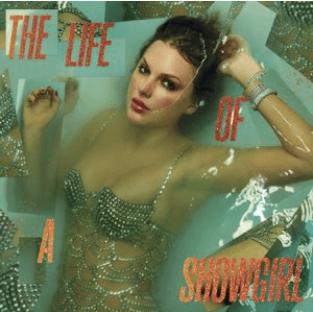
Life of a Showgirl is fine. It’s pretty mid, but it’snot the worst album I’ve ever heard by a female artist – that dubious honourbelongs to 0304 by Jewel, which failed so spectacularly at its conceptof mixing Big Band music with showtunes that my teenage heart was broken.
Still – it has some clunky lyrics, yes, and the songs aren’tas catchy as on some albums. Is it one of her best albums ever? Absolutely not.But it’s also not the artistic massacre that some people seem to think it is.
Between this and The Tortured Poets Department, mypersonal analysis of the last two releases is that Swift has started puttingout music for herself, rather than with her career and her fans in mind. It’salso entirely possible that she’s going through what I’ve seen happen with manyauthors; namely, she’s too big to critique properly, and people who should be hercreative aides are yes-manning rather than editing her.
The thing about the album that I personally appreciated,though, was that she seems happy.
The internet, however, has lost its goddamn mind over thisalbum.
Mass HysteriaBy and large, this album has been succeeding financially,but failing with fans and critics. A bunch of people I know have absolutelyloathed this album, and there’s a huge backlash among both Swifties andSwift-haters alike.
The thing is, though, the backlash isn’t just a matter of dunkingon clunky lyrics. There’s an aura of self-righteous triumph among critics, anda sort of woeful, “Whoa, was she really Bad all along?!” response from a lot offans, that’s seriously skeeving me out.
Now, this backlash comes in multiple parts; let’s start witharguably the most damning and justified part.
The Woobification of Charlie XCXThe song “Actually Romantic” is apparently a riposte to “Sympathyis a Knife” by Charlie XCX. Now, podcasts I like (suchas ICYMI) went into detail on this, but not quite *enough* detail.
As this essayput it, ghere’s no getting past the aggressive element and tone-deafness ofwriting a song called “Sweetheart” about other women picking on you, thenwriting “Actually Romantic” and what could be read as biphobia/homophobia. I’mnot going to defend that perspective, because at best, it’s a bad look, andshortsighted.
The interesting thing is, people are mostly going from thecontext of the song “Sympathy is a Knife” and this song – but that’s just notthe whole story about whatever has gone on between Charlie XCX and Swift.
For one thing, as the Swiftie in my life pointed out,Charlie didn’t *just* write the song. She made tweets and other cageyreferences to Swift online. And there was also this photoshoot, which totallyis just symbolic of Charlie’s struggles with fame and definitely, absolutely,not a reference in any way shape or form to the friendship bracelets that are ahuuuuuuge thing among Taylor Swift fans.
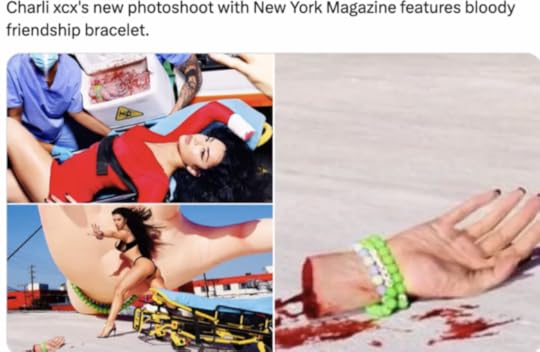
Add to that, the fact that Charlie XCX – who is not a tiny,up-and-coming indie artist, even though she’s obviously not Taylor Swift – was previouslyopening for Swift on the Eras tour, and that she’s married to a bandmate of oneof Swift’s exes, Matty Healy…and it all just turns into something a little lesscut-and-dried. My personal read is that they’ve probably bickered in private,and stuff has happened that the general public doesn’t know about.
But to read and hear about the internet’s reaction, you’dthink Taylor Swift had football-kicked a puppy.
To summarize, then: is it homophobic? Kinda. Petty?Definitely. But is there more going on here than meets the eye? We have noway of knowing, but the internet sure isn’t pausing to consider that.
A History of Misogyny and VictimhoodThe reactions I’ve seen to this album’s release have been,to put it mildly, fucking unhinged – particularly because the album itself isbeing read in the absolute worst faith possible, and being used as an indictmentof Swift as a person. I’ve seen comments that included, but weren’t limited to,the idea that Swift is “lowering herself” with Kelce and that she “could dobetter” with a partner; the idea that she’s now signalling herself as atradwife and is secretly MAGA, to the idea that her opalite necklace is a codedwhite supremacist nod. (On the necklace, there are 8 lightning bolt charms and14 links between them, which some people think is a dogwhistle about the Nazimeme “1488” – recently referenced by Pete Hegseth in an infamous militaryaddress with top generals. 1488 references the fourteen words, a whitesupremacist pledge, and 88 references the eighth letter of the alphabet, H, andstands for “HH”, meaning “Heil Hitler”. It’s a whole thing, because fascistsused to have to hide their shit, and couldn’t just say things the way they seeminglycan nowadays.)
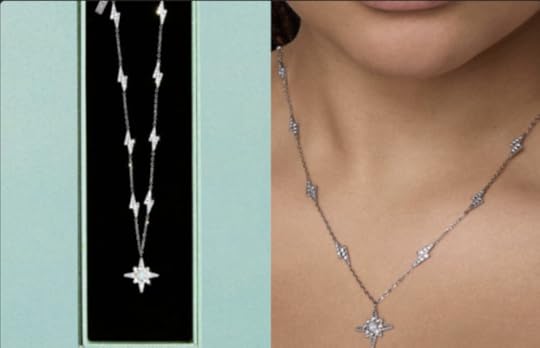
So, is Swift drifting rightward?
The problem is, it’s almost impossible to extricate the conjectureabout Taylor Swift from both normal press misogyny and the problems she’screated for herself. Swift has built a career as a confessional songwriter,coding in little hints and references to past relationships in her songs, and thepress and fans have been delighted to hunt for these Easter Eggs. The problemis, hunting for patterns that sometimes exist is ripe ground for conspiracytheorists. Now, Taylor Swift isn’t the right kind of chronically onlinepolitics nerd who’d understand the danger of this, but it’s somewhat directlyfed into the problem of the Gaylors, chronically online queer conspiracy nerdswho’ve concocted increasingly elaborate explanations for how Taylor Swift issecretly in a relationship with Karlie Kloss, a former best friend. (And ofcourse, “Actually Romantic” isn’t exactly going to help these allegations.)
But, back to the subheading. Is Swift a victim or a perpetrator?
God, that’s a stupid setup, and yet it’s the one we’re allbeing offered, twenty-four-seven right now. The shine is off the apple! Thiswill sink her career! Never mind the fact that this kind of background radiationhas been in the air since, I don’t know, Reputation? Or Lover? Iunderstand that not every news story can be a serious piece about, say, the riseof fascism or the ongoing climate crisis that I guess we’re all just fuckingignoring now. Still, the way international press and media are crowding aroundto join in on the Serious Speculation about whether Swift has *finally* losther touch is, frankly, terrifying.
From the whole reference entrapment with Kanye West – where sheagreed to be referenced in a song, though not in the way he portrayed her (as anaked wax doll in bed with him, in the context of sexual conquest and saying he“made that bitch famous”) – to whichever jeering article has come out about herdating history, it seems like the media is genuinely trying to knock Swift offa balance beam at every opportunity.
The White Woman ConundrumThere’s a queasy problem at the heart of criticizing TaylorSwift. Let’s talk about white women.
Now, I don’t really identify as a “woman” anymore; that particularword has always stuck in my throat. But as a “political woman”, i.e., someone perceivedas a woman who experiences misogyny and etcetera? Yeah, for sure. For thepurposes of this essay, I’m going to lump myself in with womanhood, becausethat’s how I’m perceived and how a lot of my experiences fit.
There’s this weird, uncomfortable thing where white womenare simultaneously protected from our possible failures in a certain way, andalso the most delicious, juicy, easy target for certain kinds of misogyny. Asusual, I’m going to talk about a Canadian and American context, because that’swhat I know best, but your personal cultural context may include more than whatI’m talking about. Whereas Black women, Latina women, and Asian women arehighly sexualised and fetishized, white women are weirdly both de-sexualised andthe object of desire. Everyone is supposed to be like “us”, but we’re supposed tocollect traits and clothes from other cultures, trophy-like. We mete outdiscrimination against other women and often hand down violence, but also endup being really, really comfortable targets for hatred.
White women are both allowed to express ourselves sexually,yet also seen as virginal and weirdly de-sexed. The standard for beauty andsuccess, but also an extremely easy target for criticism, both on the left andthe right. White women are also the figureheads and standard-bearers for whatis deemed to be cringey.
Now apply these thorny contradictions and nuances to TaylorSwift. As a conventionally beautiful white woman who’s suffered from disorderedeating and anorexia in the past, she’s both defined beauty standards andsuffered from them. As someone who’s also suffered from disordered eating,there’s something that breaks my heart about this. Even someone who defines thebeauty standard both didn’t feel like she was enough.
Swift has definitely lashed out and been petty in public andprivate, and she doesn’t seem to see her own role in conflicts very well. Thesong “Karma” from Midnights, which is my favourite of her albums, exemplifiesthis perfectly well. She has a tendency to re-open old wounds and dig up pastconflicts and relationships. She puts her foot in her mouth. She can’t leavewell enough alone – and sometimes she recognizes these traits, and sometimesshe doesn’t.
The Morality TrapThe thing that makes me, personally, deeply uncomfortablewith the backlash to Life of a Showgirl is that people seem to beaddressing Taylor Swift without an iota of self-awareness that a) she’s nevergoing to see their thoughts, and b) most of the people who will…are just herfans.
Now, it’s really fucking tricky to criticize something thatpeople like. Angry clicks get attention. Hell, there’s something deeplyuncomfortable to me about even writing this essay, because in a way, I’m stillparticipating in the same attention economy around Swift that I’m criticizing.There’s an ouroboros of criticism on the left in particular that really worriesme; an endless well of critique and self-critique that sometimes verges on thepolitical equivalent of self-harming your movement. Self-reflection andaccountability are important, but do we really think Taylor Swift is going toexperience either of those from our critiques?
What’s more likely is that a) Swifties in your life aregoing to see you mocking her work, and feel kind of vaguely shitty and uncomfortable,or b) feel that peer pressure to join in. Or, in my case, c) wonder just howmany of these invisible and extreme standards are actually in the back ofpeople’s minds, and being applied to other women.
Because here’s the thing that’s eating a hole in my brain, andhas been since I started seeing articles about how Swift getting engaged to herfootball boyfriend was “a disappointment”.
How many of the standards being applied to Taylor Swift areactually representative of people’s background thoughts about the women intheir lives?
White women like Swift tend to get a lot of criticism, butalso a lot more forgiveness for our fuckups. We have a lot more chances to comeback from disappointments and rebuild our reputations – so many nonwhite women,particularly if they’re Black, get absolutely fucking wiped out and persecutedfor far, far smaller and much more dubious offenses than Swift has committed.
So the question is, who are all these thinkpieces *for*?
Talking to OurselvesI don’t think there’s anything wrong with trying to processyour feelings out in the open, but I do think there’s something reallyinteresting and possibly rather bad about the way that sometimes, criticisminfluxes from the right and left create a confluence. Swift has beengetting a fresh backlash of hate ever since she started showing up at herboyfriend’s games. Meanwhile, people on my side of the street are veryearnestly criticizing her for what we certainly think are more meritoriousreasons, with actual grounding.
But when does criticism just become a kind of misogynisticblur of background hate and radiation? It’s awfully hard to make a good pointwhen you’re just part of a crowd, and if there’s one thing I’ve noticed on theinternet, it’s that people are absolutely shit at contextualizing theirperspectives with those of others.
One person hating something is an observation; two dozenhating something is a clamour; two hundred thousand is a sort of oceanic roar, forwhich all the details blend together.
So, then, what do we do? Does that mean we can’t hold publicfigures accountable?
The thing is, I’m not so fucking sure that all this critiqueis really about accountability. I also don’t know if people who are talkingabout accountability see how they’re pretty much just playing out games ofpunishment and shame, just with updated language and internal self-justificationsthat this time, the hate is justified, and the target is big enough thatreally, it’s harmless.
Who’s Fair Game?And now we come to the part of the essay that has beenkeeping me up at night. Who are we allowed to hate? I’m certainly not innocentof despising some famous women and people, or mocking them – preferably inprivate or semi-private, rather than adding my voice to the cosmic radiationstatic of hate and jeering that tends to blare from every portal to theinternet.
For those who don’t know, I’ve been running as a publicschool board trustee in a local election. That will be over by the time thispost is up, although results won’t be in yet. Recently, I was at a Pink Tea celebratingthe Famous Five who brought voting rights to Canadian women (vote rights for whitewomen, that is, because the five were also anti-immigrant eugenicists).
The topic of misogyny came up among some city council andpublic school board trustee candidates. We talked about our local member of parliament,Rachel Thomas, whose policies I strongly dislike (to put it somewhat mildly).She’s advocated against safe injection sites, voted against abortion, and votedagainst trans rights. While yes, she’s experienced misogyny, as oldercandidates pointed out, she’s also voted only in favour of certain women. Thething is, the more centrist people there were keen to protect and shelter herreputation and save her a seat at the table, figuratively speaking.
It comes back to the concept of white feminism. Can we trustthose who don’t advocate for us? The question I would ask is, maybe we shouldfocus on those who are not just failing to advocate, but directly advocatingagainst us. But even then – how often do we let ourselves slide into the guiltysecret pleasure of misogyny when we deem a woman to be safely hateable? I don’thave an answer for this one, but I’m going to be looking into the mirror aboutit for a long time to come.
But Taylor Swift is also not a goddamn activist, despitewhat people would like her to be; she’s a pop star, and an extremely normalperson. I have been developing a terrible, creeping suspicion that all these billionairesand people in power are, in some regards, terribly normal and petty, and utterlyunprepared for and unable to understand the power they wield.
That does not mean we should not hold them accountable – butit does mean that we should, amongst ourselves, fucking interrogate both our prioritiesand the meaning of accountability itself.
What we need are nuanced discussions. What we have is atrend cycle being doused in the gasoline of AI slop and propaganda.
And at the end of the day, I wonder – has all this culturalcriticism of creative works amounted to a hill of beans?
KurtVonnegut dryly commented, “Duringthe Vietnam War... every respectable artist in this country was against thewar. It was like a laser beam. We were all aimed in the same direction. Thepower of this weapon turns out to be that of a custard pie dropped from astepladder six feet high.”
I guess what I’m saying is, treating Taylor Swift’s marriageand parental dreams as a failure of her feminism is extremely stupid bullshitin the context of vicious backlashes against queer rights.
Pick your fucking priorities,people, and think more carefully about the standards you apply to women andfemmes in your lives. It’s just a mid album, but there’s something fundamentallygross about being this excited for a woman’s downfall.
***
A writer and artist, Michelle Browne lives in southern ABwith xer family and their cats. She is currently working on the next books inher series, other people’s manuscripts, knitting, jewelry-making, and drinkingas much tea as humanly possible. Find xer all over the internet: *Website * Amazon * Substack * Patreon * Ko-fi * Instagram * Bluesky* Mastodon * Tumblr * Medium * OG Blog * Facebook


SciFiMagpie

- Michelle Browne's profile
- 601 followers

