A Review of 'Medieval Welsh Lyrics' Translated by Joseph P. Clancy
I have no idea who recommended this book to me but thanks to whoever it was! ‘Medieval Welsh Lyrics’ has some of the most startling, vivid, awakening and sometimes astonishing verse I have read. It was very unexpected.
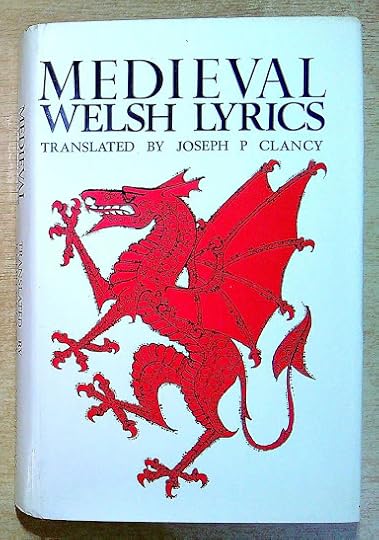
(Translated by Joseph P. Clancy and published in 1965, taking from a range of previous books on the subject.)
THE NECESSARY ABOMINATION OF TRANSLATION
I don’t speak Welsh.
The translation of poetry is a necessary abomination. If a perfect poem is a precise, even total, annealing and cross-synthesis of sound and meaning, of the chosen sonic structure of the poem, combined with the perfect representation of meaning within it, and within that, the most precise, perceptive, original and imaginative observation, relation and creation, then the ‘perfect’ or ‘best’ poem, is the one which is most wounded by being translated.
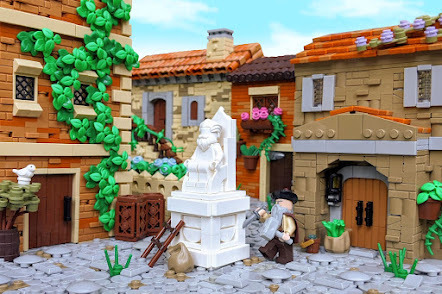
For a perfect ordering, the dis-assemblement and re-creation in some utterly other substance - its like taking apart one of the high points of Greek or roman sculpture, say ‘Lacoon’, and re-making it in Legos You can do it, and it’s awful, but if people can only see Legos and cannot perceive Marble, then that’s what you have to do. It’s bad to lose a lot and to create frankenpoems, but its worse to lose everything, which is what happens if you don’t translate into whatever the dominant medium is
What we lose is probably inestimable, and we should accept that we are dealing with half-poems, or even zombie poems, compared to the originals - the bards would not be happy. But the alternative for me is nothing, so I accept it.
what comes through is the images, descriptions, similes, concepts, arrangements of ideas and general flow of thought
STARTLING THINGS ABOUT WELSH POETRY
What startles is the immediacy and imaginative power of interwoven with vivid, glowing, immediate and intense observations of nature, and added all to this; clearsighted, almost documentary descriptions of real-life events. Though they are given in an elaborate Welsh scansion in a format driven by ritualistic forms and common tropes, these moments ‘POP’
These things are rare and hard to find in time. People do not write like this for long books of history or if they do, it is lost. So the past is monumental, graven, sombre, strange, not because it was as it was lived (though at times it was indeed), but because that is what survives; as in stone, so in verse and prosidy; the big fat masses carry on while the warp and weave of human life are lost.
what I mean is we can awaken into a scene of Daffyd ap Gwilym, lying in bed in some inn or hostelry, in the year 13-something, getting up at night and, in an attempt to sleep with a women he has seen earlier, sneaking about in the dark, knocking things over, getting lost and waking everyone up, before sneaking back into bed and pretending the whole thing never happened, and it feels like a story related from yesterday. ‘The Battle of Waun Gaeseg’ gives us a first-hand view of the experience of a small scale, disastrous, unglamorous battle, and ‘Sheep-Dealing’ the story of an equally disastrous attempt to sell some sheep, while ‘The Ship’ by Iolo Goch shows us this;
..and such a ship I think you have not seen before, but it comes to mind now strongly, does it not?
DAFYDD AP GWILYM - YOU SON OF A BITCH
there is a Master Poet and a third of the book is His. He is so talented and dominant that some of the other Very Notable poems in this are just laments for Dafydd ap Gwilym by other bards.
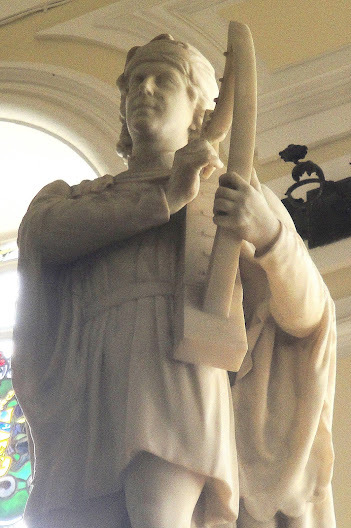
He would be thrilled to realise he had a statue, and sickened to discover there weren’t moreDafyd writes in an even more complex verse form than most of the other poets (they can’t keep up after he is gone). He exemplifies both the tropes and higher qualities of eras verse, either because he ate the soul and speaks it back, or because through his writing he re-writes what Welsh poetry is meant to be, and meant to be about. ‘AD’ in this subculture means “After Dafydd” and ‘BC’ means “Before that Cunt” (he is awful). Everyone after him is to some extent writing in response to him.
Dafydd is an apollonian talent inflicted on a contemptable piece of shit. You don’t start reading Dafydd ap Gwilym hating Dafydd ap Gwilym – it’s hard to hate a genius, but you get there over time . He is like a bright burning portal into another time, carried about by a guy whose main interest is trying to bang another guys wife - this is 90% of Dafydds time and the real slow disenchantment of his character is that he can’t change and, incredibly, for a man who perceives the world through eyes none else can match, he is largely unaware of the poverty of his own character.
As Dafydd gets older, and he writes himself laments about his stumbling entry into middle age, he is still trying to bang Morfudd; gets angry when his married cheating gf commits the indignity of getting pregnant by her husband, is shocked when she shows signs of aging, laments his own loss of looks, and ends up feeling terrible about his life (good).
His poetry will burn through history like a meteor, and the story that it tells will be of a guy who was an utter tool; a sleazy ratbag who never grew up and wasted his whole life on sketchy inherently dishonest relationships. The deep, deep contrast between his immortal talent and shit personality, which, I know, common enough for poets and painters, leaves me flabbergasted. The dissonance between his talent and his soul, combines with vividness which has adhered his memory to me. Like something sticky on the inside of a cup you can’t get off; its Dafydd ap Gwylym.
As an antidote to Dafydd; a fragment of ‘Lament for Sion Y Glyn’ by Lewis Glyn Cothi, in which he mourns his dead son.
OF WHAT USE CAN THIS POSSIBLY BE?
It is a book of vividness and immediacy in line and concept. For those of use settled on bringing imaginary worlds to life, there is not much difference between resurrecting a past world and emblazoning an imaginary one.
For anyone interested in prose, verse, observation and the combination of ideas, this is a great aleph of combinations, which grows more strange and potent, seems more original, remarkable and distinct, the more out of place it feels in its medieval home. In its humanity it seems more a work of the renaissance, in its concrete immediacy it feels modern and in the wild but telling arrangements of simile it feels almost post-modern.
For those who simply care about the past and would like to think more about what it actually felt like to, for instance, be on board a crappy ship in 14-something, or to be part of a vaunted battle which goes horribly wrong, or to hide out in a grove waiting for a ‘maid’ to turn up for a ‘tryst’, or simply to be lost in fog, or to stumble around in the dark, or, in a poem remarkable for its nature, what its like to be a relatively ordinary townsman in a normal town;
- Wiliam Herbart
Or if you would live for a moment in the mind of a man deeply displeased with his own beard;
‘Bard and Beard by Iolo Goch
Or if you want to get involved (sucked into) the extremely spicy, messy, sketchy, slutty and poetically brilliant life of DAFYDD AP GWILYM, whether it is perving on the local girls;
Or just really absolutely hating one particular owl to the extent that he writes a whole poem cursing it (this Owl specifically);

(Translated by Joseph P. Clancy and published in 1965, taking from a range of previous books on the subject.)
THE NECESSARY ABOMINATION OF TRANSLATION
I don’t speak Welsh.
The translation of poetry is a necessary abomination. If a perfect poem is a precise, even total, annealing and cross-synthesis of sound and meaning, of the chosen sonic structure of the poem, combined with the perfect representation of meaning within it, and within that, the most precise, perceptive, original and imaginative observation, relation and creation, then the ‘perfect’ or ‘best’ poem, is the one which is most wounded by being translated.

For a perfect ordering, the dis-assemblement and re-creation in some utterly other substance - its like taking apart one of the high points of Greek or roman sculpture, say ‘Lacoon’, and re-making it in Legos You can do it, and it’s awful, but if people can only see Legos and cannot perceive Marble, then that’s what you have to do. It’s bad to lose a lot and to create frankenpoems, but its worse to lose everything, which is what happens if you don’t translate into whatever the dominant medium is
What we lose is probably inestimable, and we should accept that we are dealing with half-poems, or even zombie poems, compared to the originals - the bards would not be happy. But the alternative for me is nothing, so I accept it.
what comes through is the images, descriptions, similes, concepts, arrangements of ideas and general flow of thought
STARTLING THINGS ABOUT WELSH POETRY
What startles is the immediacy and imaginative power of interwoven with vivid, glowing, immediate and intense observations of nature, and added all to this; clearsighted, almost documentary descriptions of real-life events. Though they are given in an elaborate Welsh scansion in a format driven by ritualistic forms and common tropes, these moments ‘POP’
These things are rare and hard to find in time. People do not write like this for long books of history or if they do, it is lost. So the past is monumental, graven, sombre, strange, not because it was as it was lived (though at times it was indeed), but because that is what survives; as in stone, so in verse and prosidy; the big fat masses carry on while the warp and weave of human life are lost.
what I mean is we can awaken into a scene of Daffyd ap Gwilym, lying in bed in some inn or hostelry, in the year 13-something, getting up at night and, in an attempt to sleep with a women he has seen earlier, sneaking about in the dark, knocking things over, getting lost and waking everyone up, before sneaking back into bed and pretending the whole thing never happened, and it feels like a story related from yesterday. ‘The Battle of Waun Gaeseg’ gives us a first-hand view of the experience of a small scale, disastrous, unglamorous battle, and ‘Sheep-Dealing’ the story of an equally disastrous attempt to sell some sheep, while ‘The Ship’ by Iolo Goch shows us this;
“She would rock, faulty creature,
On her side, quivering cold.
God’s wrath to me, seas’ cheeshouse,
Cramped castle, seafarers’s chest.
She’s a thin-staved false-steering
Foul Noah’s ark of a ship.
Sooty oak, sharp her furrow,
Spy old cow, round-walled, pale-clad,
Cart of coal, not a clean court,
Her sail coarse cloth, wide open,
High-nosed hag, scabby-lipped boards,
Wide-nostrilled, rope-reined saddle,
New moon, broad pan for kneading,
She’s clumsy as an old churn,
Swift tower, bulky shadow,
Stiff screen seven cubits high,
Swift-leaping sea-splashing mare,
Bowl unsteadily bouncing,
Scabby crab-bowelled jailhouse,
Broad mare, seen as far as France.
She’s make a face with seaweed,
Sea-cat, teeth under her breast.
More than a mark her rental,
bent basket amidst green cork.
She has filth, oath of Arthur,
In her cracks like stone wall.”
..and such a ship I think you have not seen before, but it comes to mind now strongly, does it not?
DAFYDD AP GWILYM - YOU SON OF A BITCH
there is a Master Poet and a third of the book is His. He is so talented and dominant that some of the other Very Notable poems in this are just laments for Dafydd ap Gwilym by other bards.

He would be thrilled to realise he had a statue, and sickened to discover there weren’t moreDafyd writes in an even more complex verse form than most of the other poets (they can’t keep up after he is gone). He exemplifies both the tropes and higher qualities of eras verse, either because he ate the soul and speaks it back, or because through his writing he re-writes what Welsh poetry is meant to be, and meant to be about. ‘AD’ in this subculture means “After Dafydd” and ‘BC’ means “Before that Cunt” (he is awful). Everyone after him is to some extent writing in response to him.
Dafydd is an apollonian talent inflicted on a contemptable piece of shit. You don’t start reading Dafydd ap Gwilym hating Dafydd ap Gwilym – it’s hard to hate a genius, but you get there over time . He is like a bright burning portal into another time, carried about by a guy whose main interest is trying to bang another guys wife - this is 90% of Dafydds time and the real slow disenchantment of his character is that he can’t change and, incredibly, for a man who perceives the world through eyes none else can match, he is largely unaware of the poverty of his own character.
As Dafydd gets older, and he writes himself laments about his stumbling entry into middle age, he is still trying to bang Morfudd; gets angry when his married cheating gf commits the indignity of getting pregnant by her husband, is shocked when she shows signs of aging, laments his own loss of looks, and ends up feeling terrible about his life (good).
His poetry will burn through history like a meteor, and the story that it tells will be of a guy who was an utter tool; a sleazy ratbag who never grew up and wasted his whole life on sketchy inherently dishonest relationships. The deep, deep contrast between his immortal talent and shit personality, which, I know, common enough for poets and painters, leaves me flabbergasted. The dissonance between his talent and his soul, combines with vividness which has adhered his memory to me. Like something sticky on the inside of a cup you can’t get off; its Dafydd ap Gwylym.
As an antidote to Dafydd; a fragment of ‘Lament for Sion Y Glyn’ by Lewis Glyn Cothi, in which he mourns his dead son.
“A sweet apple and a bird
The boy loved, and white pebbles,
A bow of thorntree twig,
And swords, wooden and brittle;
Scared of pipes, scared of scarecrows,
Begging mother for a ball,
Singing to all his chanting,
Singing ‘Oo-o’ for a nut.
He would play sweet, and flatter,
And then turn sulky with me,
Make peace for a wooden chip
Or the dice he was fond of.”
OF WHAT USE CAN THIS POSSIBLY BE?
It is a book of vividness and immediacy in line and concept. For those of use settled on bringing imaginary worlds to life, there is not much difference between resurrecting a past world and emblazoning an imaginary one.
For anyone interested in prose, verse, observation and the combination of ideas, this is a great aleph of combinations, which grows more strange and potent, seems more original, remarkable and distinct, the more out of place it feels in its medieval home. In its humanity it seems more a work of the renaissance, in its concrete immediacy it feels modern and in the wild but telling arrangements of simile it feels almost post-modern.
For those who simply care about the past and would like to think more about what it actually felt like to, for instance, be on board a crappy ship in 14-something, or to be part of a vaunted battle which goes horribly wrong, or to hide out in a grove waiting for a ‘maid’ to turn up for a ‘tryst’, or simply to be lost in fog, or to stumble around in the dark, or, in a poem remarkable for its nature, what its like to be a relatively ordinary townsman in a normal town;
“Mine is the heat of houses,
I’m fond of bread, beer, and meat.
A wooden house in lowlands
Brings me health, like a green tree.
And so I make my dwelling
In the March, I’ve wine and mead.
A kind, attractive city,
Most blest in its citizens,
Curtain-walled is the castle,
Best of cities, far as Rome!
Croes Oswalt, friend to Jesus,
Great keep for the conqueror.”
- Wiliam Herbart
Or if you would live for a moment in the mind of a man deeply displeased with his own beard;
“Old roebuck’s hair, where’s your source?
You are a crop of gorse-shoots.
Sharp and strong is every hair,
Sticking a girl, stiff heather,
Resembling, so harsh they grow,
A thousand thistle feathers.
You are like frozen stubble,
Seamless stiff-tipped arrow quills.
Go away! Prevent dishonour,
Chin’s thatch, like a horses mane.”
‘Bard and Beard by Iolo Goch
Or if you want to get involved (sucked into) the extremely spicy, messy, sketchy, slutty and poetically brilliant life of DAFYDD AP GWILYM, whether it is perving on the local girls;
“No Sunday in Llanbadarn
I was not, as some will swear,
Facing a dainty maiden,
The nape of my neck to God.
And when I’ve long been staring
Over my plume at the pews,
Says one maiden, clear and bright,
To her shrewd, pretty neighbour:
‘That lad, palefaced as a flirt,
Wearing his sisters tresses,
Adulterous of the slanting
Glances of his eye : he’s bad!’”
Obsessing over his own fading looks;
“I’d not dreamed, burdensome bane,
My face not fine and handsome,
Till I lifted, lucid thing,
The glass : and see, its ugly!
The mirror told me at last
That I am not good-looking.
The cheek for one like Enid
Turns sallow, it’s scarcely flushed.
Glassy the cheek from groaning,
But a single sallow bruise.
The long nose might be taken
For a razor : isn’t it sad?
Is it not vile, the glad eyes
Are pits completely blinded?
And the worthless curly hair
Falls from the head in handfuls.”
Or just really absolutely hating one particular owl to the extent that he writes a whole poem cursing it (this Owl specifically);
“She’s a slut, two tuneless cries,
Thick head, persistent crying,
Broad forehead, berry-bellied,
Staring old mouse-hunting hag.
Stubborn, vile, lacking colour,
Dry her voice, her colour tin,
Loud gabble in the south wood,
O that song, roebuck’s copses,
And her face, a meek maiden’s,
And her shape, a ghostly bird.
Every bird, filthy outlaw,
Beats her ; how strange she still lives.”


No comments have been added yet.