Most Leadership Models Are Garden Tools
 Photo by Sandie Clarke on Unsplash
This article will sound defensive, but stay with me.
I’ve been a voracious reader of leadership content. It is pure dopamine for me. I loved the theories and frameworks, and took the time to implement as many as I could.
Every time a leadership approach that worked beautifully in one role completely failed in the next, I thought it was me. I’d read the books. Taken the courses. Built the skills. And then I’d step into a new situation and suddenly look like I’d never led anything in my life.
For years, I carried that failure around like proof that I wasn’t cut out for leadership. That I’d somehow faked my way through the successes and now the truth was catching up with me. Major imposter syndrome.
I kept going, though. Had no choice. I eventually discovered I was using the wrong tools for the environment.
Let me show you what I mean.
The Leadership Model Lie We’ve All Been SoldHere’s what happened to leadership science, and I promise this matters for your Tuesday morning staff meeting.
Researchers spent decades studying leaders in average environments. Universities. Established corporations. Teams with adequate resources and time for development. They identified approaches that worked beautifully in those conditions, packaged them up, and sold them to us as universal truths.
Servant leadership. Coaching. Democratic decision-making. Authentic vulnerability.
Please understand that these models are brilliant. The research is solid. The principles work. I can’t dispute that they describe a system well.
“All models are wrong, but some are useful.” — George E.P. Box
But nobody mentions they only work in specific conditions. And when you try to force them into the wrong environment, there’s a mismatch that doesn’t often get addressed. And you end up thinking you’re the problem.
You’re not the problem. You’re using Garden tools in a Chaos Arena.
The Four ArenasThink about the last time leadership got really hard for you. Not just busy or stressful, but actually hard in a way that made you question whether you knew how to lead at all.
 Photo by JD Designs on Unsplash
Now think about what changed. My guess is the environment shifted in ways you didn’t name or maybe didn’t even notice. The pressure spiked. The stability vanished. The resources dried up. The culture turned competitive.
I call these different combinations of forces “Arenas.” Hopefully, these models are at least “useful.”
Garden Arenas are low pressure and high stability. Adequate resources, cooperative culture, time to develop people. This is where servant leadership thrives. Where coaching works beautifully. Where you can be vulnerable and transparent and watch trust deepen because of it.
Champion Arenas are high pressure and high stability. Sustained demands, clear patterns, proven solutions. This is where directive clarity is a gift. Where people want you to tell them exactly what’s expected. Where transactional structure helps instead of hurts.
Chaos Arenas are high pressure and low stability. Extreme threat, rapid change, survival stakes. This is where democratic process gets dangerous. Where coaching questions feel irresponsible. Where people need you to decide, not facilitate.
Drift Arenas are low pressure and low stability. Unclear goals, no external accountability, ambiguous expectations. This is where hands-off leadership creates more drift. Where structure helps. Where your team needs direction they’re not getting.
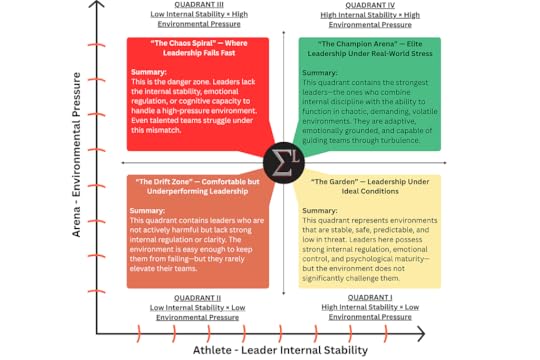
I plotted these leader-context quadrants (Athlete-Arena) against a dozen existing leadership models. Most leadership development happens in Garden conditions. Most leadership books are written from Garden perspectives. Most of what we call “good leadership” assumes Garden Arenas. Strong leadership skills, low environmental volatility.
And then we drop you into Champion, Chaos, or Drift conditions and act surprised when you struggle.
Leadership in Practice (And Why You’ve Probably Lived It)Let me paint you a picture.
You take over a new team. You’ve read that servant leadership builds trust and engagement, so you prioritize listening. You ask questions instead of giving answers. You focus on developing people because that’s what good leaders do.
But this team is drowning in a Champion Arena. High pressure, tight deadlines, clear expectations. They don’t need more questions. They need answers. Your servant leadership approach looks like indecision. Your commitment to their growth feels tone-deaf when they’re just trying to hit next quarter’s numbers.
Three months in, your boss hints that you might not be the right fit. Your team is frustrated. And you’re wondering what happened to the approach that made you successful in your last role.
 Photo by Sebastian Herrmann on Unsplash
Nothing happened to it. You’re using a Garden tool in a Champion Arena.
Or this scenario: You’re running a stable, high-performing team. Things are humming. People are intrinsically motivated. Trust is high. And then you get a new boss who immediately establishes heavy metrics, monitoring systems, and consequences. Structure where none is needed.
You watch your team’s energy drain. Trust evaporates. People who loved their work start updating their resumes.
That new boss isn’t bad at leadership. They’re using Champion tools in a Garden Arena. And it’s killing what was working.
One more: You’re leading through crisis. Real crisis. Everything is changing daily. Stakes are high. Your team is scared. But you’ve been taught that authentic leadership means being vulnerable about uncertainty. So you share your doubts. You’re real about not having all the answers.
And you watch confidence drain from their faces. Not because you’re weak. But because they needed you steady right now, not authentic about your fears.
The leadership approach feels wrong, but it’s just Arena-specific.
The Most Liberating Realization of My CareerHere’s how I pivoted.
The moment I stopped trying to be a “good leader” and started trying to match my leadership approach to actual Arena conditions, things shifted.
I stopped apologizing for being directive in high-pressure situations. I stopped feeling guilty about using transactional clarity when people needed to know exactly where they stood. I stopped forcing developmental approaches when survival was at stake.
And I stopped blaming myself when approaches that worked brilliantly in one context failed completely in another.
Here’s what I know to be true: You can be a servant leader in Garden moments and a directive leader in Chaos moments. You can be democratic about strategy and directive about execution. You can coach in low-stakes situations and command in high-stakes ones.
It sounds like inconsistency, but it’s not. It’s being good at reading your environment and adapting to what it actually demands.
The question isn’t “Am I a good leader?” The question is “Am I using the right approach for my actual conditions?”What You Can Do Right Now
First, get honest about your actual Arena. Not what your role is supposed to be on paper. What it actually is. What’s the real pressure? What’s the real stability? What forces are you actually navigating every day?
 Photo by Joakim Honkasalo on Unsplash
Most of us are operating in different Arenas than we think we are. We tell ourselves we’re in Garden conditions because that’s more comfortable, when we’re actually drowning in Champion or Chaos.
Second, look at the leadership approach you default to. The one that feels most natural. The one you learned works. Now ask: Where does this approach thrive? If you’re using servant leadership in Chaos conditions, you found your problem. If you’re using directive leadership in Garden conditions, same thing.
Third, give yourself permission to lead differently in different conditions. You’re not abandoning your values. You’re choosing the right tool for the actual job in front of you.
I’m not telling you to be someone else. This is about being strategic instead of hopeful about your leadership approach.
The Work ContinuesI’ve spent years developing this framework. Mapping leadership models to Arena conditions. Understanding why they fail outside their optimal environments. Building strategies for what to do when you’re stuck using the wrong tool in the wrong place.
If this resonates with you, if you’ve ever felt like a leadership failure when approaches that worked before suddenly stopped working, I am writing a book about this. It’s called “Right Leader, Wrong Arena,” and it goes deeper into everything I’m describing here. But honestly, what matters more than whether you read my book is whether you stop blaming yourself for Arena mismatches.
Relax, you’re not broken. Your leadership isn’t failing because you’re incompetent or faking it or fundamentally not cut out for this work.
You’re trying to use Garden tools in a Chaos Arena. You’re applying Champion approaches in Garden conditions. You’re using stable-environment strategies in volatile situations.
And once you see that, once you really understand that the problem is fit rather than competence, the path will be clear.
Here’s What I’m Asking You to DoPay attention this week to the moments when leadership feels hard. Not just busy. Actually hard in a way that makes you question yourself.
Ask: What Arena am I actually in right now? What’s the pressure? What’s the stability? What approach am I defaulting to, and where does it work best?
Notice the mismatch. Name it. And then choose a different tool.
That’s where real leadership effectiveness begins. Not in being perfect or consistent or living up to some universal standard of “good leadership.”
In being strategic enough to see your environment clearly and brave enough to lead differently than you think you’re supposed to.
You’ve got this. You just need the right tools for your actual Arena.
Damon Wells is an Army colonel and author of the upcoming book, “Right Leader, Wrong Arena.” His work focuses on the interaction between leadership traits and environmental forces. Subscribe for updates.
[image error]