The Octopus Genome — And Why It’s Unlike Anything on Earth
I don’t know about you, but the more I learn about octopuses, the more I start questioning… everything. These creatures feel like they slipped through the cracks of evolution — as if nature accidentally downloaded an alien’s DNA into the ocean. And honestly? When scientists finally sequenced the octopus genome, things got even weirder. Because it turns out, the octopus isn’t just smart. It’s biologically bizarre.
Not Just a Weird-Looking FishLet’s get this straight — octopuses aren’t fish, and they’re not like any other marine creature you can think of. They’re cephalopods, in the same family as squids and cuttlefish, but even among their relatives, they’re total outliers.
They’ve got three hearts, blue blood, and the ability to taste through their skin. They can solve puzzles, open jars, and recognize human faces. Some scientists even call them “the closest thing to an alien on Earth,” and honestly, that doesn’t feel like an exaggeration. But the real mystery lies in why they’re like this. What makes their brains, and their bodies, so unlike anything else we’ve seen in the animal kingdom? That’s what led researchers to crack open their genetic code.
Cracking the Octopus CodeWhen scientists first sequenced the octopus genome back in 2015, they were expecting… well, something normal. Maybe a few genes that explained their intelligence or color-changing abilities. Instead, what they found was a genetic system so chaotic and unusual that one researcher described it as “the genomic equivalent of a Picasso painting.”
For starters, the octopus has about 33,000 protein-coding genes — that’s more than humans. And those genes aren’t neatly arranged or predictable. They’re scattered, rearranged, duplicated, and spliced in ways we don’t see anywhere else in the animal world. It’s as if someone took the blueprint of life, threw it into a blender, and the result was… an octopus.
A Brain That Rewrites ItselfOne of the most mind-blowing things about octopus genetics is their ability to edit their own RNA. To put it simply: most creatures rely on DNA as the master blueprint for everything their body does. RNA just reads those instructions and carries them out. But octopuses? They rewrite their RNA — meaning they can change how their genes are expressed on the fly.
It’s like if your body could edit your DNA’s code in real-time because you needed to survive a different temperature or change your camouflage pattern. Humans can’t do this. Almost no animals can. But octopuses do it all the time. This ability might explain how they adapt so quickly to new environments, or how they can control each arm semi-independently — like eight separate little brains working together in perfect sync.
The Brain That FeelsSpeaking of brains, let’s talk about how strange theirs actually is. An octopus has around 500 million neurons, about as many as a dog, but here’s the catch: more than two-thirds of those neurons aren’t in the head. They’re spread throughout its arms.
That means when an octopus touches something, each arm can process that information on its own, without consulting the central brain first. They’re capable of learning, remembering, and even feeling sensations independently. It’s kind of like having eight smaller brains that all check in with the main one when needed.
Imagine your hand being able to decide what to grab, or your foot learning how to dance without your brain’s permission. That’s the level of autonomy an octopus arm has.
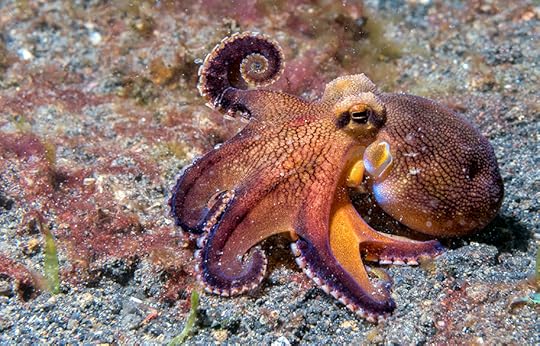 Alien, or Just Exceptionally Earthly?
Because of all this, it’s no wonder people joke about octopuses being extraterrestrial. In fact, there’s an actual (and highly debated) theory in the scientific community suggesting that octopus ancestors could’ve originated from frozen alien cells delivered by a comet. It’s called panspermia, and while it’s not widely accepted, it does tell you how otherworldly these creatures seem.
But maybe the truth is even cooler: they’re not alien — they’re just proof of how creative evolution can be when left alone for millions of years. The octopus genome shows us that life doesn’t have to follow one rulebook. Intelligence can evolve underwater, in silence, with tentacles instead of thumbs. Maybe it doesn’t even need a spine. Maybe it just needs curiosity.
The Mystery Isn’t Solved — It’s Just BeginningEven with all the research, there’s still so much we don’t understand about these animals. Their behavior constantly defies logic — from escaping through impossibly tiny cracks to mimicking other sea creatures with eerie accuracy. Some species can edit their own RNA more in colder water, suggesting they literally “recode” themselves depending on the climate.
And when they die? Their bodies dissolve in a kind of graceful self-destruction called senescence, as if their biology was never meant to last too long — just enough to leave us wondering how something so intelligent could exist for so briefly.
The more we study the octopus, the more it feels like we’re peering into an entirely separate branch of evolution — one that evolved consciousness in a completely different way than we did. Maybe the octopus doesn’t need to fit into our definitions of “smart” or “human-like.” Maybe it’s reminding us that the universe doesn’t run out of ways to create brilliance — it just hides it in unexpected forms.
The post The Octopus Genome — And Why It’s Unlike Anything on Earth appeared first on Malorie's Adventures.